
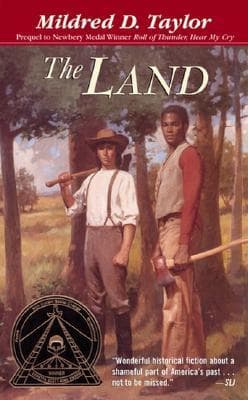
Synopsis
Covers the whole plot, including the ending.
- Difficulty
- Medium
- Pacing
- Moderate
- Mood
- Historical, Resilient, Reflective, Hopeful
- Read it if
- You enjoy historical fiction exploring themes of racial identity, land ownership, and resilience in post-Civil War America, with a focus on a young protagonist's journey.
- Skip it if
- You prefer fast-paced action or shy away from stories dealing with intense racial prejudice and violence.
The Land Plot Summary
Covers the whole plot, including the ending.
A Boy Divided
Paul-Edward Logan, a biracial boy, lives on his white father's prosperous plantation in rural Georgia. His father, Robert Logan, openly acknowledges Paul as his son, which was rare for the time. Paul's mother, Caroline, a former slave, tries to give him a sense of pride and self-worth. However, Paul faces constant prejudice from both white and Black communities. White children mock him for his Black heritage. Black children, like the Sharecroppers' children, distrust him because of his lighter skin and privileged upbringing. Even within his own family, his white half-brothers, Robert Jr. and George, resent him, often taunting and abusing him. Paul finds comfort in the land and dreams of owning his own one day.
The Runaway and the Promise
After a particularly brutal beating from Robert Jr. and George, which his father dismisses as 'boys being boys,' a heartbroken and angry Paul runs away. He wanders until he collapses from exhaustion and hunger. Two elderly Black sharecroppers, Reverend Jefferson and his wife, Miz Effie, find him. They take him in and nurse him back to health. They offer him shelter and work, treating him with a kindness he rarely experienced from his white family. During his time with them, Paul learns about the struggles of Black sharecroppers and understands racial injustice better. This strengthens his desire for independence and his own land.
Return and a New Resolve
Paul eventually returns to his father's plantation after his father's overseer, Mr. Nelson, finds him. Robert Logan is relieved, but he doesn't fully understand Paul's pain. Paul is no longer the same boy. His time with Reverend Jefferson and Miz Effie has made him more determined. He works on the farm, saving every penny and learning about farming and land management. He understands that the only way to escape prejudice and establish his identity is to get his own land, away from his father's name or his brothers' cruelty.
A Partnership Forged
Paul's drive to earn money for land leads him to seek work beyond his father's farm. He meets Mitchell, a poor white boy from a nearby farm. Despite initial racial tensions, Paul sees Mitchell as a possible partner because Mitchell is also hardworking and ambitious. They form an unusual alliance, working various odd jobs and saving their combined earnings. This partnership has challenges as they navigate societal expectations and prejudices, but it slowly builds mutual respect and shared dreams. It shows that common goals can overcome racial divides.
The Lumber Camp
To save money faster, Paul and Mitchell take dangerous work at a lumber camp. The conditions are brutal, the pay low, and the foreman, Mr. Simms, is a cruel and racist man who exploits his Black workers. Paul sees the oppression faced by Black laborers; Mr. Simms shortchanges them and uses violence to control them. Mitchell, initially focused on his own survival, starts to see the injustice, and his loyalty to Paul is tested. Paul's strength and resilience are pushed to their limits, but he holds onto his dream of land as a hope through the harshness.
Confrontation and Consequences
The exploitation at the lumber camp reaches a breaking point when Mr. Simms unjustly beats a Black worker and refuses to pay Paul and Mitchell. Paul, unable to tolerate the injustice, confronts Mr. Simms, demanding fair treatment and payment. The confrontation becomes a violent fight where Paul, using his strength and agility, overpowers Mr. Simms. This act of defiance, while dangerous, earns him the respect of the other Black workers and shows he will not be intimidated. However, it also forces Paul and Mitchell to flee the camp, fearing revenge.
The Search for Land
With their money and a renewed purpose, Paul and Mitchell search for their own land. They travel through towns and rural areas, encountering different communities and challenges. They face skepticism and prejudice from landowners unwilling to sell to a biracial man. They must constantly be on guard against those who would exploit them. Their bond strengthens as they rely on each other for support and protection. Paul carefully evaluates potential plots, showing his understanding of the land's value and potential, driven by his lifelong dream.
The First Purchase
Paul finds a promising piece of land, but the owner, a prejudiced white man, demands a very high price. Despite the unfairness, Paul agrees to the terms, understanding the importance of this first step. He makes the purchase, a significant moment in his life. However, buying land as a Black man, even one who appears white, angers local white supremacists. He and Mitchell face threats and intimidation, making it clear that owning land is only the beginning of their struggle for independence and security in a racially charged society.
Building a Home
With the land theirs, Paul and Mitchell begin the hard work of clearing the dense forest, tilling the soil, and building a cabin. Paul's farming knowledge and strong work ethic become clear. They face harsh weather, physical exhaustion, and the constant threat of interference from hostile neighbors. Their partnership is tested by the immense labor and isolation, but their shared vision of a prosperous farm keeps them going. This time is important for Paul, as he physically changes the land, making it his own through hard work.
The Threat of the Night Riders
As Paul's farm takes shape, local white supremacists, the Night Riders, increase their efforts to drive him off his land. They vandalize his property, steal his tools, and leave menacing warnings. Paul and Mitchell must arm themselves and stand guard, knowing their lives are in danger. Paul refuses to give in, understanding that doing so would mean surrendering his dream and dignity. The constant threat creates fear, but it also strengthens Paul's resolve to protect what he has worked so hard to achieve, even if it means risking his life.
A New Beginning, A New Family
Amidst the struggle, Paul meets and falls in love with Cassie, a strong Black woman who shares his values and love for the land. They marry and start a family, bringing hope and stability to Paul's life. Cassie becomes his partner, helping him work the land and providing emotional support. The birth of their children means a new beginning and a legacy for Paul, showing that he can create his own life, free from his past, even as racial prejudice continues.
The Legacy of Logan Land
Years pass, and Paul-Edward Logan, with Cassie, successfully turns his initial parcel into a thriving farm. He faces down further intimidation and violence from the Night Riders, always standing firm. He eventually expands his landholdings, fulfilling his dream of having a substantial estate. He raises his children, teaching them hard work, self-reliance, and pride in their heritage. Paul-Edward's journey ends with the establishment of 'Logan Land,' a sign of his resilience, determination, and refusal to be defined by the prejudices of his time. This begins the foundation for future generations of Logans.
The Land Characters
Paul-Edward Logan
Protagonist
A biracial man determined to own his own land and define his identity.
Paul-Edward is the son of a white plantation owner, Robert Logan, and a Black former slave, Caroline. He is a strong, intelligent, and deeply principled young man. His mixed heritage makes him an outcast in both white and Black societies, leading to a constant struggle for identity and acceptance. He is hardworking, resourceful, and possesses an innate understanding of the land. Despite facing immense prejudice and violence, he maintains a fierce independence and an unwavering commitment to his dreams.
Relationships: Robert Logan (Father; complex, distant but acknowledging); Caroline (Mother; loving, supportive, instills pride); Robert Jr. & George (Half-brothers; abusive, resentful); Mitchell (Business partner and loyal friend); Cassie (Wife; loving, supportive, partner in building their life); Reverend Jefferson & Miz Effie (Mentors; offer kindness and wisdom)
Mitchell
Supporting
A poor white boy who becomes Paul-Edward's steadfast friend and partner.
Mitchell is a poor white boy from a neighboring farm. Initially wary and somewhat prejudiced due to his upbringing, he is hardworking and ambitious. He forms an unlikely partnership with Paul-Edward, driven by a shared desire to escape poverty and make something of themselves. Through their journey, Mitchell witnesses the injustices faced by Black people and his initial prejudices slowly erode, transforming into deep loyalty and respect for Paul-Edward. He is a practical and dependable companion, often the voice of caution.
Relationships: Paul-Edward Logan (Business partner and loyal friend)
Caroline
Supporting
Paul-Edward's mother, a former slave who instills strength and pride.
Caroline is Paul-Edward's mother, a strong and dignified Black woman who was formerly enslaved. She is fiercely protective of her son and strives to instill in him a sense of self-worth and pride in his heritage, despite the societal challenges he faces. She is a source of wisdom and emotional support for Paul-Edward, teaching him resilience and the importance of holding onto his dreams. Her love and guidance are foundational to Paul-Edward's character development.
Relationships: Paul-Edward Logan (Son; deeply loving and influential); Robert Logan (Former lover and father of her child; complex, respectful but unequal)
Robert Logan
Supporting
Paul-Edward's white father, a prosperous landowner who acknowledges his son.
Robert Logan is Paul-Edward's white father and the owner of a large plantation. He is a man of his time, but he possesses a degree of progressive thinking by openly acknowledging Paul-Edward as his son, which is unusual for post-Civil War Georgia. While he provides for Paul-Edward, his understanding of the racial prejudice his son faces is limited, and he often fails to protect him from his white half-brothers' cruelty. He represents the complex moral landscape of the era, capable of both generosity and blindness.
Relationships: Paul-Edward Logan (Son; distant but acknowledging); Caroline (Former lover; respectful but unequal); Robert Jr. & George (Legitimate white sons; favored, abusive)
Robert Jr. & George
Antagonists
Paul-Edward's jealous and cruel white half-brothers.
Robert Jr. and George are Paul-Edward's legitimate white half-brothers. They are deeply resentful of Paul-Edward's presence and his father's acknowledgement of him. They are cruel, prejudiced, and frequently subject Paul-Edward to physical and emotional abuse. They embody the racial animosity and entitlement of the white planter class during the post-Reconstruction era, serving as direct obstacles and sources of pain for Paul-Edward during his youth.
Relationships: Paul-Edward Logan (Half-brothers; abusive, antagonistic); Robert Logan (Father; favored by him)
Cassie
Supporting
Paul-Edward's strong and loving wife, a partner in his dream.
Cassie is a resilient and intelligent Black woman whom Paul-Edward meets and marries. She shares his love for the land and his strong work ethic. Cassie becomes Paul-Edward's steadfast partner, not just in marriage, but in building their farm and facing the challenges of their lives. She provides emotional support, stability, and a deep sense of belonging that Paul-Edward has long sought. Her presence signifies the fulfillment of Paul-Edward's dream of a family and a home of his own.
Relationships: Paul-Edward Logan (Wife; loving, supportive, partner)
Reverend Jefferson
Supporting
A kind Black sharecropper who offers Paul-Edward shelter and wisdom.
Reverend Jefferson is an elderly Black sharecropper who, along with his wife Miz Effie, takes in a runaway Paul-Edward. He is a man of deep faith, kindness, and wisdom, offering Paul-Edward not just physical shelter but also invaluable guidance and a glimpse into the struggles and resilience of the Black community. He serves as a mentor figure, helping Paul-Edward understand the importance of self-reliance and the inherent dignity of all people.
Relationships: Paul-Edward Logan (Mentor, benefactor); Miz Effie (Wife; partner in kindness)
Mr. Simms
Antagonist
The cruel and exploitative foreman at the lumber camp.
Mr. Simms is the foreman at the lumber camp where Paul-Edward and Mitchell work. He is a harsh, racist, and exploitative man who abuses his authority, particularly over his Black workers. He embodies the systemic oppression and cruelty faced by Black laborers in the post-Civil War South. His actions directly lead to Paul-Edward's violent confrontation, serving as a catalyst for Paul-Edward's further determination to escape such injustice.
Relationships: Paul-Edward Logan (Antagonistic employer)
The Land Themes
The Quest for Land and Identity
Paul-Edward's main goal throughout the novel is to get his own land. He sees this as tied to his identity and freedom. As a biracial man, others constantly define him — Black people see him as too white, white people as too Black. Owning land, separate from his father's plantation, becomes his way of showing his self-worth and creating a space where he can be truly free and define himself. This is clear from his childhood dream, solidified after his escape to Reverend Jefferson, and ends with the establishment of 'Logan Land' where he builds his family and legacy. The land means autonomy, belonging, and a clear claim to his identity.
“'Cause what I wanted, what I had to have, was land. Land of my own. Land that nobody could ever take away from me. Land that would be mine, truly mine, for always and always.”
Racial Prejudice and Discrimination
The novel shows the widespread and brutal reality of racial prejudice in post-Civil War Georgia. Paul-Edward experiences discrimination from both white and Black communities due to his mixed heritage, showing the complexities of racial identity. White characters like his half-brothers and Mr. Simms show overt racism and violence. The distrust from some Black characters shows the deep divisions within society. The constant threat from the Night Riders highlights the dangers faced by Black individuals who dared to be independent. This theme is central to Paul-Edward's struggles, from his childhood beatings to the intimidation he faces as a landowner.
“Looking white, I was still colored, and no white man forgot it for a minute. Looking colored, I was still white, and no black man forgot it either.”
Family and Betrayal
Family relationships in 'The Land' are complex and often involve betrayal. While Paul-Edward's mother, Caroline, offers unconditional love and support, his white father, Robert Logan, despite acknowledging him, fails to fully protect him from the cruelty of his legitimate white sons, Robert Jr. and George. These half-brothers show a deep betrayal, driven by jealousy and racial animosity. This family conflict forces Paul-Edward to seek a different kind of family and belonging, finding it with Mitchell and later with Cassie, where loyalty and mutual respect define their bonds. The theme explores how family can be both a source of deep pain and great strength.
“And I knew that no matter how much Pa loved me, no matter how much Ma loved me, I was still alone in this world. And I had to make my own way.”
Resilience and Self-Reliance
Paul-Edward's journey shows the power of resilience and self-reliance. Faced with constant hardship — from childhood abuse and racial prejudice to dangerous labor and violent threats — he never gives up on his dream. His ability to endure hardship, work tirelessly, and make difficult decisions without relying on others is a defining trait. His decision to run away, his partnership with Mitchell, and his solitary fight to protect his land all highlight his determination to make his own path. This theme is clear in his physical and emotional strength, allowing him to overcome seemingly impossible obstacles.
“I was gonna make it. I was gonna make it my way. And I was gonna make it on my land.”
Plot Devices & Literary Techniques
Coming-of-Age Narrative
Paul-Edward's transformation from boy to man through trials and self-discovery.
The novel functions as a coming-of-age story, chronicling Paul-Edward's journey from a confused and hurt boy to a strong, self-reliant man. His experiences, from enduring abuse from his half-brothers to working in the harsh lumber camp and ultimately acquiring his own land, are pivotal to his development. Each challenge forces him to confront his identity, learn about the world's injustices, and strengthen his resolve. This device allows readers to witness his emotional and psychological growth as he navigates the complexities of his heritage and the post-Civil War South.
Symbolism of Land
Land as a representation of freedom, identity, and belonging.
Throughout the novel, land is a powerful symbol. For Paul-Edward, owning land represents ultimate freedom from the constraints of his mixed heritage and the prejudices of society. It signifies his ability to define his own identity, create his own legacy, and establish a place where he truly belongs, free from the shadow of his father's plantation or the control of others. The act of clearing and cultivating his own land is a physical manifestation of his self-creation and independence, making it a tangible embodiment of his dreams and aspirations.
Foil Characters
Characters that highlight Paul-Edward's qualities through contrast.
Characters like Robert Jr. and George serve as foils to Paul-Edward. Their cruelty, entitlement, and reliance on their father's status highlight Paul-Edward's resilience, work ethic, and desire for self-made success. Similarly, the initial prejudices of Mitchell, contrasted with his eventual loyalty and respect, underscore Paul-Edward's ability to forge genuine connections across racial divides. These contrasting characters emphasize Paul-Edward's virtues and the immense obstacles he faces, making his achievements all the more significant.
Flashback/Prequel Structure
The novel serves as a prequel, providing backstory to the Logan family saga.
As a prequel to the 'Roll of Thunder, Hear My Cry' series, 'The Land' functions as an extended flashback, providing the foundational history of the Logan family's land ownership. It explains how the family came to acquire and fiercely protect their land, giving context to the later novels. This structural device enriches the overarching narrative, allowing readers to understand the deep significance of the Logan land and the struggles endured by Paul-Edward to establish his family's legacy, thereby adding depth to the entire series.
The Land Quotes
“My pa always said there were two kinds of folks: them that worked and them that didn't. And them that worked, he said, they were the ones who made the world go 'round.”
“The land was a living thing, Pa always said. It breathed, it grew, it took, it gave. And if you treated it right, it would treat you right back.”
“I was a half-white boy, but I was still black. And in Mississippi, that meant I was nothing.”
“There were dreams and there were realities, and sometimes the two never met.”
“Freedom ain't free, boy. You gotta fight for it. Every single day.”
“A man without land ain't a whole man. He's just a shadow.”
“Love don't care about color. Love just is.”
“Sometimes you gotta do what you gotta do, even if it ain't what you wanna do.”
“Fear can make a man do strange things, can make him forget what's right and what's wrong.”
“I wasn't just working for myself anymore. I was working for a future, a future I could build with my own hands.”
“There was a strength in knowing who you were, no matter what anybody else said.”
“The past was always there, a shadow at your heels, but you didn't have to let it trip you up.”
“It ain't about what you got, it's about what you do with what you got.”
“Sometimes the hardest battles were the ones you fought inside yourself.”
Quiz
10 questions on the plot and the characters. Each answer comes with a short explanation.
Question 1
What is Paul-Edward Logan's primary dream that drives him to leave his father's plantation?
- To become a wealthy merchant in the city.
- To find land as good as his father's and make it his own.
- To reunite with his mother's distant relatives.
- To escape the Civil War and move to the North.
Show answer
B. To find land as good as his father's and make it his own. Paul-Edward's defining ambition from a young age is to acquire his own land, mirroring the success and independence his father achieved.
Question 2
What is unusual about Paul-Edward's upbringing compared to other mixed-race children in post-Civil War Georgia?
- He was raised entirely by his white mother.
- His white father openly acknowledged and raised him.
- He was sent to an exclusive boarding school.
- He lived in a northern state until he was a teenager.
Show answer
B. His white father openly acknowledged and raised him. The book highlights that Paul-Edward's white father openly acknowledging and raising him was highly unusual and uncommon for the time and place.
Question 3
Who is Robert, and what is his relationship to Paul-Edward?
- Paul-Edward's older, full-white half-brother who often mistreats him.
- Paul-Edward's best friend from childhood, a white boy.
- Paul-Edward's white father's foreman on the plantation.
- Paul-Edward's uncle who helps him buy land.
Show answer
A. Paul-Edward's older, full-white half-brother who often mistreats him. Robert is Paul-Edward's older half-brother, the son of his father and his white wife, and he is a source of much of Paul-Edward's early familial conflict and degradation.
Question 4
What is the main challenge Paul-Edward faces due to his mixed heritage?
- He struggles with academic studies and reading.
- He is constantly mistaken for a runaway slave.
- He is mistrusted by black people because he looks white, and discriminated against by white people when his heritage is known.
- He cannot find employment due to his young age.
Show answer
C. He is mistrusted by black people because he looks white, and discriminated against by white people when his heritage is known. The core conflict of Paul-Edward's identity is that he is caught between two worlds, not fully accepted by either black or white society due to his appearance and heritage.
Question 5
Why does Paul-Edward leave his father's home at the age of fourteen?
- He is expelled for fighting with Robert.
- His father disowns him after a major disagreement.
- To pursue his dream of owning his own land, away from the conflicts of his family.
- He is offered a job opportunity in a neighboring state.
Show answer
C. To pursue his dream of owning his own land, away from the conflicts of his family. The summary explicitly states he sets out at fourteen to pursue his dream of finding and owning land, driven by the desire for independence and escape from family betrayal.
Question 6
What specific act of betrayal and degradation does Paul-Edward face from within his own family, as mentioned in the description?
- His father refuses to teach him how to manage the plantation.
- His stepmother constantly undermines his authority.
- His half-brother Robert's malicious actions and attempts to assert dominance over him.
- His mother abandoning him to live with another man.
Show answer
C. His half-brother Robert's malicious actions and attempts to assert dominance over him. The description mentions 'even within his own family he faces betrayal and degradation.' While not explicitly naming Robert, the context of Paul-Edward's conflicts within his family points strongly to Robert's antagonistic role as a primary source of this betrayal and degradation.
Question 7
What is the significance of the title 'The Land' in relation to Paul-Edward's journey?
- It represents the specific region of Georgia where he grew up.
- It symbolizes his ultimate goal of independence, self-worth, and a place where he can belong and be free.
- It refers to the historical events tied to land ownership after the Civil War.
- It describes the vastness of the American wilderness he explores.
Show answer
B. It symbolizes his ultimate goal of independence, self-worth, and a place where he can belong and be free. The land is not just a physical place but a powerful symbol for Paul-Edward, representing his quest for identity, freedom, stability, and a place where he can truly establish himself and his lineage.
Question 8
How does Mildred D. Taylor connect 'The Land' to her other award-winning Logan family stories?
- It features the direct descendants of Cassie Logan.
- It is a prequel, telling the story of Paul-Edward Logan, the patriarch of the Logan family.
- It is a parallel story about a different branch of the Logan family.
- It is a sequel, detailing the Logan family's move to the North.
Show answer
B. It is a prequel, telling the story of Paul-Edward Logan, the patriarch of the Logan family. The book description states it's 'the newest addition to the award-winning Logan family stories' and that it's 'inspired by her own history,' implying it delves into the origins of the family, making Paul-Edward the patriarch whose story precedes the others.
Question 9
What specific characteristic of Paul-Edward's appearance contributes to his social isolation from black communities?
- His light skin color, making him 'look white'.
- His distinctive clothing style.
- His physical height and strength.
- His lack of a Southern accent.
Show answer
A. His light skin color, making him 'look white'. The text explicitly states: 'Black people distrust him because he looks white.' This physical characteristic, a result of his mixed heritage, is a major source of his isolation.
Question 10
Beyond land ownership, what deeper sense of 'belonging' is Paul-Edward seeking throughout his journey?
- Belonging to a specific social club or organization.
- Belonging to a community that accepts him fully, regardless of his mixed heritage, and where he can define his own identity.
- Belonging to the elite class of landowners in Georgia.
- Belonging to a specific religious denomination.
Show answer
B. Belonging to a community that accepts him fully, regardless of his mixed heritage, and where he can define his own identity. Paul-Edward's struggle with identity and acceptance from both black and white communities drives a deeper need for a place where he truly belongs, where his identity is not a source of conflict but acceptance, which he hopes to build on his own land.
The Land FAQ
What is the central conflict Paul-Edward Logan faces throughout the story?
Paul-Edward's central conflict stems from his mixed heritage; he is too white for Black society and too Black for white society. This constant struggle for identity and acceptance, coupled with the racial prejudices of post-Civil War Georgia, drives his desire to own land and establish a place where he truly belongs.
Who is Robert and what is his relationship with Paul-Edward?
Robert is Paul-Edward's older half-brother, the legitimate white son of his father, Edward Logan. Their relationship is complex and often antagonistic, marked by Robert's jealousy, resentment, and frequent attempts to undermine Paul-Edward, particularly regarding their father's favor and the family's land.
What significant event prompts Paul-Edward to leave his father's plantation at age fourteen?
Paul-Edward leaves after a culmination of racial slurs, mistreatment, and the realization that his aspirations for owning land are continually thwarted by Robert and the societal structure. A particularly humiliating incident, often involving Robert's cruelty, solidifies his decision to strike out on his own to achieve his dream of land ownership.
How does Mitchell, the white overseer, impact Paul-Edward's early life?
Mitchell, the white overseer, is a source of constant torment and discrimination for Paul-Edward, exacerbating the racial tensions on the Logan plantation. He embodies the prejudiced attitudes of the era and actively works to belittle and undermine Paul-Edward, reinforcing the harsh realities of his mixed heritage.
What role does Paul-Edward's mother, Caroline, play in shaping his character and aspirations?
Caroline, Paul-Edward's mother, instills in him a strong sense of pride, resilience, and the importance of self-worth despite societal prejudices. She encourages his dreams and provides emotional support, acting as a grounding force and a reminder of his heritage, which fuels his determination to acquire land and secure his family's future.
How does the 'Land' itself function as a symbol throughout the novel?
The 'Land' symbolizes not just wealth and independence, but also identity, belonging, and a refuge from racial prejudice for Paul-Edward. It represents his quest for a place where he can be judged solely on his merits, free from the constraints of his mixed heritage and the societal expectations of post-Civil War Georgia.
Are there any subtle foreshadowing elements regarding Robert's true nature or eventual actions?
Yes, Robert's early displays of jealousy, his manipulative behavior towards Paul-Edward, and his repeated attempts to gain favor with their father subtly foreshadow his more significant betrayals later in the story. His constant need to assert dominance and undermine Paul-Edward's efforts are early indicators of his malicious intent.
What is the significance of the horses, particularly Ghost Wind, in Paul-Edward's journey?
Horses, especially Ghost Wind, symbolize freedom, power, and Paul-Edward's connection to the land and his own strength. Ghost Wind represents his independent spirit and his ability to master challenges, becoming a loyal companion and a source of solace that reflects his own untamed spirit and determination.
How does Paul-Edward's internal struggle with his identity manifest psychologically?
Paul-Edward's internal struggle is characterized by a constant negotiation between his white appearance and his Black heritage, leading to feelings of isolation and a search for self-acceptance. He grapples with societal rejection from both sides, which fuels his ambition to create a space where his identity is defined by his actions and accomplishments, not by his lineage.
What psychological impact does the constant racial discrimination have on Paul-Edward's worldview?
The pervasive racial discrimination instills in Paul-Edward a deep-seated distrust of societal norms and a fierce independence. It hardens his resolve and makes him acutely aware of injustice, shaping his worldview to prioritize self-reliance and the creation of a secure future where his family will not suffer the same indignities.
How does Paul-Edward's relationship with his father, Edward Logan, evolve and what psychological effect does this have on him?
Paul-Edward's relationship with his father is complex, marked by both affection and the limitations imposed by society. While his father acknowledges him, he also fails to fully protect him from Robert's cruelty, leading to Paul-Edward's feelings of abandonment and a psychological drive to prove his worth independently, without relying on his father's protection.
What is the psychological significance of Paul-Edward's repeated dreams and visions of owning land?
Paul-Edward's recurring dreams of owning land are more than just aspirations; they are a psychological coping mechanism and a manifestation of his deepest desires for autonomy, security, and a place of belonging. These dreams provide him with resilience and a clear purpose, guiding his actions and sustaining him through hardship.
To what extent is Paul-Edward a product of his environment versus an individual who defies it?
Paul-Edward is undeniably shaped by the racial prejudices and societal structures of post-Civil War Georgia, which dictate many of the challenges he faces. However, his unyielding determination, moral compass, and refusal to be defined by others' perceptions demonstrate his remarkable ability to defy his environment and forge his own path, making him a testament to individual resilience.
Is Paul-Edward's pursuit of land primarily an act of defiance, a quest for identity, or both?
Paul-Edward's pursuit of land is undeniably both an act of defiance against the racial and social injustices of his time and a profound quest for identity. Owning land allows him to reject the limitations imposed by society and create a space where his identity is self-determined, offering him a sense of belonging and self-worth that society denies him.
How does the novel challenge or reinforce traditional notions of family and inheritance in the post-Civil War South?
The novel challenges traditional notions by portraying a biracial family where the white patriarch acknowledges his Black son, yet simultaneously reinforces them through the ongoing struggle for legitimate inheritance and the systemic racism that still prioritizes white lineage. It highlights the complexities and hypocrisies of family structures during a period of immense social change.
In what ways does 'The Land' serve as a prequel to other Logan family stories, and how does it enrich our understanding of the family's legacy?
'The Land' serves as a foundational prequel, establishing the origins of the Logan family's land and their enduring values of independence, resilience, and racial pride. It deepens our understanding of their legacy by revealing the immense struggles and sacrifices made by Paul-Edward, which ultimately laid the groundwork for the family's future strength and their unwavering connection to their land.
Could Paul-Edward have achieved his dreams without leaving his father's estate, or was his departure essential?
Paul-Edward's departure from his father's estate was essential for him to truly achieve his dreams and forge his own identity. Remaining would have meant perpetual subjugation under Robert and the societal limitations of his father's protection, preventing him from independently acquiring land and proving his self-worth on his own terms.
About the author

Mildred DeLois Taylor is a Newbery Award-winning American young adult novelist. She is best known for her novel Roll of Thunder, Hear My Cry, part of her Logan family series.
Similar books
- The Adventures of Huckleberry Finn
Mark Twain
3.8 (1.2M) average on GoodreadsHistorical FictionFeatures a young protagonist's journey and moral development against the backdrop of racial tension and societal norms.
- Copper Sun
Sharon M. Draper
4.3 (13k) average on GoodreadsHistorical FictionDeals with the harsh realities of slavery and the fight for freedom and identity in a historical setting.
- Sounder
William H. Armstrong
4.0 (28k) average on GoodreadsChildren'sBoth The Land and William H. Armstrong's Sounder explore the hardships faced by African American families in the post-Civil War South, focusing on themes of poverty, injustice, and resilience. However, The Land provides a broader scope, covering Paul-Edward's entire journey from adolescence to adulthood, including his pursuit of land and family. Sounder, in contrast, is a more focused, poignant narrative about a sharecropper family's struggle after the father is imprisoned, emphasizing the relationship between a boy and his dog. While both depict the harsh realities of the era, The Land offers a more active and ultimately triumphant narrative of agency and self-determination, whereas Sounder leans into a more tragic and enduring sense of struggle and loss.
- Harry Potter and the Sorcerer's Stone
J.K. Rowling
4.5 (7M) average on GoodreadsFantasyRescued from a miserable life under the stairs, an orphaned boy discovers he's a wizard destined for a magical school, where he uncovers a dangerous secret tied to the dark wizard who murdered his parents.
- The Hobbit, or There and Back Again
J.R.R. Tolkien
4.3 (2.9M) average on GoodreadsFantasyA comfort-loving hobbit named Bilbo Baggins is whisked away by a mischievous wizard and a band of dwarves on an unexpected journey to reclaim stolen treasure from a fearsome dragon, discovering courage and a magical ring along the way.
- Harry Potter and the Goblet of Fire
J.K. Rowling
4.6 (2.6M) average on GoodreadsFantasyA bewildered Harry Potter, underage and thrust into a deadly Triwizard Tournament, must brave dragons, mermaids, and a resurgent dark magic to survive a year that will forever alter the wizarding world.



Enjoyed the summary?
A summary gives you the shape of the book. The book itself has the detail, the examples and the voice.
Find The Land on AmazonAs an Amazon Associate, BookBrief earns from qualifying purchases. How we're funded