
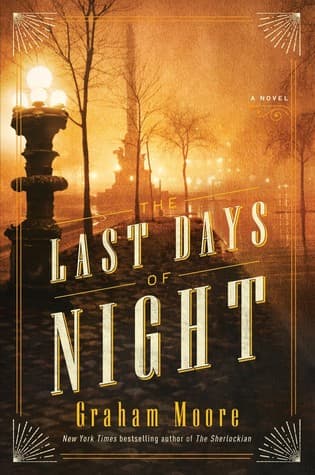
Synopsis
Covers the whole plot, including the ending.
- Difficulty
- Medium
- Pacing
- Moderate
- Mood
- Intriguing, Suspenseful, Ambitious, Atmospheric
- Read it if
- You enjoy historical thrillers, legal dramas, and stories about the cutthroat world of invention and industry, with a focus on real historical figures.
- Skip it if
- You prefer fast-paced action over intricate legal and historical details, or are looking for a straightforward hero's journey without moral ambiguity.
The Last Days of Night Plot Summary
Covers the whole plot, including the ending.
A Dauntless Lawyer Takes on a Titan
In New York City, 1888, Paul Cravath, a recent Columbia Law School graduate with a perfect record, is asked by George Westinghouse to defend him against a patent lawsuit by Thomas Edison. Edison claims Westinghouse's use of AC (alternating current) technology for electric lighting copies his DC (direct current) patents. The stakes are huge, possibly deciding who will control America's electric power future. Despite the challenge of facing Edison, a national hero backed by J.P. Morgan, Paul accepts the case, driven by his ambition and a desire to prove himself. He soon learns the legal battle will go beyond the courtroom, involving public opinion, political moves, and industrial spying.
Entering the War of the Currents
Paul starts to learn about electricity, understanding the differences between Edison's DC system and Westinghouse's AC system. He learns that while Edison's DC is safer for short distances, Westinghouse's AC is much better for long-distance transmission, making it the better technology for widespread electricity. Edison, however, starts a bad campaign, calling AC 'death current' and publicly showing its dangers, even supporting its use in the electric chair. Paul tries to fight this bad publicity, realizing that the 'War of the Currents' is not just a legal battle but a fight for public opinion and the future of technology.
The Enigmatic Nikola Tesla
Paul needs a science expert to counter Edison's claims, so he finds Nikola Tesla, a former Edison employee now working with Westinghouse. Tesla, a smart but socially awkward inventor, is at first unwilling to testify, having his own history with Edison. Paul eventually persuades Tesla, who agrees to give key information about the AC motor and its separate invention. Tesla is clearly a genius, but his odd ways and changing personality make problems for Paul, who must manage the inventor's unpredictable nature while getting him ready for the courtroom's intense look.
A Diva's Dangerous Alliance
Paul's legal work often puts him in contact with high society, where he meets Agnes Huntington, a beautiful opera singer. Agnes quickly gets involved in Paul's world, giving him a view of the social and political moves around the trial. She is smart, observant, and seems to care for Paul, but her connections are deep, including to J.P. Morgan and other important people. Paul feels drawn to Agnes, but also careful of her reasons, thinking she might be playing a more complex game than she shows, possibly even giving information to the other side.
Edison's Relentless Sabotage
As the trial goes on, Edison's methods become more aggressive. His agents spy on industry, trying to steal Westinghouse's patents and stop his work. Paul himself gets quiet threats, and his personal life is watched. Edison uses his control over newspapers to spread false information and hurt Westinghouse's name. Pressure builds on Paul, who must not only prepare his legal arguments but also protect his client and himself from Edison's constant tries to ruin their efforts. He learns that Edison is not just a smart inventor but a tough businessman willing to use any means to win.
The Electric Chair Controversy
The public talk about AC safety ends with the first execution by electric chair, a device made by Harold Brown and paid for by Edison, using Westinghouse's AC current to link it with death. The execution of William Kemmler goes wrong, creating a terrible sight that Edison's friends use to further make AC seem bad. Paul and Westinghouse are horrified by the event, which they see as a desperate and wrong attempt by Edison to turn public opinion against AC. The incident shows the moral stakes of the 'War of the Currents' and how far Edison will go.
Unveiling Hidden Agendas
As Paul digs deeper, he starts to uncover the alliances and betrayals. He finds that Agnes Huntington, while genuinely caring for him, is connected to J.P. Morgan and has been passing information, though subtly. He also learns about the financial interests, realizing that Morgan's involvement is more than just backing Edison's patents; he wants to gain power in the new electric industry. Paul understands that many people are not simply loyal to one side but are working for their own benefit, making it hard to tell true allies from those looking for chances.
Tesla's Breakdown and Recovery
Under the pressure of the lawsuit and his own problems, Nikola Tesla has a mental breakdown. His odd ways get worse, making him harder to manage and threatening his ability to testify well. Paul, seeing Tesla's genius and weakness, acts as his protector and confidante, keeping him from the public and making sure he gets the care he needs. This personal crisis for Tesla shows the human cost of the 'War of the Currents' and helps Paul understand the smart but fragile inventor more.
The Shifting Tides of War
Despite Edison's resources and public relations, Paul starts to find weaknesses in his case. Through careful research and questioning, Paul uncovers problems in Edison's patent claims and questions the originality of some of his supposed inventions. The testimony of experts, including Tesla (after he recovers), starts to weaken Edison's strong position. The situation slowly changes, as Paul shows that Westinghouse's AC system is not just a copy but a separate and better technological advance, different from Edison's DC patents.
A Concession, Not a Victory
The 'War of the Currents' ends not with a courtroom win but through a strategic move by J.P. Morgan. Seeing that AC was becoming more useful and the endless lawsuits were a financial drain, Morgan arranges a deal: General Electric, made from the merger of Edison General Electric and Thomson-Houston Electric Company, buys Westinghouse's AC patents, ending the direct legal fight. Paul, though not getting a clear legal win, sees this as a strategic success, as it proves AC technology and secures Westinghouse's future. The resolution shows the power of money over legal arguments.
The Aftermath and Personal Reckoning
Afterward, Paul thinks about the moral questions and personal deals he made during the case. He achieved success for Westinghouse and helped AC win, but at what cost? He deals with the harsh methods used by both sides, the manipulation of public opinion, and the human toll of the industrial revolution. His relationship with Agnes Huntington ends, a result of the deceptions and conflicting loyalties. Paul leaves the experience a seasoned lawyer, but also with a deeper, more skeptical understanding of power, ambition, and the often unclear lines between right and wrong in pursuing progress.
Principal Figures
Paul Cravath
Protagonist
Young, ambitious lawyer defending George Westinghouse against Thomas Edison.
Paul Cravath is a brilliant, principled, yet ambitious young lawyer fresh out of Columbia Law School. He is driven by a desire to prove himself and uphold justice, but he quickly learns that the legal world, especially when dealing with titans like Edison and Morgan, requires moral compromises and strategic cunning. He meticulously researches, builds his case, and navigates the treacherous waters of industrial espionage and public opinion. Paul is initially somewhat naive but grows increasingly sophisticated and world-weary as he witnesses the ruthless tactics employed in the War of the Currents.
Relationships: George Westinghouse (Client and mentor); Thomas Edison (Legal adversary); Nikola Tesla (Key witness, friend, and intellectual ally); Agnes Huntington (Romantic interest and complex informant)
Thomas Edison
Antagonist
Brilliant inventor and ruthless businessman, suing Westinghouse for patent infringement.
Thomas Edison is portrayed as a genius inventor, a national hero, but also a cunning, ruthless, and manipulative businessman. He is fiercely protective of his DC patents and will stop at nothing to discredit AC technology and Westinghouse. Edison employs spies, manipulates the press, and even funds the development of the electric chair using AC current to demonize his rival. He is driven by a combination of scientific pride, financial ambition, and a deep-seated belief in the superiority of his own inventions, even when evidence points elsewhere.
Relationships: Paul Cravath (Legal adversary); George Westinghouse (Business rival); J.P. Morgan (Financial backer and ally); Nikola Tesla (Former employee and intellectual rival)
George Westinghouse
Supporting
Industrialist and inventor, Paul Cravath's client and proponent of AC power.
George Westinghouse is a visionary industrialist and inventor who believes in the superior potential of alternating current (AC) for widespread electrification. He is a pragmatic and honorable man, though not above strategic business decisions. He hires Paul Cravath to defend his company against Edison's lawsuit, placing immense trust in the young lawyer. Westinghouse represents the pioneering spirit of innovation and the desire to bring efficient, affordable power to the masses, often contrasting with Edison's more self-serving ambitions.
Relationships: Paul Cravath (Client and employer); Thomas Edison (Business rival and legal opponent); Nikola Tesla (Employee and collaborator)
Nikola Tesla
Supporting
Eccentric and brilliant inventor, key to Westinghouse's defense.
Nikola Tesla is a prodigious, almost otherworldly inventor whose genius is undeniable but whose social skills and mental stability are fragile. He is the true inventor of the AC motor and a crucial witness for Westinghouse. Tesla is portrayed as deeply principled and focused on scientific advancement, often detached from the business and political machinations around him. His complex relationship with Edison, his former employer, and his subsequent alliance with Westinghouse are central to the story. He is vulnerable to stress and prone to breakdowns, making him a challenging but invaluable ally for Paul.
Relationships: Paul Cravath (Legal counsel and friend); George Westinghouse (Employer and patron); Thomas Edison (Former employer and intellectual rival)
Agnes Huntington
Supporting
Beautiful and enigmatic opera singer, connected to powerful figures.
Agnes Huntington is a captivating and intelligent opera singer who becomes Paul Cravath's romantic interest and confidante. She moves effortlessly within New York's high society, possessing a keen understanding of its hidden dynamics. Agnes is a complex character; while she seems to genuinely care for Paul, she also has deep connections to J.P. Morgan and other influential figures, raising questions about her loyalties and whether she is acting as an informant. Her beauty and charm mask a strategic mind, making her a compelling and ambiguous figure in Paul's journey.
Relationships: Paul Cravath (Romantic interest); J.P. Morgan (Acquaintance/associate); Thomas Edison (Acquaintance)
J.P. Morgan
Supporting
Powerful financier backing Thomas Edison and influencing the War of the Currents.
J.P. Morgan is the immensely powerful financier who backs Thomas Edison and holds significant influence over the nascent electric industry. He is a shrewd and ruthless businessman, more concerned with consolidating power and wealth than with the specific merits of AC or DC technology. Morgan's presence looms large over the entire conflict, as he orchestrates mergers and acquisitions, ultimately determining the resolution of the 'War of the Currents' through financial means rather than legal verdict. He represents the ultimate power of capital in shaping technological progress.
Relationships: Thomas Edison (Financial client and business partner); Agnes Huntington (Acquaintance/associate); Paul Cravath (Indirect opponent)
Frank Sprague
Mentioned
Inventor and engineer, initially aligned with Edison, later a proponent of AC.
Frank Sprague is an engineer and inventor who initially worked for Edison but later became a significant figure in the development of electric railways and eventually sided with AC technology. His shifting allegiances and contributions highlight the fluid nature of technological alliances during this period. While not a central figure in the narrative, his work and opinions are referenced as Paul builds his understanding of the electric industry.
Relationships: Thomas Edison (Former employer); George Westinghouse (Later collaborator)
Harold Brown
Mentioned
Inventor who developed the electric chair using AC current, funded by Edison.
Harold Brown is the inventor who, with financial backing from Thomas Edison, developed the electric chair. His involvement is crucial to the narrative as he becomes the public face of Edison's campaign to demonize AC by associating it with death and cruelty. Brown's work serves as a stark example of the unethical tactics employed during the War of the Currents, particularly the manipulation of public fear.
Relationships: Thomas Edison (Financial backer and collaborator)
Themes & Insights
Innovation vs. Ambition
The novel explores the link between scientific invention and the personal ambition and tough business methods that often come with it. While inventors like Tesla and Westinghouse want technological advancement for everyone, figures like Edison and Morgan are driven by profit, power, and personal legacy. The 'War of the Currents' is where the purity of invention is often overshadowed by the desire to control the market and the future of an important industry, making Paul Cravath deal with his ideals and the realities of human greed.
“What mattered was not who was right, but who could convince the world they were right.”
The Nature of Truth and Public Perception
The book shows how truth can be changed by powerful forces, especially through the media. Edison's campaign against AC, calling it 'death current' and using the electric chair as a display, shows the power of propaganda over scientific fact. Paul Cravath constantly fights not just legal arguments but also the popular public story, realizing that winning the case often means winning public support, regardless of objective truth. This theme shows how easily perception can shape reality.
“There was no such thing as an objective truth, only the truth you could make people believe.”
Moral Compromise and Ethical Dilemmas
Paul Cravath, at first an idealistic young lawyer, has to face and make many moral compromises during the case. He sees and sometimes takes part in methods that blur ethical lines, from industrial spying to changing public opinion. The novel asks if 'winning at all costs' is right, especially when the costs involve human suffering (like the electric chair) or losing integrity. Paul's journey is one of ethical thinking, as he works in a world where even the 'good guys' must sometimes use less-than-honorable ways to reach their goals, leaving him with a skeptical view of justice.
“Justice, he was learning, was not a matter of right and wrong. It was a matter of who had the better story.”
Power and Influence
The novel shows different forms of power: the power of invention (Edison, Tesla), the power of industry (Westinghouse), the power of law (Cravath), and most importantly, the power of finance (J.P. Morgan). The 'War of the Currents' is finally settled not by a judge but by Morgan's financial moves, showing that money often decides the path of technological and societal change. The influence of powerful people over public opinion, government, and even the legal system is a repeated idea, showing how different powers meet and clash.
“Money was not merely a means to an end; it was the engine, the fuel, and the destination.”
The Human Cost of Progress
While celebrating the start of electric light, the book also shows the human cost behind this progress. The intense pressure affects people like Nikola Tesla, leading to mental health problems. The harshness of the competition leads to wrong practices, public fear, and the electric chair. Paul Cravath's own ideals are worn down, leaving him with a more cynical view of humanity. The novel suggests that while technology can bring great benefits, it often comes with a cost to individual well-being and moral integrity, showing the sacrifices made in the rush of progress.
“The future was forged not by gentle hands, but by those willing to get dirty.”
Plot Devices & Literary Techniques
The War of the Currents
The central conflict between Edison's DC and Westinghouse's AC systems.
This real-life historical conflict serves as the primary plot driver. It's not just a technical debate but a battle for public perception, patent rights, and the control of the burgeoning electric industry. The 'War of the Currents' allows the author to explore themes of innovation, ambition, and the ethical dilemmas of progress, shaping the actions of all major characters and influencing the entire narrative arc. It provides a high-stakes backdrop against which Paul Cravath's personal and professional journey unfolds.
Historical Figures as Fictionalized Characters
Using real historical personalities to drive a fictionalized plot.
The novel takes well-known historical figures like Thomas Edison, George Westinghouse, Nikola Tesla, and J.P. Morgan, and imbues them with fictionalized dialogue, motivations, and internal lives. This device allows the author to explore the human drama behind historical events, making the 'War of the Currents' more personal and engaging. It blends historical fact with speculative fiction, providing a richer understanding of the era and the personalities involved, while still adhering to the known outcomes of their struggles.
The Electric Chair
A symbolic and literal weapon in Edison's campaign against AC.
The development and first use of the electric chair, deliberately designed by Edison's allies to use AC current, is a powerful and disturbing plot device. It serves as a stark symbol of Edison's ruthless tactics and his willingness to associate his rival's technology with death and cruelty. It heightens the moral stakes of the 'War of the Currents,' creating a tangible and gruesome manifestation of the dangers Edison claims AC poses, and significantly impacts public opinion and Paul's ethical considerations.
The Courtroom Drama
The legal proceedings as a stage for conflict and character development.
While the resolution of the 'War of the Currents' ultimately happens outside the courtroom, the legal battle itself is a crucial plot device. It provides a structured framework for Paul Cravath's investigation, his confrontations with Edison's legal team, and the introduction of key witnesses like Tesla. The courtroom scenes allow for intellectual sparring, reveal character through testimony, and serve as a microcosm of the larger societal struggle, even as the narrative acknowledges the limitations of legal justice against powerful financial interests.
The Last Days of Night Quotes
“The future is not a gift. It is an achievement.”
“Every great invention begins as a heresy.”
“The law is not about justice. It's about winning.”
“Genius is not a light in the dark, but a darkness in the light.”
“We are all just stories in the end.”
“The truth is rarely pure and never simple.”
“Power is not about having the most, but controlling the flow.”
“Invention is the mother of necessity.”
“The greatest trick the devil ever pulled was convincing the world he didn't exist. The greatest trick an inventor ever pulled was convincing the world his idea was original.”
“History is written by the victors, but technology is built by the obsessed.”
“A lawsuit is a war fought with paper instead of bullets.”
“Light is just electricity made visible. And so is darkness.”
“The only thing more dangerous than a man with nothing to lose is a man with everything to gain.”
“We don't fear the dark because of what we can't see. We fear it because of what we imagine.”
Quiz
10 questions on the plot and the characters. Each answer comes with a short explanation.
Question 1
What is the primary legal case that Paul Cravath takes on at the beginning of the book?
- A patent dispute over the telephone between Alexander Graham Bell and Elisha Gray
- A lawsuit filed by Thomas Edison against George Westinghouse over the invention of the light bulb
- A criminal case involving industrial sabotage at Westinghouse's factories
- A contract dispute between J.P. Morgan and Nikola Tesla over AC power rights
Show answer
B. A lawsuit filed by Thomas Edison against George Westinghouse over the invention of the light bulb The central conflict of the book revolves around Paul Cravath representing George Westinghouse in a patent infringement lawsuit brought by Thomas Edison, who claims Westinghouse stole his light bulb invention. This billion-dollar case drives the entire plot.
Question 2
What is Paul Cravath's professional background when he takes the Westinghouse case?
- An experienced patent attorney with decades of practice
- A recent graduate of Columbia Law School with no trial experience
- A former journalist who studied law independently
- A corporate lawyer who previously worked for Thomas Edison
Show answer
B. A recent graduate of Columbia Law School with no trial experience Paul Cravath is described as 'young and untested' and 'fresh out of Columbia Law School' when he takes the seemingly impossible case against Edison, making his eventual strategies and successes more remarkable.
Question 3
Which character is described as an eccentric, brilliant inventor who may hold the key to defeating Edison?
- George Westinghouse
- J.P. Morgan
- Nikola Tesla
- Alexander Graham Bell
Show answer
C. Nikola Tesla Nikola Tesla appears as a pivotal character whose alternating current (AC) system and inventive genius provide Paul Cravath with potential legal and technological advantages against Edison's direct current (DC) system.
Question 4
What advantage does Thomas Edison have in his legal battle against Westinghouse?
- Exclusive rights to all electrical inventions in the United States
- Backing from European investors who control the gas lamp industry
- Private spies, control of newspapers, and financial support from J.P. Morgan
- A personal friendship with President Grover Cleveland
Show answer
C. Private spies, control of newspapers, and financial support from J.P. Morgan Edison is portrayed as a 'wily, dangerous opponent' with extensive resources including private intelligence networks, media influence, and the crucial financial backing of banker J.P. Morgan, making him a formidable adversary.
Question 5
What role does Agnes Huntington play in the story?
- A newspaper reporter investigating the electrical industry
- A patent office clerk who leaks documents to Paul
- A beautiful opera singer who is a flawless performer both on and off stage
- Thomas Edison's wife who secretly supports Westinghouse
Show answer
C. A beautiful opera singer who is a flawless performer both on and off stage Agnes Huntington is introduced as an opera singer who becomes involved in Paul's world, described as performing flawlessly in both her professional and personal dealings, suggesting complex motivations and hidden agendas.
Question 6
What historical setting provides the backdrop for the novel's events?
- Chicago during the 1893 World's Fair
- New York City in 1888 during the transition from gas to electric lighting
- London in the early 1900s during the electrical grid expansion
- Paris in 1879 during the International Exposition of Electricity
Show answer
B. New York City in 1888 during the transition from gas to electric lighting The book is set in New York City in 1888, specifically noting that 'gas lamps still flicker in the city streets' while electric light is emerging, creating a vivid historical context for the battle between Edison and Westinghouse.
Question 7
What personal quality do both Paul Cravath and Thomas Edison share according to the book description?
- A deep distrust of new technology
- A compulsion to win at all costs
- A background in scientific research
- A desire to avoid public attention
Show answer
B. A compulsion to win at all costs The description explicitly states that Paul Cravath 'shares with his famous adversary a compulsion to win at all costs,' establishing a key parallel between the young lawyer and the established inventor that drives their conflict.
Question 8
What does the book suggest about the social world Paul enters through his work on the case?
- It is exclusively composed of scientists and engineers
- It involves glittering high-society parties and insidious behind-the-scenes dealings
- It is centered around political campaigns for electrical regulation
- It primarily takes place in courtroom settings with little social interaction
Show answer
B. It involves glittering high-society parties and insidious behind-the-scenes dealings The case gives Paul entry to 'the heady world of high society' including 'glittering parties in Gramercy Park mansions' and 'more insidious dealings done behind closed doors,' highlighting the complex social dynamics surrounding the legal battle.
Question 9
According to the book description, what realization does Paul come to as he takes greater risks in the case?
- That electricity is too dangerous to be widely adopted
- That everyone in his path is playing their own game and no one is quite who they seem
- That patent law is fundamentally flawed and needs complete reform
- That he should abandon the legal profession and become an inventor himself
Show answer
B. That everyone in his path is playing their own game and no one is quite who they seem The description concludes by noting that as Paul takes greater risks, 'he'll find that everyone in his path is playing their own game, and no one is quite who they seem,' emphasizing the novel's themes of deception, hidden agendas, and moral complexity.
Question 10
What is at stake in the legal battle between Edison and Westinghouse as described in the book?
- Control over the means to turn night into day and a vast fortune
- Exclusive rights to all future transportation inventions
- The presidency of the newly formed Institute of Electrical Engineers
- Ownership of all telegraph lines in the United States
Show answer
A. Control over the means to turn night into day and a vast fortune The opening description establishes that 'the person who controls the means to turn night into day will make history—and a vast fortune,' framing the patent battle as having monumental historical and financial consequences for the future of electricity.
The Last Days of Night FAQ
What is 'The Last Days of Night' about?
The novel follows young lawyer Paul Cravath as he represents George Westinghouse in a high-stakes patent war against Thomas Edison over who invented the light bulb. Set in 1888 New York, the story blends legal thriller with historical fiction as Paul navigates dangerous corporate espionage, high society intrigue, and alliances with brilliant inventor Nikola Tesla and enigmatic opera singer Agnes Huntington.
Why should I read 'The Last Days of Night'?
The book offers a thrilling dramatization of the real-life 'War of Currents' between Edison and Westinghouse, blending historical accuracy with page-turning suspense. Moore masterfully brings to life iconic figures like Tesla and J.P. Morgan while exploring themes of ambition, deception, and the human cost of technological progress through protagonist Paul Cravath's moral journey.
What is the background/setting of 'The Last Days of Night'?
Set primarily in New York City during 1888, the novel captures a pivotal moment when gas lamps still illuminated streets but electric light was emerging. The backdrop includes Gramercy Park mansions where high society parties mask corporate dealings, Edison's Menlo Park laboratory, Westinghouse's factories, and the courtrooms where the billion-dollar patent battle unfolds.
What are the most memorable quotes?
Key quotes include Edison's warning: 'I will make the electric light so cheap that only the rich will burn candles,' and Paul's realization: 'In New York, the truth was a currency, and like any currency, its value was determined by those who held it.' Tesla's philosophical reflection—'The present is theirs; the future, for which I really worked, is mine'—encapsulates the novel's tension between immediate profit and lasting innovation.
What writing style does the author use?
Graham Moore employs a fast-paced, cinematic prose style that blends meticulous historical research with thriller pacing. The narrative shifts between Paul's first-person perspective and third-person omniscient views of other characters, creating suspense through legal maneuvering, corporate espionage, and the moral ambiguities of Gilded Age ambition.
What minor details add significant meaning?
The recurring imagery of flickering gas lamps versus steady electric light symbolizes the transition from old to new worlds. Agnes Huntington's opera performances mirror her role as a 'performer' in Paul's life, while Tesla's obsession with pigeons foreshadows his later real-life eccentricities. Edison's use of newspapers to manipulate public opinion highlights how media shaped technological battles.
What are some subtle foreshadowing moments?
Early scenes where Paul notes that 'everyone is playing their own game' foreshadow betrayals by characters like Agnes and even his mentor. Edison's demonstration electrocuting an elephant hints at the dangers of his direct current system. Tesla's cryptic warnings about 'unseen forces' preview his alternating current breakthrough that ultimately defeats Edison.
What unexpected character connections exist?
Agnes Huntington is revealed to be working as a spy for multiple parties, including J.P. Morgan's interests. Paul's law school rival unexpectedly becomes an ally in uncovering Edison's espionage. Most surprisingly, Tesla and Westinghouse share a deeper philosophical bond about innovation's purpose that contrasts with Edison's purely commercial motives.
What are unspoken character motivations?
Paul's drive stems from insecurity about his humble origins and desire to prove himself against elite opponents. Edison's ruthless tactics mask fear of obsolescence as younger innovators challenge him. Agnes manipulates relationships not just for money but for autonomy in a society that limits women's power. Tesla seeks validation for ideas dismissed as impractical by Edison.
What psychological complexities do characters exhibit?
Paul grapples with compromising his ethics to win, mirroring Edison's 'win at all costs' mentality he initially condemns. Edison displays narcissistic traits, believing his fame justifies any action. Tesla's social awkwardness hides deep resentment toward Edison for stealing credit. Agnes performs multiple identities, reflecting the era's theme that success requires deception.
What are the major emotional turning points?
Paul's realization that Agnes has been deceiving him shatters his trust and forces moral reckoning. Westinghouse's decision to risk bankruptcy by backing Tesla's AC system shows principled courage. The climax where Paul must choose between exposing Edison's crimes or securing a settlement tests his transformation from ambitious lawyer to ethical actor.
How do relationship dynamics evolve?
Paul and Agnes move from romantic entanglement to adversarial mistrust as her spy role emerges. Paul's relationship with Westinghouse deepens from client-attorney to mutual respect through shared risks. Edison's interactions with Tesla deteriorate from professional rivalry to bitter enmity over stolen ideas. Paul's alliance with Tesla grows as both underdogs challenge Edison's monopoly.
Which parts remain ambiguous or open-ended?
The novel leaves ambiguous whether Agnes truly loved Paul or solely manipulated him. Tesla's ultimate feelings about commercializing his inventions are unresolved. The ethical implications of Paul's legal tactics—like using espionage against Edison—are debated without clear judgment. The ending suggests but doesn't confirm whether Paul's compromises were justified by victory.
What are controversial scenes or decisions?
Paul's decision to secretly record a conversation with an Edison ally raises legal ethics questions. Edison's public electrocution of animals to discredit AC power is portrayed as morally reprehensible yet effective propaganda. Agnes sleeping with Paul while spying on him sparks debate about whether her actions are feminist agency or exploitation. The settlement that leaves Edison financially intact despite his crimes divides readers on justice being served.
'The Last Days of Night' ending explained: how it ends & what it means
The novel ends with Paul forcing a settlement where Westinghouse wins control of AC technology but Edison avoids criminal exposure, allowing both to profit. Paul walks away wealthy but disillusioned, realizing victory required moral compromise. The ending suggests technological progress often depends on flawed human actions, and history remembers winners like Westinghouse/Tesla while overlooking the ethical costs of their triumph.
About the author

Graham Moore is an author known for his fiction, particularly "The Last Days of Night," which explores the rivalry between Thomas Edison and George Westinghouse during the dawn of the electrical age. His work often delves into historical themes and has garnered attention for its narrative style. Moore is also recognized for winning the Academy Award for Best Adapted Screenplay for "The Imitation Game."
Similar books
- The Alienist
Caleb Carr
4.1 (182k) average on GoodreadsFictionHistorical mystery set in late 19th-century New York with a focus on atmosphere and intricate plots.
- The Devil in the White City: Murder, Magic, and Madness at the Fair That Changed America
Erik Larson
4.0 (522k) average on GoodreadsBiographyBlends historical figures and events with a sense of suspense and the darker side of ambition.
- A Gentleman in Moscow
Amor Towles
4.3 (293k) average on GoodreadsLiterary FictionFeatures a strong sense of place and time, exploring the lives of complex characters within a historical setting.
- Angels & Demons
Dan Brown
3.9 (2.7M) average on GoodreadsThrillerA Harvard symbologist races through Rome's ancient sites, deciphering cryptic clues to unmask the Illuminati and stop a vengeful plot to destroy the Vatican with a stolen antimatter weapon.
- Gone Girl
Gillian Flynn
4.1 (2.3M) average on GoodreadsThrillerA wife's sudden disappearance on her fifth anniversary reveals a web of lies and psychological warfare, exposing the secrets within a seemingly perfect marriage.
- The Girl on the Train
Paula Hawkins
3.9 (2.1M) average on GoodreadsThrillerA woman’s fascination with a seemingly perfect couple she watches from her daily train commute leads her into a dark investigation when she witnesses something that shatters their idyllic image.





Enjoyed the summary?
A summary gives you the shape of the book. The book itself has the detail, the examples and the voice.
Find The Last Days of Night on AmazonAs an Amazon Associate, BookBrief earns from qualifying purchases. How we're funded