
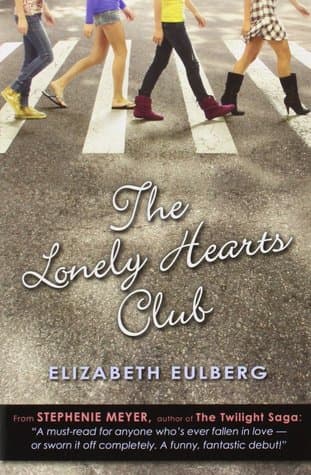
Synopsis
Covers the whole plot, including the ending.
- Difficulty
- Easy
- Pacing
- Moderate
- Mood
- Heartwarming, Humorous, Reflective, Sweet
- Read it if
- You enjoy lighthearted high school romance with a focus on female friendship and self-discovery.
- Skip it if
- You prefer complex plots, high stakes, or stories without typical romantic comedy tropes.
The Lonely Hearts Club Plot Summary
Covers the whole plot, including the ending.
The Breakup and the Vow
Penny Lane Bloom, a Beatles-obsessed high school student, is devastated when her boyfriend, Nate, breaks up with her on her front porch. He cites her 'intensity.' This is not Penny's first heartbreak; she has had many disappointing relationships. Feeling disillusioned and tired of the emotional rollercoaster, Penny makes a public vow to herself and her best friend, Tracy. She will not date anyone for the rest of high school. She declares her intention to focus on her studies, her friends, and her future, rather than the drama and heartbreak that boys seem to bring. This decision sets the stage for her new approach to life, much to Tracy's initial skepticism.
The Inadvertent Movement
Penny's declaration quickly spreads through her high school. At first, it is met with a mix of confusion and amusement. But soon, other girls, also tired of dating problems and the pressure to have a boyfriend, express interest in joining Penny. Inspired by the Beatles' album 'Sgt. Pepper's Lonely Hearts Club Band,' Penny, along with Tracy and a few other girls including Diane and Jess, officially forms 'The Lonely Hearts Club.' The club's rule is that members cannot date or pursue romantic relationships. Instead, they focus on female friendships and personal growth. The club gains unexpected popularity, transforming Penny from an ordinary student into a leader of a social movement.
The First Meeting and Public Attention
The Lonely Hearts Club holds its first meeting. It attracts a diverse group of girls, some genuinely committed and others curious. Penny, still adjusting to her new role, outlines the club's principles: no dating, mutual support, and self-improvement. The club quickly becomes a topic of conversation at school. It draws admiration from those who appreciate its message of female empowerment and criticism from those who view it as anti-boy or just a phase. The school newspaper even runs a story about the club, further amplifying its presence and putting Penny in the spotlight, which she finds both exciting and daunting.
Enter Ryan Black
Just as The Lonely Hearts Club gains momentum, a new student named Ryan Black arrives at school. Ryan is handsome, witty, and intelligent, and he quickly catches Penny's attention. Despite her vow and her leadership role, Penny finds herself drawn to Ryan's charm and genuine interest in her. Their interactions are filled with playful banter and chemistry, making Penny question the club's foundation. Ryan, aware of her no-dating stance, respects it but does not shy away from engaging with her. This creates an internal conflict for Penny as she tries to reconcile her principles with her growing feelings.
The Club's Challenges
As the school year progresses, the club members face challenges to their commitment. Diane, a founding member, struggles with her feelings for a boy she has known for years. Jess finds herself drawn to a popular athlete. Even Tracy, Penny's best friend, starts to waver when an old crush reappears. These individual struggles reflect the broader societal pressures on teenage girls to be in relationships. This makes it difficult for the club members to uphold their vow. Penny tries to be a supportive leader, but seeing her friends' temptations only heightens her own struggle regarding Ryan.
Growing Closer to Ryan
Despite her efforts to maintain her vow, Penny spends more and more time with Ryan Black. They study together, talk for hours on the phone, and share a deep connection through their mutual love for music, especially the Beatles. Their relationship deepens beyond friendship, becoming emotionally intimate without the official label of 'dating.' Penny justifies their interactions by reminding herself that they are not 'dating' in the traditional sense. But the emotional closeness and the romantic tension make her uncomfortable with her hypocrisy, especially as the leader of The Lonely Hearts Club.
The Halloween Dance Dilemma
The annual Halloween dance approaches, a major social event where couples traditionally attend together. Ryan, sensing Penny's internal conflict and their connection, asks her to go with him. This invitation presents a dilemma for Penny. Attending the dance with Ryan would violate The Lonely Hearts Club's core principle. It would likely be seen as a betrayal by its members, especially given her leadership role. Penny grapples with the desire to be with Ryan and her responsibility to the club and the girls who look up to her. The decision weighs heavily on her, forcing her to confront her true feelings and priorities.
The Betrayal and Confrontation
Penny eventually gives in to her feelings and attends the Halloween dance with Ryan. Word quickly spreads, and the club members feel betrayed by their leader. The next day, Penny faces an angry confrontation from the club, especially from Diane, who feels let down. They accuse her of hypocrisy and question the club's integrity if its founder cannot uphold its rules. Penny tries to explain her feelings for Ryan, but the hurt and disappointment of the other girls are clear. The Lonely Hearts Club, once a symbol of unity, is now fractured, and Penny's leadership is undermined.
Repercussions and Realizations
Following the confrontation, The Lonely Hearts Club disbands. Members feel disillusioned and betrayed. Penny is ostracized by many of her former clubmates and feels immense guilt. She realizes that while her initial vow was sincere, her feelings for Ryan were equally real and powerful. She reflects on the club's purpose—whether it was about empowerment or simply a reaction to past hurts. Penny understands that love and relationships are not inherently bad. Her vow, while well-intentioned, became a rigid rule that prevented her from experiencing genuine connection when it presented itself in a healthy way. She understands that the club's message was perhaps misinterpreted or taken too literally.
Mending Fences and Finding Balance
Penny reaches out to Tracy, Diane, and other former club members. She offers sincere apologies and explains her journey of self-discovery. She acknowledges her mistakes in not being transparent and in allowing her personal feelings to clash with her public role. While some friendships take time to heal, Penny's honesty helps mend many of the fractured relationships. She and Ryan continue their relationship, but Penny learns to navigate it with more self-awareness and integrity. She realizes that the spirit of the Lonely Hearts Club was not necessarily about abstaining from love. It was about empowering girls to make choices for themselves and not settle for less, a lesson she now applies to her own life.
The New Perspective
By the end of the school year, Penny has grown. She no longer views relationships as inherently problematic. Instead, she understands the importance of healthy boundaries, self-respect, and choosing partners wisely. Her friendship with Tracy is stronger than ever, built on honesty and mutual understanding. While The Lonely Hearts Club as a formal entity no longer exists, its original message, reinterpreted through Penny's experiences, continues to resonate: girls should prioritize their own well-being and happiness, whether that means choosing to date or choosing to remain single. Penny finds a balance, recognizing that true empowerment comes from making authentic choices, not from rigid rules.
The Lonely Hearts Club Characters
Penny Lane Bloom
Protagonist
A Beatles-obsessed teenager who vows off dating and inadvertently starts a movement.
Penny is a passionate and intelligent high school student, deeply influenced by the Beatles, whose romantic life has been a series of disappointments. Initially, she is heartbroken and disillusioned by boys, leading her to make a firm vow of no dating. She is principled and well-intentioned, but also somewhat naive and prone to letting her emotions guide her. Penny struggles with her identity as a leader and her personal desires, often finding herself in conflict between the two. Her journey is one of self-discovery, learning to reconcile her ideals with the complexities of real-life emotions.
Relationships: Tracy (Best friend and confidante); Ryan Black (Love interest who challenges her vow); Nate (Ex-boyfriend who initially caused her heartbreak); Diane (Club member and friend who feels betrayed)
Tracy
Supporting
Penny's pragmatic best friend who initially supports the club but questions its rigidity.
Tracy is Penny's loyal and level-headed best friend. She is more pragmatic and less idealistic than Penny, often offering a grounded perspective. While she supports Penny's initial vow and helps form The Lonely Hearts Club, she sometimes questions the feasibility and rigidity of its rules. Tracy cares deeply for Penny and wants her to be happy, even if it means challenging Penny's decisions. She represents a voice of reason and reality, navigating her own romantic interests while trying to be a good friend.
Relationships: Penny Lane Bloom (Best friend)
Ryan Black
Supporting
The charming new student who falls for Penny and challenges her no-dating vow.
Ryan is the new student at school, immediately captivating Penny with his good looks, wit, and shared love for music. He is intelligent, respectful, and genuinely interested in Penny as a person, even understanding and acknowledging her commitment to The Lonely Hearts Club. Ryan is patient and understanding, but also persistent in pursuing a connection with Penny, making it clear that he sees something special in her. He represents the catalyst that forces Penny to confront her true feelings and the limitations of her self-imposed rules.
Relationships: Penny Lane Bloom (Love interest)
Diane
Supporting
A founding member of The Lonely Hearts Club who strongly believes in its mission.
Diane is one of the first girls to join Penny in forming The Lonely Hearts Club. She is earnest and takes the club's mission very seriously, having experienced her own share of romantic disappointments. Diane is a strong advocate for female empowerment and feels a deep sense of commitment to the club's principles. Her belief in the club's purpose makes her feel particularly betrayed when Penny's relationship with Ryan comes to light, representing the collective disappointment of the club members.
Relationships: Penny Lane Bloom (Fellow club member and friend)
Jess
Supporting
Another early member of The Lonely Hearts Club who struggles with temptation.
Jess is an early member of The Lonely Hearts Club who, like Diane, is drawn to its message of freedom from dating drama. However, Jess is more susceptible to the allure of popularity and external validation. She finds herself tempted by a popular athlete, highlighting the internal struggles many club members face in upholding their vow. Her character helps to illustrate the real-world pressures and temptations that make adhering to a strict no-dating rule challenging for teenagers.
Relationships: Penny Lane Bloom (Fellow club member)
Nate
Mentioned
Penny's ex-boyfriend whose breakup sparks her no-dating vow.
Nate is Penny's ex-boyfriend who breaks up with her at the very beginning of the story, citing her 'intensity.' His actions are the catalyst for Penny's decision to swear off boys and subsequently form The Lonely Hearts Club. While he doesn't play a significant ongoing role, his breakup with Penny is crucial for establishing her initial emotional state and motivation. He represents the kind of disappointing romantic experience Penny is trying to avoid.
Relationships: Penny Lane Bloom (Ex-boyfriend)
The Lonely Hearts Club Themes
The Nature of Love and Relationships
The novel explores the complexities of teenage love. It moves beyond superficial infatuation to deeper emotional connections. Penny's journey shows that love is not always a source of heartbreak. It can also be a source of growth and happiness when approached with maturity and self-awareness. The initial vow to abstain from dating is a reaction to past hurts. But her eventual relationship with Ryan shows that genuine connection can blossom organically, challenging rigid rules. The story suggests that true love involves understanding, respect, and emotional intimacy, rather than just the pursuit of a 'boyfriend.'
“Maybe love wasn't about the grand gestures or the perfect boys, but about finding someone who made you feel like yourself, only better.”
Female Friendship and Empowerment
The Lonely Hearts Club aims to celebrate and prioritize female friendships over romantic pursuits. The club provides a space for girls to support each other, share their frustrations, and focus on personal growth. While the club's initial rules become problematic, the underlying message of empowering girls to make choices for themselves and not define their worth by a boyfriend remains strong. Penny's friendships with Tracy and the other club members evolve. This shows the resilience and importance of these bonds, even after misunderstandings. It emphasizes that self-worth comes from within and from supportive relationships with peers.
“We were a club of girls who chose ourselves. And that, I realized, was the most powerful choice of all.”
Identity and Self-Discovery
Penny's journey is an exploration of identity. She starts by defining herself by her romantic relationships. Then, in reaction, she defines herself by her abstinence from them. Her role as the leader of The Lonely Hearts Club further shapes her public identity. However, her developing feelings for Ryan force her to confront who she truly is and what she genuinely wants, independent of external expectations or self-imposed rules. She learns that true identity comes from within, from understanding her own desires and values, rather than adhering to a persona or a movement. This leads to a more balanced and authentic sense of self.
“I was Penny Lane Bloom, not just the president of a club. And Penny Lane Bloom liked Ryan Black.”
Hypocrisy and Integrity
A central theme is the challenge of maintaining integrity when personal desires conflict with public vows. Penny, as the leader of The Lonely Hearts Club, faces pressure to uphold its no-dating rule. Her growing feelings for Ryan put her in a hypocritical position. This leads to the club's eventual disillusionment. This shows the difficulty of living up to rigid ideals, especially when emotions are involved. The story suggests that true integrity might not always mean adhering strictly to rules. It means understanding one's own heart and being honest about it, even if it means admitting to changing beliefs.
“How could I tell them to swear off boys when all I wanted to do was spend every minute with one?”
Plot Devices & Literary Techniques
The Vow/The Rule
Penny's personal commitment to abstain from dating, which becomes the central conflict.
The vow Penny makes to herself to not date for the rest of high school serves as the primary inciting incident and the central conflict generator. It establishes the premise of the story and sets up the internal and external challenges she will face. This rigid rule acts as a barrier that Penny must either uphold, break, or redefine, driving much of the plot and character development. It creates the initial drama, the formation of the club, and the eventual crisis when her feelings for Ryan emerge.
The Lonely Hearts Club
A social movement founded by Penny, based on her no-dating vow.
The club itself is a significant plot device. It provides a platform for the theme of female empowerment and friendship, and it amplifies Penny's personal vow into a public statement. The club's existence creates external pressure on Penny, as her actions are scrutinized by its members. It serves as a symbol of her initial commitment and becomes the physical manifestation of her hypocrisy when she falls for Ryan, leading to the climax and resolution of the story. The club's rise and fall mirror Penny's personal journey.
The Beatles References
Penny's deep connection to The Beatles, woven throughout the narrative.
Penny's obsession with The Beatles is more than just a character quirk; it's a recurring motif that provides thematic depth and foreshadowing. The club's name itself is a direct reference. Specific song lyrics or album titles often reflect Penny's emotional state or the situation she's in, acting as a form of internal monologue or commentary. This device not only grounds Penny's personality but also adds a layer of cultural resonance, connecting her personal journey to universal themes of love, heartbreak, and self-discovery found in The Beatles' music.
Love Interest as Catalyst
Ryan Black's arrival and charm directly challenge Penny's established principles.
Ryan Black functions as a classic catalyst character. His introduction into Penny's life directly challenges her foundational vow and the very existence of The Lonely Hearts Club. Without Ryan, Penny's commitment might never have been truly tested. He forces her to confront her true feelings and the practicality of her rules, thereby driving her internal conflict and pushing the plot forward. His presence is essential for Penny's growth and the ultimate re-evaluation of her beliefs.
The Lonely Hearts Club Quotes
“The thing about boys is, they're not like a really good book. You can't just pick them up and put them down whenever you want to.”
“Being in a relationship shouldn't mean you lose yourself.”
“Boys are like puppies. They're cute and fun, but they require a lot of work and sometimes they chew on your favorite shoes.”
“Sometimes you have to break a few hearts to find your own.”
“It's not about finding someone to complete you. It's about finding someone who accepts you completely.”
“The best kind of love is the one that makes you a better person, without changing you into someone else.”
“Just because you're lonely doesn't mean you have to settle.”
“Friendship is just as important as romance, sometimes even more so.”
“Being single isn't a disease, it's a choice. And sometimes, it's the right one.”
“Don't let a boy define you. You define yourself.”
“Life isn't a romantic comedy. There aren't always grand gestures and happy endings with a kiss in the rain.”
“Sometimes the person you're looking for has been there all along, you just weren't ready to see them.”
“The Lonely Hearts Club isn't about being lonely. It's about being strong enough to be yourself, no matter what.”
“It's okay to be a work in progress. Everyone is.”
Quiz
10 questions on the plot and the characters. Each answer comes with a short explanation.
Question 1
What is the primary reason Penny starts The Lonely Hearts Club?
- She wants to focus on her studies and has no time for dating.
- She is tired of boys and dating after a series of bad experiences.
- She is secretly in love with a boy who doesn't notice her and wants to avoid other relationships.
- Her best friend dares her to go a year without dating.
Show answer
B. She is tired of boys and dating after a series of bad experiences. Penny's frustration with boys and dating after repeated disappointments leads her to make a vow to stop, which then inspires the club.
Question 2
What band is The Lonely Hearts Club named after?
- The Rolling Stones
- The Beatles
- Led Zeppelin
- Queen
Show answer
B. The Beatles The club is explicitly named after 'Sgt. Pepper's Lonely Hearts Club Band' by The Beatles.
Question 3
What is the central conflict Penny faces after forming the club?
- Her friends abandon her because they disagree with her no-dating vow.
- Her grades suffer because she is too focused on managing the club.
- She develops feelings for a boy, which contradicts her club's no-dating policy.
- The school administration tries to shut down The Lonely Hearts Club.
Show answer
C. She develops feelings for a boy, which contradicts her club's no-dating policy. The primary internal conflict for Penny is her developing feelings for a boy despite her vow and the club's principles.
Question 4
How do other girls initially react to Penny's decision to stop dating?
- They mock her and try to set her up with boys.
- They are inspired and want to join her in her no-dating vow.
- They are indifferent and don't pay much attention.
- They are concerned about her well-being and think she's depressed.
Show answer
B. They are inspired and want to join her in her no-dating vow. The book description states that 'a few other girls are inspired' by Penny's choice, leading to the birth of the movement.
Question 5
What is the main theme explored by Penny's internal struggle with her no-dating vow and her feelings for a boy?
- The importance of conformity versus individuality.
- The conflict between personal principles and unexpected emotions.
- The difficulty of maintaining friendships while pursuing romantic interests.
- The societal pressure on teenage girls to always be in a relationship.
Show answer
B. The conflict between personal principles and unexpected emotions. Penny's personal vow clashes with her developing attraction, highlighting the theme of how personal rules can be challenged by genuine feelings.
Question 6
How does Penny's newfound 'fame' for her non-dating ways complicate her life?
- It makes her a target for bullies who disagree with her stance.
- It forces her to uphold a public image that may not align with her changing private feelings.
- It attracts too much media attention, making her uncomfortable.
- It makes it impossible for her to attend social events without scrutiny.
Show answer
B. It forces her to uphold a public image that may not align with her changing private feelings. The description states 'Penny is suddenly known for her nondating ways . . . which is too bad, because there's this certain boy she can't help but like,' indicating the public persona creates a problem for her private feelings.
Question 7
What specific characteristic of Penny's personality is highlighted by her decision to start the club?
- Her shyness and introversion.
- Her tendency to follow trends rather than set them.
- Her independence and willingness to challenge social norms.
- Her desire for attention and popularity.
Show answer
C. Her independence and willingness to challenge social norms. Penny makes a 'personal choice' to stop dating, which then inspires others. This shows her initiative and willingness to go against the common dating culture.
Question 8
How does the author use the concept of 'love' in the subtitle 'Love is all you need... or is it?' to foreshadow the book's central dilemma?
- It suggests that Penny will realize she needs more than just romantic love to be happy.
- It implies that Penny will struggle with the idea of needing love when she's trying to avoid it.
- It hints that the club will fail because its members ultimately realize they do need love.
- It foreshadows a situation where Penny's friends try to convince her that love is not necessary.
Show answer
B. It implies that Penny will struggle with the idea of needing love when she's trying to avoid it. The subtitle directly questions the universally accepted idea that 'love is all you need,' setting up Penny's conflict where she tries to reject love but finds herself drawn to it.
Question 9
Considering the genre is Young Adult Romance, what is the most probable outcome of Penny's dilemma regarding the 'certain boy'?
- She will successfully resist her feelings and uphold her club's principles.
- She will abandon the club and pursue the relationship, leading to its dissolution.
- She will find a way to reconcile her feelings with her personal growth, possibly redefining the club's purpose.
- She will discover the boy is not interested in her, resolving her conflict without action.
Show answer
C. She will find a way to reconcile her feelings with her personal growth, possibly redefining the club's purpose. In Young Adult Romance, characters typically grow and find a balance. The most likely outcome is that Penny learns a lesson about love and personal vows, leading to a resolution that allows for both her feelings and a revised understanding of her principles, rather than a complete abandonment of either.
Question 10
What does the phrase 'A movement is born' imply about the impact of Penny's personal choice?
- It suggests that her choice will only affect her closest friends.
- It indicates that her decision will have a widespread and significant influence on others.
- It means she will become a political activist against dating culture.
- It implies that her club will be short-lived and insignificant.
Show answer
B. It indicates that her decision will have a widespread and significant influence on others. The term 'movement' implies a broader, collective shift or trend, indicating that Penny's individual choice resonates with many and grows into something larger than herself.
The Lonely Hearts Club FAQ
What prompts Penny to start the Lonely Hearts Club, and what is its initial purpose?
Penny starts the Lonely Hearts Club out of frustration with the dating scene and a series of bad experiences with boys. Her initial purpose is to make a personal vow to stop dating and focus on herself and her friendships, creating a supportive space for other girls who feel similarly disillusioned.
Who are the key members of the Lonely Hearts Club besides Penny, and what unique perspectives do they bring?
Besides Penny, the key members include Olivia, a fashion-forward girl who initially joins for the 'anti-dating' trend, and Tracy, a more cynical and practical friend who is wary of the club's growing popularity. Their diverse personalities highlight different reasons girls might opt out of dating, from genuine disinterest to social statement.
How does the school and social environment react to the formation and growth of the Lonely Hearts Club?
The school's initial reaction is a mix of curiosity, confusion, and some boys' resentment, as the club challenges traditional dating norms. As the club gains traction, it becomes a significant topic of discussion, with some girls embracing it as empowering and others dismissing it as a silly phase.
Who is Ryan and what role does he play in Penny's personal journey regarding the club?
Ryan is a new boy at school who catches Penny's attention and challenges her commitment to the Lonely Hearts Club. He represents the unexpected romantic interest that makes Penny question her no-dating vow, forcing her to confront the complexities of her own rules and desires.
What is the significance of the club being named after 'Sgt. Pepper's Lonely Hearts Club Band'?
The name 'Sgt. Pepper's Lonely Hearts Club Band' is significant because it's a fictional band within the Beatles' album, suggesting a playful, almost performative aspect to Penny's club. It also evokes a sense of community and shared identity, mirroring how the girls come together under a common, albeit unconventional, banner.
Are there any subtle hints about Penny's eventual romantic conflict before Ryan's introduction?
Yes, there are subtle hints. Penny's internal monologues often reveal a lingering desire for genuine connection despite her anti-dating stance, and her observations of other couples sometimes show a wistful curiosity. These moments foreshadow her struggle when Ryan appears, indicating her vow wasn't entirely absolute.
How does Penny's relationship with her best friend, Tracy, evolve as the Lonely Hearts Club gains prominence?
Penny's relationship with Tracy becomes strained as the club grows. Tracy, initially supportive but skeptical, worries about Penny losing herself in the club's fame and becoming hypocritical, leading to arguments and a period of distance as Penny navigates her new role and her feelings for Ryan.
What unspoken fears or insecurities might drive Penny's initial strong aversion to dating?
Penny's strong aversion to dating is likely driven by a fear of rejection, a desire to avoid the emotional pain of past bad relationships, and a deeper insecurity about her self-worth being tied to male attention. She seeks control and validation outside of romantic pursuits.
How does the concept of 'identity' play a role in Penny's journey, both before and during the club's existence?
Identity plays a crucial role as Penny initially defines herself by her non-dating status, finding a new sense of purpose and leadership. However, as her feelings for Ryan emerge, she struggles with reconciling her public 'Lonely Hearts Club' identity with her private desires, forcing her to redefine who she truly is.
In what ways does Penny's leadership of the club affect her self-perception and relationships with other girls?
Penny's leadership initially boosts her self-perception, giving her a sense of purpose and influence. However, it also creates pressure to maintain an image, leading to a disconnect with some members and internal conflict when her personal feelings contradict the club's principles, affecting her authenticity.
How does the book explore the tension between individual choice and social influence, particularly in a high school setting?
The book explores this tension by showing how Penny's personal choice to stop dating quickly becomes a social phenomenon, influencing others and creating a movement. It highlights how peer pressure and the desire for belonging can shape or challenge individual decisions, especially within the confines of high school social dynamics.
Does the book ultimately advocate for celibacy or non-dating, or does it offer a more nuanced message about relationships?
The book offers a more nuanced message. While it initially champions non-dating as an empowering choice, it ultimately suggests that genuine connection, whether platonic or romantic, is valuable. It advocates for self-discovery and making choices based on personal happiness rather than rigid rules or external expectations.
How does Penny's final decision regarding Ryan and the club reflect growth rather than simply abandoning her principles?
Penny's final decision reflects growth because she doesn't abandon her principles but reinterprets them. She learns that true self-love and independence don't necessitate isolation from romance. Her choice to pursue a relationship with Ryan, while still valuing her friendships and individual strength, shows a more mature understanding of love and self.
Could the Lonely Hearts Club be seen as a metaphor for something larger in the context of young adult life?
Yes, the Lonely Hearts Club can be seen as a metaphor for the search for identity and belonging in young adult life. It represents the desire to define oneself outside of societal norms, to find a supportive community, and to navigate the complexities of personal values versus external pressures during a formative period.
What is the author's likely message about the definition of 'love' in the context of the entire story?
The author's likely message is that 'love' is multifaceted, encompassing not only romantic relationships but also self-love, strong friendships, and a passion for one's own life and interests. The story suggests that true love starts with knowing and valuing oneself, and that healthy relationships enhance, rather than complete, an individual.
How do the male characters, particularly Ryan and other boys, react to the club's existence and its impact?
Male characters react with a mix of confusion, frustration, and sometimes a dismissive attitude towards the club. Some boys feel challenged or rejected by the girls' collective decision not to date, while Ryan, in particular, respects Penny's choices but also subtly challenges her to consider her own feelings beyond the club's rules.
What role do Penny's parents play in her decision-making process and overall understanding of relationships?
Penny's parents offer a stable, if sometimes slightly distant, backdrop. They provide a sounding board for her frustrations and gently encourage her to follow her heart, serving as a quiet influence that contrasts with the loud opinions of her peers. Their own healthy relationship implicitly guides Penny's reflections on what she truly wants.
How does Penny's internal conflict between her public persona and private feelings manifest throughout the book?
Penny's internal conflict manifests through her increasingly frequent secret meetings with Ryan and her attempts to hide her growing feelings from her friends and club members. She experiences guilt and anxiety, constantly weighing her commitment to the club's principles against her undeniable attraction, leading to moments of awkwardness and self-doubt.
Similar books
- To All the Boys I've Loved Before
Jenny Han
4.2 (490k) average on GoodreadsYoung AdultFeatures a relatable protagonist navigating unexpected romance and high school drama, with a strong focus on self-discovery.
- Anna and the French Kiss
Stephanie Perkins
4.0 (364k) average on GoodreadsYoung AdultOffers a charming, feel-good high school romance with a focus on internal conflict and new beginnings.
- Eleanor & Park
Rainbow Rowell
4.0 (860k) average on GoodreadsYoung AdultRowell's work delves into significantly more complex character backstories and emotional depth, particularly regarding socio-economic struggles and trauma. Eulberg's 'The Lonely Hearts Club' provides a lighter, less intense emotional journey, focusing more on typical adolescent romantic dilemmas rather than profound personal challenges.
- Harry Potter and the Sorcerer's Stone
J.K. Rowling
4.5 (7M) average on GoodreadsFantasyRescued from a miserable life under the stairs, an orphaned boy discovers he's a wizard destined for a magical school, where he uncovers a dangerous secret tied to the dark wizard who murdered his parents.
- The Hunger Games
Suzanne Collins
4.3 (6.4M) average on GoodreadsFantasyIn a future where children fight to the death on live television, Katniss Everdeen volunteers for the arena, turning a death sentence into a fight for survival and a spark of rebellion.
- To Kill a Mockingbird
Harper Lee
4.3 (4.5M) average on GoodreadsHistorical FictionIn the 1930s Jim Crow South, Harper Lee writes about racial injustice, moral growth, and the quiet courage of a lawyer father, Atticus Finch, as seen through his young daughter's eyes.






Enjoyed the summary?
A summary gives you the shape of the book. The book itself has the detail, the examples and the voice.
Find The Lonely Hearts Club on AmazonAs an Amazon Associate, BookBrief earns from qualifying purchases. How we're funded