

Synopsis
Covers the whole plot, including the ending.
- Difficulty
- Medium
- Pacing
- Moderate
- Mood
- Atmospheric, Bleak, Cynical, Suspenseful
- Read it if
- You enjoy Cold War espionage thrillers that explore the moral ambiguities and bureaucratic failings of intelligence agencies, with a focus on character and atmosphere over pure action.
- Skip it if
- You prefer fast-paced, action-heavy spy novels with clear-cut heroes and villains, or straightforward plots.
The Looking Glass War Plot Summary
Covers the whole plot, including the ending.
The Department's Desperation
The Department, a small, old-fashioned British intelligence agency, faces obsolescence next to the more powerful Circus (MI6). Led by the ambitious Director, Paul Avery, and his manipulative deputy, Adrian Haldane, they desperately seek a mission to prove their worth. A defector, a Polish émigré named Krystof, brings a grainy photograph and a vague story about a new missile base in East Germany, near the West German border. Despite the questionable intelligence, Avery and Haldane seize on it, seeing a chance to impress Whitehall and secure their budget, mostly ignoring the more skeptical views of their few competent officers, like John Standfast.
Recruiting the Reluctant Agent
To investigate Krystof's claims, The Department decides to send an agent into East Germany. They choose Fred Leiser, a Polish-born British citizen and a World War II veteran agent, now working a dull job. Leiser is a man haunted by his past and the loss of his family during the war. He is at first unwilling to return to the field, doubting his abilities and the Department's methods. However, after intense psychological manipulation and an appeal to his lingering sense of duty by Haldane and his team, Leiser agrees to take on the mission, despite the clear risks and his lack of recent training.
Flawed Training and Preparation
Leiser undergoes a rushed and largely poor training program from The Department's officers, including Standfast, Taylor, and the overly dramatic Johnson. The training uses outdated techniques, bureaucratic arguments, and a clear lack of realism. Leiser struggles with the modern equipment and rules, often relying on his instinctive, wartime methods. The officers, especially Taylor and Johnson, focus more on their internal power struggles and proving their own theories than on properly preparing Leiser for the very real dangers he will face, further showing the Department's distance from the realities of espionage.
The Infiltration
Leiser is secretly sent into East Germany. His mission is to find and photograph the alleged missile site. Almost immediately, the mission runs into trouble. The initial meeting point is compromised, and Leiser must improvise, relying on his old instincts. He finds himself in a hostile and unfamiliar place, where every move is watched. The Department, back in London, nervously monitors his progress, but their communication methods are unreliable, and their understanding of the situation on the ground is very limited, leading to growing tension and second-guessing among the officers overseeing the operation.
Leiser's Struggle and Discovery
Alone and isolated, Leiser endures a difficult journey through East Germany. He feels paranoia, hunger, and constant fear of being caught. His wartime training helps him more than the Department's recent instruction. He eventually finds a military installation that seems to match the description of the missile site. He manages to gather photographic evidence, but his presence is noticed. He is aware of being watched and pursued, increasing the tension of his mission as he prepares for extraction, while back in London, The Department celebrates what they believe is a major success.
The Extraction and Its Aftermath
The Department plans Leiser's extraction, which involves a pre-arranged pick-up. However, the East German security forces are now actively hunting him. The extraction becomes a desperate fight for survival. Leiser finds himself in a deadly chase with the Stasi. The operation ends in a violent confrontation at the border, where Leiser is badly wounded. The Department's carefully made plans fall apart, showing their lack of foresight and the brutal realities of the Cold War espionage they so eagerly sought to join. Leiser's fate hangs in the balance, as does The Department's future.
The Truth Revealed
Following the disastrous extraction attempt and Leiser's capture, The Circus, led by Smiley and Control, steps in. They reveal that the 'missile site' was a carefully planned deception by the East Germans, designed to expose The Department's amateur operations and potentially embarrass British intelligence. The Circus had known about the deception all along and had allowed The Department to proceed, partly to observe their methods and partly as a cynical ploy to discredit them. The 'missiles' were merely a training exercise for a mobile rocket launcher, not a fixed missile base.
The Department's Reckoning
The exposure of their incompetence and Leiser's tragic fate brings The Department to a devastating reckoning. Avery and Haldane must face the disastrous results of their ambition and their detachment from reality. Their grand plan to matter again has instead led to humiliation and the likely end of their agency. The moral implications of sacrificing Leiser for a fabricated cause weigh heavily, though mostly on the more thoughtful officers like Standfast, while Avery and Haldane try to shift blame and save their careers.
Leiser's Ultimate Fate
After being captured and questioned, Fred Leiser is killed by the East German authorities. His death is a direct and tragic result of The Department's reckless and poorly planned operation. He was a pawn in a larger game, sacrificed by his own side's ambition and incompetence, and by the schemes of the opposing intelligence services. Leiser's death highlights the novel's bleak portrayal of espionage, where individual lives are expendable for the sake of institutional survival and political maneuvering, leaving a deep sense of waste and injustice.
The Aftermath and Dissolution
After the Leiser disaster and The Circus's involvement, The Department is finally disbanded. Its officers, including Avery, Haldane, Standfast, and Taylor, are left to pick up the pieces of their careers and confront the moral emptiness of their recent actions. Some, like Standfast, are deeply affected by Leiser's fate and the ethical compromises made. Others, like Avery and Haldane, try to distance themselves from the failure. The novel ends with The Department's closure, but a lingering unease about the human cost of intelligence work and the blurred lines between duty and self-preservation.
Principal Figures
Fred Leiser
Protagonist/Victim
A Polish-born former wartime agent, reluctantly drawn back into a fatal mission.
Fred Leiser is a middle-aged, Polish-born British citizen, a veteran of World War II intelligence operations. He is a quiet, unassuming man, haunted by the loss of his family during the war and deeply weary of espionage. He possesses a strong sense of duty but lacks the guile and ruthlessness of modern spies, often relying on instinct and old-fashioned methods. Leiser is fundamentally an honest and decent man caught in a web of deceit and institutional ambition, making him a tragic figure.
Relationships: Paul Avery (superior who manipulates him); Adrian Haldane (superior who manipulates him); John Standfast (one of his trainers, more sympathetic to him)
Paul Avery
Antagonist/Director
The ambitious and insecure Director of The Department, desperate for relevance.
Paul Avery is the outwardly charming but deeply insecure Director of The Department. He is driven by a desperate need to justify his agency's existence and secure his own position within the British intelligence hierarchy. Avery is more concerned with appearances and political maneuvering than with the actual efficacy or moral implications of his operations. He is a bureaucrat first and foremost, detached from the human cost of his decisions, and easily swayed by ambition and pride, making him responsible for Leiser's fate.
Relationships: Adrian Haldane (his manipulative deputy and confidant); Fred Leiser (agent he sends to his death)
Adrian Haldane
Antagonist/Deputy Director
A cunning and cynical deputy, who manipulates agents and superiors alike.
Adrian Haldane is Avery's deputy and the true orchestrator of The Department's ill-fated mission. He is intelligent, cynical, and highly manipulative, possessing a keen understanding of human psychology which he uses to great effect in persuading Leiser and managing Avery. Haldane sees espionage as a game of chess, where agents are pawns and moral considerations are secondary to strategic advantage and institutional survival. He is detached and ruthless, embodying the darker side of intelligence work.
Relationships: Paul Avery (his superior, whom he subtly controls); Fred Leiser (agent he recruits and sends on the mission); John Standfast (colleague with whom he has a strained, competitive relationship)
John Standfast
Supporting/Conscientious Officer
A more grounded and morally aware officer within The Department.
John Standfast is one of the more competent and morally conflicted officers within The Department. Unlike Avery and Haldane, he harbors genuine doubts about the feasibility and ethics of the Leiser mission. He has a more realistic understanding of the dangers involved and a greater sense of responsibility towards the agents. Standfast represents the lingering conscience within an increasingly amoral organization, often clashing with the more self-serving ambitions of his superiors.
Relationships: Fred Leiser (one of his trainers, feels a sense of responsibility for him); Paul Avery (his superior, whom he frequently disagrees with); Adrian Haldane (his superior, whom he distrusts)
Taylor
Supporting/Bureaucrat
A junior officer more concerned with protocol and his own advancement.
Taylor is a younger officer in The Department, characterized by his adherence to protocol and his eager desire to prove himself. He is less experienced than Standfast and more susceptible to the institutional pressures and internal politics of The Department. Taylor's character highlights the generational shift in intelligence, where the old guard's practical experience is being replaced by a more bureaucratic and theory-driven approach, often to the detriment of real-world effectiveness.
Relationships: Fred Leiser (one of his trainers, but struggles to connect with him); John Standfast (colleague, often at odds with his pragmatism)
Krystof
Supporting/Informant
The Polish defector whose dubious intelligence sparks The Department's mission.
Krystof is a Polish émigré and the initial source of the intelligence about the alleged missile site. His character is presented as somewhat unreliable and opportunistic, his information vague and easily misinterpreted. He serves as the catalyst for the entire plot, but his true motivations and the accuracy of his claims remain ambiguous, underscoring the precarious nature of intelligence gathering and the ease with which it can be manipulated or misunderstood by desperate agencies.
Relationships: Paul Avery (his debriefer, who eagerly accepts his information)
George Smiley
Mentioned/Supporting
A senior, highly competent officer from The Circus (MI6).
George Smiley is a recurring character in le Carré's works, representing the more astute and ethical side of British intelligence. In 'The Looking Glass War', he appears briefly and is mentioned as a figure of authority and competence from The Circus. Smiley is portrayed as intelligent, observant, and morally grounded, serving as a stark contrast to the bumbling and self-serving officers of The Department. His presence signifies a higher level of strategic understanding and a more cynical awareness of inter-agency politics.
Relationships: Control (his superior at The Circus)
Control
Mentioned/Supporting
The enigmatic head of The Circus (MI6).
Control is the mysterious and powerful head of The Circus, another recurring character in le Carré's novels. He operates largely in the background, making strategic decisions that impact the broader intelligence landscape. Control represents the ultimate authority and strategic cunning within British intelligence, often using other agencies as pawns in larger games. His decision to allow The Department to proceed with their flawed mission, knowing it was a deception, highlights the ruthless and manipulative nature of high-level espionage.
Relationships: George Smiley (his trusted subordinate)
Themes & Insights
Bureaucratic Incompetence and Self-Preservation
The novel shows the dangers of an intelligence agency putting its own survival and political standing above operational effectiveness and human lives. The Department, led by Avery and Haldane, cares more about budget battles and internal rivalries than about actual intelligence gathering. This is clear in their hasty decision to approve the Leiser mission based on questionable information, their poor training of Leiser, and their complete distance from the realities of his dangerous situation. Their actions are driven by fear of becoming irrelevant, leading to tragic outcomes.
“They were anachronisms, living in a world of ghosts, fighting battles long since lost, or won by others.”
The Human Cost of Espionage
The most affecting theme is how intelligence work harms the individual. Fred Leiser, a decent man haunted by his past, is used as an expendable pawn by The Department. His unwillingness to return, his struggles during training, and his ultimate death show the moral emptiness of sacrificing human lives for institutional ambition. The novel shows how agents like Leiser are not just tools but individuals with their own histories, fears, and weaknesses, often discarded once they are no longer useful, as seen in the careless disregard for Leiser's well-being.
“He was a man without a country, without a family, without a future, and now, almost, without a past.”
Deception and Moral Ambiguity
Deception is central to espionage, and le Carré explores its moral consequences. The East Germans use deception to expose The Department, and The Circus allows The Department to fall into this trap. Internally, Avery and Haldane deceive themselves and their subordinates about the mission's chances. The line between truth and lies, right and wrong, becomes increasingly unclear. This moral ambiguity is shown by characters like Haldane, who manipulates with a clear conscience, and by the final revelation that the entire premise of Leiser's mission was a lie.
“In our trade, the more you know, the less you understand.”
Nostalgia and Obsolescence
The Department is defined by its clinging to outdated methods and a romanticized view of wartime espionage. They are an agency stuck in the past, unprepared for the complexities of the Cold War. Leiser himself is a relic of an earlier time, his skills and mindset belonging to a different kind of war. This theme shows the dangers of failing to adapt, as the Department's reliance on 'old school' tactics and its inability to change directly lead to its downfall and Leiser's tragedy. It criticizes institutions that live on past glory.
“They were still fighting the last war, a war of gentlemen and amateurs, while the real war was fought by technicians and professionals.”
Plot Devices & Literary Techniques
The MacGuffin (The Missile Base)
An object or goal that serves to drive the plot, but is ultimately unimportant in itself.
The alleged East German missile base functions as the primary MacGuffin in 'The Looking Glass War'. Its existence is the entire premise for The Department's mission and Leiser's deployment. However, the true nature of the 'missile base' – revealed to be a deceptive training exercise – demonstrates that its actual importance is secondary to its role in motivating the characters and exposing the flaws of The Department. The focus shifts from the object itself to the actions and consequences it provokes.
Dramatic Irony
The audience is aware of information that the characters are not, creating tension and foreshadowing.
Dramatic irony is heavily employed throughout the novel, particularly concerning the true nature of the missile site and the Department's competence. The audience, often privy to the cynical internal monologues of characters like Haldane or the later intervention of The Circus, understands the futility and danger of Leiser's mission long before the characters within The Department do. This creates a pervasive sense of dread and highlights the tragic inevitability of Leiser's fate, as the reader watches the characters unwittingly walk into a trap.
The Doppelgänger Motif
Characters who mirror or contrast each other, highlighting aspects of their personalities or roles.
While not a direct doppelgänger, Fred Leiser serves as a symbolic mirror to The Department itself. Both are relics of a bygone era, struggling to adapt to a new, ruthless world of espionage. Leiser's outdated skills and the Department's antiquated methods lead to their shared downfall. Furthermore, the contrast between The Department's bumbling incompetence and The Circus's sharp, cynical efficiency (represented by Smiley and Control) highlights the two faces of British intelligence, one dying, the other thriving in the Cold War's moral murk.
Foil Characters
Characters who contrast with another character to highlight particular qualities.
John Standfast acts as a foil to both Paul Avery and Adrian Haldane. His pragmatism, ethical reservations, and genuine concern for Leiser's well-being stand in stark contrast to Avery's ambition and Haldane's manipulative cynicism. Standfast's presence within The Department highlights the moral decay and self-serving nature of his superiors, offering a glimpse of what a more responsible and effective intelligence agency might look like, while simultaneously underscoring the dominance of the less ethical approach.
The Looking Glass War Quotes
“There are some secrets, you see, that are so deep, so terrible, that they can only be hinted at.”
“The only thing worse than a lie is a truth that comes too late.”
“We are all of us, in our different ways, prisoners of the past.”
“Patriotism is the last refuge of a scoundrel, and often the first resort of a fool.”
“You can't be a spy and a good man. You have to choose.”
“The trouble with operations is that they have a life of their own, quite apart from the people who conceive them.”
“We are not dealing with a game of chess, but with a game of mirrors.”
“The greatest danger we face is not from the enemy, but from ourselves.”
“To be a professional, you must be prepared to sacrifice everything, even your own beliefs.”
“Every secret has a shelf life. And sometimes, the longer you keep it, the more dangerous it becomes.”
“We create our own monsters, and then we are surprised when they turn on us.”
“The world is full of people who want to be heroes, but very few who are willing to pay the price.”
“Intelligence is not about knowing everything, but about knowing what matters.”
“There are no good wars, only necessary ones, and even those are never truly good.”
Quiz
10 questions on the plot and the characters. Each answer comes with a short explanation.
Question 1
What is the primary motivation for 'The Department' to send an agent into East Germany?
- To rescue a captured agent from a previous mission.
- To investigate a suspected Soviet missile base near the West German border.
- To establish a new spy network in a critical industrial region.
- To deliver sensitive documents to a defector.
Show answer
B. To investigate a suspected Soviet missile base near the West German border. The Department hears a rumor of a missile base and sees it as an opportunity to regain relevance and political standing.
Question 2
Who is the deactivated agent chosen by The Department for the mission into East Germany?
- Arthur Fancy
- George Smiley
- Fred Leiser
- A. K. Mundt
Show answer
C. Fred Leiser The synopsis explicitly states that 'deactivated agent Fred Leiser' is sent back into East Germany.
Question 3
What is the state of 'The Department' at the beginning of the novel?
- It is a highly funded and respected intelligence agency.
- It is a newly formed division, eager to prove itself.
- It is faded since the war and engaged in bureaucratic battles.
- It is a covert organization operating entirely outside official channels.
Show answer
C. It is faded since the war and engaged in bureaucratic battles. The synopsis describes The Department as 'faded since the war and busy only with bureaucratic battles,' indicating its decline.
Question 4
What specific type of training does Fred Leiser primarily rely on for his mission?
- Advanced Cold War espionage techniques.
- Special forces combat and survival training.
- Schoolboy training and his memories of the war.
- Extensive language and cultural immersion.
Show answer
C. Schoolboy training and his memories of the war. The synopsis states Leiser is 'armed only with some schoolboy training and his memories of the war,' highlighting his inadequate preparation.
Question 5
The Department's decision to send Leiser is largely driven by what two emotions, according to the synopsis?
- Ambition and loyalty.
- Fear and pride.
- Desperation and patriotism.
- Curiosity and duty.
Show answer
B. Fear and pride. The synopsis mentions the Department 'swiftly becoming carried away by fear and pride' in their decision-making.
Question 6
What is the general atmosphere or characteristic of Communist East Germany as described in the synopsis?
- A bustling hub of international intrigue.
- A land of eloquent silence.
- A technologically advanced surveillance state.
- A war-torn and chaotic region.
Show answer
B. A land of eloquent silence. The synopsis refers to East Germany as 'the land of eloquent silence,' implying a pervasive quiet and possibly oppressive atmosphere.
Question 7
What is the political context or period in which the story is set?
- The immediate aftermath of World War II.
- The height of the Cold War.
- The détente period between East and West.
- The collapse of the Soviet Union.
Show answer
B. The height of the Cold War. The synopsis explicitly states, 'The Cold War is at its height,' setting the political backdrop.
Question 8
What does 'The Department' hope to achieve by taking on this mission, beyond merely confirming the missile base?
- To spark a direct military confrontation with the Soviets.
- To secure a large increase in their operational budget.
- To regain some political standing in the Intelligence market place.
- To establish a new, independent intelligence branch.
Show answer
C. To regain some political standing in the Intelligence market place. The Department views the rumor as 'the perfect opportunity to regain some political standing in the Intelligence market place,' indicating their ambition for recognition.
Question 9
How is the fate of Fred Leiser connected to 'The Department's' own fortunes?
- His success will lead to The Department's disbandment.
- His fate becomes inseparable from The Department's.
- His failure will have no impact on The Department.
- He is a disposable asset, irrelevant to their long-term goals.
Show answer
B. His fate becomes inseparable from The Department's. The synopsis concludes by stating, 'Leiser's fate becomes inseparable from the Department's,' highlighting the high stakes for both.
Question 10
What term best describes The Department's general desire for involvement in Cold War activities?
- Cautious observation.
- Strategic avoidance.
- Dying for a piece of the action.
- Strict adherence to protocol.
Show answer
C. Dying for a piece of the action. The synopsis states, 'The Department is dying for a piece of the action,' emphasizing their eagerness and desperation for relevance.
The Looking Glass War FAQ
What is the primary motivation for the Department to launch Operation Mayfly?
The Department, a dwindling British intelligence agency, is primarily motivated by a desperate need to reassert its relevance and secure its budget. They latch onto an unverified rumor of a missile base in East Germany, viewing it as a golden opportunity to prove their worth against more prominent agencies like the Circus, despite the flimsiness of the intelligence.
Who is Fred Leiser and what makes him suitable, or unsuitable, for the mission?
Fred Leiser is a Polish émigré and former wartime agent for the Department, now running a garage. He is 'suitable' because he has past field experience and is easily manipulated by the Department's nostalgic appeals, but 'unsuitable' because his training is outdated, his skills are rusty, and he lacks the sophisticated tradecraft required for a modern Cold War operation.
What is the nature of the alleged missile base that triggers the Department's operation?
The alleged missile base is initially reported by a defecting East German musician, but its existence and capabilities are highly dubious. It's later revealed to be a largely defunct, poorly maintained site, possibly a decoy or a relic, rather than the active, threatening installation the Department fervently believes it to be, fueling their self-deception.
How does the Department prepare Leiser for his infiltration into East Germany?
Leiser's preparation is a haphazard and largely inadequate affair, consisting of superficial refresher courses, outdated equipment, and psychological manipulation. He is given minimal real-world training for modern espionage, relying instead on his wartime memories and the Department's nostalgic, almost theatrical, recreation of past glories, which sets him up for failure.
What is the ultimate fate of Fred Leiser during Operation Mayfly?
Fred Leiser is captured and killed in East Germany during his mission. His death is a direct consequence of the Department's incompetence, their poor planning, and their abandonment of him once the operation begins to unravel, highlighting the tragic human cost of bureaucratic ambition and self-deception.
What is the significance of the 'looking glass' in the book's title?
The 'looking glass' signifies the distorted reality and self-deception that pervades the Department. They see a reflection of their past glory and importance, rather than their current obsolescence, leading them to misinterpret intelligence and pursue a dangerous, ill-conceived operation based on their own internal desires and fears.
How does le Carré use the character of Fred Leiser to comment on the nature of espionage?
Le Carré uses Leiser to expose the brutal reality behind the romanticized image of espionage. Leiser is not a suave, capable spy but a vulnerable, manipulated individual, a pawn sacrificed by a self-serving bureaucracy, revealing the moral bankruptcy and human cost often hidden beneath the surface of intelligence operations.
Are there any subtle indications early on that Operation Mayfly is doomed to fail?
Yes, several. The Department's immediate and uncritical acceptance of flimsy intelligence, their reliance on outdated methods, the almost theatrical and performative nature of Leiser's training, and the internal bickering and lack of genuine concern for Leiser's well-being all subtly foreshadow the operation's inevitable collapse.
How does the Department's internal politics and rivalries contribute to the mission's failure?
The Department's internal politics, marked by bureaucratic infighting, personal vendettas, and a desperate struggle for relevance against the Circus, significantly contribute to the mission's failure. Officers like Avery and Haldane prioritize their own careers and the Department's image over practical planning or Leiser's safety, leading to reckless decisions and neglect.
Analyze the psychological impact of the Department's nostalgia on its decision-making.
The Department's profound nostalgia for its wartime glory distorts its perception of reality, leading to delusional decision-making. They are psychologically trapped in the past, unable to adapt to the complexities of the Cold War, and this emotional bias causes them to project their past successes onto a current, ill-conceived operation, ignoring all warning signs.
How does the character of Avery represent a certain type of Cold War intelligence officer?
Avery represents the ambitious, often ruthless, and ultimately detached Cold War intelligence officer who prioritizes institutional survival and personal advancement over human life. He is a bureaucrat first, a spy second, embodying the moral decay and self-serving nature that le Carré often critiques within intelligence agencies.
What role does guilt play in the aftermath of Leiser's death for the surviving Department officers?
Guilt manifests differently among the Department officers. Some, like Haldane, experience a degree of genuine remorse and disillusionment, while others, like Avery, quickly rationalize Leiser's death as an unfortunate but necessary sacrifice, effectively absolving themselves of responsibility and demonstrating their moral detachment.
Is 'The Looking Glass War' primarily a critique of a specific intelligence agency or a broader commentary on bureaucracy and human nature?
While it specifically targets the inefficiencies and moral failings of a fictional British intelligence 'Department', the novel is broadly a scathing commentary on bureaucracy, institutional self-preservation, and the darker aspects of human nature. It critiques how organizations can become detached from reality, sacrificing individuals for their own perceived importance.
How does the novel challenge traditional notions of heroism and patriotism in espionage narratives?
The novel profoundly challenges traditional notions by presenting a world devoid of true heroes or noble patriotism. Leiser is not a hero but a victim, and the Department's actions are driven by ego and self-interest, not national duty. It strips away the glamour, revealing espionage as a cynical, often destructive, bureaucratic exercise.
Could Operation Mayfly have succeeded under different circumstances or with different leadership?
It's highly unlikely. The fundamental flaws were deeply ingrained in the Department's culture: outdated methods, a lack of genuine intelligence, and a profound detachment from reality. Even with different leadership, the institutional inertia and self-deception would likely have led to a similar, if not identical, disastrous outcome.
What is the significance of the ending, particularly the Department's attempts to cover up the failure?
The ending, with the Department's swift and ruthless cover-up, underscores the book's central themes: institutional self-preservation at all costs and the expendability of individuals. It highlights the moral bankruptcy of the agency, prioritizing its image and existence over truth, accountability, or the life of its agent.
How does the setting of Cold War East Germany contribute to the novel's atmosphere and themes?
The setting of Cold War East Germany, with its oppressive silence, constant surveillance, and moral ambiguity, perfectly amplifies the novel's themes of paranoia, deception, and the grim realities of espionage. It creates a stark, dangerous backdrop against which the Department's incompetence and Leiser's vulnerability are tragically exposed.
About the author
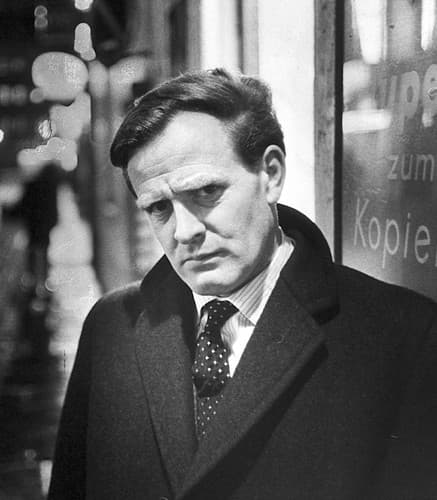
David John Moore Cornwell, better known by his pen name John le Carré, was a British and Irish author, best known for his espionage novels, many of which were successfully adapted for film or television. "A sophisticated, morally ambiguous writer", he is considered one of the greatest novelists of the postwar era. During the 1950s and 1960s he worked for both the Security Service (MI5) and the Secret Intelligence Service (MI6).
Similar books
- The Spy Who Came in from the Cold
John le Carré
4.1 (77k) average on GoodreadsThrillerShares a similar tone, Cold War setting, and exploration of the grim realities and moral compromises of espionage.
- A Perfect Spy
John le Carré
4.0 (16k) average on GoodreadsThrillerDelves into the psychological toll of espionage and the complex motivations of agents, with a focus on character depth.
- Tinker Tailor Soldier Spy
John le Carré
4.1 (107k) average on GoodreadsFictionFeatures a detailed look into the inner workings and bureaucratic infighting of a British intelligence agency during the Cold War.
- Casino Royale
Ian Fleming
3.7 (70k) average on GoodreadsThrillerFleming's James Bond novels, like Casino Royale, present a highly romanticized, glamorous, and often fantastical view of espionage, featuring a charismatic, virtually invincible protagonist. The Looking Glass War directly subverts this by showcasing the mundane, bureaucratic, and morally compromising reality of spy work, with an ordinary, ill-equipped agent facing tragic consequences.
- The Bourne Identity
Robert Ludlum
4.0 (397k) average on GoodreadsThrillerLudlum's The Bourne Identity focuses on high-octane action, intricate conspiracies, and a protagonist with extraordinary physical and intellectual capabilities. In contrast, le Carré's novel emphasizes the psychological toll, institutional incompetence, and the tragic vulnerability of its agents, prioritizing internal struggles and bureaucratic failings over external, explosive confrontations.
- Angels & Demons
Dan Brown
3.9 (2.7M) average on GoodreadsThrillerA Harvard symbologist races through Rome's ancient sites, deciphering cryptic clues to unmask the Illuminati and stop a vengeful plot to destroy the Vatican with a stolen antimatter weapon.





Enjoyed the summary?
A summary gives you the shape of the book. The book itself has the detail, the examples and the voice.
Find The Looking Glass War on AmazonAs an Amazon Associate, BookBrief earns from qualifying purchases. How we're funded