
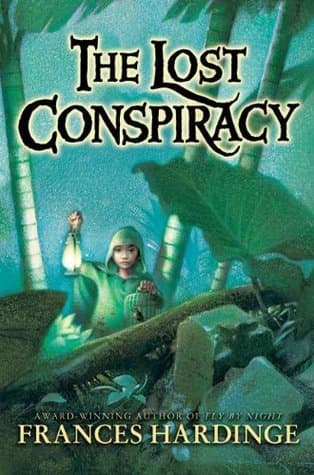
Synopsis
Covers the whole plot, including the ending.
- Difficulty
- Medium
- Pacing
- Moderate
- Mood
- Atmospheric, Mysterious, Introspective, Thought-provoking
- Read it if
- You enjoy intricate world-building, morally ambiguous characters, and a slow-burn mystery with a satisfying unraveling of secrets.
- Skip it if
- You prefer fast-paced action from the beginning or straightforward good vs. evil narratives.
The Lost Conspiracy Plot Summary
Covers the whole plot, including the ending.
The Arrival of the Lost
On the island of the Forty-Nine, Hathin lives in the shadow of her older sister, Arilou, who is revered as a 'Lost' — a prophetess who speaks the words of the ancestors. Their village, the Smiling People, are ostracized and viewed with suspicion by the other tribes and the colonial settlers, known as the Forty-Niners, who follow strict, old laws. Hathin carefully tends to Arilou, making sure her prophetic pronouncements are believable, as their survival depends on this deception. Arilou is not truly a Lost; Hathin secretly provides her with information, fabricating the prophecies to maintain their status and protection within their community. This fragile balance is a constant source of tension and fear for Hathin.
The Colonial Laws and the Ash-Gatherers
The Forty-Niners impose severe laws on the island, particularly regarding the 'ash-gatherers' — individuals who seek out the ashes of the recently deceased. Their beliefs state that a person's ashes must be burned in a specific, sacred location within a strict timeframe for the soul to pass on. Failure to do so condemns the soul to wander. This creates a dangerous trade, as ash-gatherers often steal bodies or interfere with proper burials, leading to conflict and exploitation. Hathin observes these harsh realities, understanding the precarious position of her own people, the Smiling People, who are often victims of these predatory practices and colonial injustices, further highlighting the need for their deception to ensure safety.
A New Governor and Rising Tensions
A new Governor-General, Hamavel, arrives on the island, bringing a more aggressive and calculating approach to colonial rule. He is particularly interested in the Lost and their prophecies, seeing them as a tool for control and legitimacy. Hamavel's presence increases the scrutiny on Arilou and Hathin, forcing Hathin to be even more careful in orchestrating Arilou's 'visions.' The political climate grows more volatile, with Hamavel subtly manipulating the various factions on the island, including the indigenous tribes and the colonial settlers, for his own ends. Hathin senses that their carefully constructed world is becoming more fragile under his watchful eye, threatening to expose their secret.
The Betrayal and Arilou's Capture
The deception surrounding Arilou's prophecies eventually unravels, or perhaps is deliberately exposed. Arilou is captured by the Forty-Niners, specifically by Governor-General Hamavel's forces, who intend to use her as a political pawn. This event shatters Hathin's world and forces her out of her subservient, invisible role. She realizes the full extent of the danger they are in and that her sister's life is at stake. Hathin is left alone, grappling with the immediate need to rescue Arilou and the deeper implications of their long-held lie. This moment propels Hathin into a quest beyond her village, forcing her to rely on her own ingenuity and courage.
Hathin's Journey and Unlikely Allies
Determined to save Arilou, Hathin goes on a dangerous journey into the heart of the Forty-Niner colonial city, a place of alien customs and dangers. She navigates the bustling streets, the rigid social hierarchies, and the constant threat of discovery. Along the way, she meets a diverse cast of characters, some hostile, others surprisingly helpful. She forms an uneasy alliance with a pragmatic and cynical Forty-Niner named Kael, who is involved in the ash-gathering trade, and a resourceful young boy. These unexpected connections are important as Hathin begins to piece together the larger conspiracy, realizing Arilou's capture is part of a much grander scheme.
The Secrets of the Lost
As Hathin investigates the conspiracy, she uncovers the true, terrifying nature of the Lost and the ancient secrets of the island. She learns that the Lost are not merely prophetesses but are connected to a powerful, sentient fungal network that spans the island, communicating through spores and influencing minds. This network, known as the 'Voice of the Island,' holds immense power and has been manipulated by various factions throughout history. Hathin realizes that the prophecies are not just human constructs but are influenced by this ancient entity, giving her a new, chilling perspective on Arilou's role and the dangers they face.
Governor Hamavel's Master Plan
Hathin discovers Governor-General Hamavel's insidious plan. He is not merely interested in using Arilou as a political tool; he seeks to gain complete control over the Voice of the Island, the sentient fungal network, to solidify his power and ensure the Forty-Niners' dominance. He intends to exploit the Lost and their connection to this network to manipulate the island's inhabitants and resources. Hathin realizes that Hamavel's ambition is a threat to all the islanders, not just her sister, and that his actions could irrevocably alter the balance of power and the very essence of the island.
The Unveiling of the Deception
In a shocking revelation, Hathin discovers that she, not Arilou, has a genuine, though dormant, connection to the Voice of the Island. Her 'invisibility' and ability to observe without being noticed were not merely personal traits but subtle manifestations of this inherent link. This discovery complicates her mission significantly. She must now not only rescue Arilou but also come to terms with her own extraordinary abilities and responsibilities. The truth about her identity forces Hathin to re-evaluate everything she thought she knew about herself and her sister, adding a personal dimension to her already dangerous quest.
Confrontation and Sacrifice
Hathin, armed with her new understanding and an unlikely band of allies, confronts Governor-General Hamavel in a climactic showdown. The confrontation takes place among the ancient, spore-laden chambers connected to the Voice of the Island. Hathin is forced to make difficult choices, risking her own life and the lives of those she cares about. She must decide whether to save Arilou at any cost or to prioritize the greater good of the island and its inhabitants, which means preventing Hamavel from seizing control of the Voice. This moment tests Hathin's courage, ingenuity, and moral compass to their limits.
The Aftermath and a New Beginning
After the confrontation, Hamavel's plans are stopped, though not without significant cost. The island's future remains uncertain, but the immediate threat of colonial domination through the Voice of the Island is averted. Hathin, having fully embraced her connection to the Voice, becomes a genuine Lost, no longer in her sister's shadow. The relationship between the sisters is irrevocably changed, built on a new foundation of honesty and shared understanding. Hathin now faces the task of guiding her people and the island towards a more equitable future, accepting her role as a true conduit for the Voice of the Island.
The Lost Conspiracy Characters
Hathin
Protagonist
The 'invisible' younger sister who orchestrates her sister's prophecies.
Hathin is initially presented as quiet, observant, and seemingly insignificant, living in the shadow of her 'prophetess' sister, Arilou. She is fiercely intelligent, possessing a sharp mind for detail and strategy, which she uses to meticulously construct Arilou's prophecies. Hathin is deeply loyal to her sister and her people, driven by a desire for their safety and acceptance. Her perceived invisibility allows her to notice details others miss, making her an acute observer of human nature and the political machinations on the island.
Relationships: Arilou (Sister; Hathin acts as her secret orchestrator and protector.); Kael (Unlikely ally; a cynical Forty-Niner ash-gatherer who assists her quest.); Governor-General Hamavel (Antagonist; Hathin actively opposes his manipulative schemes.)
Arilou
Supporting
The beautiful 'Lost' prophetess, whose prophecies are secretly fabricated by Hathin.
Arilou is Hathin's older sister, publicly revered as a Lost, a conduit for ancestral spirits. She is beautiful, charismatic, and plays her role convincingly, but she is also aware of the deception and relies heavily on Hathin. Arilou is often portrayed as more outwardly emotional and perhaps less resilient than Hathin, struggling with the burden of their lie and the expectations placed upon her. Her initial role is largely passive, a vessel for Hathin's orchestrations, but she cares deeply for her sister.
Relationships: Hathin (Sister; Hathin is her secret helper and protector.); Governor-General Hamavel (Captor and manipulator; he seeks to exploit her public image.)
Governor-General Hamavel
Antagonist
The cunning and ambitious colonial governor who seeks to control the island's ancient power.
Governor-General Hamavel is the primary antagonist, a calculating and ruthless leader of the Forty-Niners. He is driven by an insatiable hunger for power and control, viewing the island and its indigenous inhabitants as resources to be exploited. Hamavel is highly intelligent and manipulative, skilled at playing different factions against each other. He presents a façade of benevolence and order, but beneath it lies a cold, pragmatic determination to achieve his goals, even at great human cost. He is particularly interested in the Lost and their connection to the island's ancient secrets.
Relationships: Hathin (Opponent; he seeks to control what she protects.); Arilou (Pawn; he uses her public image for his political agenda.)
Kael
Supporting
A cynical Forty-Niner ash-gatherer who becomes an unexpected ally to Hathin.
Kael is a pragmatic and world-weary Forty-Niner, deeply entrenched in the illicit and dangerous trade of ash-gathering. He is cynical and initially mistrustful, driven by self-preservation and a keen understanding of the island's harsh realities. Despite his rough exterior, Kael possesses a hidden moral compass and a surprising capacity for loyalty once earned. He is resourceful and knowledgeable about the hidden corners of the colonial city and the intricacies of the ash trade, making him an invaluable, if reluctant, guide for Hathin.
Relationships: Hathin (Ally; he helps her navigate the colonial city and uncover the conspiracy.)
The Voice of the Island
Supporting/Supernatural Force
A sentient, ancient fungal network that connects all life on the island and is the true source of the Lost's power.
The Voice of the Island is not a character in the traditional sense but a powerful, sentient entity – an ancient, island-wide fungal network that influences thoughts, emotions, and provides visions. It is the true, hidden source of the Lost's prophetic abilities. It communicates through spores and can subtly manipulate the minds of those connected to it. Its intentions are complex, often appearing neutral but reacting to threats to the island's balance. It represents the deep, mystical essence of the island itself.
Relationships: Hathin (Possessor of a natural, dormant connection.); The Lost (Those who traditionally serve as its conduits.); Governor-General Hamavel (Target of his ambition to control it.)
The Smiling People
Mentioned/Collective
Hathin and Arilou's tribe, ostracized and misunderstood by other islanders.
The Smiling People are Hathin and Arilou's tribe, known for their seemingly pleasant demeanor, which is often misinterpreted as treachery or weakness by other islanders and the Forty-Niners. They are a marginalized community, frequently victims of prejudice and colonial exploitation. Their survival depends on their ability to adapt and, in the case of Hathin and Arilou, maintain their elaborate deception. They embody the indigenous struggle against colonial oppression and the resilience of cultural identity.
Relationships: Hathin & Arilou (Members of their community, whose safety they strive to ensure.)
The Forty-Niners
Collective
The colonial settlers who impose their strict laws on the island.
The Forty-Niners are the colonial settlers who have established a dominant presence on the island, imposing their strict laws and cultural beliefs upon the indigenous inhabitants. They are driven by a desire for order, profit, and the assertion of their own traditions, often at the expense of local customs and rights. Their society is hierarchical and bureaucratic, with a strong emphasis on legalistic adherence, particularly concerning death and burial rites. They represent the oppressive force of colonialism and the clash of cultures.
Relationships: Hathin (Hathin navigates and challenges their laws and authority.)
The Lost Conspiracy Themes
Deception and Truth
The novel explores deception, both as a tool for survival and a source of moral conflict. Hathin's entire life is built on a lie — her sister Arilou's prophetic abilities are fabricated to protect their village from colonial oppression and tribal prejudice. This theme is in the constant tension Hathin feels, the careful planning needed to maintain the illusion, and the eventual unraveling of the truth. The story questions whether a 'good' lie can exist and the devastating consequences when truth is revealed, as seen when Arilou is captured, forcing Hathin to confront the reality of their situation. Ultimately, Hathin discovers that true power is not in maintaining a lie, but in embracing an uncomfortable truth about herself and the island.
“A lie is a small thing, but it is a thing that grows. It grows roots, and branches, and leaves, until it is a forest, and you are lost inside it.”
Colonialism and Resistance
The conflict between the indigenous tribes and the colonial Forty-Niners is a central backdrop to the narrative. The Forty-Niners impose their old laws, exploit resources, and marginalize the native populations, particularly the Smiling People, who are seen as traitors. This theme is clear in the harsh 'ash-gathering' laws, the political maneuvering of Governor-General Hamavel, and the constant threat of violence and cultural erasure faced by the islanders. Hathin's journey is an act of resistance, not just to save her sister, but to protect her people and the island from colonial subjugation. The novel highlights the power dynamics, prejudice, and the struggle for self-determination against an oppressive regime.
“The Forty-Niners brought their laws with them, like a disease, and they tried to make us sick with them too.”
Identity and Self-Discovery
Hathin's journey is one of self-discovery. Initially defined by her 'invisibility' and her role as Arilou's shadow, Hathin gradually uncovers her true potential and a deep connection to the island's ancient power. Her transformation from a quiet, unnoticed girl into a courageous and decisive protagonist is central to the story. The theme explores how external roles can hide internal strength and how confronting difficult truths about oneself can lead to liberation. The revelation of her own dormant connection to the Voice of the Island forces Hathin to redefine who she is, moving beyond the identity prescribed by her family and society to embrace her unique, powerful self.
“She was not invisible. She had simply been looking in the wrong direction for herself.”
The Power of Storytelling and Belief
The novel emphasizes how stories, prophecies, and beliefs shape reality and power. Arilou's fabricated prophecies, carefully crafted by Hathin, show how narratives can influence communities, provide hope, and even dictate political actions. The Forty-Niners' strict adherence to their own ancestral laws and the legend of the Lost also highlight the power of collective belief. The story looks at the manipulation of these narratives, showing how Governor-General Hamavel tries to use the Lost's mythology for his own colonial agenda. Ultimately, it reveals that while stories can be manipulated, there is also an inherent, ancient 'story' — the Voice of the Island — that holds a deeper, more profound truth.
“A story, once told, becomes as real as stone, even if it began as a whisper in the dark.”
Plot Devices & Literary Techniques
The 'Lost' Prophecies
The central deception that drives the initial plot and defines the sisters' lives.
The 'Lost' prophecies are the fabricated visions and pronouncements delivered by Arilou, secretly orchestrated by Hathin. This device establishes the sisters' precarious existence and their reliance on deception for survival. It creates immediate stakes, as any misstep could expose their lie and endanger their community. The prophecies serve as a narrative engine, influencing the actions of other characters and drawing the sisters into larger political conflicts. They also provide a framework for exploring themes of truth, belief, and manipulation, as characters react to what they believe are divine messages.
The Voice of the Island (Fungal Network)
A sentient, ancient fungal network that is the true source of the Lost's power and a major plot catalyst.
The Voice of the Island is a critical plot device, serving as both a magical element and a hidden antagonist/protector. Initially hinted at through the Lost's abilities, its true nature as a sentient fungal network is gradually revealed. This device introduces a unique form of magic and biological intelligence into the world, allowing for mind-to-mind communication, shared visions, and subtle influence. It becomes the ultimate prize for Governor-General Hamavel and the ultimate responsibility for Hathin, elevating the conflict beyond personal stakes to the fate of the entire island. Its existence recontextualizes all previous 'prophecies' and 'visions'.
Ash-Gathering Laws and Trade
The colonial laws surrounding death and ashes, creating a dangerous economy and social stratification.
The ash-gathering laws and the resulting trade are a crucial plot device that illuminates the oppressive nature of the Forty-Niner colonizers and the desperation of the island's inhabitants. These laws dictate strict rules about the handling of the dead's ashes, creating a lucrative but morally corrupt industry for 'ash-gatherers' who exploit the bereaved. This device provides a tangible example of colonial control and its impact on indigenous culture and spirituality. It also introduces characters like Kael, who are entangled in this grim economy, and provides Hathin with a means to navigate the underworld of the colonial city and understand its harsh realities.
Hathin's 'Invisibility'
Hathin's perceived lack of presence, which is later revealed to be a manifestation of her latent powers.
Hathin's 'invisibility' is a key character trait that functions as a subtle plot device. Initially presented as a psychological characteristic – her quiet demeanor and tendency to be overlooked – it later gains a supernatural dimension. This device allows Hathin to observe and gather information without drawing attention, making her an effective orchestrator of Arilou's prophecies and a skilled spy during her quest. The eventual revelation that her 'invisibility' is a manifestation of her dormant connection to the Voice of the Island transforms it from a personal quirk into a crucial aspect of her identity and power, foreshadowing her true role.
The Lost Conspiracy Quotes
“It was the only way to be safe, to pretend to be nothing.”
“The island had always been hungry. It ate secrets, and it ate people.”
“Sometimes, the truth was a weapon. And sometimes, it was a shield.”
“We are all made of stories, and some of them are lies.”
“Fear was a kind of hunger, too, gnawing at the edges of everything.”
“The greatest prison is not built of stone, but of what you believe to be true.”
“To be truly invisible, you had to be forgotten.”
“Children see what adults ignore, and sometimes, that's their greatest strength.”
“Every secret kept has a shadow, and shadows grow.”
“Some truths are like wild birds; they won't be caged.”
“The world was full of puzzles, and some of them were meant to be solved.”
“Trust was a fragile thing, easily broken and rarely mended whole.”
“Even the smallest whisper can start an avalanche, if it falls on the right ear.”
“Sometimes, the greatest bravery is not in fighting, but in enduring.”
“The past was a ghost that haunted the present, whispering its old lies.”
Quiz
10 questions on the plot and the characters. Each answer comes with a short explanation.
Question 1
What is the primary role Hathin initially plays in relation to her sister, Arilou?
- She is Arilou's protector and bodyguard.
- She is Arilou's almost invisible attendant and 'shadow'.
- She is the true prophetess, with Arilou being her public face.
- She is Arilou's scribe, documenting her prophecies.
Show answer
B. She is Arilou's almost invisible attendant and 'shadow'. Hathin's initial role is described as Arilou's nearly invisible attendant, a 'shadow' who helps maintain the illusion of Arilou's prophetic abilities.
Question 2
What unique resource or commodity are bounty hunters on the island seeking from the living?
- Rare jungle herbs for medicinal purposes.
- The ashes of their funerary pyres.
- Precious metals found in volcanic caves.
- Ancient artifacts from the island's first inhabitants.
Show answer
B. The ashes of their funerary pyres. The bounty hunters are described as stalking the living for the ashes of their funerary pyres, indicating a unique and macabre aspect of the island's culture.
Question 3
What is the name given to the island's precious oracles, of whom Arilou is proclaimed one?
- The Speakers
- The Whisperers
- The Lost
- The Seers
Show answer
C. The Lost Arilou is proclaimed a beautiful prophetess, one of the island's precious oracles, specifically called 'a Lost'.
Question 4
What is the primary reason the smiling tribe is despised by others on the island?
- They refuse to share their valuable resources.
- They are seen as traitorous murderers.
- They practice forbidden magic.
- They constantly raid other settlements.
Show answer
B. They are seen as traitorous murderers. The smiling tribe is explicitly stated to be despised by all as 'traitorous murderers', indicating a deep-seated historical conflict.
Question 5
What is the nature of the 'lie' that Arilou and Hathin live and guard so carefully?
- They are secretly plotting against the colonists.
- Their true identities as members of the despised smiling tribe.
- The pretense that Arilou is a genuine prophetess, which she is not.
- They are not actually sisters by blood.
Show answer
C. The pretense that Arilou is a genuine prophetess, which she is not. The description states that 'neither Arilou nor Hathin is exactly what she seems, and they live a lie that is carefully constructed and jealously guarded,' implying their prophetic abilities are fabricated.
Question 6
What propels Hathin to journey beyond her known world and self?
- A personal quest for self-discovery and independence.
- A desire to escape her sister's shadow.
- A desperate attempt to save herself and Arilou from a sinister, island-wide conspiracy.
- Orders from a secret organization to uncover ancient island magic.
Show answer
C. A desperate attempt to save herself and Arilou from a sinister, island-wide conspiracy. Hathin is drawn into a sinister conspiracy and must journey beyond all she has known in a desperate attempt to save them both, indicating a strong external motivation tied to the plot.
Question 7
What is the central irony regarding the danger Hathin faces as the story progresses?
- The colonists, not the 'traitors', are the true benevolent force.
- The only thing more dangerous than the secret she hides is the truth she must uncover.
- Arilou's prophecies begin to come true, despite being faked.
- The bounty hunters are ultimately seeking the sisters for protection, not their ashes.
Show answer
B. The only thing more dangerous than the secret she hides is the truth she must uncover. The blurb explicitly states, 'As the stakes mount and falsehoods unravel, she discovers that the only thing more dangerous than the secret she hides is the truth she must uncover.'
Question 8
What kind of legal system do the colonists attempt to apply to the new island land?
- A new, progressive system designed for the island's unique challenges.
- Traditional island tribal laws.
- Archaic laws from their homeland.
- A system based on the oracles' prophecies.
Show answer
C. Archaic laws from their homeland. The colonists are described as seeking to apply 'archaic laws to a new land,' highlighting a potential conflict between old traditions and a new environment.
Question 9
Which of the following best describes the overall setting of the island?
- A barren, desolate wasteland with ancient ruins.
- A pristine, untouched paradise free from human conflict.
- A diverse landscape of sandy beaches, dense jungles, and slumbering volcanoes, fraught with ancient tensions and new calamity.
- A futuristic metropolis built on a volcanic island.
Show answer
C. A diverse landscape of sandy beaches, dense jungles, and slumbering volcanoes, fraught with ancient tensions and new calamity. The description vividly details the island as having 'sandy beaches, dense jungles, and slumbering volcanoes,' and mentions it is 'in the midst of ancient tensions and new calamity,' combining environmental and social elements.
Question 10
What is the central theme that emerges from the sisters' 'lie' and Hathin's eventual quest for truth?
- The inevitability of fate and destiny.
- The power of deception versus the danger and necessity of uncovering truth.
- The corrupting influence of power on individuals.
- The importance of tradition over innovation.
Show answer
B. The power of deception versus the danger and necessity of uncovering truth. The entire premise revolves around a 'lie' that is guarded, and Hathin's journey culminates in discovering that 'the only thing more dangerous than the secret she hides is the truth she must uncover,' directly pointing to the theme of truth vs. deception.
The Lost Conspiracy FAQ
What is the central premise of 'The Lost Conspiracy'?
'The Lost Conspiracy' centers on two sisters, Arilou and Hathin, living on an island where Arilou is revered as a 'Lost' – a prophetess who speaks the words of the island's ancient spirits. Their lives are built on a carefully guarded lie, which unravels as they become entangled in a sinister island-wide conspiracy, forcing Hathin to uncover dangerous truths.
Who are the 'Lost' and what is their significance on the island?
The 'Lost' are individuals believed to be conduits for the island's ancient spirits, speaking prophecies and offering guidance. They are highly revered and seen as essential to the island's spiritual and social fabric, with their words influencing decisions and events across different tribes and colonist groups.
What is the relationship between Arilou and Hathin at the beginning of the story?
At the beginning, Arilou is the charismatic, beautiful 'Lost' and Hathin is her quiet, seemingly unremarkable attendant. Their relationship is defined by their shared secret: Hathin is the true 'Lost,' whispering prophecies to Arilou, who then delivers them, creating a carefully maintained facade for the outside world.
What is the primary conflict driving the plot forward?
The primary conflict arises when Arilou and Hathin are unwittingly drawn into a deep conspiracy involving the various island factions, ancient laws, and the true nature of the 'Lost.' Hathin must navigate this complex web of deceit and danger to protect herself and Arilou, while also confronting the truth about their abilities and the island's history.
Who are the 'smiling tribe' and why are they despised?
The 'smiling tribe' refers to the Jes, a group often seen with unsettling smiles, who are widely despised and accused of being traitorous murderers. This animosity stems from historical events and misunderstandings, making them scapegoats and targets for other island inhabitants, particularly the colonists.
What is the true nature of the 'Lost' ability, and how does Hathin experience it?
The 'Lost' ability is not a divine channeling but a form of shared consciousness or empathy with the island itself and its inhabitants, allowing the 'Lost' to 'hear' truths and connections. Hathin experiences it as a constant influx of information and emotions, which she must filter and interpret, often struggling with its overwhelming nature.
How does the practice of 'ash-hunting' connect to the island's unique spiritual beliefs?
Ash-hunting, where bounty hunters pursue the living for the ashes of their future funerary pyres, is connected to the belief that the ashes of the dead hold spiritual power and can be used for various purposes, including rituals or even as currency. It highlights a macabre and pragmatic aspect of the island's spiritual economy and reverence for the deceased.
What is the significance of the 'slumbering volcanoes' mentioned in the synopsis?
The 'slumbering volcanoes' are not merely a geographical feature but symbolize the island's underlying tensions and dormant dangers, both physical and political. Their potential for eruption mirrors the simmering conflicts between tribes and colonists, hinting at the catastrophic consequences if the island's delicate balance is disturbed.
How does the concept of 'truth' evolve for Hathin throughout her journey?
Initially, Hathin's truth is the secret of her being the real 'Lost,' a carefully guarded lie. As she journeys, her understanding of truth expands to encompass the island's history, the motivations of its people, and ultimately, the complex, often uncomfortable, reality of her own identity and abilities, challenging her initial black-and-white perceptions.
Discuss Hathin's psychological transformation from 'invisible attendant' to protagonist.
Hathin begins as an 'invisible attendant,' defined by her hidden role and subservience to Arilou. Her transformation is driven by necessity and her innate empathy; she gradually finds her voice and agency, moving from whispering truths to Arilou to speaking them herself, embracing her power and becoming a proactive force in the conspiracy.
How does Arilou's character grapple with her constructed identity as a prophetess?
Arilou grapples with her constructed identity by simultaneously enjoying the adoration and struggling with the pressure and guilt of the deception. She relies heavily on Hathin, but also develops her own sense of self within the role, sometimes believing in the facade more than Hathin does, leading to internal conflict and moments of both vanity and vulnerability.
What psychological impact does living a 'carefully constructed and jealously guarded' lie have on the sisters?
Living this lie creates a profound bond and codependency between Arilou and Hathin, but also fosters isolation and internal conflict. Hathin experiences suppressed identity and anxiety, while Arilou feels the pressure of maintaining a false image, leading to a complex mix of resentment, love, and fear that shapes their individual psychological landscapes.
Is the 'conspiracy' primarily political, spiritual, or a blend of both?
The 'conspiracy' is a complex blend of political and spiritual elements. It involves the manipulation of ancient spiritual beliefs and the 'Lost' for political power and control over the island's resources and inhabitants. The spiritual aspect provides the foundation for the political machinations, making them inseparable.
How does the book challenge traditional notions of heroism, especially through Hathin's journey?
The book challenges traditional heroism by featuring Hathin, an unassuming, quiet girl, as its central figure. Her heroism isn't about grand gestures or physical prowess, but about quiet observation, empathy, resilience, and the courage to speak uncomfortable truths, highlighting that true strength can reside in unexpected places and forms.
What is the author's message about the nature of power and those who wield it?
Frances Hardinge suggests that power is often derived from perception and belief, rather than inherent truth, and can be easily manipulated. Those who wield it often exploit spiritual or social structures for personal gain, highlighting the dangers of unquestioning faith and the importance of discerning genuine authority from constructed facades.
In what ways does the novel explore themes of identity and belonging?
The novel explores identity through Hathin's struggle to embrace her true self beyond her 'attendant' role, and Arilou's grapple with a fabricated identity. Belonging is examined through the various island tribes and colonists, each striving for their place and struggling with prejudice, ultimately suggesting that true belonging comes from self-acceptance and genuine connection, not external validation.
How does the setting of a remote island contribute to the story's themes and atmosphere?
The remote island setting intensifies themes of isolation, limited knowledge, and the clash of cultures. Its enclosed nature creates a pressure cooker environment where ancient tensions and new conflicts are amplified, fostering a sense of claustrophobia and highlighting how easily truths can be controlled and distorted within a confined world.
What role does the 'archaic laws' of the colonists play in the unfolding drama?
The colonists' 'archaic laws' create friction with the island's indigenous customs and spiritual practices, serving as a source of conflict and misunderstanding. These laws often provide a legalistic cover for their expansionist desires and contribute to the oppression of other tribes, further complicating the island's already fraught political landscape.
Similar books
- A Face Like Glass
Frances Hardinge
4.2 (6k) average on GoodreadsFantasyShares Hardinge's unique, intricate world-building and focus on identity.
- Uprooted
Naomi Novik
4.1 (167k) average on GoodreadsFantasyCombines rich folklore, a magical forest, and a young woman discovering her power amidst ancient conflicts.
- Harry Potter and the Sorcerer's Stone
J.K. Rowling
4.5 (7M) average on GoodreadsFantasyRescued from a miserable life under the stairs, an orphaned boy discovers he's a wizard destined for a magical school, where he uncovers a dangerous secret tied to the dark wizard who murdered his parents.
- The Hunger Games
Suzanne Collins
4.3 (6.4M) average on GoodreadsFantasyIn a future where children fight to the death on live television, Katniss Everdeen volunteers for the arena, turning a death sentence into a fight for survival and a spark of rebellion.
- 1984
George Orwell
4.2 (3.1M) average on GoodreadsPoliticsIn a future where surveillance and thought control are absolute, a man's search for truth clashes with the Party, showing that hope can be a form of rebellion.
- Divergent
Veronica Roth
4.2 (2.9M) average on GoodreadsFantasyIn a society divided by virtues, a sixteen-year-old's difference from the norm starts a rebellion that threatens her world.





Enjoyed the summary?
A summary gives you the shape of the book. The book itself has the detail, the examples and the voice.
Find The Lost Conspiracy on AmazonAs an Amazon Associate, BookBrief earns from qualifying purchases. How we're funded