
Synopsis
Covers the whole plot, including the ending.
- Difficulty
- Easy
- Pacing
- Moderate
- Mood
- Inspiring, Heartwarming, Encouraging, Frustrating (initially)
- Read it if
- You're a child (or parent of a child) who enjoys stories about creativity, perseverance, and managing frustration, or if you like books with charming illustrations and a positive message about making mistakes.
- Skip it if
- You prefer complex narratives or stories without a clear moral lesson, or if you dislike children's picture books.
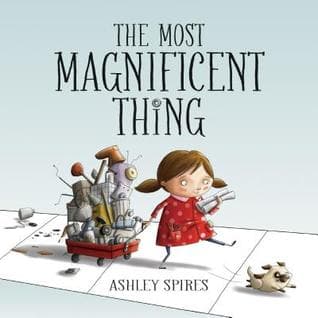
The Most Magnificent Thing Plot Summary
Covers the whole plot, including the ending.
A Magnificent Idea Takes Root
A young, unnamed girl, accompanied by her loyal dog, has a brilliant idea: she is going to make the most magnificent thing. She envisions it perfectly in her mind, knowing exactly how it will look and how it will function. She's confident in her abilities, as she makes things all the time, declaring it will be 'easy-peasy.' The girl and her dog set out to gather all the necessary materials, collecting various bits and pieces from around their home and yard, full of excitement and anticipation for the project ahead. Her initial enthusiasm is boundless, convinced that success is just around the corner.
The First Attempt and Mounting Frustration
With all her materials laid out, the girl begins to work. She tinkers and hammers and measures, she smoothes and wrenches and fiddles, she twists and tweaks and fastens. She works diligently, following her vision. However, when she's finished, the result is not at all magnificent. In fact, it's 'all wrong.' She tries to fix it, pulling and pushing, bending and pounding, but it only gets worse. The girl is disappointed but not defeated, deciding to scrap her first attempt and start over, still determined to create her perfect invention.
Repeated Failures and Growing Anger
The girl makes another magnificent thing, and it's also 'all wrong.' She tries again, and again, and again. Each new creation fails to meet her expectations, looking nothing like the perfect image in her head. Her initial confidence begins to wane as a pile of 'wrong' things accumulates around her. The dog tries to offer support, wagging his tail and making encouraging noises, but the girl is too absorbed in her mounting frustration to notice. With each failed attempt, her mood darkens, and her determination starts to curdle into annoyance.
The Breaking Point: Rage and Quitting
The girl's frustration finally boils over into intense anger. Her teeth are clenched, her eyes are narrowed, and she lets out a big, loud growl. She kicks her creation, sending pieces flying. She slams her tools down. She is so mad that she quits. She declares she is done with the magnificent thing, proclaiming she will never make another one again. The dog looks on, concerned by her outburst, as the girl throws herself onto the ground, utterly defeated and furious with her inability to achieve her vision.
A Calming Walk and a Change of Perspective
Seeing her distress, the girl's dog nudges her gently, then whimpers and gives her a sad look. He suggests a walk, and though initially resistant, the girl agrees. They walk past various sights—a squirrel, a puddle, a rock. The fresh air and change of scenery slowly begin to soothe her anger. As they walk, the girl's mind starts to clear. She isn't thinking about her project, but rather enjoying the simple act of walking with her friend, which allows her intense emotions to subside and her mind to relax.
A New View of the 'Wrong' Things
When they return home, the girl sees all her 'wrong' things piled up. But this time, she looks at them differently. She notices the good parts of each failed attempt: the way one piece connects, the interesting curve of another, the sturdy frame of a third. She realizes that even in her failures, there were elements of ingenuity and potential. This new perspective reignites a spark of inspiration within her, and she begins to see how she can combine the 'good parts' to create something truly magnificent.
The Final, Magnificent Creation
With renewed energy and a clear vision, the girl gets back to work. She takes the good parts from all her 'wrong' things and carefully reassembles them. She tinkers and hammers and measures, she smoothes and wrenches and fiddles, she twists and tweaks and fastens, but this time with a focused determination that wasn't there before. She works meticulously, applying the lessons learned from her previous failures, her dog watching patiently beside her. This time, her efforts are guided by experience and a calmer, more reflective approach.
Joy and Unveiling
Finally, the magnificent thing is complete. It is exactly how she imagined it, but even better, because it incorporates the wisdom gained from all her struggles. The girl is beaming with pride and excitement. She calls her dog over, eager to show him her masterpiece. The dog, equally excited, wags his tail furiously. The magnificent thing is revealed to be a contraption with wheels, a seat, and various levers—a unique and wonderful invention, perfectly suited for her and her best friend.
The Magnificent Ride
The girl and her dog climb into the magnificent thing. She pushes a button, pulls a lever, and they set off on a joyful ride. The magnificent thing works perfectly, carrying them smoothly and swiftly. They ride around, experiencing the thrill of their shared creation. The journey symbolizes not just the success of the invention, but also the triumph of perseverance, the value of learning from mistakes, and the joy of shared experience. It shows her creativity and resilience, proving that even after many failures, a magnificent outcome is possible.
The Most Magnificent Thing Characters
The Girl
Protagonist
A determined young inventor who learns the value of perseverance and managing frustration.
The unnamed protagonist is a creative and confident young girl who loves to make things. Initially, she is full of enthusiasm and believes making her 'magnificent thing' will be 'easy-peasy.' However, as she faces repeated failures, she experiences intense frustration and anger, culminating in her wanting to quit. Her journey is defined by her learning to cope with these negative emotions, take a break, and then approach her problem with a fresh perspective. She ultimately demonstrates resilience and the ability to learn from her mistakes, leading to her successful invention.
Relationships: The Dog (Best friend and supportive companion)
The Dog
Supporting
The girl's loyal and patient best friend, offering silent support and encouragement.
The girl's dog is her constant companion and silent supporter throughout her creative endeavor. He is always by her side, observing her process, her triumphs, and her frustrations. He doesn't speak, but his actions—nudging her, whimpering, offering a sad look, and suggesting a walk—are crucial in helping the girl overcome her anger and find a new perspective. He represents unwavering friendship and the calming presence needed during moments of intense emotion. His patience contrasts with the girl's initial impulsiveness.
Relationships: The Girl (Best friend and owner)
The Most Magnificent Thing Themes
Perseverance and Resilience
The main theme is the importance of not giving up, even after repeated failures. The girl tries multiple times to build her magnificent thing, each attempt resulting in disappointment. Her journey shows that success often comes after many setbacks and that resilience is key to achieving goals. The story shows that the 'magnificent thing' isn't just the final invention, but also the girl's ability to keep trying.
“She tries again. And again. And again. And again.”
Managing Frustration and Anger
The book clearly shows the girl's escalating frustration and eventual explosive anger when her project doesn't go as planned. It normalizes these strong emotions but also demonstrates a healthy way to cope: taking a break. The dog's gentle suggestion for a walk allows the girl to cool down and gain a new perspective, showing children that it's okay to feel angry, but it's important to find constructive ways to deal with it.
“The girl is so mad she quits.”
The Value of Mistakes and Learning
Initially, the girl sees her failed creations as 'all wrong.' However, after her walk, she looks at them with fresh eyes and realizes that even the 'wrong' things contain 'good parts.' This theme emphasizes that mistakes are not failures but chances for learning and improvement. Her final magnificent thing is a culmination of lessons learned from her previous attempts, illustrating that the process of trial and error is essential for innovation and growth.
“Then she looks at the parts she likes, and she pulls them out.”
Creativity and Imagination
From the very beginning, the girl's desire to make a 'magnificent thing' is driven by her imagination. She has a clear vision in her mind, and her creative process involves gathering materials, experimenting, and problem-solving. The story celebrates the joy of creating and inventing, encouraging young readers to explore their own ideas and build things, even if the path to completion is challenging.
“She knows just how it will look. She knows just how it will work. All she has to do is make it, and she makes things all the time.”
Plot Devices & Literary Techniques
Repetition of Actions
Emphasizes the girl's persistent effort and the iterative nature of creation.
The repeated phrases describing the girl's actions, such as 'she tinkers and hammers and measures, she smoothes and wrenches and fiddles, she twists and tweaks and fastens,' highlight her dedication and the physical process of making. This repetition underscores the effort involved in creation and is used both in her initial attempts and her final successful build, showing consistency in her work ethic despite varying outcomes. It also helps build a sense of rhythm and immersion for the reader.
Visual Contrast (Color and Expression)
Illustrates the girl's emotional state throughout her creative process.
The illustrations effectively use color and the girl's facial expressions to convey her emotions. Her initial scenes are bright and full of enthusiasm, while her moments of frustration and anger are depicted with darker, more chaotic imagery, sharp angles, and her red, scowling face. The calming walk features softer colors and more serene expressions, leading to a return of bright, joyful colors upon her success. This visual storytelling enhances the emotional arc of the narrative without relying solely on text.
The 'Wrong' Things Pile
A physical manifestation of failure that transforms into a source of inspiration.
The growing pile of discarded, 'wrong' inventions serves as a tangible representation of the girl's repeated failures and mounting frustration. Initially, it symbolizes defeat. However, after her walk, this same pile becomes a crucial plot device, as she re-examines it and discovers 'good parts' within her past mistakes. This transformation of the pile from a symbol of failure to a resource for success underscores the theme of learning from one's errors and finding value in imperfect attempts.
The Dog as a Silent Catalyst
A non-verbal character whose actions drive the emotional turning point.
The dog, despite not speaking, plays a pivotal role in the plot's turning point. His quiet presence, gentle nudges, and 'suggestion' for a walk are what break the girl out of her cycle of anger and frustration. He doesn't offer advice but provides the space and encouragement for her to process her emotions and gain a new perspective. He acts as a calming influence and a symbol of unconditional support, demonstrating that sometimes, the best help is simply a kind presence and a change of environment.
The Most Magnificent Thing Quotes
“She is going to make the most MAGNIFICENT thing!”
“It is not her magnificent thing. Not even close.”
“She gets mad. REALLY, REALLY MAD.”
“She smashes, pummels, and explodes it.”
“Her assistant suggests a long walk, and the girl is too mad to argue.”
“After her walk, she sees her earlier attempts with fresh eyes.”
“She realizes that some parts are wrong, but others are right.”
“She tinkers, hammers, and measures again.”
“It isn't perfect, but it is just right.”
“She makes things, and she makes things again.”
“The girl and her assistant go for another walk, just because.”
“A regular girl and her best friend in the whole wide world.”
Quiz
10 questions on the plot and the characters. Each answer comes with a short explanation.
Question 1
What is the main character's wonderful idea at the beginning of the book?
- To build a treehouse for her dog
- To make the most magnificent thing
- To paint a beautiful picture
- To bake a special cake
Show answer
B. To make the most magnificent thing The story begins with the girl having a wonderful idea to create 'the most MAGNIFICENT thing,' which sets the entire plot in motion as she attempts to bring her vision to life.
Question 2
Who is the girl's very best friend in the story?
- A cat
- A robot
- A dog
- A sibling
Show answer
C. A dog The book explicitly states that the girl's very best friend is a dog, who accompanies her throughout her creative process and helps her when she gets frustrated.
Question 3
What does the girl do when she gets really mad about her failed attempts?
- She throws her tools away
- She asks for help from an adult
- She quits the project
- She starts a different project
Show answer
C. She quits the project After repeated failures, the girl becomes so frustrated and angry that she decides to quit making her magnificent thing entirely, which is a key turning point in the story.
Question 4
How does the girl's dog help her when she quits the project?
- By fetching her tools
- By barking to get her attention
- By convincing her to take a walk
- By showing her a different idea
Show answer
C. By convincing her to take a walk The dog encourages the girl to take a walk, which allows her to calm down, gain perspective, and return to her project with renewed enthusiasm.
Question 5
Which of these groups of verbs is used in the book to describe how the girl works on her project?
- She runs, jumps, and plays
- She tinkers, hammers, and measures
- She sings, dances, and laughs
- She reads, writes, and draws
Show answer
B. She tinkers, hammers, and measures The book uses precise action verbs in groups of threes, such as 'tinkers and hammers and measures,' to vividly depict the girl's creative process and enrich vocabulary.
Question 6
What is the main theme of 'The Most Magnificent Thing'?
- The importance of friendship
- The rewards of perseverance and creativity
- The dangers of anger
- The joy of playing with pets
Show answer
B. The rewards of perseverance and creativity The story centers on the girl's journey through frustration and failure to ultimately succeed, highlighting themes of perseverance, creativity, and learning from mistakes.
Question 7
After taking a walk, how does the girl feel about her project?
- More confused than before
- Renewed enthusiasm
- Completely disinterested
- Angry again
Show answer
B. Renewed enthusiasm The walk helps the girl calm down and gain a fresh perspective, leading her to return to her project with renewed enthusiasm and eventually get it just right.
Question 8
What educational areas does this book tie into, as mentioned in the description?
- Art and Music
- Science, Technology, Engineering, and Math (STEM)
- History and Geography
- Language and Literature only
Show answer
B. Science, Technology, Engineering, and Math (STEM) The book's focus on creation, precise action verbs, and problem-solving makes it a great tie-in for learning about STEM concepts, encouraging young readers to explore invention and engineering.
Question 9
How does the book depict the girl's frustration and anger?
- Through detailed art and honest storytelling
- By having other characters criticize her
- Through musical elements in the text
- By avoiding negative emotions entirely
Show answer
A. Through detailed art and honest storytelling The story uses vivid illustrations and straightforward narrative to honestly portray the girl's frustration and anger, offering children a relatable way to discuss and manage these feelings.
Question 10
What is the outcome of the girl's project by the end of the book?
- She gives up and never finishes it
- She manages to get it just right
- Her dog finishes it for her
- It turns out differently than she imagined
Show answer
B. She manages to get it just right After persevering through frustration and taking a break, the girl successfully creates her magnificent thing, achieving her initial goal and demonstrating the value of persistence.
The Most Magnificent Thing FAQ
What is 'The Most Magnificent Thing' about?
The book follows an unnamed girl and her dog as she attempts to create 'the most magnificent thing'—an invention she envisions perfectly. Despite repeated failures that lead to frustration and anger, she perseveres with her dog's encouragement, ultimately succeeding through creativity and resilience.
Why should I read 'The Most Magnificent Thing'?
It's an award-winning picture book that humorously and vividly teaches children about perseverance, managing emotions like frustration, and the value of creativity. The detailed illustrations and precise action verbs make it engaging for early learners, tying into STEM concepts and character education.
What is the background/setting of 'The Most Magnificent Thing'?
The story is set in a simple, everyday urban or suburban environment where the girl works on her project, likely in a workshop or backyard. The setting emphasizes the ordinary context of her creative struggle, making it relatable to young readers.
What are the most memorable quotes?
Key quotes include the girl's realization that 'she knows just how it will look' and 'she knows just how it will work,' highlighting her initial confidence. The repetitive action verbs like 'she tinkers and hammers and measures' are also memorable for their rhythmic and descriptive quality.
What writing style does the author use?
Ashley Spires uses a concise, rhythmic style with groups of three verbs (e.g., 'tinkers and hammers and measures') to depict action vividly. The narrative is straightforward yet emotionally resonant, blending humor with honest portrayals of frustration to engage young readers.
What minor details add significant meaning?
The dog's silent but persistent presence as the girl's best friend subtly underscores themes of loyalty and support. Small visual cues in the illustrations, like the girl's changing facial expressions, amplify her emotional journey from excitement to anger to satisfaction.
What are some subtle foreshadowing moments?
Early phrases like 'easy-peasy!' ironically foreshadow the upcoming challenges. The dog's calm demeanor throughout hints at its role in helping the girl regain composure later, suggesting that support is key to overcoming obstacles.
What unexpected character connections exist?
The girl and her dog share a deep, unspoken bond where the dog acts as both a companion and a catalyst for her emotional recovery. Their relationship evolves from simple friendship to a dynamic where the dog actively encourages her perseverance.
What are unspoken character motivations?
The girl is driven by a desire to bring her creative vision to life, motivated by intrinsic curiosity and pride. Her dog is motivated by loyalty and a subtle understanding of her needs, prompting the walk that helps her reset emotionally.
What psychological complexities do characters exhibit?
The girl shows a range of emotions, from initial confidence to intense frustration and eventual resilience, reflecting real childhood struggles with perfectionism. The dog exhibits emotional intelligence by sensing her anger and guiding her toward a calming activity.
What are the major emotional turning points?
Key moments include the girl's first failure, which sparks frustration; her peak anger leading to quitting; the walk with her dog that provides emotional relief; and her return to the project with renewed enthusiasm, culminating in success.
How do relationship dynamics evolve?
Initially, the girl and dog are playful companions, but as she struggles, the dog becomes a supportive figure who nudges her toward self-regulation. Their dynamic shifts from casual to interdependent, highlighting how relationships aid in personal growth.
Which parts remain ambiguous or open-ended?
The exact nature of 'the most magnificent thing' is never specified, leaving it open to interpretation by readers. The girl's thought process during the walk is also ambiguous, allowing children to infer how she regains perspective.
What are controversial scenes or decisions?
Some might debate the girl's decision to quit in anger, viewing it as a negative example, but it's portrayed honestly as part of the emotional learning process. Her frustration is vividly depicted, which could be intense for very young readers but serves a teaching purpose.
'The Most Magnificent Thing' ending explained: how it ends & what it means
The story ends with the girl successfully creating her magnificent thing after taking a break and returning with fresh eyes. This emphasizes themes of perseverance, the importance of managing emotions, and the idea that mistakes are part of the creative process, offering a reassuring message for children.
Similar books
- The Dot
Peter Reynolds
4.3 (35k) average on Goodreads"The Dot" focuses on overcoming initial self-doubt and the fear of starting to create, encouraging children to 'make a mark.' "The Most Magnificent Thing" goes further, exploring the sustained effort, frustration, and iterative process after the initial creative impulse, making it a valuable complement for teaching perseverance beyond the first step.
- Harry Potter and the Sorcerer's Stone
J.K. Rowling
4.5 (7M) average on GoodreadsFantasyRescued from a miserable life under the stairs, an orphaned boy discovers he's a wizard destined for a magical school, where he uncovers a dangerous secret tied to the dark wizard who murdered his parents.
- The Hobbit, or There and Back Again
J.R.R. Tolkien
4.3 (2.9M) average on GoodreadsFantasyA comfort-loving hobbit named Bilbo Baggins is whisked away by a mischievous wizard and a band of dwarves on an unexpected journey to reclaim stolen treasure from a fearsome dragon, discovering courage and a magical ring along the way.
- Harry Potter and the Goblet of Fire
J.K. Rowling
4.6 (2.6M) average on GoodreadsFantasyA bewildered Harry Potter, underage and thrust into a deadly Triwizard Tournament, must brave dragons, mermaids, and a resurgent dark magic to survive a year that will forever alter the wizarding world.
- Harry Potter and the Order of the Phoenix
J.K. Rowling
4.5 (2.5M) average on GoodreadsFantasyIn a year of oppressive secrets and the threat of Voldemort, Harry Potter and Dumbledore's Army secretly train for war, shown through Jim Kay and Neil Packer's dark illustrations.
- The Lightning Thief
Rick Riordan
4.3 (2M) average on GoodreadsFantasyThrust into a world of mythological monsters and divine treachery, an ordinary boy discovers he's the son of Poseidon and must embark on a perilous quest across modern America to prevent an Olympian war.





Enjoyed the summary?
A summary gives you the shape of the book. The book itself has the detail, the examples and the voice.
Find The Most Magnificent Thing on AmazonAs an Amazon Associate, BookBrief earns from qualifying purchases. How we're funded