
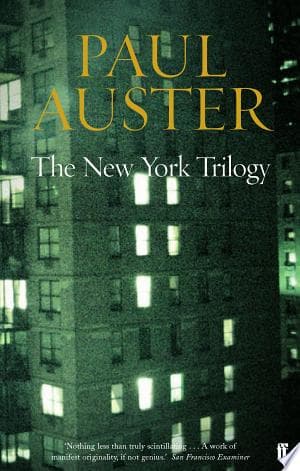
Synopsis
Covers the whole plot, including the ending.
- Difficulty
- Medium
- Pacing
- Moderate
- Mood
- Atmospheric, Philosophical, Unsettling, Introspective, Melancholy
- Read it if
- You enjoy philosophical mysteries, existentialist themes, and a deep exploration of identity, authorship, and the nature of reality. Perfect for fans of meta-fiction and unreliable narrators.
- Skip it if
- You prefer straightforward plots, clear resolutions, and traditional detective stories without philosophical ambiguity or a deconstruction of genre.
The New York Trilogy Plot Summary
Covers the whole plot, including the ending.
City of Glass: Daniel Quinn Becomes Paul Auster
Daniel Quinn, an author of detective novels writing as William Wilson, gets phone calls meant for a private detective named Paul Auster. Quinn first ignores them, but then pretends to be Auster. Virginia Stillman hires him because she fears her husband, Peter Stillman, will harm their son, Peter Stillman Jr., after his release from prison. Peter Stillman Sr. had kept his son in a dark room for nine years as a language experiment, hoping to find the 'language of God.' Quinn, curious about the idea, takes the case, entering a stranger reality than his books.
City of Glass: The Watcher and the Watched
Quinn starts following Peter Stillman Sr. after he leaves prison. Stillman Sr. takes what seem like random, planned walks around New York City, carefully marking his paths with chalk. Quinn records these movements, trying to understand their meaning. He believes they contain a hidden language or code related to Stillman's language experiment. Quinn moves into an apartment across the street from Stillman, focusing completely on watching him. The lines between detective and target, and watcher and watched, start to blur as Quinn's identity becomes tied to his subject. He even tries to befriend Stillman, pretending to be a fellow language scholar.
City of Glass: The Disappearance and Quinn's Descent
After several weeks of watching, Peter Stillman Sr. disappears. Quinn, having put everything into the case, has no target or clear goal. He stays in Stillman's apartment, continuing his watch, even after his rent money runs out. His connection to Virginia and Peter Stillman Jr. also fades. Quinn's body and mind worsen; he stops eating, his clothes become dirty, and he starts writing his observations in a red notebook. His identity as Daniel Quinn, William Wilson, and Paul Auster breaks apart. He becomes an empty person, lost in the city's anonymity. The story ends when a friend of the real Paul Auster finds Quinn's red notebook.
Ghosts: Blue's Assignment to Watch Black
The second novella introduces Blue, a young private detective working for White. Blue gets an unusual job: to watch a man named Black, who lives in an apartment across the street from Blue. Blue is told not to talk to Black, only to observe his daily routines and record them in a notebook, which he must send to White every Sunday. The job has no clear end date or goal beyond observation. Blue commits to the task, carefully writing down Black's everyday activities, mainly reading, writing, and looking out the window. The story is clearly a detective story, with characters named after colors.
Ghosts: The Cycle of Observation and Identity
As months turn into years, Blue's life is taken over by watching Black. He notices similarities between their lives: Black reads the same books, does similar things, and even seems to know what Blue will observe. Blue's own identity begins to disappear into his role as watcher. He questions the job's purpose, suspecting White might be controlling him or that Black knows he is there. He tries to find clues in Black's ordinary life, which leads to dead ends and more frustration. The isolation and the endless, unrewarding task affect Blue's mind, blurring the line between his reality and Black's.
Ghosts: Confrontation and Disappearance
Feeling desperate and that his efforts are useless, Blue decides to break his rules and confront Black. He enters Black's apartment and finds Black writing. Black, seemingly not surprised, has a short, unclear conversation with Blue, suggesting their roles are cyclical. In frustration, Blue attacks Black, knocking him out. He then takes Black's clothes and leaves the apartment, essentially becoming Black. Blue continues to send reports to White, now from Black's perspective. Eventually, White sends a last letter, ending the assignment and telling Blue to disappear. This leaves Blue without identity or purpose.
The Locked Room: Fanshawe's Disappearance and the Narrator's Task
The third novella, told by an unnamed writer, begins with his childhood friend, Fanshawe, disappearing. Fanshawe's wife, Sophie, tells the narrator that Fanshawe left many unpublished writings and made the narrator his literary executor. The narrator, who always felt less talented than Fanshawe, must read, edit, and possibly publish these manuscripts. This job makes him explore Fanshawe's inner world, which he always found mysterious, and face his mixed feelings of admiration and anger toward his friend.
The Locked Room: The Narrator's Impersonation and Obsession
The narrator finds Fanshawe's work brilliant, confirming his friend's talent. He publishes the works, which receive good reviews. Over time, the narrator's connection to Sophie grows, and they marry. He steps into Fanshawe's former life, raising Fanshawe's child (Sophie's son, adopted by Fanshawe). The narrator becomes more and more obsessed with Fanshawe's disappearance, believing his friend is still alive and hiding on purpose. He starts searching for Fanshawe, driven by a need to understand his friend's reasons and to find his own identity again.
The Locked Room: The Pursuit and the Unmasking
The narrator's search for Fanshawe leads him across Europe, following unclear clues. He meets various people who knew Fanshawe, each giving a different view of the elusive man. The search becomes a crisis for the narrator, as his own identity becomes more and more tied to Fanshawe's. He eventually finds Fanshawe in a remote, almost empty place. Fanshawe, now a shadow of himself, says he faked his death to escape his life and writing goals. He gives the narrator a final, locked red notebook, telling him not to open it. The narrator, respecting Fanshawe's wish for privacy, returns to his life. He is changed by the meeting and the weight of Fanshawe's secret.
The Locked Room: The Unopened Book and Lingering Questions
The narrator returns to New York, having kept his promise to Fanshawe. He continues to live with Sophie and the child, but meeting Fanshawe has changed his view of reality and himself. He holds the locked red notebook, the last part of Fanshawe's legacy, but chooses not to open it. He respects Fanshawe's desire for privacy and the mystery around his life. The story ends with the narrator thinking about identity, authorship, and the unclear nature of truth. This leaves the reader wondering what secrets the locked room—the notebook and Fanshawe's mind—might hold. The narrator states he is the 'real' Paul Auster, blurring the lines even more.
Principal Figures
Daniel Quinn
Protagonist
Reclusive mystery writer who impersonates a detective.
Quinn is a lonely and disillusioned writer of detective novels under the pseudonym William Wilson. His life is mundane until a series of mistaken phone calls plunges him into a bizarre case. He is an intellectual, drawn to philosophical puzzles and the intricacies of language. His journey in 'City of Glass' is one of increasing detachment from reality and a gradual dissolution of his own identity, as he becomes consumed by his role as an ersatz detective and then an observer of nothing. He is driven by a profound curiosity and a need for meaning, which ultimately leads to his undoing.
Relationships: Virginia Stillman (Client who hires him); Peter Stillman Sr. (His surveillance target); Paul Auster (the writer) (The person he impersonates and who later finds his notebook)
Peter Stillman Sr.
Antagonist/Mystery Figure
Linguist who imprisoned his son and becomes Quinn's surveillance target.
Stillman Sr. is a former professor of linguistics who, in a twisted experiment, imprisoned his son in a dark room for nine years, believing he could discover the 'language of God.' Upon his release from prison, he engages in cryptic, seemingly random walks through New York City, drawing maps with chalk. He is a profoundly disturbed intellectual, obsessed with the breakdown and re-creation of language. His actions are both horrifying and strangely philosophical, serving as a catalyst for Quinn's descent into existential confusion. He represents the potential for human intellect to stray into madness.
Relationships: Virginia Stillman (Estranged wife); Peter Stillman Jr. (Son, victim of his experiment); Daniel Quinn (His unwitting observer)
Virginia Stillman
Supporting
Woman who hires 'Paul Auster' to protect her son.
Virginia Stillman is the wife of Peter Stillman Sr. and the mother of Peter Stillman Jr. She approaches Quinn (believing him to be Paul Auster, the detective) out of fear for her son's safety after her husband's release from prison. She is a figure of quiet desperation and concern, trapped by the traumatic legacy of her husband's actions. Her initial plea for help sets the entire plot of 'City of Glass' in motion, but she gradually fades from Quinn's narrative as his obsession with Stillman Sr. takes over.
Relationships: Peter Stillman Sr. (Estranged husband); Peter Stillman Jr. (Son); Daniel Quinn (Her hired detective)
Blue
Protagonist
Private detective hired to perpetually observe a man named Black.
Blue is the central character of 'Ghosts,' a young, relatively inexperienced private detective working for White. He is assigned the task of continuously observing Black, a seemingly mundane man. Blue is initially diligent and committed to his work, meticulously recording Black's activities. However, the prolonged, purposeless nature of his surveillance gradually erodes his sense of self and purpose. He becomes increasingly isolated and introspective, questioning the meaning of his existence and the nature of his assignment. His character embodies the themes of surveillance, identity, and the existential void.
Relationships: White (His employer); Black (His surveillance target); Brown (His predecessor on the case)
Black
Mystery Figure/Antagonist
The enigmatic man observed by Blue in 'Ghosts'.
Black is the subject of Blue's surveillance in 'Ghosts.' He lives a seemingly unremarkable life, spending his days reading, writing, and staring out his window. He appears to be aware of Blue's presence, subtly mimicking Blue's actions or anticipating his observations. Black is a mirror image, a doppelgänger figure for Blue, symbolizing the interchangeability of identities and the cyclical nature of observation. His mysterious past and the ambiguity of his actions drive Blue's descent into confusion and despair. He represents the ultimate 'locked room' that Blue cannot penetrate.
Relationships: Blue (His observer); White (His employer (implied))
White
Supporting
Blue's employer, who gives him the enigmatic assignment.
White is the head of the detective agency in 'Ghosts' and Blue's employer. He assigns Blue the task of observing Black, providing vague instructions and an open-ended timeline. White remains a distant, almost omniscient figure, communicating primarily through letters. His motivations are never fully revealed, adding to the novella's atmosphere of mystery and existential uncertainty. He represents the unseen authority, the puppeteer who orchestrates the lives of Blue and Black, embodying themes of control and manipulation.
Relationships: Blue (His employee); Black (The target of his surveillance)
The Narrator (of 'The Locked Room')
Protagonist
Writer who becomes the literary executor and eventually the replacement for his missing friend, Fanshawe.
The unnamed narrator of 'The Locked Room' is a writer who has always felt overshadowed by his childhood friend, Fanshawe. He is intelligent and reflective, but lacks the raw, intuitive brilliance he attributes to Fanshawe. When Fanshawe disappears, the narrator is tasked with managing his literary legacy, a role that gradually leads him to inhabit Fanshawe's life, marrying his wife and raising his son. He is driven by a complex mix of admiration, envy, and a deep need to understand Fanshawe, which culminates in a desperate search for his friend and a confrontation with his own identity.
Relationships: Fanshawe (Childhood friend, literary rival, and subject of his obsession); Sophie (Fanshawe's wife, later the narrator's wife)
Fanshawe
Mystery Figure/Supporting
The brilliant, enigmatic childhood friend who disappears, leaving behind a literary legacy.
Fanshawe is the central enigma of 'The Locked Room.' He is depicted as a charismatic, brilliant, and deeply private individual, a true artist whose talent the narrator both admires and resents. His sudden disappearance leaves behind a vast body of unpublished work and a profound mystery. Fanshawe represents the elusive nature of genius and identity, as well as the desire to escape one's predetermined role. His decision to vanish and his eventual reappearance challenge the narrator's understanding of self, authorship, and the very concept of existence.
Relationships: The Narrator (Childhood friend and eventual literary executor/impersonator); Sophie (His wife)
Sophie
Supporting
Fanshawe's wife, who later marries the narrator.
Sophie is Fanshawe's wife, who contacts the narrator after her husband's disappearance, entrusting him with Fanshawe's manuscripts. She is a pragmatic and grounded character, providing a sense of stability amidst the narrator's existential crisis. Her decision to marry the narrator and build a new life with him further blurs the lines between the narrator's and Fanshawe's identities. She represents continuity and a longing for normalcy in the face of profound loss and mystery, providing a domestic anchor for the narrator's increasingly abstract quest.
Relationships: Fanshawe (Her missing husband); The Narrator (Her second husband)
Paul Auster (as a character in 'City of Glass')
Mentioned/Supporting
The real detective Daniel Quinn impersonates.
In 'City of Glass,' Paul Auster is initially the name of the private detective whom Daniel Quinn is mistaken for. Later, the real Paul Auster (the author, or a character representing him) appears in the narrative, interviewed by Quinn, providing a meta-fictional layer. This character functions as a symbolic figure, representing the author's insertion into his own fiction and further blurring the lines between reality and narrative. He is a calm, composed individual, a writer, who offers Quinn no easy answers, reinforcing the novel's themes of identity and authorship.
Relationships: Daniel Quinn (The person who impersonates him and later interviews him)
Themes & Insights
Identity and Self-Discovery
The trilogy explores how identity changes and how fragile it is. Characters often take on new names, roles, or lives, which makes them question who they are. Daniel Quinn becomes 'Paul Auster,' then a nameless watcher; Blue's identity mixes with Black's; and the narrator of 'The Locked Room' essentially becomes Fanshawe. This theme shows how external roles and relationships can shape and eventually erase one's sense of self. It suggests that identity is not fixed but always changing, often defined by how others see us or the roles we must play.
“He had entered the world of his own book, and there was no way out.”
Language and Meaning
Language is a main focus, especially in 'City of Glass' with Peter Stillman Sr.'s language experiment. The characters often struggle to find meaning in words, or they believe language can be broken down and rebuilt to show deeper truths. Stillman's attempt to find the 'language of God' and Quinn's efforts to understand Stillman's walks are examples. The failure to find clear meaning through language causes frustration and a sense of hopelessness. This suggests that language, while a way to communicate, can also cause deep misunderstanding and isolation, trapping characters in their own interpretations.
“Words are not a means to an end. They are the end. The only end.”
Surveillance and Observation
Watching and being watched is a repeated idea in all three novellas. Quinn following Stillman, Blue constantly watching Black, and the narrator investigating Fanshawe's life all show the power dynamics and psychological effects of surveillance. This theme explores how watching can lead to obsession, paranoia, and the loss of the watcher's own identity. It also asks questions about knowledge and whether true understanding can come only from external observation. It suggests that watching often reveals more about the watcher than the watched.
“The detective is the one who looks, who listens, who moves through this morass of objects and events in search of the discovery that will give his life meaning.”
Authorship and Narrative Control
The trilogy often blurs the lines between author, narrator, and character. This creates a commentary on storytelling itself. Paul Auster appears as a character, the narrator of 'The Locked Room' is a writer, and the stories are framed as detective fiction. All these things add to this theme. It asks who controls the story, whether characters are just puppets of their authors, and how stories build reality. This self-referential quality invites readers to think about their own role in understanding the text and how arbitrary story beginnings and endings are.
“I'm not Paul Auster. He's the one who writes the books. I'm just the one who lives here.”
Solitude and Alienation
Many characters in the trilogy are isolated and alone, both from society and from themselves. Quinn's secluded life, Blue's solitary surveillance, and Fanshawe's deliberate disappearance all show this theme. New York City often acts as a setting for this isolation, a place where people can get lost and become anonymous. This theme shows the psychological toll of isolation, leading characters to obsessive behaviors, crises of existence, and a desperate search for connection or meaning in a world that does not care. Their attempts to connect often lead to more entanglement and loss of self.
“He was alone, and he was nothing. And that was the only truth he knew.”
Plot Devices & Literary Techniques
Metafiction
The author inserts himself as a character and comments on the nature of storytelling.
Auster frequently breaks the fourth wall and self-referentially comments on the act of writing and reading. In 'City of Glass,' Daniel Quinn impersonates a detective named 'Paul Auster,' and later, the real Paul Auster (the author) appears as a character in the story. In 'The Locked Room,' the narrator explicitly states he is 'Paul Auster.' This device blurs the lines between author, narrator, and character, making the reader acutely aware of the constructed nature of the narrative and questioning the authenticity of the 'story' being told.
Doppelgängers and Doubles
Characters mirror or replace each other, blurring identities.
The trilogy is replete with characters who serve as doubles for one another. Daniel Quinn becomes 'Paul Auster,' then an anonymous observer. Blue and Black in 'Ghosts' are mirror images, their lives intertwined and interchangeable. The narrator of 'The Locked Room' effectively replaces Fanshawe, marrying his wife and living his life. This device underscores the theme of fluid identity, suggesting that individuals are not unique but can be replaced or absorbed by others, and that identity is often a performance or a role, rather than an inherent quality.
The Unreliable Narrator
The perspective of the story is biased, fragmented, or potentially delusional.
Each novella is told from a subjective and often unstable point of view. Daniel Quinn's mental state deteriorates in 'City of Glass,' making his observations questionable. Blue's isolation and obsession in 'Ghosts' distort his perception of reality. The narrator of 'The Locked Room' admits his own biases and competitive feelings towards Fanshawe. This device forces the reader to constantly question the 'truth' of the narrative, highlighting the subjective nature of reality and emphasizing the difficulty of ever fully grasping another person's experience or even one's own.
Labyrinthine New York City
The city itself functions as a character and a metaphor for confusion and lostness.
New York City is more than just a setting; it is a character in itself, a vast, indifferent, and confusing labyrinth. Quinn's aimless wanderings, Stillman's cryptic chalk maps, and Blue's endless stakeout within its confines reflect the characters' internal states of confusion and alienation. The city's endless streets and anonymity mirror the characters' lost identities and their futile search for meaning. It acts as a physical manifestation of the psychological maze they navigate, a place where one can easily get lost, both literally and figuratively.
The Detective Story Structure (Deconstructed)
Using and subverting genre conventions to explore existential themes.
Auster employs the tropes of classic detective fiction—the private eye, the mysterious client, the perplexing case, the pursuit of clues—but deliberately subverts them. Instead of leading to a clear resolution, the investigations lead to greater ambiguity, existential crises, and the dissolution of the detective's identity. The 'clues' are often meaningless, the 'criminals' are elusive or non-existent, and the 'mystery' itself becomes a metaphor for the unknowable nature of existence. This device allows Auster to explore profound philosophical questions within a familiar, yet ultimately frustrated, narrative framework.
The New York Trilogy Quotes
“The world is in my head. My body is in the world.”
“The fact that he had no answers did not mean that the questions were not worth asking.”
“He had always imagined that the key to good detective work was a close observation of details.”
“The city was an inexhaustible space, a labyrinth of endless steps.”
“Every life is inexplicable, I kept telling myself, and no matter how many facts are told, no matter how many details are given, the essential thing resists telling.”
“To be inside and outside at the same time—that was the essence of the thing.”
“The story is not in the words; it's in the struggle.”
“He had become so immersed in the case that he had lost sight of why he had taken it on in the first place.”
“Nothing is real until it is written down.”
“The more he learned, the less he understood.”
“He was a man who had disappeared into his own life.”
“The truth is not in the open, but in the hidden.”
“To live is to be haunted.”
“He had entered a world where the rules no longer applied.”
Quiz
10 questions on the plot and the characters. Each answer comes with a short explanation.
Question 1
In 'City of Glass,' what is the protagonist Quinn's profession before he becomes involved in the Stillman case?
- A private detective
- A writer of detective novels under the pseudonym William Wilson
- A journalist for a New York newspaper
- A university professor of literature
Show answer
B. A writer of detective novels under the pseudonym William Wilson Quinn writes detective novels under the pseudonym William Wilson, which sets up the theme of identity confusion when he is mistaken for a real private detective named Paul Auster.
Question 2
What is the central task that Blue is assigned by White in 'Ghosts'?
- To investigate a murder in Brooklyn
- To follow and report on a man named Black
- To find a missing manuscript
- To protect a witness in a trial
Show answer
B. To follow and report on a man named Black Blue is hired by White to surveil Black, leading to a psychological exploration where Blue becomes obsessed and his identity merges with Black's.
Question 3
In 'The Locked Room,' what is the narrator's relationship to the missing writer Fanshawe?
- They are brothers
- They are childhood friends
- They are business partners
- They are strangers connected by a case
Show answer
B. They are childhood friends The narrator is Fanshawe's childhood friend, who is tasked with managing Fanshawe's literary estate after his disappearance, blurring lines between their identities.
Question 4
What philosophical concept is explored through Peter Stillman's experiments in 'City of Glass'?
- The theory of relativity
- The idea of a prelapsarian language
- Existential nihilism
- Utilitarianism
Show answer
B. The idea of a prelapsarian language Peter Stillman believes in a prelapsarian language from before the Fall of Man, which he tries to rediscover, reflecting the book's themes of language and meaning.
Question 5
How does 'Ghosts' end for Blue?
- He solves the case and returns to his normal life
- He realizes he is being watched by White and confronts him
- He becomes indistinguishable from Black and the narrative collapses
- He discovers Black is a fictional character
Show answer
C. He becomes indistinguishable from Black and the narrative collapses Blue's surveillance of Black leads to a breakdown where their identities merge, culminating in an ambiguous ending that questions reality and self.
Question 6
What role does the character Paul Auster play in 'City of Glass'?
- He is the author of the novel
- He is a real private detective whom Quinn is mistaken for
- He is Quinn's alias during the investigation
- He is a suspect in the Stillman case
Show answer
B. He is a real private detective whom Quinn is mistaken for Paul Auster appears as a character—a writer and private detective—whom Quinn contacts, adding metafictional layers by blurring the author's identity with the narrative.
Question 7
In 'The Locked Room,' what does the narrator find in Fanshawe's locked room?
- A treasure of gold and jewels
- Fanshawe's dead body
- A manuscript that reveals Fanshawe's true identity
- Nothing—it is empty
Show answer
D. Nothing—it is empty The locked room is empty, symbolizing the void at the heart of identity and the elusive nature of truth in the trilogy.
Question 8
Which literary technique is prominently used across The New York Trilogy to deconstruct detective fiction?
- Stream of consciousness
- Metafiction and self-reference
- Magical realism
- Epistolary form
Show answer
B. Metafiction and self-reference Auster uses metafiction, such as characters named after the author and self-referential plots, to subvert traditional detective tropes and explore existential questions.
Question 9
What is the significance of the color-coded names (Blue, White, Black) in 'Ghosts'?
- They represent political affiliations in New York
- They are codes for different detective agencies
- They symbolize the characters' moral alignments
- They reflect the abstract, interchangeable nature of identity
Show answer
D. They reflect the abstract, interchangeable nature of identity The color names strip characters of personal identity, emphasizing themes of anonymity and the fluidity of self in urban isolation.
Question 10
How does Quinn's investigation in 'City of Glass' ultimately conclude?
- He solves the case and exposes Stillman's crimes
- He is killed by Stillman in a confrontation
- He descends into madness and disappears, living as a vagrant
- He writes a successful novel about his experiences
Show answer
C. He descends into madness and disappears, living as a vagrant Quinn's obsession leads to his disintegration; he abandons his identity, ends up homeless, and the case remains unresolved, highlighting the trilogy's existential themes.
The New York Trilogy FAQ
What is 'The New York Trilogy' about?
The book comprises three interconnected novels—'City of Glass,' 'Ghosts,' and 'The Locked Room'—that follow protagonists who take on detective roles but become entangled in existential crises. In 'City of Glass,' Daniel Quinn investigates a man named Peter Stillman Jr., only to lose his own identity; in 'Ghosts,' Blue surveils Black and ends up questioning reality; and in 'The Locked Room,' the narrator searches for a missing friend, Fanshawe, confronting authorship and selfhood.
Why should I read 'The New York Trilogy'?
It blends detective fiction with philosophical depth, offering a gripping narrative that explores identity, language, and coincidence in a stark, urban setting. Readers interested in postmodern literature, existential themes, or innovative storytelling will find it transfixing, as it subverts genre conventions to probe what it means to be human.
What is the background/setting of 'The New York Trilogy'?
Set primarily in New York City during the late 20th century, the trilogy uses the city's anonymous, labyrinthine streets as a metaphor for existential isolation. The urban environment—with its apartments, parks, and crowded spaces—becomes a character itself, reflecting the protagonists' internal confusion and search for meaning.
What are the most memorable quotes?
Notable quotes include: 'The world is in my head. My body is in the world' from 'City of Glass,' highlighting the mind-body duality; and 'Every word was a mirror, and every mirror was a word' from 'Ghosts,' emphasizing the theme of language as reality. These lines encapsulate the book's focus on perception and identity.
What writing style does Paul Auster use?
Auster employs a sparse, precise prose style with a minimalist aesthetic, reminiscent of Raymond Chandler's detective fiction but infused with existential inquiry. The narrative is often metafictional, blurring lines between author, character, and reader, and uses repetition and coincidence to create a sense of uncanny reality.
What minor details add significant meaning?
In 'City of Glass,' the red notebook Quinn uses to document his investigation becomes a symbol of his fragmented identity, as his entries grow increasingly incoherent. In 'Ghosts,' the color-coded names (Blue, Black, White) subtly comment on identity as a constructed, arbitrary label, deepening the theme of existential ambiguity.
What are some subtle foreshadowing moments?
Early in 'City of Glass,' Quinn's mistaken identity as the detective Paul Auster foreshadows his eventual loss of self. In 'The Locked Room,' references to Fanshawe's unpublished manuscripts hint at the narrator's eventual appropriation of his friend's life, suggesting themes of authorship and erasure.
What unexpected character connections exist?
Characters across the trilogy share thematic links rather than direct plots: Quinn from 'City of Glass' and Blue from 'Ghosts' both experience surveillance leading to self-dissolution, while the narrator of 'The Locked Room' mirrors Fanshawe's isolation. These connections reinforce the idea of interchangeable identities in a chaotic universe.
What are unspoken character motivations?
Quinn in 'City of Glass' is driven by a subconscious desire to escape his grief over his family's death, using the detective role as a distraction. In 'The Locked Room,' the narrator's search for Fanshawe masks an envy and need to assert his own identity, revealing hidden insecurities about creativity and success.
What psychological complexities do characters exhibit?
Characters often grapple with paranoia and dissociation: Blue in 'Ghosts' becomes obsessed with Black, leading to a breakdown where he questions his own existence. Quinn experiences a schism between his writer persona and detective role, illustrating the psychological toll of living through fabricated identities.
What are the major emotional turning points?
In 'City of Glass,' Quinn's realization that he has become indistinguishable from the man he surveils, Peter Stillman Jr., marks a descent into madness. In 'The Locked Room,' the narrator's discovery of Fanshawe's body and manuscripts triggers a crisis of authorship, forcing him to confront his own emptiness and desire.
How do relationship dynamics evolve?
Relationships often devolve into mirroring or erasure: in 'Ghosts,' Blue's surveillance of Black turns into a symbiotic obsession where their identities blur. In 'The Locked Room,' the narrator's admiration for Fanshawe shifts to rivalry and eventual replacement, highlighting how connection can lead to existential theft.
Which parts remain ambiguous or open-ended?
The fate of Quinn at the end of 'City of Glass' is left unclear—whether he dies, disappears, or merges with his fiction. In 'The Locked Room,' the true nature of Fanshawe's disappearance and the narrator's reliability are ambiguous, inviting debate over reality versus narrative construction.
What are controversial scenes or decisions?
Quinn's decision to impersonate the detective Paul Auster in 'City of Glass' raises ethical questions about identity theft and authorship. In 'The Locked Room,' the narrator's choice to publish Fanshawe's work under his own name sparks controversy over artistic integrity and the morality of appropriating another's life.
'The New York Trilogy' ending explained: how it ends & what it means
The trilogy concludes with 'The Locked Room,' where the narrator assumes Fanshawe's life and work, suggesting that identity is a mutable, constructed narrative. The open-endedness implies that the search for meaning is endless, and reality is shaped by language and coincidence, leaving readers to ponder the nature of self and truth.
About the author

Paul Benjamin Auster is an American writer and film director. His notable works include The New York Trilogy (1987), Moon Palace (1989), The Music of Chance (1990), The Book of Illusions (2002), The Brooklyn Follies (2005), Invisible (2009), Sunset Park (2010), Winter Journal (2012), and 4 3 2 1 (2017). His books have been translated into more than forty languages.
Similar books
- The Name of the Rose
Umberto Eco
4.1 (301k) average on GoodreadsHistorical FictionCombines a detective plot with deep philosophical and semiotic inquiry.
- Ficciones
Jorge Luis Borges
4.4 (49k) average on GoodreadsFantasyExplores labyrinthine narratives, identity, and the nature of fiction itself.
- The Crying of Lot 49
Thomas Pynchon
3.7 (71k) average on GoodreadsLiterary FictionFeatures a protagonist unraveling a vast, potentially conspiratorial mystery that blurs reality.
- Invisible Cities
Italo Calvino
4.1 (62k) average on GoodreadsFantasyCalvino's work also deals with the nature of storytelling, urban landscapes, and the subjective experience of reality, presenting a series of fantastical cities described by Marco Polo to Kublai Khan. Like Auster, Calvino uses a minimalist yet poetic style and explores philosophical ideas through narrative. However, Invisible Cities is more overtly allegorical and fantastical, with its focus on the imaginative potential of language and memory, rather than the bleak, existential detective work and the blurring of authorial lines that define The New York Trilogy. Calvino's tone is often more whimsical and celebratory of imagination, while Auster's is more somber and interrogative of its limits.
- Angels & Demons
Dan Brown
3.9 (2.7M) average on GoodreadsThrillerA Harvard symbologist races through Rome's ancient sites, deciphering cryptic clues to unmask the Illuminati and stop a vengeful plot to destroy the Vatican with a stolen antimatter weapon.
- Gone Girl
Gillian Flynn
4.1 (2.3M) average on GoodreadsThrillerA wife's sudden disappearance on her fifth anniversary reveals a web of lies and psychological warfare, exposing the secrets within a seemingly perfect marriage.






Enjoyed the summary?
A summary gives you the shape of the book. The book itself has the detail, the examples and the voice.
Find The New York Trilogy on AmazonAs an Amazon Associate, BookBrief earns from qualifying purchases. How we're funded