
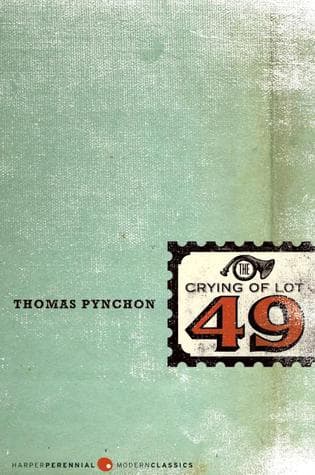
Synopsis
Covers the whole plot, including the ending.
- Difficulty
- Hard
- Pacing
- Variable
- Mood
- Surreal, Paranoiac, Satirical, Confusing, Intellectually Stimulating
- Read it if
- You enjoy complex, satirical, and intellectually challenging literary mysteries with a strong sense of paranoia and a non-linear narrative.
- Skip it if
- You prefer straightforward plots, clear resolutions, or realistic fiction without experimental elements.
The Crying of Lot 49 Plot Summary
Covers the whole plot, including the ending.
The Inheritance and the Journey
Oedipa Maas, a housewife in Kinneret, California, with her psychiatrist husband, Mucho, receives a letter. It says she is executrix of the estate of Pierce Inverarity, a wealthy real estate mogul and her former lover. This news immediately disrupts her mundane life. She decides to travel to San Narciso, a fictional Southern California city, to fulfill her duties. Upon arrival, she checks into a motel and begins to adapt to the strange new environment and the task ahead. This initial step pulls her from her domestic complacency into a world of unexpected complexities and ambiguous signals, setting the stage for her subsequent investigation.
Metzger and the Nefastis Machine
In San Narciso, Oedipa meets Metzger, a young, ambitious lawyer also involved with Inverarity's estate. Their first encounter leads to a brief sexual liaison. While at Metzger's apartment, Oedipa sees a movie on TV, 'Cashiered,' which features a character played by Ronald Reagan. More significantly, she encounters the Nefastis Machine, a device invented by John Nefastis. It supposedly operates on Maxwell's Demon principle, requiring a sentient being to observe it to decrease entropy. This machine introduces concepts of information theory and observation's role, themes that will echo throughout her journey.
The Tristero Symbol
While out with Metzger, Oedipa sees a bathroom wall with the symbol 'WASTE' followed by a muted post horn. Later, she finds the same post horn symbol in a men's restroom, written as 'Trystero.' This is her first direct encounter with what appears to be a secret, alternative postal system, or perhaps a complex prank. The symbol's appearance is unsettling, suggesting a hidden layer of communication operating beneath everyday life. This discovery sparks her curiosity and initial suspicion that something larger is at play than just random graffiti.
The Yoyodyne Tour
Oedipa visits Yoyodyne, a large defense contractor owned by Inverarity, to investigate its assets. During her tour, she meets Mike Fallopian, a member of the right-wing John Birch Society. Fallopian mentions the Tristero and its historical roots, claiming it was an underground postal service opposed to the Thurn and Taxis monopoly. He also hints at the organization's violent past and its continued, hidden existence. This encounter deepens Oedipa's understanding of the Tristero, providing historical context and suggesting its potential for widespread influence, further fueling her growing obsession.
The Inamorati Anonymous Meeting
Oedipa attends a meeting of Inamorati Anonymous, a support group for people who have fallen in love with their therapists. Here, she overhears a man named Stanley Koteks discussing a coded message on a toilet wall, which he identifies as a 'Trystero' communication. The message, seemingly innocuous, refers to a secret postal system. This incident reinforces the idea that the Tristero is not isolated but has infiltrated various aspects of society, even seemingly unrelated support groups. It further blurs the line between random coincidence and deliberate, organized communication, intensifying Oedipa's paranoia.
The San Narciso Oracle
Driven by her growing obsession, Oedipa visits Zapf's Used Books, seeking more information about the Tristero. She meets Emory Bortz, a professor researching a Jacobean revenge play, 'The Courier's Tragedy,' which contains references to the Trystero. Bortz explains the historical rivalry between the Trystero and the Thurn and Taxis postal system, detailing the Trystero's origins as a group of oppressed mail couriers. This visit provides Oedipa with significant historical and literary context, suggesting the Tristero's existence spans centuries and is embedded in cultural narratives, not just modern graffiti.
The Disappearance of Mucho
Back in Kinneret, Oedipa finds her husband, Mucho Maas, increasingly detached and changed by his experiments with LSD. He describes experiencing a complete dissolution of his ego and a profound, almost mystical, connection to all things. His professional life as a disc jockey is affected, and he becomes entirely absorbed in his altered state of consciousness. Mucho's transformation represents a different kind of escape from reality, one driven by drugs rather than conspiracy, and it leaves Oedipa feeling increasingly isolated and alone, as her primary support system disintegrates.
The Shadowy Figures
As Oedipa continues her investigation, she meets increasingly bizarre and shadowy figures who seem connected to the Tristero. These include a group of old men suffering from DTs, a Dr. Hilarius, and a number of seemingly ordinary individuals who use the secret postal system. Each encounter offers fragments of information, but no clear answers, leaving Oedipa to piece together a puzzle with missing pieces. The ambiguity of these interactions further blurs the line between reality and hallucination, making her question the true nature of the conspiracy.
The Final Clues and Isolation
Oedipa continues to find more evidence of the Tristero's widespread influence, from coded messages in trash cans to secret drop boxes. She learns of a 'dead letter' system and various forms of clandestine communication. However, as her understanding of the potential conspiracy grows, her personal connections diminish. Metzger disappears, Mucho is lost to drugs, and even Dr. Hilarius goes mad. Oedipa finds herself increasingly alone, with no one to confirm or deny her suspicions. The world around her seems to dissolve into a network of symbols and unanswered questions, leaving her on the brink of either a profound revelation or a complete breakdown.
The Crying of Lot 49
After gathering many clues, Oedipa learns that Pierce Inverarity's stamp collection, which might contain rare Tristero stamps, is to be auctioned as 'Lot 49.' She believes this auction will finally provide her with a definitive answer: either the Tristero is real, and the stamps will confirm its existence, or it is all an elaborate hoax, or perhaps a symptom of her own paranoia. The novel concludes with Oedipa sitting in the auction room, the lights dimming, awaiting the 'crying' of Lot 49. The ending is ambiguous, with no clear resolution, leaving the reader to ponder the reality of the Tristero and Oedipa's sanity.
Principal Figures
Oedipa Maas
Protagonist
A suburban housewife thrust into a perplexing conspiracy.
Oedipa Maas is initially a bored and somewhat complacent housewife living in Kinneret, California. Her life is upended when she is named executrix of her wealthy ex-lover Pierce Inverarity's estate. She is intelligent and observant but also prone to self-doubt and paranoia. Her journey is one of discovery, not just of the potential Tristero conspiracy, but also of her own capacity for investigation and her increasing isolation. She grapples with the reliability of her perceptions and the nature of reality itself.
Relationships: Pierce Inverarity (Deceased former lover and the catalyst for her journey.); Mucho Maas (Her husband, a disc jockey who succumbs to LSD-induced detachment.); Metzger (A young lawyer and temporary lover, involved with Inverarity's estate.)
Pierce Inverarity
Catalyst/Mentioned
Oedipa's deceased former lover and a wealthy, enigmatic real estate mogul.
Pierce Inverarity is the posthumous catalyst for Oedipa's journey. Though deceased, his presence permeates the novel through his vast estate and the complex web of businesses and eccentric individuals connected to him. He was a wealthy and influential real estate mogul, described as having a penchant for elaborate hoaxes and a somewhat sinister, all-encompassing control over various aspects of California life. His ambiguous nature – was he a genius, a prankster, or a figurehead for something larger? – contributes directly to the novel's central mystery.
Relationships: Oedipa Maas (Former lover and executrix of his estate.); Metzger (Lawyer for his estate.); Dr. Hilarius (His former psychiatrist.)
Mucho Maas
Supporting
Oedipa's husband, a disc jockey who undergoes a profound drug-induced transformation.
Mucho Maas is Oedipa's husband, a former used car salesman turned disc jockey. He is initially a relatively grounded, if somewhat anxious, individual. However, his increasing use of LSD leads to a radical transformation, as he experiences ego dissolution and a profound sense of interconnectedness. His journey into drug-induced mysticism parallels Oedipa's descent into a potential conspiracy, but his path leads to a withdrawal from reality rather than an investigation of it. His detachment leaves Oedipa increasingly isolated.
Relationships: Oedipa Maas (Husband, but their relationship deteriorates due to his drug use.)
Metzger
Supporting
Pierce Inverarity's young, ambitious lawyer and Oedipa's brief lover.
Metzger is a young, charming, and somewhat opportunistic lawyer working on Pierce Inverarity's estate. He quickly becomes Oedipa's lover and initial guide through the intricacies of the estate. He is initially helpful, providing some context and connections, but he is ultimately unreliable and self-serving. His sudden disappearance later in the novel further contributes to Oedipa's sense of abandonment and the growing ambiguity of her situation. He represents a fleeting connection that ultimately proves to be another dead end in her quest for answers.
Relationships: Oedipa Maas (Brief sexual and professional entanglement.); Pierce Inverarity (Lawyer for his estate.)
Dr. Hilarius
Supporting
Oedipa's psychiatrist and Pierce Inverarity's former therapist, who descends into madness.
Dr. Hilarius is Oedipa's psychiatrist, whom she consults sporadically. He was also Pierce Inverarity's former therapist. He becomes increasingly unstable and eventually barricades himself in his office with a rifle, believing he is being persecuted by a Nazi conspiracy. His descent into madness, particularly his fear of a hidden network, mirrors Oedipa's own growing paranoia and questions the line between genuine conspiracy and mental illness. His character serves as a stark warning and a source of both humor and dread for Oedipa.
Relationships: Oedipa Maas (Her psychiatrist.); Pierce Inverarity (His former psychiatrist.)
Mike Fallopian
Supporting
A member of the John Birch Society who provides early information about the Tristero.
Mike Fallopian is a seemingly ordinary man whom Oedipa encounters during her investigation of Yoyodyne. He is a member of the John Birch Society, a right-wing organization known for its belief in vast conspiracies. Fallopian is one of the first characters to provide Oedipa with concrete, albeit fragmented, historical information about the Tristero, claiming it was a historical underground postal service. His enthusiastic, conspiratorial outlook both educates and unsettles Oedipa, making her wonder if he is a reliable source or merely another eccentric.
Relationships: Oedipa Maas (Informant regarding the Tristero.)
John Nefastis
Mentioned
The inventor of the Nefastis Machine, a device based on Maxwell's Demon.
John Nefastis is the inventor of the Nefastis Machine, a theoretical device Oedipa encounters at Metzger's apartment. The machine supposedly operates on the principle of Maxwell's Demon, requiring a sentient observer to decrease entropy. Though he never appears in person, his invention introduces crucial concepts of information theory, observation, and the subjective nature of reality into the narrative. The machine symbolizes the novel's central theme of the observer's role in shaping reality and the search for meaningful signals amidst noise.
Relationships: Metzger (Possesses his machine.)
Emory Bortz
Supporting
A professor researching 'The Courier's Tragedy' and the Tristero's history.
Emory Bortz is a professor Oedipa meets at Zapf's Used Books. He is deeply engrossed in researching a Jacobean revenge play, 'The Courier's Tragedy,' which contains explicit references to the Trystero. Bortz provides Oedipa with significant historical and literary context for the Tristero, detailing its origins as an alternative postal system. His academic insights lend a veneer of historical credibility to the conspiracy, but also raises questions about how much of the Tristero's existence is historical fact versus literary invention or modern reinterpretation.
Relationships: Oedipa Maas (Academic informant regarding the Tristero.)
Stanley Koteks
Mentioned
A man Oedipa overhears discussing a Tristero message at an Inamorati Anonymous meeting.
Stanley Koteks is a character Oedipa overhears at an Inamorati Anonymous meeting. He is discussing a coded message on a restroom wall, which he identifies as a Tristero communication. His casual recognition of the symbol and the message suggests the Tristero's presence is not limited to isolated incidents but is known, at least to some, within various subcultures. He further reinforces the idea of a pervasive, hidden communication network operating in plain sight, adding another layer to Oedipa's growing conviction.
Themes & Insights
The Nature of Reality and Paranoia
The novel constantly blurs the line between objective reality, hallucination, and elaborate hoax. Oedipa is never certain if the Tristero is a genuine, centuries-old conspiracy, a modern prank by Pierce Inverarity, or a delusion of her own increasingly paranoid mind. This ambiguity is central to the narrative, forcing both Oedipa and the reader to question what constitutes truth. Scenes like Oedipa's encounters with various eccentric characters, each offering fragmented and often contradictory information about the Tristero, exemplify this theme. So does her husband Mucho's drug-induced detachment from conventional reality.
“She had heard of similar things, of course, in the literature of paranoia, but it was just that, literature.”
Communication and Miscommunication
Information, its transmission, and its distortion are core to the novel. The Tristero itself is an alternative postal system, highlighting the human need for communication outside official channels. However, the messages Oedipa encounters are often ambiguous, coded, or incomplete, leading to misinterpretation rather than clarity. The Nefastis Machine, which requires an observer to function, symbolizes the subjective nature of information. The many symbols, acronyms (like WASTE), and hidden messages underscore the search for meaning in a world oversaturated with data, yet lacking genuine connection. The novel suggests that while communication abounds, true understanding remains elusive.
“Behind the hieroglyphic streets there would either be a transcendent meaning, or only the earth. She couldn't choose.”
Entropy and Information Theory
Pynchon integrates scientific concepts, particularly entropy and information theory, to explore the novel's themes. The Nefastis Machine, based on Maxwell's Demon, directly introduces the idea of decreasing entropy through observation. It suggests that meaning (information) can be created or discerned from chaos (entropy) by an active consciousness. Conversely, the vast, seemingly random collection of clues and coincidences Oedipa encounters can be seen as increasing entropy, a descent into disorder. Oedipa's struggle to find a coherent pattern in the Tristero's signals is her attempt to reduce this entropy, to impose order and meaning on a chaotic world, or risk being overwhelmed by its meaninglessness.
“Either you're a member of the Tristero, or you're not. And if you're not, then you're a member of the other side.”
Isolation and Alienation
As Oedipa investigates the Tristero mystery, she becomes increasingly isolated from conventional society and her personal relationships. Her husband, Mucho, retreats into drug-induced bliss, and her brief lover, Metzger, disappears. The more she seeks connection and understanding of the hidden world, the more she finds herself alone, unable to share her revelations or confirm her suspicions with anyone. This isolation amplifies her paranoia and self-doubt, as she grapples with the possibility that she is either discovering a profound truth or simply going mad. The ending, with Oedipa alone awaiting the auction, perfectly encapsulates this theme.
“She was to have all the help she needed, but by now she was sure she was to have none.”
The American Dream and Consumerism
The novel offers a satiric critique of the American Dream and the widespread nature of consumerism and corporate influence. Pierce Inverarity, a wealthy real estate mogul, embodies the excesses of American capitalism. He amassed his fortune through various, sometimes dubious, ventures that touch every aspect of life in San Narciso. The landscape is dominated by corporate entities like Yoyodyne, and even the Tristero, if real, operates as an alternative economy. The critique extends to the shallowness of suburban life (Oedipa's initial existence) and the emptiness beneath the glossy surface of material prosperity, suggesting a deeper, hidden reality or spiritual void.
“She was meant to be an executrix, not a detective. But she could not stop.”
Plot Devices & Literary Techniques
The MacGuffin (The Tristero)
An ambiguous, elusive secret society that drives the plot.
The Tristero (or W.A.S.T.E.) serves as the central MacGuffin of the novel. It is the mysterious, potentially centuries-old, underground postal system that Oedipa is constantly trying to confirm or deny. Its exact nature, purpose, and even its very existence remain elusive throughout the narrative. The Tristero drives Oedipa's investigation and shapes her perceptions, providing a focal point for her paranoia and search for meaning. However, whether it is a grand conspiracy, an elaborate hoax by Pierce Inverarity, or a manifestation of Oedipa's own psychological state is never definitively answered, making it a perfect Pynchonian MacGuffin that raises more questions than it answers.
Intertextuality and Allusion
References to historical events, literature, and popular culture.
Pynchon extensively uses intertextuality and allusion, weaving in references to historical events (like the Thurn and Taxis postal monopoly), literary works ('The Courier's Tragedy'), and popular culture (Ronald Reagan's movie). These allusions enrich the narrative by providing layers of historical and cultural context, suggesting the Tristero's deep roots in human history and consciousness. They also serve to blur the lines between fiction and reality, making Oedipa (and the reader) question the authenticity of the information she uncovers. This device creates a dense, multi-layered text that mirrors the complexity and ambiguity of the conspiracy itself.
Ambiguous Ending
The narrative concludes without a clear resolution, leaving the central mystery unsolved.
The novel famously ends without a definitive resolution to the Tristero mystery. Oedipa is left awaiting the 'crying' of Lot 49, hoping for a final revelation, but the reader is never privy to what that revelation might be, or if it even occurs. This ambiguous ending is a powerful plot device that reinforces the novel's central themes of paranoia, the subjective nature of reality, and the elusiveness of truth. It forces the reader to confront the same uncertainty as Oedipa, prompting them to question whether the conspiracy is real, a product of her mind, or an elaborate prank, thereby extending the novel's intellectual challenge beyond its final page.
The Unreliable Narrator/Protagonist
Oedipa's perspective is increasingly clouded by paranoia and doubt.
While not a first-person narrative, the story is largely filtered through Oedipa's increasingly subjective and paranoid perspective. As she delves deeper into the Tristero, her mental state becomes more unstable, making her an unreliable lens through which to view the events. Her perceptions are colored by her growing isolation, the influence of drugs (through Mucho), and the sheer overwhelming nature of the clues she uncovers. This device constantly forces the reader to question the veracity of what Oedipa experiences, leaving open the possibility that the entire conspiracy is a product of her own psyche or an elaborate delusion, rather than an objective reality.
The Crying of Lot 49 Quotes
“She had dedicated her equanimity to the void.”
“Either Oedipa had to be crazy, or a Tristero existed.”
“Behind the hieroglyphic streets there would either be a transcendent meaning, or only the earth.”
“The only way to break the circuit was to set up a counter-force, a new circuit.”
“She was meant to be alone, to learn.”
“For there either was some Tristero beyond the appearance of the Tristero, or there was just her.”
“It was as if she had been appointed to gather these parts of America and make of them a whole.”
“The Paranoids were right. She was being watched.”
“She might have found the Tristero, or she might have been made to think she had.”
“Such a coincidence, an anomaly, a secret whispering out of the institutional walls.”
“There was a moment's pause, a silence that became a kind of vacuum, or a void.”
“The world was not a solid, but a liquid. And she was drowning.”
“She could not yet accept that the world was just something to be manipulated.”
“Behind the name of the Tristero, there might be nothing. Or there might be everything.”
Quiz
10 questions on the plot and the characters. Each answer comes with a short explanation.
Question 1
What is the name of the former lover whose estate Oedipa Maas is made executrix of?
- Mike Fallopian
- Pierce Inverarity
- Mucho Maas
- Stanley Koteks
Show answer
B. Pierce Inverarity Oedipa Maas is made executrix of the estate of her former lover, Pierce Inverarity, which sets the entire plot in motion.
Question 2
What is the name of the hotel where Oedipa first encounters the symbol of the muted post horn?
- The Echo Courts
- The Fangoso Lagoons
- The Scope
- The Zapf's Last Stand
Show answer
C. The Scope Oedipa sees the muted post horn symbol in the ladies' room of The Scope hotel, which is a pivotal early encounter with the Trystero.
Question 3
What is the name of Oedipa's husband?
- Dr. Hilarius
- Mucho Maas
- Metzger
- Fallopian
Show answer
B. Mucho Maas Oedipa's husband is Mucho Maas, a disc jockey who eventually starts taking LSD and becomes increasingly detached.
Question 4
What organization does Oedipa suspect is operating a secret postal system, represented by the muted post horn?
- Yoyodyne
- Pynchon's Postal Service
- W.A.S.T.E.
- Tristero
Show answer
C. W.A.S.T.E. Oedipa discovers an underground postal system, W.A.S.T.E. (We Await Silent Trystero's Empire), which uses the muted post horn as its symbol.
Question 5
What drug does Mucho Maas start taking, leading to a significant change in his personality?
- Heroin
- Marijuana
- LSD
- Cocaine
Show answer
C. LSD Mucho Maas begins to experiment with LSD, which causes him to experience heightened empathy and a detachment from reality, further isolating Oedipa.
Question 6
The play that Oedipa attends, which seems to contain coded messages about the Trystero, is titled:
- The Courier's Tragedy
- The Postman Always Rings Twice
- The Inheritor's Dilemma
- The Unveiling of Lot 49
Show answer
A. The Courier's Tragedy Oedipa attends a performance of 'The Courier's Tragedy,' a Jacobean revenge play, which seems to contain explicit references to the Trystero.
Question 7
What is the primary theme explored through Oedipa's journey of discovery and the ambiguity of the Trystero?
- The triumph of love over adversity
- The nature of reality and paranoia
- The evils of corporate greed
- The importance of family bonds
Show answer
B. The nature of reality and paranoia The central theme revolves around Oedipa's struggle to discern reality from delusion, questioning whether the Trystero is a genuine conspiracy or a figment of her own paranoia, or an elaborate hoax.
Question 8
What is the significance of the phrase 'TRP' found in various contexts throughout the novel?
- It stands for 'The Righteous Path,' a religious cult.
- It is an abbreviation for 'Transitional Rubber Products,' a company owned by Inverarity.
- It is the initials of Thomas R. Pynchon, the author, subtly breaking the fourth wall.
- It refers to 'The Real Paper,' a newspaper that publishes underground messages.
Show answer
D. It refers to 'The Real Paper,' a newspaper that publishes underground messages. TRP stands for 'The Real Paper,' a newspaper that Oedipa finds distributing coded messages and serving as another facet of the mysterious underground network.
Question 9
Dr. Hilarius, Oedipa's psychiatrist, eventually reveals that he was a former Nazi concentration camp doctor who experimented with:
- Mind control techniques
- Psychotropic drugs
- Amnesia-inducing therapies
- Dream interpretation methods
Show answer
B. Psychotropic drugs Dr. Hilarius confesses to Oedipa that he was a Nazi doctor who experimented with psychotropic drugs during the war, adding another layer of unsettling revelation to her journey.
Question 10
What is the ultimate 'revelation' Oedipa is waiting for at the end of the novel, related to 'The Crying of Lot 49'?
- The reading of Pierce Inverarity's final will and testament, revealing a hidden fortune.
- The auctioning of Inverarity's stamp collection, which may confirm or deny the existence of the Trystero.
- A public announcement from the Trystero confirming their existence and purpose.
- A personal encounter with the leader of the Trystero.
Show answer
B. The auctioning of Inverarity's stamp collection, which may confirm or deny the existence of the Trystero. The novel ends with Oedipa awaiting 'the Crying of Lot 49,' which refers to the auctioning of Inverarity's rare stamp collection, potentially containing definitive evidence about the Trystero.
The Crying of Lot 49 FAQ
What is the central mystery Oedipa Maas investigates throughout the novel?
Oedipa Maas investigates the existence and nature of Trystero, or Tristero, a centuries-old, clandestine, and possibly anachronistic mail delivery service that seems to operate in opposition to the official U.S. Mail. Her search involves deciphering cryptic symbols, encountering various eccentric characters, and piecing together fragments of a vast, hidden network.
Who is Pierce Inverarity, and what is his significance to Oedipa's journey?
Pierce Inverarity is Oedipa's deceased former lover and a wealthy real estate mogul, whose estate she is appointed executrix of. His vast and sprawling business empire, including holdings like Yoyodyne, seems to be the nexus from which the Trystero clues emanate, making her executorship the catalyst for her entire investigation.
What role do the 'Inverarity's Stamp Collection' and 'Lot 49' play in the narrative?
Lot 49 refers to a specific collection of stamps from Pierce Inverarity's estate that is scheduled for auction. These stamps are not merely philatelic items but contain forgeries and obscure cancellations that serve as crucial evidence, pointing directly to the existence and operations of the Trystero system.
Describe the significance of the acronym W.A.S.T.E. and its connection to Trystero.
W.A.S.T.E. stands for 'We Await Silent Trystero's Empire' and is a seemingly underground, unofficial mail system that Oedipa encounters. It uses refuse receptacles as mailboxes and features the muted post horn symbol, indicating a direct link and perhaps a modern manifestation of the ancient Trystero network.
Who are some of the key eccentric characters Oedipa encounters, and how do they contribute to her quest?
Oedipa encounters a diverse cast including Metzger, a lawyer and Pierce's co-executor; Dr. Hilarius, her psychiatrist who eventually goes mad; Mike Fallopian, a member of the Peter Pinguid Society; and Genghis Cohen, a stamp expert. Each character provides fragments of information, misdirection, or philosophical musings that deepen Oedipa's confusion and commitment to the Trystero mystery.
What is the historical background of Tristero as presented in the novel, particularly concerning Thurn and Taxis?
The novel suggests Tristero originated as a rival mail service to the powerful Thurn and Taxis postal monopoly in 16th-century Europe, eventually being suppressed but continuing underground. This historical context provides a deep, almost mythological foundation for the contemporary Trystero Oedipa uncovers, suggesting its enduring resilience and hidden nature.
How does the 'Yoyodyne' corporation, one of Pierce's holdings, connect to the Trystero mystery?
Yoyodyne, a large defense contractor, appears to be a hub where many Trystero clues converge, particularly through its employees. Oedipa discovers that some Yoyodyne workers are involved with W.A.S.T.E. and seem to be part of the underground network, suggesting Pierce's deep, perhaps unwitting, connection to the conspiracy.
What is the significance of the play 'The Courier's Last Stop' by Richard Wharfinger?
'The Courier's Last Stop' is a Jacobean revenge tragedy that Oedipa attends, which explicitly depicts a conflict between the Thurn and Taxis postal system and a shadowy rival, the Tristero. This play serves as a direct, anachronistic historical exposition for the Trystero conspiracy, blurring the lines between fiction and reality for Oedipa.
Are there any subtle recurring symbols or motifs beyond the muted post horn that hint at the Trystero's presence?
Beyond the muted post horn, recurring motifs include the acronym W.A.S.T.E. itself, the number 49 (related to the auction lot), and various references to communication, miscommunication, and entropy. These details subtly reinforce the pervasive, yet elusive, nature of the Trystero network and Oedipa's increasingly fragmented reality.
How does Oedipa's psychological state evolve throughout her investigation, and what might be driving her?
Oedipa begins her investigation with a sense of duty and curiosity but gradually descends into paranoia, isolation, and an existential crisis. She grapples with the possibility that she's either uncovering a vast conspiracy or experiencing a profound hallucination, driven by a desperate need for meaning and connection in a chaotic world.
What is the significance of Oedipa's name, and how does it relate to the Oedipus myth?
Oedipa's name is a direct allusion to Oedipus, who famously solved the riddle of the Sphinx but then tragically uncovered the truth of his own incestuous origins. This foreshadows Oedipa's own quest for truth, suggesting that her 'revelation' might be deeply unsettling or self-implicating, possibly leading to madness or a disturbing self-discovery.
How does the novel explore themes of paranoia and conspiracy from Oedipa's perspective?
The novel immerses the reader in Oedipa's growing paranoia, presenting the Trystero as either a genuine, pervasive conspiracy or a product of her increasingly fractured mind. Pynchon masterfully blurs these lines, making Oedipa (and the reader) question the nature of reality and the reliability of perception when faced with overwhelming, ambiguous evidence.
In what ways does Oedipa experience increasing isolation as her investigation progresses?
As Oedipa delves deeper, her connections to her 'normal' life erode: her husband Mucho retreats into LSD, her lover Metzger disappears, and even her psychiatrist Dr. Hilarius goes mad. This leaves her increasingly alone with her perceived reality, amplifying her sense of isolation and forcing her to confront the implications of her discoveries without external validation.
Does the novel ultimately confirm the existence of Trystero, or is it left ambiguous?
The novel famously leaves the existence of Trystero ambiguous. Oedipa stands 'awaiting the Crying of Lot 49,' on the brink of a potential revelation, but the book ends before this occurs. Pynchon deliberately withholds a definitive answer, forcing the reader to grapple with the same uncertainty Oedipa experiences.
What are the primary interpretations of the ending of 'The Crying of Lot 49'?
The ending is widely debated: some interpret it as Oedipa being on the verge of uncovering a genuine, vast conspiracy; others see it as her descent into madness or a delusion orchestrated by Pierce Inverarity as a posthumous prank. A third view suggests it's a commentary on the inherent unknowability of truth in a postmodern world.
How does the novel critique or satirize American society and culture?
Pynchon satirizes various aspects of American society, including corporate greed, the military-industrial complex (Yoyodyne), suburban alienation, the counterculture, and the pervasive sense of consumerism and artificiality. The Trystero itself can be seen as a metaphor for hidden truths or discontents beneath the surface of official narratives.
Could Pierce Inverarity have orchestrated the entire Trystero mystery as a posthumous joke or elaborate game?
This is a prominent interpretation. Given Pierce's immense wealth, eccentric personality, and vast influence, it's plausible he meticulously constructed the entire Trystero 'mystery' as a complex, posthumous game designed to entertain, torment, or even enlighten Oedipa. The ambiguity of his motives fuels much of the novel's interpretive debate.
What is the significance of entropy as a concept in the novel?
Entropy, a term from thermodynamics, refers to the gradual decline into disorder. In the novel, it serves as a metaphor for the breakdown of communication, the decay of meaning, and the increasing chaos Oedipa perceives in the world. Her search for order in the Trystero can be seen as a resistance to this pervasive entropic force.
How does the novel engage with postmodern literary themes and techniques?
The novel exemplifies postmodernism through its unreliable narration, blurring of reality and fiction, intertextual references, fragmented narrative, self-reflexivity, and rejection of a single, definitive truth. It revels in ambiguity and challenges traditional notions of coherence and meaning, making it a quintessential postmodern text.
About the author
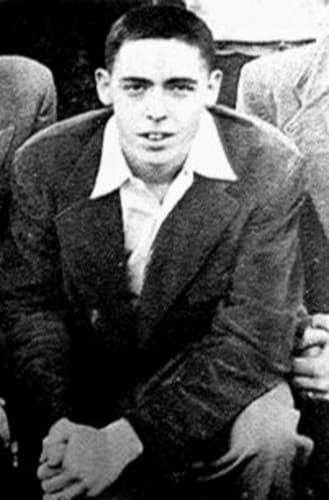
Thomas Ruggles Pynchon Jr. is an American novelist noted for his dense and complex novels. His fiction and non-fiction writings encompass a vast array of subject matter, genres and themes, including history, music, science, and mathematics. For Gravity's Rainbow, Pynchon won the 1973 U.S. National Book Award for Fiction.
Similar books
- Ulysses
James Joyce
3.7 (111k) average on GoodreadsLiterary FictionFeatures stream-of-consciousness, dense prose, and a highly symbolic, experimental narrative.
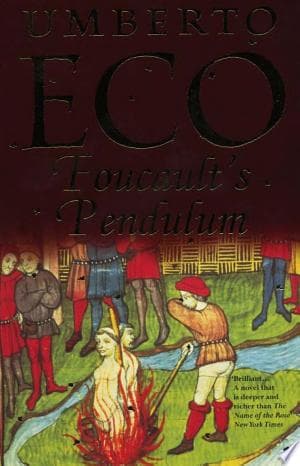
- Foucault's Pendulum
Umberto Eco
3.9 (60k) average on GoodreadsThrillerBoth novels explore elaborate conspiracies and semiotics. However, Pynchon's novel is more concise and less didactic, offering greater interpretive freedom. Eco's work can feel more like a scholarly treatise, while Pynchon maintains a manic energy and existential dread.
- White Noise
Don DeLillo
3.9 (87k) average on GoodreadsLiterary FictionBoth explore themes of media saturation and constructed reality. The Crying of Lot 49 differs in its focus on a historical, almost mythical, underground system (Tristero) which spans centuries, blurring history and myth, whereas DeLillo often grounds his paranoia in contemporary anxieties and consumer culture.
- The Old Man and the Sea
Ernest Hemingway
3.8 (831k) average on GoodreadsLiterary FictionA Cuban fisherman's long struggle with a giant marlin becomes a story of endurance and dignity, now retold for young adults with illustrations, phonetic guides, and writing prompts in Traditional Chinese.
- One Hundred Years of Solitude
Gabriel García Márquez
4.1 (753k) average on GoodreadsLiterary FictionThrough the multi-generational story of the Buendía family, a mythical town deals with the repeating patterns of time, love, and solitude, as the extraordinary mixes with the ordinary.
- The Goldfinch
Donna Tartt
3.9 (720k) average on GoodreadsLiterary FictionHaunted by a tragic explosion and clutching a stolen Dutch masterpiece, a young orphan navigates the opulent drawing rooms of New York and the gritty underbelly of the art world, desperately seeking connection and redemption amidst a life spiraling into crime and obsession.




Enjoyed the summary?
A summary gives you the shape of the book. The book itself has the detail, the examples and the voice.
Find The Crying of Lot 49 on AmazonAs an Amazon Associate, BookBrief earns from qualifying purchases. How we're funded