
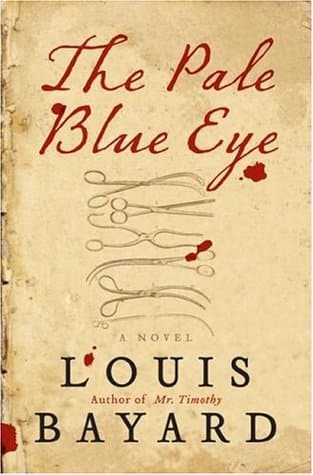
Synopsis
Covers the whole plot, including the ending.
- Difficulty
- Medium
- Pacing
- Moderate
- Mood
- Atmospheric, Suspenseful, Dark, Melancholic
- Read it if
- You enjoy historical mysteries with a dark, atmospheric tone and a famous literary figure as a character.
- Skip it if
- You prefer fast-paced thrillers without extensive historical detail or character introspection.
The Pale Blue Eye Plot Summary
Covers the whole plot, including the ending.
The Discovery and the Missing Heart
In October 1830, at the United States Military Academy at West Point, Cadet Leroy Fry's body is found hanging from a tree, an apparent suicide. The Superintendent, Colonel Sylvanus Thayer, wanting to avoid scandal, initially dismisses it. However, the next morning, a more horrifying discovery is made: Fry's body, held in the infirmary, has been desecrated, and his heart surgically removed. Faced with a clear murder and potential damage to the Academy's reputation, Thayer quietly hires Augustus Landor, a respected retired New York City detective living nearby, to investigate unofficially and keep the academy's name out of public view. Landor, a widower haunted by his past, reluctantly agrees, seeing a chance to escape his own sadness.
Landor Meets Poe
Augustus Landor begins his investigation at West Point, navigating the strict, secretive military academy. He interviews cadets and officers, encountering silence and suspicion. During his inquiries, he meets Cadet Edgar Allan Poe, a melancholic and intelligent young man known for his poetry, erratic behavior, and drinking. Poe, though initially a suspect due to his morbid interests, quickly shows a keen deductive mind and unusual perceptiveness that impresses Landor. Despite Poe's oddities and the academy's disapproval, Landor decides to take Poe on as an unofficial assistant, recognizing the cadet's unique ability to understand human psychology.
The Second Victim and the Occult
As Landor and Poe investigate, another cadet, Stoddard, is found murdered similarly to Fry—his body also desecrated and his heart removed. This second murder confirms the ritualistic nature of the killings, chilling the Academy. Landor and Poe discover cryptic symbols and texts related to the occult, suggesting the killer might be involved in a secret society or practicing dark magic. Pressure mounts on Landor as Colonel Thayer demands results, while Academy authorities, particularly Captain Hitchcock, grow suspicious of Landor's methods and Poe's involvement, fearing a scandal.
Suspects and Secret Societies
Landor and Poe focus their investigation on cadets close to Fry and Stoddard, including Cadet Ballinger, Cadet Lundy, and Cadet Marquis. They find evidence of a secret society within West Point, dedicated to arcane rituals, which the victims may have joined. Poe's knowledge of obscure texts and his ability to interpret symbolic clues are helpful, leading them to suspect the murders are not random but part of a larger, sinister plan. The atmosphere at West Point becomes tense, with fear and suspicion among the cadets.
The Medical Connection and Lea Marquis
The precise surgical removal of the hearts leads Landor and Poe to investigate West Point's medical staff, especially Dr. Daniel Marquis, the Academy's physician, and his family. Poe becomes infatuated with Dr. Marquis's daughter, Lea, a beautiful but sickly young woman who seems to share Poe's melancholic nature and interest in the macabre. Their growing romance adds a personal layer to Poe's investigation, drawing him into the Marquis family's world. Landor, meanwhile, observes the family closely, noting their guarded behavior and the doctor's evasiveness about autopsies and body handling.
The Third Victim and the Trap
Cadet Ballinger, a key suspect, is found gravely injured; his heart was targeted but not fully removed, suggesting the killer was interrupted. This near-miss increases the urgency of the investigation. Landor, convinced the killer is within the Academy, decides to set a trap. He uses Poe's insights into the killer's likely motivation and his own detective experience to plan how to lure the murderer out. The tension builds as Landor and Poe prepare for a confrontation, knowing the killer is intelligent, cunning, and deeply involved in the West Point community, making every move dangerous.
The Confrontation and the Revelation
Landor's trap successfully draws out Cadet Lundy, who confesses to the murders. Lundy reveals himself to be a deranged individual, driven by a twisted interpretation of occult rituals and a desire for power and immortality. He had meticulously planned the killings, believing that by consuming his victims' hearts, he could gain their strength and knowledge. The confrontation is violent, but Landor and Poe subdue Lundy. The Academy is relieved to have the killer caught, seemingly ending the horrific spree. However, Landor still feels a lingering unease, a sense that something crucial remains unaddressed.
Landor's Lingering Doubts
Despite Lundy's confession and the apparent resolution, Landor is troubled by inconsistencies and unanswered questions. Certain details of the murders, particularly the precision of the heart removal, do not align with Lundy's known abilities or his capture. He suspects Lundy may have been a pawn, or at least not the sole perpetrator. Landor confides his doubts in Poe, who, despite his infatuation with Lea, begins to share Landor's growing unease. They revisit the evidence, searching for overlooked clues that might point to a more complex and sinister truth behind the ritualistic killings at West Point.
The Marquis Family's Secret
Landor's deeper investigation leads him back to Dr. Marquis and his family. He uncovers the truth: Dr. Marquis, a former surgeon, meticulously removed the hearts, driven by a desperate attempt to cure his daughter, Lea's, terminal illness. He believed, based on ancient texts and his own distorted medical theories, that transferring 'life force' from healthy young men could save her. Lea, aware of her father's actions, was complicit, even orchestrating some events, manipulating Poe with her charm and shared morbid interests. Cadet Lundy was merely a disturbed accomplice, easily manipulated by the Marquis family.
The Final Confrontation and Poe's Role
Landor confronts Dr. Marquis and Lea with his discoveries. The truth shatters Poe, who is devastated by Lea's betrayal and the realization that his beloved was involved in such heinous acts. In a climactic confrontation, Lea, consumed by her illness and complicity, makes a desperate attempt to escape or inflict further harm. Landor, with Poe's assistance, prevents further tragedy. The Marquis family's dark secret is fully exposed, revealing a chilling tale of desperation, medical malpractice, and manipulative deceit, all hidden beneath West Point's strict discipline and reputation. The Academy's image is irrevocably tarnished.
Aftermath and Departures
With the full truth revealed, Dr. Marquis is apprehended, and Lea's fate, though tragic, is sealed by her illness and complicity. The Academy must deal with the scandal, though Colonel Thayer tries to contain the damage. Landor, his health and spirit further strained by the ordeal, prepares to return to his solitude, forever changed by the horrors he uncovered. Poe, heartbroken and disillusioned by Lea's betrayal, decides to leave West Point. His intense friendship with Landor has shaped his perspective. The experience fuels his morbid interests and contributes to the dark themes that will define his future writing, setting his path as a writer of the macabre.
The Pale Blue Eye Characters
Augustus Landor
Protagonist
A retired, melancholic detective hired to solve the West Point murders.
Augustus Landor is a former New York City detective, now a widower living in self-imposed seclusion near West Point. Haunted by the death of his wife and the mysterious disappearance of his daughter, he is a man of profound sorrow and keen intellect. He possesses a sharp mind for observation and deduction, but his personal grief often clouds his judgment and makes him vulnerable. He is initially reluctant to take on the case but finds himself drawn into the mystery, seeking a distraction from his own pain.
Relationships: Edgar Allan Poe (mentor/apprentice, then a complex friendship built on mutual respect and shared intellect); Colonel Thayer (employer, a pragmatic and demanding superior); Lea Marquis (suspect, victim of her father's actions, and ultimately a manipulator)
Edgar Allan Poe
Supporting/Deuteragonist
A young, brilliant, and troubled cadet who assists Landor.
Cadet Edgar Allan Poe is a highly intelligent, intensely poetic, and often inebriated young man. He is an outcast at West Point, prone to morbid fascinations and a romantic, melancholic disposition. Despite his eccentricities and rebellious nature, he possesses an extraordinary capacity for observation, deduction, and understanding the darker aspects of human psychology. His past is shrouded in mystery, and he yearns for recognition and connection, often seeking solace in literature and alcohol.
Relationships: Augustus Landor (apprentice/confidant, a surrogate father figure and intellectual equal); Lea Marquis (romantic interest, a tragic and ultimately manipulative love); Cadet Lundy (fellow cadet, later revealed as an accomplice)
Lea Marquis
Antagonist/Supporting
The sickly, enigmatic daughter of Dr. Marquis, who captivates Poe.
Lea Marquis is the beautiful and seemingly frail daughter of Dr. Daniel Marquis. She suffers from a mysterious, debilitating illness, which makes her appear vulnerable and ethereal. She possesses an intelligent and manipulative mind, using her charm and shared morbid interests to draw Poe into her orbit. Her outward fragility belies a strong will and a deep desperation, making her a complex and tragic figure, complicit in her father's horrific acts, driven by a desperate hope for survival.
Relationships: Edgar Allan Poe (object of affection, used as a tool for manipulation); Dr. Daniel Marquis (father, co-conspirator in the murders); Augustus Landor (antagonist, the detective who uncovers her secrets)
Dr. Daniel Marquis
Antagonist
The Academy's physician and Lea's father, harboring a dark secret.
Dr. Daniel Marquis is the highly respected but increasingly desperate physician at West Point. He is a man of science, but his professional ethics are compromised by his overwhelming love for his dying daughter, Lea. Driven by a desperate, misguided belief in ancient rituals and a twisted interpretation of medical science, he becomes the primary perpetrator of the heart removals, believing he can save Lea. He is a meticulous and intelligent man, capable of great deception to protect his family and his horrific secret.
Relationships: Lea Marquis (daughter, the object of his desperate attempts to save); Augustus Landor (antagonist, the detective who uncovers his crimes); Cadet Lundy (pawn/accomplice, easily manipulated)
Colonel Sylvanus Thayer
Supporting
The rigid Superintendent of West Point, obsessed with the Academy's reputation.
Colonel Sylvanus Thayer is the stern, unyielding Superintendent of West Point. He is fiercely dedicated to the Academy's reputation and discipline, valuing order and discretion above all else. His primary concern is to avoid scandal and protect the institution's image, which leads him to hire Landor for a covert investigation. He is a pragmatic and authoritarian figure, often clashing with Landor's unconventional methods and Poe's rebellious nature.
Relationships: Augustus Landor (employer, a tense professional relationship); Cadets (commander, maintaining strict discipline)
Cadet Lundy
Supporting/Antagonist
A quiet, disturbed cadet initially thought to be the sole killer.
Cadet Lundy is a quiet, unassuming cadet who initially appears to be a minor character but is later revealed as an accomplice in the murders. He is deeply disturbed, susceptible to manipulation, and harbors a fascination with the occult. His initial confession provides a convenient, albeit incomplete, solution to the murders, masking the true orchestrators. He is a tragic figure, easily exploited by the more cunning minds of Dr. Marquis and Lea.
Relationships: Dr. Daniel Marquis (manipulator, the true mastermind); Lea Marquis (manipulator, who exploits his vulnerabilities); Edgar Allan Poe (fellow cadet, his initial 'confession' misleads Poe)
Cadet Leroy Fry
Mentioned
The first victim, whose apparent suicide initiates the investigation.
Cadet Leroy Fry is the initial victim whose body is discovered hanging, an apparent suicide, at West Point. His subsequent desecration, with his heart removed, transforms the case into a murder investigation. He was likely involved in the secret society and became a target due to his vulnerability or specific characteristics sought by the killers for their ritualistic purposes. His death sets the entire plot in motion, revealing the dark underbelly of the academy.
Relationships: Augustus Landor (victim of the case Landor investigates); Edgar Allan Poe (victim whose death Poe helps investigate)
Cadet Stoddard
Mentioned
The second victim, confirming the ritualistic nature of the murders.
Cadet Stoddard is the second victim discovered, murdered in a manner identical to Fry, with his heart also removed. His death solidifies the understanding that a serial killer is at large and that the crimes are ritualistic, rather than isolated incidents. Stoddard's murder intensifies the fear and urgency of the investigation, pushing Landor and Poe to delve deeper into the occult theories surrounding the case.
Relationships: Augustus Landor (victim of the case Landor investigates); Edgar Allan Poe (victim whose death Poe helps investigate)
Cadet Ballinger
Supporting
An arrogant cadet who becomes a target of the killer.
Cadet Ballinger is an ambitious and somewhat arrogant cadet at West Point. He is one of the cadets associated with Fry and Stoddard, and his near-fatal attack (his heart targeted but not fully removed) further narrows the focus of the investigation. He represents the type of cadet who might be involved in secret societies, seeking power or prestige, making him a prime target for the ritualistic murders. His survival, albeit injured, provides crucial clues.
Relationships: Augustus Landor (a cadet investigated by Landor); Edgar Allan Poe (a fellow cadet, a potential victim)
The Pale Blue Eye Themes
The Corrupting Nature of Grief and Desperation
This theme explores how deep grief and desperation can lead people to commit horrific acts, twisting their moral compass. Dr. Daniel Marquis's love for his dying daughter, Lea, pushes him to believe in and practice ancient, barbaric rituals, thinking he can save her by sacrificing others. Similarly, Lea's fear of death and hope for survival lead her to manipulate Poe and aid her father. Landor himself grieves for his lost family, making him susceptible to being misled and fueling his initial reluctance to engage with life. The novel shows how these powerful emotions, unchecked, can warp judgment and break ethical boundaries.
“Grief, I have learned, is a cunning adversary, capable of twisting the most noble intentions into a grotesque parody of love.”
Appearance vs. Reality
The novel skillfully contrasts outward appearances with hidden truths. West Point, with its strict discipline and honorable facade, hides a dark side of secret societies, murder, and moral decay. Characters like Lea Marquis appear fragile and innocent but hold manipulative and deadly secrets. Dr. Marquis, the respected physician, is revealed as a cold-blooded killer. Even Landor, the seasoned detective, is not immune, as his own past and his daughter's disappearance are shrouded in deception. This theme highlights how unreliable perception is and the dangers of judging by surface impressions.
“The most dangerous secrets are not those we hide from others, but those we hide from ourselves.”
The Birth of the Macabre Artist
This theme directly addresses Edgar Allan Poe's early genius and how the traumatic events at West Point contribute to his literary style. Poe's morbid interests, acute observational skills, and melancholic temperament are all amplified by his direct involvement in the gruesome murders and his heartbreaking betrayal by Lea. The horrors he witnesses, the psychological depths he explores, and the disillusionment he experiences provide fertile ground for the dark, gothic, and psychologically complex tales he would later write. The novel presents this period as a crucible that shaped the literary master of the macabre.
“There are some wounds that bleed not from the body, but from the soul, and their ink stains all that follows.”
The Nature of Justice and Redemption
The novel explores the complex nature of justice, especially when crimes are driven by extreme desperation. While the Marquis family's actions are horrific, their motivations stem from a deep, though twisted, love. Landor's pursuit of justice is complicated by his own past and his understanding of human fallibility. The case's resolution, while catching the culprits, offers little true redemption for anyone involved. The theme questions whether true justice can be achieved when the lines between victim and perpetrator are blurred by despair and love, leaving a lingering sense of moral ambiguity.
“Justice, I have found, is rarely a clean thing. It leaves as many scars as it heals.”
Plot Devices & Literary Techniques
Red Herring
Misleading clues or characters designed to divert the reader's attention from the true culprit.
The character of Cadet Lundy serves as a significant red herring. His initial confession and the apparent ease with which he is apprehended lead both the Academy and the reader to believe the case is solved. His disturbed nature and fascination with the occult make him a plausible, albeit incomplete, suspect. This diversion allows the true orchestrators, Dr. Marquis and Lea, to operate in the shadows for longer, deepening the mystery and making the final revelation more shocking. Poe's initial suspicion of Lundy also contributes to this misdirection.
Unreliable Narrator
A narrator whose credibility has been compromised, often due to personal biases or hidden information.
Augustus Landor, the first-person narrator, is an unreliable narrator, particularly concerning his own past and motivations. His profound grief over his wife's death and the mysterious disappearance of his daughter significantly color his perceptions and judgments. He withholds crucial information about his personal history, and his emotional state often leads him to misinterpret events or overlook critical details. This unreliability is gradually revealed, culminating in the shocking truth about his own family's fate, forcing the reader to re-evaluate everything they thought they knew.
Foreshadowing
Hints or clues about future events, often creating suspense and anticipation.
The novel employs extensive foreshadowing, particularly through Poe's morbid interests and poetic inclinations. His fascination with death, his unsettling poems, and his keen insights into the darker aspects of human nature subtly hint at the gruesome and ritualistic nature of the murders. Landor's recurring thoughts about his missing daughter and his own buried secrets also foreshadow the eventual revelation of his personal tragedy. The sickly nature of Lea Marquis and Dr. Marquis's evasiveness regarding the autopsies also provide early, subtle clues about their involvement.
Gothic Atmosphere
The use of dark, mysterious, and often isolated settings to create a sense of dread and suspense.
The setting of West Point in 1830, with its imposing stone architecture, rigid military discipline, and isolated location in the Hudson Highlands, provides a perfect gothic backdrop. The cold October nights, the mist-shrouded grounds, and the hidden nooks and crannies of the academy contribute to an oppressive and mysterious atmosphere. This gothic setting enhances the themes of hidden secrets, ritualistic violence, and psychological decay, creating a pervasive sense of dread and tension that permeates the entire narrative.
The Pale Blue Eye Quotes
“For there is no more terrible a sight than that of a man who has lost his mind.”
“The past is a foreign country; they do things differently there.”
“There are some things, you see, that simply cannot be explained away by logic or science.”
“Grief, I have learned, is not a state but a process, one that never truly ends.”
“The world, my friend, is full of shadows, and sometimes, the darkest ones are cast by the brightest lights.”
“A secret is a burden, and burdens, if carried too long, will crush a man.”
“There are certain moments in life when one knows, with absolute certainty, that everything is about to change.”
“The human heart is a dark forest, and one can get lost in its depths.”
“Justice, you see, is not always about what is right, but about what can be proven.”
“Every man has his demons, and mine, I assure you, are legion.”
“To truly see, one must often close one's eyes to the obvious.”
“Fear, my dear boy, is a powerful motivator, and it can drive men to do terrible things.”
“The most dangerous lies are the ones we tell ourselves.”
“There is a kind of beauty in despair, a stark, unyielding truth that strips away all pretense.”
Quiz
10 questions on the plot and the characters. Each answer comes with a short explanation.
Question 1
What is the initial cause of death reported for the first cadet found, before the discovery of the missing heart?
- Stab wound
- Gunshot
- Suicide by hanging
- Poisoning
Show answer
C. Suicide by hanging The first cadet's body was discovered 'swinging from a rope just off the parade grounds,' leading to an initial assumption of suicide.
Question 2
Who is the civilian detective called upon by West Point Academy to investigate the murder?
- Edgar Allan Poe
- Augustus Landor
- Mr. Timothy
- Captain Hitchcock
Show answer
B. Augustus Landor Augustus Landor, a former New York City police detective, is called out of retirement to investigate the case.
Question 3
What specific body part is discovered to be missing from the first cadet's body the morning after its initial discovery?
- An eye
- A hand
- The brain
- The heart
Show answer
D. The heart The 'even greater horror' that comes to light the next morning is that 'Someone has stolen into the room where the body lay and removed the heart.'
Question 4
In what year is 'The Pale Blue Eye' primarily set at West Point Academy?
- 1812
- 1830
- 1849
- 1803
Show answer
B. 1830 The story explicitly states, 'At West Point Academy in 1830, the calm of an October evening is shattered...'
Question 5
What is Edgar Allan Poe's personal habit that Landor finds challenging but learns to manage?
- A gambling addiction
- A penchant for drink
- Kleptomania
- Chronic oversleeping
Show answer
B. A penchant for drink Poe is described as 'a moody, intriguing young cadet with a penchant for drink,' and Landor wonders if he 'can stay sober long enough to put his keen reasoning skills to the task.'
Question 6
Augustus Landor retired to the Hudson Highlands for what stated reason?
- To write his memoirs
- For his health
- To escape a scandal
- To raise a family
Show answer
B. For his health Landor is described as 'a former police detective... before retiring to the Hudson Highlands for his health.'
Question 7
The investigation leads Landor and Poe into a hidden world involving what kind of illicit activities?
- Counterfeiting and smuggling
- Political espionage
- Secret societies and ritual sacrifices
- Illegal dueling rings
Show answer
C. Secret societies and ritual sacrifices The investigation takes them 'into a hidden world of secret societies, ritual sacrifices, and more bodies.'
Question 8
What is a central theme that threatens to unravel the newly formed friendship between Landor and Poe as the investigation progresses?
- A disagreement over romantic interests
- Rivalry for promotion within West Point
- The macabre murders and Landor's own buried secrets
- Poe's constant insubordination towards Landor
Show answer
C. The macabre murders and Landor's own buried secrets The text states, 'Soon, however, the macabre murders and Landor's own buried secrets threaten to tear the two men and their newly formed friendship apart.'
Question 9
What literary accomplishment is mentioned regarding Edgar Allan Poe at the time he assists Landor?
- He has published a successful novel
- He has two volumes of poetry to his name
- He is a renowned playwright
- He has written several popular essays
Show answer
B. He has two volumes of poetry to his name Poe is described as 'a moody, intriguing young cadet with a penchant for drink, two volumes of poetry to his name, and a murky past.'
Question 10
What characteristic of Poe does Landor find particularly useful for the investigation, despite Poe's other habits?
- His physical strength and combat skills
- His extensive knowledge of military tactics
- His astute powers of observation and keen reasoning skills
- His connections to high-ranking officials
Show answer
C. His astute powers of observation and keen reasoning skills Landor is 'Impressed with Poe's astute powers of observation' and is convinced 'that the poet may prove useful—if he can stay sober long enough to put his keen reasoning skills to the task.'
The Pale Blue Eye FAQ
What is the central mystery Augustus Landor is called to investigate at West Point?
Augustus Landor is called to West Point to investigate the apparent suicide of Cadet Leroy Fry, whose body is found hanging. The situation escalates into a gruesome murder investigation when Fry's heart is mysteriously removed from his body after it's brought to the infirmary, prompting the academy to seek outside help to avoid scandal.
How does Edgar Allan Poe become involved in the investigation?
Edgar Allan Poe, a young cadet with a reputation for poetry and drink, approaches Landor with an offer to help. Landor, initially skeptical, soon recognizes Poe's keen intellect and observational skills, realizing that Poe's unique perspective and ability to blend in with the cadets could be invaluable to solving the case.
What kind of relationship develops between Landor and Poe?
A complex and surprisingly deep rapport develops between Landor and Poe. Despite their age difference, they share a similar intelligence and a melancholic temperament. Landor acts as a mentor figure to Poe, while Poe's insights prove crucial to the investigation, forging a bond that is ultimately tested by the dark truths they uncover.
What are some of the initial clues or red herrings that Landor and Poe encounter?
Early in their investigation, Landor and Poe uncover clues suggesting a possible connection to occult rituals and secret societies among the cadets. They encounter cryptic notes, unusual symbols, and learn about the cadets' interest in mysticism, leading them down a path that initially points towards ritualistic murder.
Who are the primary suspects throughout the early stages of the investigation?
Initially, Landor and Poe consider several cadets as suspects due to their strange behaviors, involvement in secret societies, or known animosity towards Fry. This includes cadets like Stoddard and Ballinger, who seem to have a deeper, perhaps sinister, knowledge of the academy's darker undercurrents, and the family of Dr. Marquis.
What is the significance of the Marquis family in the story?
The Marquis family, particularly Dr. Daniel Marquis, his wife, and their daughter Lea, become central to the investigation. Dr. Marquis is the academy's physician, and Lea forms a romantic connection with Poe. Their presence introduces a domestic element to the West Point setting, but their secrets ultimately prove to be deeply intertwined with the murders.
How does Landor's personal history influence his investigation?
Landor's past as a widower and his daughter's tragic fate profoundly influence his perspective. His own grief and sense of failure make him empathetic to the victims and drive his relentless pursuit of justice, but also cloud his judgment and make him susceptible to manipulation, particularly when it comes to protecting those he cares about.
What is the shocking twist regarding the true identity of the murderer?
The shocking twist reveals that Augustus Landor himself is the murderer. He orchestrated the killings of Fry and other cadets to frame them for the rape and murder of his daughter, Mattie. His grief-stricken mind concocted an elaborate revenge plot, making him the very criminal Poe was helping him to catch.
What was the real motive behind the murders committed by Landor?
Landor's true motive was revenge. He discovered that a group of cadets, including Leroy Fry, had raped and murdered his daughter, Mattie. Driven by an all-consuming grief and a desire for justice outside the law, he systematically targeted the perpetrators, meticulously planning their deaths to appear as ritualistic suicides or unrelated murders.
How does Landor's psychological state evolve throughout the narrative?
Landor's psychological state is one of profound grief and carefully controlled vengeance. Initially appearing as a detached, professional investigator, his internal turmoil slowly reveals itself through his interactions and his increasingly desperate attempts to cover his tracks. His sanity is fractured by loss, leading him to commit heinous acts while maintaining a facade of integrity.
What aspects of Poe's known personality or future works are foreshadowed in the novel?
The novel highlights Poe's melancholic disposition, his struggles with alcohol, and his fascination with death and the macabre, all elements prominent in his later literary career. His acute observational skills and deductive reasoning, essential for his character Auguste Dupin, are also clearly showcased, hinting at his future as a pioneer of detective fiction.
How does the setting of West Point contribute to the psychological atmosphere of the story?
The isolated, rigid, and honor-bound setting of West Point creates an oppressive psychological atmosphere. It fosters an environment where secrets can fester, and the pressure of conformity can drive individuals to extreme acts. The stark, often grim landscape mirrors the dark events unfolding, enhancing the sense of dread and confinement.
How does Lea Marquis's role in the story impact Poe's psychological state?
Lea Marquis's presence, and Poe's developing romantic feelings for her, offer a brief respite and a flicker of hope for the young cadet. However, her true nature as Landor's accomplice and her manipulation of Poe ultimately shatter his trust and deepen his cynicism, contributing to his already melancholic and disillusioned outlook.
Could Landor's actions be interpreted as a form of distorted justice?
Yes, Landor's actions can be interpreted as a form of distorted justice. While his initial motivation stems from a profound and understandable desire for retribution for his daughter's rape and murder, his methods involve further murder and deception, ultimately corrupting the very concept of justice he seeks to uphold. It raises questions about the line between vengeance and justice.
What is the significance of the 'pale blue eye' in the title?
The 'pale blue eye' likely refers to several elements: the eyes of the deceased cadets, the piercing gaze of Landor himself, and perhaps even a subtle nod to Poe's future story 'The Tell-Tale Heart,' where an old man's 'vulture eye' is a source of obsession. It symbolizes an unnerving scrutiny and the chilling, often cold, nature of observation and truth.
How does the novel challenge the reader's perception of heroism and villainy?
The novel profoundly challenges the reader's perception of heroism and villainy by revealing the protagonist, Landor, to be the antagonist. His seemingly noble pursuit of justice is a cover for his calculated revenge, forcing the reader to re-evaluate their sympathies and recognize the capacity for darkness within seemingly good individuals. Poe, the 'hero' in the investigation, is unknowingly aiding a killer.
What themes of grief and revenge are explored in the book?
The book deeply explores themes of grief and revenge, showing how overwhelming loss can warp an individual's moral compass. Landor's grief over Mattie's death transforms into a consuming desire for vengeance, leading him down a path of calculated murder. The novel portrays revenge as a destructive force that ultimately consumes the avenger, leaving a trail of further tragedy.
How does the ending reflect Poe's future literary themes?
The ending, with its revelations of betrayal, hidden madness, and the triumph of darkness, strongly foreshadows themes prevalent in Poe's later works. The psychological horror, the unreliable narrator, the macabre elements, and the exploration of guilt and obsession are all central to his unique brand of gothic literature, suggesting this experience deeply influenced his artistic output.
About the author

Louis Bayard is an American author known for his works of fiction, including "The Pale Blue Eye." His writing often blends historical elements with engaging narratives, showcasing his skill in creating intricate plots and rich character development. Bayard's work has garnered attention for its unique storytelling and depth.
Similar books
- The Alienist
Caleb Carr
4.1 (182k) average on GoodreadsFictionFeatures a historical detective duo investigating gruesome murders in 19th-century New York.
- Fingersmith
Sarah Waters
4.0 (81k) average on GoodreadsHistorical FictionIntricate plot with twists, historical setting, and psychological depth.
- The Name of the Rose
Umberto Eco
4.1 (301k) average on GoodreadsHistorical FictionHistorical mystery set in a closed environment with a focus on intellect and deduction.
- Angels & Demons
Dan Brown
3.9 (2.7M) average on GoodreadsThrillerA Harvard symbologist races through Rome's ancient sites, deciphering cryptic clues to unmask the Illuminati and stop a vengeful plot to destroy the Vatican with a stolen antimatter weapon.
- Gone Girl
Gillian Flynn
4.1 (2.3M) average on GoodreadsThrillerA wife's sudden disappearance on her fifth anniversary reveals a web of lies and psychological warfare, exposing the secrets within a seemingly perfect marriage.
- The Girl on the Train
Paula Hawkins
3.9 (2.1M) average on GoodreadsThrillerA woman’s fascination with a seemingly perfect couple she watches from her daily train commute leads her into a dark investigation when she witnesses something that shatters their idyllic image.





Enjoyed the summary?
A summary gives you the shape of the book. The book itself has the detail, the examples and the voice.
Find The Pale Blue Eye on AmazonAs an Amazon Associate, BookBrief earns from qualifying purchases. How we're funded