
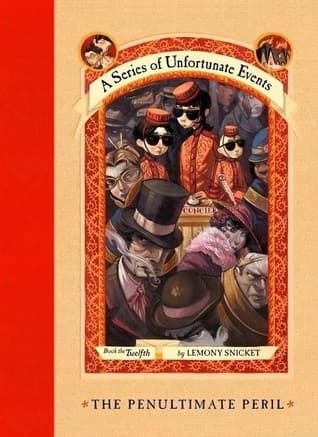
Synopsis
Covers the whole plot, including the ending.
- Difficulty
- Medium
- Pacing
- Moderate
- Mood
- Mysterious, Melancholy, Suspenseful, Witty, Darkly Humorous
- Read it if
- You enjoy dark humor, intricate mysteries, and a series that consistently subverts expectations while exploring themes of morality and resilience.
- Skip it if
- You prefer straightforward narratives with clear happy endings, or find persistent misfortune and a sense of impending doom too disheartening.
The Penultimate Peril Plot Summary
Covers the whole plot, including the ending.
The Arrival at the Denouement
Violet, Klaus, and Sunny Baudelaire arrive at the Hotel Denouement, disguised as concierges, told to meet one of their parents there. The identical triplet brothers, Frank and Ernest Denouement, the hotel managers, immediately put them to work. The hotel is a large, complex building where all guests are given rooms based on an alphabetical system, causing much confusion. The children are looking for the last sugar bowl, a mysterious item important to V.F.D.'s past, hoping to find answers about their parents and the organization. They meet familiar faces, including the Quagmires, who also seek answers, and are surprised by the hotel's strange guests and rules.
The Incomplete Guest Register and the Disguised Villain
Klaus finds that the hotel's guest register is missing many names. This makes him suspicious, as such a detail could hide a known villain. The Baudelaires figure out that Count Olaf must be at the hotel, likely in disguise, and probably one of the Denouement brothers. They also learn that the hotel is a secret meeting place for both good and bad V.F.D. members. The children start investigating the guests, trying to tell who is good and who is with Olaf, all while keeping their concierge disguises and doing odd jobs for the hotel's unusual clients.
The Trial of Count Olaf
Justice Strauss and Jerome Squalor arrive at the Hotel Denouement, wanting to hold a fair trial for Count Olaf. They try to get the guests and the Baudelaires to join a proper legal process. However, Olaf, disguised as 'Detective Dupin,' twists the situation, blaming the Baudelaires for various crimes and turning people against them. The hotel's unique structure, with its two sides (one for noble V.F.D. members, one for villains), makes it hard to find the truth, and the trial quickly becomes chaotic. The children realize that the legal system, in this setting, is easily corrupted and may not give them the justice they want.
The Mystery of the Triplets
The Baudelaires struggle to tell apart the identical triplet managers, Frank and Ernest Denouement. They suspect one is a good V.F.D. member, and the other works with Count Olaf. To add to the confusion, they hear about a third, rumored brother, Dewey Denouement, said to be the most secretive and possibly holding key information about the sugar bowl and their parents. The children realize that finding Dewey is essential to understanding the V.F.D. split and their family's history. This task is made harder by the triplets' identical looks and their habit of speaking in riddles and partial truths.
The Sugar Bowl and the Medusoid Mycelium
The Baudelaires discover that the hard-to-find sugar bowl contains not just sugar, but a strong antidote to the Medusoid Mycelium, a deadly fungal poison. This news greatly increases the importance of their search, as the sugar bowl becomes vital for survival. They also learn that Count Olaf and his friends are spreading the Medusoid Mycelium as a weapon. The children understand that getting the sugar bowl is not just about finding V.F.D. secrets, but about stopping widespread harm. The urgency of their mission grows as they see the immediate danger from the fungus.
The Truth About Dewey Denouement
The Baudelaires finally meet Dewey Denouement, the third, previously hidden, triplet. Dewey is a good V.F.D. member who has been secretly gathering and organizing all information about the organization in a hidden archive under the hotel's pond. He reveals that the sugar bowl holds the cure for the Medusoid Mycelium and that it is important to V.F.D.'s efforts to fight Olaf. Dewey explains the history of the split and why the sugar bowl is important for preventing more tragedies. He offers the children a bit of hope, giving them answers and a way forward.
The Harpoon Gun and Dewey's Fate
In a main fight, Count Olaf, trying to shoot the Baudelaires with a harpoon gun, accidentally kills Dewey Denouement. The children are shocked and upset by this sad event, as Dewey was their last hope for direct answers and help. Olaf, always manipulative, tries to blame the Baudelaires for Dewey's murder, further making them seem like villains to the other guests. This incident shows Olaf's increased cruelty and the Baudelaires' despair, leaving them without a trusted adult ally and facing serious accusations.
The Hotel Denouement Fire
After Dewey's death, Count Olaf sets the Hotel Denouement on fire, trapping the remaining guests and V.F.D. members inside. The fire quickly spreads through the complex hotel, causing widespread panic and disorder. The Baudelaires, still reeling from Dewey's death and being blamed for it, must navigate the burning building, trying to save themselves and others. The fire represents the complete breakdown of order and the destruction of the last known V.F.D. meeting place. It forces the children to make impossible choices and face the ultimate test of their cleverness and bravery.
The Escape and the Sugar Bowl's Loss
Amidst the flames and confusion, the Baudelaires manage to escape the burning Hotel Denouement. However, in their desperate attempt to flee and save the other guests, they lose the sugar bowl, which falls into the ocean. This loss is a crushing blow, as it means the antidote to the Medusoid Mycelium is now gone, and their long search for it has ended in failure. They are left with only their wits and each other, facing an uncertain future with Count Olaf still free and the world believing them to be murderers and arsonists. The children must face the harsh reality of their ongoing misfortunes.
Count Olaf's Capture
After escaping the burning hotel, the Baudelaires find themselves on a boat with Count Olaf, who also managed to flee the fire. In a final, desperate act, they manage to overpower and capture him. However, their victory is mixed and uncertain. They are now adrift at sea with their enemy, cut off from the rest of the world, and still widely seen as villains. The children consider their next step, realizing that even with Olaf captured, their troubles are far from over. The future remains unclear, setting the stage for the final book in their story.
The Penultimate Peril Characters
Violet Baudelaire
Protagonist
The eldest Baudelaire, an inventor and problem-solver.
Violet is the eldest of the Baudelaire orphans, known for her exceptional talent in inventing and her ability to tie back her hair with a ribbon to signify deep thought. She is pragmatic, resourceful, and often takes the lead in devising plans to escape Count Olaf's clutches or solve the mysteries surrounding V.F.D. Her intelligence and quick thinking are invaluable in navigating the perilous situations they face. She deeply cares for her siblings and strives to protect them.
Relationships: Klaus Baudelaire (Younger brother, intellectual partner); Sunny Baudelaire (Youngest sister, protected and cared for); Count Olaf (Arch-nemesis, constant threat)
Klaus Baudelaire
Protagonist
The middle Baudelaire, a prodigious reader and researcher.
Klaus is the middle Baudelaire child, distinguished by his love for books and his encyclopedic knowledge. He possesses an extraordinary memory and can recall obscure facts that often prove crucial in solving riddles or understanding complex situations. He is the intellectual backbone of the Baudelaire siblings, often providing the research and background information needed for their plans. Klaus is analytical and thoughtful, though sometimes prone to overthinking.
Relationships: Violet Baudelaire (Older sister, collaborates on plans); Sunny Baudelaire (Youngest sister, protected and cared for); Count Olaf (Arch-nemesis, constant threat)
Sunny Baudelaire
Protagonist
The youngest Baudelaire, with sharp teeth and a keen sense of observation.
Sunny is the youngest Baudelaire, initially communicating in a series of babbling remarks that only her siblings can understand, but gradually developing clearer speech. Her sharp teeth are often used for unusual tasks, from cutting ropes to climbing. Despite her age, Sunny is remarkably observant, brave, and often contributes unexpected solutions or insights. She provides emotional support and often reminds her siblings of their bond.
Relationships: Violet Baudelaire (Older sister, protected and cared for); Klaus Baudelaire (Older brother, protected and cared for); Count Olaf (Arch-nemesis, constant threat)
Count Olaf
Antagonist
The notorious villain perpetually pursuing the Baudelaire fortune.
Count Olaf is the Baudelaires' persistent and cruel nemesis, obsessed with acquiring their inheritance. He is a master of disguise, often adopting elaborate personas to trick unsuspecting adults and get close to the children. Olaf is utterly devoid of empathy, driven solely by greed and a desire for power. He is manipulative, theatrical, and charismatic in a sinister way, often convincing others to do his bidding. His history is deeply intertwined with V.F.D. and the Baudelaire parents.
Relationships: Baudelaire Orphans (Targets of his schemes, constant pursuit); His Henchmen (Loyal (or easily manipulated) followers); Esmé Squalor (Romantic partner and accomplice)
Dewey Denouement
Supporting
The secretive third triplet, a noble V.F.D. member.
Dewey Denouement is the third, previously unknown, triplet brother of Frank and Ernest. He is a noble V.F.D. member, dedicated to preserving knowledge and fighting against the schism. Dewey maintains a secret archive beneath the Hotel Denouement's pond, containing vital information about V.F.D. and the sugar bowl. He is kind, intelligent, and tries to help the Baudelaires, but his secretive nature and tragic fate highlight the dangers of the V.F.D. world. He represents a potential, but ultimately lost, source of guidance for the orphans.
Relationships: Baudelaire Orphans (Potential allies and source of information); Frank Denouement (Brother, noble V.F.D. member); Ernest Denouement (Brother, villainous V.F.D. member (implied))
Frank Denouement
Supporting
One of the triplet managers, a noble V.F.D. member.
Frank Denouement is one of the identical triplet managers of the Hotel Denouement, and a noble member of V.F.D. He works to maintain the hotel as a safe haven for good V.F.D. members and to combat the villainous side of the organization. He is often indistinguishable from his brother Ernest, leading to confusion for the Baudelaires. Frank tries to help the children, but the chaos of the hotel and the presence of Olaf make his efforts difficult. He embodies the confusing and often deceptive nature of the V.F.D. world.
Relationships: Baudelaire Orphans (Briefly a potential ally); Ernest Denouement (Brother, his identical twin); Dewey Denouement (Brother, hidden from public view)
Ernest Denouement
Supporting
One of the triplet managers, an associate of Count Olaf.
Ernest Denouement is the other identical triplet manager of the Hotel Denouement, and an associate of Count Olaf. He works to undermine the noble V.F.D. efforts and facilitate Olaf's schemes within the hotel. His identical appearance to Frank creates constant confusion, making it difficult for the Baudelaires to discern who is good and who is evil. Ernest represents the insidious infiltration of villainy into even seemingly safe places, further blurring the lines between good and evil.
Relationships: Baudelaire Orphans (Antagonistic, obstructs their progress); Frank Denouement (Brother, his identical twin); Dewey Denouement (Brother, hidden from public view); Count Olaf (Ally and accomplice)
Esmé Squalor
Supporting
Count Olaf's fashionable and cruel girlfriend.
Esmé Squalor is Count Olaf's girlfriend and accomplice, obsessed with fashion and being 'in' or 'out.' She is just as cruel and self-serving as Olaf, often using her social standing and wealth to aid his nefarious schemes. At the Hotel Denouement, she continues to assist Olaf, often in bizarre and stylish disguises. Esmé's character highlights the superficiality and moral bankruptcy of many adults in the Baudelaires' world, who prioritize trends over justice and kindness.
Relationships: Count Olaf (Romantic partner and accomplice); Baudelaire Orphans (Antagonistic, aids Olaf in their pursuit)
The Penultimate Peril Themes
The Ambiguity of Good and Evil
This theme is key to 'The Penultimate Peril,' as the Hotel Denouement itself is split into two sides, one for good V.F.D. members and one for villains, yet they look the same from the outside. The identical Denouement triplets – Frank (good), Ernest (evil), and Dewey (good) – show this uncertainty perfectly, making it almost impossible for the Baudelaires to tell friend from enemy. Count Olaf's 'trial' further blurs these lines, as Justice Strauss's attempts at fairness are easily ruined by Olaf's tricks and the cooperation of other adults. The children must make moral decisions without clear guidance, showing how complex their world is.
“It is a popular misconception that all V.F.D. members are noble, and that all enemies of V.F.D. are villainous. In fact, it is much more complicated than that.”
The Corruption of Justice
The idea of justice is repeatedly weakened in this book. Justice Strauss's honest attempt to hold a proper trial for Count Olaf at the Hotel Denouement quickly turns into a silly show. Olaf, disguised as 'Detective Dupin,' manipulates the process, turning public opinion against the Baudelaires and ensuring he is found innocent. The adult guests, instead of looking for truth, are easily swayed by appearances and sensationalism. This shows how easily the legal system can be twisted by power and lies, leaving the innocent vulnerable and the guilty unpunished, further isolating the Baudelaires in their search for fairness.
“Justice, like a well-made curry, can be a complicated and spicy dish, and one that is often best served with a generous dollop of something cool and creamy, if you want to avoid burning your mouth.”
The Burden of Knowledge and Secrecy
The Baudelaires' constant search for information about V.F.D. and their parents' past is a main force, but this book shows the heavy burden that comes with it. Dewey Denouement's secret archive, while giving important answers about the sugar bowl and the Medusoid Mycelium, also makes him a target, leading to his death. The children learn that some truths are dangerous and that knowing too much can lead to greater risk. The V.F.D. split itself is a secret that has caused great suffering, showing how hidden information can divide and destroy.
“Knowledge is like a library, and sometimes a library is on fire.”
Loss and Continued Misfortune
True to the series, 'The Penultimate Peril' highlights the continuous bad luck the Baudelaires face. The loss of Dewey Denouement, a kind and knowledgeable adult who offered real help, is especially devastating. His accidental death by Olaf's harpoon gun takes away a key ally and source of information from the children. Also, the destruction of the Hotel Denouement, the last known V.F.D. meeting place, and the loss of the sugar bowl (and its antidote) into the ocean, mean the complete breakdown of their hopes and efforts. These combined losses reinforce the bleak reality of their lives and the widespread nature of tragedy in their world.
“It is a sad but true fact that sometimes the most helpful people are the ones who are no longer around to help.”
Plot Devices & Literary Techniques
The Hotel Denouement
A labyrinthine hotel serving as a V.F.D. meeting place and a metaphor for the world's divisions.
The Hotel Denouement is a crucial setting, designed with a deliberately confusing alphabetical room system. It serves as a secret meeting place for both noble and villainous V.F.D. members, literally divided into two sides. This physical division mirrors the moral ambiguity of the V.F.D. schism and the blurred lines between good and evil. Its labyrinthine structure and the identical triplet managers (Frank, Ernest, Dewey) create an environment of constant confusion and deception, making it difficult for the Baudelaires to discern allies from enemies. The hotel ultimately becomes a symbol of the failing V.F.D. organization when it is destroyed by fire.
The Sugar Bowl
A mysterious object containing the antidote to the Medusoid Mycelium.
The sugar bowl, a long-standing MacGuffin in the series, is revealed to contain the antidote to the Medusoid Mycelium. This revelation elevates its importance from a mere V.F.D. relic to a vital object for survival. Its contents represent hope and a potential solution to a deadly threat. The Baudelaires' desperate pursuit of the sugar bowl drives much of the plot, only for it to be tragically lost at sea during the hotel fire, symbolizing the continued denial of a simple solution to their complex problems and the pervasive nature of misfortune.
The Medusoid Mycelium
A deadly fungal poison used as a weapon by Count Olaf.
The Medusoid Mycelium is a highly dangerous, fast-acting fungal poison that causes death almost instantly. It is introduced as a new and terrifying threat, weaponized by Count Olaf and his associates. The fungus raises the stakes of the Baudelaires' quest, as the sugar bowl's antidote becomes essential for combating this biological weapon. Its presence underscores the escalating dangers the children face and highlights the extreme villainy of Olaf, who is willing to unleash such a devastating force upon the world. The fungus represents a new, more insidious form of peril.
The Identical Triplets
Frank, Ernest, and Dewey Denouement, who embody the moral ambiguity of the V.F.D. schism.
The identical triplet brothers, Frank, Ernest, and Dewey Denouement, serve as a powerful plot device to illustrate the theme of moral ambiguity. Frank is a noble V.F.D. member, Ernest is allied with Count Olaf, and Dewey is a secretive, noble V.F.D. archivist. Their identical appearances make it nearly impossible for the Baudelaires to distinguish between them, forcing the children to rely on subtle cues and moral judgment rather than outward appearances. This device highlights the difficulty of discerning good from evil in a fractured world and contributes to the pervasive sense of confusion and mistrust.
The Penultimate Peril Quotes
“It is a curious thing, the death of a parent. We are told to expect it, but it's never something you can prepare for.”
“The world is a vast and complicated place, and there are a great many things in it that are true, even if you do not believe them.”
“It is a sad but true fact that sometimes the most important things in life are the ones that are the hardest to talk about.”
“The Baudelaire orphans knew that it is one thing to be in a dangerous situation, and another thing entirely to be in a dangerous situation with no idea how you got there.”
“It is a rare and beautiful thing when the truth and justice align, but it is a common and tragic thing when they do not.”
“There are many things in life that are difficult to understand, but few are as difficult as the human heart.”
“The phrase 'at your leisure' is a polite way of saying 'whenever you get around to it, if ever,' and it often means 'never at all.'”
“It is a terrible thing to be lonely, but it is an even more terrible thing to be lonely with someone else.”
“The world is quiet here.”
“Even the most well-intentioned people can make terrible mistakes, and even the most terrible mistakes can sometimes lead to something good.”
“Sometimes, the most important thing a person can do is simply to listen.”
“The truth, like a good story, is often best told in pieces, so that the listener can put them together themselves.”
“There are some things that cannot be explained, no matter how much you try, and sometimes the best thing to do is to simply accept them.”
“The most important decisions in life are rarely made quickly, and almost never made easily.”
Quiz
10 questions on the plot and the characters. Each answer comes with a short explanation.
Question 1
Where do the Baudelaire orphans find themselves working at the beginning of 'The Penultimate Peril'?
- The Heimlich Hospital
- The Hotel Denouement
- Prufrock Preparatory School
- Briny Beach
Show answer
B. The Hotel Denouement The Baudelaire orphans begin 'The Penultimate Peril' working as concierges at the Hotel Denouement, which is also the secret headquarters of V.F.D.
Question 2
What is the primary objective of the Baudelaires and the Denouement brothers at the Hotel Denouement?
- To find Count Olaf's hidden treasure
- To identify the sugar bowl's contents
- To determine who is a volunteer and who is a villain for the V.F.D. meeting
- To escape the hotel before it collapses
Show answer
C. To determine who is a volunteer and who is a villain for the V.F.D. meeting The Baudelaires, with the help of the Denouement brothers, are trying to discern which guests are volunteers and which are villains for the upcoming V.F.D. meeting.
Question 3
Which character is revealed to be one of the Denouement triplets, working undercover at the hotel?
- Hal
- Justice Strauss
- Dewey Denouement
- Esmé Squalor
Show answer
C. Dewey Denouement Dewey Denouement is one of the three Denouement triplets and is working at the hotel, maintaining the V.F.D. records in the underwater archives.
Question 4
What significant item is Count Olaf attempting to retrieve from the Hotel Denouement?
- The Snicket files
- The sugar bowl
- A secret antidote
- His acting troupe's costumes
Show answer
B. The sugar bowl Count Olaf is desperately trying to acquire the mysterious sugar bowl, an item of great importance to V.F.D., which is hidden somewhere in the hotel.
Question 5
How does Dewey Denouement tragically meet his end?
- He is pushed off the hotel roof by Count Olaf.
- He is caught in a fire set by Esmé Squalor.
- He is accidentally shot by a harpoon gun, fired by Count Olaf, while arguing with the Baudelaires.
- He drowns in the hotel's underwater archives.
Show answer
C. He is accidentally shot by a harpoon gun, fired by Count Olaf, while arguing with the Baudelaires. Dewey Denouement is accidentally killed by a harpoon gun, fired by Count Olaf, during a struggle and misunderstanding with the Baudelaires, making them appear guilty.
Question 6
What major thematic element is highlighted by the blurred lines between volunteers and villains at the Hotel Denouement?
- The importance of family loyalty.
- The inherent goodness of humanity.
- The moral ambiguity of the world and the difficulty of distinguishing good from evil.
- The triumph of justice over injustice.
Show answer
C. The moral ambiguity of the world and the difficulty of distinguishing good from evil. The Hotel Denouement, with its 'In' and 'Out' doors and the struggle to identify V.F.D. members, strongly emphasizes the theme of moral ambiguity and how difficult it is to tell who is truly good or evil.
Question 7
Who unexpectedly arrives at the hotel and serves as the judge for the impromptu trial of the Baudelaires and Count Olaf?
- Mr. Poe
- Justice Strauss
- Aunt Josephine
- Jerome Squalor
Show answer
B. Justice Strauss Justice Strauss, a kind judge from the Baudelaires' past, arrives at the hotel and reluctantly presides over the trial of the Baudelaires and Count Olaf.
Question 8
What crucial piece of evidence does Count Olaf destroy during the trial, which could have exonerated the Baudelaires?
- A letter from their parents
- A photograph of the Quagmire triplets
- The V.F.D. register from the underwater archives
- A map to the sugar bowl
Show answer
C. The V.F.D. register from the underwater archives Count Olaf burns the V.F.D. register, a comprehensive list of V.F.D. members and their affiliations, which was housed in the underwater archives and could have clarified the Baudelaires' innocence.
Question 9
What is the Baudelaires' ultimate decision regarding their role in the V.F.D. conflict after the hotel fire?
- They decide to abandon the V.F.D. entirely and live a normal life.
- They choose to follow Count Olaf, believing he holds the key to their parents' fate.
- They resolve to continue seeking answers and participating in the V.F.D. despite the dangers.
- They surrender to the authorities to clear their names.
Show answer
C. They resolve to continue seeking answers and participating in the V.F.D. despite the dangers. After the destruction of the Hotel Denouement, the Baudelaires decide to continue their journey with Count Olaf (who forcibly takes them) to find more answers about V.F.D. and their parents, effectively choosing to remain in the thick of the conflict.
Question 10
What is the 'next-to-last' event that occurs at the very end of 'The Penultimate Peril'?
- The Baudelaires are reunited with the Quagmire triplets.
- The Hotel Denouement is completely destroyed by fire.
- Count Olaf is finally arrested by the police.
- The Baudelaires discover the location of the sugar bowl.
Show answer
B. The Hotel Denouement is completely destroyed by fire. The Hotel Denouement, the V.F.D. headquarters, is consumed by a massive fire, forcing the Baudelaires and Count Olaf to escape in a boat, marking the 'next-to-last' major catastrophe.
The Penultimate Peril FAQ
What is the primary setting for 'The Penultimate Peril' and why is it significant?
'The Penultimate Peril' primarily takes place at the Hotel Denouement, a massive, modular hotel that constantly rearranges itself. This setting is significant because it serves as the designated meeting place for all surviving members of V.F.D., making it a central hub for both allies and enemies, and its ever-changing layout reflects the moral ambiguity and shifting allegiances within the organization.
What roles do the Baudelaire orphans assume at the Hotel Denouement?
The Baudelaire orphans disguise themselves as concierges at the Hotel Denouement, each adopting a specific role. Violet poses as Frank, Klaus as Ernest, and Sunny as Dewey, using these aliases to navigate the hotel, gather information about V.F.D., and observe the various guests without revealing their true identities.
Who are Frank and Ernest Denouement, and how do they relate to the Baudelaires' mission?
Frank and Ernest Denouement are identical triplets, both managers of the Hotel Denouement. Frank is a noble V.F.D. member, while Ernest is a villainous associate of Count Olaf. The Baudelaires initially struggle to distinguish between them due to their identical appearance, which complicates their efforts to find allies and avoid traps.
What is the significance of the 'unidentified triplets' mentioned in the synopsis?
The 'unidentified triplets' refer to the Denouement brothers: Frank, Ernest, and the previously unknown Dewey. Their existence, particularly Dewey's hidden identity and role in cataloging V.F.D. secrets, is crucial to the plot, as their allegiances and fates directly impact the Baudelaires' understanding of V.F.D.'s schism and their pursuit of justice.
How does the 'harpoon gun' factor into the climax of the book?
The harpoon gun is wielded by Count Olaf in the climax, specifically when he attempts to kill Dewey Denouement. This act is pivotal as it leads to Dewey's death by falling into the pond, a tragic event for which the Baudelaires are wrongly accused by the surviving V.F.D. members, further cementing their status as pariahs.
What are the 'two mysterious initials' and what do they represent?
The 'two mysterious initials' are 'J.S.', which refer to Jacques Snicket and Jerome Squalor. These initials symbolize the ongoing mystery of V.F.D.'s true nature and the blurred lines between its noble and villainous factions, as the Baudelaires encounter various characters with these initials, creating confusion and misdirection.
What is the importance of the Hotel Denouement's pond in the narrative?
The Hotel Denouement's pond is crucial as it contains a hidden library of V.F.D. documents and secrets, meticulously compiled by Dewey Denouement. This submerged archive represents the vast, concealed history of the organization and becomes the site of Dewey's death, a pivotal moment that further isolates the Baudelaires.
How does the 'rooftop sunbathing alon' connect to the wider V.F.D. conspiracy?
The 'rooftop sunbathing alon' is likely a misdirection or a symbolic representation of the absurdity and hidden elements within the V.F.D. world. It could allude to the secretive meetings and bizarre occurrences that take place within the Hotel Denouement, where even the most mundane activities might conceal vital information or secret members.
How do the Baudelaires' experiences at the Hotel Denouement challenge their moral compass?
The Baudelaires' time at the Hotel Denouement forces them to confront profound moral ambiguities, particularly regarding the V.F.D. schism. They witness both noble and villainous acts from members of the same organization, making it difficult to discern true allies from enemies and blurring their clear-cut understanding of good and evil.
In what ways do the orphans display resilience despite overwhelming despair in this installment?
Despite the constant threats and the emotional toll of Dewey's death, the Baudelaires demonstrate remarkable resilience by continuing their pursuit of truth and justice. They adapt to new disguises, use their unique skills to solve puzzles, and maintain their bond, refusing to succumb to the manipulation and despair orchestrated by Count Olaf and the villainous V.F.D. faction.
How does the narrative explore the theme of identity through the Baudelaires' disguises?
The Baudelaires' use of disguises as concierges Frank, Ernest, and Dewey highlights the fluidity and performative nature of identity. By assuming these roles, they not only hide from their enemies but also subtly explore different aspects of their personalities and the expectations placed upon them, blurring the lines between who they are and who they pretend to be.
What psychological impact does witnessing Dewey Denouement's death have on the Baudelaires?
Witnessing Dewey's death, and subsequently being framed for it, has a devastating psychological impact on the Baudelaires. It deepens their sense of injustice and isolation, as even potential allies turn against them. This event forces them to question their role in the V.F.D. conflict and further pushes them towards making difficult, morally grey decisions.
Is Count Olaf's portrayal in this book more complex than in previous installments?
Yes, Count Olaf's portrayal becomes more complex in 'The Penultimate Peril.' While still undeniably villainous, his motivations and past connections to V.F.D. are hinted at, suggesting a more intricate history than previously understood. His interactions, particularly with the varying Denouement brothers, reveal a deeper involvement in the V.F.D. schism, making him less of a cartoonish villain and more of a tragic antagonist.
The book ends with the Baudelaires making a controversial choice. What is it, and what does it suggest about their future?
The book ends with the Baudelaires departing with Count Olaf in his boat, seemingly choosing to align with him or at least follow him to the final destination. This controversial choice suggests they are no longer purely innocent victims but active participants in the V.F.D. conflict, potentially embracing morally ambiguous actions in their quest for answers and justice, hinting at a darker, more complex future.
How does 'The Penultimate Peril' challenge the traditional good vs. evil dichotomy prevalent in children's literature?
'The Penultimate Peril' profoundly challenges the good vs. evil dichotomy by revealing the deep moral schism within V.F.D. and showing that both noble and villainous individuals exist within the same organization. The Baudelaires encounter characters who are neither wholly good nor evil, forcing them and the reader to grapple with shades of grey and the complexities of human nature, a mature theme for children's literature.
What is the symbolic meaning of the 'unsavory curry' mentioned in the synopsis?
The 'unsavory curry' symbolizes the pervasive unpleasantness and moral decay within the Hotel Denouement and V.F.D. at large. It represents the unappetizing and dangerous situations the Baudelaires constantly find themselves in, where even something as simple as a meal can be laced with hidden dangers, deceit, or simply be deeply unpleasant, reflecting the overall atmosphere of despair.
Does this book offer any definitive answers about the true nature of V.F.D.?
While 'The Penultimate Peril' provides more clues and revelations about V.F.D.'s history and the schism that divided it, it ultimately offers few definitive answers. Instead, it deepens the mystery, presenting conflicting accounts and leaving many questions open, particularly regarding the true motivations of various members and the ultimate goal of the organization, pushing the resolution to the final book.
About the author
Lemony Snicket is the pen name of author Daniel Handler, known for his children's books featuring dark humor and whimsical storytelling. His series "A Series of Unfortunate Events" includes titles such as The Bad Beginning, The Reptile Room, The Wide Window, The Miserable Mill, The Austere Academy, and The Ersatz Elevator, which follow the misadventures of the Baudelaire orphans. Snicket's work has garnered a significant following and has been adapted into various media, including films and television.
Similar books
- The Mysterious Benedict Society
Trenton Lee Stewart
4.2 (123k) average on GoodreadsFantasyFeatures clever orphans solving puzzles and facing eccentric villains in a unique setting.
- Coraline
Neil Gaiman
4.0 (23k) average on GoodreadsFantasyExplores dark fantasy themes and brave children confronting unsettling, otherworldly threats.
- A Wrinkle in Time
Madeleine L'Engle
4.0 (1.1M) average on GoodreadsFantasyInvolves young protagonists on a perilous journey, facing cosmic mysteries and moral dilemmas.
- The Amber Spyglass
Philip Pullman
4.1 (298k) average on GoodreadsFantasyPullman's final book, while exploring complex philosophical themes, ultimately provides a more hopeful and bittersweet resolution for its protagonists. Snicket's "The Penultimate Peril" maintains a darker, more cynical tone, consistently reinforcing the inevitability of misfortune and the limited agency of its young heroes.
- Harry Potter and the Sorcerer's Stone
J.K. Rowling
4.5 (7M) average on GoodreadsFantasyRescued from a miserable life under the stairs, an orphaned boy discovers he's a wizard destined for a magical school, where he uncovers a dangerous secret tied to the dark wizard who murdered his parents.
- The Hunger Games
Suzanne Collins
4.3 (6.4M) average on GoodreadsFantasyIn a future where children fight to the death on live television, Katniss Everdeen volunteers for the arena, turning a death sentence into a fight for survival and a spark of rebellion.






Enjoyed the summary?
A summary gives you the shape of the book. The book itself has the detail, the examples and the voice.
Find The Penultimate Peril on AmazonAs an Amazon Associate, BookBrief earns from qualifying purchases. How we're funded