
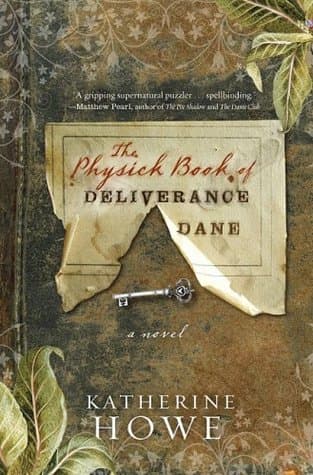
Synopsis
Covers the whole plot, including the ending.
- Difficulty
- Medium
- Pacing
- Moderate
- Mood
- Atmospheric, Suspenseful, Historical, Mysterious
- Read it if
- You enjoy historical mysteries with a supernatural twist, dual timelines, and strong female protagonists.
- Skip it if
- You prefer fast-paced thrillers or are not interested in detailed historical settings and research-driven plots.
The Physick Book of Deliverance Dane Plot Summary
Covers the whole plot, including the ending.
A Summer in Marblehead
Connie Goodwin, a Harvard graduate student, agrees to spend her summer in Marblehead, Massachusetts, preparing her grandmother's abandoned house for sale. Her mother, Chloe, insists on it, changing Connie's dissertation plans. The house is old, dusty, and full of forgotten items. While sorting, Connie finds an antique Bible in a chest. Inside, she discovers a small, carved wooden key and a yellowed piece of parchment with 'Deliverance Dane' written on it. This discovery sparks her academic interest, drawing her away from her dissertation topic and toward the house's past.
The Key and the Name
Curious about the key and the name 'Deliverance Dane,' Connie begins research. Her initial inquiries at local historical societies and libraries in Marblehead and Salem find little information about a woman by that name connected to the Salem witch trials. However, she learns more about the general history of the trials and the hysteria in Puritan New England. She becomes increasingly interested in the period's dark history, sensing a connection between her grandmother's house, the mysterious key, and the events of 1692. This search for knowledge starts to take over her summer.
A Glimpse into the Past
The story shifts to Andover, 1692, introducing Deliverance Dane. Deliverance is a skilled midwife, respected but also viewed with some suspicion by people, especially Reverend Johnson. She lives with her husband, Edward Dane, and their young son, Obadiah. As the witch hysteria spreads from Salem to Andover, Deliverance becomes vulnerable. Her knowledge of herbs and healing, once comforting, now seems like a sign of dealing with the Devil. The fear and accusations grow, threatening her family's safety and her life.
The Physick Book's Purpose
Connie continues her research, now focusing on the 'physick book.' She learns from historical texts and local legends about such books, which often contain herbal remedies, spells, and ancient knowledge, sometimes linked to those accused of witchcraft. She realizes that the 'physick book' associated with Deliverance Dane is not just remedies but a book of powerful, possibly dangerous, magic. The key she found, she suspects, is connected to this book, perhaps meant to unlock its secrets. Her search grows, driven by the belief that the book holds answers to Deliverance's fate and her own family's history.
Accusations and Betrayal
Back in 1692 Andover, the witch hysteria reaches Deliverance Dane. Several 'afflicted' girls, including Martha Carrier's daughter, accuse her of witchcraft, claiming to see her spectral form tormenting them. Deliverance is arrested and examined, maintaining her innocence and refusing to confess. Her husband, Edward, struggles to defend her against the overwhelming superstition and fear. Old resentments and belief in the Devil's work fuel the accusations, trapping Deliverance in a terrifying legal and spiritual battle with little hope of a fair trial.
Visions and Connections
As Connie learns more about Deliverance's story, she starts to have disturbing visions. These are not just academic thoughts but vivid sensations that transport her to 17th-century Salem and Andover, showing scenes from Deliverance's life and trial. She sees the spectral accusations, the fear in Deliverance's eyes, and the grim Puritan setting. These visions are confusing and frightening, making her question her sanity. At the same time, she feels a strong, almost spiritual, connection to Deliverance Dane, as if their lives are linked across centuries, suggesting a family or karmic tie she does not yet understand.
The Search for the Book
Connie realizes her academic research alone will not uncover the physick book. She seeks local experts, first contacting Professor Manning, a Salem historian, who initially dismisses her interest in Deliverance Dane. Later, she meets an elderly, reclusive woman named Rose, who lives nearby and knows a lot about local lore and the witch trials. Rose gives cryptic clues and hints, recognizing Connie's unique connection to the past. Rose's mysterious guidance helps Connie understand the physick book and its hidden location.
Deliverance's Escape
Imprisoned and facing death, Deliverance Dane, using her secret knowledge and the physick book, makes a desperate escape. She uses a powerful spell from the physick book, a power passed down through generations of women in her family, to free herself. This act is not just physical; it shows her deep connection to the earth and ancient magic. Her escape is difficult, showing her strength and will to survive, but it also strengthens the community's belief that she is a powerful witch, further entrenching her legend.
The Family Secret Revealed
Through Rose's guidance, her research, and the increasingly vivid visions, Connie discovers she is a direct descendant of Deliverance Dane. The physick book, the key, and the house are all part of her ancestral legacy. This revelation explains her intense connection to Deliverance and the powerful visions she has had. It turns her academic pursuit into a personal quest, forcing her to confront the dark history of the Salem witch trials and the hidden, magical heritage within her family. Her grandmother's house is a repository of her family's secrets.
The Unveiling of the Physick Book
Following clues left by her grandmother and guided by her visions, Connie finds the hidden physick book within the old house. The key she found in the Bible unlocks its secrets, revealing a hidden compartment. The book itself is old and fragile, filled with faded script, intricate drawings, and dried herbs. It contains herbal remedies, spells, and incantations, proving to be a true grimoire. As Connie reads its pages, she understands Deliverance's knowledge and the power that was within her ancestor, a power that now resonates within Connie herself.
The Legacy of Power
With the physick book and knowledge of her lineage, Connie must now deal with the implications of her magical heritage. She realizes that her ancestors' 'witchcraft' was a form of ancient, powerful knowledge and a connection to nature, misunderstood and feared by Puritan society. The book is not just a historical artifact; it is a living legacy, offering her access to powers she never imagined. She feels the weight of this inheritance, understanding that it brings both responsibility and potential danger. Her summer project has become a journey of self-discovery and the awakening of dormant abilities.
Confronting the Past
Connie begins to carefully experiment with some of the simpler remedies and spells in the physick book, seeing small but real results. She uses her new understanding to bring closure to Deliverance's story and, in doing so, to her own family's past. She realizes that true power is not in vengeance but in understanding and healing. Her journey ends with a deeper appreciation for her ancestors, a reconciliation with her family history, and an acceptance of her unique identity. The physick book bridges past and present, fear and understanding, allowing Connie to embrace her full self.
Principal Figures
Connie Goodwin
Protagonist
A Harvard graduate student who uncovers her family's magical past.
Connie Goodwin is a pragmatic, academically-minded Harvard doctoral student initially focused on her dissertation. She views the world through a lens of rational inquiry and historical fact. When thrust into her grandmother's abandoned house, her initial reluctance gives way to an insatiable curiosity as she uncovers clues about Deliverance Dane. She is intelligent, persistent, and initially skeptical, but open-minded enough to accept the magical truths she uncovers. Her journey is one of self-discovery, moving from a detached academic observer to an active participant in a centuries-old family legacy.
Relationships: Deliverance Dane (ancestor; shares a spiritual and genetic connection); Chloe Goodwin (mother; initially strained, but improves through shared understanding of family history); Rose (mentor/guide; provides cryptic but crucial information); Professor Manning (academic contact; initially dismissive, represents traditional historical views)
Deliverance Dane
Co-protagonist/Ancestral Figure
A skilled midwife accused of witchcraft in 1692 Andover.
Deliverance Dane is a strong-willed, intelligent woman living in Puritan New England. She possesses a deep knowledge of herbs, healing, and ancient, inherited magic, which she practices through her 'physick book.' She is devoted to her family but also fiercely independent and resilient in the face of persecution. Her healing abilities, while valued by some, make her vulnerable to suspicion and accusations during the Salem witch trials. She represents the wise women of the past whose knowledge was feared and condemned. Her quiet strength and refusal to confess define her character.
Relationships: Edward Dane (husband; supportive but ultimately helpless against the accusations); Obadiah Dane (son; she seeks to protect him above all else); Reverend Johnson (antagonist; represents the oppressive Puritanical authority); Connie Goodwin (descendant; their lives are spiritually intertwined)
Rose
Supporting
An enigmatic old woman who guides Connie to her family's past.
Rose is an elderly, reclusive woman living near Connie's grandmother's house. She possesses an intuitive, almost mystical understanding of the local history, particularly concerning the witch trials and the Dane family. She speaks in riddles and offers cryptic advice, but her wisdom proves invaluable to Connie's quest. Rose acts as a bridge between the present and the past, a keeper of ancient knowledge and secrets. She seems to understand Connie's lineage and destiny before Connie herself does, subtly nudging her towards the truth.
Relationships: Connie Goodwin (mentor/guide; shares ancestral knowledge and encourages Connie's quest)
Chloe Goodwin
Supporting
Connie's mother, who instigates Connie's move to Marblehead.
Chloe Goodwin is Connie's mother, a practical and somewhat distant figure who initiates Connie's summer in Marblehead by asking her to sell her grandmother's house. She represents the generation that has largely forgotten or suppressed the family's deeper history, focusing on mundane realities. While initially seeming to be a catalyst for Connie's inconvenience, her request ultimately leads to Connie's profound discovery. Her relationship with Connie is initially a bit strained, but improves as Connie uncovers their shared heritage.
Relationships: Connie Goodwin (daughter; their relationship evolves from functional to more understanding)
Edward Dane
Supporting
Deliverance Dane's loving but ultimately powerless husband.
Edward Dane is Deliverance's devoted husband. He is a good, honest man who loves his wife deeply and tries to protect her from the escalating accusations of witchcraft. However, he is a man of his time, bound by the rigid Puritanical society and its fear-driven justice system. His powerlessness in the face of the witch hysteria highlights the overwhelming forces Deliverance was up against. He represents the common man caught in extraordinary, terrifying circumstances, demonstrating loyalty and love even when facing the impossible.
Relationships: Deliverance Dane (husband; deeply loving and supportive)
Reverend Johnson
Antagonist
A rigid Puritan minister who contributes to the witch hysteria.
Reverend Johnson is a stern and dogmatic Puritan minister in Andover. He embodies the rigid religious fervor and fear of the Devil that fueled the Salem witch trials. He views Deliverance Dane's independent spirit and healing knowledge with suspicion, seeing it as a potential sign of her allegiance to dark forces. He is a primary force behind the accusations against Deliverance, driven by a sincere but misguided belief in rooting out evil. He represents the oppressive authority and societal pressures that condemned innocent people.
Relationships: Deliverance Dane (accuser/persecutor; views her as an agent of the Devil)
Obadiah Dane
Supporting
Deliverance and Edward Dane's young son.
Obadiah is the young son of Deliverance and Edward Dane. He is a vulnerable and innocent figure, representing what Deliverance is fighting to protect. His presence underscores the human cost of the witch trials, as families were torn apart and children left without parents due to unfounded accusations. His memory and the desire to secure his future are strong motivators for Deliverance's actions.
Relationships: Deliverance Dane (mother; she is fiercely protective of him); Edward Dane (father; they are united in their love for him)
Professor Manning
Supporting
A Salem historian Connie consults.
Professor Manning is a respected historian specializing in the Salem witch trials. He represents conventional academic wisdom and initial skepticism towards Connie's more unconventional discoveries. While knowledgeable about the general history, he is initially dismissive of Connie's specific interest in Deliverance Dane, whom he considers a minor, obscure figure. His character highlights the limitations of purely academic research when faced with hidden, mystical truths.
Relationships: Connie Goodwin (academic contact; initially dismissive of her specific research focus)
Themes & Insights
The Power of Ancestry and Legacy
The novel explores how the past shapes the present, especially through family lines. Connie's journey is a historical investigation and a rediscovery of her own lineage, showing that her ancestors, like Deliverance Dane, had unique powers and knowledge. The 'physick book' is a physical representation of this legacy, passed down through generations. Connie's visions and her connection to Deliverance show how ancestral trauma and gifts can echo across centuries, shaping identity. The book emphasizes that people are products of their past, whether they know it or not.
“The past was not a dead thing, she realized, but a living current that flowed through her, through the house, through the very land.”
Knowledge vs. Superstition
A main theme is the conflict between genuine knowledge, especially esoteric or natural knowledge, and the fear-driven superstition that condemns it. Deliverance Dane's understanding of herbs and healing, in her physick book, is seen as witchcraft by the Puritan community. This shows how fear and ignorance can demonize what is misunderstood or unconventional. Connie's modern scientific approach initially clashes with the magical reality she uncovers, forcing her to combine rational thought with ancient, mystical wisdom. The book suggests that true knowledge often goes beyond conventional understanding.
“What one generation called healing, another called witchcraft. It was all a matter of perspective, and power.”
The Peril of Mass Hysteria and Accusation
The Salem witch trials story reminds readers of the dangers of mass hysteria, false accusations, and the abuse of power. Deliverance's story shows how easily innocent people can be condemned when fear and religious extremism override reason and justice. The 'afflicted girls' and zealous ministers represent the destructive force of collective delusion. The novel also draws parallels to other times when fear of 'the other' led to persecution, urging readers to be watchful against such forces. It highlights how fragile justice is when panic spreads.
“Fear was a powerful contagion, spreading faster than any fever, and just as deadly.”
Female Empowerment and Agency
The novel explores themes of female empowerment through Deliverance Dane's character. In a society that controlled women, Deliverance's knowledge, healing abilities, and secret powers gave her agency and self-preservation. Her physick book symbolizes this independent female knowledge, passed down through women. Connie's journey mirrors this, as she gains agency by embracing her ancestral powers, moving beyond academic pursuits to a more intuitive, empowered self. The book celebrates the strength and resilience of women throughout history.
“Some knowledge, once held by women, was too powerful to be forgotten, even if it had to be hidden.”
Plot Devices & Literary Techniques
The Physick Book
A grimoire containing ancestral knowledge, spells, and remedies.
The physick book is the central plot device, serving as both a tangible artifact and a symbolic representation of Deliverance Dane's hidden powers and the family's magical legacy. It acts as the primary MacGuffin that drives Connie's investigation in the present and reveals Deliverance's practices in the past. More than just a book, it is a repository of ancient, often feared, female knowledge, containing herbal remedies, incantations, and spells. Its discovery and deciphering are crucial for Connie to understand her ancestry and unlock her own dormant abilities, bridging the gap between historical fact and magical reality.
The Key and Parchment
Physical clues linking Connie to Deliverance Dane.
The intricately carved wooden key and the accompanying parchment with 'Deliverance Dane' written on it serve as the initial inciting incident and crucial plot devices. They are the first tangible clues Connie finds, sparking her academic curiosity and setting her on her quest. The key hints at a hidden lock or secret, while the name provides the focus for her research. These items are more than just historical curiosities; they are direct physical links between Connie's present and Deliverance's past, symbolizing the unlocking of family secrets and the initiation into a hidden world.
Visions and Dreams
Supernatural experiences connecting Connie to Deliverance's past.
As Connie delves deeper into Deliverance's story, she experiences vivid, almost corporeal visions and dreams that transport her to 17th-century Salem and Andover. These are not merely imaginative projections but seem to be inherited memories or spiritual connections. This device serves to blur the line between historical research and supernatural experience, allowing Connie (and the reader) to directly witness Deliverance's trials and tribulations. The visions are crucial for revealing plot points from the past that Connie could not discover through conventional research, and they strengthen her personal connection to Deliverance, hinting at their shared lineage.
Dual Narrative Structure
Alternating chapters between Connie's present and Deliverance's past.
The novel employs a dual narrative structure, alternating between Connie Goodwin's contemporary investigation in Marblehead and Deliverance Dane's harrowing experiences during the Salem witch trials in 1692. This device allows the author to build suspense and reveal information gradually, creating parallels and thematic connections between the two timelines. The past narrative provides context and emotional depth to Connie's discoveries, while the present narrative gives urgency and purpose to her historical quest. It highlights how historical events continue to resonate and impact lives centuries later, weaving a complex tapestry of fate and inheritance.
The Physick Book of Deliverance Dane Quotes
“Do not meddle in the affairs of witches, for you are crunchy and taste good with ketchup.”
“The past is not dead. It is not even past.”
“There are some things that are true whether you believe them or not.”
“History, like a living thing, can be both a comfort and a curse.”
“Sometimes the only way to move forward is to look back.”
“Fear can make people do terrible things, even to those they love.”
“The line between magic and science is often blurred, depending on who is doing the looking.”
“Every secret has a life of its own, and sometimes, it demands to be told.”
“Some questions are not meant to be answered, only to be lived with.”
“The strongest spells are woven with the threads of memory and desire.”
“What is hidden in plain sight is often the most difficult to see.”
“The truth has a way of finding its own voice, no matter how long it has been silenced.”
“Sometimes, the greatest strength lies in knowing when to let go.”
“The echo of a voice can carry more weight than the voice itself.”
Quiz
10 questions on the plot and the characters. Each answer comes with a short explanation.
Question 1
What is Connie Goodwin's academic pursuit when she is called to handle her grandmother's abandoned home?
- Medical research for a new cure
- Doctoral dissertation research in history
- Archeological excavation planning
- Literary analysis of colonial texts
Show answer
B. Doctoral dissertation research in history Connie is a Harvard graduate student who needs to spend her summer doing research for her doctoral dissertation.
Question 2
What specific item does Connie discover within a seventeenth-century Bible that initiates her quest?
- A valuable gold coin
- A lock of hair and a locket
- An ancient key with a parchment fragment
- A hidden map to buried treasure
Show answer
C. An ancient key with a parchment fragment Connie discovers an ancient key within a seventeenth-century Bible, which contains a yellowing fragment of parchment with the name 'Deliverance Dane' on it.
Question 3
What is the name of the rare artifact of singular power that Connie seeks to unearth?
- The Book of Shadows
- The Salem Grimoire
- The Physick Book
- The Witch's Almanac
Show answer
C. The Physick Book Connie's discovery launches her on a quest to find out who Deliverance Dane was and to unearth a rare artifact of singular power: a physick book.
Question 4
During which historical period do the 'harrowing stories' and 'visions' that haunt Connie take place?
- The American Revolutionary War
- The Salem witch trials of the 1690s
- The Great Depression
- The Victorian era in New England
Show answer
B. The Salem witch trials of the 1690s The book moves between contemporary times and the Salem witch trials of the 1690s, and Connie is haunted by visions of the long-ago witch trials.
Question 5
What is the primary genre combination of 'The Physick Book of Deliverance Dane'?
- Science Fiction, Romance, Thriller
- Fantasy, Historical Fiction, Mystery
- Contemporary, Horror, Biography
- Young Adult, Adventure, Dystopian
Show answer
B. Fantasy, Historical Fiction, Mystery According to the provided information, the book's genres are 'Fantasy, Historical Fiction, Mystery'.
Question 6
What is the significance of the name 'Deliverance Dane' written on the parchment fragment?
- It is the name of Connie's long-lost grandmother.
- It is the name of a key figure from the Salem witch trials whose story Connie investigates.
- It is a coded message indicating the location of the physick book.
- It refers to the author of the seventeenth-century Bible.
Show answer
B. It is the name of a key figure from the Salem witch trials whose story Connie investigates. The discovery of the name Deliverance Dane launches Connie on a quest to find out who this woman was, connecting her to the past events of the witch trials.
Question 7
How does the narrative structure of the novel contribute to its themes?
- It focuses solely on the past to provide a historical account.
- It uses a single, linear timeline to build suspense.
- It travels seamlessly between the 1690s and modern times, linking past and present mysteries.
- It employs multiple unreliable narrators from different eras.
Show answer
C. It travels seamlessly between the 1690s and modern times, linking past and present mysteries. The novel 'travels seamlessly between the witch trials of the 1690s and a modern woman's story of mystery, intrigue, and revelation,' emphasizing the connection between eras.
Question 8
What specific fear begins to plague Connie as she unravels Deliverance's story?
- That she will fail her doctoral dissertation due to distractions.
- That her family home is haunted by malevolent spirits.
- That she is more tied to Salem's dark past than she could have imagined.
- That the physick book will fall into the wrong hands.
Show answer
C. That she is more tied to Salem's dark past than she could have imagined. As the pieces of Deliverance's harrowing story begin to fall into place, Connie begins to fear that she is more tied to Salem's dark past than she could have ever imagined.
Question 9
How is the 'physick book' described in terms of its content and power?
- It is a collection of ancient poetry and philosophical musings.
- It is a diary detailing the daily life of colonial women.
- Its pages are a secret repository for lost knowledge, making it an artifact of singular power.
- It contains prophecies about future events in American history.
Show answer
C. Its pages are a secret repository for lost knowledge, making it an artifact of singular power. The physick book is described as a 'rare artifact of singular power' whose 'pages a secret repository for lost knowledge.'
Question 10
What role does Connie's mother play in initiating Connie's journey to Salem?
- She explicitly asks Connie to research her family's witch trial history.
- She tasks Connie with handling the sale of her grandmother's abandoned home near Salem.
- She sends Connie a mysterious package containing the ancient key.
- She reveals her own hidden past as a descendant of a witch.
Show answer
B. She tasks Connie with handling the sale of her grandmother's abandoned home near Salem. Connie's mother asks her to handle the sale of Connie's grandmother's abandoned home near Salem, which draws Connie into the mysteries.
The Physick Book of Deliverance Dane FAQ
What is the central mystery Connie Goodwin attempts to solve in the contemporary storyline?
Connie Goodwin's central mystery involves uncovering the identity of Deliverance Dane and locating a powerful, lost artifact known as Deliverance's physick book. Her quest is sparked by finding an ancient key with Deliverance's name on a parchment fragment inside a 17th-century Bible in her grandmother's abandoned house near Salem.
Who is Deliverance Dane, and what is her significance in the historical narrative?
Deliverance Dane is a young woman living in Salem during the tumultuous period of the witch trials in the 1690s. She is a healer and a practitioner of folk magic, inheriting her knowledge from her mother, which ultimately makes her a target of suspicion and persecution during the trials.
How does the author connect Connie Goodwin's modern-day research to the historical events of the Salem witch trials?
The author connects Connie's research to the past through a series of discoveries: the key with Deliverance's name, the physick book, and ultimately, the revelation of a direct ancestral link between Connie and Deliverance Dane. This lineage explains Connie's growing visions and her deep, almost psychic, connection to the historical events.
What is the 'physick book' and why is it considered an artifact of 'singular power'?
The physick book is a collection of herbal remedies, spells, and ancient knowledge passed down through generations of women, including Deliverance Dane. It is considered an artifact of singular power because it contains not only healing lore but also protective charms and potentially dangerous, forgotten magic, making it a target for those who seek to control its power.
What role does Cotton Mather play in the historical sections of the novel?
Cotton Mather appears as a prominent historical figure during the Salem witch trials, representing the zealous religious authority and intellectual justification behind the persecutions. His writings and influence contribute to the atmosphere of fear and the legal framework that condemns women like Deliverance.
What is the significance of the specific location of Connie's grandmother's house near Salem?
The house's location is crucial because it is the ancestral home of Deliverance Dane, containing hidden remnants and clues to her past. It acts as a physical conduit between the two timelines, storing the key, the Bible, and later, revealing the true resting place of the physick book, directly linking Connie to the land and its history.
Are there any subtle clues early in the book that hint at Connie's direct lineage to Deliverance Dane?
Early clues include Connie's unexplained vivid dreams and visions of the 17th century, her intuitive pull towards certain objects and locations in her grandmother's house, and a sense of unease or familiarity with the historical narratives she uncovers, all subtly hinting at a deeper, inherited connection.
How does the author use the motif of 'seeing' or 'vision' to connect the two storylines?
The motif of 'seeing' is central, manifesting as Connie's increasingly vivid visions and dreams of Deliverance's life, almost as if she is witnessing the past directly. This supernatural 'seeing' bridges the gap between the centuries, allowing Connie to experience Deliverance's trials and tribulations firsthand, rather than just reading about them.
How does Connie's academic background as a Harvard graduate student influence her approach to the mystery?
Connie's academic background initially grounds her in a rational, evidence-based approach to history, making her skeptical of supernatural elements. However, as she uncovers more compelling and personal evidence, her academic rigor helps her meticulously piece together the historical narrative, even as she grapples with the increasingly inexplicable occurrences.
Discuss the psychological impact of the Salem witch trials on Deliverance Dane and other accused women.
The trials inflicted immense psychological trauma, isolating accused women like Deliverance from their communities and families, forcing confessions under duress, and instilling profound fear of persecution and death. The constant threat of accusation and the public spectacle of trials stripped them of their dignity and sanity.
How does Connie's emotional state evolve as she delves deeper into Deliverance's story?
Connie's emotional state shifts from initial academic curiosity to growing obsession, fear, and eventually, a deep sense of empathy and responsibility towards Deliverance. She becomes increasingly haunted by the past, feeling a profound personal connection and a drive to seek justice or understanding for her ancestor.
What psychological pressures did Deliverance face in deciding whether to use her 'gifts' and knowledge?
Deliverance faced intense psychological pressure, torn between using her healing gifts, which were essential to her community but also dangerous given the climate, and concealing them to ensure her safety. Her decision to help others, despite the risks, highlights her courage and sense of duty, but also her vulnerability.
To what extent can 'The Physick Book of Deliverance Dane' be considered a feminist novel?
The novel can be seen as feminist through its focus on women's knowledge, power, and persecution throughout history. It highlights how female wisdom (healing, intuition) was demonized, and celebrates the resilience and interconnectedness of women across generations, particularly in the face of patriarchal oppression.
What is the author's message about the dangers of mass hysteria and religious extremism, as depicted in the Salem witch trials?
The author powerfully illustrates the devastating consequences of mass hysteria and religious extremism, showing how fear, superstition, and rigid dogma can quickly dismantle rational thought and lead to brutal persecution. The novel serves as a cautionary tale about the fragility of justice and the dangers of unchecked power.
How does the novel explore the concept of inherited memory or ancestral trauma?
The novel explores inherited memory through Connie's vivid visions and her almost visceral connection to Deliverance's experiences, suggesting that trauma and knowledge can be passed down through generations. Connie's quest becomes a process of confronting and healing this ancestral trauma, not just solving a mystery.
Is the ending of the novel conclusive regarding the fate of the physick book, or does it leave room for further interpretation?
The ending provides a sense of resolution regarding the physick book's discovery and its significance to Connie. While its immediate fate is clear, the broader implications of its power and the potential for its knowledge to continue influencing future generations are left open, suggesting its enduring, mystical presence.
What is the significance of the 'key' found in the Bible, beyond just having Deliverance's name on it?
The key is a symbolic object representing access to hidden knowledge and unlocking secrets from the past. Its presence within the Bible, an object of religious authority, suggests that the 'forbidden' knowledge of the physick book was intentionally hidden within plain sight, protected by a veneer of sanctity, waiting for the right descendant to find it.
How does the portrayal of historical figures like Cotton Mather contribute to the novel's themes?
Mather's portrayal underscores the theme of intellectual and religious authority being misused, leading to persecution. He embodies the rigid, patriarchal mindset that condemned women for their independent knowledge and spiritual practices, highlighting the conflict between established power and individual freedom.
About the author

Katherine Howe is an author known for her works of fiction, particularly "The Physick Book of Deliverance Dane," which explores themes of witchcraft and history. Her writing often blends elements of the supernatural with historical narratives, reflecting her interest in the past and its impact on the present.
Similar books
- A Discovery of Witches
Deborah Harkness
4.0 (369k) average on GoodreadsFantasyFeatures a female academic protagonist discovering a magical legacy tied to ancient texts and historical figures.
- The Mists of Avalon
Marion Zimmer Bradley
4.1 (192k) average on GoodreadsFantasyExplores female power, ancient knowledge, and historical events through a mystical lens.
- The Crucible
Arthur Miller
3.6 (323k) average on GoodreadsHistorical FictionMiller's play offers a more allegorical and dramatic portrayal of the Salem Witch Trials, focusing on mass hysteria and political parallels. Howe's novel provides a more granular, historically specific, and personal account of the trials' impact on individuals and families, though it lacks Miller's stark, universal thematic resonance.
- Harry Potter and the Sorcerer's Stone
J.K. Rowling
4.5 (7M) average on GoodreadsFantasyRescued from a miserable life under the stairs, an orphaned boy discovers he's a wizard destined for a magical school, where he uncovers a dangerous secret tied to the dark wizard who murdered his parents.
- The Hunger Games
Suzanne Collins
4.3 (6.4M) average on GoodreadsFantasyIn a future where children fight to the death on live television, Katniss Everdeen volunteers for the arena, turning a death sentence into a fight for survival and a spark of rebellion.
- 1984
George Orwell
4.2 (3.1M) average on GoodreadsPoliticsIn a future where surveillance and thought control are absolute, a man's search for truth clashes with the Party, showing that hope can be a form of rebellion.





Enjoyed the summary?
A summary gives you the shape of the book. The book itself has the detail, the examples and the voice.
Find The Physick Book of Deliverance Dane on AmazonAs an Amazon Associate, BookBrief earns from qualifying purchases. How we're funded