
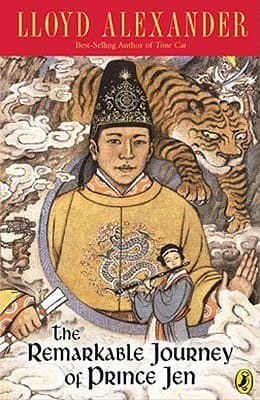
Synopsis
Covers the whole plot, including the ending.
- Difficulty
- Easy
- Pacing
- Moderate
- Mood
- Whimsical, Adventurous, Reflective, Hopeful
- Read it if
- You enjoy classic quest narratives with allegorical undertones, character-driven coming-of-age stories, or lighthearted fantasy adventures inspired by East Asian folklore.
- Skip it if
- You prefer gritty, dark fantasy, or stories with complex magic systems and intricate world-building over character development and moral lessons.
The Remarkable Journey of Prince Jen Plot Summary
Covers the whole plot, including the ending.
The Quest Begins
Prince Jen, heir to Tungho, is a spirited but naive young man who wants adventure. When an old prophecy mentions the legendary court of T'ien-kuo, a place of wisdom and peace, Jen volunteers to find it. His father, the Emperor, consults an old man named Master Hu, who gives Jen six ordinary gifts: a saddle, a sword, a paint box, a bowl, a kite, and a flute. Master Hu warns Jen that the gifts are not what they seem and their true purpose will only be revealed during his journey. Jen, with his loyal but anxious servant Mafoo, leaves Tungho, full of youthful confidence and a sense of destiny, though confused by the simple gifts.
The First Misfortunes and the Saddle's Lesson
Soon after leaving Tungho, Jen and Mafoo face problems. Their best horse, meant for Jen, is stolen, and Jen must ride a small, stubborn donkey. This humbling experience, along with the difficult journey, starts to chip away at Jen's pride. He first thinks the saddle Master Hu gave him is useless without a grand horse. However, when the donkey throws him, Jen realizes the saddle, though plain, gives stability and comfort, no matter the animal. This incident suggests that the gifts have deeper, metaphorical meanings beyond their literal looks, making Jen question his ideas about status and value.
The Bandits and the Sword's True Purpose
Jen and Mafoo are attacked by bandits led by General Tsei-wei. Jen, using the sword from Master Hu, tries to fight them with force but is easily beaten. Mafoo, despite his fear, distracts the bandits, letting Jen escape, though they lose most of their belongings. Jen is discouraged by his failure. Later, they find a village being robbed by the same bandits. Jen realizes the sword's purpose is not just for personal fighting, but for defending the innocent and upholding justice, even when outnumbered. He uses it to disarm and outsmart the bandits, instead of fighting directly, securing the villagers' safety.
The Artist and the Paint Box
Continuing their journey, Jen and Mafoo find a reclusive artist named Master Wu, who lives in poverty but creates beautiful art. Jen, still focused on the practicalities of their journey, first sees the paint box as useless. Master Wu, however, shows how the paint box, with simple colors, can change perception and create beauty from ordinary things. He teaches Jen that true art is not just about skill, but about seeing the world with an open heart and mind, and capturing the essence of things. This meeting broadens Jen's understanding of value beyond material wealth and physical power.
The Hermit and the Empty Bowl
Jen and Mafoo find themselves in a barren area, suffering from hunger and thirst. They meet a wise, elderly hermit who owns little but shares what he has. Jen, still focused on his own needs, is confused by the empty bowl Master Hu gave him, seeing no practical use for it. The hermit shows that the bowl is meant to be filled not just with food for oneself, but with generosity for others. He explains that true nourishment comes from sharing and receiving, and that an empty bowl can symbolize a readiness to give and accept help. This lesson deeply affects Jen, teaching him compassion and interdependence.
Voyaging Moon and the Kite's Ascent
Jen and Mafoo arrive in a town where they meet Voyaging Moon, a spirited and independent girl who plays the flute well. Voyaging Moon is trying to help her poor community. Jen, at first interested in her, is still somewhat self-absorbed. The kite, one of Master Hu's gifts, seems the most frivolous. However, Voyaging Moon, through her determination and her dreams for her people, inspires Jen. Together, they use the kite not just for play, but as a symbol of hope and a way to send messages of encouragement. Jen realizes the kite means aspiration, the ability to reach for higher goals, and to lift spirits even in hard times, a lesson he learns alongside Voyaging Moon's own resilience.
The Flute's Melody and Inner Harmony
As Jen and Voyaging Moon become closer, she teaches him to play the flute. At first, Jen struggles, making only harsh sounds. Voyaging Moon patiently guides him, explaining that true music comes from within, from a harmonious spirit. The flute, the final gift, becomes a symbol for self-expression, communication, and finding inner peace. By learning to play, Jen starts to understand himself better, to listen more carefully, and to express his emotions and thoughts in a new way. The music they create together symbolizes their growing bond and Jen's developing maturity, as he learns to blend his own voice with others.
The Betrayal and the Test of Leadership
During their travels, Mafoo, overcome by fear and hardship, briefly betrays Jen by trying to leave him and return to Tungho. This act deeply hurts Jen, shaking his trust. However, after thinking and talking with Voyaging Moon, Jen realizes Mafoo's actions came from fear, not malice. He chooses to forgive Mafoo, understanding that true leadership involves compassion and inspiring loyalty rather than demanding it. This incident strengthens Jen's growth, showing his capacity for empathy and his changing understanding of human nature, making him a more effective and understanding leader.
The Confrontation with General Tsei-wei
Jen, Voyaging Moon, and Mafoo eventually confront General Tsei-wei and his bandits again, who are now threatening a larger area. This time, Jen is not the naive prince who first met them. He uses the lessons from the gifts: the sword for strategic defense, the saddle for steady leadership, the paint box for creative problem-solving, the empty bowl for inspiring generosity among the villagers, the kite for communication and morale, and the flute for unity and courage. With Voyaging Moon's bravery and Mafoo's renewed loyalty, they gather the local people and, through cleverness and cooperation, defeat General Tsei-wei, bringing peace to the region.
Reaching T'ien-kuo
After their victory over General Tsei-wei, Jen, Voyaging Moon, and Mafoo continue their journey, feeling a sense of purpose. They eventually arrive at a simple, unadorned place that is T'ien-kuo. It is not a grand court as Jen had imagined, but a peaceful community of wise individuals. Jen realizes that the true 'court' was never a physical place of splendor, but the wisdom, compassion, and leadership he developed through his trials. The journey itself, and the lessons from the six gifts, changed him into a wise and just ruler worthy of understanding T'ien-kuo's true meaning. He has found the legendary court within himself.
The Return to Tungho
Prince Jen, now a mature and enlightened young man, returns to Tungho with Voyaging Moon and Mafoo. He is no longer the proud and naive boy who left. His experiences have given him humility, wisdom, and a deep understanding of his people and the world. He brings back not material treasures, but the valuable lessons learned from Master Hu's gifts. His father, the Emperor, and the people of Tungho see the profound change in him. Jen is now truly prepared to rule, not just by birthright, but by character, ready to apply the wisdom of T'ien-kuo to his own kingdom, promising a reign of justice, compassion, and peace.
Principal Figures
Prince Jen
Protagonist
The young, initially naive prince of Tungho on a quest for wisdom.
Prince Jen begins as a spirited but proud and somewhat arrogant young man, eager for adventure and glory. He is initially self-absorbed and struggles with the practicalities of his quest, often misunderstanding the true purpose of Master Hu's gifts. His journey is marked by a series of misfortunes that force him to confront his flaws. He possesses an underlying good heart and a capacity for learning, which gradually surfaces as he faces challenges and interacts with various characters.
Relationships: Mafoo (Loyal but fearful servant, initially a foil to Jen's arrogance, later a trusted companion.); Voyaging Moon (Love interest and spiritual guide, who helps Jen understand compassion and the flute's meaning.); Master Hu (Mysterious mentor who provides the enigmatic gifts and sets Jen on his quest.); Emperor (Jen's father, who sends him on the quest to find wisdom.)
Mafoo
Supporting
Prince Jen's loyal but perpetually anxious and practical servant.
Mafoo is Jen's faithful servant, characterized by his constant worrying, practical nature, and deep-seated fear. He often serves as a foil to Jen's initial impulsiveness and pride, voicing the common-sense concerns Jen often ignores. Despite his timidity, Mafoo possesses a core of loyalty and courage that emerges when Jen is in true danger. His internal struggles with fear and his brief betrayal highlight the human element of the journey and Jen's growing capacity for forgiveness and understanding.
Relationships: Prince Jen (Master and servant, evolving into a bond of deep loyalty and friendship.)
Voyaging Moon
Supporting
A brave, compassionate, and musically gifted girl who becomes Jen's companion and love interest.
Voyaging Moon is a spirited and independent young woman who embodies compassion, resilience, and a deep connection to the arts, particularly music. She is practical and resourceful, often helping Jen and Mafoo navigate difficult situations. Her ability to play the flute beautifully and her selfless desire to help her community inspire Jen. She serves as a moral and emotional guide for Jen, helping him understand the deeper meanings of the gifts and the importance of empathy and inner harmony.
Relationships: Prince Jen (Friend, mentor in music and compassion, and eventual love interest.); Mafoo (Fellow traveler and companion, often sharing his anxieties.)
Master Hu
Supporting
The mysterious old man who bestows the six enigmatic gifts upon Prince Jen.
Master Hu is an enigmatic and wise figure who appears briefly at the beginning of the story. He serves as the catalyst for Jen's journey, providing the seemingly simple yet profoundly symbolic gifts. He speaks in riddles and offers cryptic warnings, setting the stage for Jen's personal growth. Though his physical presence is limited, his influence pervades the entire narrative, as Jen constantly grapples with the meaning of his gifts. He represents the ancient wisdom and guiding forces of the world.
Relationships: Prince Jen (Mentor and guide, though their interaction is brief and indirect.)
General Tsei-wei
Antagonist
A ruthless bandit leader who repeatedly threatens Jen and the common people.
General Tsei-wei is the primary antagonistic force in the story, representing the chaotic and destructive aspects of the world. He is a formidable and cruel bandit leader who preys on the innocent, embodying the challenges of injustice and brute force that Jen must overcome. His repeated appearances force Jen to apply the lessons learned from his gifts, particularly the sword, in confronting evil not just through strength, but through wisdom and strategy.
Relationships: Prince Jen (Antagonist, representing the external evils Jen must combat.)
Master Wu
Supporting
A reclusive artist who teaches Jen about perception and the beauty of creation.
Master Wu is a kind and insightful artist living in poverty, yet creating magnificent works. He teaches Jen that true value lies not in material wealth but in the ability to perceive beauty and to create. Through his interaction, Jen begins to understand the deeper meaning of the paint box and the importance of seeing beyond superficial appearances. He is a gentle mentor who opens Jen's eyes to the world of art and inner vision.
Relationships: Prince Jen (Temporary mentor, teaching Jen about art and perspective.)
The Hermit
Supporting
A wise, elderly figure who teaches Jen the lesson of generosity and sharing.
The Hermit is a humble and generous old man living in solitude. Despite his lack of possessions, he freely shares what little he has, demonstrating the true meaning of the empty bowl. He teaches Jen about the interconnectedness of life, the importance of giving, and that true sustenance comes from sharing with others. His wisdom helps Jen move beyond self-interest towards compassion and community.
Relationships: Prince Jen (Temporary mentor, teaching Jen about generosity and interdependence.)
Themes & Insights
The Journey of Self-Discovery
The main theme is Prince Jen's change from a naive, proud youth to a wise and compassionate leader. His physical quest for T'ien-kuo symbolizes his internal journey of self-discovery. Each challenge he faces, and each lesson from the six gifts, removes a layer of his initial arrogance and ignorance, showing his true potential. This theme is clear from his confident departure to his return as a mature ruler, understanding that the true 'court' was the wisdom he gained within himself, not a physical place. The journey's difficulties are key to his growth.
“The greatest treasure is not what you find, but what you become.”
The Nature of True Wisdom and Power
The book explores the idea that true wisdom and power are not found in wealth, status, or brute force, but in humility, compassion, and understanding. Jen first seeks glory and power through traditional means (a grand horse, a sharp sword), but he learns that real strength comes from empathy (the empty bowl), creativity (the paint box), spiritual aspiration (the kite), effective communication (the flute), and steady leadership (the saddle). His defeat of General Tsei-wei is not through greater force, but by using these nuanced forms of wisdom. T'ien-kuo itself shows this theme, being a place of quiet wisdom rather than showy grandeur.
“A king rules not by the strength of his arm, but by the wisdom of his heart.”
The Meaning of the Gifts
Each of Master Hu's six gifts is a powerful symbol, representing a different part of Jen's character development and the virtues he must learn. The saddle teaches humility and steady purpose, regardless of outside circumstances. The sword means justice and strategic defense, not just aggression. The paint box represents perception, creativity, and finding beauty. The empty bowl symbolizes generosity and human connection. The kite stands for aspiration, hope, and rising above challenges. The flute embodies inner harmony, self-expression, and communication. Together, they form a complete course for Jen's moral and spiritual education, showing that the most valuable tools often have the deepest symbolic meaning.
“The gifts are not what they seem, Prince Jen. Their true purpose will unfold as you do.”
The Importance of Companionship and Loyalty
Jen's journey is not alone; his relationships with Mafoo and Voyaging Moon deeply shape it. Mafoo's constant, though fearful, loyalty provides a steady anchor and shows Jen his own growth. Voyaging Moon offers not only love but also important lessons in compassion, music, and resilience. Mafoo's brief betrayal highlights the fragility of trust and the importance of forgiveness and understanding in keeping relationships strong. Their combined efforts are essential in overcoming obstacles, showing that even a prince needs the support and wisdom of others to succeed. The theme emphasizes that true leadership involves building loyalty and working with others.
“No journey is truly taken alone, for our companions shape the path as much as we do.”
Plot Devices & Literary Techniques
The Six Gifts
A set of seemingly ordinary objects that serve as symbolic tools for Prince Jen's education.
The six gifts—a saddle, a sword, a paint box, a bowl, a kite, and a flute—are the central plot device. They function as both literal objects that Jen carries and metaphorical lessons he must learn. Each gift is introduced at the beginning as an enigma, and its true meaning is revealed through Jen's experiences and interactions with various characters. They provide a clear structure for Jen's character arc, with each gift corresponding to a specific virtue or understanding he must acquire. They act as a test, a guide, and ultimately, a symbol of his transformation.
The Quest/Hero's Journey
Prince Jen's journey to find the legendary court of T'ien-kuo, following a classic narrative structure.
The entire narrative is framed as a classic Hero's Journey. Prince Jen receives a call to adventure (the quest for T'ien-kuo), crosses the threshold from his familiar world, faces trials and tribulations, gains allies (Mafoo, Voyaging Moon), encounters mentors (Master Hu, Master Wu, the Hermit), experiences a symbolic death and rebirth (his transformation), and ultimately returns to his world as a changed individual. This structure provides a universal framework for understanding Jen's growth and the archetypal nature of his journey.
Foil Characters
Characters who highlight the protagonist's traits or flaws through contrast.
Mafoo serves as a significant foil to Prince Jen. Mafoo's constant fear and practicality contrast sharply with Jen's initial arrogance and idealism, making Jen's growth in humility and courage more apparent. General Tsei-wei acts as a villainous foil, representing the destructive power Jen must overcome, highlighting the difference between brute force and wise leadership. These characters emphasize Jen's development by providing points of comparison and conflict that force him to evolve.
Symbolism
The use of objects, characters, and places to represent deeper ideas or qualities.
Beyond the explicit symbolism of the six gifts, the novel employs broader symbolism. T'ien-kuo itself symbolizes inner peace, wisdom, and enlightenment rather than a physical kingdom. The journey through diverse landscapes symbolizes the varied experiences and challenges of life. The music played on the flute symbolizes harmony, connection, and the expression of the soul. This rich symbolism elevates the narrative beyond a simple adventure story, inviting readers to consider deeper philosophical and moral lessons.
The Remarkable Journey of Prince Jen Quotes
“Go to the end of the world, if you must, but bring back wisdom.”
“A journey of a thousand miles begins with a single step, but it is the steps after that truly test the traveler.”
“One does not choose wisdom; wisdom chooses the one who seeks it.”
“The greatest treasure is not what you find, but what you become in the finding.”
“Sometimes the shortest path to a goal is the one that seems longest.”
“True strength is not in never falling, but in rising every time you fall.”
“Fear is a fog that blinds the eyes and chills the heart, but it can be swept away by a single ray of courage.”
“A good deed, however small, can ripple outward to touch many lives.”
“The world is full of wonders, if only you open your eyes to see them.”
“Love is a bridge that can span the widest chasms.”
“Even the mightiest emperor is but a man, and wisdom is his truest crown.”
“To truly know oneself, one must first lose oneself.”
“The greatest battles are not fought with swords, but within the heart.”
“Sometimes, the answers you seek are not found in distant lands, but in the heart of your own home.”
Quiz
10 questions on the plot and the characters. Each answer comes with a short explanation.
Question 1
What is the initial reason Prince Jen volunteers to search for the legendary court of T'ien-kuo?
- He is forced by his father, the Emperor.
- He seeks adventure and to prove his worth.
- He is banished from his own kingdom.
- He is searching for a lost family heirloom.
Show answer
B. He seeks adventure and to prove his worth. Prince Jen, full of high spirits and pride, volunteers for the journey, driven by a desire for adventure and to distinguish himself.
Question 2
Which of the following is NOT one of the six gifts given to Prince Jen by the mysterious old man?
- A sword
- A book
- A flute
- A paint box
Show answer
B. A book The six gifts are a saddle, a sword, a paint box, a bowl, a kite, and a flute. A book is not among them.
Question 3
What is the name of Prince Jen's faithful servant who accompanies him on his journey?
- Lord Chu
- Mafoo
- Kao
- Master Ling
Show answer
B. Mafoo The book explicitly states that Prince Jen is accompanied by his faithful servant, Mafoo.
Question 4
How does Prince Jen initially perceive the six gifts given to him?
- He immediately understands their symbolic meaning.
- He finds them practical and useful for his journey.
- He is puzzled by them and their apparent lack of immediate utility.
- He dismisses them as worthless trinkets.
Show answer
C. He is puzzled by them and their apparent lack of immediate utility. The description states Jen is 'Puzzled by the gifts,' indicating he doesn't immediately grasp their significance.
Question 5
What is the profession or skill of Voyaging Moon, the girl who joins Prince Jen?
- She is a skilled warrior.
- She is a talented artist.
- She is a flute-girl.
- She is a wise scholar.
Show answer
C. She is a flute-girl. The summary clearly identifies her as a 'valiant flute-girl, Voyaging Moon.'
Question 6
What is the primary challenge Prince Jen faces early in his journey, despite his initial high spirits?
- He immediately encounters hostile armies.
- He finds himself lost in an uncharted wilderness.
- He stumbles almost immediately into a series of misfortunes.
- He is betrayed by his own servant, Mafoo.
Show answer
C. He stumbles almost immediately into a series of misfortunes. The text states, 'Jen sets off, but stumbles almost immediately into a series of misfortunes,' highlighting his early struggles.
Question 7
What is the ultimate purpose of the six gifts given to Prince Jen, as he discovers through his journey?
- They are magical artifacts that grant him special powers.
- They are tokens to bribe powerful figures he meets.
- They represent virtues and skills he must learn to master himself.
- They are clues leading him to a hidden treasure.
Show answer
C. They represent virtues and skills he must learn to master himself. The summary indicates Jen must 'discover the real meaning of the gifts and face his true destiny,' implying they are symbolic of his personal growth and learning.
Question 8
What does Prince Jen's initial 'high spirits and pride' at the start of his journey foreshadow about his character development?
- That he is inherently a good leader who will face no personal challenges.
- That he will need to overcome arrogance and learn humility and wisdom.
- That he will maintain these qualities throughout his adventure without change.
- That his journey will be purely physical, with no internal transformation.
Show answer
B. That he will need to overcome arrogance and learn humility and wisdom. In many hero's journeys, initial pride often leads to a fall and subsequent growth. Given his 'series of misfortunes' and the need to 'discover the real meaning of the gifts,' Jen's early pride suggests a journey of character development.
Question 9
The description mentions 'a breathtakingly exciting string of adventures.' This suggests the narrative structure will heavily rely on what literary device?
- Extensive internal monologue and philosophical debate.
- A series of episodic challenges and encounters.
- A single, overarching conflict resolved in one major confrontation.
- Flashbacks and non-linear storytelling.
Show answer
B. A series of episodic challenges and encounters. A 'string of adventures' implies multiple distinct, yet connected, events or episodes that contribute to the overall journey.
Question 10
What does 'facing his true destiny' imply for Prince Jen by the end of the story, considering his initial motivations and the nature of the gifts?
- He will simply return to his kingdom as the same prince.
- He will achieve a deeper understanding of himself and his role, transcending his initial pride.
- He will conquer the court of T'ien-kuo and become its ruler.
- He will abandon his royal duties for a life of simple adventure.
Show answer
B. He will achieve a deeper understanding of himself and his role, transcending his initial pride. Given the 'puzzling' gifts and the need to 'discover their real meaning,' 'facing his true destiny' points to a journey of self-discovery and growth, transforming him from a proud prince to a more enlightened leader.
The Remarkable Journey of Prince Jen FAQ
What is the central quest Prince Jen undertakes at the beginning of the story?
Prince Jen, feeling restless and eager for glory, volunteers to embark on a perilous journey to find the legendary court of T'ien-kuo, a mythical kingdom said to embody ultimate wisdom and peace. He believes this quest will prove his worthiness to rule and bring honor to his own kingdom, P'an-ku.
Who provides Prince Jen with the mysterious gifts, and what are they initially intended for?
A mysterious old man, encountered by Jen just before his departure, bestows upon him six seemingly ordinary objects: a saddle, a sword, a paint box, a bowl, a kite, and a flute. Jen is told these are gifts for his homage to the Emperor of T'ien-kuo, though their true purpose remains obscure to him at first.
How does Jen's initial journey contrast with his expectations?
Jen's initial journey is a stark contrast to his high spirits and pride; he quickly stumbles into a series of misfortunes, losing his horse, his attendants, and his way. His early experiences are marked by humility, hardship, and the gradual erosion of his initial arrogance, forcing him to rely on others.
Who are the key companions Jen acquires during his adventures, and what roles do they play?
Jen is joined by his loyal but often exasperated servant, Mafoo, who provides practical advice and steadfast support. He also encounters Voyaging Moon, a courageous and independent flute-girl, whose wisdom and bravery prove invaluable, and who eventually becomes a romantic interest.
What is the ultimate 'destiny' Jen faces, and how does it differ from his initial aspirations?
Jen's ultimate destiny is not to find a glorious, physical court of T'ien-kuo, but to understand the true meaning of leadership and self-discovery. He learns that true wisdom lies in compassion, humility, and the ability to find beauty and purpose in the ordinary, rather than in external glory or power.
What is the symbolic significance of the saddle in Jen's journey?
The saddle, initially a symbol of Jen's princely status and swift travel, becomes significant when he loses his horse and must walk. It later represents the burden of responsibility and the need to carry one's own weight, both literally and figuratively, rather than relying on others to bear the load.
How does the sword's meaning evolve for Prince Jen?
Initially, the sword symbolizes martial prowess and his princely right to command. However, Jen learns that true strength isn't always found in battle; the sword is used more for practical tasks or as a last resort, teaching him that wisdom and diplomacy are often more effective than brute force.
What deeper meaning does the paint box reveal to Jen?
The paint box, at first seeming frivolous, becomes a tool for seeing and appreciating the world's beauty, even in hardship, and for expressing one's inner vision. Jen eventually uses it to create art that reflects his understanding and connection to the world, rather than just copying reality.
How does the kite function as a symbol throughout the narrative?
The kite represents freedom, aspiration, and the ability to rise above immediate circumstances and gain perspective. It also symbolizes the connection between heaven and earth, and the idea that one's spirit can soar even when one's physical self is constrained, ultimately leading to higher understanding.
Describe the psychological transformation of Prince Jen from arrogance to humility.
Jen begins as a proud and somewhat naive prince, confident in his status and abilities. His series of misfortunes strips away his external markers of power, forcing him to confront his own limitations and rely on the kindness of strangers and the wisdom of his companions. This journey gradually cultivates humility, empathy, and a deeper understanding of himself and others.
How does Mafoo's loyalty and practical nature psychologically impact Jen?
Mafoo serves as a grounding force for Jen, constantly reminding him of practical realities and often expressing exasperation at Jen's initial naivety. His unwavering loyalty, despite Jen's mistakes, teaches Jen the value of true companionship and the importance of listening to those with different perspectives and experiences.
What psychological role does Voyaging Moon play in Jen's development?
Voyaging Moon challenges Jen's preconceived notions of women and leadership with her independence, courage, and wisdom. She acts as an equal partner and intellectual foil, pushing Jen to think beyond his princely upbringing and fostering his emotional maturity, empathy, and capacity for love.
How does the concept of 'true wisdom' evolve for Prince Jen throughout the book?
Initially, Jen equates wisdom with finding a mythical, powerful court. By the end, he realizes true wisdom is internal, found in empathy, humility, self-awareness, and the ability to appreciate the simple beauties and duties of life. It's about being a good person and a just ruler, not just a powerful one.
Is the court of T'ien-kuo a real place within the narrative, or purely metaphorical?
The book strongly suggests that the court of T'ien-kuo is not a physical location to be found, but rather a metaphorical representation of an ideal state of being, wisdom, and enlightened governance. Jen's 'discovery' of it is an internal realization of the qualities it represents, which he then embodies.
How does the ending of the story challenge typical fantasy quest narratives?
Unlike many fantasy quests that culminate in defeating a villain or claiming a magical prize, Jen's journey ends with a personal transformation and the understanding that the 'prize' was within himself all along. It subverts the expectation of external glory for internal growth and the embrace of responsibility.
What is the significance of Jen eventually returning to his own kingdom, P'an-ku?
Jen's return to P'an-ku signifies that his true destiny isn't to abandon his responsibilities for a mythical ideal, but to apply the wisdom he gained to his own world. He brings the spirit of T'ien-kuo to his people, transforming his kingdom into a place reflecting the ideals he sought, rather than simply escaping it.
Could the old man who gave Jen the gifts be considered a divine or magical being, or merely a wise mentor?
The old man's true nature is left ambiguous, allowing for multiple interpretations. He possesses an almost prescient knowledge of Jen's future and the gifts' true purpose, suggesting a magical or divine quality. However, he could also be seen as a wise, archetypal mentor figure, representing the forces of destiny or enlightened guidance.
How does the romance between Jen and Voyaging Moon contribute to the story's themes?
The romance between Jen and Voyaging Moon is built on mutual respect, shared hardship, and intellectual companionship rather than just superficial attraction. It reinforces themes of equality, partnership, and the idea that true love involves valuing another's strength and wisdom, further contributing to Jen's growth as a person and a future ruler.
What message does the book convey about the nature of leadership?
The book conveys that true leadership is not about inherited power or military might, but about humility, empathy, wisdom, and the willingness to serve one's people. Jen learns that a good ruler understands the struggles of ordinary folk and governs with compassion and a deep sense of responsibility, rather than personal glory.
About the author

Lloyd Alexander was an American author known for his contributions to children's and young adult literature. His notable works include "The Black Cauldron," "The High King," "Taran Wanderer," "The Iron Ring," and "The Remarkable Journey of Prince Jen," which often explore themes of adventure and heroism. Alexander received the Newbery Medal for "The High King," recognizing its significance in children's literature.
Similar books
- The Phantom Tollbooth
Norton Juster
4.2 (242k) average on GoodreadsFantasyFeatures a young protagonist on a whimsical quest, learning life lessons through allegorical encounters.
- A Wrinkle in Time
Madeleine L'Engle
4.0 (1.1M) average on GoodreadsFantasyA journey of self-discovery and moral lessons disguised as an adventure.
- The Hobbit, or There and Back Again
J.R.R. Tolkien
4.3 (2.9M) average on GoodreadsFantasyA reluctant hero embarks on a quest, growing in courage and wisdom through challenges.
- A Wizard of Earthsea
Ursula K. Le Guin
4.0 (241k) average on GoodreadsFantasyWhile both feature a young protagonist's journey of self-discovery, Earthsea delves more deeply into themes of magic, its consequences, and the balance of power, with a darker, more introspective tone. Ged's internal struggles are often more psychologically complex, and the world-building emphasizes ecological philosophy, contrasting with Prince Jen's focus on philosophical virtues and personal cultivation.
- Harry Potter and the Sorcerer's Stone
J.K. Rowling
4.5 (7M) average on GoodreadsFantasyRescued from a miserable life under the stairs, an orphaned boy discovers he's a wizard destined for a magical school, where he uncovers a dangerous secret tied to the dark wizard who murdered his parents.
- The Hunger Games
Suzanne Collins
4.3 (6.4M) average on GoodreadsFantasyIn a future where children fight to the death on live television, Katniss Everdeen volunteers for the arena, turning a death sentence into a fight for survival and a spark of rebellion.





Enjoyed the summary?
A summary gives you the shape of the book. The book itself has the detail, the examples and the voice.
Find The Remarkable Journey of Prince Jen on AmazonAs an Amazon Associate, BookBrief earns from qualifying purchases. How we're funded