
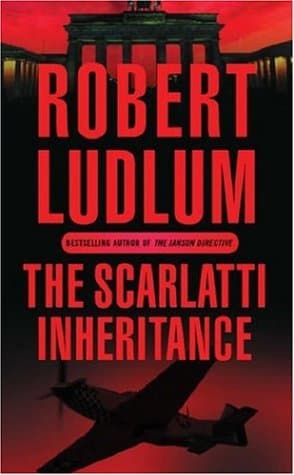
Synopsis
Covers the whole plot, including the ending.
- Difficulty
- Medium
- Pacing
- Moderate
- Mood
- Suspenseful, Intriguing, Conspiratorial, Tense
- Read it if
- You enjoy classic spy thrillers with intricate plots, historical settings, and a focus on uncovering hidden conspiracies.
- Skip it if
- You prefer fast-paced modern thrillers with less exposition or find historical espionage less engaging.
The Scarlatti Inheritance Plot Summary
Covers the whole plot, including the ending.
The Proposal from Ulrich
In Washington D.C. during World War II, Elizabeth Scarlatti, an American intelligence operative, gets a coded message from General Heinrich Ulrich, a top Nazi commander. Ulrich offers to defect to the Allies with intelligence that could shorten the war. His condition is the immediate release of the top-secret 'Scarlatti Inheritance' file, held by the U.S. government. Rumors say the file contains information that could ruin powerful Western figures, including members of the Scarlatti family, suggesting a deep historical conspiracy.
Unveiling the Past: Matthew Scarlatti
The story then goes back to the early 20th century, introducing Matthew Scarlatti, the family patriarch. Matthew, a brilliant but troubled man, has severe mental health issues, including delusions. Despite this, he is a financial genius who builds a vast fortune. His struggles are made worse by his manipulative mother, who constantly undermines him and controls his life, especially his relationships. This historical thread begins to show the origins of the 'Scarlatti Inheritance' and the dark secrets that have affected the family for generations, setting the stage for future betrayals.
The Marriage to Katherine
Matthew's mother arranges his marriage to Katherine, a woman who seems gentle. However, Katherine is not what she appears; she is cold and calculating, secretly involved with a clandestine organization led by her father. Their marriage is loveless and driven by hidden motives. Katherine's main goal is to control the Scarlatti fortune to fund her father's operations. Matthew, already fragile, becomes more isolated and tormented by his wife's manipulations and his mother's constant interference, leading him deeper into despair.
The Birth of Adam and the Disappearance
Despite the difficult marriage, Matthew and Katherine have a son, Adam Scarlatti. Matthew adores Adam, seeing him as a source of light in his dark life. However, Matthew's mental state worsens, fueled by Katherine's gaslighting and his mother's control. One day, Matthew mysteriously disappears, presumed to have died by suicide. His disappearance leaves a vast fortune and unanswered questions. Katherine quickly takes control of the Scarlatti empire and raises Adam with a distorted view of his father, further embedding the family's secrets.
Adam's Upbringing and Doubts
Adam Scarlatti grows up under his mother Katherine's strict and manipulative teaching. She tells him his father was a tragic figure who succumbed to madness. But as Adam matures, he notices inconsistencies in his mother's stories and feels a pull to understand his father's true fate. He develops a sharp mind and a strong sense of justice, which makes him question the narratives he's been given. His subtle inquiries set him on a path that conflicts with Katherine and the powerful forces she represents, hinting at a deeper conspiracy behind Matthew's disappearance.
The Scarlatti Inheritance Revealed
The 'Scarlatti Inheritance' is revealed to be more sinister than a family fortune. It is a vast financial network, built and secretly controlled by Katherine Scarlatti and her father, designed to fund a powerful, clandestine organization with ties to the growing Nazi Party in Germany. This organization, operating under the guise of legitimate business, aims to destabilize global economies and facilitate a new world order. The Scarlatti wealth is funneled into these schemes, making the family, knowingly or not, involved in the rise of fascism and the impending war.
The Alliance with Ulrich
Back in the present (WWII), Elizabeth Scarlatti, who is Adam's daughter, works with her father, Adam, to understand Ulrich's offer. Adam, now an influential figure, has been secretly investigating his mother's past and the true nature of the Scarlatti Inheritance. He realizes Ulrich's defection is a critical chance to expose Katherine and her network. Adam and Elizabeth agree to meet with Ulrich, understanding the immense risks. Their alliance is formed from a shared desire to dismantle Katherine's corrupt empire and prevent further global devastation, even if it means exposing their own family's dark secrets.
The Confrontation and Betrayals
Adam confronts his mother, Katherine, with evidence of her involvement with the Nazi-affiliated organization and his father Matthew's true fate. Katherine, a master manipulator, initially denies everything, but as Adam shows irrefutable proof, her facade crumbles. This confrontation causes betrayals within her network as loyalties are tested. The stakes are incredibly high, as Katherine's organization has operatives deeply embedded in various governments and industries, making it dangerous for Adam and Elizabeth to trust anyone outside their immediate circle. The confrontation becomes a deadly game.
The Scarlatti File's True Purpose
The 'Scarlatti Inheritance' file is finally opened, revealing its contents. It is not just about family secrets or financial misdeeds; it contains a list of prominent Western individuals—politicians, industrialists, and military leaders—who secretly collaborated with Katherine Scarlatti's organization, funneling money and resources to the Nazi war machine. This revelation confirms Ulrich's claims and shows the extent of Katherine's influence. The file's exposure threatens to dismantle entire power structures and expose a deep conspiracy that could shake multiple nations, proving its strategic importance to both sides.
The Climax and Resolution
In a thrilling climax, Adam and Elizabeth, using Ulrich's intelligence, race against Katherine and her operatives to expose the full truth in the Scarlatti file. They face numerous assassination attempts and close calls, navigating espionage and double-crosses. They succeed in making the file public, leading to the arrests and downfall of many powerful collaborators. Katherine Scarlatti's empire crumbles, and she is brought to justice. The information from Ulrich, combined with the Scarlatti file, helps the Allied war effort, ending a long and dangerous conspiracy that threatened global stability.
Principal Figures
Adam Scarlatti
Protagonist
The son who uncovers his family's dark secrets and fights against corruption.
Adam Scarlatti is a brilliant and determined man, deeply affected by the mysterious disappearance of his father and the manipulative upbringing by his mother, Katherine. He possesses a sharp intellect and a strong moral compass, which drives him to investigate the truth behind the Scarlatti fortune and its insidious connections. Despite growing up in a world of wealth and privilege, he rejects the corrupting influence of his family's past, seeking justice and redemption. His personal quest for truth ultimately leads him to confront powerful global conspiracies.
Relationships: Matthew Scarlatti (His father, whose fate he investigates.); Katherine Scarlatti (His manipulative mother and primary antagonist.); Elizabeth Scarlatti (His daughter and fellow operative.); General Heinrich Ulrich (An uneasy ally who provides crucial intelligence.)
Katherine Scarlatti
Antagonist
The cold, calculating matriarch who secretly funds a Nazi-affiliated organization.
Katherine Scarlatti is the cunning and ruthless matriarch of the Scarlatti family. Driven by a thirst for power and control, she orchestrates the family's vast financial network to fund a secret organization with strong ties to the Nazi Party. She is a master manipulator, using her charm and intelligence to deceive those around her, including her husband, Matthew, and her son, Adam. Her ambition knows no bounds, and she is willing to destroy anyone who stands in her way. She embodies the insidious nature of greed and ideological extremism, operating from the shadows of high society.
Relationships: Matthew Scarlatti (Her husband, whom she manipulates and likely causes his disappearance.); Adam Scarlatti (Her son, whom she tries to control and who ultimately exposes her.); General Heinrich Ulrich (An adversary within the Nazi hierarchy, whose defection threatens her.)
Matthew Scarlatti
Supporting
Adam's father, a financial genius with mental health struggles, whose disappearance fuels the mystery.
Matthew Scarlatti is the brilliant but tragically flawed patriarch of the Scarlatti family. Despite his genius in finance, he suffers from severe mental health issues, exacerbated by his overbearing mother and the manipulative actions of his wife, Katherine. He is a sensitive and artistic soul trapped in a world of ruthless ambition. His mysterious disappearance is the central enigma that drives Adam's investigation, revealing the depth of the family's secrets and the extent of Katherine's malevolence. He represents the innocent victim caught in a web of greed and political intrigue.
Relationships: Katherine Scarlatti (His manipulative wife.); Adam Scarlatti (His son, who seeks to avenge his memory.)
Elizabeth Scarlatti
Supporting
Adam's daughter and a skilled intelligence operative.
Elizabeth Scarlatti is Adam's daughter and a highly capable American intelligence operative. She is intelligent, resourceful, and possesses a strong sense of duty, inherited from her father. Elizabeth plays a crucial role in the present-day narrative, acting as a liaison with General Ulrich and assisting Adam in his dangerous mission to expose Katherine's network. She demonstrates courage under pressure and a keen understanding of espionage, proving to be an invaluable asset in unraveling the complex conspiracy. Her dedication reflects the younger generation's fight against historical evils.
Relationships: Adam Scarlatti (Her father and partner in the mission.); General Heinrich Ulrich (A key contact for intelligence.)
General Heinrich Ulrich
Supporting
A high-ranking Nazi officer who offers defection and crucial intelligence.
General Heinrich Ulrich is a high-ranking officer within the Nazi High Command who secretly seeks to defect to the Allied forces. He is a pragmatic and opportunistic individual, motivated by a desire to shorten the war and perhaps secure his own future, rather than pure moral conviction. Ulrich holds crucial information about the Scarlatti Inheritance and its connections to the Nazi regime, making his defection a pivotal moment in the narrative. His character embodies the complex moral ambiguities of wartime, where enemies can become uneasy allies for strategic reasons.
Relationships: Adam Scarlatti (His contact and an uneasy ally.); Elizabeth Scarlatti (His initial point of contact for defection.)
The Senator
Mentioned
A powerful American politician with ties to the Scarlatti network.
The Senator is a powerful and influential American politician who is revealed to be a clandestine collaborator within Katherine Scarlatti's network. While not a central character, his presence highlights the pervasive reach of the conspiracy into high levels of government. He represents the corrupting influence of the Scarlatti fortune and the willingness of powerful individuals to betray their country for personal gain or ideological alignment. His eventual exposure is a key outcome of the Scarlatti file's release, demonstrating the breadth of the network's infiltration.
Relationships: Katherine Scarlatti (A hidden collaborator in her network.)
Themes & Insights
The Corrupting Influence of Power and Wealth
The novel shows how great wealth and unchecked power corrupt people and institutions. The Scarlatti fortune, built legitimately, becomes Katherine Scarlatti's tool to fund a Nazi-affiliated organization. This is clear in Matthew Scarlatti's manipulation, the infiltration of Western governments, and figures like the Senator betraying their nations for personal gain. The pursuit of power blinds characters to morality, turning an inheritance into a weapon of global destabilization.
“Money… it buys silence, it buys loyalty, and it buys oblivion.”
The Weight of Family Secrets and Legacy
The Scarlatti family carries generations of dark secrets, deceit, and manipulation. Matthew's mental health struggles, his disappearance, and Katherine's agenda are all hidden truths that affect the family. Adam's journey is driven by his desire to uncover these secrets and understand his father's true fate. The 'Scarlatti Inheritance' is not just money but a legacy of corruption that Adam must confront to break the cycle. The past affects the present, demanding accountability.
“The past, like a persistent ghost, clung to the Scarlatti name, demanding its due.”
Betrayal and Deception
Betrayal is a theme throughout the novel, on both personal and global levels. Katherine betrays Matthew's trust and sanity, manipulating him for her own ends. She then creates a network of collaborators who betray their countries by secretly supporting the Nazi regime. General Ulrich's defection, while good for the Allies, is also a betrayal of his own command. These deceptions create a climate of mistrust, forcing characters like Adam and Elizabeth to constantly question loyalties and uncover hidden agendas in their mission.
“Every alliance was a gamble, every trust a potential trap.”
The Fight for Truth and Justice
At its core, the novel is about pursuing truth and justice against great odds. Adam Scarlatti dedicates his life to finding the real story behind his father's disappearance and his family's inheritance. His and Elizabeth's efforts to expose Katherine's conspiracy, even at personal risk, show this theme. The 'Scarlatti file' symbolizes this struggle, representing hidden truths that, once revealed, can dismantle corrupt networks and bring justice to a world full of deceit.
“The truth, however ugly, was the only weapon they had against the lies.”
Plot Devices & Literary Techniques
The MacGuffin: The Scarlatti Inheritance File
A top-secret document containing explosive information, driving the entire plot.
The Scarlatti Inheritance file serves as the central MacGuffin of the novel. Its contents are initially shrouded in mystery, rumored to hold secrets capable of destroying reputations and shortening the war. This file is the primary object of desire for General Ulrich, and its potential release is the catalyst for the entire narrative. As the story unfolds, the file's true nature as a list of powerful Nazi collaborators is revealed, giving it immense strategic importance and making its acquisition a matter of life and death. It constantly propels the characters forward, creating suspense and urgency.
Flashback Narrative
Alternating timelines to reveal the historical origins of the conspiracy.
The novel effectively uses a flashback narrative structure, interweaving the present-day World War II espionage with the historical account of Matthew Scarlatti's life and the early formation of Katherine's sinister network. This device allows Ludlum to slowly unveil the origins of the 'Scarlatti Inheritance' and the deep-seated family secrets that fuel the contemporary conflict. The past provides crucial context and motivation for the characters' actions in the present, building a complex tapestry of intrigue and revealing how historical betrayals continue to impact current events.
The Double-Cross/Betrayal
Frequent twists of loyalty and hidden agendas.
The double-cross is a recurring plot device that injects constant suspense and unpredictability into the narrative. Characters frequently reveal hidden loyalties or ulterior motives, making it difficult for Adam and Elizabeth to trust anyone. General Ulrich's defection itself is a calculated betrayal, and within Katherine's network, internal power struggles and shifts in allegiance are common. This device keeps the reader on edge, questioning every character's true intentions and highlighting the treacherous nature of the espionage world, where alliances are fragile and betrayal is always a possibility.
The Scarlatti Inheritance Quotes
“There are some things in life that you don't question, you just accept and move on. Others you question to the death.”
“The past is never really dead. It just waits for the right time to reappear.”
“Power is not given, it is taken.”
“A man who trusts no one will find no one to trust him.”
“Sometimes the greatest deception is in plain sight.”
“The truth is a weapon, and like any weapon, it can be used for good or for evil.”
“Fear is a powerful motivator, but it can also blind you to reality.”
“There are no coincidences, only patterns we haven't yet recognized.”
“Loyalty is a fragile thing, easily broken by ambition or fear.”
“The greatest lies are often built upon a kernel of truth.”
“When you dig into the past, be prepared for what you might find.”
“Every man has his price, but some prices are higher than others.”
“The world is not as it seems, and those who control it prefer it that way.”
“Sometimes the only way to win is to break all the rules.”
Quiz
10 questions on the plot and the characters. Each answer comes with a short explanation.
Question 1
What is the primary motivation for the Nazi High Command member's offer to defect?
- To gain political asylum in a neutral country.
- To secure a large sum of money for his family.
- To divulge information that will shorten the war.
- To expose corruption within the Nazi party.
Show answer
C. To divulge information that will shorten the war. The book description explicitly states that the Nazi defector's purpose is to 'divulge information that will shorten the war.'
Question 2
What is the key condition for the Nazi defection to proceed?
- The safe passage of his entire family.
- The release of the ultra-top-secret file on the Scarlatti Inheritance.
- A guarantee of protection from future prosecution.
- Access to specific intelligence documents.
Show answer
B. The release of the ultra-top-secret file on the Scarlatti Inheritance. The synopsis clearly states that his defection 'entails the release of the ultra-top-secret file on the Scarlatti Inheritance.'
Question 3
What is the potential consequence if the contents of the Scarlatti Inheritance file are made public?
- It will reveal hidden Nazi gold reserves.
- It will expose a vast espionage network.
- It will destroy many of the Western world's greatest and most illustrious reputations.
- It will lead to a major diplomatic crisis.
Show answer
C. It will destroy many of the Western world's greatest and most illustrious reputations. The book's summary indicates that the file's contents 'will destroy many of the Western world's greatest and most illustrious reputations if they are made known.'
Question 4
The Scarlatti Inheritance file is described as 'ultra-top-secret.' What does this classification imply about its nature?
- It is related to military battle plans.
- It contains information of extreme sensitivity and importance, known only to a very select few.
- It details the location of hidden assets.
- It is a coded message from the German high command.
Show answer
B. It contains information of extreme sensitivity and importance, known only to a very select few. The term 'ultra-top-secret' signifies the highest level of confidentiality, meaning its contents are extremely sensitive and access is severely restricted, impacting very powerful individuals.
Question 5
What kind of individuals are primarily at risk from the release of the Scarlatti Inheritance file?
- Low-level government employees.
- Ordinary citizens with minor indiscretions.
- Elite members and influential figures in the Western world.
- Members of the Nazi party.
Show answer
C. Elite members and influential figures in the Western world. The file's contents threaten to 'destroy many of the Western world's greatest and most illustrious reputations,' indicating that high-ranking and well-known figures are implicated.
Question 6
The story is set against the backdrop of what major historical conflict?
- The Cold War.
- World War I.
- World War II.
- The Vietnam War.
Show answer
C. World War II. The description mentions 'information that will shorten the war' and 'elite member of the Nazi High Command,' directly placing the narrative during World War II.
Question 7
The Scarlatti Inheritance is described as a 'spellbinding story of international terror and intrigue, greed and cunning, suspense and murder.' Which of these elements is most directly linked to the file's potential impact?
- International terror.
- Greed and cunning.
- Suspense.
- Murder.
Show answer
B. Greed and cunning. The destruction of 'illustrious reputations' often stems from hidden actions driven by 'greed and cunning,' which the file is likely to expose, rather than directly causing 'terror' or 'murder' as an immediate impact of its contents.
Question 8
Considering the stakes, what is likely the primary concern of the Western powers regarding the defection and the file?
- Whether the Nazi defector is trustworthy.
- The immediate military advantage gained from the defector's intelligence.
- Balancing the need for war-ending intelligence against the catastrophic political fallout from the file's release.
- The logistical challenges of handling the defector.
Show answer
C. Balancing the need for war-ending intelligence against the catastrophic political fallout from the file's release. The core conflict presented is the trade-off: valuable intelligence to end the war versus the immense political and reputational damage of releasing the Scarlatti Inheritance file, which implicates 'illustrious reputations.'
Question 9
The phrase 'international terror and intrigue' suggests what about the scope of the events in the book?
- The story is confined to a single country.
- The plot involves threats and conspiracies spanning multiple nations and involving various global actors.
- The terror is primarily psychological for the main character.
- Intrigue is limited to personal relationships.
Show answer
B. The plot involves threats and conspiracies spanning multiple nations and involving various global actors. 'International' explicitly means across nations, and 'terror and intrigue' imply clandestine, dangerous activities involving multiple parties on a global scale.
Question 10
Given the description, what kind of moral dilemma might be central to the protagonist's actions?
- A choice between personal wealth and loyalty to family.
- A conflict between duty to country (ending the war) and the ethical implications of exposing highly damaging secrets about powerful individuals.
- Deciding whether to trust a known enemy or a questionable ally.
- The struggle between love and revenge.
Show answer
B. A conflict between duty to country (ending the war) and the ethical implications of exposing highly damaging secrets about powerful individuals. The setup presents a direct conflict: the defector offers information to 'shorten the war' but demands the release of a file that will 'destroy many of the Western world's greatest and most illustrious reputations.' This forces a moral choice between national good and protecting powerful individuals from ruin.
The Scarlatti Inheritance FAQ
What is the core premise driving the plot of 'The Scarlatti Inheritance'?
The core premise involves a high-ranking Nazi officer, Major Andreas Braun, offering to defect and provide critical intelligence to the Allies. However, his defection is contingent upon the release of the highly classified 'Scarlatti Inheritance' file, which contains explosive information capable of ruining prominent figures in the Western world.
Who is Matthew Canfield and what is his initial role in the story?
Matthew Canfield is a former OSS agent, now working for a secretive US intelligence group. He is initially tasked with investigating the Major Braun defection and understanding the true implications of the Scarlatti Inheritance file, which quickly draws him into a dangerous web of deception and murder.
What is the significance of the Scarlatti Inheritance itself, beyond just a file?
The Scarlatti Inheritance refers to a vast fortune amassed by the ruthless matriarch, Elizabeth Scarlatti, and distributed among her powerful, influential children. This inheritance is tied to the illicit dealings and betrayals documented in the file, revealing how these funds supported anti-democratic activities and fascist sympathies within the Allied nations.
Who is Elizabeth Scarlatti and what is her impact on the narrative?
Elizabeth Scarlatti is the formidable and cunning matriarch of the Scarlatti family, a woman of immense wealth and influence. Her past dealings and the way she manipulated her children and their fortunes form the dark foundation of the entire conspiracy, directly linking to the 'inheritance' and the powerful figures it implicates.
How does Major Andreas Braun connect to the Scarlatti family?
Major Andreas Braun is revealed to be a Scarlatti by birth, specifically the son of Elizabeth Scarlatti. His defection is not merely a wartime maneuver but a desperate attempt to expose the corruption within his own family and the Western powers they secretly support, driven by a deeply personal vendetta.
What is the true identity of Chancellor Konig, and how does it impact the story's climax?
Chancellor Konig is ultimately revealed to be a Scarlatti, another child of Elizabeth, and a key figure in the conspiracy. His position of power and his familial connection to the inheritance make him a formidable antagonist, underscoring the deep infiltration of the Scarlatti network into high levels of government.
What specific historical context is utilized by Ludlum to make the conspiracy believable?
Ludlum leverages the real-world anxieties of World War II, particularly fears of fifth columnists and secret fascist sympathizers within Allied governments. The idea of powerful individuals secretly funding or aiding the enemy, even for personal gain, resonates with historical suspicions of the era.
How does Ludlum use character names, like 'Scarlatti,' to evoke a sense of grandeur and historical weight?
The name 'Scarlatti' itself carries echoes of Italian nobility and historical power, immediately suggesting a long-established, influential family. This choice imbues the fictional family with an inherited sense of gravitas and wealth, making their deep-seated corruption seem all the more shocking and pervasive.
Analyze Matthew Canfield's psychological journey from a detached agent to a deeply invested protagonist.
Canfield begins as a professional agent following orders, but as he uncovers the extent of the Scarlatti family's treachery and witnesses numerous murders, his personal sense of justice is ignited. The betrayal by figures he once respected, coupled with the danger to innocent lives, transforms his mission into a deeply personal fight against corruption.
How does Elizabeth Scarlatti's manipulative nature contribute to the psychological torment of her children?
Elizabeth Scarlatti psychologically dominated her children by instilling a ruthless ambition and a sense of entitlement, while also fostering intense sibling rivalry and dependence on her wealth. This manipulation created a fractured family dynamic where trust was nonexistent, and each child was a pawn in her larger, power-hungry game.
Discuss the theme of moral ambiguity as it applies to the characters involved in the Scarlatti conspiracy.
Many characters, even those seemingly on the 'right' side, grapple with moral ambiguity. Figures within Allied intelligence often resort to morally questionable tactics to counter the Scarlatti threat, blurring the lines between hero and antagonist. The Scarlattis themselves believe their actions are justified for maintaining power, highlighting the subjective nature of morality in a high-stakes world.
What psychological impact does the constant threat of exposure have on the Scarlatti family members?
The constant threat of the Scarlatti file being exposed creates an intense paranoia and desperation among the family members. This fear drives them to extreme measures, including murder, to protect their reputations and fortunes, revealing how deeply their identities and sense of self are intertwined with their illicit power.
Is 'The Scarlatti Inheritance' primarily a story about national security or about family betrayal?
While it has strong national security implications due to the wartime setting and high-level conspiracy, 'The Scarlatti Inheritance' is arguably more fundamentally about family betrayal. The core conflict stems from Elizabeth Scarlatti's manipulation of her own children and their subsequent internecine struggles, which then spill over to impact global events.
How does Ludlum's use of a 'hidden enemy within' trope reflect broader societal anxieties of the time?
The 'hidden enemy within' trope, where powerful figures in one's own government are secretly working against national interests, tapped into deep Cold War anxieties about infiltration and betrayal. It suggested that threats weren't always external but could come from trusted, high-ranking individuals, fostering a pervasive sense of mistrust.
Could the Scarlatti Inheritance be seen as a metaphor for the corrupting influence of unchecked wealth and power?
Absolutely. The Scarlatti Inheritance serves as a potent metaphor for how immense, unchecked wealth and power can corrupt individuals and institutions, leading to moral decay and a willingness to betray national interests for personal gain. It illustrates that even in the face of global conflict, greed can be a more powerful motivator than patriotism.
How does the ending of the novel, particularly the fate of the Scarlatti file, contribute to its overall message?
The ambiguous or controlled dissemination of the Scarlatti file at the end, rather than a full public exposure, reinforces the idea that some truths are too dangerous or disruptive to be fully revealed. It suggests that even after the immediate threat is neutralized, the underlying power structures and the potential for corruption remain, leaving a lingering sense of unease.
Is there a definitive 'hero' in 'The Scarlatti Inheritance', or are all characters morally compromised to some extent?
While Matthew Canfield acts heroically in pursuing justice, the novel suggests that a definitive, unblemished hero is difficult to find in such a morally grey world. Even those fighting the conspiracy often engage in deception and violence, implying that the fight against such deep-seated corruption inevitably compromises even the best intentions.
About the author

Robert Ludlum was an American author known for his espionage and thriller novels. His notable works include The Bourne Identity, The Bourne Supremacy, The Bourne Ultimatum, The Matarese Circle, and The Scarlatti Inheritance, which often feature intricate plots and complex characters. Ludlum's writing has had a significant impact on the thriller genre, particularly with the popular Bourne series.
Similar books
- The Odessa File
Frederick Forsyth
4.1 (55k) average on GoodreadsThrillerBoth are Cold War-era thrillers involving Nazi secrets and extensive investigations.
- The Bourne Identity
Robert Ludlum
4.0 (397k) average on GoodreadsThrillerLudlum's signature style of intricate plots, government conspiracies, and a protagonist uncovering his past.
- Eye of the Needle
Ken Follett
4.2 (129k) average on GoodreadsThrillerWorld War II spy thriller with high stakes and intricate espionage.
- The Day of the Jackal
Frederick Forsyth
4.3 (118k) average on GoodreadsThrillerWhile both are meticulously plotted thrillers from the same era, Ludlum's focuses more on personal identity, inherited guilt, and grand conspiracies, whereas Forsyth's is a purely procedural narrative about an assassin's meticulous planning and execution, with less emphasis on character backstory or emotional depth. Ludlum's scope is broader in its historical reach and familial intrigue.
- Tinker Tailor Soldier Spy
John le Carré
4.1 (107k) average on GoodreadsFictionLudlum's "The Scarlatti Inheritance" is a more action-oriented and less psychologically nuanced work than le Carré's. Ludlum prioritizes thrilling escapism and clear-cut good-versus-evil narratives (despite complex origins), while le Carré delves deeply into the moral ambiguities, bureaucratic ennui, and psychological toll of espionage, presenting a more realistic and somber view of the spy world.
- Angels & Demons
Dan Brown
3.9 (2.7M) average on GoodreadsThrillerA Harvard symbologist races through Rome's ancient sites, deciphering cryptic clues to unmask the Illuminati and stop a vengeful plot to destroy the Vatican with a stolen antimatter weapon.





Enjoyed the summary?
A summary gives you the shape of the book. The book itself has the detail, the examples and the voice.
Find The Scarlatti Inheritance on AmazonAs an Amazon Associate, BookBrief earns from qualifying purchases. How we're funded