
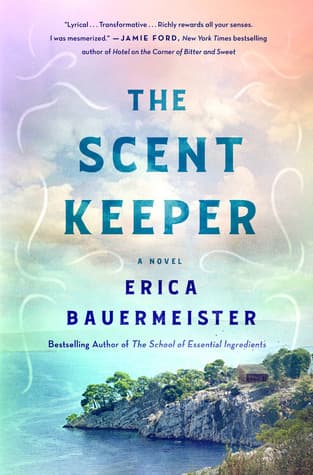
Synopsis
Covers the whole plot, including the ending.
- Difficulty
- Medium
- Pacing
- Moderate
- Mood
- Atmospheric, Evocative, Introspective, Melancholy, Hopeful
- Read it if
- You love evocative prose, sensory details, stories about self-discovery, and the power of memory and family secrets. Perfect for fans of unique historical fiction with a touch of magical realism.
- Skip it if
- You prefer fast-paced thrillers or dislike detailed descriptions of scents and emotions. If you're looking for a straightforward plot without much introspection, this might not be for you.
The Scent Keeper Plot Summary
Covers the whole plot, including the ending.
An Isolated Childhood and Mysterious Scents
Emmeline lives an isolated, idyllic childhood on a remote island off the coast of Maine with her father, who teaches her to interpret the world through her senses, especially scent. He assigns names like 'Fear' or 'Joy' to various natural smells. Their cabin is lined with drawers, each containing a stoppered bottle of a unique, strong scent that her father meticulously creates using a complex machine. He tells her these are 'stories' and warns her never to open them. Emmeline's father teaches her to read and write, but their world is limited to the island. She often wonders about her mother, whom her father vaguely describes as 'gone' and associated with a particular, heartbreaking scent. This mystery fuels her early curiosity.
The Arrival of a Stranger and a Broken Rule
A woman named Rose arrives on the island, a rare visitor who seems to know Emmeline's father. Rose's presence disrupts Emmeline's routine, and she senses a change in her father's demeanor. One day, Emmeline opens one of the forbidden scent bottles. The scent is overwhelmingly powerful, evoking a flood of unfamiliar emotions and images—a bustling city, a feeling of being lost. This act of disobedience fills her with both wonder and fear, confirming that the scents hold unsettling secrets about the world beyond her island home and her own hidden past. She quickly re-seals the bottle, fearing her father's reaction.
Tragedy Strikes and Emmeline's Departure
Emmeline's father falls gravely ill. In his final days, he reveals that Emmeline is not his biological daughter. He explains that he rescued her from a dangerous situation when she was a baby and brought her to the island to protect her. He entrusts her with a small wooden box containing a few personal items and a cryptic message about her true identity. After his death, Rose returns to the island and takes Emmeline to the mainland. This abrupt departure from her isolated home ends her childhood innocence and begins her journey into the unknown 'real world' her father had shielded her from.
A New Life with Rose and the Perfumery
Rose takes Emmeline to live with her in a small town, where Rose owns a struggling perfumery. Emmeline struggles to adapt to this new, busy environment after her solitary upbringing. Rose, a skilled perfumer, begins to teach Emmeline the technical aspects of scent creation, blending, and the commercial business of fragrances. Emmeline discovers she has an innate talent for identifying and combining scents, a gift honed by her father's unique teachings. However, Rose's motivations are complex; she sees Emmeline's talent as a way to save her failing business, subtly using Emmeline's abilities while withholding truths about her past.
Unraveling Her Past Through Scent
As Emmeline works in the perfumery, she encounters various scents that trigger flashes of memory or strong, unidentifiable emotions. She realizes that the 'stories' her father created were not just abstract concepts but actual scent markers from her past. Using the few clues her father left her, along with her heightened sense of smell, Emmeline starts a quiet investigation into her origins. She learns about a perfumer named Jean-Pierre, a rival of her father's, and suspects a connection to her birth. Her quest becomes a subtle game of discovery, piecing together fragments of a life she can't remember but can smell.
Discovery of the True Parents
Through diligent research and following scent trails, Emmeline discovers that her biological mother was a perfumer named Marguerite, and her father was a renowned, ambitious perfumer, Jean-Pierre. She learns that her father, the man who raised her, was Marguerite's brother, and he took Emmeline to protect her after a tragic incident. Her biological parents were rivals in the world of high-end perfumery, and their relationship was tumultuous, marked by both passion and professional jealousy. The 'stories' in the drawers on the island were scents Marguerite had created, preserved by Emmeline's uncle.
Confrontation and Betrayal
Emmeline confronts Rose, asking why she withheld information about her past. Rose confesses that she knew Emmeline's biological parents and her uncle. She admits she saw an opportunity to use Emmeline's talent for scent to revive her own failing perfumery, hoping to capitalize on Emmeline's genetic legacy. Rose's confession reveals a web of past relationships, rivalries, and unfulfilled ambitions that shaped Emmeline's early life. Feeling betrayed and used, Emmeline decides she must leave Rose and forge her own path, seeking to understand her heritage on her own terms.
Journey to Paris and the Legacy of Marguerite
Emmeline travels to Paris, the center of the perfumery world and the city where her biological parents had their careers. She seeks out places associated with Marguerite, learning more about her mother's innovative spirit and unique approach to fragrance creation. Emmeline discovers that Marguerite was not just a competitor but an artist who saw scent as a form of storytelling, much like Emmeline's uncle taught her. She finds remnants of her mother's work and begins to understand the connection she shares with Marguerite through their shared gift and philosophy of scent.
Meeting Jean-Pierre and Understanding the Past
Emmeline eventually meets Jean-Pierre, her biological father, who is now an aging, somewhat bitter perfumer. He is initially distant but slowly opens up, revealing his version of events surrounding Marguerite's death and Emmeline's infancy. He explains the intense professional rivalry and personal drama that led to a tragic accident, which her uncle interpreted as a need to protect Emmeline from the volatile environment. Jean-Pierre expresses regret and a sense of loss for the family he never knew. This meeting gives Emmeline a more complete, albeit painful, picture of her origins, allowing her to reconcile with her complex heritage.
Forging Her Own Path
With a fuller understanding of her past, Emmeline resolves to honor both her uncle's protective love and her biological parents' creative legacy. She decides to use her talent not for commercial gain in the way Rose envisioned, but to create scents that tell true stories, like her uncle's 'stories' and her mother's artistic vision. She finds a balance between the natural world of her childhood and the art of perfumery. Emmeline ultimately establishes her own perfumery, creating fragrances that evoke emotions and memories, finally finding her true place in the world, rooted in her past but looking towards her own future.
The Scent Keeper Characters
Emmeline
Protagonist
A young woman with an extraordinary sense of smell, seeking her true identity.
Emmeline is the central character, an orphan raised in isolation on an island by a man she believes is her father. She possesses an incredibly acute sense of smell and a unique ability to interpret scents as 'stories' or emotions. Driven by an insatiable curiosity about her origins and the world beyond her island home, she is initially naive but grows into a determined and independent woman. Her journey involves unraveling the mysteries of her past and understanding the complex legacy of her biological parents in the world of perfumery, while also honoring the protective love of her adoptive father.
Relationships: Emmeline's Father (Uncle) (Adoptive father and protector); Rose (Guardian and mentor (later manipulator)); Marguerite (Biological mother, renowned perfumer); Jean-Pierre (Biological father, renowned perfumer)
Emmeline's Father (Uncle)
Supporting
Emmeline's adoptive father, who teaches her about scent and protects her.
Emmeline's adoptive father is a mysterious, reclusive man who dedicates his life to raising Emmeline on a remote island. He teaches her to interpret the natural world through her senses, particularly smell, and creates a unique library of 'scent stories' in his cabin. His primary motivation is to protect Emmeline from the dangers and complexities of the outside world, especially the tragic circumstances of her birth. He is a loving, if enigmatic, figure who withholds the truth about her origins until his death, believing he is shielding her from pain. He is later revealed to be Emmeline's maternal uncle.
Relationships: Emmeline (Adoptive father-daughter bond); Rose (Acquaintance from the past); Marguerite (Sister)
Rose
Supporting
Emmeline's guardian after her father's death, a perfumer with complex motives.
Rose is a perfumer who takes Emmeline in after her adoptive father's death. She runs a struggling perfumery and recognizes Emmeline's extraordinary talent for scent. While she initially offers Emmeline a home and a new life, her motivations are gradually revealed to be complex and self-serving. Rose knew Emmeline's biological parents and her uncle, and she sees Emmeline's gift as a means to revive her own failing business. She withholds crucial information about Emmeline's past, manipulating her for her own gain, making her a morally ambiguous figure caught between care and ambition.
Relationships: Emmeline (Guardian-ward, later mentor-apprentice, then betrayer); Emmeline's Father (Uncle) (Acquaintance from the past); Marguerite (Acquaintance/competitor in perfumery)
Marguerite
Mentioned
Emmeline's biological mother, a brilliant and innovative perfumer.
Marguerite is Emmeline's biological mother, a legendary and highly artistic perfumer whose innovative approach to scent creation set her apart. She is described as having a unique ability to infuse her fragrances with deep emotional resonance, seeing them as stories and expressions of the soul. Her life was marked by both creative brilliance and a tumultuous relationship with Jean-Pierre, her professional rival and lover. Though deceased before the main narrative begins, her legacy, her 'scent stories,' and her philosophy profoundly influence Emmeline's journey and understanding of her own gifts.
Relationships: Emmeline (Biological mother); Emmeline's Father (Uncle) (Brother); Jean-Pierre (Biological father of Emmeline, lover and rival)
Jean-Pierre
Supporting
Emmeline's biological father, a renowned but ambitious perfumer.
Jean-Pierre is Emmeline's biological father, a celebrated perfumer known for his ambition and talent. He was both a lover and a fierce professional rival to Marguerite. His character embodies the cutthroat, commercial side of the perfumery world, contrasting with Marguerite's more artistic approach. He carries the weight of past regrets and the tragedy that led to Emmeline's separation from him. Meeting Emmeline later in life, he is initially guarded but eventually reveals his perspective on the past, offering Emmeline a more complete, if painful, understanding of her origins.
Relationships: Emmeline (Biological father); Marguerite (Biological mother of Emmeline, lover and rival)
Thomas
Mentioned
A young man who works with Rose and forms a connection with Emmeline.
Thomas is a young man who works in Rose's perfumery and becomes a friend and confidant to Emmeline. He is kind and observant, offering Emmeline a sense of normalcy and companionship in her new, confusing life. He is one of the few people Emmeline trusts as she navigates the complexities of the mainland. While not deeply involved in the central mystery of Emmeline's past, he represents a supportive presence and a potential romantic interest, offering a glimpse of a future beyond her quest for identity.
Relationships: Emmeline (Friend and potential romantic interest)
The Scent Keeper Themes
Identity and Self-Discovery
The novel explores Emmeline's quest to understand who she is, both in terms of her origins and her unique talents. Her journey from an isolated childhood to uncovering her biological heritage in the world of perfumery is central to the narrative. The 'scent stories' her father creates become literal clues to her past, forcing her to confront the complex legacies of both her adoptive and biological families to forge her own identity. This theme is in her pursuit of truth, even when it means confronting painful revelations about betrayal and tragedy.
“Every scent was a story, he'd told her. And she was finally ready to read her own.”
The Power of Scent and Memory
Scent is not merely a sensory detail but a narrative device and thematic core of the book. It is a direct link to memory, emotion, and truth. Emmeline's ability to interpret scents allows her to access forgotten memories, understand complex relationships, piece together her fragmented past. The 'scent stories' her father creates are literal encapsulations of moments and emotions, showing how powerfully scent can evoke the past and shape perception. This theme highlights how our olfactory sense can be a gateway to our deepest selves and hidden histories.
“Scent was the language of memory, of emotion. It was the whisper of what had been, and what could be.”
Family, Love, and Betrayal
The book explores various forms of familial love—the protective, secretive love of Emmeline's adoptive father; the complex, ambitious love between her biological parents; and the manipulative 'love' of Rose. It looks at the sacrifices made for family, the secrets kept, and the betrayals that can arise from ambition and fear. Emmeline's understanding of love evolves as she learns about the motivations behind her uncle's protection and Rose's exploitation, ultimately leading her to define what true, unconditional love means for her. The narrative shows how love, in its many forms, can both nurture and complicate lives.
“Love, like scent, could be a comfort, a warning, or a poison.”
Nature vs. Civilization
Emmeline's upbringing on a remote, natural island with her father's teachings about the elemental scents of the earth contrasts with the commercial, artificial world of perfumery in cities. This theme explores the tension between an intuitive, sensory understanding of the world and a more structured, profit-driven approach. Emmeline must reconcile these two worlds, integrating her connection to natural scents with the art of synthetic fragrance creation. Her ultimate goal is to bridge these two realms, creating authentic 'scent stories' that honor both her wild origins and her artistic heritage.
“The island had taught her the language of earth and sky. The city was teaching her the language of ambition and artifice.”
Plot Devices & Literary Techniques
The Scent Stories
Bottled fragrances that encapsulate memories, emotions, and hidden truths.
The 'scent stories' are a central plot device. These are unique, potent fragrances created by Emmeline's adoptive father and later discovered to be creations of her biological mother. Each bottle holds a specific, powerful emotion or memory, acting as a direct link to Emmeline's past and the mysteries surrounding her birth. They function as both symbolic representations of her fragmented heritage and literal clues, guiding her investigation into her identity. Their forbidden nature in her childhood adds to their allure and significance, driving her initial curiosity and later her quest for truth.
Sensory Detail and Imagery (Olfactory Focus)
The extensive use of scent descriptions to drive narrative and character understanding.
The novel heavily relies on rich, evocative sensory descriptions, particularly focusing on the sense of smell. Bauermeister uses olfactory imagery not just to set the scene but to reveal character emotions, foreshadow events, and advance the plot. Emmeline's heightened sense of smell allows her to perceive the world in a unique way, making scent a narrative lens. This device immerses the reader in Emmeline's perspective and emphasizes the central theme of scent as a language of memory and emotion, making the abstract concrete through detailed aroma descriptions.
The Remote Island Setting
An isolated environment that fosters innocence and mystery, then contrasts with the 'real world'.
The remote island serves as both a literal and metaphorical setting. It represents Emmeline's sheltered, innocent childhood, protected from the complexities and dangers of the 'real world.' Its isolation allows for her unique sensory education and the preservation of her father's secrets. When Emmeline leaves the island, the stark contrast with the bustling mainland and the sophisticated world of perfumery highlights her transition from innocence to experience. The island remains a symbol of her origins and the pure, unadulterated connection to scent that defines her.
The Wooden Box
A physical object containing cryptic clues about Emmeline's true parentage.
The small wooden box entrusted to Emmeline by her dying adoptive father is a classic plot device for revealing hidden information. It contains a few personal items and cryptic notes that serve as the initial tangible clues to her true identity. This box acts as a catalyst for Emmeline's journey, providing her with the starting points for her investigation into her biological parents. It symbolizes the legacy of her past and the secrets she must unravel, a physical manifestation of the mystery surrounding her birth.
The Scent Keeper Quotes
“Scent is the most powerful of all our senses. It can transport you instantly across great distances and years, and even, I believe, across the boundaries of life and death.”
“The world was a symphony of scents, and most people, I realized, were deaf.”
“Every scent has a story, a history, a memory tied to it. You just have to learn how to listen.”
“To truly know a person, you must know their scent. It is the truest part of them, the part they cannot hide.”
“Sometimes the most beautiful things are the ones that are hardest to hold onto.”
“The world outside the island was a cacophony of smells, overwhelming and confusing, yet also exhilarating.”
“Love, I learned, had its own scent. It was subtle, changing, but always there, a constant undertone.”
“We are all scent keepers, in our own way, collecting the invisible threads of our lives.”
“The past is never truly gone; it just lingers in the air, waiting for the right breeze to stir it.”
“To forget a scent is to forget a part of yourself, a piece of your own story.”
“There are some things that even scent cannot explain, only hint at, like the deepest secrets of the human heart.”
“Fear had a sharp, metallic edge, like a forgotten coin left in the rain.”
“The stories we tell ourselves about scents are just as important as the scents themselves.”
“Every person carries a library of scents within them, a silent history waiting to be read.”
Quiz
10 questions on the plot and the characters. Each answer comes with a short explanation.
Question 1
What is the primary way Emmeline's father teaches her about the natural world on their remote island?
- Through reading ancient texts and maps
- Through her senses, especially touch and smell
- By having her draw and paint the flora and fauna
- Through practical survival skills like hunting and fishing
Show answer
B. Through her senses, especially touch and smell Emmeline's father focuses on teaching her through her senses, particularly how to identify and understand the natural world by its scents and textures, which becomes a foundational skill for her.
Question 2
What mystery does Emmeline's father refuse to explain about their cabin?
- The source of their food and supplies
- The purpose of the hidden room beneath the floorboards
- The mysterious scents stored in drawers and the machine that creates them
- Why they are isolated from the rest of the world
Show answer
C. The mysterious scents stored in drawers and the machine that creates them A central mystery of Emmeline's childhood is the collection of mysterious scents in drawers and the machine used to create them, which her father keeps secret from her.
Question 3
What event propels Emmeline out of her isolated childhood and into the 'real world'?
- A storm that destroys their cabin, forcing them to seek help
- Her father's decision to finally leave the island for her education
- An unforeseen incident that forces her departure from the island
- She discovers a hidden boat and decides to escape on her own
Show answer
C. An unforeseen incident that forces her departure from the island The synopsis mentions that 'one day the unforeseen happens, and Emmeline is vaulted out into the real world,' indicating an unexpected event rather than a planned departure.
Question 4
What is the primary role of scent in Emmeline's quest for identity and understanding her past?
- It helps her to find rare ingredients for perfume creation as a means of survival.
- It serves as a metaphorical representation of her father's distant memories.
- It acts as a powerful trigger for memories and reveals hidden truths about her past.
- It is a skill she develops to communicate non-verbally with others she meets.
Show answer
C. It acts as a powerful trigger for memories and reveals hidden truths about her past. The book emphasizes that scent is a key element in Emmeline's journey, capable of conjuring memories and revealing hidden truths, which helps her piece together her identity and past.
Question 5
The 'real world' Emmeline encounters is described as a place of what contrasting elements?
- Simplicity, tranquility, and isolation
- Love, betrayal, ambition, and revenge
- Science, logic, and pure reason
- Poverty, hardship, and constant struggle
Show answer
B. Love, betrayal, ambition, and revenge The synopsis explicitly states that the 'real world' is 'a place of love, betrayal, ambition, and revenge,' highlighting the complex and often harsh realities she faces.
Question 6
What is Emmeline's primary motivation once she is in the 'real world'?
- To become a renowned perfumer and achieve fame
- To find her mother, who she believes is still alive
- To understand her past and unlock clues to her identity
- To return to her isolated island home as quickly as possible
Show answer
C. To understand her past and unlock clues to her identity The core of Emmeline's journey in the real world is a quest to 'understand her past' and 'unlock the clues to her identity,' driven by her curiosity about her origins.
Question 7
How does the book describe the beauty of scent in relation to human experience?
- As a simple aesthetic pleasure with no deeper meaning.
- As a provocative force that reveals hidden truths and guides one home.
- As a scientific phenomenon best understood through chemical analysis.
- As a tool for manipulation and control over others.
Show answer
B. As a provocative force that reveals hidden truths and guides one home. The synopsis explicitly states that the book explores 'the provocative beauty of scent, the way it can reveal hidden truths, lead us to the person we seek, and even help us find our way back home,' highlighting its profound impact.
Question 8
Given the description, what literary genre blend does 'The Scent Keeper' most clearly represent?
- Pure historical romance
- Science fiction thriller
- Fantasy and Historical Fiction with coming-of-age elements
- Contemporary mystery novel
Show answer
C. Fantasy and Historical Fiction with coming-of-age elements The book description explicitly states 'Fantasy, Historical Fiction' as its genres, and the plot clearly details Emmeline's 'coming-of-age' journey.
Question 9
The author, Erica Bauermeister, is also known for which other national bestselling novel?
- The Secret Life of Bees
- The School of Essential Ingredients
- Where the Crawdads Sing
- The Nightingale
Show answer
B. The School of Essential Ingredients The introduction states, 'Erica Bauermeister, the national bestselling author of The School of Essential Ingredients, presents a moving and evocative coming-of-age novel.'
Question 10
How does Emmeline's isolated childhood likely prepare her for the complexities of the 'real world' she later encounters?
- Her isolation makes her naive and easily manipulated by others.
- Her keen sensory awareness and deep connection to nature provide a unique perspective and resilience.
- It provides her with advanced survival skills that are directly applicable to urban life.
- She develops a strong distrust of all strangers due to her father's warnings.
Show answer
B. Her keen sensory awareness and deep connection to nature provide a unique perspective and resilience. While her isolation might lead to some naivety, her father's unique teaching through senses likely hones her observational skills and provides a deep, intuitive understanding of the world, which would be an unusual and potentially powerful asset in navigating complex human interactions, fitting with the theme of scent revealing truths.
The Scent Keeper FAQ
What is The Scent Keeper about?
The Scent Keeper tells the story of Emmeline, who grows up isolated on a remote island with her father, learning about the world through her senses, especially scent. After an unforeseen event forces her into the 'real world,' she embarks on a quest to understand her past, her family's secrets, and the profound power of scent to unlock memories and guide her journey.
Why should I read The Scent Keeper?
You should read The Scent Keeper for its unique premise centered around the evocative power of scent, its lyrical prose, and its exploration of identity, family secrets, and the contrast between an isolated, sensory childhood and the complexities of the modern world. It's a deeply immersive and emotional coming-of-age story.
What is the background/setting of The Scent Keeper?
The story begins on a remote, unnamed island off the coast of Maine, where Emmeline lives an enchanted, isolated childhood. Later, the setting shifts to various locations in the 'real world,' including a bustling city, as Emmeline navigates society and eventually finds herself working in a perfumery, all while pursuing clues to her past.
What are the most memorable quotes?
Memorable quotes often revolve around the profound impact of scent, such as 'Scent is the most overlooked of the senses, and yet it is the one that connects us most deeply to memory and emotion.' Another speaks to Emmeline's unique perspective: 'She understood the world not through words, but through the invisible stories carried on the air.'
What writing style does the author use?
Erica Bauermeister uses a lyrical, evocative, and highly sensory writing style, rich with descriptions of smells, textures, and natural elements. Her prose is often poetic, immersing the reader in Emmeline's unique perception of the world and the emotional landscape of the story, making it feel both intimate and expansive.
What minor details add significant meaning?
The specific descriptions of the scents in the drawers, which Emmeline's father carefully curates, are not just random. Each scent represents a memory or an emotion, subtly foreshadowing the complex tapestry of human experience she will later encounter and hinting at the secrets of her lineage and the 'scent keeper' tradition.
What are some subtle foreshadowing moments?
The mysterious machine Emmeline's father uses to create and store scents, combined with his evasiveness about her mother and their past, subtly hints at a larger, hidden history and a legacy tied to the art of perfumery. His repeated warnings about the 'real world' also foreshadow the betrayal and ambition Emmeline will face.
What unexpected character connections exist?
An unexpected connection emerges between Emmeline and the wealthy, enigmatic owner of the perfumery where she finds work. This character, it is revealed, has a deeper, familial tie to Emmeline's past and the 'scent keeper' lineage, playing a pivotal role in unraveling the mystery of her identity and her parents' history.
What are unspoken character motivations?
Emmeline's father's unspoken motivation for isolating her on the island is a desperate attempt to protect her from a dangerous past and preserve a secret tradition, even at the cost of her full understanding of the world. His silence is driven by love and fear, rather than malice.
What psychological complexities do characters exhibit?
Emmeline exhibits a unique psychological complexity due to her sensory-driven upbringing, leading her to perceive the world through a lens of scent and emotion, often struggling with the spoken and unspoken rules of social interaction. Her journey involves reconciling her instinctual understanding with societal norms and betrayals.
What are the major emotional turning points?
A major emotional turning point is when Emmeline is forced to leave the island, marking her abrupt transition from innocence to experience. Another occurs when she discovers the truth about her parents and the 'scent keeper' legacy, transforming her understanding of her own identity and purpose.
How do relationship dynamics evolve?
Emmeline's relationship with her father evolves from one of pure, unquestioning devotion to one marked by curiosity, frustration over his secrecy, and ultimately, a deeper understanding and appreciation of his protective love. Her relationships in the 'real world' evolve from naive trust to a more discerning understanding of human ambition and betrayal.
Which parts remain ambiguous or open-ended?
While Emmeline's personal quest is largely resolved, the precise future of the 'scent keeper' tradition remains somewhat ambiguous. The extent to which the world will truly embrace or understand the profound power of scent, as Emmeline does, is left open to interpretation, suggesting an ongoing journey for her.
What are controversial scenes or decisions?
The decision by Emmeline's father to completely isolate her from society and withhold crucial information about her past could be seen as controversial. While motivated by protection, it ultimately leaves Emmeline unprepared for the complexities and dangers of the 'real world,' forcing her into harsh experiences.
The Scent Keeper ending explained: how it ends & what it means
The Scent Keeper ends with Emmeline having uncovered the full truth of her heritage, her mother's identity, and the 'scent keeper' lineage. She finds a sense of belonging and purpose, not just in her ability to interpret scents, but in her role of preserving and sharing their stories. It signifies her finding 'home' within herself and her unique gift, ready to continue her life with a complete understanding of her past.
Similar books
- The House of the Spirits
Isabel Allende
4.2 (190k) average on GoodreadsFantasyFeatures lush, descriptive prose, family sagas, and a touch of magical realism woven into a historical setting, much like 'The Scent Keeper's' evocative style.
- The Starless Sea
Erin Morgenstern
3.9 (89k) average on GoodreadsFantasyBoth incorporate magical realism. Morgenstern's novel features more intricate and clearly defined magical systems and world-building, whereas Bauermeister's fantastical elements are less explicitly detailed.
- The Luminaries
Eleanor Catton
3.7 (66k) average on GoodreadsLiterary FictionWhile both are complex narratives, Catton's work is highly structured and intellectual with overt symbolism. Bauermeister's novel is more intimate, character-driven, and emotionally focused, with a gentler narrative pace.
- Harry Potter and the Sorcerer's Stone
J.K. Rowling
4.5 (7M) average on GoodreadsFantasyRescued from a miserable life under the stairs, an orphaned boy discovers he's a wizard destined for a magical school, where he uncovers a dangerous secret tied to the dark wizard who murdered his parents.
- The Hunger Games
Suzanne Collins
4.3 (6.4M) average on GoodreadsFantasyIn a future where children fight to the death on live television, Katniss Everdeen volunteers for the arena, turning a death sentence into a fight for survival and a spark of rebellion.
- 1984
George Orwell
4.2 (3.1M) average on GoodreadsPoliticsIn a future where surveillance and thought control are absolute, a man's search for truth clashes with the Party, showing that hope can be a form of rebellion.




Enjoyed the summary?
A summary gives you the shape of the book. The book itself has the detail, the examples and the voice.
Find The Scent Keeper on AmazonAs an Amazon Associate, BookBrief earns from qualifying purchases. How we're funded