
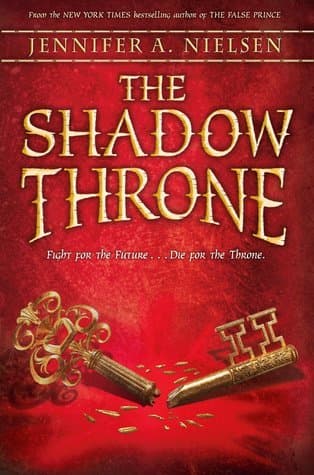
Synopsis
Covers the whole plot, including the ending.
- Difficulty
- Easy
- Pacing
- Fast
- Mood
- Action-packed, Suspenseful, Adventurous, Hopeful
- Read it if
- You enjoy fast-paced fantasy adventures with clever protagonists, political intrigue, and high stakes, especially if you like stories where a seemingly reckless hero outsmarts his enemies.
- Skip it if
- You prefer slow-burn fantasy with extensive world-building, or if you dislike young adult narratives with a focus on a singular, often impulsive, hero.
The Shadow Throne Plot Summary
Covers the whole plot, including the ending.
The War Begins: Imogen's Capture and Jaron's Reckless Plan
The war against Avenia has begun, and Carthya is under siege. King Jaron, despite his youth, is determined to protect his kingdom. King Vargan of Avenia kidnaps Imogen, Jaron's love interest and a loyal servant. Vargan uses her to force Carthya's surrender. Jaron, driven by duty and personal affection, plans a daring, almost suicidal, mission to infiltrate Avenia and rescue Imogen himself. Ignoring his advisors, particularly Fink and Mott, Jaron sets out with a small, reluctant group, knowing the immense risks. His first attempt to enter Avenia is dangerous, immediately showing the overwhelming odds against him and King Vargan's ruthless nature.
Separation and Disguise: Jaron's Solo Infiltration of Avenia
Jaron's rescue attempt quickly fails. He is separated from Fink and Mott, who must find their own ways to help defend Carthya. Jaron, always resourceful, disguises himself and goes into Avenia alone, determined to find Imogen. He navigates the hostile territory, using his wits and stealth, while the war continues. His journey through Avenia tests his resolve and shows his ability to blend in and gather information, even in extreme danger. He learns of Vargan's brutal methods and Carthya's desperate situation, which further strengthens his determination to save Imogen and return to lead his people.
Imogen's Plight and Jaron's Capture
Jaron eventually finds Imogen, who is held captive in a remote Avenian stronghold. He learns of her mistreatment and the psychological torment King Vargan inflicts on her. Vargan wants to break her spirit and use her as a pawn. Just as Jaron tries to free her, Vargan's soldiers ambush and capture him. This capture is a devastating blow, putting both Jaron and Imogen in extreme danger and seemingly ending any hope of a quick rescue or a favorable turn in the war. Vargan, now holding both the King of Carthya and his beloved, believes he has won.
The Interrogation and the Threat of the Shadow Throne
While imprisoned, Jaron endures brutal questioning by King Vargan. Vargan seeks to get information about Carthya's defenses and demoralize Jaron. Vargan also reveals his understanding of the 'Shadow Throne' prophecy, believing it refers to a mythical seat of power that will give him ultimate control over Carthya if Jaron is eliminated. Jaron, despite his pain, uses his quick wit and cunning to resist Vargan, subtly manipulating his captor and buying time. He understands that Vargan's obsession with this prophecy is a key weakness he might use, even in his terrible situation. Imogen, also imprisoned, worries Jaron constantly.
Reunions and Escapes: Jaron, Imogen, and Tobias
Jaron's ingenuity and a stroke of luck allow him and Imogen to make a harrowing escape from Vargan's stronghold. During their flight, they meet Tobias, Jaron's former rival for the throne. Tobias has been working with Vargan, seemingly against Carthya. It becomes clear that Tobias has been forced and manipulated, with his family held hostage. A tense reunion occurs. Jaron must decide whether to trust Tobias, whose loyalty is now unclear. This encounter complicates their escape and forces Jaron to confront the moral compromises made by those under pressure, showing how widespread Vargan's tyranny is.
The Road to Drylliad: Fink's Return and the Council's Despair
As Jaron, Imogen, and Tobias make their dangerous way back towards Carthya, they face many challenges, including pursuing Avenian soldiers and difficult terrain. Meanwhile, back in Carthya, Fink, having escaped his own ordeal, returns to Drylliad and reports to the Carthyian regents and war council. The council is in despair, believing Jaron to be dead or lost, and thinking about surrendering to Vargan. Fink, however, maintains hope and provides important information about Avenian movements, urging them to keep fighting. His return brings a glimmer of hope amidst the overwhelming despair, but the kingdom remains close to collapse.
The Prophecy and the True Shadow Throne
During their difficult journey, Jaron puts together information about the 'Shadow Throne' prophecy. He realizes Vargan's interpretation is wrong. He figures out that the Shadow Throne is not a physical object or a seat of power, but a concept representing Carthya's true, hidden strength: its people, their loyalty, and their willingness to fight for their freedom and their rightful king. This revelation is a turning point for Jaron. It shifts his focus from a single object to his nation's collective spirit. He understands that his task is not just to defeat Vargan, but to inspire his people to reclaim their own strength.
The Battle for Drylliad and Tobias's Redemption
Jaron, Imogen, and Tobias finally reach Drylliad, arriving just as Vargan's forces launch a final, decisive attack on the capital. Jaron, though tired, immediately takes command, rallying the demoralized Carthyian soldiers. In the chaotic battle, Tobias proves his loyalty, fighting bravely alongside Jaron against Vargan's forces, earning Jaron's trust and respect. The battle is fierce and bloody, with many casualties on both sides. Jaron uses his unusual tactics, using the city's layout and his knowledge of Vargan's arrogance to gain an advantage, even as the odds remain against them.
Confrontation with Vargan and the Unmasking of the Traitor
In the battle's most important moments, Jaron confronts King Vargan directly. Their duel is a clash of wills and swords. Jaron uses his agility and cunning against Vargan's brute force. During this confrontation, Jaron reveals his understanding of the Shadow Throne and exposes a shocking betrayal: a high-ranking Carthyian noble, Lord Conner, has secretly worked with Vargan, causing much of the kingdom's downfall. Conner's treachery, motivated by a desire for power, is a devastating blow to Carthya. It also clarifies the true extent of the internal threats Jaron has been facing, beyond just Avenia.
Victory, Resolution, and the Future of Carthya
With Conner's betrayal exposed and King Vargan defeated, the war turns in Carthya's favor. Jaron, though wounded, wins. He has not only saved his kingdom but also inspired his people. The immediate threats are gone, and Carthya begins the difficult process of rebuilding. Jaron, now an experienced king, strengthens his reign, earning the loyalty of his subjects and advisors. He ensures justice for Conner and begins to address the needs of his war-torn nation, looking towards a future of peace and stability, with Imogen by his side and a renewed sense of purpose for Carthya.
The Shadow Throne Characters
Jaron
Protagonist
The young, cunning, and reluctant King of Carthya, fighting to save his kingdom and loved ones.
Jaron, formerly Prince Jaron and Sage, is the young King of Carthya. Despite his youth and a reputation for recklessness, he possesses extraordinary cunning, wit, and a fierce loyalty to his kingdom and the people he cares about. He often acts impulsively but always with a strategic mind, using his perceived weaknesses to his advantage. His journey in "The Shadow Throne" sees him mature further, grappling with the immense responsibility of kingship while facing seemingly insurmountable odds. He is driven by a deep sense of justice and a desire to protect Carthya from external and internal threats.
Relationships: Imogen (love interest, loyal companion); Mott (loyal bodyguard and advisor); Fink (loyal page, friend, and spy); Tobias (former rival, reluctant ally, then loyal general); King Vargan (primary antagonist)
Imogen
Supporting
Jaron's loyal love interest, kidnapped by King Vargan.
Imogen is a steadfast and courageous young woman who serves as a maid in the castle and is Jaron's love interest. Her capture by King Vargan is a major catalyst for Jaron's actions in the book. Despite her vulnerable position as a captive, she displays remarkable resilience and wit, refusing to break under Vargan's pressure. Her presence, both as a captive and later as a companion during their escape, provides emotional depth to Jaron's character and highlights the personal stakes of the war. She is intelligent and perceptive, often offering Jaron quiet support and understanding.
Relationships: Jaron (love interest); King Vargan (captor, antagonist)
King Vargan
Antagonist
The ruthless and ambitious King of Avenia, determined to conquer Carthya.
King Vargan is the primary antagonist of the story, the tyrannical ruler of Avenia who wages war against Carthya. He is cruel, manipulative, and obsessed with power, believing himself destined to rule the continent. Vargan uses deceit, psychological warfare, and overwhelming military force to achieve his goals. His obsession with the 'Shadow Throne' prophecy drives many of his actions, demonstrating his superstitious and ruthless nature. He underestimates Jaron's intelligence and resilience, ultimately leading to his downfall.
Relationships: Jaron (primary enemy); Imogen (captor); Lord Conner (secret ally/pawn)
Mott
Supporting
Jaron's fiercely loyal bodyguard and a skilled warrior.
Mott is one of Jaron's most loyal and trusted bodyguards and advisors. A seasoned warrior, he is pragmatic, brave, and deeply devoted to Jaron, often acting as a grounding force for the young king's more impulsive decisions. Despite his initial skepticism about Jaron's plans, he follows him into danger without hesitation. Mott's strength and combat skills are crucial in many perilous situations, and his unwavering presence provides Jaron with a sense of security and a moral compass. He represents the steadfast loyalty of Carthya's old guard.
Relationships: Jaron (loyal bodyguard and advisor); Fink (companion in arms)
Fink
Supporting
Jaron's young, nimble, and fiercely loyal page and spy.
Fink is a young boy, Jaron's page, who proves to be incredibly resourceful, brave, and loyal. Despite his small stature, he is quick-witted, agile, and an excellent spy, often providing Jaron with crucial intelligence. He deeply admires Jaron and is fiercely protective of him. Fink's journey in the book involves being separated from Jaron and having to navigate dangerous situations on his own, demonstrating his growth and resilience. His determination to help Carthya, even when Jaron is presumed lost, showcases his unwavering spirit.
Relationships: Jaron (loyal page and friend); Mott (companion in arms)
Tobias
Supporting
Jaron's former rival for the throne, forced into an alliance with Vargan.
Tobias was once a claimant to the Carthyian throne, a scholarly and honorable young man. In "The Shadow Throne," he is revealed to be working with King Vargan, seemingly against Carthya. However, it is quickly revealed that Vargan has coerced him by holding his family hostage. Tobias struggles with his conscience and his forced allegiance, eventually choosing to side with Jaron and fight for Carthya. His character highlights the moral complexities of war and the difficult choices people are forced to make under duress. He proves his redemption through his actions in the final battle.
Relationships: Jaron (former rival, then ally); King Vargan (coerced associate)
Rodrick
Supporting
Captain of the Royal Guard, a loyal and experienced military leader.
Rodrick is the Captain of Carthya's Royal Guard, a seasoned and dependable military officer. He is deeply loyal to the crown and to Jaron, despite sometimes questioning Jaron's unconventional methods. Rodrick provides a stable presence in the Carthyian war council, offering strategic advice and leading the kingdom's forces in battle. His experience and steady leadership are crucial in holding Carthya's defenses together during Jaron's absence and the war's most desperate moments. He represents the traditional military strength and integrity of Carthya.
Relationships: Jaron (loyal captain and advisor)
Lord Conner
Antagonist
A treacherous Carthyian regent secretly conspiring with King Vargan.
Lord Conner is revealed to be a traitor within Carthya's own ranks, a regent who secretly conspires with King Vargan. Driven by ambition and a desire for power, he undermines Carthya from within, providing Vargan with crucial intelligence and facilitating the kingdom's downfall. His betrayal adds a layer of internal conflict and danger to Jaron's struggle. Conner represents the insidious threat of internal treachery, demonstrating that not all enemies wear a foreign uniform. His unmasking is a critical plot point, unifying Carthya against both external and internal threats.
Relationships: King Vargan (secret ally/mastermind); Jaron (secret enemy)
The Shadow Throne Themes
Leadership and Responsibility
Jaron's journey is about taking on the heavy role of kingship. He learns that true leadership is not just about cunning or bravery, but about making difficult decisions, inspiring loyalty, and understanding his people's needs. His reckless bravery becomes strategic leadership. He puts the kingdom's survival over personal glory. The theme is shown by the contrast between Jaron's unusual methods and his advisors' more traditional expectations. This ultimately proves that effective leadership can come in many forms, especially when facing overwhelming odds.
“A king fights for his people, not just for his own life. My life is theirs to command.”
Loyalty and Betrayal
This theme is central to the war, appearing in various ways. Mott and Fink's loyalty to Jaron contrasts with Lord Conner's betrayal, who conspires with Vargan from within Carthya's council. Tobias's forced 'betrayal' and eventual redemption further explore the complexities of loyalty when under pressure. Jaron's ability to tell true loyalty from deception is important for his survival and Carthya's victory. This shows that trust is a powerful, yet fragile, weapon in war.
“Some betrayals are born of fear, others of greed. Both can kill a kingdom.”
The True Meaning of Power
King Vargan's misguided obsession with the 'Shadow Throne' as a literal object of power drives much of his ambition. Jaron, however, eventually discovers that the true 'Shadow Throne' is not a physical item but a metaphor for the collective strength, resilience, and spirit of Carthya's people. This theme questions the usual understanding of power, stating that real authority comes from a nation's loyalty and unity, rather than from conquest or mystical objects. Jaron's triumph shows this deeper understanding of power.
“The Shadow Throne isn't a chair, Vargan. It's the hearts of my people, beating as one.”
Resilience and Hope in Adversity
Throughout the book, Carthya faces overwhelming odds. Its capital is under siege, its king is missing, and its people are demoralized. Yet, characters like Imogen, Fink, and the Carthyian soldiers show resilience, refusing to give up hope. Jaron himself embodies this theme. He endures capture, torture, and the constant threat of death, yet never loses his resolve or his cunning. The story shows that even in the darkest moments, the human spirit's ability to resist and the belief in a better future can be the strongest weapons against tyranny.
“Hope is a dangerous thing for those who cling to it, but a necessary one for those who would defy despair.”
Plot Devices & Literary Techniques
The Shadow Throne Prophecy
A mysterious prophecy that drives the motivations of both protagonist and antagonist.
The Shadow Throne prophecy is a central plot device, initially misunderstood by King Vargan as a literal, powerful artifact that will grant him dominion over Carthya. This misinterpretation fuels his war and his actions against Jaron. Jaron's eventual realization that the 'Shadow Throne' represents the collective spirit and loyalty of Carthya's people provides a crucial turning point. It shifts the focus from a physical object to a metaphorical understanding of national strength, highlighting the theme of true power and serving as a symbolic representation of Carthya's resilience.
Disguise and Secret Identities
Jaron's use of disguises to infiltrate enemy territory and gather intelligence.
Jaron frequently employs disguises and assumes different identities, harkening back to his days as 'Sage.' This device allows him to move undetected through Avenia, gather critical information, and approach situations from unexpected angles. His ability to blend in and manipulate perceptions is key to his survival and his efforts to rescue Imogen. It underscores Jaron's cunning nature and his unconventional approach to kingship, contrasting with the more direct, brute-force tactics of his enemies. It also creates dramatic tension as he navigates dangerous situations while concealing his true identity.
Coerced Alliance/Redemption Arc
Tobias's forced collaboration with the antagonist leading to his eventual redemption.
The plot device of Tobias being forced to work with King Vargan, due to threats against his family, introduces moral complexity and a compelling redemption arc. This device not only raises the stakes for Jaron, who must decide whether to trust a former rival, but also explores the theme of loyalty under duress. Tobias's eventual decision to fight alongside Jaron, proving his true allegiance, reinforces the idea that even those who appear to be enemies can be swayed by honor and justice, adding depth to the narrative and strengthening Carthya's forces.
Separated Companions
Jaron being separated from his trusted advisors, forcing independent action.
Early in the narrative, Jaron is separated from Mott and Fink, forcing each character to act independently and face their own challenges. This device allows for multiple perspectives on the war effort and showcases the individual strengths and resilience of Jaron's loyal companions. It heightens the sense of peril for Jaron, as he must rely solely on his wits, while also demonstrating Fink and Mott's unwavering dedication to Carthya in their own separate struggles. Their eventual reunions are moments of relief and reinforcement, highlighting the strength of their bonds.
The Shadow Throne Quotes
“Perhaps that was the best way to get rid of a monster. Not with a sword or a magic spell, but with a simple act of kindness.”
“Sometimes the greatest power lies not in what you can do, but in what you choose not to do.”
“Every lie, no matter how small, casts a shadow. And enough shadows can obscure the sun.”
“The world was not a storybook, and happy endings were not guaranteed, but they were worth fighting for.”
“Fear was a tool, like any other. It could be used to control, or it could be used to protect.”
“Even a small light can banish a great deal of darkness.”
“A crown does not make a king; character does.”
“Sometimes the bravest thing you can do is admit you're afraid.”
“Secrets were like seeds; once planted, they grew, sometimes into something beautiful, often into something thorny.”
“The most dangerous chains are the ones you cannot see.”
“Loyalty is a gift, not a right. It must be earned, and cherished.”
“The greatest battles are often fought within oneself.”
“Love, even in its simplest form, could be a powerful weapon against despair.”
“History is written by the victors, but truth has a way of finding its own voice.”
“A true home is not a place, but a feeling shared with those you love.”
Quiz
10 questions on the plot and the characters. Each answer comes with a short explanation.
Question 1
What is King Vargan of Avenia's primary motivation for kidnapping Imogen?
- To force Jaron to abdicate the throne.
- To use her as leverage to bring Carthya to its knees.
- To marry her and form an alliance with Carthya.
- To exchange her for valuable Carthyan gold.
Show answer
B. To use her as leverage to bring Carthya to its knees. The book states that Vargan kidnapped Imogen 'in a plot to bring Carthya to its knees,' indicating his goal was to weaken Carthya by using her as a bargaining chip or distraction.
Question 2
What is Jaron's immediate response upon learning of Imogen's kidnapping?
- He rallies his army for a full-scale invasion of Avenia.
- He sends a diplomatic envoy to negotiate her release.
- He embarks on a daring rescue mission himself.
- He seeks advice from his council on the best course of action.
Show answer
C. He embarks on a daring rescue mission himself. The text explicitly states, 'Jaron knows it is up to him to embark on a daring rescue mission,' highlighting his personal commitment to saving her.
Question 3
How does the war affect Jaron's friends and allies?
- They all remain by his side, fighting together.
- They are captured and held as prisoners in Avenia.
- They are flung far and wide across Carthya and its neighboring lands.
- They abandon him due to the overwhelming odds.
Show answer
C. They are flung far and wide across Carthya and its neighboring lands. The summary notes that 'His friends are flung far and wide across Carthya and its neighbouring lands,' indicating their dispersal due to the war's chaos.
Question 4
What specific quality is Jaron noted to possess that might aid him in his struggles?
- Exceptional physical strength.
- A vast network of spies.
- Lightning-quick wit.
- Unwavering loyalty from all his subjects.
Show answer
C. Lightning-quick wit. The description mentions, 'But even with his lightning-quick wit, Jaron cannot forestall the terrible danger,' highlighting his intelligence as a key characteristic.
Question 5
What is the ultimate question posed at the end of the book's description, reflecting a major theme?
- Will Carthya form an alliance with Avenia?
- Who will sit on Carthya's throne?
- Will Imogen ever forgive Jaron?
- Can Jaron defeat Vargan in single combat?
Show answer
B. Who will sit on Carthya's throne? The final sentence of the summary is, 'And in the end, who will sit on Carthya's throne?' This directly addresses the theme of leadership and succession amidst conflict.
Question 6
What seems to be a recurring problem Jaron faces during his rescue mission and journey?
- Lack of adequate supplies and provisions.
- Betrayal from his closest advisors.
- Everything that can go wrong does.
- Constant pursuit by Vargan's elite guard.
Show answer
C. Everything that can go wrong does. The text states, 'But everything that can go wrong does,' indicating a consistent pattern of misfortune or challenges during Jaron's efforts.
Question 7
The description implies that Carthya is facing what type of military outcome early in the war?
- A decisive victory.
- A stalemate with no clear advantage.
- What looks to be a devastating loss.
- Minor skirmishes with minimal impact.
Show answer
C. What looks to be a devastating loss. Jaron undertakes his journey 'In a last-ditch effort to stave off what looks to be a devastating loss for the kingdom,' suggesting Carthya is on the brink of defeat.
Question 8
Beyond saving Imogen, what larger objective does Jaron undertake in his 'last journey'?
- To secure a peace treaty with Avenia.
- To reclaim lost territories from enemy forces.
- To save everything and everyone he loves.
- To discover a hidden weapon to turn the tide of war.
Show answer
C. To save everything and everyone he loves. The summary states Jaron 'undertakes what may be his last journey to save everything and everyone he loves,' indicating a broader goal beyond just Imogen.
Question 9
The phrase 'War has come to Carthya. It knocks at every door and window in the land' primarily serves to emphasize what aspect of the conflict?
- The strategic importance of Carthya's borders.
- The widespread and pervasive nature of the war's impact.
- The element of surprise in Avenia's attack.
- The physical destruction of Carthyan infrastructure.
Show answer
B. The widespread and pervasive nature of the war's impact. This metaphorical language highlights that the war is not confined to battlefields but affects every part of daily life and every citizen within Carthya.
Question 10
Despite his quick wit, what limitation is Jaron explicitly stated to face regarding the impending danger?
- He cannot convince his allies to join him.
- He cannot forestall the terrible danger that descends on him and his country.
- He cannot escape the kingdom's borders.
- He cannot protect Imogen from Vargan's influence.
Show answer
B. He cannot forestall the terrible danger that descends on him and his country. The text directly states, 'But even with his lightning-quick wit, Jaron cannot forestall the terrible danger that descends on him and his country,' indicating that his intelligence alone isn't enough to prevent the overarching threat.
The Shadow Throne FAQ
What is "The Shadow Throne" about?
"The Shadow Throne" centers on King Jaron of Carthya as he navigates a full-scale war against King Vargan of Avenia. The central conflict escalates when Vargan kidnaps Imogen, forcing Jaron to embark on a perilous rescue mission while simultaneously trying to protect his kingdom and scattered allies from total devastation.
Why should I read "The Shadow Throne"?
You should read "The Shadow Throne" for its thrilling blend of high-stakes fantasy, clever political intrigue, and Jaron's signature quick wit and daring plans. It offers a satisfying conclusion to the series, delving deep into themes of leadership, sacrifice, and the true cost of war, all while maintaining a fast-paced, engaging narrative.
What is the background/setting of "The Shadow Throne"?
The story is set in the kingdom of Carthya, a land plunged into war with its aggressive neighbor, Avenia. The narrative spans various locations within Carthya and its surrounding territories as Jaron and his allies are separated and forced to fight on multiple fronts, highlighting the widespread impact of the conflict.
What are the most memorable quotes?
One memorable quote is Jaron's internal monologue about the burden of kingship, often reflecting on how his recklessness is both his greatest strength and weakness. Another would be any of the sharp, sarcastic retorts Jaron delivers even in the face of imminent danger, showcasing his defiant spirit.
What writing style does the author use?
Jennifer A. Nielsen employs a direct, engaging writing style that balances action-packed sequences with moments of internal reflection. Her prose is accessible for young adult readers, yet sophisticated enough to convey complex emotional and strategic depth, often characterized by Jaron's first-person perspective and witty narration.
What minor details add significant meaning?
Minor details, such as the specific weaknesses of certain fortresses or the subtle loyalties of seemingly insignificant characters, often play crucial roles in Jaron's elaborate plans. For instance, the knowledge of hidden passages or the true nature of certain alliances, initially dismissed, become pivotal to turning the tide of battle.
What are some subtle foreshadowing moments?
Subtle foreshadowing includes early mentions of King Vargan's ruthless ambition extending beyond simple conquest, hinting at his deeper, more personal vendetta against Jaron. Also, the repeated emphasis on Jaron's willingness to sacrifice himself often foreshadows the extreme lengths he will go to protect Carthya and Imogen.
What unexpected character connections exist?
Unexpected connections might involve characters previously thought to be minor adversaries or neutral parties revealing hidden loyalties or past relationships that significantly impact Jaron's mission. For example, a seemingly antagonistic figure might turn out to have a personal history with one of Jaron's allies, leading to a surprising alliance.
What are unspoken character motivations?
Unspoken motivations often involve characters like Tobias or Roden, whose loyalty to Jaron is clear but whose personal struggles with Jaron's reckless leadership style are implied. Imogen's desire for independence and agency, even amidst her love for Jaron, is also a subtle but powerful undercurrent.
What psychological complexities do characters exhibit?
Jaron exhibits significant psychological complexity, wrestling with his identity as both a cunning rogue and a responsible king. He struggles with the guilt of past mistakes and the immense pressure of leading his country in war, often masking his fear and vulnerability with bravado and sarcasm.
What are the major emotional turning points?
A major emotional turning point is Jaron's realization of the true depth of Vargan's cruelty and the personal stakes involved when Imogen is kidnapped. Another is the moments where Jaron faces seemingly insurmountable odds and must choose between his own survival and the greater good of his kingdom, often leading to profound personal sacrifice.
How do relationship dynamics evolve?
Relationship dynamics evolve significantly, particularly between Jaron and his loyal regents, where trust is tested under the strain of war. His relationship with Imogen deepens under duress, solidifying their bond amidst extreme danger. Even Jaron's dynamics with his adversaries grow more complex as personal vendettas intertwine with political conflict.
Which parts remain ambiguous or open-ended?
While the main conflict is resolved, some aspects might remain open-ended regarding the future political landscape of the region or the full extent of Carthya's recovery after the devastating war. The long-term implications of certain alliances or rivalries could also be left for readers to ponder.
What are controversial scenes or decisions?
Controversial scenes often involve Jaron's incredibly risky and seemingly self-destructive decisions, which, while ultimately successful, put his life and the lives of his allies in extreme peril. His willingness to use deception and manipulation, even against those he loves, can also be a point of debate.
"The Shadow Throne" ending explained: how it ends & what it means
The book ends with Jaron successfully defeating King Vargan, rescuing Imogen, and securing Carthya's future, though at great personal cost. It signifies Jaron fully embracing his role as king, demonstrating that true leadership requires not just cunning and bravery, but also an unwavering commitment to one's people and a willingness to make the ultimate sacrifice. The ending solidifies his reign and the love he shares with Imogen, bringing a hard-won peace to Carthya.
About the author

Jennifer A. Nielsen is an American author known for her works of fiction, particularly in the young adult genre. Her notable books include "The False Prince," "The Runaway King," "The Shadow Throne," "The Scourge," and "Resistance," which often feature themes of adventure and resilience. Nielsen's storytelling has garnered a dedicated readership and critical attention.
Similar books
- The False Prince
Jennifer A. Nielsen
4.2 (76k) average on GoodreadsFantasyFirst book in the same series, featuring the same protagonist and similar adventurous tone.
- Fablehaven
Brandon Mull
4.1 (134k) average on GoodreadsFantasyShares a similar blend of young adult fantasy, adventure, and magical elements.
- Harry Potter and the Sorcerer's Stone
J.K. Rowling
4.5 (7M) average on GoodreadsFantasyRescued from a miserable life under the stairs, an orphaned boy discovers he's a wizard destined for a magical school, where he uncovers a dangerous secret tied to the dark wizard who murdered his parents.
- The Hunger Games
Suzanne Collins
4.3 (6.4M) average on GoodreadsFantasyIn a future where children fight to the death on live television, Katniss Everdeen volunteers for the arena, turning a death sentence into a fight for survival and a spark of rebellion.
- 1984
George Orwell
4.2 (3.1M) average on GoodreadsPoliticsIn a future where surveillance and thought control are absolute, a man's search for truth clashes with the Party, showing that hope can be a form of rebellion.
- Divergent
Veronica Roth
4.2 (2.9M) average on GoodreadsFantasyIn a society divided by virtues, a sixteen-year-old's difference from the norm starts a rebellion that threatens her world.




Enjoyed the summary?
A summary gives you the shape of the book. The book itself has the detail, the examples and the voice.
Find The Shadow Throne on AmazonAs an Amazon Associate, BookBrief earns from qualifying purchases. How we're funded