

Synopsis
Covers the whole plot, including the ending.
- Difficulty
- Medium
- Pacing
- Moderate
- Mood
- Bleak, tense, cynical, morally complex, suspenseful
The Spy Who Came in from the Cold Plot Summary
Covers the whole plot, including the ending.
The Berlin Wall Crossing
Alec Leamas, head of British intelligence's Berlin station, watches from the shadows as his last agent, Karl Riemeck, tries to cross the Berlin Wall. Riemeck, a double agent for the British, is shot by East German border guards, specifically Mundt's men. This failure is a major blow to British intelligence in Berlin, leaving Leamas's section depleted. The incident shows the harsh reality of Cold War espionage, deeply affecting Leamas and making him want to leave the service.
Control's Proposal
Back in London, a dejected Leamas is called by Control, the head of British Intelligence. Instead of letting Leamas retire, Control suggests a dangerous final mission: to pretend to defect to the East and discredit Mundt, the ruthless head of East German intelligence suspected of being a British double agent. The plan is to make it look like Mundt is betraying the East Germans, forcing them to eliminate him. Leamas is hesitant but agrees, driven by duty and a desire to end his career decisively.
The Descent into Disgrace
Leamas begins the process of appearing to be a disgraced, disillusioned former spy. He is 'retired' from the Service, denied his pension, and deliberately starts drinking heavily, committing petty crimes, and generally falling apart. This staged decline is meant to make him an attractive target for East German intelligence, making him seem vulnerable and bitter, ready to betray his former employers. He takes a low-level job in a library, where he meets Liz Gold, a naive Communist Party member, forming an unexpected, real connection with her amid his despair.
Meeting Liz Gold
While working at the library as part of his cover, Leamas meets Liz Gold, a kind, idealistic young woman involved with the local Communist Party. Their relationship quickly grows, becoming the only real connection Leamas has during his deception. Liz, unaware of Leamas's true identity or mission, sees him as a struggling, sympathetic figure. Her innocence contrasts with his cynical spy world. Leamas finds himself genuinely caring for her, a complication he hadn't expected, which puts her in danger.
The Defection and Interrogation
As planned, Leamas's 'disgrace' attracts East German agents. He is contacted and eventually 'defects,' smuggled into East Germany. There, he undergoes intense interrogation, first by Karden and later by Fiedler, Mundt's Jewish deputy. Leamas carefully sticks to his fabricated story, showing what appears to be real bitterness towards British intelligence and a willingness to expose their secrets. He presents himself as a man who has fallen out of favor and seeks revenge, carefully feeding them information designed to implicate Mundt.
Fiedler's Suspicions
Fiedler, a shrewd, ambitious intelligence officer, interrogates Leamas. As Leamas carefully gives his fabricated information, Fiedler starts to build a case suggesting Mundt, Fiedler's superior and rival, is a British agent. Leamas's story, combined with circumstantial evidence and Fiedler's existing dislike for Mundt, creates a compelling, though false, narrative. Fiedler, a Jew who resents Mundt's Nazi past and ruthless methods, sees a chance to expose and remove his rival, unknowingly playing into Control's scheme.
Liz's Arrival and Arrest
Unknown to Leamas or Control, Liz Gold, worried about Leamas's disappearance and influenced by her Communist contacts, travels to East Germany to find him. Her unexpected arrival at the safe house where Leamas is held jeopardizes the entire operation. She is immediately arrested by the East Germans, who now see her as a potential accomplice or part of the British plot. Her presence introduces an unforeseen, dangerous variable, forcing Leamas to make difficult choices and threatening to expose his mission.
The Tribunal
A tribunal is held to hear Fiedler's accusations against Mundt. Leamas testifies, presenting the fabricated evidence that portrays Mundt as a British double agent. The plan seems to be working as Control intended. However, the prosecution, led by Mundt's loyalists, unexpectedly calls Liz Gold to the stand. Under intense questioning, Liz, naive and unaware of the true stakes, accidentally reveals details about Leamas's life in London that contradict his cover story. Her testimony, though innocent, begins to unravel the deception, casting doubt on Leamas's credibility.
The Revelation of the Truth
Liz's testimony creates the critical flaw in Leamas's story. The now suspicious East German tribunal forces Leamas to reveal the truth. He confesses that the entire operation was a setup to protect Mundt. It is revealed that Mundt is, in fact, a deeply embedded and valuable British double agent, and the entire scheme, including Riemeck's death and Leamas's feigned defection, was designed to eliminate Fiedler, who was close to uncovering Mundt's true allegiance. Leamas is horrified to realize he has been used as a pawn in a larger, more cynical game, with Liz as an unwitting sacrifice.
Fiedler's Execution and Mundt's Vindication
Following Leamas's forced confession, Fiedler is arrested and executed for treason, having been tricked into believing Mundt was the traitor. Mundt is cleared and restored to his position, his value to the British confirmed. Leamas and Liz are then released, supposedly to cross back over the Berlin Wall. This 'release' is part of Mundt's plan to eliminate them, as they now know the full truth of his double agency. Leamas understands they are being led to their deaths, but he and Liz are given a chance to escape, hoping to scale the Wall to freedom.
The Attempted Escape
Leamas and Liz are driven to a secluded section of the Berlin Wall late at night. A British agent, arranged by Mundt, throws down a rope ladder from the Western side. Leamas tells Liz to climb first. She scales the ladder, but as she reaches the top, East German searchlights illuminate the area, and shots ring out. Liz is hit and falls back down, dead. Leamas, devastated and realizing the full betrayal, hesitates. The British agent on the other side calls to him, urging him to climb. Leamas, however, chooses not to, accepting his fate.
Leamas's Death
After Liz is shot and killed while trying to climb the Berlin Wall, Leamas is left alone on the Eastern side, cradling her body. The British agent from the Western side continues to urge him to climb the ladder, emphasizing that he is safe and the mission is accomplished. However, Leamas, broken by Liz's death and the manipulation he has endured, makes a final choice. He looks up at the ladder, then down at Liz's lifeless form, and slowly descends from the Wall, refusing to abandon her. As he reaches the ground, he is shot and killed by the East German guards, choosing death over a return to the morally ambiguous world of espionage that destroyed them both.
The Spy Who Came in from the Cold Characters
Alec Leamas
Protagonist
A jaded British intelligence operative seeking an end to his career.
Alec Leamas is a weary, cynical, and disillusioned head of the British intelligence's Berlin station. He is a career spy, hardened by years in the field and the moral compromises inherent in his profession. Despite his tough exterior, he possesses a deep sense of loyalty and a surprising capacity for genuine human connection, particularly with Liz Gold. He is a man caught between the ruthless demands of his job and a longing for a normal life, a desire that ultimately becomes his undoing. His world is one of shadows and betrayal, where the lines between good and evil are perpetually blurred.
Relationships: Control (superior/manipulator); Liz Gold (lover/victim); Mundt (ostensible enemy/true ally); Fiedler (interrogator/pawn)
Liz Gold
Supporting
A naive, idealistic librarian who becomes entangled in Leamas's mission.
Liz Gold is a young, idealistic, and politically naive librarian who is a member of the local Communist Party. She is kind, empathetic, and sees the best in people, a stark contrast to the cynical world of espionage. Her genuine affection for Leamas draws her into his dangerous mission, entirely without her understanding the true stakes. She represents innocence and ordinary humanity, and her unwitting involvement and tragic demise highlight the destructive reach of the spy world into civilian lives. Her moral clarity stands in sharp relief against the moral ambiguity of the spies.
Relationships: Alec Leamas (lover)
Control
Antagonist
The ruthless, calculating head of British Intelligence.
Control is the cold, calculating, and morally ambiguous head of British Intelligence. He masterminds the elaborate plot to protect Mundt by sacrificing Leamas and Fiedler. His methods are purely utilitarian; he views agents as expendable assets in the larger game of geopolitical power. He operates from a detached, intellectual perspective, prioritizing the long-term strategic advantage over individual lives or moral considerations. He embodies the 'chess master' archetype, pulling strings from afar and willing to sacrifice pawns for the greater good of his cause, or at least his perception of it.
Relationships: Alec Leamas (superior/manipulator)
Hans-Dieter Mundt
Antagonist
A ruthless East German intelligence chief and secret British double agent.
Mundt is the cold, brutal, and highly effective head of the East German intelligence service, the Abteilung. He is a former Nazi, which adds to his ruthlessness and Fiedler's animosity towards him. Unknown to almost everyone, Mundt is a deeply valuable British double agent, a fact that drives the entire plot. He is utterly pragmatic and self-preserving, willing to sacrifice anyone, including his own agents and Leamas, to maintain his cover and position. He embodies the moral compromises of the Cold War, where former enemies become allies in the shadow war.
Relationships: Fiedler (rival/victim); Alec Leamas (ostensible enemy/protected asset)
Fiedler
Supporting
Mundt's ambitious, intelligent Jewish deputy.
Fiedler is Mundt's intelligent and ambitious Jewish deputy in East German intelligence. He is a sharp interrogator and a keen analyst, but also deeply resentful of Mundt's Nazi past and ruthless methods. This personal animosity makes him susceptible to Control's manipulation, as he genuinely believes Leamas's fabricated story about Mundt being a British traitor. Fiedler represents the internal conflicts and power struggles within the East German intelligence apparatus, and his moral opposition to Mundt ironically makes him a perfect pawn in the British scheme.
Relationships: Mundt (rival/superior); Alec Leamas (interrogator/interrogated)
George Smiley
Supporting
A senior British intelligence officer, appearing briefly.
George Smiley makes a brief appearance at the beginning of the novel, serving as Control's trusted lieutenant and Leamas's confidante. He is presented as a quiet, observant, and intellectually formidable figure, embodying the more contemplative and ethical side of British intelligence, though he is still complicit in the cynical machinations of the Service. His presence foreshadows his larger role in le Carré's wider 'Smiley' universe and provides a glimpse into the internal workings of the Circus.
Relationships: Control (subordinate/confidante); Alec Leamas (colleague)
Karden
Supporting
An East German interrogator.
Karden is an East German interrogator who first handles Leamas upon his 'defection'. He is less sophisticated than Fiedler, more of a blunt instrument, but still effective in his role. He represents the initial, more straightforward phase of Leamas's interrogation, setting the stage for Fiedler's deeper analysis. Karden is a functional character, serving to advance the plot by processing Leamas into the East German system.
Relationships: Alec Leamas (interrogator)
Karl Riemeck
Supporting
Leamas's last agent in East Germany.
Karl Riemeck is Leamas's last agent in East Germany, a dedicated but ultimately doomed spy. His death at the Berlin Wall in the opening scene serves as the catalyst for Leamas's desire to 'come in from the cold' and sets the stage for the entire intricate plot. Riemeck represents the expendability of agents in the Cold War and the brutal reality of intelligence work, where lives are routinely sacrificed for strategic gains. His death is a personal blow to Leamas, highlighting the human cost of the spy game.
Relationships: Alec Leamas (handler/agent)
The Spy Who Came in from the Cold Themes
The Moral Ambiguity of Espionage
The novel explores the blurred lines between good and evil, right and wrong, in Cold War espionage. Both sides, East and West, use similar ruthless tactics, betray their agents, and sacrifice innocent lives for strategic advantage. Leamas's mission shows this, as he must betray his identity and manipulate Liz, all to protect a 'good' agent (Mundt) who is himself a ruthless killer. The book suggests that the 'cold' of the Cold War has frozen moral principles, leaving agents in an ethical wasteland where the ends justify the means, no matter how cruel.
“What do you think spies are: priests, saints, and martyrs? They're a squalid procession of vain fools, traitors, too, yes; pansies, sadists, and drunkards, people who play cowboys and Indians to cheer up their broken lives.”
Betrayal and Deception
Betrayal is the core of the spy world in the novel. Leamas betrays his identity, his country (seemingly), and Liz. Control betrays Leamas by using him as a pawn and hiding the full truth. Mundt betrays his country for the British, and Fiedler is betrayed by the system he serves. The entire plot relies on layers of deception, where everyone is either lying or being lied to. This constant duplicity erodes trust and makes real human connection almost impossible, leading to tragic consequences for those who cannot navigate this treacherous world.
“The Service is not a school for gentlemen, Leamas. It is a cynical business, and you are part of it.”
The Human Cost of the Cold War
Beyond geopolitical maneuvering, the novel shows the devastating human cost of the Cold War. Individual lives are sacrificed, careers destroyed, and personal relationships shattered for national security. Riemeck's death, Leamas's emotional desolation, and especially Liz Gold's innocent demise highlight this theme. Liz, a civilian, is caught in the crossfire of a war she barely understands, paying the ultimate price for the machinations of powerful, unseen forces. The 'cold' is not just political; it's an emotional and moral chill that freezes human warmth and empathy.
“They kill people, Leamas. That's what they do.”
The Nature of Identity
Leamas's journey forces him to shed his identity as a respected agent and adopt a fabricated persona of a disgraced, drunken failure. This process of becoming someone else, of living a lie so completely, blurs the lines of who he truly is. He struggles with the authenticity of his feelings for Liz, questioning whether they are part of the act or genuinely felt. The novel suggests that in espionage, one's true self can become lost or irrevocably altered by constant deception, leaving agents as hollowed-out reflections of their former selves, unable to 'come in from the cold' and find peace.
“He was a man who had lost his faith, but kept his ritual.”
Plot Devices & Literary Techniques
The Double Cross
The central plot is a deception within a deception.
The entire narrative is built upon a complex double-cross. Leamas is led to believe he is defecting to expose Mundt as a British agent, but the real plan is to use his testimony to eliminate Fiedler, thereby protecting Mundt, who is the actual British agent. This layered deception keeps the reader, and Leamas, off balance, revealing the true nature of the mission only at the climax. It highlights the profound cynicism of the intelligence services, where agents are routinely manipulated and sacrificed, and truth is a weapon to be wielded, not a principle to be upheld.
The Naive Outsider
Liz Gold's innocence highlights the brutality of espionage.
Liz Gold serves as the naive outsider, a character whose innocence and lack of understanding of the spy world starkly contrast with its brutal realities. Her genuine love for Leamas and her idealistic political beliefs make her vulnerable and ultimately lead to her tragic demise. Her presence allows the novel to comment on the destructive impact of espionage on ordinary lives, pulling a civilian into a morally bankrupt world she is ill-equipped to navigate. She functions as a moral compass, highlighting the profound ethical compromises made by the professional spies.
The Berlin Wall
A potent symbol of division, death, and entrapment.
The Berlin Wall is not just a setting but a powerful symbol throughout the novel. It represents the literal and ideological division of the Cold War, the impossibility of escape, and the constant threat of death. The novel opens with an agent being shot trying to cross it and ends with Leamas and Liz attempting the same perilous journey. It functions as a physical barrier that defines the spy's world, a place where life and death are separated by concrete and barbed wire, embodying the 'cold' and unforgiving nature of the conflict.
The Unreliable Narrative (Leamas's Perspective)
The story is primarily told from Leamas's manipulated viewpoint.
The narrative is largely filtered through Leamas's perspective, making him an unreliable narrator in the sense that he is himself being systematically deceived. The reader experiences the plot as Leamas does, initially believing his mission is to expose Mundt. This device allows le Carré to deliver the shocking twist when the true nature of the double-cross is revealed, pulling the rug out from under both Leamas and the reader. It immerses the reader in the disorientation and moral confusion inherent in the world of espionage, where perception is constantly manipulated.
Quiz
10 questions on the plot and the characters. Each answer comes with a short explanation.
Question 1
Who is the author of 'The Spy Who Came in from the Cold'?
- Graham Greene
- John le Carré
- Ian Fleming
- Len Deighton
Show answer
B. John le Carré The book is explicitly stated to be by John le Carré.
Question 2
What genre is 'The Spy Who Came in from the Cold' primarily classified as?
- Science Fiction
- Romance
- Thriller
- Fantasy
Show answer
C. Thriller The description provided lists 'Thriller' as one of the genres.
Question 3
What is the main protagonist's desire regarding his career?
- To be promoted to a higher rank.
- To retire from espionage.
- To train new recruits.
- To go on one more major mission.
Show answer
B. To retire from espionage. The description states the agent 'wants desperately to end his career of espionage'.
Question 4
What does the phrase 'to come in from the cold' metaphorically suggest in the context of espionage?
- To defect to the enemy.
- To retire from active service.
- To undertake a final, dangerous mission.
- To be exposed to the public.
Show answer
B. To retire from active service. The phrase is used in the context of an agent wanting to end his career, implying retirement from the clandestine world of espionage.
Question 5
Which of the following adjectives is used to describe the atmosphere of the novel by J.B. Priestley?
- Warm and inviting
- Chilly hell
- Exciting and fast-paced
- Mysterious and confusing
Show answer
B. Chilly hell J.B. Priestley is quoted as describing the atmosphere as 'chilly hell'.
Question 6
According to the provided text, what impact did this novel have on the spy genre?
- It introduced a new type of spy gadgetry.
- It popularized the '007' style of espionage.
- It changed the rules of the game.
- It focused solely on political intrigue.
Show answer
C. It changed the rules of the game. The description states that 'le Carré changed the rules of the game' with this novel.
Question 7
The assignment described for the protagonist is characterized as:
- Routine and safe
- A simple administrative task
- Breathlessly perilous
- A training exercise
Show answer
C. Breathlessly perilous The text describes the assignment as 'one last breathlessly perilous assignment'.
Question 8
What does the phrase 'changed the rules of the game' imply about le Carré's contribution to the spy thriller genre?
- He introduced more complex plot twists.
- He focused on the moral ambiguity and psychological toll of espionage.
- He made the spies more heroic and less flawed.
- He simplified the geopolitical landscape depicted.
Show answer
B. He focused on the moral ambiguity and psychological toll of espionage. While not explicitly stated in the short blurb, le Carré is known for moving away from the idealized spy narratives and focusing on the grittier, more realistic, and morally compromised aspects of espionage, which is what 'changing the rules' generally refers to in his context.
Question 9
Considering the description 'atmosphere of chilly hell', what kind of tone or mood is the novel likely to evoke?
- Optimistic and hopeful
- Lighthearted and comedic
- Bleak, oppressive, and dangerous
- Relaxed and comfortable
Show answer
C. Bleak, oppressive, and dangerous The phrase 'chilly hell' strongly suggests a negative, unpleasant, and potentially terrifying environment, characteristic of a bleak and dangerous tone.
Question 10
The protagonist's desire to 'come in from the cold' suggests he is disillusioned with his life as a spy. What might be a underlying theme conveyed by this character's motivation?
- The allure of a simpler, non-violent life.
- The personal cost and moral compromise inherent in espionage.
- The desire for recognition and public acclaim.
- The excitement and thrill of the unknown.
Show answer
B. The personal cost and moral compromise inherent in espionage. An agent wanting to leave a dangerous and morally complex profession like espionage implies a deep weariness with the personal sacrifices, ethical dilemmas, and the psychological burden associated with it. This points to the theme of the personal cost and moral compromise.
The Spy Who Came in from the Cold FAQ
What is the plot of The Spy Who Came in from the Cold?
The novel follows Alec Leamas, a British spy who undertakes one final, dangerous mission to bring down a communist East German official. However, the operation becomes far more complex and morally ambiguous than he initially anticipated, forcing him to question his loyalties and the true nature of espionage.
Who is the main character in The Spy Who Came in from the Cold?
The protagonist is Alec Leamas, a seasoned British intelligence officer. He is weary of his profession and desperate to retire, but is drawn into one last, high-stakes assignment.
What makes The Spy Who Came in from the Cold a classic spy novel?
Le Carré revolutionized the spy genre by portraying espionage realistically, devoid of glamour. The novel delves into the moral compromises, psychological toll, and political machinations inherent in the Cold War, offering a stark and cynical view of the spy world.
What are the main themes in The Spy Who Came in from the Cold?
Key themes include the moral ambiguity of espionage, the dehumanizing effects of the Cold War, betrayal, disillusionment, and the blurred lines between good and evil. The novel questions the effectiveness and cost of intelligence operations.
Is The Spy Who Came in from the Cold a fast-paced thriller?
While it is a suspenseful novel, it's not a typical action-packed thriller. The tension builds through psychological depth, intricate plotting, and a pervasive atmosphere of dread and paranoia, rather than constant chases and shootouts.
How does The Spy Who Came in from the Cold differ from other spy novels?
Unlike more idealized portrayals, Le Carré's novel presents spies as flawed, morally compromised individuals operating in a world of deception and futility. It focuses on the psychological burden and ethical dilemmas of intelligence work.
What is the significance of the title 'The Spy Who Came in from the Cold'?
The title refers to Alec Leamas's desire to leave the dangerous, clandestine world of espionage ('the cold') and return to a normal life. It symbolizes his yearning for safety and a sense of belonging after years of deception.
What is the atmosphere like in The Spy Who Came in from the Cold?
The novel is characterized by a bleak, chilling, and paranoid atmosphere. It effectively conveys the oppressive mood of the Cold War era, with a pervasive sense of distrust and the constant threat of danger.
Is The Spy Who Came in from the Cold based on a true story?
While John le Carré drew heavily on his own experiences in British intelligence, the specific plot of 'The Spy Who Came in from the Cold' is fictional. However, it is renowned for its authentic portrayal of the realities of espionage during the Cold War.
Who are the main intelligence agencies involved in The Spy Who Came in from the Cold?
The primary agencies depicted are the British Secret Intelligence Service (MI6) and the East German secret police (Stasi), along with their Soviet counterparts. The novel explores the intense rivalry and covert operations between these organizations.
About the author
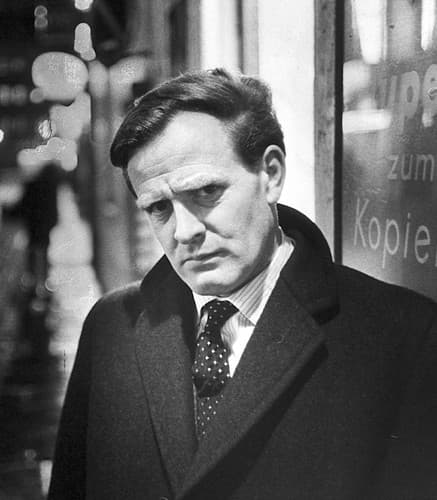
David John Moore Cornwell, better known by his pen name John le Carré, was a British and Irish author, best known for his espionage novels, many of which were successfully adapted for film or television. "A sophisticated, morally ambiguous writer", he is considered one of the greatest novelists of the postwar era. During the 1950s and 1960s he worked for both the Security Service (MI5) and the Secret Intelligence Service (MI6).
Similar books
- Casino Royale
Ian Fleming
3.7 (70k) average on GoodreadsThrillerCompared to Ian Fleming's "Casino Royale," Le Carré's novel is a stark antithesis. Fleming's James Bond embodies the glamorous, action-hero spy, operating in a world of luxury, clear-cut good-vs-evil narratives, and fantastical gadgets. Le Carré, conversely, strips away all glamour, presenting a grimy, bureaucratic, and morally ambiguous world where spies are often shabby, disillusioned, and ultimately disposable. While Fleming celebrates the adventure, Le Carré dissects the cost and futility of espionage, offering a far more realistic and cynical portrayal of the craft. The pacing also differs significantly, with Fleming favoring fast-paced action sequences and Le Carré building tension through intricate plotting and psychological depth.
- The Hunt for Red October
Tom Clancy
4.1 (336k) average on GoodreadsThrillerWhile both are Cold War thrillers, "The Spy Who Came in from the Cold" and Tom Clancy's "The Hunt for Red October" diverge significantly in focus and tone. Clancy's novel is a meticulously detailed technothriller, prioritizing naval strategy, cutting-edge technology, and geopolitical maneuvering. Its heroes are often brilliant tacticians and engineers, operating with a strong sense of patriotic duty. Le Carré's work, however, is intensely character-driven and psychological, focusing on the human cost and moral compromises of espionage rather than the mechanics of warfare. Clancy's world often presents clearer objectives and a sense of ultimate victory, whereas Le Carré's is steeped in disillusionment, where 'victories' are often Pyrrhic and morally tainted. Clancy's narrative is expansive and global; Le Carré's is claustrophobic and intensely personal.
- Angels & Demons
Dan Brown
3.9 (2.7M) average on GoodreadsThrillerA Harvard symbologist races through Rome's ancient sites, deciphering cryptic clues to unmask the Illuminati and stop a vengeful plot to destroy the Vatican with a stolen antimatter weapon.
- Gone Girl
Gillian Flynn
4.1 (2.3M) average on GoodreadsThrillerA wife's sudden disappearance on her fifth anniversary reveals a web of lies and psychological warfare, exposing the secrets within a seemingly perfect marriage.
- The Girl on the Train
Paula Hawkins
3.9 (2.1M) average on GoodreadsThrillerA woman’s fascination with a seemingly perfect couple she watches from her daily train commute leads her into a dark investigation when she witnesses something that shatters their idyllic image.
- The Da Vinci Code
Dan Brown
3.9 (1.9M) average on GoodreadsThrillerA symbologist and a cryptologist race through European landmarks, deciphering ancient codes and uncovering a conspiracy that could rewrite the foundations of Christianity.




Enjoyed the summary?
A summary gives you the shape of the book. The book itself has the detail, the examples and the voice.
Find The Spy Who Came in from the Cold on AmazonAs an Amazon Associate, BookBrief earns from qualifying purchases. How we're funded