
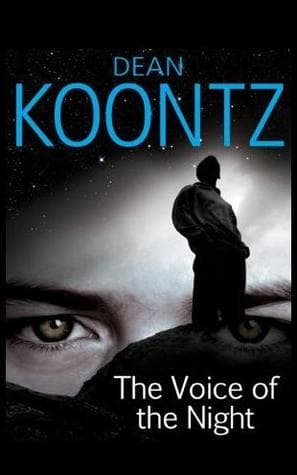
Synopsis
Covers the whole plot, including the ending.
- Difficulty
- Medium
- Pacing
- Moderate
- Mood
- Dark, Suspenseful, Psychological, Disturbing
- Read it if
- You enjoy psychological thrillers with a focus on disturbing character dynamics and the slow burn of guilt and terror.
- Skip it if
- You are sensitive to graphic violence, animal cruelty, or themes of psychological manipulation and murder.
The Voice of the Night Plot Summary
Covers the whole plot, including the ending.
The Unlikely Friendship and a Disturbing Question
Colin and Roy are an inseparable, yet mismatched, pair in high school. Colin is shy, introverted, and struggles with social anxieties, especially around girls. Roy, on the other hand, is charismatic, popular, and a natural leader, attracting both friends and romantic interests easily. Despite their differences, Colin is drawn to Roy's magnetic personality, while Roy seems to find a strange interest in Colin's timidity. Their bond leads to constant speculation among their peers. One day, during a casual conversation, Roy unsettlingly asks Colin, "You ever killed anything?" This question, delivered with unnerving intensity, changes their dynamic from a typical friendship to something far more sinister, hinting at Roy's dark interests and the disturbing path their relationship will take.
The First 'Game' and Its Aftermath
After his chilling question, Roy soon escalates his dark games. He manipulates Colin into helping torment and kill a stray cat, framing it as a test of courage and loyalty. Colin, deeply disturbed and guilt-ridden, is horrified by the act but too afraid to defy Roy, whose persuasive power and implicit threats are overwhelming. The incident leaves Colin traumatized and further strengthens Roy's psychological dominance over him. Roy uses Colin's involvement as leverage, ensuring his silence and continued participation in his escalating acts of cruelty. This event sets a dangerous pattern for their future, with Colin trapped in a cycle of fear and unwilling obedience, forever marked by the horrific deed.
Escalation to Human Targets
Roy's 'games' gradually become more severe, moving from animals to humans. He begins by orchestrating elaborate pranks and acts of vandalism that cause significant distress and harm to various people in their community. Colin, increasingly terrified and morally conflicted, finds himself an unwilling participant, forced by Roy's threats and manipulation to assist in these schemes. Roy's methods are subtle, often making Colin seem like the instigator or ensuring that Colin's fingerprints are on the crimes, making him feel irrevocably entangled. The victims are often chosen at random, or for minor perceived slights against Roy, showing his growing disregard for human life and the law, while Colin's guilt and fear deepen with each new transgression.
The Disappearance of Laura
The 'games' reach a terrifying peak with the disappearance of Laura, a popular and well-liked girl from their school. Roy, driven by an unknown motive, orchestrates her abduction, again forcing Colin into a position of complicity. While Colin doesn't directly participate in the physical abduction, he is made aware of it and coerced into providing an alibi or performing other tasks that help Roy cover his tracks. The community is thrown into a panic, and a police investigation begins, but no trace of Laura is found. Colin is wracked with guilt and terror, knowing the truth but paralyzed by fear of Roy's retaliation and the consequences of revealing his own involvement. This event confirms Roy's identity as a true psychopath.
The Cover-Up and Colin's Internal Struggle
After Laura's disappearance, Roy proves to be a master manipulator, deflecting any suspicion away from himself and even subtly involving others. He maintains a normal facade, charming authorities and peers alike, while continuing to control Colin psychologically. Colin, meanwhile, is tormented by his knowledge of Roy's crimes and his own unwilling participation. He experiences vivid nightmares, panic attacks, and a deep sense of isolation. His conscience battles with his paralyzing fear of Roy, who has made it clear that revealing the truth would mean dire consequences for Colin. This period tests Colin's mental and emotional strength, as he struggles to maintain his sanity while living with such a horrific secret.
The Years of Silence and Guilt
Years pass since Laura's disappearance, and the case eventually goes cold. Colin graduates high school and tries to build a normal life, but his past, particularly his involvement in Roy's crimes, continues to haunt him. He lives with an ever-present sense of guilt and dread, constantly looking over his shoulder, fearing Roy's reappearance or the truth coming out. Roy, meanwhile, seems to have successfully moved on, leaving town and building a new life, seemingly unburdened by his past actions. Colin's life is marked by anxiety and self-doubt, a direct result of the trauma he endured and the secret he carries, unable to fully escape the shadow of his former 'friendship' with Roy.
Roy's Reappearance and Renewed Terror
Just as Colin begins to find some peace in his adult life, Roy unexpectedly reappears. He contacts Colin, initially pretending to rekindle their old friendship, but his true intentions quickly become clear. Roy, now seemingly more refined and successful, still possesses the same chilling charisma and manipulative skill. His presence immediately reignites Colin's deep-seated terror and guilt. Roy subtly reminds Colin of their shared past and the secrets they hold, hinting at new 'games' and further involvement. Colin is once again trapped in Roy's web, his carefully constructed adult life threatening to unravel as the nightmare of his youth returns with terrifying force.
The New Targets and Colin's Resistance
Roy, seemingly bored with his new life, begins to involve Colin in new criminal activities, similar to their high school 'games' but with higher stakes. He targets individuals whom he perceives as having wronged him or simply for the thrill. However, this time, Colin is an adult, no longer the timid, easily manipulated boy. He feels the familiar terror but also a growing resolve to resist Roy's influence. He attempts to subtly sabotage Roy's plans or warn potential victims, though often without success. This period marks a shift in Colin's character, as he moves from passive victim to an active, though still fearful, opponent of Roy's evil, realizing he can no longer allow himself to be controlled.
The Confrontation and the Revelation
Driven to his breaking point, Colin finally confronts Roy directly, demanding an end to his torment and threats. During this intense confrontation, Roy, in a chilling display of his psychopathy, reveals the extent of his depravity and his true motives. He confesses to more crimes than Colin was even aware of, detailing them with a disturbing lack of remorse. He explains that his 'games' were always about control and the thrill of power over others, particularly Colin. This revelation shatters any lingering illusion Colin had about Roy, confirming him as purely evil and solidifying Colin's determination to stop him, no matter the cost.
The Final Showdown
The conflict between Colin and Roy escalates into a violent and desperate struggle. Knowing that Roy will never stop, Colin realizes he must take decisive action to protect himself and others. The final confrontation takes place in a tense and isolated setting, where Colin, despite his fear, manages to outwit and overpower Roy. The battle is brutal and psychologically draining, forcing Colin to confront the darkest parts of his past and the man who shaped it. In the end, Colin manages to kill Roy, bringing a definitive, though traumatic, end to the psychopath's reign of terror and freeing himself from the decades of fear and guilt that have plagued his life.
Aftermath and Redemption
In the immediate aftermath of Roy's death, Colin faces the consequences of his actions, including police questioning and the emotional toll of what he has done. While the authorities may not fully understand the decades of psychological torment Colin endured, he finds a measure of peace in knowing Roy can no longer harm anyone. The book concludes with Colin beginning the difficult process of healing and coming to terms with his past. He is no longer controlled by fear or guilt, but he carries the scars of his experiences. This final stage focuses on Colin's journey toward self-acceptance and the possibility of a future free from Roy's shadow, marking a hard-won redemption.
The Voice of the Night Characters
Colin
Protagonist
A shy, introverted man haunted by a dark past with his charismatic, psychopathic friend.
Colin is initially presented as a timid, socially awkward high school student, easily intimidated and manipulated. He struggles with anxiety and a deep-seated fear of confrontation. His defining characteristic is his intense moral compass, which is constantly at war with his fear of Roy. Despite his timidity, he possesses an underlying resilience and a strong sense of right and wrong, which eventually propels him to break free from Roy's control. He is intelligent and observant, though his self-doubt often overshadows these qualities.
Relationships: Roy (Childhood friend turned tormentor; a relationship built on manipulation and fear.); Laura (Victim of Roy's crimes, whose disappearance deeply traumatizes Colin.)
Roy
Antagonist
A charismatic and intelligent psychopath who delights in manipulation and cruelty.
Roy is the quintessential charismatic psychopath. He is popular, charming, and highly intelligent, capable of effortlessly manipulating those around him. Beneath his appealing exterior lies a chilling void of empathy and a profound fascination with death and power. He sees people, especially Colin, as tools or playthings for his sadistic 'games.' His actions are driven by a desire for control and the thrill of inflicting fear and suffering, rather than any discernible emotional motivation. He is cunning, patient, and utterly ruthless, making him a truly terrifying adversary.
Relationships: Colin (His primary victim and unwilling accomplice, whom he psychologically dominates.); Laura (One of his most significant victims, whose abduction marks a turning point in his escalating crimes.)
Laura
Supporting
A popular high school girl whose disappearance becomes a pivotal event in the narrative.
Laura is portrayed as a bright, popular, and well-liked girl in high school. While her character isn't deeply explored, her existence and tragic disappearance serve as a crucial catalyst for the plot. Her abduction by Roy, with Colin's unwilling complicity, elevates Roy's 'games' from mere cruelty to outright murder, and permanently traumatizes Colin. She represents the innocent victims of Roy's psychopathy and the profound impact his actions have on the community and, most acutely, on Colin's conscience. Her memory continues to haunt Colin for years, fueling his guilt and fear.
Relationships: Roy (Her abductor and presumed murderer.); Colin (Colin is haunted by her disappearance, knowing Roy was responsible.)
Mr. & Mrs. Thorpe
Mentioned
Colin's parents, who are largely unaware of the true nature of his friendship with Roy.
Colin's parents are depicted as loving but somewhat oblivious to the darker aspects of their son's life and his friendship with Roy. They provide a semblance of normalcy in Colin's chaotic world, offering a safe home environment. However, they are unable to truly penetrate Colin's anxieties or understand the sinister hold Roy has over him. Their presence highlights Colin's isolation and the burden of his secret, as he feels unable to confide in them about the horrors he's experiencing, further emphasizing his internal struggle.
Relationships: Colin (His parents, concerned but unaware of his deep struggles.)
Police Detectives (various)
Mentioned
Law enforcement figures investigating Laura's disappearance, ultimately failing to solve the case.
Throughout the narrative, various police detectives are mentioned as being involved in the investigation of Laura's disappearance. They represent the forces of law and order, but their efforts are ultimately thwarted by Roy's cunning and Colin's silence. They interview suspects, follow leads, and maintain a presence in the community, but are unable to uncover the truth. Their inability to solve the case underscores Roy's manipulative genius and the profound difficulty of bringing a hidden psychopath to justice, especially when key witnesses are too terrified to speak.
The Voice of the Night Themes
The Nature of Evil and Psychopathy
The novel deeply explores the insidious nature of psychopathy through Roy. It shows evil not as a monstrous, easily identifiable force, but as something that can hide behind a charming facade, capable of manipulating and destroying lives without remorse. Roy's actions, from animal cruelty to human abduction, show a complete lack of empathy and a perverse enjoyment of control. This theme appears in Roy's casual cruelty, his ability to deceive everyone, and his chilling confessions, where he details his 'games' with a detached, almost scientific, interest, highlighting a deep moral void.
“You ever killed anything?”
Guilt and Complicity
A central theme is the overwhelming burden of guilt and the psychological torment of complicity. Colin, though an unwilling participant, is deeply scarred by his involvement in Roy's crimes. His guilt shows as anxiety, nightmares, and a constant fear of exposure. The story explores how fear can force an otherwise moral person into abhorrent actions, and the long-lasting psychological damage that results. Colin's struggle to come to terms with his past, and his eventual decision to confront Roy, are driven by his desperate need to lessen this pervasive guilt and reclaim his moral integrity.
“He knew he was a coward, and that was a worse punishment than any prison.”
Manipulation and Control
The dynamic between Roy and Colin is a masterclass in psychological manipulation and control. Roy expertly uses Colin's timidity, fear, and desire for acceptance to bend him to his will. He uses threats, gaslighting, and shared secrets to maintain his dominance. This theme explores how one individual can have absolute power over another, eroding their will and sense of self. Roy's ability to manipulate not just Colin, but also the wider community and law enforcement, shows the pervasive danger of unchecked psychological power and the vulnerability of those susceptible to it.
“Roy had a way of making you believe that whatever he wanted, you wanted too, or at least you should.”
The Trauma of the Past
The novel vividly shows how past trauma can haunt an individual for decades, shaping their adult life. Colin's experiences with Roy in his youth leave him with deep-seated anxiety, paranoia, and an inability to fully escape his past. Roy's reappearance in adulthood forces Colin to confront these unresolved traumas directly. The theme emphasizes that ignoring or suppressing traumatic events does not diminish their power, but rather allows them to fester, impacting mental health and personal relationships. Colin's journey is one of confronting and ultimately overcoming the lingering shadows of his traumatic youth.
“The past wasn't dead; it was merely sleeping, waiting to awaken and consume him.”
Plot Devices & Literary Techniques
Unreliable Narrator (Subtle)
Colin's subjective and fear-driven perspective shapes the story's interpretation.
While Colin is the primary viewpoint character, his extreme fear, guilt, and trauma subtly make him an unreliable narrator, especially concerning his own actions and motivations in relation to Roy. He constantly second-guesses himself, minimizes his own agency in the past, and struggles with his memories. This device deepens the psychological horror, as the reader experiences the events through Colin's distorted lens, questioning the full extent of his complicity and the reality of his perceptions, enhancing the sense of dread and psychological entrapment.
Foreshadowing
Early disturbing events hint at the escalating darkness of Roy's character.
The novel uses significant foreshadowing, particularly through Roy's early questions and actions. His initial query about killing, his fascination with death, and the incident with the cat are clear precursors to his later, more heinous crimes. This device builds suspense and a sense of impending doom, signaling to the reader that Roy's 'games' will inevitably escalate to human targets. It also highlights Colin's escalating fear and the inevitability of his deeper entanglement, making his eventual confrontation with Roy feel like a long-dreaded, yet necessary, climax.
Psychological Horror
The primary mode of fear comes from mental manipulation and internal torment.
Rather than relying solely on jump scares or graphic violence, the novel primarily employs psychological horror. The terror stems from Roy's manipulative control over Colin, the crushing burden of Colin's guilt, and the constant threat of exposure or further harm. The reader is immersed in Colin's internal world of fear, anxiety, and moral struggle. This device makes the horror more pervasive and deeply unsettling, as it attacks the characters' (and by extension, the readers') sense of safety, sanity, and moral integrity, demonstrating the destructive power of psychological abuse.
The 'Game' Metaphor
Roy frames his cruel acts as a 'game,' normalizing and trivializing his atrocities.
Roy consistently refers to his sadistic acts as 'games,' a chilling metaphor that serves multiple purposes. It trivializes the horrific nature of his crimes, making them seem less real and more palatable to himself and, initially, to Colin. It also frames his actions as a form of entertainment or challenge, highlighting his psychopathic detachment and lack of empathy. This device underscores Roy's manipulative nature, as he uses this language to control Colin and to justify his own depravity, making his evil seem almost playful, which is profoundly disturbing.
The Voice of the Night Quotes
“The past is a phantom that haunts the present, a whisper that can become a scream.”
“There are monsters, and then there are men who become monsters.”
“Sometimes, the most terrifying thing isn't what you see, but what you only hear.”
“Loneliness is a peculiar kind of hunger, an ache that no food can satisfy.”
“Truth is a weapon, but sometimes, the lie is a shield.”
“The greatest prison is not made of bars, but of the mind.”
“In the dark, every shadow seems to hold a secret, every sound a threat.”
“Some people collect stamps; I collect nightmares.”
“Hope is a fragile thing, easily crushed, but sometimes, it's all you have.”
“The world is a stage, and we are all actors, playing roles we don't always understand.”
“Even in silence, there can be a voice, if you listen closely enough.”
“Fear isn't just an emotion; it's a living thing, feeding on your doubts.”
“To forget is to betray, to remember is to suffer.”
“There's a difference between being alone and being lonely, and sometimes, the latter is far more dangerous.”
Quiz
10 questions on the plot and the characters. Each answer comes with a short explanation.
Question 1
What is the primary motivation behind Roy's escalating 'game' with Colin?
- To teach Colin how to be more assertive and brave.
- To fulfill his own dark desires and manipulate Colin into participating in his violent fantasies.
- To get revenge on people who have wronged him in the past.
- To impress a girl he is trying to win over.
Show answer
B. To fulfill his own dark desires and manipulate Colin into participating in his violent fantasies. Roy's actions are driven by his own psychopathic tendencies and a fascination with death, using Colin as a pawn to enact his violent schemes.
Question 2
Which of the following best describes Colin's initial personality at the beginning of the novel?
- Confident and outgoing.
- Rebellious and aggressive.
- Shy and nervous, especially around girls.
- Intellectual and analytical.
Show answer
C. Shy and nervous, especially around girls. The book explicitly states Colin was 'so shy' and 'nervous around girls,' contrasting him with the popular Roy.
Question 3
What is the first significant act Roy pressures Colin into after asking 'You ever killed anything?'
- Stealing from a local store.
- Hurting an animal.
- Confronting a school bully.
- Playing a dangerous prank on a neighbor.
Show answer
B. Hurting an animal. The 'game' begins with Roy pushing Colin to commit acts of violence against animals, escalating from there.
Question 4
What role does Colin's fascination with Roy play in their destructive friendship?
- It gives Colin the courage to stand up to Roy.
- It makes Colin want to emulate Roy's popularity and charm.
- It makes Colin vulnerable to Roy's manipulation, as he is drawn to Roy's perceived strength and excitement.
- It allows Colin to understand Roy's motives and stop him.
Show answer
C. It makes Colin vulnerable to Roy's manipulation, as he is drawn to Roy's perceived strength and excitement. Colin's fascination, coupled with his shyness, makes him an ideal target for Roy's manipulation, as he's drawn to the charismatic yet dangerous friend.
Question 5
How does the author use the contrast between Colin and Roy to develop the novel's central conflict?
- By showing how two similar individuals can still become enemies.
- By highlighting the corrupting influence of a dominant, malevolent personality on a timid, impressionable one.
- By demonstrating that even the most popular people can have hidden insecurities.
- By exploring the difficulties of maintaining friendships despite differing interests.
Show answer
B. By highlighting the corrupting influence of a dominant, malevolent personality on a timid, impressionable one. The stark contrast between Roy's darkness and Colin's timidity is central to the psychological thriller, showing how one can be drawn into another's destructive orbit.
Question 6
What is the significance of the 'game' becoming 'too irresistible to stop' for Colin?
- It implies Colin genuinely enjoys the violence.
- It highlights the psychological hold Roy has over Colin and Colin's own growing desensitization or fear of consequences.
- It suggests Colin is secretly as evil as Roy.
- It refers to an actual board game they play together.
Show answer
B. It highlights the psychological hold Roy has over Colin and Colin's own growing desensitization or fear of consequences. The 'irresistible' nature of the game for Colin reflects his entrapment, whether due to fear, a twisted sense of loyalty, or a gradual breaking down of his moral resistance.
Question 7
What literary device is primarily used in the phrase 'Roy was fascinated with death'?
- Metaphor
- Foreshadowing
- Irony
- Simile
Show answer
B. Foreshadowing This phrase directly hints at the dark and dangerous path Roy will lead Colin down, setting expectations for the violent plot to unfold.
Question 8
How does the novel explore the theme of moral compromise?
- Through Colin's unwavering refusal to participate in Roy's schemes.
- By showing Colin's gradual descent into complicity with Roy's increasingly violent acts, blurring his own moral lines.
- By presenting Roy as a character who eventually seeks redemption.
- By having a third character intervene and force both boys to face their actions.
Show answer
B. By showing Colin's gradual descent into complicity with Roy's increasingly violent acts, blurring his own moral lines. A core theme is how Colin, initially timid, is forced to compromise his morals under Roy's influence, participating in acts he would never have considered alone.
Question 9
What is the primary psychological impact of Roy's manipulation on Colin?
- It makes Colin more confident and self-assured.
- It isolates Colin from other friends and family, trapping him in Roy's world.
- It causes Colin to question his own identity and moral compass, leading to immense internal conflict and fear.
- It inspires Colin to seek professional help for Roy.
Show answer
C. It causes Colin to question his own identity and moral compass, leading to immense internal conflict and fear. Roy's manipulation deeply affects Colin's psyche, forcing him into situations that challenge his understanding of himself and right/wrong, leading to significant internal turmoil.
Question 10
What does the phrase 'No one could understand why Colin and Roy were best friends' immediately establish for the reader?
- That their friendship is a source of joy and happiness.
- That their friendship is unusual and likely problematic, setting a tone of mystery and potential danger.
- That they are both outcasts from society.
- That their friendship is based on shared academic interests.
Show answer
B. That their friendship is unusual and likely problematic, setting a tone of mystery and potential danger. This opening line highlights the stark differences between the two, immediately signaling that their bond is unconventional and likely to lead to trouble, setting a mysterious and ominous tone.
The Voice of the Night FAQ
What is the central premise of 'The Voice of the Night'?
The novel explores the dangerous friendship between the timid, impressionable Colin and the charismatic, psychopathic Roy. Roy gradually manipulates Colin into participating in and witnessing horrific acts, drawing him into a 'game' of murder and terror that Colin finds both repellent and strangely compelling, ultimately struggling to escape Roy's control.
Who are the two main characters and what are their initial dynamics?
The main characters are Colin and Roy. Colin is shy, introverted, and a loner, while Roy is outgoing, popular, and a natural leader. Despite their contrasting personalities, Colin is drawn to Roy's magnetism and confidence, while Roy sees in Colin a malleable target for his dark desires and a potential accomplice.
How does Roy initiate Colin into his 'game'?
Roy initiates Colin by asking provocative questions about killing and then escalating to actual acts of violence, starting with animals and progressing to humans. He uses psychological manipulation, dares, and a warped sense of camaraderie to break down Colin's moral resistance and draw him deeper into their shared secrets.
What role does Roy's fascination with death play in the narrative?
Roy's fascination with death is the driving force behind his actions and his 'game.' He views death as the ultimate power and a source of perverse pleasure, using it to assert control over others and to define his own existence. This obsession is what makes him such a terrifying and unpredictable antagonist.
What is the significance of the title, 'The Voice of the Night'?
The title can be interpreted in several ways: it refers to the dark, seductive impulses that emerge under the cover of night, often personified by Roy's manipulative whispers and commands. It also represents Colin's own internal struggles and the 'voice' of his conscience battling against the evil he is drawn into, especially during the quiet, vulnerable hours of darkness.
Are there any subtle clues about Roy's true nature early in the book, beyond his direct actions?
Yes, subtle clues include Roy's unsettling intensity, his lack of empathy when discussing violence, and his almost predatory interest in Colin's reactions. His charm often feels superficial, and his eyes are sometimes described in ways that suggest a coldness or a hidden malevolence, foreshadowing his psychopathic tendencies.
Is there a specific moment where Colin fully realizes the extent of Roy's depravity?
While Colin has many unsettling moments, his full realization likely crystallizes after witnessing Roy commit human murder, especially when Roy shows no remorse and instead expresses exhilaration. This act shatters any remaining illusion Colin might have held about Roy's 'game' being anything other than pure evil.
Does the author's afterword offer any unique insights into the book's themes or development?
Typically, Dean Koontz's afterwords often provide context on his inspiration, the challenges of writing a particular story, or deeper philosophical underpinnings he intended to explore. For this book, it might discuss the psychological horror aspect, the nature of evil, or perhaps the influence of his own youth on the character dynamics.
How does Colin's shyness contribute to his vulnerability to Roy's influence?
Colin's shyness makes him isolated and crave connection, which Roy exploits. His lack of social confidence makes him more susceptible to Roy's dominant personality and charisma, as Roy offers him a sense of belonging and excitement that Colin's ordinary life lacks, even if that excitement is terrifying.
What psychological mechanisms does Roy use to manipulate Colin?
Roy employs a range of psychological tactics, including gaslighting, guilt trips, flattery, and intimidation. He isolates Colin from other potential friends, creates a shared secret bond, and constantly tests Colin's boundaries, slowly desensitizing him to violence and eroding his moral compass.
Does Colin experience Stockholm Syndrome or a similar psychological attachment to Roy?
While not a classic case of Stockholm Syndrome, Colin does exhibit a complex psychological attachment to Roy. He fears Roy, yet also feels a strange fascination and dependency, a warped sense of loyalty born from shared secrets and Roy's powerful influence. This bond is more a result of manipulation and terror than genuine affection.
How does the novel explore the concept of latent evil within ordinary individuals?
The novel suggests that even seemingly ordinary individuals like Colin can be drawn into darkness when exposed to powerful, corrupting influences. It explores how fear, loneliness, and the desire for acceptance can compromise one's morals, hinting that the potential for evil or complicity might lie dormant within many, awaiting activation.
Is Roy purely evil, or are there any redeeming qualities or vulnerabilities shown?
Roy is depicted as a pure psychopath, largely devoid of redeeming qualities. His charisma is a tool for manipulation, and any seeming vulnerability is usually a calculated act. The novel emphasizes his complete lack of empathy and conscience, painting him as a truly malevolent force rather than a complex character with moral ambiguities.
Does Colin ever truly break free of Roy's psychological hold, even after physical separation?
The novel suggests that while Colin may physically escape Roy, the psychological scars and the trauma of their 'game' will likely haunt him indefinitely. The experience fundamentally alters him, and the memory of Roy and the darkness he witnessed will remain a permanent fixture in his psyche, making true 'freedom' a complex concept.
What statement does the book make about the nature of friendship and its potential for corruption?
The book offers a chilling cautionary tale about the dark side of friendship, demonstrating how a bond can be twisted into a tool for manipulation and destruction. It highlights how vulnerability and a desire for connection can be exploited, leading individuals down paths they would never otherwise consider, underscoring the importance of discerning character.
Could 'The Voice of the Night' be interpreted as an allegory for the struggle between good and evil within one's own mind?
Yes, the novel can certainly be interpreted allegorically. Roy might represent the seductive, destructive impulses within the human psyche, while Colin embodies the conscience and the struggle to resist temptation and maintain one's moral integrity. Their external conflict mirrors an internal battle for Colin's soul.
How does the setting contribute to the novel's atmosphere and themes?
The suburban setting, often depicted as seemingly idyllic, creates a stark contrast with the horrific events unfolding within it. This juxtaposition heightens the sense of unease and suggests that evil can lurk beneath the surface of normalcy. The isolated nature of some locations also facilitates Roy's dark activities.
What is the ultimate fate of Roy and Colin, and how does it reflect the book's message?
Roy typically meets a violent end, often at Colin's hand in a desperate act of self-preservation or defiance. Colin, while surviving, is left profoundly scarred and changed by the ordeal. Their fates reflect the book's message that while evil can be confronted, its impact leaves lasting damage, and escape often comes at a terrible personal cost.
About the author

Dean Koontz is a prolific American author best known for his suspenseful thrillers and horror novels. His works often blend elements of the supernatural, science fiction, and detective fiction, exploring themes of good versus evil and the human condition. Notable books include 'Life Expectancy,' 'The Bad Place,' and 'Strangers,' which have garnered international acclaim and bestseller status.
Similar books
- The Stepford Wives
Ira Levin
3.8 (29k) average on GoodreadsThrillerLevin's novel focuses on external, systemic horror rooted in societal conformity and conspiracy, with the threat being a broader, malevolent force. Koontz's The Voice of the Night internalizes the horror within the protagonist's psyche, making the threat personal and stemming from an individual's psychopathy.
- Red Dragon
Thomas Harris
4.0 (274k) average on GoodreadsThrillerHarris's work explores psychopathy through the lens of FBI profiling and a more externalized criminal investigation, focusing on the cat-and-mouse game between law enforcement and the killer. Koontz's novel, conversely, is a first-person account of a victim haunted by a past psychopathic encounter, emphasizing the personal trauma and the direct confrontation with the antagonist.
- Angels & Demons
Dan Brown
3.9 (2.7M) average on GoodreadsThrillerA Harvard symbologist races through Rome's ancient sites, deciphering cryptic clues to unmask the Illuminati and stop a vengeful plot to destroy the Vatican with a stolen antimatter weapon.
- Gone Girl
Gillian Flynn
4.1 (2.3M) average on GoodreadsThrillerA wife's sudden disappearance on her fifth anniversary reveals a web of lies and psychological warfare, exposing the secrets within a seemingly perfect marriage.
- The Girl on the Train
Paula Hawkins
3.9 (2.1M) average on GoodreadsThrillerA woman’s fascination with a seemingly perfect couple she watches from her daily train commute leads her into a dark investigation when she witnesses something that shatters their idyllic image.
- The Da Vinci Code
Dan Brown
3.9 (1.9M) average on GoodreadsThrillerA symbologist and a cryptologist race through European landmarks, deciphering ancient codes and uncovering a conspiracy that could rewrite the foundations of Christianity.






Enjoyed the summary?
A summary gives you the shape of the book. The book itself has the detail, the examples and the voice.
Find The Voice of the Night on AmazonAs an Amazon Associate, BookBrief earns from qualifying purchases. How we're funded