
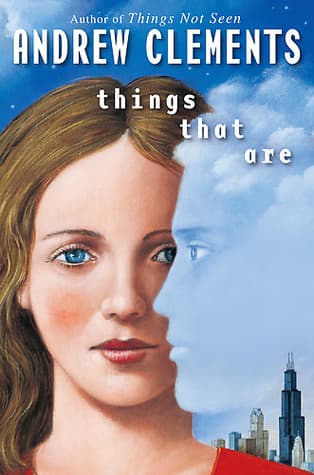
Synopsis
Covers the whole plot, including the ending.
- Difficulty
- Easy
- Pacing
- Moderate
- Mood
- Mysterious, Suspenseful, Thought-provoking, Clever
- Read it if
- You enjoy mysteries with a unique perspective, where a protagonist's non-visual senses are key to solving the puzzle.
- Skip it if
- You prefer fantasy with extensive world-building and magic systems over character-driven suspense.
Things That Are Plot Summary
Covers the whole plot, including the ending.
A Familiar Voice and an Unfamiliar Presence
Alicia, a blind teenager living in a secluded house with her parents, uses her heightened senses daily. One day, her childhood friend, Bobby, now called Robert, returns. While she is happy to reconnect with him, she senses a peculiar, almost imperceptible shift in the air, a feeling of another presence in the house no one else notices. This unsettling feeling combines with her parents' unusual protectiveness and subtle changes in their behavior, making Alicia's normally reliable instincts wary of something unseen and unspoken. The initial joy of Robert's return is overshadowed by this growing unease.
The Invisible Man's Warning
One night, Alicia is startled by a voice only she can hear. It belongs to a man named William, who introduces himself as invisible. William explains he is a 'thing that is' – a being that exists outside normal human perception. He warns Alicia that she and her family are in danger from a powerful, malevolent entity that also exists invisibly. William urges her to trust her instincts and be wary of those around her, including Robert, as the invisible threat can manipulate human perception and actions. This encounter leaves Alicia both terrified and intrigued, forcing her to confront the reality of things she cannot see but can distinctly sense.
Robert's Shifting Persona
As Alicia spends more time with Robert, she notices subtle but disturbing inconsistencies in his personality. His voice sometimes shifts, his mannerisms change, and he occasionally makes comments that seem out of character for the Bobby she once knew. While he is often charming and supportive, there are moments of abruptness or coldness that make Alicia question his true intentions. She recalls William's warning about the invisible entity's ability to manipulate people and starts to wonder if Robert is truly himself, or if he is being influenced by the unseen danger. Her growing suspicion creates a rift in their rekindling friendship.
The Police Investigation
The police arrive at Alicia's home, led by a detective investigating a series of mysterious incidents and disappearances. They explain they believe an invisible man, identified as William, is responsible for these crimes and is extremely dangerous. They warn Alicia and her family to be on high alert and report any unusual occurrences. This revelation throws Alicia into confusion. William had presented himself as a protector, but the police paint him as a villain. She struggles to reconcile these two opposing narratives, unsure whom to trust. The police presence intensifies the sense of danger and mystery surrounding her family.
Alicia's Independent Investigation
Feeling caught between William's warnings and the police's accusations, Alicia decides to rely on her own heightened senses and intellect to uncover the truth. She begins to actively seek out subtle clues, paying close attention to changes in air currents, faint sounds, and shifts in temperature that indicate an unseen presence. She realizes that her blindness, which forces her to rely on other senses, gives her a unique advantage in perceiving these 'things that are.' She starts to experiment, trying to communicate with William more directly and to understand the nature of the invisible world now intersecting with her own.
The Nature of 'Things That Are'
William explains to Alicia the concept of 'things that are.' He describes them as beings that exist on a different vibrational frequency, making them invisible and intangible to most humans. He reveals there are both benevolent and malevolent 'things that are,' and that the dangerous entity targeting Alicia's family is a powerful, ancient one. William himself is a benevolent 'thing that is' who chose to interact with Alicia because of her unique sensory perception. He elaborates on their abilities to influence thoughts and manipulate the physical world in subtle ways, giving Alicia a deeper understanding of the unseen forces at play and the true nature of the threat.
The Revelation of the True Threat
Through William's guidance and her own acute observations, Alicia uncovers the horrifying truth: the malevolent 'thing that is' not only influences Robert but has been targeting her family for generations. This entity, referred to as the 'Shadow,' seeks to gain full access to the physical world, and Alicia's family line possesses a unique genetic trait that makes them a key to its plan. The Shadow has been subtly manipulating events, causing discord and misfortune, all to achieve its ultimate goal. Alicia realizes that Robert is not entirely evil but is a pawn, his mind being slowly taken over by the Shadow.
Confrontation and Betrayal
Alicia confronts Robert, but it quickly becomes clear that the Bobby she knew is largely gone, replaced by a cold, calculating persona controlled by the Shadow. The entity, speaking through Robert, reveals its full intentions and mocks Alicia's attempts to resist. This confrontation is emotionally devastating for Alicia, as she witnesses the true extent of her friend's manipulation and the threat he now poses. The Shadow, using Robert's voice, tries to sow doubt and fear, attempting to break Alicia's resolve. Alicia realizes she must fight not only for her family but for what remains of Robert's humanity.
The Battle for Control
With William's guidance, Alicia devises a plan to confront and repel the Shadow. William, despite his invisible nature, can exert subtle forces, and Alicia uses her acute senses to pinpoint the Shadow's weak points and direct William's efforts. The house becomes the battleground, with objects subtly shifting, temperatures fluctuating, and unseen forces clashing. Alicia's parents, though unable to perceive the full extent of the battle, sense the intense energy and danger. The climax involves a desperate struggle to sever the Shadow's influence over Robert and to banish it from their home, requiring Alicia to trust her instincts completely and embrace her unique perception.
The Aftermath and Resolution
After an intense struggle, Alicia and William succeed in weakening and banishing the Shadow, freeing Robert from its control. Robert, disoriented and traumatized, slowly begins to recover, though the experience has left its mark. The police, unable to comprehend the true nature of the events, close their investigation, still believing William to be a criminal on the loose. Alicia's parents, while relieved, remain largely unaware of the invisible war that took place. Alicia, however, emerges with a new understanding of the world, her own abilities, and the hidden 'things that are' that exist alongside humanity. She accepts her unique perception as a strength, forever changed by her ordeal.
Things That Are Characters
Alicia
Protagonist
A blind teenager with heightened senses who uncovers an invisible world.
Alicia is a sharp, independent, and perceptive teenager who has been blind since birth. Her lack of sight has amplified her other senses, allowing her to detect subtle shifts in the environment that others miss. She is intelligent, analytical, and initially skeptical, but her trust in her own instincts is paramount. She values her independence and resents pity. Her inherent curiosity and courage drive her to investigate the mysterious occurrences around her, even when faced with danger and conflicting information.
Relationships: Robert (Childhood friend, potential romantic interest, later manipulated by the Shadow.); William (Invisible protector and mentor, guiding her through the invisible world.); Parents (Loving but overprotective, initially unaware of the true dangers.)
Robert (Bobby)
Supporting/Antagonist (manipulated)
Alicia's childhood friend who returns, only to become a pawn for a malevolent entity.
Robert, formerly Bobby, is Alicia's childhood friend who returns to her life after a period away. He is initially charming, kind, and seeks to rekindle their friendship and perhaps something more. However, he gradually becomes a vessel for the malevolent 'Shadow' entity, his personality shifting and his actions becoming increasingly sinister. He is not inherently evil but is a victim of manipulation, his true self struggling against the invisible influence. His internal conflict and eventual release are central to Alicia's journey.
Relationships: Alicia (Childhood friend, potential romantic interest, later manipulated against her.); The Shadow (Possessed and controlled by the malevolent entity.)
William
Supporting/Mentor
A benevolent invisible being who guides Alicia in understanding the unseen world.
William is an invisible 'thing that is,' a being existing on a different vibrational frequency. He is intelligent, wise, and possesses knowledge of the invisible world and its inhabitants. He acts as Alicia's mentor and protector, providing crucial information and assistance in her fight against the Shadow. Despite being unseen, his presence is distinct, and he communicates telepathically with Alicia. He is a 'good' entity, dedicated to maintaining balance and protecting humanity from malevolent 'things that are.' The police, however, wrongly identify him as a dangerous criminal.
Relationships: Alicia (Protector and mentor.); The Shadow (Ancient adversary, sworn to oppose it.)
The Shadow
Antagonist
A malevolent invisible entity seeking to cross into the physical world.
The Shadow is the primary antagonist of the story, a powerful and ancient 'thing that is' that is purely malevolent. It exists on an invisible plane but seeks to gain full access to the physical world, targeting Alicia's family due to their unique genetic trait. It manipulates humans, possesses individuals like Robert, and sows discord and fear. It is a force of pure negativity, driven by a desire for power and control. Its true form is never fully revealed, but its presence is felt as a chilling, oppressive force.
Relationships: Alicia (Primary target and adversary.); Robert (Possessed host and pawn.); William (Ancient adversary.)
Alicia's Parents
Supporting
Loving and protective parents who are unknowingly caught in an invisible conflict.
Alicia's parents are caring and supportive, but also understandably overprotective of their blind daughter. They live in a secluded home, perhaps to provide a sense of security for Alicia. They are initially unaware of the invisible world and the true danger lurking around them, perceiving only the surface-level events, such as Robert's return and the police investigation. Their concern for Alicia is genuine, but their inability to see 'things that are' makes them vulnerable and somewhat naive to the true threat, placing Alicia in the position of protector.
Relationships: Alicia (Daughter, whom they love and protect.); Robert (Familiar face, unaware of his possession.)
Things That Are Themes
Perception Beyond Sight
The novel explores how true understanding can extend beyond conventional sight. Alicia, being blind, relies on her other senses—hearing, touch, and an intuitive 'sixth sense'—to perceive the invisible world of 'things that are.' This theme is central, as her blindness, initially seen as a disability, becomes her greatest strength, allowing her to detect presences and dangers that sighted people cannot. For example, she senses William's presence and the subtle shifts in Robert's personality, which others attribute to normal behavior, but she knows are signs of something deeper. The story challenges the reader to consider what it truly means to 'see' and to trust senses beyond the visual.
“Just because you can't see something, doesn't mean it isn't there.”
Trust and Deception
The theme of trust and deception is woven throughout the narrative, as Alicia must navigate conflicting information and question the reality presented to her. She is warned by William, an invisible entity, that he is her protector, while the police identify him as a dangerous criminal. Simultaneously, her trusted childhood friend, Robert, begins to exhibit unsettling changes that point to manipulation. Alicia must learn to trust her own instincts above external appearances and authority figures, discerning who is truly a friend and who is an enemy, or a victim of deception. This requires her to develop a sophisticated understanding of truth that goes beyond what is overtly stated or seen.
“Sometimes, the things we think we know best are the most dangerous.”
The Seen and the Unseen Worlds
The novel explores the coexistence of a visible, tangible world and a hidden, invisible one. 'Things That Are' explores the idea that there are dimensions and beings beyond normal human perception, operating just beneath the surface of reality. The conflict arises when these two worlds intersect, particularly through Alicia's unique ability to bridge them. The narrative uses the concept of 'things that are' to represent hidden truths, dangers, and even benevolent forces that influence human lives without being detected by most. It prompts reflection on the limitations of human perception and the vastness of existence.
“There are more things in heaven and earth, Horatio, than are dreamt of in your philosophy.”
Family and Protection
At its heart, the story is about the lengths a family will go to protect its members, and how that protection can be challenged by unseen forces. Alicia's parents are protective of her, particularly due to her blindness, creating a somewhat sheltered environment. However, this protection proves insufficient against an invisible threat that targets their family line. Alicia, in turn, takes on the role of protector, fighting to save not only herself but also Robert and her parents from the malevolent Shadow. The theme highlights the evolution of protection within the family unit and the sacrifices made to safeguard loved ones against unimaginable dangers.
“I had to protect them, even if they couldn't see what I was fighting.”
Plot Devices & Literary Techniques
Heightened Senses
Alicia's blindness amplifies her other senses, allowing her to perceive the invisible world.
Alicia's heightened senses, a direct consequence of her blindness, serve as the primary plot device for her access to the invisible world. Her acute hearing, sense of touch, and innate intuition allow her to detect subtle environmental shifts, unheard voices, and unseen presences that are imperceptible to sighted individuals. This device is crucial for her understanding of 'things that are' and for her communication with William. It transforms what is typically considered a disability into a unique advantage, enabling her to be the only one who can truly perceive and combat the unseen antagonist.
The Invisible World/Things That Are
A hidden dimension of beings existing on a different vibrational frequency.
The concept of 'things that are' establishes the fantastical element of the story. These are beings that exist on a different vibrational frequency, making them invisible and intangible to most humans. This device creates the central conflict, as malevolent 'things that are' (the Shadow) seek to interact with the visible world, while benevolent ones (William) try to maintain balance. It provides the framework for the mystery and the supernatural threats, allowing for events that defy conventional explanation and compelling Alicia to understand and operate within this hidden reality.
The Manipulated Friend
Robert's possession by the Shadow serves as a personal and emotional threat.
The manipulation of Robert by the Shadow is a powerful plot device that introduces a deep emotional layer to the conflict. By possessing Alicia's childhood friend, the antagonist creates a personal betrayal and a moral dilemma for Alicia. She is forced to fight not just an abstract evil, but a corrupted version of someone she cares deeply about. This device heightens the stakes, making the battle more agonizing and forcing Alicia to confront the painful reality that even those closest to her can become instruments of danger, blurring the lines between friend and foe.
Things That Are Quotes
“The wind was a whisper, a promise of something just beyond reach, and Thomas felt it in his bones.”
“Sometimes, the most important things are the ones you can't quite see, but you know they're there.”
“The town had a secret, and it was a secret that hummed beneath the pavement, pulsed in the air, and whispered in the trees.”
“He didn't believe in magic, not really, but then again, he'd never seen the sun rise quite like that before.”
“The library wasn't just a place for books; it was a portal, a memory, a map to everything that was and could be.”
“Fear was a cold hand on his shoulder, but curiosity was a burning ember in his gut.”
“Some truths are too big to be contained in words, too strange to be easily explained.”
“The world was shifting, not crumbling, but rearranging itself into something new, something... more.”
“He learned that the universe had a sense of humor, albeit a very peculiar and sometimes terrifying one.”
“The past wasn't just behind them; it was woven into the fabric of the present, influencing every breath.”
“It wasn't about what you saw, but how you saw it, the lens through which you chose to view the world.”
“Even the most ordinary day could hold the seed of something extraordinary, if you only knew where to look.”
“The silence wasn't empty; it was full of possibilities, full of unspoken questions and unheard answers.”
“To truly understand, sometimes you had to let go of what you thought you knew.”
Quiz
10 questions on the plot and the characters. Each answer comes with a short explanation.
Question 1
What is Alicia's primary physical challenge mentioned in the book's description?
- She is deaf.
- She is blind.
- She uses a wheelchair.
- She has a speech impediment.
Show answer
B. She is blind. The description explicitly states, 'Alicia may be blind, but that doesn't mean she can't see what is happening right in front of her eyes.'
Question 2
Who is 'William' described as in the book's synopsis?
- Alicia's childhood friend
- An invisible man
- Alicia's new neighbor
- Robert's older brother
Show answer
B. An invisible man The description states, 'Or even the invisible man, William, and just how dangerous he is to Alicia...'
Question 3
What is the relationship between Bobby and Robert?
- They are brothers.
- They are the same person.
- They are rivals for Alicia's affection.
- Bobby is Robert's father.
Show answer
B. They are the same person. The description mentions, 'Or how Bobby now Robert has returned to figure out their relationship,' indicating they are the same individual.
Question 4
What is a central theme of the novel, as suggested by the description?
- The importance of physical sight in understanding the world.
- The dangers of trusting strangers.
- Trusting even things we know but cannot see.
- The challenges of living with a disability.
Show answer
C. Trusting even things we know but cannot see. The description explicitly states, 'which at its heart is about trusting even things we know but cannot see.'
Question 5
What kind of plot elements can readers expect from 'Things That Are'?
- Primarily historical fiction and drama.
- Adventure, romance, and mystery.
- Slice-of-life and coming-of-age.
- Dystopian and philosophical.
Show answer
B. Adventure, romance, and mystery. The description states, 'here is a novel full of adventure, romance, and mystery.'
Question 6
What is Alicia's internal conflict regarding William and the police's claims?
- She believes William is innocent despite her parents' warnings.
- She is unsure if her instincts about William being dangerous are correct.
- She is trying to prove the police are wrong about William's existence.
- She is debating whether to help William escape the police.
Show answer
B. She is unsure if her instincts about William being dangerous are correct. The text states, 'Or is Alicia wrong this time? If her normally sharp instincts are wrong, the results could be disastrous,' indicating her doubt about her own judgment regarding William.
Question 7
How do Alicia's parents generally approach her blindness?
- They are overprotective and restrict her freedom.
- They try to give her freedom.
- They ignore it and expect her to manage entirely on her own.
- They constantly seek new medical treatments for her.
Show answer
B. They try to give her freedom. The description mentions, 'Like how her parents try to give her freedom,' in the context of Alicia's observations.
Question 8
The book description implies that Alicia's blindness enhances what ability?
- Her ability to hear distant sounds.
- Her ability to perceive situations beyond superficial appearances.
- Her ability to memorize information quickly.
- Her ability to navigate unfamiliar environments.
Show answer
B. Her ability to perceive situations beyond superficial appearances. The phrase 'Alicia may be blind, but that doesn't mean she can't see what is happening right in front of her eyes' suggests a heightened perception or intuition despite her lack of physical sight.
Question 9
What is the potential consequence if Alicia's 'normally sharp instincts' are incorrect regarding William?
- William will be unjustly imprisoned.
- Her parents will lose trust in her judgment.
- The results could be disastrous.
- Robert will leave her again.
Show answer
C. The results could be disastrous. The description directly states, 'If her normally sharp instincts are wrong, the results could be disastrous.'
Question 10
Considering the genres listed (Fantasy, Children's, Mystery, Science Fiction, Young Adult), what element most strongly hints at the 'Fantasy' or 'Science Fiction' aspect in the description?
- Alicia's blindness.
- The return of 'Bobby now Robert'.
- The character of 'William, the invisible man'.
- The theme of trusting what cannot be seen.
Show answer
C. The character of 'William, the invisible man'. An 'invisible man' is a clear fantastical or science fiction element that directly contributes to those genre classifications, more so than the other options.
Things That Are FAQ
What is the central premise of 'Things That Are'?
'Things That Are' centers on Alicia, a blind protagonist with remarkably sharp instincts, who finds herself entangled in a mystery involving an 'invisible man' named William. The police claim William is dangerous to her family, forcing Alicia to question her own perceptions and the reality of what she 'sees' versus what she's told.
Who are the main characters in the story?
The main characters include Alicia, the blind girl whose unique perception drives the narrative; Robert (formerly Bobby), a childhood friend who returns and complicates Alicia's emotional landscape; and William, the mysterious 'invisible man' whose presence sparks the central conflict and mystery.
What role do Alicia's parents play in the narrative?
Alicia's parents are portrayed as supportive figures who encourage her independence despite her blindness. Their attempts to give her freedom, however, might inadvertently expose her to dangers or lead her to question the boundaries they've set, especially concerning the mysterious William.
What kind of relationship did Alicia and Robert have before his return?
Alicia and Robert (Bobby) shared a childhood relationship, implying a history of familiarity and perhaps nascent feelings. His return is significant because it forces them to re-evaluate their connection, adding a romantic and emotional layer to the unfolding mystery.
What is the primary conflict Alicia faces regarding William?
Alicia's primary conflict revolves around the identity and true nature of William. The police label him as a dangerous threat, but Alicia's instincts, which are usually infallible, might be telling her something different. This internal struggle between external warnings and her own perception forms the core mystery.
How does Andrew Clements use Alicia's blindness as a narrative device beyond a simple character trait?
Clements uses Alicia's blindness not as a disability, but as an enhanced sense that allows her to 'see' things others miss, challenging conventional notions of perception. It makes her uniquely attuned to subtle cues, forcing readers to question what is truly visible versus what is truly understood, especially concerning William.
Are there any subtle clues early in the book that hint at William's true nature?
While specific details are kept under wraps to preserve the mystery, Clements likely embeds subtle clues through Alicia's heightened senses—perhaps unusual sounds, specific scents, or peculiar tactile sensations that only she notices when William is 'present.' These details would subtly contradict the police's rigid portrayal of him.
How does the author subtly connect the 'invisible man' concept to the themes of trust and belief?
The 'invisible man' concept directly ties into themes of trust and belief by making William a figure who cannot be seen conventionally, forcing characters (and readers) to trust in non-visual evidence or Alicia's unique perception. This challenges the reliance on sight, emphasizing belief in 'things we know but cannot see.'
What is the significance of Robert's return in relation to Alicia's ability to trust her instincts?
Robert's return complicates Alicia's emotional state, potentially making her more vulnerable or distracted. His presence might challenge her usual sharp focus, making her question her instincts not just about William, but also about her feelings for Robert, adding another layer of uncertainty to her internal world.
How does Alicia's reliance on her 'inner vision' impact her self-identity and confidence?
Alicia's reliance on her 'inner vision' is central to her self-identity, making her confident and independent. When her instincts are challenged, particularly by external authorities like the police regarding William, it creates a profound crisis of confidence, forcing her to re-evaluate who she is and what she believes.
What psychological impact does the concept of an 'invisible man' have on Alicia?
The concept of an 'invisible man' has a complex psychological impact on Alicia. It could be terrifying due to the unknown, but also intriguing as it aligns with her non-visual way of perceiving the world. The conflicting information about William likely creates cognitive dissonance, forcing her to deeply examine her own sanity and judgment.
How does the story explore the psychology of perception and reality through Alicia's eyes?
The story profoundly explores the psychology of perception by demonstrating that 'seeing' is not solely visual. Through Alicia, readers witness how reality is constructed from sensory input beyond sight, challenging the idea that what is unseen is not real, and highlighting how individual perception shapes truth.
In what ways does the narrative delve into the psychological complexities of trust, both in oneself and in others?
The narrative delves into the psychological complexities of trust by placing Alicia in a situation where she must choose between trusting her own, normally infallible, instincts and trusting the authoritative claims of the police. This creates internal conflict and tests her trust in her family and Robert, who may be influenced by external narratives.
What is the underlying message about 'seeing' beyond the physical in the book?
The underlying message is that true 'seeing' extends beyond physical sight, encompassing intuition, empathy, and understanding. The book argues that often the most important 'things that are' are those we perceive with our hearts and minds, rather than just our eyes, as exemplified by Alicia's unique abilities.
Does the book suggest that 'invisible' elements in life are more significant than visible ones?
Yes, the book strongly suggests that 'invisible' elements—like emotions, intentions, unspoken truths, or even William himself—can be profoundly more significant than what is outwardly visible. It champions the idea that deep understanding often comes from perceiving what lies beneath the surface, aligning with Alicia's unique perspective.
How might the ending challenge or confirm the reader's own biases about reality?
The ending is likely designed to challenge reader biases by revealing a truth that defies conventional visual logic, perhaps confirming Alicia's 'unseen' perception over the 'visible' evidence presented by others. It would force readers to question their own reliance on sight and consider alternative forms of reality and knowledge.
What philosophical questions does the existence of William raise for the characters and the reader?
William's existence raises profound philosophical questions about the nature of reality, perception, and truth. Is something real if only one person can perceive it? Does consensus define existence? These questions force characters and readers to contemplate the limitations of sensory input and the validity of subjective experience.
Could William be interpreted as a metaphor for something else, rather than a literal invisible man?
Yes, William could certainly be interpreted metaphorically. He might represent misunderstood individuals, hidden truths, the power of imagination, or even aspects of Alicia's own subconscious. His 'invisibility' could symbolize things society chooses not to see or acknowledge, making his character rich with symbolic potential.
How does the blend of fantasy, mystery, and science fiction genres enhance the book's core themes?
The blend of genres enhances the themes by creating a rich, multi-layered narrative. Fantasy elements allow for the 'invisible man,' pushing boundaries of reality. Mystery drives the plot, keeping readers engaged in uncovering truth. Science fiction might offer a logical (or pseudo-logical) explanation for William, while also grounding the fantastic, all reinforcing the exploration of perception and unseen truths.
About the author

Andrew Clements was a prolific author of children's literature, celebrated for his engaging and relatable stories. His notable works include the beloved "Frindle," "A Week in the Woods," and the "Jake Drake" series, which often explored themes of school, friendship, and growing up. Clements' accessible writing style and keen understanding of young readers earned him widespread critical acclaim and a dedicated fanbase.
Similar books
- A Wrinkle in Time
Madeleine L'Engle
4.0 (1.1M) average on GoodreadsFantasyFeatures young protagonists encountering unseen forces and complex moral dilemmas.
- Holes
Louis Sachar
4.0 (970k) average on GoodreadsChildren'sWhile both books feature elements of mystery and an underlying fantastical premise, Sachar's Holes integrates its speculative elements (the curse, the history) more subtly and organically within a grounded, realistic setting. Things That Are takes a more direct and overt leap into science fiction, which can feel less seamlessly woven into the initial mystery.
- Harry Potter and the Sorcerer's Stone
J.K. Rowling
4.5 (7M) average on GoodreadsFantasyRescued from a miserable life under the stairs, an orphaned boy discovers he's a wizard destined for a magical school, where he uncovers a dangerous secret tied to the dark wizard who murdered his parents.
- The Hunger Games
Suzanne Collins
4.3 (6.4M) average on GoodreadsFantasyIn a future where children fight to the death on live television, Katniss Everdeen volunteers for the arena, turning a death sentence into a fight for survival and a spark of rebellion.
- 1984
George Orwell
4.2 (3.1M) average on GoodreadsPoliticsIn a future where surveillance and thought control are absolute, a man's search for truth clashes with the Party, showing that hope can be a form of rebellion.
- Divergent
Veronica Roth
4.2 (2.9M) average on GoodreadsFantasyIn a society divided by virtues, a sixteen-year-old's difference from the norm starts a rebellion that threatens her world.





Enjoyed the summary?
A summary gives you the shape of the book. The book itself has the detail, the examples and the voice.
Find Things That Are on AmazonAs an Amazon Associate, BookBrief earns from qualifying purchases. How we're funded