
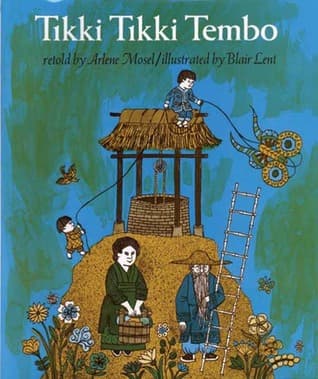
Synopsis
Covers the whole plot, including the ending.
- Difficulty
- Easy
- Pacing
- Moderate
- Mood
- Playful, Instructive, Traditional
- Read it if
- You enjoy classic folktales, repetitive storytelling that's fun to read aloud, and stories with a clear moral about the importance of practicality.
- Skip it if
- You prefer modern themes or stories without a direct 'lesson'.
Tikki Tikki Tembo Plot Summary
Covers the whole plot, including the ending.
The Naming of Two Sons
In ancient China, a mother has two sons. She gives her firstborn son a very long and important name: Tikki tikki tembo-no sa rembo-chari bari ruchi-pip peri pembo. This name means 'the most wonderful thing in the whole wide world.' Her second son, being less important, is simply named Chang, which means 'little or nothing.' They live in a small house near a mountain with an old well. The two brothers play together, often near the well, despite their mother's warnings to stay away.
Chang Falls into the Well
One day, while playing near the well, Chang falls in. Tikki Tikki Tembo, hearing his brother's cries, runs to their mother to tell her what happened. He shouts, 'Mother! Chang has fallen into the well!' Their mother, annoyed at being disturbed from her chores, scolds Tikki Tikki Tembo for interrupting her for such a small matter, reminding him that Chang's name is short and not important. However, she quickly realizes the urgency and sends Tikki Tikki Tembo to get the Old Man with the Ladder.
Rescuing Chang
Tikki Tikki Tembo runs to the Old Man with the Ladder's house and explains that his brother Chang has fallen into the well. The Old Man, understanding the simple name and the urgency, quickly gets his ladder and rushes back with Tikki Tikki Tembo to their house. He lowers the ladder into the well and helps Chang climb out. Chang is wet and cold but unharmed. He is quickly brought inside to warm up and dry off.
Tikki Tikki Tembo Falls into the Well
A month later, the two brothers are again playing near the well. This time, Tikki Tikki Tembo falls into the well. Chang, seeing his older brother in trouble, runs to their mother to tell her. He shouts, 'Mother! Tikki tikki tembo-no sa rembo-chari bari ruchi-pip peri pembo has fallen into the well!' The mother, surprised by the long name, struggles to remember it and scolds Chang for taking so long to deliver the message, not understanding the difficulty of repeating the name.
The Difficulties of a Long Name
The mother, after finally recalling and repeating the full name, sends Chang to get the Old Man with the Ladder. Chang runs to the Old Man's house and tries to explain. He starts, 'Old Man with the Ladder, Tikki tikki tembo-no sa rembo-chari bari ruchi-pip peri pembo has fallen into the well!' The Old Man, confused by the long name, struggles to understand and remember it, asking Chang to repeat it many times. Important time is lost as Chang tries to say the lengthy name.
The Rescue of Tikki Tikki Tembo
After many repetitions and much frustration, the Old Man with the Ladder finally remembers Tikki tikki tembo-no sa rembo-chari bari ruchi-pip peri pembo's name and the urgent situation. He quickly gets his ladder and rushes back to the house with Chang. They lower the ladder into the well, and Tikki Tikki Tembo is pulled out. However, because of the delay in telling his name and getting help, Tikki Tikki Tembo has been in the cold water for a much longer time. He is very ill and swallows a lot of water.
Tikki Tikki Tembo's Recovery
Tikki Tikki Tembo is brought inside, but he is in a much worse state than Chang was. He is very sick from being in the cold well for so long. His mother and Chang spend a long time trying to help him recover. They give him warm rice water and ginger tea, and care for him day and night. It takes many months for Tikki Tikki Tembo to fully recover from his ordeal, a contrast to Chang's quick return to health.
The Moral of the Story
From that day forward, the people of China learned a lesson. They decided that it was better to give their children short, simple names rather than long, honorable ones. This way, if a child ever fell into a well or had other trouble, help could be called quickly without the delay caused by a long name. This ancient tale explains why Chinese children now have shorter names, ensuring that no more time is lost in emergencies.
Tikki Tikki Tembo Characters
Tikki tikki tembo-no sa rembo-chari bari ruchi-pip peri pembo
Protagonist
The firstborn son with an honorable, long name.
Tikki Tikki Tembo is the firstborn son, given a grand and important name meaning 'the most wonderful thing in the whole wide world.' He is obedient when sent to fetch the Old Man with the Ladder for Chang, but his own rescue is severely delayed due to the impracticality of his long name. His near-fatal incident is the central event that drives the story's moral about the importance of simple names.
Relationships: Chang (Younger brother); Mother (Caring but traditional mother)
Chang
Supporting
The secondborn son with a simple, short name.
Chang is the second son, named simply 'little or nothing,' reflecting his less important status in the family. Despite his simple name, he is quick-thinking and acts immediately when his brother falls into the well. His ability to quickly relay his own name for help highlights the contrast with his brother's predicament, and his struggle to recall Tikki Tikki Tembo's long name emphasizes the story's central message.
Relationships: Tikki tikki tembo-no sa rembo-chari bari ruchi-pip peri pembo (Older brother); Mother (Caring mother)
Mother
Supporting
The traditional mother who bestows the names.
The mother adheres to traditional Chinese customs of naming, giving her firstborn an elaborate, honorable name and her secondborn a simple one. She is initially annoyed by interruptions but quickly acts when her sons are in danger. Her struggle to recall Tikki Tikki Tembo's full name and her eventual realization of the peril it causes are crucial to the story's resolution and the change in naming conventions.
Relationships: Tikki tikki tembo-no sa rembo-chari bari ruchi-pip peri pembo (Son); Chang (Son)
Old Man with the Ladder
Supporting
The rescuer of the brothers from the well.
The Old Man with the Ladder is a helpful neighbor who lives nearby. He is the immediate point of contact for rescuing anyone who falls into the well. His quick response to Chang's plight contrasts sharply with his confusion and delay when trying to understand Tikki Tikki Tembo's long name, directly illustrating the central problem of the story.
Relationships: Tikki tikki tembo-no sa rembo-chari bari ruchi-pip peri pembo (Neighbor, rescuer); Chang (Neighbor, rescuer)
Tikki Tikki Tembo Themes
The Importance of Practicality over Tradition
The story challenges the tradition of giving firstborn sons long, honorable names. While such names mean importance, the story shows they are not practical in emergencies. Tikki Tikki Tembo's near-death experience, because of the time it took to say his name, contrasts with Chang's quick rescue. This shows how sticking to tradition can have dangerous results, leading to a change towards more practical naming conventions in China.
“And from that day to this, the Chinese have always given their children short names instead of long names.”
Communication and Its Obstacles
A main theme is the challenge of clear communication, especially under stress. The simple, short name 'Chang' allows for quick and clear communication, leading to an immediate rescue. In contrast, Tikki Tikki Tembo's long, complicated name creates a big problem. Chang struggles to remember and repeat it, and the Old Man with the Ladder struggles to understand it, causing critical delays. This shows how clarity and conciseness in communication are important, especially in urgent situations.
“Please, please, not so fast,' said the Old Man with the Ladder. 'What is the name again?”
Consequences of Actions (and Names)
The story shows the direct results of choices made, specifically in naming. The mother's decision to give a grand name to her firstborn leads to a life-threatening situation. While the intention was to honor, the outcome was nearly tragic. Conversely, the simple name given to Chang ensures his safety. This theme shows that even seemingly harmless traditions or choices can have big and unexpected effects, teaching a lesson about foresight and the possible results of one's decisions.
“But because of the long name, it took a long, long time to tell the Old Man with the Ladder.”
Plot Devices & Literary Techniques
Repetition
Emphasizes the difficulty of the long name and builds narrative rhythm.
The repeated phrase 'Tikki tikki tembo-no sa rembo-chari bari ruchi-pip peri pembo' is a central literary device. It serves multiple purposes: it makes the name memorable for the reader, highlights its unwieldiness and length, and builds a rhythmic, almost chant-like quality to the storytelling. Each time a character struggles to recall or pronounce the name, the repetition underscores the plot's central conflict and the theme of communication breakdown.
Foreshadowing (Implicit)
Subtly hints at future danger through the contrast in names.
While not explicit, the initial description of the two brothers' names – one long and honorable, the other short and simple – implicitly foreshadows the differing outcomes of their respective accidents. The narrative establishes the 'less important' nature of Chang's short name, but his swift rescue subtly hints that its simplicity will be advantageous. Conversely, the very grandeur of Tikki Tikki Tembo's name, while presented as a privilege, implicitly sets the stage for it to become a burden.
Dramatic Irony
The audience understands the danger of the long name before the characters do.
The audience quickly grasps the inherent problem with Tikki Tikki Tembo's long name, especially after Chang's swift rescue. However, the characters, particularly the mother and the Old Man with the Ladder, initially struggle to comprehend the magnitude of the communication breakdown caused by the name. This creates dramatic irony, as the reader anticipates the difficulties and the tragic delay long before the characters fully realize the life-threatening consequences of adhering to tradition.
Tikki Tikki Tembo Quotes
“Tikki tikki tembo-no sa rembo-chari bari ruchi-pip peri pembo.”
“Chang.”
“Mother, I want to go to the well to fetch some water.”
“The old woman with the ladder.”
“He fell into the well!”
“Go tell the old woman with the ladder to pull him out.”
“Tikki tikki tembo-no sa rembo-chari bari ruchi-pip peri pembo is in the well!”
“It took so long to say his name.”
“Chang fell into the well!”
“Help! Help! Chang is in the well!”
“They pulled him out quickly.”
“But because of the long name, it took a long, long time.”
“And that is why, ever since that day, the Chinese people have always given their children short names.”
Quiz
10 questions on the plot and the characters. Each answer comes with a short explanation.
Question 1
What is the primary reason the First Son's long name causes a problem?
- It is considered bad luck in ancient China.
- It takes too long to say in an emergency.
- The other children make fun of him for it.
- His mother forgets how to pronounce it.
Show answer
B. It takes too long to say in an emergency. The central conflict of the story arises when Tikki tikki tembo-no sa rembo-chari bari ruchi-pip peri pembo falls into the well, and his brother must repeat his very long name multiple times to get help, delaying the rescue.
Question 2
What is the full name of the First Son?
- Tikki Tikki Tembo
- Chari Bari Ruchi-Pip Peri Pembo
- Tikki tikki tembo-no sa rembo-chari bari ruchi-pip peri pembo
- No Sa Rembo-Chari Bari Ruchi
Show answer
C. Tikki tikki tembo-no sa rembo-chari bari ruchi-pip peri pembo The First Son's complete, honorable name is Tikki tikki tembo-no sa rembo-chari bari ruchi-pip peri pembo, which is a key detail and the source of the story's main problem.
Question 3
What happens to the Second Son, Chang, at the beginning of the story?
- He falls into the well.
- He gets lost in the village.
- He scrapes his knee.
- He runs away from home.
Show answer
C. He scrapes his knee. Early in the story, Chang scrapes his knee, and his mother quickly responds to his short name, highlighting the contrast with the later emergency involving his brother's long name.
Question 4
Who is the first person Chang runs to for help when his brother falls into the well?
- His father
- The Old Man with the Ladder
- His mother
- A neighbor
Show answer
C. His mother When Tikki tikki tembo-no sa rembo-chari bari ruchi-pip peri pembo falls into the well, Chang first runs to his mother to inform her of the accident.
Question 5
What is the traditional Chinese belief about naming children that is implied in the story?
- Shorter names bring good fortune.
- The first son should always have a long, honorable name.
- Children's names should reflect their birth order.
- Names should be kept secret to avoid evil spirits.
Show answer
B. The first son should always have a long, honorable name. The story explains that 'the old Chinese used to give all their children great long names,' and especially the first and honored sons, indicating a cultural practice of giving long, honorable names to important children.
Question 6
How long does it take for Tikki tikki tembo-no sa rembo-chari bari ruchi-pip peri pembo to recover from his ordeal?
- Three days and three nights
- Three weeks and three days
- Three months and three days
- Three years and three months
Show answer
C. Three months and three days After being rescued from the well, Tikki tikki tembo-no sa rembo-chari bari ruchi-pip peri pembo is sick for a long time, specifically three months and three days, due to swallowing so much water.
Question 7
What is the ultimate lesson or moral of the story?
- Always listen to your elders.
- Wells are dangerous and should be avoided.
- It is wiser to give children short names.
- Honorable names bring good luck.
Show answer
C. It is wiser to give children short names. The story concludes by stating that 'that is why the Chinese stopped giving their children such great long names,' directly implying that the practical difficulty of a long name in an emergency led to a cultural shift towards shorter names.
Question 8
What is the main difference in how the mother reacts when Chang scrapes his knee versus when Tikki tikki tembo falls into the well?
- She ignores Chang but panics for Tikki tikki tembo.
- She immediately helps Chang but questions Chang about Tikki tikki tembo.
- She scolds both equally for being careless.
- She sends Chang to get help for his own injury, but goes herself for Tikki tikki tembo.
Show answer
B. She immediately helps Chang but questions Chang about Tikki tikki tembo. When Chang scrapes his knee, his mother immediately tends to him. However, when Chang reports his brother's fall, she repeatedly makes him say the full, long name, emphasizing the delay caused by the name itself.
Question 9
Why does the Old Man with the Ladder initially hesitate to help when Chang comes to him?
- He is too old and weak to carry the ladder.
- He needs to hear the full, proper name of the person in distress.
- He believes falling into a well is a punishment from the gods.
- He is asleep and cannot be woken easily.
Show answer
B. He needs to hear the full, proper name of the person in distress. Like the mother, the Old Man with the Ladder insists on hearing the entire long name of Tikki tikki tembo-no sa rembo-chari bari ruchi-pip peri pembo before he will act, further delaying the rescue.
Question 10
What is the significance of the repeated phrase 'Hih hih hih' from the mother and the Old Man with the Ladder?
- It indicates their amusement at the situation.
- It signifies their frustration with Chang's slowness.
- It represents a traditional sound used to get someone's attention or acknowledge a statement.
- It is a sound of distress or worry.
Show answer
C. It represents a traditional sound used to get someone's attention or acknowledge a statement. The 'Hih hih hih' sound is used by both the mother and the Old Man with the Ladder to prompt Chang to repeat the name correctly or to acknowledge his statement, serving as a verbal punctuation or interjection in their conversation.
Tikki Tikki Tembo FAQ
What is "Tikki Tikki Tembo" about?
"Tikki Tikki Tembo" is an ancient Chinese folktale about two brothers, Tikki Tikki Tembo-no sa rembo-chari bari ruchi-pip peri pembo and Chang, who live near a well. When Tikki Tikki Tembo falls into the well, the story highlights the perilous delay caused by his extremely long and honorable name when Chang tries to get help.
Why should I read "Tikki Tikki Tembo"?
You should read "Tikki Tikki Tembo" for its engaging narrative, its memorable rhythm, and its subtle moral lesson about the practicality of names. It's a classic children's story that effectively teaches about the importance of quick communication in emergencies, all while being a joy to read aloud.
What is the background/setting of "Tikki Tikki Tembo"?
The story is set in ancient China, reflecting a cultural tradition where first-born sons were given long, honorable names. The setting emphasizes a time and place where customs and respect for tradition could sometimes have unforeseen consequences, particularly in a rural village with a prominent old well.
What are the most memorable quotes?
The most memorable 'quote' is the full name itself: "Tikki tikki tembo-no sa rembo-chari bari ruchi-pip peri pembo." The repetitive chants of "Tikki tikki tembo... fell into the well!" and the Grandfather's patient, drawn-out recitation of the name are also iconic and central to the story's charm.
What writing style does the author use?
Arlene Mosel uses a simple, repetitive, and rhythmic writing style that is perfect for young children. The story's pacing builds tension through the repeated difficulty of pronouncing Tikki Tikki Tembo's long name, making it highly engaging for read-aloud sessions and easy for children to follow along.
What minor details add significant meaning?
The detail that Tikki Tikki Tembo is the first-born son, and thus given a long and honorable name, is crucial. This cultural detail explains *why* his name is so long, providing context for the central conflict and the underlying message about tradition versus practicality.
What are some subtle foreshadowing moments?
The recurring mention of the old well, where the boys often play, subtly foreshadows the impending accidents. Each time the well is mentioned, it subtly reinforces its danger, preparing the reader for the inevitable fall, especially given the children's proximity to it.
What unexpected character connections exist?
While not 'unexpected' in a dramatic sense, the deep familial connection between Tikki Tikki Tembo and Chang, and their shared Grandfather, is vital. It highlights the responsibility Chang feels for his brother and the Grandfather's role as the keeper of wisdom and tradition, despite the name's impracticality.
What are unspoken character motivations?
Chang's unspoken motivation is his deep love and concern for his older brother, Tikki Tikki Tembo. Despite the frustration of his brother's long name, Chang persists in seeking help, driven by a primal desire to save his sibling, even when others are slow to respond.
What psychological complexities do characters exhibit?
The Grandfather exhibits a complexity of respecting tradition while also understanding its impracticality. He patiently recites the long name, adhering to custom, yet his actions and the story's outcome imply a subtle recognition of the burden such a name places on his family during a crisis.
What are the major emotional turning points?
The major emotional turning points occur each time a boy falls into the well, particularly when Tikki Tikki Tembo falls. The reader feels a mounting sense of urgency and frustration as Chang repeatedly tries to convey his brother's identity, highlighting the emotional toll of the delay.
How do relationship dynamics evolve?
The relationship dynamics primarily show Chang's unwavering loyalty to his brother, Tikki Tikki Tembo, and the Grandfather's patient, albeit slow, response to the children's pleas. The story doesn't show a major evolution, but rather reinforces the protective bond between siblings and the authority of the elder.
Which parts remain ambiguous or open-ended?
The story leaves ambiguous the exact long-term consequences for the family beyond Tikki Tikki Tembo's recovery and Chang's shortened name. It implies a lesson learned about name length but doesn't explicitly detail how this affected future naming conventions or other aspects of their village life.
What are controversial scenes or decisions?
While not controversial for its target audience, the decision of the Grandfather and other villagers to repeatedly insist on the full, long name of Tikki Tikki Tembo, even as he drowns, can be seen as a problematic adherence to tradition over immediate safety. This creates the central conflict and moral lesson.
"Tikki Tikki Tembo" ending explained: how it ends & what it means
The story ends with Tikki Tikki Tembo being rescued from the well, but he is sick for a long time afterward due to the delay in getting help. Because of this perilous experience, the Chinese people decide that from then on, all children will be given short, simple names, meaning the cultural tradition of long names for first-borns was changed due to this event.
About the author

Arlene Mosel was an American author celebrated for her children's books. Her most famous work, 'Tikki Tikki Tembo,' published in 1968, became a classic, beloved for its storytelling and cultural representation. Mosel's career focused on adapting and retelling traditional tales for young readers.
Similar books
- Strega Nona
Tomie dePaola
4.2 (85k) average on GoodreadsFantasyA humorous folktale with a touch of magic and a lesson learned through mishap.
- Harry Potter and the Sorcerer's Stone
J.K. Rowling
4.5 (7M) average on GoodreadsFantasyRescued from a miserable life under the stairs, an orphaned boy discovers he's a wizard destined for a magical school, where he uncovers a dangerous secret tied to the dark wizard who murdered his parents.
- The Hobbit, or There and Back Again
J.R.R. Tolkien
4.3 (2.9M) average on GoodreadsFantasyA comfort-loving hobbit named Bilbo Baggins is whisked away by a mischievous wizard and a band of dwarves on an unexpected journey to reclaim stolen treasure from a fearsome dragon, discovering courage and a magical ring along the way.
- Harry Potter and the Goblet of Fire
J.K. Rowling
4.6 (2.6M) average on GoodreadsFantasyA bewildered Harry Potter, underage and thrust into a deadly Triwizard Tournament, must brave dragons, mermaids, and a resurgent dark magic to survive a year that will forever alter the wizarding world.
- Harry Potter and the Order of the Phoenix
J.K. Rowling
4.5 (2.5M) average on GoodreadsFantasyIn a year of oppressive secrets and the threat of Voldemort, Harry Potter and Dumbledore's Army secretly train for war, shown through Jim Kay and Neil Packer's dark illustrations.
- The Lightning Thief
Rick Riordan
4.3 (2M) average on GoodreadsFantasyThrust into a world of mythological monsters and divine treachery, an ordinary boy discovers he's the son of Poseidon and must embark on a perilous quest across modern America to prevent an Olympian war.





Enjoyed the summary?
A summary gives you the shape of the book. The book itself has the detail, the examples and the voice.
Find Tikki Tikki Tembo on AmazonAs an Amazon Associate, BookBrief earns from qualifying purchases. How we're funded