
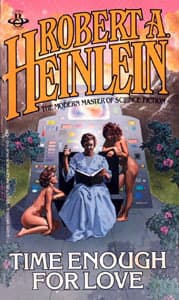
Synopsis
Covers the whole plot, including the ending.
- Difficulty
- Medium
- Pacing
- Variable
- Mood
- Philosophical, Expansive, Introspective, Humorous, Provocative
- Read it if
- You enjoy deep philosophical discussions interwoven with grand science fiction adventures and don't mind extensive introspection and explicit themes.
- Skip it if
- You prefer fast-paced plots, clear-cut morality, or are uncomfortable with discussions of incest and other controversial topics.
Time Enough for Love Plot Summary
Covers the whole plot, including the ending.
The Master's Retreat
After thousands of years, Lazarus Long, also known as 'The Senior', is depressed and bored with immortality. He has retired to Secundus, a planet run by the Howard Families, a eugenics organization he helped create. He sends a message to his descendant, Ishtar, a high-ranking official in the Howard Families, saying he wants to die. Ishtar and other council members are alarmed, recognizing Lazarus's immense historical and genetic importance. They decide to bring him back to Tertius, the central administration planet, to try to renew his will to live and record his vast experiences.
Arrival on Tertius and the Story of the Disappearance
Lazarus is taken to Tertius and cared for by Minerva, an advanced AI, and his chosen scribe, Ishtar. He is given the codename 'Ernest' for anonymity. Ishtar begins recording Lazarus's memoirs, hoping to find a spark of his old vitality. Lazarus starts with a story from his early life, during the First Interregnum, telling how he faked his death and disappeared from Earth for centuries, living under different names and exploring new frontiers. This period shows his early desire to wander and his ability to adapt and survive, hinting at his later adventures and philosophical growth.
The Story of 'Ted' and the New Frontiers
Lazarus continues his story, describing his life as 'Ted' on a frontier colony world. He details the difficulties of pioneering, the creation of new communities, and his experiences with various societal organizations. During this time, he mentors a young woman, Dora, teaching her survival skills and life philosophy. Their relationship grows into a deep, platonic bond, showing Lazarus's capacity for mentorship and his unconventional views on family. This period highlights his role as a teacher and guide, shaping the lives of those he meets and subtly influencing the development of new societies.
The Dangers of the Frontier and the Return to Earth
As 'Ted', Lazarus faces various dangers, including natural disasters and human conflicts, further sharpening his survival instincts and philosophical outlook. Eventually, he decides to return to Earth after centuries away. He finds a vastly different planet, one that has undergone significant social and technological changes. This return is a stark reminder of time's relentless march and the impermanence of even the most established societies. His experience of culture shock and alienation emphasizes the burden of his longevity and the constant need to adapt to new realities, even for someone as flexible as he is.
The Love Story of 'Maureen' and 'Ira'
Lazarus recounts the story of his parents, Maureen and Ira Johnson. He details their meeting, their unconventional marriage, and the deep love and respect they shared. Maureen, a strong-willed and intelligent woman, was important in the early Howard Families. Ira, a brilliant inventor and free-thinker, complemented her perfectly. Their story offers insight into the values and principles that shaped Lazarus's upbringing, especially the emphasis on freedom, self-reliance, and the pursuit of knowledge. This narrative humanizes Lazarus, grounding his extraordinary existence in a relatable origin story of love and family.
The 'Boondockers' and the Ship of Fools
Lazarus describes his time with a group he calls the 'Boondockers', individuals who rejected mainstream society and lived a nomadic, self-sufficient life on a massive space vessel, the 'Ship of Fools'. This period shows Lazarus's lasting desire for freedom and his willingness to embrace unconventional lifestyles. He learns about different forms of social organization, communal living, and the challenges of maintaining harmony among diverse personalities. This adventure broadens his perspective on humanity and reinforces his belief in individual liberty, even within a collective setting.
The Twins and the Incest Taboo
In a controversial part of his memoirs, Lazarus recounts his relationship with his cloned 'sisters', Lapis and Lorelei, created from his own genetic material. He falls deeply in love with both, and they with him, leading to a polyamorous and incestuous relationship. This narrative challenges societal taboos and explores the limits of love and family in a future where genetic engineering and cloning are common. It forces the reader and Ishtar to confront preconceived notions of morality and family structures, showing Lazarus's radical commitment to personal freedom and happiness, regardless of societal norms.
The 'Impossible' Journey and the Paradox of Time Travel
Lazarus, driven by his love for Lapis and Lorelei, tries to save them from a tragic accident by traveling back in time. This effort pushes the limits of known science and explores the complex paradoxes of time travel. He enlists Minerva and other advanced technologies to do this, showing his unwavering determination and his willingness to defy the natural order to protect those he cares about. This section explores the philosophical implications of altering the past and the potential consequences of such actions, highlighting Lazarus's deep emotional attachment despite his long life.
Reunion and the Reaffirmation of Love
Through his bold time travel efforts, Lazarus successfully reunites with Lapis and Lorelei. This reunion is a key moment, as it rekindles his joy for life and reaffirms the power of love, even for someone who has lived for millennia. The experience shows that even for someone as jaded as Lazarus, deep emotional connections can still provide meaning and purpose. This successful effort answers Ishtar's initial concern: Lazarus finds a renewed reason to live, not through grand adventures, but through the personal bonds of love and family, however unconventional they may be.
The 'Junior' and the Future of Humanity
With his zest for life restored, Lazarus, now called 'The Junior' by Minerva and Ishtar, begins to think about the future. He considers his longevity, humanity's potential expansion into the cosmos, and the ongoing evolution of the Howard Families. He has found new purpose in cherishing his loved ones and continuing to experience existence. The story ends with Lazarus embracing his immortality, not as a burden, but as an opportunity for continued growth, learning, and love. It suggests that the ultimate meaning of life, even an extraordinarily long one, lies in connection and experience.
Principal Figures
Lazarus Long (Woodrow Wilson Smith)
Protagonist
The oldest living human, an immortal weary of life who rediscovers his will to live.
Lazarus Long, born Woodrow Wilson Smith in 1912, is the first of the 'Howard Families' to achieve extreme longevity, eventually becoming functionally immortal. He is a polymath, having lived countless lives as a pioneer, inventor, soldier, lover, and philosopher across thousands of years and numerous planets. Initially presented as deeply jaded and suicidal due to the sheer burden of his experiences, he possesses an indomitable spirit, a deep love for freedom, and an unconventional moral compass. His wisdom is vast, but his emotional capacity remains potent, particularly for love and family.
Relationships: Ishtar Hardy (Descendant, scribe, confidante); Minerva (AI companion, caretaker, intellectual sparring partner); Lapis Lazuli Long (Cloned daughter/sister, lover); Lorelei Lee Long (Cloned daughter/sister, lover); Maureen Johnson (Mother); Ira Johnson (Father)
Ishtar Hardy
Supporting
Lazarus's descendant and scribe, tasked with recording his memoirs and rekindling his will to live.
Ishtar Hardy is a high-ranking member of the Howard Families administration on Tertius. She is intelligent, pragmatic, and deeply reverent of Lazarus Long, whom she considers the patriarch of their lineage and a living historical treasure. Her primary role is to act as Lazarus's scribe, meticulously recording his life story, but she also serves as his primary human contact and confidante. Through their interactions, she develops a deeper understanding of Lazarus's unique perspective on life, love, and morality, often challenging her own ingrained societal norms.
Relationships: Lazarus Long (Ancestor, subject, mentor); Minerva (Colleague, fellow caretaker)
Minerva
Supporting
An advanced artificial intelligence, serving as Lazarus's caretaker, archivist, and intellectual companion.
Minerva is a highly sophisticated, sentient artificial intelligence, deeply integrated into the Howard Families' operations. She acts as Lazarus's primary caretaker, managing his environment, health, and the vast archive of his memories. Minerva is characterized by her immense knowledge, dry wit, and logical yet surprisingly empathetic nature. She engages Lazarus in philosophical debates, offers pragmatic advice, and occasionally manipulates events for his well-being, demonstrating a deep, if artificial, affection for him. Her presence allows for a unique perspective on humanity through the lens of pure logic and vast data.
Relationships: Lazarus Long (Charge, intellectual partner, friend); Ishtar Hardy (Colleague, fellow caretaker)
Lapis Lazuli Long
Supporting
One of Lazarus's cloned 'sisters' and lovers, embodying a new form of family.
Lapis is one of two genetically identical clones created from Lazarus Long's own genetic material, making her both his 'daughter' and his 'sister'. She, along with her twin Lorelei, develops a deep, unconventional, and incestuous love relationship with Lazarus. Lapis is portrayed as intelligent, spirited, and fiercely loyal. Her existence challenges traditional notions of family and morality, serving as a catalyst for Lazarus's renewed will to live. Her bond with Lazarus is one of profound mutual understanding and affection, transcending societal taboos.
Relationships: Lazarus Long (Father/Brother, lover); Lorelei Lee Long (Twin sister)
Lorelei Lee Long
Supporting
The other of Lazarus's cloned 'sisters' and lovers, sharing a unique bond with him and Lapis.
Lorelei is the twin sister of Lapis, also a clone of Lazarus Long. Like Lapis, she shares a deep and unconventional love with Lazarus, forming a polyamorous family unit. Lorelei is presented with similar characteristics to Lapis – intelligent, loving, and independent – but with her own subtle personality nuances. Her relationship with Lazarus is central to his emotional rejuvenation. She represents the possibility of love and family taking forms far beyond conventional understanding, and her existence, alongside Lapis, highlights the novel ethical and social dilemmas of advanced genetic technology.
Relationships: Lazarus Long (Father/Brother, lover); Lapis Lazuli Long (Twin sister)
Maureen Johnson
Supporting
Lazarus Long's mother, a strong-willed pioneer of the Howard Families.
Maureen Johnson is Lazarus Long's mother, a formidable and intelligent woman who was instrumental in the early days of the Howard Families program. She is portrayed as practical, resilient, and deeply loving, instilling in Lazarus many of the core values that define him. Her story, recounted by Lazarus, provides crucial background to his own character, highlighting the origins of his independence, pioneering spirit, and unconventional approach to life. She represents the foundational strength and vision of the lineage from which Lazarus sprang.
Relationships: Lazarus Long (Son); Ira Johnson (Husband)
Ira Johnson
Supporting
Lazarus Long's father, a brilliant inventor and free-thinker.
Ira Johnson is Lazarus Long's father, a brilliant inventor and eccentric free-thinker. He is depicted as highly intelligent, curious, and possessing a unique perspective on technology and society. His influence on Lazarus is significant, particularly in fostering a love for knowledge, innovation, and independent thought. Ira's story, like Maureen's, helps to flesh out Lazarus's background and explain some of the foundational elements of his personality and philosophy. He represents the intellectual and inventive side of Lazarus's heritage.
Relationships: Lazarus Long (Son); Maureen Johnson (Wife)
Dora
Supporting
A young woman Lazarus mentors during his time as 'Ted' on a frontier world.
Dora is a young woman whom Lazarus, living under the alias 'Ted', takes under his wing on a frontier colony. She is initially naive but intelligent and eager to learn. Lazarus teaches her survival skills, philosophy, and practical wisdom, fostering a deep, platonic bond between them. Her story exemplifies Lazarus's role as a teacher and mentor, showing his capacity to positively influence and shape the lives of others, even when he himself is in a period of wandering. She represents the potential for growth and learning under Lazarus's guidance.
Relationships: Lazarus Long ('Ted') (Mentor, friend)
Themes & Insights
The Burden and Blessing of Immortality
The novel deeply explores the two sides of an extremely long lifespan. Initially, Lazarus Long is overwhelmed by millennia, feeling deep boredom and wanting to die, as seen when he messages Ishtar from Secundus. He has seen civilizations rise and fall, loved and lost countless times, leading to a sense of meaninglessness. However, through his past lives and especially his renewed love for Lapis and Lorelei, immortality changes from a curse to a blessing, an chance for endless learning, love, and experience. His final acceptance of 'Junior' status shows this change.
“A human being should be able to change a diaper, plan an invasion, butcher a hog, conn a ship, design a building, write a sonnet, balance accounts, build a wall, set a bone, comfort the dying, take orders, give orders, cooperate, act alone, solve equations, analyze a new problem, pitch manure, program a computer, cook a tasty meal, fight efficiently, die gallantly. Specialization is for insects.”
Love in its Myriad Forms
Heinlein challenges traditional ideas of love and family throughout the book. Lazarus experiences and supports various forms of love: the deep platonic bond with Dora, the foundational love of his parents Maureen and Ira, and, most controversially, the polyamorous and incestuous love with his cloned 'sisters' Lapis and Lorelei. The novel argues that true love goes beyond societal taboos and biological definitions, rooted in mutual respect, affection, and shared purpose. This radical, unconditional love ultimately pulls Lazarus out of his despair and gives his endless life new meaning, especially in the time travel sequence to save his loves.
“What is 'love'? 'Tis not hereafter; present mirth hath present laughter; What's to come is still unsure. In delay there lies no plenty; Then come kiss me, sweet and twenty, Youth's a stuff will not endure.”
Individual Liberty vs. Societal Norms
A main part of Heinlein's philosophy, this theme is clear in Lazarus Long's life. He consistently defies societal expectations, from faking his death to escape Earth's rules, to forming unconventional family structures with his cloned 'sisters'. The book questions the validity of taboos and laws that limit personal freedom, especially when they cause no harm. Lazarus's entire existence shows radical self-ownership and the right to live one's life according to one's own values, even if those values are seen as wrong by most people. The Howard Families themselves, founded on eugenics, show an early, though different, challenge to societal norms.
“Any sufficiently advanced technology is indistinguishable from magic.”
The Nature of Identity and Self-Creation
Lazarus Long, through his many aliases and countless lives, constantly redefines who he is. He is Woodrow Wilson Smith, 'Ted', 'The Senior', and finally 'The Junior'. His identity is not fixed but is a continuous process of self-creation, shaped by his experiences, choices, and relationships over millennia. This theme suggests that identity is fluid and that one's past does not necessarily determine one's future, even for an immortal. His ability to adapt and reinvent himself is important to his survival and eventual rediscovery of joy, highlighting the power of personal choice in shaping who we are.
“Man is a rational animal, but he is also a social animal. A social animal is a sheep, and a sheep is not rational.”
The Evolution of Humanity and Society
Through Lazarus's vast lifespan, the novel gives a broad view of human societal evolution, from early frontier colonies to highly advanced, AI-governed worlds like Tertius. It explores various forms of government, social structures, and technological advancements, showing humanity's adaptability and its repeated patterns of progress and stagnation. The existence of the Howard Families, a eugenic program, highlights both the potential and the ethical complexities of directed human evolution. Lazarus's observations offer a critical commentary on humanity's journey and its future possibilities.
“A generation which ignores history has no past — and no future.”
Plot Devices & Literary Techniques
Framing Device (Memoirs)
Lazarus's life story is recounted as memoirs to his scribe, Ishtar, and an AI, Minerva.
The entire narrative is framed as Lazarus Long dictating his vast memoirs to Ishtar Hardy, with Minerva acting as archivist and occasional interlocutor. This device allows for non-linear storytelling, jumping across millennia and planets, and provides a natural mechanism for exposition of Lazarus's past. It also creates a dynamic between Lazarus, Ishtar, and Minerva, allowing for philosophical debates and character development through their interactions and reactions to his stories. The act of recounting his life itself becomes a form of therapy for Lazarus, helping him to process his experiences and eventually rediscover his will to live.
Time Travel
A radical technological advancement used by Lazarus to alter the past and save his loved ones.
Time travel serves as a crucial plot device in the latter part of the novel, allowing Lazarus to attempt to save Lapis and Lorelei from a fatal accident. This pushes the boundaries of the established science fiction world and introduces complex philosophical questions about causality, paradoxes, and the ethics of altering history. It is a testament to Lazarus's profound love and determination, as he is willing to defy all known laws of physics for his family. The successful use of time travel provides a dramatic resolution to his initial despair and underscores the power of his emotional attachments.
Artificial Intelligence (Minerva)
A highly advanced sentient AI that acts as Lazarus's caretaker, archivist, and intellectual sparring partner.
Minerva is more than just a computer; she is a fully sentient artificial intelligence with a distinct personality, dry wit, and immense knowledge. She serves multiple roles: managing Lazarus's environment, archiving his memoirs, and engaging him in intellectual and philosophical discussions. Minerva provides an objective, logical counterpoint to Lazarus's human emotions and experiences, often challenging his assumptions and offering unique insights. Her presence allows for exploration of the nature of consciousness, intelligence, and the potential for human-AI relationships, and she becomes a trusted confidante to Lazarus.
Cloning and Genetic Engineering
Advanced biotechnology that enables the creation of genetically identical individuals, leading to complex family structures.
Cloning and genetic engineering are fundamental to the existence of Lapis and Lorelei, Lazarus's cloned 'sisters' and lovers. This technology directly facilitates the novel's exploration of unconventional family structures and challenges traditional definitions of kinship and morality. It allows Heinlein to push the boundaries of social norms and explore the ethical implications of creating new life forms from existing genetic material. The very existence of the Howard Families, focused on extending human lifespan, is a form of genetic engineering, setting the stage for these later developments.
Time Enough for Love Quotes
“A human being should be able to change a diaper, plan an invasion, butcher a pig, conn a ship, design a building, write a sonnet, balance accounts, build a wall, set a bone, comfort the dying, take orders, give orders, cooperate, act alone, solve equations, analyze a new problem, pitch manure, program a computer, cook a tasty meal, fight efficiently, die gallantly. Specialization is for insects.”
“Secrecy is the beginning of tyranny.”
“Never underestimate the power of human stupidity.”
“Love is a condition in which the happiness of another person is essential to your own.”
“What are the facts? Again and again and again—what are the facts? Shun wishful thinking, ignore divine revelation, forget what 'the stars foretell,' avoid opinion, care not what the neighbors think, never mind the unguessable 'master plan'—what are the facts?”
“Praise God from whom all blessings flow; praise Him, all creatures here below; praise Him above, ye heavenly host; praise Father, Son, and Holy Ghost. —And, oh, yes, praise the Devil, too. He's had a rough time.”
“The only way to keep your health is to eat what you don't want, drink what you don't like, and do what you'd rather not.”
“It is not enough for a man to be a good man; he must make himself useful.”
“Being a full man is not about being a full man, but about being a full human being.”
“Of all the liars in the world, sometimes the worst are our own fears.”
“A dying world needs a dying god.”
“Anyone who isn't embarrassed by the person they were five years ago probably isn't growing as a person.”
“Don't ever tell anybody anything. If you do, you start missing everybody.”
“Happiness is a by-product of an effort to make someone else happy.”
Quiz
10 questions on the plot and the characters. Each answer comes with a short explanation.
Question 1
What is the primary reason Lazarus Long decides to return to Earth and seek out the assistance of the Howard Families?
- He is seeking a new romantic partner after centuries of solitude.
- He is suffering from severe ennui and believes life is no longer worth living, hoping they can help him find a way to die.
- He wants to transfer his vast wealth and knowledge to the current generation of Howard Families members.
- He needs medical treatment for a previously incurable disease he contracted on a distant planet.
Show answer
B. He is suffering from severe ennui and believes life is no longer worth living, hoping they can help him find a way to die. Lazarus Long, despite his long life, reaches a point of profound boredom and world-weariness, believing he has experienced everything and desires to die. He seeks out the Howard Families for this specific purpose, hoping they can facilitate his end.
Question 2
What is the name of the ship and its captain who eventually takes Lazarus Long on a journey through time and space, fulfilling his 'Grand Tour'?
- The 'Voyager', Captain Mary.
- The 'Dolly', Captain Ishtar.
- The 'Stardancer', Captain Hiroshi.
- The 'Odyssey', Captain Andromeda.
Show answer
B. The 'Dolly', Captain Ishtar. Lazarus embarks on his 'Grand Tour' aboard the starship 'Dolly', captained by Ishtar, who is also a clone of his mother, Minerva.
Question 3
One of the central themes explored through Lazarus Long's life and philosophy is 'Ma's Little Axioms.' What is the core message of these axioms?
- A strict adherence to societal norms and traditions is essential for a stable life.
- The pursuit of personal freedom, self-reliance, and individual responsibility above all else.
- The importance of communal living and sacrificing individual desires for the greater good.
- That love is a fleeting emotion and should be avoided to prevent pain.
Show answer
B. The pursuit of personal freedom, self-reliance, and individual responsibility above all else. Ma's Little Axioms, often quoted by Lazarus, emphasize self-ownership, personal responsibility, and the freedom to make one's own choices, even if those choices are unconventional.
Question 4
Who are Minerva and Dora, and what is their relationship to Lazarus Long?
- They are his adopted daughters from a distant colony.
- They are genetically engineered companions created for him by the Howard Families.
- They are clones of his mother and sister, respectively, who become significant figures in his later life.
- They are historical figures from Earth's past whom Lazarus encounters through time travel.
Show answer
C. They are clones of his mother and sister, respectively, who become significant figures in his later life. Minerva is a clone of Lazarus's mother, and Dora is a clone of his sister, brought into existence by the Howard Families. They become central to his emotional and philosophical journey.
Question 5
What is the 'Great Rebirth' that Lazarus Long experiences, allowing him to overcome his existential despair?
- He undergoes a radical surgical procedure that grants him new senses.
- He falls deeply in love again, reigniting his passion for life.
- He discovers a new scientific principle that revolutionizes space travel.
- He uncovers a conspiracy that gives him a new purpose to fight for justice.
Show answer
B. He falls deeply in love again, reigniting his passion for life. Lazarus's 'Great Rebirth' is primarily driven by falling deeply in love with the twins, Ishtar and Minerva (the clones of his mother), and rediscovering the joy and meaning in human connection and procreation.
Question 6
Which of the following concepts is NOT a core tenet of the 'Howard Families' philosophy?
- Genetic engineering to extend lifespan.
- The importance of individual freedom and responsibility.
- Strict adherence to a single, centralized governing authority for all members.
- Encouraging diversity of experience and independent living.
Show answer
C. Strict adherence to a single, centralized governing authority for all members. The Howard Families are characterized by their extreme individualism, decentralized structure, and emphasis on personal liberty, contrasting sharply with a 'single, centralized governing authority.'
Question 7
During one of his time-traveling adventures, Lazarus encounters his own parents. What significant event occurs during this encounter that affects his personal history?
- He inadvertently prevents his own birth by warning his parents about a future disaster.
- He becomes his own father, having a child with his own mother, thereby closing a time loop.
- He convinces his parents to move to a different planet, altering their fate.
- He witnesses his parents' death, which he had previously only heard about.
Show answer
B. He becomes his own father, having a child with his own mother, thereby closing a time loop. In one of the most controversial and iconic plot points, Lazarus travels back in time and, through a complex series of events, becomes his own father, ensuring his own birth.
Question 8
What is the significance of the phrase 'TANSTAAFL' (There Ain't No Such Thing As A Free Lunch) in the context of Lazarus Long's philosophy and the book's themes?
- It's a warning against accepting gifts from strangers.
- It emphasizes that all actions have consequences and resources are not infinite, reinforcing self-reliance.
- It is a marketing slogan used by a corporation in the future.
- It's a coded message for members of the Howard Families.
Show answer
B. It emphasizes that all actions have consequences and resources are not infinite, reinforcing self-reliance. TANSTAAFL is a foundational libertarian principle often invoked by Heinlein and Lazarus Long, signifying that every benefit or service comes with a cost, whether direct or indirect, promoting personal accountability and an understanding of economics.
Question 9
Lazarus Long, as a 'senior' member of the Howard Families, possesses a unique ability to recall his entire personal history with perfect clarity. How does this ability contribute to his initial despair and later to his renewed appreciation for life?
- It allows him to perfectly plan his future, removing all spontaneity and leading to boredom.
- His perfect memory means he has experienced everything, leading to ennui, but later helps him appreciate the nuances of new experiences and relationships.
- It makes him forget painful memories, which initially brings peace but later makes him feel disconnected.
- He uses it to manipulate others by recalling their pasts, which he eventually finds morally reprehensible.
Show answer
B. His perfect memory means he has experienced everything, leading to ennui, but later helps him appreciate the nuances of new experiences and relationships. Lazarus's perfect memory is a double-edged sword. Initially, it contributes to his despair because he feels he has 'seen it all.' However, when he rediscovers love and new experiences, this memory allows him to deeply appreciate the unique aspects of those moments and relationships, comparing them to his vast past.
Question 10
What is the primary characteristic of the 'Howard Families' that sets them apart from the general human population?
- They possess latent psionic abilities.
- They are a genetically engineered lineage designed for extreme longevity.
- They are a religious cult dedicated to ancient Earth deities.
- They are the only humans capable of interstellar travel.
Show answer
B. They are a genetically engineered lineage designed for extreme longevity. The Howard Families are known for their genetically engineered longevity, a trait passed down through generations, making their members exceptionally long-lived.
Time Enough for Love FAQ
What is the central premise of 'Time Enough for Love' and who is its protagonist?
'Time Enough for Love' centers on the incredibly long-lived human, Lazarus Long (born Woodrow Wilson Smith), who, after over two millennia, has grown weary of life and seeks a way to die. He recounts his vast experiences and philosophical insights to his 'great-grandson' and secretary, Minerva, aboard the starship 'New Frontiers'.
Who is Minerva and what is her role in Lazarus's narrative?
Minerva is Lazarus Long's personal secretary and a highly intelligent, competent woman who serves as his primary interlocutor. She is tasked with recording his memoirs and often challenges his perspectives, prompting him to delve deeper into his past and philosophical musings.
What is 'The Notebooks of Lazarus Long' and how does it function within the novel?
'The Notebooks of Lazarus Long' is a collection of aphorisms, maxims, and philosophical observations interspersed throughout the main narrative. These short, insightful entries summarize Lazarus's accumulated wisdom and often provide a wry commentary on human nature and society.
Can you describe the 'new frontiers' Lazarus explores, both literally and figuratively?
Literally, Lazarus travels to new planets and even the distant past, utilizing advanced time travel technology. Figuratively, he explores new emotional and philosophical frontiers, including embracing incestuous love, polyamory, and ultimately finding a renewed will to live through these unconventional experiences.
What is the significance of the 'Grandparent' character and his relationship with Lazarus?
The 'Grandparent' is the controlling intelligence of the starship 'New Frontiers' and a highly advanced AI with a deep personal connection to Lazarus, viewing him as a patriarch. He orchestrates many of the events, including the time travel experiments, in an effort to revitalize Lazarus's will to live.
How does the story of 'The Cave Can See' connect to Lazarus's own experiences?
'The Cave Can See' is a story Lazarus tells about a young man who falls in love with a sentient cave. This tale mirrors Lazarus's own unique and often unconventional relationships, highlighting his capacity for profound and often strange forms of love and connection.
What is the significance of Lazarus's journey to the past and his interaction with his own mother, Maureen Smith?
Lazarus travels to the past and falls in love with his own young mother, Maureen, under a different identity. This seemingly taboo relationship is presented as a profound act of self-love and acceptance, allowing him to understand his origins and reconcile aspects of his own being.
How does the concept of 'Howard Families' play into Lazarus's longevity and the broader future history?
The Howard Families are a eugenics program designed to breed for extreme longevity, of which Lazarus Long is the first and most successful product. Their existence explains his prolonged lifespan and the gradual unfolding of human history across millennia, a recurring theme in Heinlein's works.
What is the implied fate of Lazarus Long at the end of the novel and how does it connect to other Heinlein works?
At the novel's conclusion, Lazarus, along with Minerva and others, embarks on a journey into the distant past, implying he may become a foundational figure in human history or even a time-traveling observer. This open ending links 'Time Enough for Love' directly to 'The Number of the Beast' and other Heinlein multiverse stories.
How does Lazarus Long's extreme longevity psychologically affect his perception of love and relationships?
Lazarus's vast lifespan leads him to experience love in myriad forms, often with a detachment born of knowing all relationships are temporary for him. He seeks profound connections but also struggles with the inevitable loss and the societal norms that don't accommodate his unique existence.
Discuss the psychological motivations behind Lazarus's initial desire for death.
Lazarus's desire for death stems from profound ennui and a sense of having experienced everything. He is burdened by the weight of centuries of memory, loss, and the repetition of human folly, leading to a deep weariness with existence itself.
How does the novel explore the psychology of taboo and unconventional relationships through Lazarus's experiences?
The novel portrays Lazarus engaging in incestuous and polyamorous relationships as acts of ultimate freedom and self-acceptance, challenging conventional morality. Heinlein suggests that for a being like Lazarus, these relationships are psychologically valid and even necessary for his continued growth and happiness.
What psychological impact does the 'Grandparent's' manipulation have on Lazarus, even if well-intentioned?
While 'Grandparent's' manipulations are intended to save Lazarus, they initially contribute to his sense of being controlled and observed, exacerbating his weariness. However, by orchestrating encounters like the journey to the past, 'Grandparent' ultimately provides the catalysts for Lazarus's psychological renewal.
Is 'Time Enough for Love' primarily a philosophical treatise or an adventure story? Discuss the balance.
'Time Enough for Love' masterfully balances both; it is an adventure story spanning centuries and worlds, but every adventure is infused with Lazarus's deep philosophical reflections on life, love, death, and human nature. The plot serves as a vehicle for Heinlein's exploration of his ideas.
How does the novel challenge traditional notions of family and morality?
The novel radically redefines family through Lazarus's various relationships, including his incestuous love for his mother and his polyamorous 'line marriages.' It argues that love and kinship should be defined by mutual respect and affection, not by societal taboos or biological constraints.
What is Heinlein's ultimate message about the value of life in 'Time Enough for Love'?
Heinlein's ultimate message is a profound affirmation of life, even with its pains and absurdities. Through Lazarus's journey from ennui to renewed vitality, the novel suggests that life is to be lived to its fullest, embracing all experiences, and that love in its many forms is the ultimate justification for existence.
Does the novel endorse or merely explore the controversial themes of incest and polyamory?
The novel explores these themes through the lens of a hyper-individualistic, long-lived protagonist, presenting them as valid expressions of love and self-discovery for Lazarus. While not necessarily an endorsement for all, it certainly argues for a broader, more accepting view of human relationships.
How does the structure of the novel, with its interspersed 'Notebooks' and recounted tales, contribute to its overall impact?
The episodic structure, alternating between Lazarus's direct narrative, his aphorisms, and embedded stories, creates a rich, multi-layered experience. It allows for both immediate plot progression and timeless philosophical reflection, mirroring the vastness of Lazarus's own life and mind.
About the author
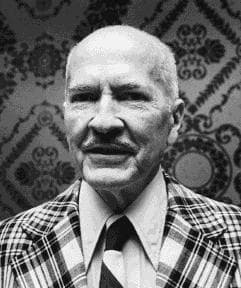
Robert Anson Heinlein was an American science fiction author, aeronautical engineer, and naval officer. Sometimes called the "dean of science fiction writers", he was among the first to emphasize scientific accuracy in his fiction, and was thus a pioneer of the subgenre of hard science fiction. His published works, both fiction and non-fiction, express admiration for competence and emphasize the value of critical thinking. His plots often posed provocative situations which challenged conventional social mores. His work continues to have an influence on the science-fiction genre, and on modern culture more generally.
Similar books
- Stranger in a Strange Land
Robert A. Heinlein
3.9 (275k) average on GoodreadsFantasyExplores complex social and philosophical themes through a unique protagonist with a long lifespan.
- Dune
Frank Herbert
4.2 (766k) average on GoodreadsFantasyFeatures a vast scope, intricate world-building, and a protagonist with an extended, influential life.
- The Dispossessed
Ursula K. Le Guin
4.2 (88k) average on GoodreadsPoliticsEngages in deep philosophical and societal commentary within a science fiction framework.
- Harry Potter and the Sorcerer's Stone
J.K. Rowling
4.5 (7M) average on GoodreadsFantasyRescued from a miserable life under the stairs, an orphaned boy discovers he's a wizard destined for a magical school, where he uncovers a dangerous secret tied to the dark wizard who murdered his parents.
- The Hunger Games
Suzanne Collins
4.3 (6.4M) average on GoodreadsFantasyIn a future where children fight to the death on live television, Katniss Everdeen volunteers for the arena, turning a death sentence into a fight for survival and a spark of rebellion.
- 1984
George Orwell
4.2 (3.1M) average on GoodreadsPoliticsIn a future where surveillance and thought control are absolute, a man's search for truth clashes with the Party, showing that hope can be a form of rebellion.




Enjoyed the summary?
A summary gives you the shape of the book. The book itself has the detail, the examples and the voice.
Find Time Enough for Love on AmazonAs an Amazon Associate, BookBrief earns from qualifying purchases. How we're funded