
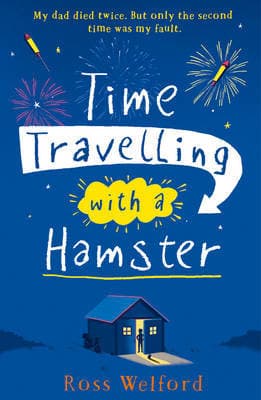
Synopsis
Covers the whole plot, including the ending.
- Difficulty
- Easy
- Pacing
- Moderate
- Mood
- Heartwarming, Adventurous, Emotional, Humorous
- Read it if
- You enjoy heartwarming stories about family, grief, and adventure with a touch of sci-fi, perfect for middle-grade readers and adults who love a good cry.
- Skip it if
- You prefer hard science fiction or stories without emotional depth, or if you dislike plots involving time travel paradoxes and their implications.
Time Travelling with a Hamster Plot Summary
Covers the whole plot, including the ending.
The Inheritance and the Impossible Request
Al Chaudhury, a twelve-year-old, lives in Gateshead with his mother and step-father, Steve. Four years earlier, his inventor father, Terry, died of cancer. On his twelfth birthday, Al gets a letter from Terry, written before he died. It reveals a secret: Terry invented a time machine. The letter asks Al to go back to 1984 to stop an accident that broke his father's neck, saving his father's life and changing the future. The letter also gives directions to a shed in his grandmother's garden where the time machine is, along with instructions and a warning about a 'paradox'.
Discovering the Time Machine
Following his father's letter, Al convinces his grandmother, Dolly, to let him look in the old shed. She resists at first, but they find a hidden space under the shed. It holds a strange machine: a bathtub with wires, circuits, and a control panel. This is Terry's time machine, powered by a glowing, unstable substance. Al understands how big his father's claims are and the hard task ahead. Dolly, though not believing in time travel, is touched by Al's resolve and the link to her son. She agrees to help him prepare.
The First Trip to 1984
Following his father's instructions, Al gets ready for his trip. He brings his pet hamster, Alan Shearer, and carefully types 1984 into the time machine. The machine starts, and after a confusing, sick-making trip, Al lands in a field, disoriented and muddy. He quickly learns that being in 1984 is harder than he thought. He has trouble with old technology, no money, and needs food and shelter. He soon meets a younger version of his mother, Fiona, and his grandfather, who is alive in this time. Al finds his way to his father's childhood home and watches his young father, Terry, from a distance.
The Accident and the Failed Intervention
Al learns the accident his father mentioned involves a treehouse. He watches the area, trying to understand what happened. He sees young Terry and his friends playing near the treehouse. The accident happens when Terry falls from it, breaking his neck. Al tries to warn them, but he is too far away and his efforts don't work. He watches in shock as the events happen just as his father said, seeing how hard it is to change the past. Sad but not giving up, Al knows he needs a more direct plan to stop the accident from happening again.
A Change of Plans and Necessary Evils
Al realizes a direct action is too risky and won't work. He decides he needs to destroy the treehouse before the accident. This needs money and things he doesn't have in 1984. He tries harder and harder ways: stealing money from his younger grandfather, breaking into his father's childhood home for a valuable comic book Terry owns, and finally, setting his old school (a rundown building in 1984) on fire. This is to create a diversion and maybe a hiding place. These actions bother him, but his need to save his father is stronger than his worries about doing wrong.
The Fire and the Hamster's Plight
Al successfully sets fire to his old school, causing a big blaze that draws everyone's attention, including young Terry and his friends. In the confusion, Al tries to get away, but in his rush, he loses Alan Shearer, his pet hamster, who was with him in the time machine. This loss deeply upsets Al, adding more urgency and guilt to his task. He knows he can't leave 1984 without his hamster, making his next steps even harder, as he now has to save his father and find Alan Shearer.
The Second Attempt and the Paradox
After the fire, Al goes back to the treehouse, set on taking it apart. He uses tools he got and works hard to bring it down. Just as young Terry and his friends come near, Al pulls down the last support, and the treehouse falls safely. He has stopped the accident. But a big thought hits him: by saving his father, he has removed the reason for his own life. He is a paradox, a boy who shouldn't be. He feels himself starting to disappear, a scary result of changing his own past, just as his father warned about the 'paradox'.
A Life Unlived and a Difficult Choice
As Al fades, he briefly sees the future he made: a world where his father is alive, married to a different woman, and has other children. Al sees his father, happy and well, but Al himself does not exist in this time. The vision is lovely but also very painful, confirming that his actions erased him. He now understands that to truly save his father, he must let the original accident happen. With a heavy heart, Al knows he must undo what he did, even if it means giving up his father's life to keep his own existence and the life he knows.
Reversing the Past and a New Understanding
With new clarity and great sadness, Al uses the time machine to go back to the exact moment of the treehouse accident. This time, instead of stopping it, he watches, heartbroken, as young Terry falls and breaks his neck. He makes sure the original timeline stays the same, keeping his own existence. After seeing the tragedy again, Al goes back to his own time, carrying the heavy weight of what he has seen and done. He finds himself back in his grandmother's shed, the time machine still working, but his task is now done, though not how he expected.
A Changed Present and Lasting Legacy
Al returns home, tired and sad. He finds that while the main parts of his life are the same, there are small changes. His mother seems happier, and Steve, his step-father, is more present. He also finds Alan Shearer, his hamster, safe, having somehow returned to the present in the time machine. Al now understands his father's love and his own identity deeply. He realizes that even though he couldn't save his father, the journey itself, and the love that drove it, was a strong connection. He keeps the time machine a secret, a sign of his father's brilliance and their special bond.
Time Travelling with a Hamster Characters
Al Chaudhury
Protagonist
A twelve-year-old boy tasked with an impossible mission to save his father.
Al is a thoughtful, determined, and somewhat naive twelve-year-old boy deeply affected by his father's death. He possesses a strong sense of loyalty and love for his family. His journey through time forces him to confront complex moral dilemmas, make difficult choices, and mature beyond his years. He is initially driven by a literal interpretation of his father's request but ultimately learns a deeper lesson about love, loss, and the nature of existence. He shows surprising resourcefulness and courage throughout his adventures, despite his youth.
Relationships: Terry Chaudhury (Father-son, Al is driven by love for his deceased father); Fiona Chaudhury (Mother-son, Al loves and protects his mother); Dolly Chaudhury (Grandmother-grandson, Dolly is supportive and helpful); Steve (Step-father-step-son, initially strained but improves); Alan Shearer (Pet-owner, Al's beloved hamster and companion)
Terry Chaudhury
Catalyst/Deceased Father
Al's eccentric, inventive father who posthumously sets him on a time-traveling mission.
Terry is Al's brilliant but unconventional father, an inventor who dies of cancer when Al is eight. He is the mastermind behind the time machine and the architect of Al's mission. His letters reveal his playful, intelligent, and deeply loving nature, as well as his foresight regarding the paradoxes of time travel. Despite his physical absence, Terry's presence is central to the narrative, guiding Al from beyond the grave and shaping his son's destiny. He is remembered as a man of great imagination and an enduring spirit.
Relationships: Al Chaudhury (Father-son, their bond transcends time); Fiona Chaudhury (Wife-husband (in original timeline), a loving but ultimately tragic relationship); Dolly Chaudhury (Mother-son, a close and supportive relationship)
Dolly Chaudhury
Supporting
Al's wise and supportive grandmother, who aids him in his time-traveling quest.
Dolly is Al's paternal grandmother, a practical and loving woman who, despite her initial skepticism, becomes Al's confidante and helper. She provides the shed where the time machine is hidden and assists Al in preparing for his journeys, even when she doesn't fully understand the science behind it. Her grief for her son, Terry, makes her sympathetic to Al's mission, and she offers emotional support and a grounding presence. She represents the unwavering love of family and the acceptance of the extraordinary.
Relationships: Al Chaudhury (Grandmother-grandson, a deeply supportive bond); Terry Chaudhury (Mother-son, she deeply misses her deceased son); Fiona Chaudhury (Mother-in-law-daughter-in-law, a cordial relationship)
Fiona Chaudhury
Supporting
Al's mother, who struggles with the loss of her first husband.
Fiona is Al's mother, a kind and loving woman who has moved on to marry Steve after Terry's death. She carries the grief of losing Terry, which manifests in her desire for Al to have a stable, normal life. She is unaware of Al's time-traveling adventures, representing the 'normal' world Al must navigate. Her younger self is also encountered by Al in 1984, showing her as a vibrant young woman before the tragedy. Her happiness in the altered timeline is a key factor in Al's ultimate decision.
Relationships: Al Chaudhury (Mother-son, a loving and protective bond); Terry Chaudhury (Wife-husband (in original timeline), a loving but tragic past); Steve (Wife-husband, a new relationship providing stability)
Steve
Supporting
Al's kind but somewhat awkward step-father.
Steve is Al's step-father, a well-meaning but initially somewhat distant figure. He tries his best to be a good father figure to Al, despite Al's initial resentment and comparison to his biological father. Steve often feels like an outsider in the family dynamic, particularly concerning Terry's enduring legacy. His character represents the challenges of blended families and the quiet efforts of someone trying to fit in and provide support, eventually earning Al's respect.
Relationships: Al Chaudhury (Step-father-step-son, initially strained, improves over time); Fiona Chaudhury (Husband-wife, a supportive marital relationship)
Alan Shearer
Supporting/Symbolic
Al's pet hamster, an unexpected companion on his time-traveling adventures.
Alan Shearer is Al's beloved pet hamster, named after the famous footballer. He accompanies Al on his time-traveling journeys, providing a source of comfort and a tangible connection to Al's present. The hamster's unexpected ability to travel through time and his brief disappearance become a source of worry for Al, symbolizing the unpredictable nature of his mission and the small, precious things Al risks losing. He is a constant, innocent presence amidst the complex ethical dilemmas.
Relationships: Al Chaudhury (Pet-owner, a strong bond of affection)
Grandpa Chaudhury
Mentioned/Supporting
Al's paternal grandfather, encountered in 1984.
Grandpa Chaudhury is Al's paternal grandfather, who is alive and well in 1984. Al interacts with him briefly, stealing money from his wallet, which causes Al significant guilt. He represents the living past that Al is trying to alter and provides a glimpse into Terry's family life before the accident. He is a practical man, and his presence highlights the real-world consequences of Al's actions in the past.
Relationships: Al Chaudhury (Grandfather-grandson (in 1984), unknown to him); Terry Chaudhury (Father-son, a typical family relationship)
Mrs. Singh
Supporting
Al's elderly neighbor who offers him food and comfort.
Mrs. Singh is an elderly neighbor of Al and his family. She is a kind and observant woman who provides Al with food and a listening ear, though she remains unaware of his extraordinary activities. She represents the supportive community around Al and offers him small moments of normalcy and comfort amidst his secret mission. Her presence highlights Al's isolation in his secret endeavors.
Relationships: Al Chaudhury (Neighbor, a kind and caring older woman)
Time Travelling with a Hamster Themes
Grief and Acceptance
The novel explores Al's grief after his father's death. At first, he cannot accept the loss, which makes him try to change the past. But through his time travel, Al learns that real love means valuing memories and accepting what cannot be changed. His choice to let the past happen shows he accepts his father's death and his own life, moving from denial to a more mature understanding of grief.
“I knew that I couldn’t save my dad. But I could still try to save the things he loved.”
Identity and Self-Discovery
Al's mission connects directly to who he is. His father's letter suggests Al's life depends on the accident. When Al stops the accident, he faces the scary truth of a paradox — his own non-existence. This makes him ask basic questions about himself and his place. His journey is not just about saving his father, but about understanding his own role, leading him to choose his own life, even if it means accepting a hard truth.
“If I saved him, I would never have been born. And if I was never born, I couldn’t save him.”
The Ethics of Time Travel and Paradox
The book explores the classic science fiction problem of time travel and its effects. Terry's warning about the 'paradox' sets up the main conflict. Al's actions in 1984, especially stopping the accident, show the grandfather paradox. This makes him see a future where he does not exist. This theme shows that changing the past, even with good intentions, can have unexpected and very bad personal results. It makes the reader think about the real cost of changing history.
“Some things, once done, cannot be undone. And some things, once undone, cannot be redone.”
Love and Family Bonds
At its heart, the novel shows the lasting power of family love. Al's strong love for his father drives him on his amazing journey. His relationships with his mother, grandmother, and even his step-father are key to his emotions. The story stresses that family bonds, whether by blood or situation, are strong and give needed support and meaning. Al's final decision, though sad, is an act of deep love, keeping the family he knows and the life he has.
“Love, I’d learned, wasn’t about being together forever. It was about making sure the people you cared about were happy, even if that meant letting go.”
Plot Devices & Literary Techniques
The Time Machine (Bathtub)
A modified bathtub serving as the literal vehicle for time travel.
The time machine, ingeniously disguised as a modified bathtub in a shed, is the central plot device. Its unconventional appearance reflects Terry's eccentric genius and the slightly whimsical tone of the story. It functions as the literal means by which Al travels between 2014 and 1984, enabling the entire narrative. The specific instructions and dangers associated with its use, particularly the energy source and the 'paradox' warning, drive much of the plot's tension and Al's decision-making process.
Letters from the Past
Posthumous letters from Terry guiding Al's mission.
Terry's posthumous letters serve as a crucial plot device, setting Al's mission in motion and providing him with vital information, instructions, and warnings. These letters not only advance the plot by revealing the existence of the time machine and the specific task but also deepen the characterization of Terry, allowing his voice and personality to guide Al from beyond the grave. They create a strong emotional connection between father and son, despite Terry's death.
The Grandfather Paradox
The central logical conflict of time travel, where changing the past erases the present.
The grandfather paradox is the core conceptual plot device of the novel. It is explicitly mentioned by Terry in his letters and becomes the terrifying reality Al faces when he successfully prevents his father's accident. This paradox forces Al to make the ultimate sacrifice, choosing between his father's life and his own existence. It elevates the story beyond a simple adventure, introducing a profound philosophical and emotional dilemma that drives Al's character development and the story's resolution.
The Treehouse
The site of the fateful accident that sets the entire plot in motion.
The treehouse is a symbolic and literal plot device. It is the specific location where young Terry has the accident that leads to his broken neck and, eventually, his early death. As such, it becomes the focal point of Al's mission in 1984. Al's attempts to destroy or dismantle it represent his struggle against destiny and his efforts to change the past. Its eventual collapse, and then its re-establishment, mark the success and subsequent reversal of Al's interventions.
Time Travelling with a Hamster Quotes
“The past is like a foreign country; they do things differently there.”
“Sometimes the only way to move forward is to go back.”
“Just because something is impossible doesn't mean you shouldn't try.”
“What if the very thing you're trying to fix is the thing that makes everything else right?”
“Grief is a funny thing. It makes you do strange things, makes you see strange things.”
“Every decision you make, big or small, sends ripples through time.”
“It's not about changing the past. It's about understanding it.”
“Love, you see, is the ultimate time machine. It transcends all boundaries.”
“Sometimes the greatest adventures are the ones you never intended to have.”
“Even a small hamster can change the course of history.”
“The future isn't written. It's something we create, every single day.”
“It’s funny how the things you think you want the most turn out to be the things you need the least.”
“Home isn't a place, it's a feeling. And sometimes, you have to travel a long way to find it.”
Quiz
10 questions on the plot and the characters. Each answer comes with a short explanation.
Question 1
What is the name of Al Chaudhury's pet hamster?
- Sir Reginald
- Alan Shearer
- Captain Nibbles
- Professor Squeak
Show answer
B. Alan Shearer Al's beloved pet hamster is named Alan Shearer, after the famous footballer. This detail is mentioned early in the book and is significant as the hamster accompanies Al on his time-traveling adventure.
Question 2
According to the book's premise, how many times did Al's dad 'die'?
- Once
- Twice
- Three times
- He never actually died
Show answer
B. Twice The very first line of the book states, 'My dad died twice.' This sets up the central mystery and Al's motivation for time travel.
Question 3
What era does Al travel back to in order to try and save his dad?
- The 1970s
- The 1990s
- The 1980s
- The early 2000s
Show answer
C. The 1980s The book explicitly states that Al travels back to the 1980s to find his father as a child. This is a key plot detail for understanding the setting of much of the story.
Question 4
What is the primary motivation for Al to use his dad's time machine?
- To become rich by knowing future lottery numbers.
- To prevent his father's death.
- To witness historical events firsthand.
- To escape trouble at school.
Show answer
B. To prevent his father's death. Al's entire journey is driven by his profound grief and his desire to change the past to save his father from dying. This is the central conflict and theme of the book.
Question 5
Which of the following actions does Al undertake as part of his time-traveling adventure, according to the description?
- Winning a science fair with future technology.
- Lies, theft, burglary, and setting his school on fire.
- Becoming a famous musician in the past.
- Building a new time machine with his father.
Show answer
B. Lies, theft, burglary, and setting his school on fire. The book's description explicitly lists 'lies, theft, burglary, and setting his school on fire' as actions Al takes, highlighting the chaotic and desperate nature of his quest.
Question 6
What is the 'time machine' Al uses?
- A refurbished DeLorean car.
- A complex device built by his late dad.
- A magical amulet he inherited.
- A portal found in an old abandoned house.
Show answer
B. A complex device built by his late dad. The premise states, 'Al Chaudhury discovers his late dad’s time machine,' indicating it was a creation of his father, not a pre-existing magical item or a famous pop culture reference.
Question 7
What is a significant challenge Al faces related to his pet hamster during his time travel?
- Teaching the hamster to operate the time machine.
- Keeping the hamster safe and avoiding losing him.
- Preventing the hamster from aging too rapidly.
- Explaining the hamster's presence to people in the past.
Show answer
B. Keeping the hamster safe and avoiding losing him. The description mentions, 'All without losing his pet hamster, Alan Shearer…' This highlights the added challenge and emotional attachment Al has to his hamster, making it a key element of his journey.
Question 8
What is a central theme explored in 'Time Travelling with a Hamster' regarding loss and change?
- The futility of trying to change the past.
- The acceptance of grief and the understanding that some events cannot be undone.
- The idea that time travel can solve all personal problems.
- The importance of historical accuracy in time travel.
Show answer
B. The acceptance of grief and the understanding that some events cannot be undone. While Al attempts to change the past, the underlying theme in many time-travel stories, especially those for young adults dealing with loss, often revolves around the protagonist learning to accept grief and the unchangeable nature of certain events, finding peace in the present rather than altering the past.
Question 9
What paradox is implicitly set up by the dual 'death' premise of Al's father?
- The grandfather paradox, where Al's actions could prevent his own birth.
- The bootstrap paradox, where an object or information exists without an origin.
- The butterfly effect, where small changes have large consequences.
- The 'many-worlds' interpretation of quantum mechanics.
Show answer
A. The grandfather paradox, where Al's actions could prevent his own birth. The premise states Al's dad died 'again four years later when he was twelve,' implying Al's future actions could affect his father's past, potentially altering the timeline that led to Al's existence. This directly relates to the grandfather paradox, where going back to affect a parent's past could erase one's own future.
Question 10
How does the genre classification 'Fantasy, Children's, Science Fiction, Young Adult' influence the likely tone and outcome of Al's journey?
- It suggests a purely scientific and gritty exploration of time travel, with a tragic ending.
- It implies a blend of imaginative elements with relatable emotional depth, likely leading to a meaningful, rather than strictly successful, resolution.
- It indicates a focus solely on humor and slapstick comedy, devoid of serious themes.
- It guarantees that Al will successfully alter the past and completely restore his family.
Show answer
B. It implies a blend of imaginative elements with relatable emotional depth, likely leading to a meaningful, rather than strictly successful, resolution. For children's and young adult fiction, especially with fantasy/sci-fi elements, stories often prioritize emotional growth and understanding over purely 'successful' plot outcomes. The blend of genres suggests imaginative adventure combined with character development and dealing with complex emotions like grief, usually leading to a resolution that is meaningful rather than simply 'fixing' everything.
Time Travelling with a Hamster FAQ
What is 'Time Travelling with a Hamster' about?
'Time Travelling with a Hamster' follows twelve-year-old Al Chaudhury as he discovers his recently deceased father's time machine. Driven by a letter from his dad, Al embarks on a mission to travel back to 1984 to prevent his father's childhood accident, hoping to change the future and bring his dad back.
Why should I read 'Time Travelling with a Hamster'?
You should read this book for its unique blend of adventure, humor, and heartfelt exploration of grief and family love. It's a clever time-travel story with a deeply emotional core, featuring a determined young protagonist and a surprisingly complex plot that appeals to both young readers and adults.
What is the background/setting of 'Time Travelling with a Hamster'?
The story is primarily set in contemporary England, specifically in Northumberland, where Al lives. However, a significant portion of the narrative takes place in 1984, as Al travels back in time to Washington, Tyne and Wear, experiencing the 1980s through the eyes of a modern child.
What are the most memorable quotes?
One memorable quote is, 'My dad died twice. Once when he was thirty nine and again four years later when he was twelve.' This opening line immediately hooks the reader and sets up the central mystery. Another is Al's realization that 'You can't change the past without changing the future, and sometimes the future is better left alone.'
What writing style does the author use?
Ross Welford employs an engaging, first-person narrative voice from Al's perspective, characterized by wit, humor, and genuine emotional depth. The language is accessible for young readers but sophisticated enough to handle complex themes, often using short, impactful sentences to build suspense and convey Al's urgency.
What minor details add significant meaning?
The specific details of Al's father's childhood, like his love for Duran Duran and his secret treehouse hideout, are crucial. These seemingly small elements become vital clues Al uses to navigate 1984 and connect with his young father, providing both authenticity and narrative direction.
What are some subtle foreshadowing moments?
The recurring mention of the specific date of his father's accident and the precise circumstances, even before Al fully understands his mission, subtly foreshadows the challenges and paradoxes he will face. Also, the hints about the time machine's limitations and the unexpected consequences of altering the past are subtly woven into his father's notes.
What unexpected character connections exist?
One unexpected connection is Al's bond with his younger, twelve-year-old father, Mike. This unique dynamic allows Al to see his dad not just as a parent but as a peer, understanding his struggles and dreams. Another is the unexpected help Al receives from his quirky grandmother, who has her own unspoken understanding of time and fate.
What are unspoken character motivations?
Al's primary unspoken motivation is his profound grief and desire to undo his father's death, which drives him to extreme and often illegal actions. His grandmother's unspoken motivation seems to be a deep, enduring love for her son and a quiet acceptance of the mysteries of life, leading her to subtly support Al's impossible quest.
What psychological complexities do characters exhibit?
Al exhibits the psychological complexity of a child grappling with immense loss, leading to a single-minded determination that borders on obsession. His father, in his childhood form, shows the complexities of a bright but lonely boy, whose accident is not just physical but also affects his emotional development, subtly influencing his adult self.
What are the major emotional turning points?
A major emotional turning point is when Al first meets his young father, Mike, in 1984, realizing the profound implications of his mission. Another is when Al experiences the accident himself, understanding the true nature of his father's past and the futility of completely altering it without severe consequences.
How do relationship dynamics evolve?
Al's relationship with his deceased father evolves from one of simple longing to a deep understanding and empathy, forged by experiencing his dad's childhood. His relationship with his grandmother also deepens, moving from typical grandchild-grandparent interactions to a shared, unspoken secret and mutual support.
Which parts remain ambiguous or open-ended?
The precise mechanics of the time machine and the full extent of the grandfather paradox are left somewhat ambiguous, allowing for a more character-driven narrative. The 'rules' of time travel are hinted at but never fully explained, leaving some room for interpretation on how certain events could or could not be changed.
What are controversial scenes or decisions?
Al's decision to set his school on fire to create a distraction, even for a noble cause, could be seen as controversial due to its extreme nature. Also, his repeated acts of theft and deception, while justified by his mission, raise questions about the ethics of his actions, even with the best intentions.
'Time Travelling with a Hamster' ending explained: how it ends & what it means
Al ultimately realizes he cannot prevent his father's accident without erasing his own existence. Instead, he travels back to the moment of the accident and takes his father's place, sustaining the injury himself. This means his father lives a full life, but Al sacrifices his own future, living out his father's childhood. The ending means that while the past cannot be 'undone' to bring back the dead, love and sacrifice can still profoundly alter and improve the lives of those we care about.
Similar books
- Artemis Fowl
Eoin Colfer
3.9 (496k) average on GoodreadsFantasyCombines a clever young protagonist with fantastical elements and a fast-paced adventure.
- A Wrinkle in Time
Madeleine L'Engle
4.0 (1.1M) average on GoodreadsFantasyWhile both books feature young protagonists embarking on fantastical journeys to save a family member and explore themes of love and courage, L'Engle's A Wrinkle in Time (1962) delves into more overt philosophical and theological questions, with a greater emphasis on cosmic good versus evil. Welford's approach is more grounded in personal grief and the immediate implications of altering one's own past, making it perhaps more emotionally direct for younger readers, whereas L'Engle's work is more abstract and allegorical. Both utilize science fiction elements, but L'Engle's are more intricately woven into a larger metaphysical framework.
- Harry Potter and the Sorcerer's Stone
J.K. Rowling
4.5 (7M) average on GoodreadsFantasyRescued from a miserable life under the stairs, an orphaned boy discovers he's a wizard destined for a magical school, where he uncovers a dangerous secret tied to the dark wizard who murdered his parents.
- The Hunger Games
Suzanne Collins
4.3 (6.4M) average on GoodreadsFantasyIn a future where children fight to the death on live television, Katniss Everdeen volunteers for the arena, turning a death sentence into a fight for survival and a spark of rebellion.
- 1984
George Orwell
4.2 (3.1M) average on GoodreadsPoliticsIn a future where surveillance and thought control are absolute, a man's search for truth clashes with the Party, showing that hope can be a form of rebellion.
- Divergent
Veronica Roth
4.2 (2.9M) average on GoodreadsFantasyIn a society divided by virtues, a sixteen-year-old's difference from the norm starts a rebellion that threatens her world.





Enjoyed the summary?
A summary gives you the shape of the book. The book itself has the detail, the examples and the voice.
Find Time Travelling with a Hamster on AmazonAs an Amazon Associate, BookBrief earns from qualifying purchases. How we're funded