
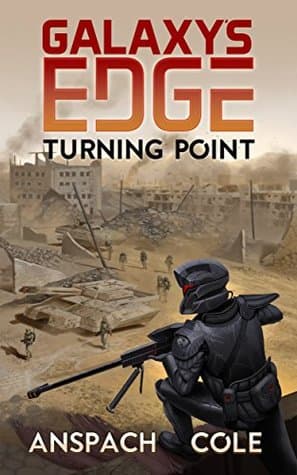
Synopsis
Covers the whole plot, including the ending.
- Difficulty
- Medium
- Pacing
- Fast
- Mood
- Action-packed, Suspenseful, Epic, Gritty
- Read it if
- You enjoy military sci-fi with large-scale space battles, political intrigue, and high stakes.
- Skip it if
- You prefer character-driven stories over plot-heavy, action-focused narratives.
Turning Point Plot Summary
Covers the whole plot, including the ending.
Article Nineteen and the Galactic Core
The Galactic Legion, seeing the deep corruption and inefficiency from the Galactic Core, activates Article Nineteen. This plan aims to break down current power structures and force a 'hard reset' on the galaxy's political and military landscape. This move faces immediate opposition from groups that benefit from the current system. The House of Reason, a powerful political group, sees this as a chance to push its own agenda and surprisingly allies with the zhee extremists, a violent species. This alliance escalates the situation, forcing the Legion into 'Total War' to restore order and stop the zhee from gaining power through the House of Reason.
Victory Squad's Intelligence Mission
Captain Chhun, leading the Victory Squad, gets critical information about Goth Sullus. Sullus, a strong and ambitious leader, is quickly expanding his empire, threatening galactic stability. The information suggests a weakness or asset that, if used, could cripple Sullus's operations. Chhun and his squad go on a high-stakes mission, crossing dangerous areas and hostile forces to check the information and possibly launch a decisive attack. Their success is vital, as Sullus's growing power directly challenges the Legion's efforts to bring order to the galaxy.
Exo and Wraith's Uneasy Alliance
Exo, a mysterious and skilled person, finds himself in a risky alliance with Wraith, another enigmatic figure with a hidden goal. Despite their distrust and different reasons, they are brought together by a shared aim: to find and investigate a long-dormant fleet of immense power. This sleeping fleet is rumored to have technology and firepower far beyond anything known in the galaxy. Both Exo and Wraith understand that whoever controls this fleet could permanently change the balance of power between the Legion, the Republic, and Goth Sullus's Empire. Their journey is full of danger; they must overcome external threats and their constant suspicion of each other.
The Zhee and House of Reason's Offensive
The alliance between the zhee extremists and the politically smart House of Reason launches a series of coordinated attacks. The zhee, known for their brutal methods and large numbers, provide the military force, while the House of Reason gives strategic targets and logistical help, using their knowledge of galactic infrastructure. These attacks aim to destabilize the Legion's efforts under Article Nineteen and claim new territories for their joint rule. Planets fall, supply lines are cut, and civilians suffer greatly. The Legion is spread thin, fighting on many fronts against a clever and ruthless enemy that uses the chaos of the 'hard reset'.
Chhun's Confrontation with Sullus's Forces
Using the information they gathered, Captain Chhun and Victory Squad pinpoint a key installation or asset belonging to Goth Sullus's empire. This leads to a direct fight with Sullus's highly trained and loyal forces. The battle is intense, showing the Legion's tactical skill against the Empire's disciplined might. Chhun's leadership and Victory Squad's combat skills are fully tested as they try to infiltrate, disable, or capture the target. The stakes are very high; success could disrupt Sullus's expansion, while failure would empower him and possibly compromise future Legion operations. This engagement is a small part of the larger war for galactic control.
Unveiling the Slumbering Fleet's Secrets
After overcoming many obstacles, Exo and Wraith finally reach the slumbering fleet. What they find is more surprising and terrifying than they imagined. The fleet is not just old but ancient, with technology far beyond current understanding, capable of immense destruction. They learn its origins, purpose, and why it was dormant. The discovery has huge implications: this fleet could be the key to peace or, if activated by the wrong people, could unleash an apocalypse on the entire galaxy. The knowledge they uncover makes them rethink their loyalties and the true cost of power.
The Legion's Counter-Offensive
Despite initial setbacks and widespread chaos, the Legion gathers its forces and starts a strategic counter-offensive against the zhee and House of Reason alliance. Using the full power of Article Nineteen's mandate, they target key enemy strongholds and supply lines. General Aetius, a clever military strategist, plans complex moves to isolate and overpower enemy forces. The Legion's renewed offensive shows their determination and superior training, pushing back against the encroaching darkness. However, the conflict is far from over, as the zhee and the House of Reason prove to be tough and adaptable enemies, able to absorb heavy losses and regroup.
Sullus's Retaliation and Expansion
Angered by the Legion's interference and Captain Chhun's successful mission, Goth Sullus retaliates brutally. He deploys more of his powerful fleet and ground forces, speeding up his expansion and targeting worlds once thought safe. Sullus shows his ruthlessness and strategic mind, using the galaxy's turmoil to strengthen his rule. His actions are a clear reminder that even amid the larger conflict with the zhee and the House of Reason, his empire remains a strong and growing threat. The Legion must now fight a multi-front war, battling both an extremist alliance and a rapidly expanding, powerful empire.
The Choice of the Ancient Fleet
With full knowledge of the slumbering fleet's immense power and destructive potential, Exo and Wraith face an impossible choice. They know that activating the fleet could be the ultimate weapon to end the galactic war, but it also risks uncontrolled destruction or falling into the wrong hands. They discuss the ethical issues, potential consequences, and the moral burden of such a decision. Their fragile alliance is tested as they weigh the options, knowing their choice will decide the fate of countless worlds and species. The decision is not just tactical but deeply philosophical, forcing them to confront the nature of power and responsibility.
Clash of Ideologies and Empires
The galactic conflict grows, becoming a complex three-way struggle for control. The Legion, under Article Nineteen, fights to restore order and fight corruption. The zhee extremists, backed by the House of Reason's strategic cunning, seek to impose their brutal ideology. Meanwhile, Goth Sullus's growing empire continues its relentless expansion, aiming to establish a new order under his absolute rule. Battles rage across star systems, alliances change, and the lines between good and evil blur. Each group believes its cause is right, leading to a brutal and long war that threatens to tear the galaxy apart, with no clear winner.
Principal Figures
Captain Chhun
Protagonist
A skilled and resolute Legion Captain leading Victory Squad.
Captain Chhun is a highly competent and morally driven officer within the Galactic Legion. He embodies the Legion's ideals of duty, discipline, and protection of the innocent. His leadership of Victory Squad showcases his tactical brilliance and unwavering courage in the face of overwhelming odds. Chhun is pragmatic but not cynical, always prioritizing the mission and the well-being of his squad. He is deeply committed to halting the spread of Goth Sullus's empire and upholding the Legion's mandate, even as the galaxy descends into chaos.
Relationships: Victory Squad (Leader and protector of his elite squad)
Exo
Protagonist
A mysterious and powerful individual with a hidden past and a crucial role in discovering ancient power.
Exo is an enigmatic figure whose origins and true motivations are shrouded in mystery. He possesses unique skills and knowledge, suggesting a background far beyond that of a typical galactic citizen. Despite his guarded nature, he is driven by a deep sense of purpose, often operating outside conventional allegiances. His alliance with Wraith is tenuous, born out of necessity rather than trust, as they both seek to understand and potentially control the ancient slumbering fleet. Exo represents the unknown variables in the galactic conflict, a wild card whose actions could tip the scales.
Relationships: Wraith (Uneasy, pragmatic alliance based on shared objective); Slumbering Fleet (Deep connection and understanding of its nature)
Wraith
Protagonist/Supporting
An equally mysterious individual, allied with Exo, with their own agenda regarding ancient power.
Wraith is a shadowy character, as elusive and secretive as Exo. While allied with Exo in the pursuit of the slumbering fleet, Wraith's true loyalties and ultimate goals remain ambiguous. They are intelligent, cunning, and resourceful, capable of navigating dangerous situations with ease. Wraith's presence adds an element of unpredictability to their joint mission, as their actions are often dictated by a personal code or a long-term plan that is not immediately apparent. They represent the moral ambiguity and shifting allegiances prevalent in the turbulent galaxy.
Relationships: Exo (Uneasy, pragmatic alliance based on shared objective)
Goth Sullus
Antagonist
The ambitious and ruthless leader of a rapidly expanding empire.
Goth Sullus is a formidable and charismatic antagonist, driven by an insatiable hunger for power and control. He is a brilliant strategist and a ruthless commander, who has rapidly forged a powerful empire amidst the galactic chaos. Sullus believes in a strong, centralized authority and views the Legion's Article Nineteen as an opportunity to further his own dominion. He is willing to employ brutal tactics to achieve his goals, making him a significant threat to all other factions. His ambition and military prowess make him a primary obstacle for Captain Chhun and the Legion.
Relationships: His Empire's Forces (Absolute ruler and commander); Captain Chhun (Primary military adversary)
The House of Reason
Antagonist
A powerful political entity that allies with zhee extremists for strategic gain.
The House of Reason represents the corrupt and self-serving political elite of the Galactic Core. While outwardly presenting themselves as upholders of order, they are deeply entrenched in the very corruption Article Nineteen seeks to dismantle. Their alliance with the zhee extremists is a shocking display of their willingness to compromise galactic safety for their own power and influence. They provide the zhee with strategic intelligence and logistical support, leveraging their political networks to undermine the Legion and solidify their own position in the power vacuum.
Relationships: Zhee Extremists (Strategic, self-serving alliance)
Zhee Extremists
Antagonist
A bloodthirsty alien species known for their brutal tactics and overwhelming numbers.
The zhee are a highly aggressive and expansionist alien species, notorious for their savage combat methods and overwhelming numbers. They are driven by a fanatical ideology and show no mercy to their enemies. Their alliance with the House of Reason provides them with an unexpected avenue to expand their influence and wreak havoc across the galaxy. The zhee represent the raw, destructive force that threatens to engulf civilization, making them a primary military threat that the Legion must contain at all costs.
Relationships: The House of Reason (Strategic, self-serving alliance)
General Aetius
Supporting
A high-ranking Legion General responsible for orchestrating the counter-offensive.
General Aetius is a seasoned and highly respected military strategist within the Galactic Legion. He is tasked with implementing Article Nineteen and leading the Legion's efforts to combat the multifaceted threats plaguing the galaxy. Aetius is calm under pressure, possessing a keen tactical mind and the ability to coordinate large-scale operations. He represents the strategic backbone of the Legion, making critical decisions that guide their response to the zhee-House of Reason alliance and Goth Sullus's expansion. His leadership is crucial in preventing the complete collapse of galactic order.
Relationships: The Legion (High-ranking commander and strategist)
Victory Squad
Supporting
Captain Chhun's elite and highly skilled combat unit.
Victory Squad is an elite special operations unit within the Galactic Legion, personally led by Captain Chhun. They are comprised of highly trained and experienced soldiers, each specializing in various combat roles. The squad operates with exceptional cohesion and efficiency, capable of undertaking dangerous infiltration missions, direct engagements, and intelligence gathering. They are fiercely loyal to Captain Chhun and the Legion's cause, serving as the sharp edge of the Legion's efforts against Goth Sullus and other threats. Their teamwork and individual skills are vital to the success of many critical missions.
Relationships: Captain Chhun (His direct command and trusted subordinates)
Themes & Insights
The Nature of Power and Corruption
The novel explores how unchecked power leads to corruption, and how desperate measures are sometimes needed to fix it. The Galactic Core's deep corruption, which Article Nineteen aims to dismantle, is a central example. The House of Reason's alliance with the zhee also shows how political power can be twisted for self-preservation, even at the expense of galactic stability. Goth Sullus's ruthless expansion highlights how ambition corrupts, where seeking power justifies any means.
“The rot had spread too deep, consuming the very heart of governance. Only a hard reset could excise the cancer.”
The Cost of Total War
The book shows the terrible results of 'Total War,' as declared by the Legion. It covers not just military fights but also the widespread suffering of civilians, the destruction of infrastructure, and the moral compromises made by all sides. The zhee's brutal tactics and Sullus's retaliations emphasize the huge human and material cost of such a conflict. The story stresses that while necessary, total war leaves deep scars, forcing characters like Captain Chhun to face grim realities and make hard choices for the greater good.
“Every victory carried the weight of a thousand losses, every gain stained with the blood of innocents.”
Moral Ambiguity and Shifting Alliances
In a galaxy at war, clear lines between good and evil blur, and alliances are often practical rather than based on principles. The shaky partnership between Exo and Wraith, driven by a shared goal rather than trust, illustrates this. The House of Reason's surprising alliance with the zhee further shows how desperate times can lead to morally questionable decisions. Characters must make hard choices, often compromising their ideals for a perceived greater good, highlighting the complex ethical landscape of the conflict.
“In the shadow of galactic collapse, even enemies found common ground, though trust remained a luxury no one could afford.”
The Burden of Ancient Power
The discovery of the slumbering fleet brings up the theme of ancient power and the huge responsibility that comes with possibly activating it. Exo and Wraith's dilemma about whether to unleash this force, capable of both saving and destroying, explores the ethical questions of wielding god-like abilities. It asks if humanity is ready for such power or if it will inevitably lead to more chaos. The fleet itself represents a 'turning point,' a choice that could define the galaxy's future.
“To awaken such a force was to play god, with the galaxy as our chessboard and oblivion as the ultimate checkmate.”
Plot Devices & Literary Techniques
Article Nineteen
A radical Legion protocol for galactic 'hard reset'.
Article Nineteen serves as the inciting incident and a major catalyst for the entire galactic conflict. It's a 'hard reset' protocol initiated by the Legion to dismantle corrupt power structures in the Galactic Core. This device immediately establishes the high stakes of the story, as its implementation directly leads to widespread resistance, the formation of new alliances (like the House of Reason and zhee), and the Legion's commitment to Total War. It provides the overarching framework for the Legion's actions and the chaos that ensues, driving the plot forward by forcing all factions to react to its disruptive force.
The Slumbering Fleet
An ancient, dormant fleet with immense, galaxy-altering power.
The slumbering fleet acts as a powerful MacGuffin and a ticking time bomb. Its existence provides a compelling goal for Exo and Wraith, driving their parallel storyline and adding a layer of mystery and anticipation. The fleet represents an ultimate power that could decisively end the war for any faction that controls it, creating immense tension. Its discovery and the subsequent ethical dilemma surrounding its activation serve as a major 'turning point' for the galaxy, raising the stakes exponentially and forcing characters to confront profound questions about power and responsibility.
Critical Intelligence
Crucial information that guides Captain Chhun's mission against Sullus.
The 'critical intelligence' received by Captain Chhun functions as a classic plot driver, propelling Victory Squad's storyline. It provides a specific, actionable objective against Goth Sullus, allowing for focused missions and direct confrontations. This device ensures that Chhun's narrative thread is not merely reactive but actively seeks to disrupt the antagonist's plans. It creates immediate stakes and allows for character development through the challenges and successes of executing the mission based on this vital information, showcasing the Legion's proactive approach.
The Zhee-House of Reason Alliance
An unexpected and dangerous political-military partnership.
This alliance is a significant plot twist and a major antagonist force. It elevates the conflict beyond a simple Legion vs. corrupt government scenario, introducing a truly bloodthirsty and ideological threat. The alliance creates a more complex and dangerous adversary for the Legion, forcing them to fight on multiple fronts against both political cunning and raw military power. This device increases the stakes, showcases the moral compromises within the galaxy, and ensures that the Legion's 'Total War' is against a formidable and multifaceted enemy.
Turning Point Quotes
“Freedom, like anything truly valuable, must be actively defended. It doesn't just... exist.”
“The greatest weapon isn't a blaster or a starship, but an idea that inspires millions.”
“Sometimes the hardest part of a journey isn't the distance, but the first step.”
“Hope is a fragile thing, easily crushed, but also incredibly resilient if given just a tiny spark.”
“The past isn't just history; it's the foundation we stand on, for better or worse.”
“Even in the darkest corners of the galaxy, light can be found, if you know where to look, or are brave enough to create it.”
“Loyalty isn't given; it's earned, through actions, not just words.”
“The universe doesn't care about your plans. It cares about your adaptability.”
“Fear can be a powerful motivator, but it's a poor master.”
“Every choice has a ripple, some small, some large enough to change the tide of history.”
“You can't fight a war without believing in something worth fighting for.”
“Victory isn't just about winning battles; it's about not losing yourself in the process.”
“The future isn't written; it's forged by the choices we make today.”
Quiz
10 questions on the plot and the characters. Each answer comes with a short explanation.
Question 1
What is the primary purpose of the Legion's initiation of Article Nineteen?
- To form an alliance with the House of Reason.
- To conduct a hard reset to halt corruption and ineptitude from the Galactic Core.
- To launch a preemptive strike against Goth Sullus.
- To retreat from the ongoing conflict.
Show answer
B. To conduct a hard reset to halt corruption and ineptitude from the Galactic Core. Article Nineteen is described as a 'hard reset designed to halt the corruption and ineptitude that continues to spill forth from the Galactic Core.'
Question 2
Which faction does the House of Reason align itself with, prompting the Legion to commit to Total War?
- Goth Sullus's fledgling empire.
- The Republic.
- The bloodthirsty zhee extremists.
- Captain Chhun's Victory Squad.
Show answer
C. The bloodthirsty zhee extremists. The text states, 'But when the House of Reason aligns itself with the bloodthirsty zhee extremists, the Legion has no choice but to commit to a savage campaign of Total War.'
Question 3
What is Captain Chhun and Victory Squad's objective?
- To secure the slumbering fleet.
- To negotiate peace with the House of Reason.
- To follow intelligence to land a powerful blow against Goth Sullus.
- To assist the Legion in their Total War campaign.
Show answer
C. To follow intelligence to land a powerful blow against Goth Sullus. Captain Chhun and Victory Squad 'follow intelligence that could land a powerful blow against Goth Sullus and his fledgling empire.'
Question 4
What is the potential impact of the 'slumbering fleet' that Exo and Wraith are moving towards?
- It could permanently alter the balance of power or eradicate the galaxy.
- It is a decoy to distract Goth Sullus.
- It is a new supply line for the Republic.
- It will allow the Legion to retreat safely.
Show answer
A. It could permanently alter the balance of power or eradicate the galaxy. The slumbering fleet 'could permanently alter the delicate balance of power among Legion, Republic, and Empire... or could just as easily eradicate the galaxy altogether.'
Question 5
Why does the Legion decide to commit to 'Total War'?
- Because Article Nineteen failed to halt the corruption.
- As a direct response to Captain Chhun's intelligence.
- Due to the House of Reason aligning with the zhee extremists.
- To prevent Exo and Wraith from reaching the slumbering fleet.
Show answer
C. Due to the House of Reason aligning with the zhee extremists. The text explicitly states, 'But when the House of Reason aligns itself with the bloodthirsty zhee extremists, the Legion has no choice but to commit to a savage campaign of Total War.'
Question 6
Who are the two individuals in a 'tenuous alliance' moving towards the slumbering fleet?
- Captain Chhun and Goth Sullus.
- Exo and Wraith.
- A Legionnaire and a Republic soldier.
- A zhee extremist and a member of the House of Reason.
Show answer
B. Exo and Wraith. The synopsis mentions, 'Exo and Wraith, in an tenuous alliance, move toward a slumbering fleet.'
Question 7
What is the primary conflict driving the Legion's actions at the beginning of the book?
- A territorial dispute with the Republic.
- The corruption and ineptitude emanating from the Galactic Core.
- The formation of Goth Sullus's empire.
- The threat of the slumbering fleet.
Show answer
B. The corruption and ineptitude emanating from the Galactic Core. The Legion initiates Article Nineteen 'designed to halt the corruption and ineptitude that continues to spill forth from the Galactic Core.'
Question 8
How does the House of Reason's alignment impact the broader galactic conflict?
- It strengthens the Legion's position, allowing them to focus on Goth Sullus.
- It forces the Legion to escalate their campaign to 'Total War'.
- It leads to a temporary ceasefire between all major factions.
- It causes Captain Chhun to abandon his mission against Goth Sullus.
Show answer
B. It forces the Legion to escalate their campaign to 'Total War'. The alignment 'with the bloodthirsty zhee extremists' directly results in 'the Legion has no choice but to commit to a savage campaign of Total War.'
Question 9
What is the specific threat posed by the zhee extremists that makes the House of Reason's alliance with them so critical?
- They possess advanced stealth technology.
- They are described as 'bloodthirsty', indicating extreme aggression and danger.
- They control the Galactic Core.
- They are able to manipulate the slumbering fleet.
Show answer
B. They are described as 'bloodthirsty', indicating extreme aggression and danger. The description 'bloodthirsty zhee extremists' implies a significant, violent threat, making their alliance with the House of Reason a critical turning point that necessitates 'Total War' from the Legion.
Question 10
Considering the various storylines, what is the overarching theme suggested by the title 'Turning Point'?
- The stability of established galactic powers.
- The inevitability of peace in the galaxy.
- A critical moment where the balance of power and fate of the galaxy could fundamentally change.
- The cyclical nature of conflict with no real resolution.
Show answer
C. A critical moment where the balance of power and fate of the galaxy could fundamentally change. With Article Nineteen, Total War, an attack on Goth Sullus, and a slumbering fleet that could 'alter the delicate balance of power' or 'eradicate the galaxy,' the events collectively point to a critical juncture, a 'turning point' for the galaxy.
Turning Point FAQ
What is Article Nineteen and why does the Legion initiate it?
Article Nineteen is a drastic measure, essentially a 'hard reset' protocol initiated by the Legion to combat the rampant corruption and profound ineptitude emanating from the Galactic Core. It signifies the Legion's decision to directly intervene and dismantle the failing political and administrative structures that have led the galaxy into turmoil.
Who are the zhee extremists and what is their significance in the conflict?
The zhee extremists are a bloodthirsty faction, characterized by their violent and radical ideologies. Their significance escalates dramatically when the House of Reason, a presumably more established power, aligns itself with them, forcing the Legion to commit to a 'Total War' strategy against this dangerous new alliance.
What is Captain Chhun's objective with Victory Squad?
Captain Chhun and Victory Squad are pursuing crucial intelligence that could allow them to deliver a significant blow against Goth Sullus. Their mission focuses on disrupting the operations and weakening the nascent empire Sullus is attempting to establish, likely through strategic strikes or intelligence gathering.
What is the 'slumbering fleet' and why is it so important?
The 'slumbering fleet' is an ancient or powerful collection of warships whose awakening could drastically shift the balance of power in the galaxy. It holds the potential to either empower one of the major factions (Legion, Republic, Empire) or, terrifyingly, unleash a destructive force capable of eradicating the galaxy entirely.
What kind of alliance do Exo and Wraith form, and what is their ultimate goal?
Exo and Wraith form a tenuous and perhaps unlikely alliance, driven by a shared objective. Their ultimate goal is to reach and potentially control or influence the 'slumbering fleet.' This alliance suggests they might have a unique understanding of the fleet's power or a desperate need to prevent it from falling into the wrong hands.
Are there any clues about the true nature of the House of Reason's alignment with the zhee?
The sudden alignment of the House of Reason, implied to be a more established or rational entity, with the 'bloodthirsty zhee extremists' suggests a deeper, perhaps desperate or manipulative, motive. It could indicate a severe internal power struggle within the House, or a calculated move to gain leverage, underestimating the zhee's true fanaticism.
What is the historical context or origin of the 'slumbering fleet'?
While not explicitly detailed, the term 'slumbering fleet' implies an ancient origin, possibly a remnant of a forgotten civilization or a powerful, long-dormant military force. Its potential for 'eradication' hints at advanced, perhaps self-aware, weaponry or a catastrophic past event that led to its dormancy, making its awakening incredibly perilous.
How does Goth Sullus's 'fledgling empire' interact with the ongoing Legion-zhee conflict?
Goth Sullus's 'fledgling empire' likely operates as a third, opportunistic party in the galaxy-wide conflict, seeking to expand its influence while the Legion is preoccupied with the House of Reason and zhee. Captain Chhun's mission against Sullus indicates that his growing power is a significant threat that the Legion cannot ignore, even amidst Total War.
What are the underlying motivations for the corruption and ineptitude in the Galactic Core?
The narrative points to deep-seated corruption and ineptitude in the Galactic Core, which likely stems from a combination of unchecked power, self-serving bureaucracy, and a profound disconnect from the needs of the wider galaxy. This systemic failure is the primary catalyst for the Legion's drastic Article Nineteen intervention.
How does the Legion's decision for 'Total War' impact its own psychological and moral standing?
Committing to 'Total War' signifies a profound shift for the Legion, likely forcing them to abandon previous ethical restraints and embrace more ruthless tactics. This decision would undoubtedly create internal moral dilemmas and psychological strain on its soldiers, including Captain Chhun, as they confront the brutal realities of such a conflict.
What psychological traits define Captain Chhun and Victory Squad in their mission?
Captain Chhun and Victory Squad likely embody traits of unwavering determination, strategic cunning, and a strong sense of duty, essential for operating behind enemy lines against Goth Sullus. Their ability to follow critical intelligence suggests a reliance on precision and adaptability in high-stakes, covert operations.
What psychological dynamics are at play in the 'tenuous alliance' between Exo and Wraith?
The 'tenuous alliance' between Exo and Wraith implies a relationship built on necessity rather than trust or camaraderie, suggesting a clash of personalities, differing ideologies, or past conflicts. Their shared, critical objective to reach the slumbering fleet likely overrides their individual differences, creating a high-tension, fragile partnership.
Is Article Nineteen truly a 'hard reset' or a symptom of the Legion's own failing strategies?
Whether Article Nineteen is a true 'hard reset' or a symptom of the Legion's own strategic failures is debatable. It could be argued that the Legion, having allowed the corruption to fester, is now resorting to extreme measures, suggesting a reactive rather than purely proactive approach, potentially indicating their own prior missteps or limitations.
Could the 'slumbering fleet' represent a greater good, or is its awakening inherently catastrophic?
The description suggests the 'slumbering fleet' could either 'alter the delicate balance of power' or 'eradicate the galaxy altogether,' presenting a clear dichotomy. Its potential 'greater good' might lie in its ability to decisively end the current conflicts, but its inherent destructive power makes its awakening a monumental risk, possibly an unavoidable catastrophe.
What is the author's commentary on the nature of 'Total War' through the Legion's actions?
The author, through the Legion's commitment to 'Total War,' seems to comment on the desperate and brutal realities of galactic conflict, where even a force like the Legion, presumably upholding order, is forced into extreme measures. It highlights the moral compromises and potential for self-destruction inherent in such all-encompassing warfare, suggesting it's a last resort with immense consequences.
Is Goth Sullus merely an antagonist, or does he represent a legitimate, albeit ruthless, alternative to the existing powers?
Goth Sullus could be interpreted as more than just an antagonist. His 'fledgling empire' suggests he's building a new order, possibly appealing to those disillusioned by the Galactic Core's corruption and the ongoing wars. While 'ruthless,' he might represent a pragmatic, albeit authoritarian, alternative that some factions could view as a necessary evil or even a path to stability.
How does the 'Fight to Win' theme manifest across the different plotlines?
The 'Fight to Win' theme manifests in the Legion's uncompromising Article Nineteen and Total War against the zhee, Captain Chhun's focused mission to strike Goth Sullus, and the desperate, tenuous alliance of Exo and Wraith to secure the slumbering fleet. Each faction is driven by a singular, ultimate objective, willing to take extreme measures to achieve victory.
Similar books
- Starship Troopers
Robert A. Heinlein
4.0 (192k) average on GoodreadsFantasyFeatures military action and a clear, pragmatic ideology in space warfare.
- Old Man's War
John Scalzi
4.2 (162k) average on GoodreadsFantasyInvolves future soldiers fighting alien threats and explores themes of galactic conflict.
- Dune
Frank Herbert
4.2 (766k) average on GoodreadsFantasyWhile both novels explore clashes of empires and ideologies, Herbert's Dune delves significantly deeper into political philosophy, ecological themes, and the intricate motivations of its various factions. Turning Point presents ideological conflicts more as a backdrop for military engagement, focusing less on the philosophical underpinnings and more on the immediate strategic implications, a distinction noted by critics like Harold Bloom in discussions of genre depth.
- The Hunger Games
Suzanne Collins
4.3 (6.4M) average on GoodreadsFantasyIn a future where children fight to the death on live television, Katniss Everdeen volunteers for the arena, turning a death sentence into a fight for survival and a spark of rebellion.
- 1984
George Orwell
4.2 (3.1M) average on GoodreadsPoliticsIn a future where surveillance and thought control are absolute, a man's search for truth clashes with the Party, showing that hope can be a form of rebellion.
- Divergent
Veronica Roth
4.2 (2.9M) average on GoodreadsFantasyIn a society divided by virtues, a sixteen-year-old's difference from the norm starts a rebellion that threatens her world.




Enjoyed the summary?
A summary gives you the shape of the book. The book itself has the detail, the examples and the voice.
Find Turning Point on AmazonAs an Amazon Associate, BookBrief earns from qualifying purchases. How we're funded