

Synopsis
Covers the whole plot, including the ending.
- Difficulty
- Medium
- Pacing
- Variable
- Mood
- Adventurous, Mysterious, Educational, Thought-provoking
- Read it if
- You enjoy classic adventure stories, detailed scientific exploration, and mysterious, morally ambiguous anti-heroes.
- Skip it if
- You prefer fast-paced thrillers or stories with clear-cut heroes and villains.
Twenty Thousand Leagues Under the Sea Plot Summary
Covers the whole plot, including the ending.
The Mysterious Monster
In 1866, stories of a huge, fast sea creature sinking ships spread. Professor Pierre Aronnax, a French marine biologist, first thought the creature was a hoax or a large narwhal. However, after more incidents, he was asked by the American government to join an expedition on the USS Abraham Lincoln to hunt this 'monster.' Aronnax, joined by his assistant, Conseil, accepted, driven by scientific interest. They left New York with the crew, including the harpooner Ned Land, who was eager for the hunt.
Aboard the Abraham Lincoln
The USS Abraham Lincoln, a powerful frigate, spent months searching the Pacific Ocean without success. Aronnax, Conseil, and Ned Land grew frustrated. Ned Land, especially, was annoyed by the lack of action, constantly looking for the creature. Finally, near Japan, the 'monster' was seen. The Abraham Lincoln chased it, leading to a tense fight. During the chase, the creature was agile and tough. In the chaos, the frigate's rudder was damaged, and Aronnax, Conseil, and Ned Land were thrown overboard.
Discovery of the Nautilus
After falling into the ocean, Aronnax, Conseil, and Ned Land found each other and held onto a floating object. They were amazed to discover it was a large, sleek, metal submarine. As they climbed aboard, a hatch opened, and the crew took them prisoner. They were brought before Captain Nemo, an intelligent and somber man. Nemo revealed the vessel was the Nautilus, his advanced submarine, and that they were now his permanent guests, forbidden to ever return to the surface.
Life Under the Sea
Captain Nemo, though holding them captive, treated Aronnax with respect due to his scientific background, giving him access to the Nautilus's library and observations. Aronnax was amazed by the submarine's technology, its self-sufficiency, and Nemo's knowledge of the ocean. They explored incredible underwater places: coral reefs, deep-sea trenches, and marine life. Ned Land, however, remained restless and planned to escape, while Conseil observed everything quietly. Nemo often took Aronnax on dives outside the submarine, showing him wonders.
Underwater Hunting and Exploration
The Nautilus went on many trips. Aronnax joined an underwater hunt in the forest of Crespo, where Nemo used electric rifles to kill large sea animals for food. They visited a huge underwater coal mine, showing how the Nautilus got its own fuel. Aronnax was constantly amazed by the marine life and geology. Ned Land, despite seeing these wonders, focused on his desire for freedom, often telling Aronnax and Conseil his frustrations. Nemo, while showing Aronnax beauty, also hinted at his deep sadness and anger against humanity.
Through the Red Sea and the Mediterranean
The Nautilus traveled through the Red Sea, and to Aronnax's surprise, Nemo revealed a secret underwater passage, the Arabian Tunnel, allowing them to enter the Mediterranean Sea without surfacing. This showed Nemo's detailed knowledge of the ocean's hidden routes. In the Mediterranean, they saw the ruins of ancient cities underwater, further strengthening Aronnax's appreciation for Nemo's unique abilities. Ned Land, seeing land nearby, tried several times to convince Aronnax to join an escape plan, but Aronnax's scientific interest often outweighed his desire for freedom.
The Sunken Atlantis and the South Pole
The journey continued, taking the Nautilus to the sunken city of Atlantis, where Aronnax walked among ancient ruins. Later, Nemo set a course for the South Pole. Despite extreme conditions, icebergs, and freezing temperatures, the Nautilus reached the pole, an amazing feat of navigation. Nemo claimed the South Pole for himself. This journey showed Nemo's ambition to explore the Earth's last frontiers, far from human civilization.
Giant Squid Attack
As the Nautilus sailed the Atlantic Ocean, it met a group of giant squids, one of them huge. The monster squid attacked the submarine, its tentacles wrapping around the hull. The crew, led by Captain Nemo, fought back with axes and harpoons. Ned Land, a skilled harpooner, was very helpful in the battle. During the fight, a crewman was pulled away by a squid, a moment that affected Nemo deeply, showing a rare glimpse of his human emotion and the dangers of their isolated life.
Mysterious Wreckage and Revenge
The Nautilus found the wreckage of a sunken ship, a reminder of human destruction. Nemo later showed his vengeful nature when he met a warship, which he identified as belonging to a nation that had wronged him. With cold resolve, he rammed the warship, sinking it. Aronnax, horrified by this act of deliberate destruction, began to understand Nemo's deep hatred for the surface world and his reason for living beneath the waves. This event strengthened Ned Land's resolve to escape.
The Malestrom and Escape
As the Nautilus continued its journey, Captain Nemo became more withdrawn and sad, spending more time alone. The submarine eventually got caught in the Maelstrom, a giant whirlpool off the coast of Norway. Amidst the chaos and the Nautilus's violent movements, Ned Land seized the chance. He, Aronnax, and Conseil got into the small dinghy attached to the submarine. They were thrown into the raging waters, losing consciousness. When they woke, they were safe on a fishing boat, having miraculously escaped the Nautilus and the Maelstrom, leaving Captain Nemo's fate unknown.
Principal Figures
Professor Pierre Aronnax
Protagonist
A renowned French marine biologist and the narrator of the story.
Aronnax is a brilliant and curious scientist, deeply passionate about marine life. He is initially driven by the desire to study the mysterious 'monster' and later by the unparalleled opportunity to explore the ocean's depths aboard the Nautilus. He possesses a keen observational mind and a desire for knowledge, which often conflicts with his longing for freedom. While initially horrified by Nemo's actions, he maintains a scientific objectivity and fascination with the Captain and his vessel.
Relationships: Conseil (loyal assistant and devoted companion); Ned Land (fellow captive, foil, and friend); Captain Nemo (captor, scientific peer, and enigmatic figure of fascination)
Conseil
Supporting
Professor Aronnax's faithful and methodical Flemish servant.
Conseil is the epitome of loyalty and order. He is devoted to Aronnax, always anticipating his needs and meticulously categorizing marine species with scientific precision, even in the most chaotic circumstances. He is calm, unflappable, and possesses an encyclopedic knowledge of biological classifications. He rarely expresses his own opinions or desires, seemingly content to serve Aronnax and observe the world through his master's scientific lens, providing a humorous and grounding presence.
Relationships: Professor Aronnax (master and devoted servant); Ned Land (fellow captive and companion)
Ned Land
Supporting
A brash, strong, and resourceful Canadian harpooner.
Ned Land is a man of action, a skilled harpooner with an independent spirit and a deep love for freedom. He is pragmatic, courageous, and often impatient, contrasting sharply with Aronnax's scientific detachment. While he appreciates some of the ocean's wonders, his primary focus throughout their captivity is escape. He is a formidable hunter and fighter, proving his worth in confrontations with sea creatures. His bluntness and strong will often lead to friction with Captain Nemo but provide a necessary counterbalance to Aronnax's intellectual curiosity.
Relationships: Professor Aronnax (fellow captive and friend, often disagreeing on priorities); Conseil (fellow captive and companion); Captain Nemo (antagonist and object of his contempt and desire for freedom)
Captain Nemo
Antagonist/Complex Figure
The enigmatic and brilliant commander of the Nautilus.
Captain Nemo is a genius inventor, engineer, and scientist, but also a deeply melancholic and vengeful man. He has renounced the surface world due to a profound personal tragedy and injustice inflicted upon him by humanity. He lives in self-imposed exile, using the Nautilus as a vessel for exploration, scientific discovery, and acts of retribution against the nations he despises. He is a man of culture, with a vast library and artistic tastes, yet capable of extreme ruthlessness. His motivations are shrouded in mystery, gradually revealed through hints and his actions.
Relationships: Professor Aronnax (captor and intellectual sparring partner, sharing a love for science); Ned Land (captor and object of Ned's defiance); Nautilus Crew (loyal, silent subordinates, sharing his exile)
The Nautilus
Central Plot Device/Character-like
Captain Nemo's advanced, self-sufficient submarine.
The Nautilus is more than just a vessel; it is a character in itself, embodying Captain Nemo's genius, his self-sufficiency, and his separation from humanity. It is a marvel of engineering, capable of deep-sea exploration, immense speed, and extended submersion. It is powered by electricity generated from seawater, harvests its own food, and contains vast libraries and art collections. The Nautilus is Nemo's sanctuary, his weapon, and his world, allowing him to traverse the oceans unseen and untouched by the surface.
Relationships: Captain Nemo (creator, master, and extension of his will); Professor Aronnax (object of scientific fascination); Ned Land (prison and object of escape attempts)
Farragut
Mentioned
Captain of the USS Abraham Lincoln.
Captain Farragut is the commander of the American frigate USS Abraham Lincoln, tasked with hunting down the 'monster.' He is a determined and experienced naval officer, dedicated to his mission. While he doesn't play a long-term role in the narrative, he represents the conventional world's attempt to confront the unknown and the initial antagonist to Captain Nemo's hidden existence.
Themes & Insights
The Allure and Dangers of Science and Technology
The novel explores science's dual nature. The Nautilus is an advanced machine, allowing exploration and self-sufficiency, showing humanity's potential for discovery. Aronnax represents the pursuit of knowledge. However, Captain Nemo also uses this technology for destruction and revenge, sinking warships and isolating himself, showing how science can be used for destructive or isolating ends without moral limits. The wonders Aronnax sees are often contrasted with Nemo's acts of revenge, like sinking the warship.
“The sea is everything. It covers seven tenths of the terrestrial globe. Its breath is pure and healthy. It is an immense desert, where man is never lonely, for he feels life stirring on all sides. The sea is only a embodiment of a supernatural and wonderful existence; it is nothing but love and emotion; it is the 'living infinite,' as one of your poets has said.”
Freedom vs. Captivity
This theme is central to the story, mainly shown by Ned Land's constant desire for escape and Aronnax's conflict between scientific interest and his wish to return to the surface. Captain Nemo, despite his freedom from society, is also a prisoner—of his past grievances and his chosen exile. The Nautilus, while offering freedom of movement in the ocean, is also a gilded cage for its inhabitants. The tension between personal liberty and the appeal of unique experiences drives much of the character interaction and plot.
“I wished to know what was going on in the world, what new discoveries had been made, what new thoughts had been evolved.”
Humanity's Relationship with Nature
Verne presents the ocean as a vast, mysterious, and inspiring place, mostly untouched by human interference. Aronnax's observations highlight the biodiversity and wonders of the deep sea. Captain Nemo, in his respect for the ocean and his rejection of the surface world, embodies a radical separation from destructive human civilization. He sees the sea as a purer existence, untouched by the wars and injustices of land-dwellers. Yet, even in this pristine environment, human elements like sunken Atlantis or hunting for food show humanity's complex interaction with nature.
“Man is a creature of the land, and it is on land that he has made all his conquests.”
Revenge and Isolation
Captain Nemo is shaped by a deep sense of grievance and a desire for revenge against a nation or nations that caused him great suffering. His self-imposed isolation aboard the Nautilus is a direct result of this trauma, serving as both a refuge and a way to enact his retribution. His actions, like deliberately sinking a warship, show this burning desire for vengeance. This theme explores the destructive nature of unchecked anger and how it can lead to extreme alienation, even for a genius like Nemo, making him a tragic and solitary figure.
“I am not what you call a civilized man. I have done with society for ever, for reasons which I alone have the right to appreciate. I do not, therefore, obey its laws, and I desire you never to allude to them before me again.”
Plot Devices & Literary Techniques
The Unreliable Narrator
The story is told from Professor Aronnax's limited perspective.
Professor Aronnax narrates the story, providing a scientific and often awestruck perspective on the events. However, his understanding of Captain Nemo's true motivations and past remains incomplete, filtered through his own observations and Nemo's cryptic hints. This narrative choice creates suspense and mystery around Nemo's character and the ultimate fate of the Nautilus, as Aronnax can only report what he sees and hears, leaving many questions unanswered for the reader.
Foreshadowing
Hints and clues throughout the story suggest future events or reveal deeper truths.
Verne uses foreshadowing to build suspense and deepen the mystery surrounding Captain Nemo. Early in the narrative, Nemo's intense reactions to news of surface conflicts, his melancholic demeanor, and his cryptic remarks about past wrongs hint at his vengeful nature and the tragic backstory that drives him. For example, his deep sorrow after the death of a crewman during the squid attack, or his intense musical compositions, suggest a profound emotional depth and a history of loss, preparing the reader for his later act of destruction against the warship.
The MacGuffin (Initial)
The 'sea monster' that drives the initial plot.
The initial 'sea monster' serves as a MacGuffin, a plot device that sets the story in motion and brings the main characters together. Its true nature (the Nautilus) is quickly revealed, but its existence is what compels Aronnax, Conseil, and Ned Land to embark on the USS Abraham Lincoln and ultimately encounter Captain Nemo. The mystery of the monster is less important than its role in initiating the extraordinary journey and the subsequent exploration of the undersea world.
Symbolism
Objects and settings represent deeper ideas.
Numerous elements in the novel carry symbolic weight. The Nautilus itself symbolizes both the pinnacle of human ingenuity and technology, and the ultimate form of isolation and escape from society. The ocean represents both boundless freedom and an unforgiving wilderness. Captain Nemo's vast library symbolizes his intellectual prowess and his connection to human culture, even as he rejects humanity. The sunken Atlantis can symbolize lost civilizations or the fragility of human achievements against the power of nature.
Twenty Thousand Leagues Under the Sea Quotes
“The sea is only the embodiment of a supernatural and wonderful existence. It is nothing but love and emotion; it is the 'living infinite.'”
“I may brave human laws, but I will not brave those of nature.”
“The earth does not want new continents, but new men.”
“The sea is everything. It covers seven tenths of the terrestrial globe. Its breath is pure and healthy. It is an immense desert, where man is never lonely, for he feels life stirring on all sides.”
“There is no such thing as chance; everything is preordained.”
“Science, my lad, is composed of errors, but of errors that are good to commit, for they lead little by little to the truth.”
“It is a horrible thing to be alone in the world, to have no one to whom one can pour out one's heart.”
“We are of a race of men who have made a pact with the sea.”
“The Nautilus is a world in itself, an independent world, and I am its master.”
“What is it, after all, this world of ours, but a speck of dust in the immensity of the universe?”
“To struggle with the sea is a terrible thing, but to struggle with humanity is still worse.”
“The ocean is a living abyss. It is a boundless realm of mystery and wonder.”
“Man is a land animal, and he has no business in the sea.”
“I am not what is commonly called a civilized man!”
Quiz
10 questions on the plot and the characters. Each answer comes with a short explanation.
Question 1
Which character is a French oceanographer who joins the expedition to hunt the 'monster'?
- Ned Land
- Captain Nemo
- Pierre Aronnax
- Conseil
Show answer
C. Pierre Aronnax Pierre Aronnax is clearly identified as the French oceanographer at the beginning of the story who joins the expedition.
Question 2
What is the true nature of the 'monster' that threatens international shipping?
- A giant squid
- A futuristic submarine called the Nautilus
- An uncharted volcanic island
- A previously unknown species of whale
Show answer
B. A futuristic submarine called the Nautilus The synopsis explicitly states that the 'monster' is actually a futuristic submarine, the Nautilus, commanded by Captain Nemo.
Question 3
Who is Ned Land?
- Captain Nemo's first mate
- Pierre Aronnax's assistant
- A Canadian harpooner
- The captain of the US Navy ship
Show answer
C. A Canadian harpooner Ned Land is introduced as the 'brash Canadian harpooner' who is thrown overboard with Aronnax and Conseil.
Question 4
What is the approximate distance, in miles, covered during the journey on the Nautilus?
- 20,000 miles
- 50,000 miles
- 2,000 miles
- 100,000 miles
Show answer
B. 50,000 miles The title 'Twenty Thousand Leagues' is clarified in the synopsis as 'nearly 50,000 miles,' which is the approximate distance covered.
Question 5
Which organization initially organizes the expedition to hunt the 'monster'?
- The French Navy
- An international scientific consortium
- The US Navy
- A private shipping company
Show answer
C. The US Navy The synopsis states that the expedition is 'organized by the US Navy'.
Question 6
What is the primary role of Conseil in the story?
- He is the captain of the US Navy ship.
- He is Captain Nemo's loyal first mate.
- He is Pierre Aronnax's unflappable assistant.
- He is the lead harpooner on the expedition.
Show answer
C. He is Pierre Aronnax's unflappable assistant. Conseil is described as Pierre Aronnax's 'unflappable assistant' in the introductory text.
Question 7
What is a significant location visited by the Nautilus and its passengers, mentioned in the synopsis?
- The Bermuda Triangle
- The Lost City of El Dorado
- The sunken ruins of Atlantis
- The North Pole under ice
Show answer
C. The sunken ruins of Atlantis The synopsis lists 'the sunken ruins of Atlantis' as one of the destinations on their journey.
Question 8
What is Captain Nemo's distinguishing characteristic, as described in the provided text?
- He is a renowned scientist from France.
- He is a shadowy, mystical, preternaturally imposing man.
- He is an old friend of Pierre Aronnax.
- He is a former officer of the US Navy.
Show answer
B. He is a shadowy, mystical, preternaturally imposing man. Captain Nemo is described as a 'shadowy, mystical, preternaturally imposing man' in the synopsis.
Question 9
What is the implied central theme of the novel, based on the provided description?
- The dangers of technological advancement without moral guidance.
- The pursuit of revenge against those who wrong you.
- The marvels and mysteries of undersea exploration and scientific discovery.
- The conflict between national navies and rogue individuals.
Show answer
C. The marvels and mysteries of undersea exploration and scientific discovery. The synopsis emphasizes 'a journey of discovery through undersea forests, coral graveyards, miles-deep trenches, and even the sunken ruins of Atlantis,' and refers to it as a 'novel of undersea exploration,' strongly suggesting this as a central theme.
Question 10
In what year was 'Twenty Thousand Leagues Under the Sea' first published?
- 1860
- 1870
- 1880
- 1890
Show answer
B. 1870 The synopsis explicitly states the book has been 'captivating readers ever since its first publication in 1870.'
Twenty Thousand Leagues Under the Sea FAQ
What is the initial premise that leads Professor Aronnax, Conseil, and Ned Land aboard the Nautilus?
The story begins with reports of an unidentified, fast-moving 'monster' sinking ships worldwide. Professor Aronnax, a renowned French oceanographer, is invited to join a US Navy expedition aboard the frigate Abraham Lincoln to hunt and destroy this menace. He brings his loyal assistant, Conseil, and they are later joined by the skilled Canadian harpooner, Ned Land, who is eager to confront the creature.
Who is Captain Nemo and what is his primary motivation for living beneath the sea?
Captain Nemo is the enigmatic and brilliant commander of the Nautilus, a technologically advanced submarine far beyond its time. He has voluntarily severed all ties with terrestrial society, driven by a profound hatred for humanity, particularly oppressive governments. His motivation is to live a life of absolute freedom and scientific exploration beneath the waves, using the ocean's resources while avoiding the conflicts of the surface world.
What kind of technological marvels does the Nautilus possess that were visionary for Verne's time?
The Nautilus is a marvel of engineering, powered by electricity derived from the sea itself, predating widespread electrical power. It features advanced diving capabilities, an air recycling system, and powerful underwater searchlights. Its most impressive feature is its ability to remain completely self-sufficient, harvesting all its food and resources from the ocean, including synthetic fabrics and a library filled with books.
How do Professor Aronnax, Conseil, and Ned Land react differently to their captivity aboard the Nautilus?
Professor Aronnax is initially fascinated by the Nautilus and Captain Nemo's genius, often prioritizing scientific discovery over escape. Conseil remains stoic and dedicated to Aronnax, observing everything with calm logic. Ned Land, however, is fiercely independent and constantly plots escape, viewing Nemo as a jailer and longing for his freedom and a return to the surface world.
What are some of the most memorable locations visited by the Nautilus during its journey?
The Nautilus traverses a vast array of undersea landscapes, including the vibrant coral reefs of the Pacific, the mysterious sunken city of Atlantis, and the ice-bound waters beneath the South Pole. They also explore vast undersea forests, navigate through deep ocean trenches, and witness the rich biodiversity of various marine ecosystems, offering Aronnax unparalleled opportunities for scientific observation.
What is the significance of the 'Abyss' or the 'Indian Prince' in Captain Nemo's personal history?
While the novel doesn't explicitly name Nemo's country or the full details of his past, oblique references and later works by Verne (like 'The Mysterious Island') reveal he is Prince Dakkar of Bundelkund, an Indian nobleman whose family was massacred by the British during the Indian Rebellion of 1857. This tragedy fuels his profound hatred for imperialistic nations and his desire for vengeance against the surface world.
How does Captain Nemo's relationship with the three captives evolve throughout their journey?
Nemo maintains a distant yet sometimes paternalistic relationship with Aronnax, respecting his scientific mind but guarding his secrets. He mostly ignores Conseil. His relationship with Ned Land is one of constant tension and mutual distrust, as Nemo recognizes Ned's desire for freedom and Ned sees Nemo as a tyrant. Nemo often uses them as witnesses to his discoveries but also as silent prisoners.
What specific act of violence does Captain Nemo commit that deeply disturbs Professor Aronnax?
Captain Nemo's most disturbing act is the deliberate ramming and sinking of a warship, implied to be British, towards the end of the novel. This act of cold-blooded vengeance, while justified by Nemo due to past injustices, horrifies Aronnax, forcing him to confront the moral implications of Nemo's self-imposed justice and his own complicity as a witness to these atrocities.
What is the ultimate fate of the Nautilus and its crew, including Captain Nemo, at the end of the novel?
In the chaotic climax, the Nautilus is caught in the maelstrom of the Moskenstraumen whirlpool off the coast of Norway. Aronnax, Conseil, and Ned Land manage to escape in the Nautilus's dinghy just before the submarine is dragged into the depths. The fate of Captain Nemo and his crew is left ambiguous within this novel, suggesting their demise, though later Verne novels provide a different outcome.
How does the novel explore the theme of humanity's relationship with nature and technology?
The novel highlights both the beauty and the destructive potential of humanity's interaction with nature. Captain Nemo, through the Nautilus, represents a mastery of technology to live in harmony with the ocean, utilizing its resources sustainably. However, his use of this advanced technology for vengeance also demonstrates humanity's capacity for destruction, even when operating outside conventional society.
What role does the 'library' aboard the Nautilus play in Captain Nemo's characterization?
The extensive library, filled with thousands of books in multiple languages, reveals Nemo's profound intellectualism, his love for knowledge, and his desire to preserve human culture despite his rejection of society. It underscores that he is not merely a madman but a deeply cultured and educated individual, finding solace and purpose in the pursuit of learning even in his isolation.
How does the author use Professor Aronnax's perspective to convey scientific information and wonder?
Aronnax, as an oceanographer, serves as the reader's primary lens for experiencing the undersea world. His detailed scientific observations, cataloging of marine species, and explanations of oceanographic phenomena provide both educational content and a sense of wonder. His initial awe and later moral conflict make him a relatable character through whom Verne explores complex themes.
Are there any subtle clues about Nemo's true identity or past before it was revealed in other Verne novels?
Yes, Verne drops several subtle hints. Nemo possesses a portrait of a woman and two young children, suggesting a lost family. He speaks of 'my country' and 'my family' being massacred by an oppressive power. His passionate hatred for certain flags and his funding of rebellions (like the Cretan revolt) strongly imply a past rooted in political conflict and personal tragedy, though the specifics are withheld.
What is the significance of the name 'Nautilus' and 'Nemo'?
The name 'Nautilus' refers to a type of cephalopod known for its shell and ability to navigate the sea, symbolizing the submarine's organic integration with the ocean. 'Nemo' is Latin for 'No One' or 'Nobody,' reflecting Captain Nemo's deliberate rejection of his former identity and his desire to be unknown and untraceable by the surface world, living a life outside of human society.
How does the novel address the concept of freedom versus captivity?
The novel constantly explores this dichotomy. Nemo believes he has found ultimate freedom from societal constraints beneath the sea, yet he holds others captive. Aronnax finds intellectual freedom but physical captivity, while Ned Land yearns for absolute personal freedom. The narrative questions whether true freedom can exist when it infringes upon the freedom of others, or if any individual can truly escape society.
What is the symbolic meaning of the 'giant squid' attack and how does it reflect Nemo's worldview?
The giant squid attack is a harrowing test of survival, forcing Nemo and his crew to fight a truly monstrous foe from the deep. It symbolizes the untamed, dangerous power of nature that even Nemo, with all his technology, must contend with. It also highlights Nemo's willingness to sacrifice himself and his crew for their shared survival, demonstrating a different kind of camaraderie than found on land.
How does Ned Land's character provide a foil to Professor Aronnax and Captain Nemo?
Ned Land represents raw instinct, practicality, and a desire for simple freedom, contrasting with Aronnax's intellectualism and Nemo's complex philosophical motivations. He is grounded in the physical world, craving fresh air and familiar land, while Aronnax is drawn to scientific discovery and Nemo to an isolated, technologically advanced existence. Ned's rebelliousness highlights the moral compromises Aronnax makes and the tyranny inherent in Nemo's 'freedom.'
What ethical dilemmas does Professor Aronnax face during his time on the Nautilus?
Aronnax struggles with profound ethical dilemmas. He is torn between his scientific fascination with the Nautilus and Nemo, and his moral revulsion at Nemo's violent acts against humanity. He grapples with his role as a passive observer of atrocities, his desire for freedom, and his loyalty to Ned Land, often prioritizing the pursuit of knowledge over immediate escape or intervention.
About the author
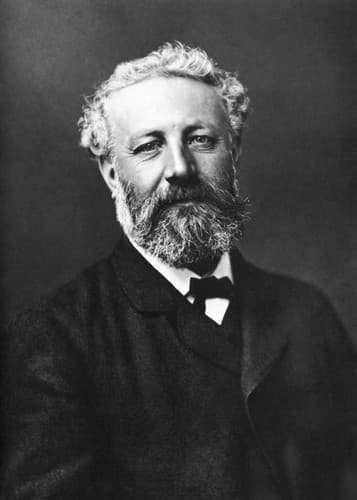
Jules Gabriel Verne was a French novelist, poet, and playwright. His collaboration with the publisher Pierre-Jules Hetzel led to the creation of the Voyages extraordinaires, a series of bestselling adventure novels including Journey to the Center of the Earth (1864), Twenty Thousand Leagues Under the Seas (1870), and Around the World in Eighty Days (1872). His novels, always well documented, are generally set in the second half of the 19th century, taking into account the technological advances of the time.
Similar books
- Journey to the Center of the Earth
Jules Verne
3.9 (154k) average on GoodreadsFantasyAnother Verne classic featuring scientific exploration and a perilous journey.
- The Martian
Andy Weir
4.4 (817k) average on GoodreadsThrillerFocuses on scientific problem-solving and survival in an extreme environment, albeit in space.
- The War of the Worlds
H.G. Wells
3.8 (245k) average on GoodreadsFantasyWhile both Verne and Wells are pioneers of science fiction, their approaches differ significantly. Verne, as seen in Twenty Thousand Leagues, often grounds his fantastical elements in plausible, albeit advanced, human technology and exploration, celebrating human ingenuity. Wells, in The War of the Worlds, frequently explores more dystopian themes, alien invasion, and the fragility of humanity against superior, non-human forces. Verne's scientific speculation tends to be optimistic and descriptive, whereas Wells' is often critical and cautionary, focusing on societal implications and existential threats. Verne's focus is on discovery and adventure, while Wells' is on survival and social commentary.
- Harry Potter and the Sorcerer's Stone
J.K. Rowling
4.5 (7M) average on GoodreadsFantasyRescued from a miserable life under the stairs, an orphaned boy discovers he's a wizard destined for a magical school, where he uncovers a dangerous secret tied to the dark wizard who murdered his parents.
- The Hunger Games
Suzanne Collins
4.3 (6.4M) average on GoodreadsFantasyIn a future where children fight to the death on live television, Katniss Everdeen volunteers for the arena, turning a death sentence into a fight for survival and a spark of rebellion.
- 1984
George Orwell
4.2 (3.1M) average on GoodreadsPoliticsIn a future where surveillance and thought control are absolute, a man's search for truth clashes with the Party, showing that hope can be a form of rebellion.






Enjoyed the summary?
A summary gives you the shape of the book. The book itself has the detail, the examples and the voice.
Find Twenty Thousand Leagues Under the Sea on AmazonAs an Amazon Associate, BookBrief earns from qualifying purchases. How we're funded