
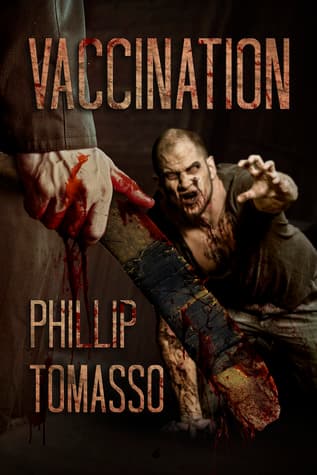
Synopsis
Covers the whole plot, including the ending.
- Difficulty
- Easy
- Pacing
- Fast
- Mood
- Tense, apocalyptic, desperate, action-packed
Vaccination Plot Summary
Covers the whole plot, including the ending.
The First Call
Chase McKinney, a 9-1-1 dispatcher, starts his shift during a city-wide H1N1 vaccination campaign. The first calls are normal, but soon a disturbing pattern emerges: callers report bizarre, violent attacks, people biting and eating others. One call describes a man attacking his family, showing unusual strength and a hunger for flesh. Chase first thinks it is drug-induced psychosis or mass hysteria, but the sheer number and graphic nature of the calls quickly make him realize something far more sinister is happening. The city is falling into chaos, and the 'flu' seems to be turning people into ravenous monsters. His immediate concern shifts from his job to his two children, who are with their mother.
A Father's Desperation
Overwhelmed by the unfolding apocalypse, Chase leaves his post, driven only by the need to find his children, Sarah and David. The streets are a nightmare: overturned cars, fleeing pedestrians, and the horrifying sight of the infected, now clearly 'walkers,' attacking anyone they can find. He sees firsthand how quickly the contagion spreads and how fast civilization unravels. Navigating through the pandemonium, he narrowly avoids several encounters with the infected, using his wits and any makeshift weapons he can find. His journey is a desperate race against time, fueled by paternal love and the growing realization that the world he knew is gone.
Reunion and Revelation
After a dangerous journey, Chase reaches his ex-wife's house, finding his children, Sarah and David, safe but terrified. His ex-wife, however, has been infected and is slowly succumbing. It is here that Chase pieces together the horrifying truth: the H1N1 vaccination, widely distributed by the government, caused the outbreak. The vaccine, meant to protect, has instead turned people into the walking dead. His ex-wife's deteriorating state confirms the vaccine's devastating effect. They must escape quickly before she fully turns and poses a threat to them all. The house is no longer a safe place.
Escape from the Suburbs
With his ex-wife now a full-blown walker, Chase, Sarah, and David are forced to flee their home. The suburban streets are no safer than the city, full of the infected. Chase, armed with new resolve and a few scavenged weapons, leads his children through the chaos. They encounter other survivors, some hostile, some equally desperate. The experience is traumatic for Sarah and David, who watch their father's brutal efficiency in dispatching the walkers. The journey strengthens their bond as a family, even under the worst circumstances. They realize that staying in the city means death, and they must create a new plan for survival.
The Southern Border Plan
Remembering a news report about Mexico's inability to afford the H1N1 vaccine, Chase forms a desperate plan: head south to the Mexican border. He believes that if the vaccine is the cause, then areas where it was not administered might be safe. The U.S. government's recently built wall, meant to keep out illegal immigrants, now ironically becomes their potential salvation, as it might have prevented the vaccine from crossing. This risky gamble is their only hope. They gather what supplies they can, including a vehicle, and prepare for a long, dangerous journey across an infected country. The children, though scared, trust their father's leadership.
Road to Survival
The journey south is dangerous. They navigate through abandoned towns, evade hordes of walkers, and scavenge for food and fuel. They encounter other survivors, some friendly and willing to help, others dangerous. Chase must make difficult decisions to protect his children, often using violence. Sarah and David see the brutal realities of their new world, growing up quickly under extreme pressure. The experiences strengthen Chase's determination to reach the border, despite dwindling hope and the constant threat of infection. Each day is a struggle for survival, pushing them to their physical and emotional limits.
The Scavenger's Trap
While scavenging for supplies in an abandoned supermarket, Chase and his children are ambushed by a group of ruthless survivors. These individuals have embraced the lawlessness of the new world, preying on the weak. A tense standoff ensues, forcing Chase to protect his children from both the living and the dead. He shows his growing skill in combat and survival, outsmarting the scavengers. The encounter is brutal, highlighting the dual threat posed by both the infected and desperate humans. They escape, but with further emotional scars, understanding that humanity itself is as dangerous as the zombies.
Border in Sight
After weeks of travel, the family finally reaches the imposing U.S.-Mexico border wall. The sight of it brings both relief and new challenges. The border area is not deserted; patrols of armed, uninfected individuals guard the wall, wary of any approaching survivors. Chase must find a way to convince them of his intentions and the validity of his theory about the vaccine. The children are exhausted but cling to the hope of safety. The wall, once a symbol of division, now represents their last hope for sanctuary, but crossing it is more complicated than simply avoiding the infected.
The Truth Confirmed
At the border, Chase encounters a small, organized group of uninfected U.S. military personnel and scientists who have also pieced together the truth. They confirm his theory: the H1N1 vaccine was indeed the vector for the zombie virus, a catastrophic biological weapon or a horrific accident. The Mexican government's inability to afford the vaccine inadvertently saved their population. This confirmation brings grim satisfaction, but also the crushing weight of the global catastrophe. They now face the monumental task of not only surviving but potentially finding a cure or a way to rebuild in a world overrun by the dead.
A Glimmer of Hope
With his theory validated and having proven their resilience, Chase and his children are granted entry into a secure, if sparsely populated, zone on the Mexican side of the border. They find a community of survivors – a mix of Mexican citizens and a handful of uninfected Americans – working together to establish a new society. While the world remains dangerous, this new sanctuary offers a chance for stability and recovery. Chase, Sarah, and David begin to adapt to their new reality, understanding that survival is a continuous effort, but that hope, however fragile, still exists in the bonds of family and community. The fight for humanity's future has just begun.
Principal Figures
Chase McKinney
Protagonist
A divorced 9-1-1 dispatcher turned hardened survivor and protective father.
Chase begins as an ordinary, somewhat world-weary 9-1-1 dispatcher, a divorced father struggling with the mundane. The apocalypse forces him to shed his ordinary life and embrace a primal instinct for survival. He is resourceful, quickly adapting to the brutal new world, learning to fight, scavenge, and lead. His primary motivation is the safety of his children, which fuels his courage and determination. He is intelligent, able to deduce the vaccine's role in the outbreak, and fiercely protective, willing to do whatever it takes to ensure his family's survival.
Relationships: Sarah McKinney (daughter); David McKinney (son); Ex-Wife (former spouse, infected victim)
Sarah McKinney
Supporting
Chase's observant and resilient young daughter.
Sarah is Chase's young daughter, initially a typical child, but quickly forced to mature in the face of the apocalypse. She is observant and intelligent, often noticing details that her father might miss. While she experiences fear and trauma, she displays remarkable resilience and an ability to adapt. She looks to her father for guidance and protection, and her presence is a constant reminder of what Chase is fighting for. Her innocence is gradually replaced by a hardened understanding of their new, brutal reality.
Relationships: Chase McKinney (father); David McKinney (brother)
David McKinney
Supporting
Chase's younger son, initially vulnerable but growing tougher.
David is Chase's younger son, more susceptible to fear and confusion than his older sister. He is dependent on his father and sister for comfort and protection, especially in the initial stages of the outbreak. However, as the journey progresses, David also begins to show signs of resilience and courage, slowly understanding the gravity of their situation. His vulnerability highlights the profound impact of the apocalypse on children and underscores Chase's determination to preserve a future for them. He represents the innocent victims of the catastrophe.
Relationships: Chase McKinney (father); Sarah McKinney (sister)
The Infected (Walkers)
Antagonist
Humans transformed into ravenous, mindless cannibals by the H1N1 vaccine.
The Infected are the primary antagonists, the result of the H1N1 vaccination. They are mindless, aggressive, and driven solely by an insatiable hunger for living flesh. They retain some human features but are utterly devoid of humanity, acting as a relentless, ever-present threat. Their sheer numbers and the speed of their contagion make them an overwhelming force that swiftly collapses civilization. They serve as a constant reminder of the catastrophic failure of the vaccine and the fragility of human society.
Ex-Wife (unnamed)
Supporting
Chase's infected former spouse, a tragic victim of the outbreak.
Chase's ex-wife is initially seen as the caretaker for their children. Her infection and subsequent transformation into a walker serve as a grim, personal turning point for Chase, confirming the horrific nature of the outbreak and the vaccine's role. Her fate underscores the widespread and indiscriminate nature of the contagion, affecting even those closest to the protagonist. She represents the countless, anonymous victims of the global catastrophe.
Relationships: Chase McKinney (former spouse); Sarah McKinney (mother); David McKinney (mother)
Border Patrol/Scientists (unnamed)
Supporting
A small, uninfected group at the border who confirm Chase's theory.
This collective represents a glimmer of organized, uninfected society still capable of reason and scientific deduction. They are a small contingent of military personnel and scientists guarding the Mexican border, having independently pieced together the truth about the vaccine. Their role is crucial in validating Chase's theory and providing a potential safe haven. They symbolize the last vestiges of government and scientific understanding in a shattered world, offering a pathway to a new, albeit challenging, future.
Themes & Insights
The Fragility of Civilization
The novel shows how quickly societal structures, law, and order can collapse under a widespread catastrophe. Within hours, cities fall into chaos, emergency services are overwhelmed, and humanity's civility crumbles, replaced by primal fear and violence. The story emphasizes that our modern comforts and systems are far more fragile than we assume.
“The calls kept coming, each one painting a clearer picture of a world tearing itself apart, not slowly, but in a terrifying, instant implosion.”
Paternal Love and Sacrifice
Chase's strong love for his children drives the narrative. His change from an ordinary dispatcher to a hardened survivor is motivated solely by his desire to protect Sarah and David. He makes selfless decisions, faces extreme dangers, and endures immense emotional and physical hardship, all for his children's survival. This theme highlights the powerful, instinctual bond between a parent and child.
“Every step he took, every walker he dispatched, every fear he swallowed, was for them. His children were his only reason to keep moving.”
Government Betrayal and Mistrust
The novel's core idea is that the H1N1 vaccination, meant as a preventative measure, caused the zombie outbreak. This creates a powerful theme of governmental failure and betrayal, whether accidental or intentional. It fosters deep mistrust in authority and raises questions about the true intentions behind public health initiatives, leaving survivors to question who they can truly rely on.
“The same government that promised to protect us, gave us the very thing that turned us into monsters.”
Survival vs. Humanity
As society collapses, characters must make brutal choices to survive, often at the cost of their humanity. Chase witnesses and participates in violent acts, not just against the infected but also against other desperate survivors. The novel explores the thin line between necessary brutality for self-preservation and succumbing to the savagery of the new world. It questions what remains of morality when civilization's rules no longer apply.
“He looked at his blood-stained hands, wondering how many more times he could kill before a part of him died with each blow.”
Borders and Sanctuary
The U.S.-Mexico border, initially a political barrier, becomes a symbol of hope and a potential sanctuary. The irony that the Mexican government's inability to afford the vaccine saved its population, making the border a lifeline, is central to this theme. It explores how geographical and political divisions can take on new meanings in a crisis, with 'safe zones' determined by unforeseen circumstances rather than intentional design.
“The wall, built to keep them out, might now be the only thing keeping us alive.”
Plot Devices & Literary Techniques
The MacGuffin Vaccine
The H1N1 vaccine serves as the catalyst for the apocalypse.
The H1N1 vaccination is the central plot device that triggers the entire zombie outbreak. It is initially presented as a solution to a global pandemic, but it is revealed to be the very cause of the zombie transformation. This misdirection creates a sense of government betrayal and adds a layer of tragic irony to the catastrophe. It drives the plot by explaining the origin of the infected and sets up Chase's theory about the Mexican border as a safe zone, propelling his journey.
The Unreliable Authority
Government and media initially mislead the public about the true nature of the outbreak.
This device is evident in the early stages of the outbreak, where initial reports from authorities and media outlets downplay the severity or mischaracterize the cause of the violence. This creates confusion and delays effective responses, allowing the virus to spread unchecked. Chase's role as a 9-1-1 dispatcher, hearing raw, unfiltered calls, starkly contrasts with official narratives, highlighting the danger of trusting established institutions during a crisis.
The Sanctuary Border
The U.S.-Mexico border becomes the unlikely safe haven.
The U.S.-Mexico border, specifically the Mexican side due to their lack of vaccine distribution, functions as a sanctuary. This device subverts typical expectations, turning a political barrier into a beacon of hope. It provides a tangible goal for Chase's journey and offers a resolution, however temporary, to the immediate threat. The irony of the situation – that being unable to afford a vaccine saved a nation – is a powerful commentary on global inequities and unforeseen consequences.
Quiz
10 questions on the plot and the characters. Each answer comes with a short explanation.
Question 1
What is the primary premise of the book 'Vaccination' by Phillip Tomasso III?
- A global pandemic caused by a natural virus that spreads rapidly.
- The H1N1 vaccination is more than just a preventative measure against swine flu, hinting at a darker purpose.
- A political thriller about the economic implications of vaccine manufacturing.
- A survival story focused on escaping a natural disaster.
Show answer
B. The H1N1 vaccination is more than just a preventative measure against swine flu, hinting at a darker purpose. The book's premise suggests the H1N1 vaccination has a hidden, sinister purpose beyond its stated goal of preventing swine flu.
Question 2
What unusual event occurs related to the H1N1 virus and its vaccination?
- The virus mutates rapidly, making the vaccination ineffective.
- The government struggles to produce enough vaccinations for the population.
- The flu appears unexpectedly, and the government quickly manufactures a vaccination.
- The vaccination is found to have severe side effects, causing a new epidemic.
Show answer
C. The flu appears unexpectedly, and the government quickly manufactures a vaccination. The text highlights the speed at which the flu appeared and the subsequent rapid manufacturing of the vaccination, raising suspicions.
Question 3
What is Chase McKinney's profession?
- Medical researcher in a vaccine lab.
- Government official overseeing public health.
- Dispatcher at 9-1-1.
- Border patrol agent.
Show answer
C. Dispatcher at 9-1-1. Chase McKinney's role is described as a dispatcher who takes emergency calls.
Question 4
What immediate and alarming observation does Chase McKinney make from his 9-1-1 calls?
- A surge in calls related to natural disasters.
- Widespread reports of people exhibiting symptoms of the walking dead.
- An increase in calls about the H1N1 flu symptoms.
- A significant number of calls about a malfunctioning vaccination.
Show answer
B. Widespread reports of people exhibiting symptoms of the walking dead. The text explicitly states that from his emergency calls, it becomes clear the entire city is infected with the walking dead.
Question 5
What is Chase McKinney's primary objective at the beginning of the crisis?
- To investigate the origins of the virus.
- To develop a cure for the walking dead.
- To reach and save his two children.
- To escape the city and find a safe haven.
Show answer
C. To reach and save his two children. Chase McKinney's immediate goal is stated as reaching and saving his children.
Question 6
The novel raises suspicion about the origin of the virus. What are the possibilities suggested?
- It was a naturally occurring virus that mutated rapidly.
- It was a man-made virus, with questions about the diligence of lab workers.
- It was an accidental release from a biological weapons facility.
- It was a foreign bioweapon intentionally released.
Show answer
B. It was a man-made virus, with questions about the diligence of lab workers. The text poses the question of whether the virus itself could have been man-made, implying a lack of diligence in lab work.
Question 7
Which factors are suggested as potentially making the southern border a plausible destination for safety?
- The U.S. walls were effective in preventing the spread, and Mexico had vaccinated its citizens.
- The U.S. walls were ineffective, and Mexico could not afford vaccinations, potentially trapping the infected there.
- The U.S. walls were built to keep out aliens, and Mexico could not afford vaccinations, potentially making the border a safe buffer.
- The U.S. walls were built to keep out illegal aliens, and Mexico's inability to afford vaccinations for its citizens is mentioned in relation to border safety.
Show answer
D. The U.S. walls were built to keep out illegal aliens, and Mexico's inability to afford vaccinations for its citizens is mentioned in relation to border safety. The text mentions the U.S. walls for keeping out illegal aliens and Mexico's inability to afford vaccinations, suggesting these factors might influence the safety of the southern border region.
Question 8
The description of the 'walking dead' in the context of the book implies a transformation. What is the most likely interpretation?
- People are becoming physically reanimated after death.
- The infected are exhibiting zombie-like symptoms, aggressive and mindless.
- People are suffering from a severe flu that causes delirium and hallucinations.
- The term is a metaphor for a society collapsing into chaos and lawlessness.
Show answer
B. The infected are exhibiting zombie-like symptoms, aggressive and mindless. The common trope of 'walking dead' in thrillers and horror typically refers to zombies or individuals acting like zombies, characterized by aggression and lack of reason.
Question 9
Considering the thriller genre and the plot elements, what is a likely underlying theme the author might be exploring?
- The importance of international cooperation in combating global health crises.
- The potential for man-made threats and government overreach during times of crisis.
- The resilience of the human spirit in the face of natural disasters.
- The ethical dilemmas of scientific advancement in medicine.
Show answer
B. The potential for man-made threats and government overreach during times of crisis. The suspicion around the vaccine's origin, the rapid spread of a zombie-like condition, and the mention of government actions (walls, manufacturing) point towards themes of man-made threats and potential government overreach.
Question 10
The mention of the U.S. building walls to keep out illegal aliens and Mexico's inability to afford vaccinations creates a complex scenario. What does this juxtaposition suggest about the narrative's focus?
- The narrative will focus on the political implications of border security and international aid.
- The story will likely explore how societal divisions and economic disparities can exacerbate a crisis.
- The author is critiquing U.S. immigration policies and Mexican economic instability.
- The narrative is primarily about the logistical challenges of distributing vaccines across borders.
Show answer
B. The story will likely explore how societal divisions and economic disparities can exacerbate a crisis. By linking border walls and vaccination affordability, the author introduces elements of societal division and economic inequality, suggesting these will play a role in how the crisis unfolds and is experienced by different populations.
Vaccination FAQ
What is the plot of Vaccination?
Vaccination is a thriller novel that explores a terrifying scenario where the H1N1 vaccination might be more than just a preventative measure. The story follows Chase McKinney, a 9-1-1 dispatcher, as he navigates a city overrun by the walking dead, desperately trying to reach his children.
Is Vaccination a zombie book?
Yes, Vaccination features a zombie apocalypse. The H1N1 virus, which may have been man-made, transforms the city's population into the walking dead, creating a survival scenario.
Who is the main character in Vaccination?
The main character is Chase McKinney, a 9-1-1 dispatcher. His primary motivation is to survive the outbreak and rescue his two children from the infected city.
What is the premise of the H1N1 vaccination in the book?
In Vaccination, the H1N1 vaccination is presented with suspicion. The rapid development and distribution raise questions about its true purpose and whether the virus itself could have been engineered.
How does the US-Mexico border play a role in Vaccination?
The book suggests the southern border might offer a last refuge. The presence of border walls and the inability of the Mexican government to vaccinate their citizens could make it a potential escape route, or conversely, a point of further crisis.
What makes the H1N1 virus suspicious in the novel?
The suspicious nature of the H1N1 virus stems from its sudden appearance and the incredibly fast government-led manufacturing of a vaccination. This speed leads to speculation about whether the virus was naturally occurring or man-made.
What are the stakes for Chase McKinney?
Chase McKinney's stakes are incredibly high. He must overcome the chaos of a zombie outbreak, navigate a dangerous city, and race against time to find and protect his children amidst the unfolding disaster.
What kind of threats do characters face in Vaccination?
Characters face dual threats: the infected walking dead and the potential hidden agenda behind the H1N1 vaccination itself. Societal collapse and the breakdown of order also present significant dangers.
Is Vaccination a fast-paced read?
Given its thriller genre and the high-stakes plot involving a zombie apocalypse and a mysterious vaccination, Vaccination is likely a fast-paced and suspenseful read.
What themes are explored in Vaccination?
The novel explores themes of survival, parental love, government conspiracy, and the potential consequences of scientific overreach. It also touches on societal breakdown and the search for safety in a chaotic world.
About the author

Phillip Tomasso III is an author known primarily for his fiction works. In addition to his fictional narratives, he has written "Vaccination," which explores themes related to public health and societal issues. His writing often reflects a blend of imaginative storytelling and contemporary concerns.
Similar books
- The Andromeda Strain
Michael Crichton
3.9 (223k) average on GoodreadsThrillerWhile both "Vaccination" and "The Andromeda Strain" deal with deadly pathogens and scientific races against time, Tomasso's work places a greater emphasis on human conspiracy and corporate malfeasance as the source of the threat. Crichton's novel focuses more on the inherent unpredictability of nature and the scientific process itself, with a more clinical, procedural tone. "Vaccination" is arguably more character-driven and emotionally charged, whereas "The Andromeda Strain" prioritizes scientific accuracy and the mechanics of a biological crisis.
- Angels & Demons
Dan Brown
3.9 (2.7M) average on GoodreadsThrillerA Harvard symbologist races through Rome's ancient sites, deciphering cryptic clues to unmask the Illuminati and stop a vengeful plot to destroy the Vatican with a stolen antimatter weapon.
- Gone Girl
Gillian Flynn
4.1 (2.3M) average on GoodreadsThrillerA wife's sudden disappearance on her fifth anniversary reveals a web of lies and psychological warfare, exposing the secrets within a seemingly perfect marriage.
- The Girl on the Train
Paula Hawkins
3.9 (2.1M) average on GoodreadsThrillerA woman’s fascination with a seemingly perfect couple she watches from her daily train commute leads her into a dark investigation when she witnesses something that shatters their idyllic image.
- The Da Vinci Code
Dan Brown
3.9 (1.9M) average on GoodreadsThrillerA symbologist and a cryptologist race through European landmarks, deciphering ancient codes and uncovering a conspiracy that could rewrite the foundations of Christianity.
- The Guest List
Lucy Foley
3.8 (1.3M) average on GoodreadsThrillerOn a remote Irish island, a glamorous wedding descends into a deadly whodunnit when a guest is found murdered, trapping everyone with their secrets as a storm rages.






Enjoyed the summary?
A summary gives you the shape of the book. The book itself has the detail, the examples and the voice.
Find Vaccination on AmazonAs an Amazon Associate, BookBrief earns from qualifying purchases. How we're funded