

Synopsis
Covers the whole plot, including the ending.
- Difficulty
- Hard
- Pacing
- Variable
- Mood
- Dark, Cynical, Philosophical, Suspenseful, Thought-provoking
- Read it if
- You enjoy complex, character-driven narratives that deconstruct the superhero genre, exploring moral ambiguities, political commentary, and psychological depth.
- Skip it if
- You prefer straightforward superhero tales with clear-cut heroes and villains, or shy away from dark, cynical, and violent themes.
Watchmen Plot Summary
Covers the whole plot, including the ending.
The Comedian's Fall and Rorschach's Investigation
In October 1985, Edward Blake, the government-sanctioned vigilante The Comedian, is murdered, thrown from his high-rise apartment. The masked vigilante Rorschach, one of the few active costumed adventurers after the Keene Act, investigates the crime scene. He discovers that Blake was The Comedian and believes the murder is part of a larger plot targeting former masked heroes. Rorschach visits his former teammates: Daniel Dreiberg (Nite Owl II), a retired, overweight gadgeteer, and Adrian Veidt (Ozymandias), a former hero turned wealthy businessman. Both dismiss Rorschach's paranoia, believing Blake's death is an isolated incident. Rorschach then tries to warn Dr. Manhattan and Laurie Juspeczyk (Silk Spectre II), but Dr. Manhattan, a god-like being, is indifferent, and Laurie lives with him in a government facility.
Dr. Manhattan's Exile and Laurie's Disillusionment
During a live television interview, Dr. Manhattan faces accusations that he caused cancer in his former girlfriend, Janey Slater, and other close associates. The broadcast is interrupted by the apparent disintegration of a former colleague. Overwhelmed by the public backlash and his growing detachment from humanity, Dr. Manhattan teleports himself to Mars. This threatens global stability as the US loses its ultimate defense against the Soviet Union. Laurie Juspeczyk, already feeling isolated in her relationship with Dr. Manhattan, feels increasingly drawn to Daniel Dreiberg. She moves in with him, and they start to revive their old crime-fighting partnership, finding comfort in each other's company and their past.
Rorschach's Capture and Nite Owl's Return
Rorschach continues investigating the Comedian's death, finding details about a missing scientist named Dr. Malcolm Long and a plot involving a wealthy industrialist. He is lured into a trap and framed for the murder of Moloch, a former supervillain who was terminally ill. Rorschach is arrested and unmasked as Walter Kovacs, a disturbed individual with a rigid moral code. His capture shocks the public and restarts the debate over costumed vigilantes. Meanwhile, Daniel Dreiberg, inspired by Laurie and the escalating crisis, puts on his Nite Owl costume again. Together, they begin to investigate the conspiracy Rorschach had warned them about, starting with Moloch's death.
Unmasking Rorschach's Past and the Prison Break
While imprisoned, Rorschach undergoes psychiatric evaluation by Dr. Malcolm Long. He tells Dr. Long about his horrific childhood: a prostitute mother, bullying, and witnessing the brutal murder of a young girl, which solidified his transformation into Rorschach. His confession shows a disturbing but consistent worldview. At the same time, Nite Owl and Silk Spectre, now fully embracing their vigilante identities, find evidence suggesting Rorschach was framed. They decide to break him out of prison, a daring operation amidst growing civil unrest and increasing tensions between the US and the USSR. Their escape is successful, and Rorschach immediately rejoins their investigation, convinced that Veidt is behind everything.
Dr. Manhattan's Revelation and Laurie's True Father
On Mars, Dr. Manhattan thinks about humanity and his own existence. Laurie Juspeczyk teleports herself to Mars to confront him, hoping to convince him to return to Earth. During their intense conversation, Laurie reveals her complex feelings about her mother, Sally Jupiter (the original Silk Spectre), and her strained relationship with her. Dr. Manhattan, using his non-linear perception of time, helps Laurie piece together the truth: The Comedian, Edward Blake, was her biological father, the result of a sexual assault on Sally, but also a consensual relationship later. This revelation humanizes both Blake and Sally in Laurie's eyes. Dr. Manhattan, finding renewed interest in human connection, agrees to return to Earth.
The Antarctic Sanctuary and Veidt's Confession
Following clues from Rorschach's journal and a symbol on a missing scientist's notes, Nite Owl, Rorschach, and Silk Spectre travel to Adrian Veidt's Antarctic sanctuary, the Karnak facility. They confront Veidt, who calmly admits to orchestrating the entire conspiracy: the murder of The Comedian, framing Rorschach, faking Dr. Manhattan's cancer, and the deaths of numerous scientists. He reveals his ultimate plan: to prevent nuclear war between the US and USSR by creating an external, common enemy. He explains that he has genetically engineered a massive, squid-like creature and is about to teleport it into New York City, causing a psychic shockwave that will unite humanity against this perceived alien threat.
The Squids Attack and the World Reacts
Before Nite Owl, Rorschach, and Silk Spectre can stop him, Veidt activates his plan. A colossal, genetically engineered 'alien' creature, complete with a powerful psychic brain, teleports into the middle of New York City. The resulting psychic shockwave kills millions and drives many more insane, while the physical devastation is immense. The world faces chaos and terror. However, as Veidt predicted, the sheer horror and the perceived alien threat immediately stop the escalating nuclear war between the US and the Soviet Union. Global leaders, believing humanity is under attack from an extraterrestrial force, declare an immediate ceasefire and begin to unite against this new, common enemy.
The Moral Dilemma and Rorschach's Stand
Dr. Manhattan arrives at Karnak, having returned to Earth, and witnesses the aftermath. Confronted with Veidt's confession and the horrific success of his plan, the remaining heroes face an impossible moral dilemma. Revealing Veidt's truth would shatter the fragile global peace and restart the nuclear conflict, leading to billions of deaths. Nite Owl, Silk Spectre, and Dr. Manhattan reluctantly agree to keep Veidt's secret, believing the greater good outweighs the truth and the millions already sacrificed. Rorschach, however, with his absolute moral code, cannot compromise. He declares he will expose Veidt's actions to the world, saying, 'Never compromise. Not even in the face of Armageddon.'
Rorschach's Demise and Dr. Manhattan's Departure
As Rorschach prepares to leave Karnak to deliver his journal—detailing Veidt's conspiracy—to the press, Dr. Manhattan confronts him. Understanding Rorschach's commitment to truth and the catastrophic consequences of him exposing Veidt, Dr. Manhattan is forced to make a tragic choice. Despite Rorschach's pleas to be allowed to fulfill his moral duty, Dr. Manhattan disintegrates him, killing him instantly to preserve the newfound world peace. With Rorschach's death, Dr. Manhattan expresses his disillusionment with humanity and his intention to leave Earth permanently for another galaxy, perhaps to create new life, showing his final detachment from human affairs.
The Aftermath and Lingering Doubts
Afterward, the world embraces a new era of peace, united by the perceived alien threat. Adrian Veidt remains unpunished, seen as a global savior. Nite Owl and Silk Spectre, adopting new identities, continue to fight crime on a smaller scale, having found love and purpose. However, the future of this manufactured peace is uncertain. The final scene shows the editor of a right-wing newspaper, The New Frontiersman, complaining about a lack of sensational material. His assistant suggests looking through the 'crank file,' which contains Rorschach's journal. The journal, containing the full truth of Veidt's plot, sits on a pile, its potential to unravel the global lie a ticking time bomb, ending the story with ambiguity and impending doom.
Principal Figures
Rorschach (Walter Kovacs)
Protagonist
Uncompromising vigilante, driven by a rigid moral code and a traumatic past.
Walter Kovacs is the masked vigilante Rorschach, a man with an absolute and unyielding sense of justice, seeing the world in stark black and white. Orphaned and abused, his traumatic childhood, particularly witnessing the murder of a young girl and his mother's prostitution, shaped his extreme worldview. He believes in punishment for evil, refusing to compromise or surrender, even in the face of Armageddon. His investigation into The Comedian's murder drives the initial plot. He is the moral compass of the story, albeit a deeply disturbed one, and ultimately sacrifices himself for his principles.
Relationships: The Comedian (colleague, murder victim he investigates); Nite Owl II (former colleague, reluctant ally); Dr. Manhattan (former colleague, ultimately his executioner); Adrian Veidt (former colleague, his ultimate adversary)
Dr. Manhattan (Jon Osterman)
Protagonist/Supporting
God-like being with immense powers, increasingly detached from humanity.
Jon Osterman was a nuclear physicist transformed into a god-like being after a lab accident. He possesses absolute control over matter and energy, can perceive time non-linearly, and is virtually omnipotent. His blue, glowing form is a symbol of American power, but his humanity slowly erodes as his powers grow, leading to increasing detachment and indifference to human affairs. He struggles with understanding human emotions and relationships, particularly with Laurie. His ultimate decision to leave Earth signifies his complete transcendence beyond human concerns.
Relationships: Laurie Juspeczyk (long-term girlfriend, later a catalyst for his return); Janey Slater (former girlfriend, unknowingly afflicted with cancer by his presence); The Comedian (colleague, fellow government asset)
Nite Owl II (Daniel Dreiberg)
Protagonist
Retired, technology-focused vigilante, yearning for his past heroic life.
Daniel Dreiberg, the second Nite Owl, is a brilliant inventor and a physically capable, but emotionally soft, former masked hero. He lives a quiet, unfulfilling life after the Keene Act, yearning for the excitement and purpose of his vigilante days. He is initially hesitant to get involved in Rorschach's investigation but is drawn back into action by Laurie and his own sense of justice. He represents the human desire for heroism and connection, finding renewed purpose in his relationship with Laurie and their shared return to crime-fighting.
Relationships: Rorschach (former colleague, reluctant ally); Laurie Juspeczyk (former colleague, romantic partner); Adrian Veidt (former colleague, later adversary)
Silk Spectre II (Laurie Juspeczyk)
Protagonist
Second-generation superhero, struggling with her identity, relationships, and legacy.
Laurie Juspeczyk is the daughter of the original Silk Spectre, Sally Jupiter, and The Comedian, Edward Blake, a truth she only discovers late in the story. She inherited her mother's role but struggled with her own identity, often feeling overshadowed and manipulated. Her relationship with Dr. Manhattan is strained due to his increasing emotional distance, leading her to seek comfort and connection with Daniel Dreiberg. Laurie represents the human need for love, family, and self-discovery amidst a world of god-like beings and moral complexities.
Relationships: Dr. Manhattan (long-term boyfriend); Nite Owl II (former colleague, romantic partner); Silk Spectre I (Sally Jupiter) (mother); The Comedian (biological father (unknown to her for most of the story))
Ozymandias (Adrian Veidt)
Antagonist
Former superhero, brilliant strategist, and mastermind of a global conspiracy.
Adrian Veidt, once known as Ozymandias, is considered the smartest man in the world. He retired from superheroics to build a vast corporate empire, becoming a public figure who champions peace and global unity. However, beneath his benevolent facade lies a ruthless utilitarian who believes he alone can save humanity from self-destruction. He orchestrates The Comedian's murder and an elaborate 'alien' invasion to unite the world against a common enemy, willing to sacrifice millions for what he perceives as the greater good. He represents the dangerous extreme of rationalism and the belief that the ends justify the means.
Relationships: The Comedian (former colleague, his first victim); Rorschach (former colleague, his primary investigator); Nite Owl II (former colleague, adversary); Dr. Manhattan (former colleague, ally in his ultimate deception)
The Comedian (Edward Blake)
Supporting
Cynical, violent government operative and former vigilante, whose murder sparks the plot.
Edward Blake, The Comedian, is a government-sanctioned vigilante with a dark, nihilistic worldview. He is a brutal, amoral figure who commits acts of violence and sexual assault, yet also serves his country in Vietnam and during the suppression of protests. His murder at the beginning of the story sets Rorschach's investigation in motion. Blake represents the inherent contradictions and moral compromises within the superhero concept, particularly when operating under government authority. He is also Laurie's biological father, adding a layer of tragic complexity to his character.
Relationships: Rorschach (colleague, his murder is investigated); Silk Spectre I (Sally Jupiter) (former colleague, victim, and later consensual partner); Laurie Juspeczyk (biological daughter (unknown to her for most of the story)); Adrian Veidt (colleague, his murderer)
Silk Spectre I (Sally Jupiter)
Supporting
Original Silk Spectre, grappling with her past and legacy.
Sally Jupiter was a member of the Minutemen, the first generation of masked heroes, known as the original Silk Spectre. She is a retired, glamorous, but often bitter woman, who lived a life of celebrity and struggle. She constantly tries to live through her daughter, Laurie, pushing her into the superhero role. Her past reveals a complex relationship with The Comedian, including a sexual assault and later a consensual affair, which resulted in Laurie's birth. She represents the fading glory and often problematic reality behind the idealized image of early superheroics.
Relationships: Laurie Juspeczyk (daughter); The Comedian (colleague, assailant, and father of her child); Captain Metropolis (leader of the Minutemen)
Moloch the Mystic (Edgar Jacobi)
Mentioned/Supporting
Former supervillain, terminally ill, and a pawn in Veidt's scheme.
Edgar Jacobi, known as Moloch the Mystic, was a minor supervillain from the Golden Age of heroes. By 1985, he is an elderly, terminally ill man living a quiet life, haunted by his past. He is contacted by The Comedian and later Adrian Veidt, becoming an unwitting pawn in Veidt's master plan. His murder, staged to frame Rorschach, further complicates the investigation and highlights the ruthlessness of Veidt's machinations.
Relationships: The Comedian (former adversary, later a confidante); Rorschach (former adversary, framed for his murder)
Dr. Malcolm Long
Supporting
Rorschach's prison psychiatrist, who gains insight into his disturbed mind.
Dr. Malcolm Long is the psychiatrist assigned to evaluate Walter Kovacs (Rorschach) while he is imprisoned. Initially viewing Rorschach as a clear-cut psychopath, Long gradually becomes fascinated and disturbed by Rorschach's unwavering moral code and the detailed, horrific accounts of his past. Through their sessions, Long gains a deeper, albeit unsettling, understanding of Rorschach's motivations and the psychological toll of being a vigilante. He represents the attempt to rationalize and understand the extreme psychology of the masked heroes.
Relationships: Rorschach (patient/psychiatrist)
Themes & Insights
Deconstruction of the Superhero Myth
Watchmen looks at the traditional superhero. It shows characters as flawed, psychologically damaged individuals rather than idealized figures. The Comedian is a rapist and murderer, Rorschach is a psychopath, and Dr. Manhattan is a detached god. The story explores what real-world superheroes mean for society, questioning their morality, legality, and psychological impact. It shows how the 'heroic' impulse can lead to authoritarianism (Comedian), madness (Rorschach), or alienation (Dr. Manhattan), challenging the idea of what a 'hero' is.
“'Look, I'm not a comic book character. I'm a human being. I have to live in the real world.'”
Moral Ambiguity and Utilitarianism
The main moral conflict of Watchmen is about Adrian Veidt's utilitarian plan: sacrificing millions to save billions. The story makes readers confront the logic of 'the greater good' and whether such an act, no matter how noble its intent, can ever be justified. The heroes' decision to keep Veidt's secret shows the moral compromises needed to maintain peace in a complex world. Rorschach's refusal to compromise shows the importance of truth and individual morality, even if it leads to catastrophe.
“'I did it thirty-five minutes ago.'”
Power and Corruption
This theme explores how power, whether governmental, physical, or metaphysical, corrupts or isolates. The Comedian's government sanction enables his brutality. Dr. Manhattan's omnipotence leads to his detachment from humanity. Adrian Veidt's intellect and wealth allow him to manipulate global events. The story suggests that absolute power leads to either moral decay or a loss of human connection, showing the dangers of unchecked authority and capability.
“'Nothing ends, Adrian. Nothing ever ends.'”
Nostalgia and the Past
The story is full of nostalgia, often referencing the Golden Age of superheroes (the Minutemen) and earlier, simpler days of crime-fighting. Daniel Dreiberg's longing for his Nite Owl days, Sally Jupiter's reminiscing, and the general sense of a 'bygone era' are in the story. This nostalgia is often bittersweet, even dangerous, as it can blind characters to present realities or trap them in their past glories. The difference between the idealized past and the grim present shows that progress often has a cost, and that one cannot truly go home again.
“'It's 1985. We're not in the Minutemen anymore. We're not in the good old days.'”
Existentialism and Free Will
Watchmen explores existential questions, especially through Dr. Manhattan's perspective. His non-linear perception of time and deterministic view question free will, suggesting that all events are predetermined. However, characters like Rorschach, with his absolute moral choice, and Veidt, with his audacious plan, assert their agency against difficult odds. The story explores whether humanity controls its destiny or if it is just an observer in a pre-written cosmic drama, leaving the reader to think about choice and fate.
“'We're all puppets, Laurie. I'm just a puppet who can see the strings.'”
Plot Devices & Literary Techniques
Non-Linear Narrative and Flashbacks
Interweaving past and present to build character depth and reveal backstory.
The story employs a complex non-linear narrative, frequently jumping between the present (1985) and various points in the past, often through character flashbacks, Rorschach's journal entries, or Dr. Manhattan's unique perception of time. This device is crucial for revealing the intricate backstories of the characters, the history of the Minutemen, and the political climate that led to the present crisis. It allows for a gradual unveiling of plot details and character motivations, adding layers of depth and foreshadowing.
Rorschach's Journal
A first-person account serving as a crucial plot driver and moral anchor.
Rorschach's journal serves as a primary narrative device, offering a first-person, unfiltered perspective on his investigation and his increasingly grim worldview. It functions as an internal monologue, revealing his psychological state and moral absolutism. Crucially, the journal becomes a physical plot device, containing the evidence of Veidt's conspiracy. Its potential publication at the end of the story creates lingering tension and represents the fragility of the 'peace' achieved through deception.
Interspersed Backmatter
Supplemental documents that expand the world and provide deeper context.
Between chapters, the comic includes excerpts from fictional documents such as historical texts, psychological profiles, interviews, and articles. These 'backmatter' sections provide extensive world-building, offering insights into the political history, character origins, and philosophical underpinnings of the Watchmen universe. They deepen the reader's understanding of the context, motivations, and consequences of the characters' actions, often revealing details not explicitly shown in the main narrative panels.
The Doomsday Clock
A recurring visual motif symbolizing escalating global tension.
The Doomsday Clock, a symbolic clock face counting down to midnight (representing global catastrophe), is a recurring visual motif throughout the narrative. Its hands are consistently shown at various points, particularly at 'five minutes to midnight,' reflecting the escalating Cold War tensions between the US and the USSR. It serves as a constant reminder of the impending nuclear annihilation that drives Adrian Veidt's drastic actions and provides a visual representation of the world's precarious state.
Symmetry and Parallelism
Structural and thematic mirroring to emphasize contrasts and connections.
Moore employs extensive symmetry and parallelism in both the narrative structure and thematic elements. This includes visual mirroring in panel layouts (e.g., the opening shot of The Comedian's pin mirroring the bloodstain), thematic parallels between characters (e.g., the two Silk Spectres, the two Nite Owls), and the cyclical nature of violence and history. This device enhances the sense of predestination and often highlights the contrasts between idealism and cynicism, or between different generations of heroes.
Watchmen Quotes
“Who watches the watchmen?”
“I did the right thing, didn't I? It all worked out in the end.”
“We're all puppets, Laurie. I'm just a puppet who can see the strings.”
“The accumulated filth of all their sex and murder will foam up about their waists and all the whores and politicians will look up and shout 'Save us!'... and I'll look down and whisper 'No.'”
“I'm not a comic book villain. Do you seriously think I'd explain my master-stroke if there remained the slightest chance of you affecting its outcome?”
“Nothing ends, Adrian. Nothing ever ends.”
“We do not do this thing because it is permitted. We do it because we have to. We do it because we are compelled.”
“The world is so full of people, so crowded with these miracles that they become commonplace and we forget... I forget.”
“I'm not locked in here with you. You're locked in here with me!”
“It's too late. Always has been, always will be, too late.”
“We're all in the gutter, but some of us are looking at the stars.”
“I leave it entirely in your hands.”
“A live body and a dead body contain the same number of particles. Structurally, there's no discernible difference.”
“This city is afraid of me... I have seen its true face.”
Quiz
10 questions on the plot and the characters. Each answer comes with a short explanation.
Question 1
What is the name of the superhero who is found dead at the beginning of the novel, setting off the main plot?
- The Comedian
- Rorschach
- Dr. Manhattan
- Nite Owl
Show answer
A. The Comedian The Comedian (Edward Blake) is discovered murdered after being thrown from his apartment window, which prompts Rorschach to investigate and suspect a conspiracy against former Crimebusters.
Question 2
Which character possesses god-like powers due to a scientific accident and can perceive past, present, and future simultaneously?
- Ozymandias
- Silk Spectre
- Dr. Manhattan
- The Comedian
Show answer
C. Dr. Manhattan Dr. Manhattan (Jon Osterman) gained his abilities after being trapped in an intrinsic field subtractor, making him nearly omnipotent and altering his perception of time.
Question 3
What is the real name of the vigilante known as Rorschach?
- Walter Kovacs
- Dan Dreiberg
- Adrian Veidt
- Laurie Juspeczyk
Show answer
A. Walter Kovacs Rorschach's civilian identity is Walter Kovacs, a deeply troubled and uncompromising individual who adopts the mask with shifting inkblot patterns.
Question 4
Why does Ozymandias orchestrate a massive attack on New York City using a fabricated alien monster?
- To gain political power for himself
- To frame Dr. Manhattan for the destruction
- To unite humanity against a common external threat and prevent nuclear war
- To eliminate all remaining superheroes
Show answer
C. To unite humanity against a common external threat and prevent nuclear war Adrian Veidt (Ozymandias) believes that by creating a fake extraterrestrial invasion that kills millions, he can forge global unity and avert the impending Cold War conflict, justifying it as a necessary sacrifice.
Question 5
What significant event causes Dr. Manhattan to lose his connection to humanity and retreat to Mars?
- The death of The Comedian
- A public accusation that he gave cancer to his former lovers
- The failure of his relationship with Silk Spectre II
- Discovering Ozymandias's plan
Show answer
B. A public accusation that he gave cancer to his former lovers After a televised interview where it is revealed that people close to him have developed cancer, Dr. Manhattan becomes disillusioned with humanity and exiles himself to Mars, contemplating its meaning.
Question 6
Which character is revealed to be the illegitimate daughter of The Comedian?
- Silk Spectre I
- Silk Spectre II
- Rorschach
- Dr. Manhattan
Show answer
B. Silk Spectre II Laurie Juspeczyk (Silk Spectre II) learns from her mother, Sally Jupiter (Silk Spectre I), that The Comedian raped Sally, resulting in Laurie's birth, a revelation that impacts her identity and relationships.
Question 7
What is the primary reason the Keene Act was passed in the world of 'Watchmen,' leading to the retirement of most superheroes?
- To regulate superhero costumes and identities
- In response to public backlash after a police strike and increased vigilantism
- To recruit superheroes for government service only
- To prevent superheroes from using advanced technology
Show answer
B. In response to public backlash after a police strike and increased vigilantism The Keene Act outlawed vigilante activities following events like the 1977 police strike, which saw masked heroes clashing with authorities and causing public unrest, forcing many into retirement or government work.
Question 8
How does Rorschach ultimately meet his end?
- He is killed by Ozymandias in hand-to-hand combat
- Dr. Manhattan disintegrates him to prevent him from revealing Ozymandias's plan
- He sacrifices himself to stop the alien monster
- He is arrested and imprisoned for life
Show answer
B. Dr. Manhattan disintegrates him to prevent him from revealing Ozymandias's plan After discovering Ozymandias's plot, Rorschach insists on exposing the truth, but Dr. Manhattan kills him to maintain the fragile peace achieved by the fake alien attack, highlighting themes of morality and sacrifice.
Question 9
What symbolic item does Ozymandias keep in his Antarctic fortress that reflects his admiration for Alexander the Great?
- A replica of the Gordian Knot
- A bust of Alexander the Great
- A live African lynx named Bubastis
- A copy of Plutarch's 'Lives' with Alexander's story highlighted
Show answer
D. A copy of Plutarch's 'Lives' with Alexander's story highlighted Adrian Veidt keeps a copy of Plutarch's 'Lives' open to the life of Alexander the Great, symbolizing his aspiration to achieve greatness and unity through decisive, often ruthless, actions, much like Alexander.
Question 10
Which theme is most directly explored through the recurring image of the smiley face button with a blood stain?
- The inevitability of death
- The corruption of innocence and idealism by violence
- The power of media and propaganda
- The duality of human nature
Show answer
B. The corruption of innocence and idealism by violence The blood-stained smiley face button, found at The Comedian's death scene, symbolizes how violence and cynicism taint optimistic symbols, reflecting the book's critique of superhero idealism and the dark realities of the world.
Watchmen FAQ
What is 'Watchmen' about?
'Watchmen' is a graphic novel set in an alternate 1985 where superheroes exist but have been outlawed. The story follows former members of the Crimebusters, a disbanded superhero group, as they investigate the murder of one of their own, the Comedian, uncovering a vast conspiracy that threatens global peace. Through this mystery, it explores themes of power, morality, and the human cost of heroism.
Why should I read 'Watchmen'?
You should read 'Watchmen' for its groundbreaking deconstruction of the superhero genre, complex characters, and deep philosophical themes. It blends a gripping murder mystery with political commentary and psychological depth, using innovative storytelling techniques like the 'Tales of the Black Freighter' comic-within-a-comic to enrich the narrative.
What is the background/setting of 'Watchmen'?
The setting is an alternate 1985 where superheroes emerged in the 1940s, altering history such as the U.S. winning the Vietnam War and Nixon serving multiple terms as president. Society is on the brink of nuclear war with the Soviet Union, and masked vigilantes have been outlawed by the Keene Act, forcing many into retirement or government work.
What are the most memorable quotes?
Memorable quotes include Rorschach's 'Never compromise. Not even in the face of Armageddon,' Dr. Manhattan's 'We're all puppets, Laurie. I'm just a puppet who can see the strings,' and Ozymandias's 'I did it thirty-five minutes ago,' revealing his preemptive strike. These lines capture key themes of morality, determinism, and utilitarianism.
What writing style does the author use?
Alan Moore uses a dense, layered writing style with nonlinear storytelling, incorporating excerpts from fictional documents like news articles and autobiographies. The narrative is interspersed with the 'Tales of the Black Freighter' comic, which parallels the main plot, and features intricate symbolism and recurring motifs like clocks and smiley faces.
What minor details add significant meaning?
Minor details like the recurring smiley face with a bloodstain, symbolizing the Comedian's death and the corruption of innocence, add deep meaning. The gradual change in the news vendor's dialogue reflects societal decay, and the 'Tales of the Black Freighter' comic mirrors characters' descent into madness and moral compromise.
What are some subtle foreshadowing moments?
Subtle foreshadowing includes early mentions of Ozymandias's 'smartest man in the world' status hinting at his grand scheme, and Dr. Manhattan's increasing detachment foreshadowing his role in the climax. The Comedian's cynical view of humanity in flashbacks hints at the scale of the conspiracy he uncovers before his death.
What unexpected character connections exist?
Unexpected connections include the Comedian being Laurie Juspeczyk's (Silk Spectre II) father, revealed through a DNA test, and Moloch's past involvement with Ozymandias's plan. Rorschach's real identity as Walter Kovacs and his traumatic childhood link to his black-and-white morality, shaping his relentless pursuit of justice.
What are unspoken character motivations?
Unspoken motivations include Ozymandias's desire for legacy and control, driving him to orchestrate a fake alien invasion to unite humanity. Rorschach's rigid morality stems from childhood abuse, making him unable to compromise. Dr. Manhattan's emotional distance masks a longing for human connection, which Laurie helps rekindle.
What psychological complexities do characters exhibit?
Characters exhibit complexities like Dr. Manhattan's existential crisis from perceiving time non-linearly, leading to detachment. Rorschach's psychosis blends trauma with a moral absolutism that justifies violence. Silk Spectre II grapples with identity and parental legacy, while Nite Owl II struggles with impotence and nostalgia for heroism.
What are the major emotional turning points?
Major emotional turning points include Laurie discovering the Comedian is her father, shattering her view of her mother and herself. Dr. Manhattan's re-engagement with humanity after saving Laurie from Mars. The climax where characters confront Ozymandias's massacre, forcing them to choose between exposing the truth or preserving peace.
How do relationship dynamics evolve?
Relationship dynamics evolve significantly: Laurie and Dan Dreiberg (Nite Owl II) transition from colleagues to lovers, rekindling their heroism. Dr. Manhattan and Laurie's relationship deteriorates due to his detachment but later rebuilds on Mars. Rorschach's isolation contrasts with his brief partnership with Nite Owl, highlighting his inability to connect.
Which parts remain ambiguous or open-ended?
Ambiguous parts include whether Ozymandias's plan will ultimately bring lasting peace or collapse under its own deception. The fate of Rorschach's journal, possibly exposing the truth, is left unresolved. Dr. Manhattan's departure to create life elsewhere leaves his future impact on humanity uncertain, inviting debate on hope vs. futility.
What are controversial scenes or decisions?
Controversial scenes include Ozymandias killing millions in New York to fake an alien attack, posing a utilitarian moral dilemma. Rorschach's brutal vigilantism and refusal to compromise, leading to his death. The Comedian's attempted rape of Silk Spectre I and his role in government atrocities spark debates on heroism and corruption.
'Watchmen' ending explained: how it ends & what it means
The ending reveals Ozymandias faked an alien invasion in New York, killing millions to unite the world against a common threat and avert nuclear war. The surviving heroes agree to keep the secret to preserve peace, except Rorschach, who is killed by Dr. Manhattan. It explores themes of sacrifice, morality, and whether ends justify means, leaving the future of this fragile peace uncertain.
About the author

Alan Moore is an English author known primarily for his work in comic books including Watchmen, V for Vendetta, The Ballad of Halo Jones, Swamp Thing, Batman: The Killing Joke, and From Hell. He is widely recognised among his peers and critics as one of the best comic book writers in the English language. Moore has occasionally used such pseudonyms as Curt Vile, Jill de Ray, Brilburn Logue, and Translucia Baboon; also, reprints of some of his work have been credited to The Original Writer when Moore requested that his name be removed.
Similar books
- A Game of Thrones
George R.R. Martin
4.5 (2M) average on GoodreadsFantasyFeatures a large ensemble cast, intricate political intrigue, and morally grey characters.
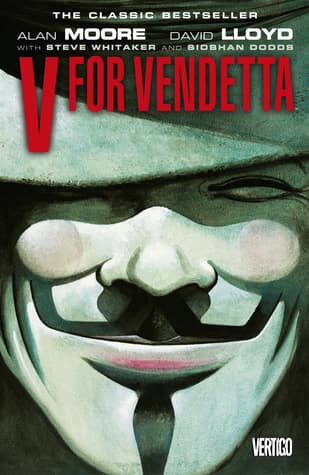
- V for Vendetta
Alan Moore
4.3 (264k) average on GoodreadsPoliticsShares a creator and themes of societal critique, authoritarianism, and radical justice.
- Harry Potter and the Sorcerer's Stone
J.K. Rowling
4.5 (7M) average on GoodreadsFantasyRescued from a miserable life under the stairs, an orphaned boy discovers he's a wizard destined for a magical school, where he uncovers a dangerous secret tied to the dark wizard who murdered his parents.
- The Hunger Games
Suzanne Collins
4.3 (6.4M) average on GoodreadsFantasyIn a future where children fight to the death on live television, Katniss Everdeen volunteers for the arena, turning a death sentence into a fight for survival and a spark of rebellion.
- 1984
George Orwell
4.2 (3.1M) average on GoodreadsPoliticsIn a future where surveillance and thought control are absolute, a man's search for truth clashes with the Party, showing that hope can be a form of rebellion.
- Divergent
Veronica Roth
4.2 (2.9M) average on GoodreadsFantasyIn a society divided by virtues, a sixteen-year-old's difference from the norm starts a rebellion that threatens her world.





Enjoyed the summary?
A summary gives you the shape of the book. The book itself has the detail, the examples and the voice.
Find Watchmen on AmazonAs an Amazon Associate, BookBrief earns from qualifying purchases. How we're funded