

Synopsis
Covers the whole plot, including the ending.
- Difficulty
- Medium
- Pacing
- Moderate
- Mood
- Dark, Gritty, Psychological, Tragic, Suspenseful
- Read it if
- You want a deep, character-driven mystery exploring the origins of a tragic crime, with a focus on social realism and psychological insight.
- Skip it if
- You prefer fast-paced, plot-centric thrillers with minimal character introspection or are sensitive to stories involving child endangerment and gang violence.
What Came Before He Shot Her Plot Summary
Covers the whole plot, including the ending.
The Campbell Children in North Kensington
After their mother's death and father's absence, the mixed-race Campbell children—fifteen-year-old Ness, thirteen-year-old Joel, and seven-year-old Toby—move in with their Auntie Dee in a cramped North Kensington flat. Their grandmother, who first took them in, could not handle the challenges, especially Toby's increasingly erratic and withdrawn behavior. Auntie Dee, a devout Christian, struggles financially and emotionally to care for the children. Ness quickly joins a bad crowd, and Joel tries to protect Toby, who shows signs of severe developmental issues and possibly autism. The family is stressed, and the children feel alone and unloved.
Joel's Burden and Toby's Peculiarities
Joel becomes Toby's main caregiver. Toby's behavior grows more challenging; he has violent outbursts, struggles to communicate, and often withdraws, focusing on specific objects or routines. Joel tries to understand and calm Toby, often sacrificing his own childhood. Ness, meanwhile, is drawn to gang life, seeking acceptance and excitement. This further separates her from her siblings and Auntie Dee. Auntie Dee's attempts to discipline Ness fail, and she often finds solace in her church, leaving Joel to handle Toby's needs and the growing family problems mostly by himself.
Encounter with the Gang: The 'Black Cats'
Joel's attempts to protect Toby make him a target for a local gang called the 'Black Cats,' led by Blade. Blade and his group harass Joel, demanding money and showing their control over the neighborhood. They see Joel as an easy victim, an outsider. The threats increase, creating fear for Joel and his younger brother. Joel feels immense pressure to protect Toby and himself. He lacks the resources or support to fight off the gang, leading him to consider desperate actions to keep them safe from the constant bullying.
Ness's Descent into Gang Life
While Joel deals with Blade, Ness becomes more involved with a rival gang, led by the charismatic Jihadi. Jihadi, older and more cunning than Blade, offers Ness a sense of belonging and excitement she craves. She starts participating in their activities, including drug dealing and petty crime, further distancing herself from her family. Her loyalty shifts entirely to Jihadi and the gang, leading to arguments with Auntie Dee and a complete disregard for her responsibilities. This leaves Joel feeling even more alone and burdened by the family's problems.
Joel's Desperate Pact
The 'Black Cats' increase their harassment of Joel, threatening Toby if Joel does not meet their demands. Cornered and scared, Joel is forced to steal a package of drugs from a known dealer. This dangerous act puts him in grave danger. He sees no other way to protect Toby from Blade's growing threats. This desperate act marks a turning point for Joel, forcing him to compromise his morals and enter a world of crime he had tried to avoid, all to keep his younger brother safe.
The Stolen Drugs and Escalating Danger
Joel steals the drugs, but his desperate act only puts him in more danger. The original owner of the drugs, a ruthless dealer, is now looking for him, and Blade's gang continues to demand more. Joel is caught between two dangerous groups, with no clear way out. The stolen drugs become a ticking time bomb, threatening to engulf his family in violence. He hides the drugs, hoping to find a way to get rid of them or satisfy the gangs without further harm, but the situation quickly spirals out of his control.
Ness's Betrayal and the Gang War
Ness, loyal to Jihadi, makes choices that further upset the fragile peace in the neighborhood. She becomes a tool in Jihadi's plans, unknowingly adding to the rising tensions between his gang and Blade's. Her actions, driven by a desire for acceptance and a misguided sense of power, worsen the gang war. Joel, seeing Ness's reckless behavior and the growing violence, realizes his family is now caught in the middle of a full-blown gang conflict, making his efforts to protect Toby even harder and more dangerous.
The Plan to Flee
Overwhelmed by constant threats, growing gang violence, and the realization that Auntie Dee cannot protect them, Joel decides he must get Toby out of London. He remembers a distant family friend, Doreen, who lives in the countryside. Joel carefully plans their escape, saving what little money he can and preparing Toby for the journey. He believes that only by leaving the city and the dangerous gangs can he ensure Toby's safety and give them a chance at a normal life, far from the chaos that has consumed them.
The Train Journey and the Wallet
Joel and Toby board a train, heading toward what Joel hopes is a safer future. During the journey, Joel, tired and distracted, makes a mistake. He accidentally takes a wallet from a sleeping passenger, thinking it is his own. The wallet belongs to Helen Clyde, who is traveling with her husband, Inspector Thomas Lynley. This seemingly small mistake has huge consequences, linking the vulnerable Campbell boys directly to people they would otherwise never have met, setting in motion the tragic events to come.
Arrival at the Wrong Destination
Due to a misunderstanding or forgotten address, Joel and Toby arrive at a house that is not Doreen's. Believing they have found safety, they enter the unfamiliar home. This house is, in fact, the home of Inspector Thomas Lynley and Helen Clyde. Confused and disoriented, Joel, still carrying the stolen wallet and increasingly desperate, confronts the unexpected occupants. The situation quickly escalates due to fear, misunderstanding, and Toby's unpredictable behavior, ending in the tragic act that forms the central mystery of the series: the shooting of Helen Clyde.
Principal Figures
Joel Campbell
Protagonist
A responsible and protective older brother burdened by the care of his younger siblings.
Joel is a thirteen-year-old boy thrust into an adult role, becoming the primary caregiver for his younger brother, Toby. He is quiet, observant, and deeply compassionate, constantly trying to understand and soothe Toby's complex needs. Joel feels the weight of his family's struggles intensely, particularly the threats from local gangs and the perceived inadequacy of his Auntie Dee. His driving force is an unwavering desire to protect Toby, even if it means putting himself in danger or making morally compromising choices.
Relationships: Toby Campbell (Protective older brother, caregiver); Ness Campbell (Concerned older brother, feels distant from her choices); Auntie Dee (Resentful and frustrated, feels unsupported); Blade (Victim of intimidation and coercion)
Toby Campbell
Supporting
Joel's younger brother, a child with severe developmental difficulties.
Toby is a seven-year-old boy who exhibits clear signs of developmental delay, possibly autism, and has unpredictable violent outbursts. He struggles with communication, often retreating into a world of his own, fixating on specific objects or routines. Toby is extremely vulnerable and reliant on Joel for care and understanding. His condition adds immense pressure to Joel's life and is a constant source of worry for the entire family, as his behavior is often misunderstood and frightening to others.
Relationships: Joel Campbell (Dependent younger brother, cared for by Joel); Ness Campbell (Distant younger brother, often ignored or misunderstood); Auntie Dee (Challenging child, Auntie Dee struggles to cope with him)
Ness Campbell
Supporting
The rebellious older sister, seeking belonging and excitement in gang life.
Ness is a fifteen-year-old girl, beautiful and headstrong, who feels neglected and unloved by her family. She craves attention, acceptance, and a sense of identity, which she finds in the local gang culture. Ness is easily influenced by charismatic figures like Jihadi and makes reckless choices that further destabilize her family. Her rebellion is a manifestation of her pain and a desperate attempt to assert control over her own life, even if it means alienating her siblings and Auntie Dee. She is drawn to the dangerous allure of the streets.
Relationships: Joel Campbell (Distant sister, often dismissive of his concerns); Toby Campbell (Indifferent older sister, sees him as a burden); Auntie Dee (Rebellious niece, constant source of conflict); Jihadi (Enamored follower, manipulated by him)
Auntie Dee
Supporting
The struggling aunt who takes in the Campbell children but is overwhelmed by their needs.
Auntie Dee is a devout Christian woman who, despite her good intentions, is ill-equipped to handle the challenges of raising the three Campbell children. She is financially strapped, emotionally fragile, and often retreats into her faith when faced with difficult situations. Auntie Dee loves the children in her own way but lacks the parenting skills, resources, and emotional fortitude to provide the stability and support they desperately need, especially given Toby's condition and Ness's rebellion. She often prioritizes church activities over actively addressing the children's immediate crises.
Relationships: Joel Campbell (Frustrated guardian, often relies on him for Toby's care); Toby Campbell (Struggling guardian, overwhelmed by his condition); Ness Campbell (Disappointed guardian, unable to control her rebellion)
Blade
Antagonist
The leader of the 'Black Cats' gang, who intimidates Joel.
Blade is a menacing and ruthless young man who leads the 'Black Cats' gang. He is a local street figure who thrives on intimidation and control. Blade targets Joel, seeing him as an easy mark, and uses threats against Toby to coerce Joel into committing crimes. He represents the immediate, tangible danger that Joel faces in North Kensington, a constant source of fear and pressure that drives Joel's desperate actions. Blade is driven by a desire for power and respect within his territory.
Relationships: Joel Campbell (Intimidator and coercer); Ness Campbell (Rival gang member)
Jihadi
Antagonist
The charismatic and manipulative leader of a rival gang, who influences Ness.
Jihadi is an older, more sophisticated, and manipulative gang leader who rivals Blade. He preys on Ness's vulnerability and desire for belonging, drawing her into his criminal enterprise. Jihadi uses his charisma to exert control over his followers, including Ness, and is a key figure in the escalating gang war in the neighborhood. He represents a more insidious and far-reaching danger than Blade, as his influence corrupts Ness and further destabilizes the Campbell family.
Relationships: Ness Campbell (Manipulator and leader); Blade (Rival gang leader)
Helen Clyde
Mentioned/Victim
Inspector Thomas Lynley's wife, whose wallet is accidentally taken by Joel.
Helen Clyde is Inspector Thomas Lynley's wife, a character whose presence is felt through the accidental theft of her wallet by Joel. Though she appears only briefly before the tragic event, her identity and her connection to Lynley are crucial to the wider series narrative. She represents the innocent victim caught in the crossfire of the Campbell children's desperate circumstances, her death serving as the devastating climax of Joel's journey. Her role is primarily to be the tragic focus of the subsequent investigation.
Relationships: Thomas Lynley (Wife); Joel Campbell (Unknowing victim of his desperation)
Inspector Thomas Lynley
Mentioned
A Scotland Yard Inspector, husband of Helen Clyde.
Inspector Thomas Lynley is a Scotland Yard Inspector, whose wife, Helen Clyde, becomes the victim of the central tragedy. Although he does not appear in a significant role in *this* particular prequel novel, his presence is implied through his relationship with Helen. He represents the established order and the world of justice that will later seek to understand the circumstances of his wife's murder. His grief and quest for answers are the starting point for the subsequent novel in the series.
Relationships: Helen Clyde (Husband)
Themes & Insights
The Crushing Weight of Poverty and Neglect
The novel shows how poverty and neglect trap the Campbell children in a cycle of desperation. Auntie Dee's financial struggles mean poor housing, food, and opportunities, forcing Joel to take on adult responsibilities. The lack of support for Toby's developmental issues highlights social service failures, leaving Joel and Auntie Dee to cope alone. This theme is clear in Joel's constant worry about money, the cramped living conditions, and his desperate actions (like stealing drugs) to protect his brother, all from a lack of resources and feeling abandoned. The children's vulnerability links directly to their socio-economic situation.
“No one was looking out for them. No one was going to do it. It was up to him. Always had been.”
The Burden of Responsibility and Lost Childhood
Joel's character shows a lost childhood, forced to act as a parent to Toby. His life centers on Toby's care, from feeding and bathing to managing outbursts and protecting him. This burden keeps Joel from a normal adolescence, as he skips school or friendships for Toby. His quiet resolve to shield Toby from harm, even at great personal risk, shows the immense weight he carries, highlighting the unfairness of a child sacrificing his own life for another due to circumstances beyond his control.
“He was thirteen. But he felt a hundred and three.”
The Destructive Allure of Gang Culture
The novel shows how gang culture targets vulnerable youth, offering a false sense of belonging and power. Ness is drawn to Jihadi's gang, seeking acceptance and excitement. This leads her to crime and further separation from her family. Joel, conversely, becomes a victim of gang intimidation, forced to commit crimes by Blade's 'Black Cats.' The gangs are a violent force in the children's lives, shaping their decisions and contributing to the tragic climax. The constant threat of violence and the moral compromises gangs demand show their destructive nature.
“The streets gave you nothing for free. They took everything.”
Misunderstanding and Lack of Communication
A key theme is the breakdown of communication and the misunderstandings that lead to tragedy. Toby's inability to communicate causes frustration and fear in others. Joel struggles to tell Auntie Dee his fears and needs, and she fails to truly listen or understand his deep struggles. The final, fatal confrontation is a tragic result of these misunderstandings: Joel's fear, Toby's unpredictable behavior, and the occupants' inability to grasp the desperate situation, all leading to an irreversible act. Characters' inability to connect and understand each other is a critical element.
“Words were like stones in his mouth. He couldn't get them out.”
The Ripple Effect of Small Choices
The story shows how small choices or accidents can lead to catastrophic results. Joel's accidental theft of Helen Clyde's wallet, a moment of tiredness and distraction, is a key event. This small mistake directly links the Campbell children to the Lynley household, setting the stage for the final, tragic encounter. Every decision by Joel, Ness, and even Auntie Dee, no matter how minor, adds to the escalating chain of events that ends in the murder. This shows how individual actions, especially under pressure, can have far-reaching and unintended impacts.
“A single mistake, a moment of inattention, and the world could turn upside down.”
Plot Devices & Literary Techniques
Foreshadowing
Hints and clues about the tragic outcome are woven throughout the narrative.
The entire novel is a build-up to the known tragedy of Helen Clyde's murder, acting as an extended piece of foreshadowing. Specific instances include Joel's constant fear of being caught, the escalating violence of the gangs, and Toby's unpredictable outbursts, all of which hint at an inevitable, violent confrontation. The description of the stolen drugs as a 'ticking time bomb' and Joel's increasing desperation also serve to create a sense of impending doom, guiding the reader towards the tragic conclusion that is already known from the series' wider context.
Dramatic Irony
The reader knows the tragic outcome, while the characters are unaware.
Dramatic irony is central to the novel's structure. Readers of Elizabeth George's series already know that Helen Clyde is murdered by a twelve-year-old boy. This prior knowledge creates a constant tension as the reader watches Joel's desperate journey, knowing where it will ultimately lead, while Joel and Toby remain oblivious to the specific tragedy awaiting them. This device heightens the emotional impact, as every small decision and interaction is viewed through the lens of the impending, unavoidable catastrophe, making the characters' struggles even more poignant.
Parallel Narrative (Implied)
The story of the Campbell children runs parallel to the unseen lives of Lynley and Helen.
While not explicitly shown within this novel, the narrative of the Campbell children is implicitly presented as a parallel to the comfortable, privileged lives of Helen Clyde and Thomas Lynley. The accidental wallet swap and the final confrontation are the points where these two vastly different worlds tragically intersect. This device highlights the stark social and economic divides within London, showing how the desperation of one world can violently collide with the unsuspecting tranquility of another, leading to a devastating outcome.
Symbolism of the Stolen Wallet
The wallet represents the accidental convergence of two disparate worlds.
The stolen wallet serves as a potent symbol of the accidental and tragic intersection of the Campbell children's desperate world with the privileged world of Helen Clyde and Thomas Lynley. It is a seemingly small object that carries immense weight, literally and metaphorically linking the two families. The wallet represents the unintended consequence of Joel's exhaustion and fear, and it becomes the tangible link that guides him to the wrong house, directly setting the stage for the murder. It symbolizes how one small, desperate act can unravel an entire life.
What Came Before He Shot Her Quotes
“The past, after all, was like a well. Deep, dark, and full of things that could drown you.”
“He knew, with the certainty of a man who had seen too much, that evil was not a grand, theatrical gesture, but a slow, insidious erosion.”
“Grief was a country no one wanted to visit, and once you were there, it was almost impossible to find your way out.”
“Secrets, like wounds, festered if left unattended.”
“The truth, like a cat, would always find its way home, no matter how many doors you tried to close.”
“There was a fine line between loyalty and complicity, and sometimes, in the heat of the moment, that line blurred to invisibility.”
“Fear was a powerful motivator, capable of making people do things they would never have imagined.”
“Every family had its ghosts, some whispered, some screamed.”
“Justice was not always about punishment; sometimes it was about understanding.”
“The silence that followed a gunshot was always the loudest sound.”
“Desperation was a bitter taste, and once you acquired it, it was hard to get rid of.”
“He had learned that the most dangerous lies were the ones you told yourself.”
“The past wasn't dead; it wasn't even past. It was a living, breathing thing, constantly reshaping the present.”
“Hope was a fragile thing, easily crushed, but sometimes, even a tiny spark was enough to light the darkest corner.”
Quiz
10 questions on the plot and the characters. Each answer comes with a short explanation.
Question 1
Which character is the twelve-year-old boy who is implied to have shot Inspector Thomas Lynley's wife?
- Ness Campbell
- Joel Campbell
- Toby Campbell
- Kenny Campbell
Show answer
C. Toby Campbell The synopsis states that Joel is the middle child and Toby is the youngest, who is implied to be the twelve-year-old responsible for the shooting.
Question 2
What is the primary reason Joel makes a 'pact with the devil'?
- To gain wealth for his family
- To protect his younger brother, Toby, from a local gang
- To help his older sister, Ness, with her troubles
- To escape his responsibilities as a caretaker
Show answer
B. To protect his younger brother, Toby, from a local gang The synopsis explicitly states, 'To protect his family, Joel makes a pact with the devil.'
Question 3
Where do the Campbell children initially live after being 'bounced' from their grandmother?
- With their grandfather
- With their aunt
- In a children's home
- On their own
Show answer
B. With their aunt The synopsis mentions they are 'bounced first from their grandmother then to their aunt.'
Question 4
Which of the Campbell children is described as 'headed for trouble as fast as her high-heeled boots will take her'?
- Joel
- Toby
- Ness
- The grandmother
Show answer
C. Ness The synopsis specifically describes Ness, the oldest, with this phrase.
Question 5
What is a significant 'problem' noted about the youngest Campbell child, Toby?
- He is constantly running away from home.
- He has a serious physical illness.
- Something clearly isn't right with him, though not explicitly stated.
- He is involved with a dangerous local gang.
Show answer
C. Something clearly isn't right with him, though not explicitly stated. The synopsis states, 'No one wants to put it into words, but something clearly isn't right with Toby.'
Question 6
In what specific part of London do the Campbell children reside?
- Southwark
- East End
- Westminster
- North Kensington
Show answer
D. North Kensington The synopsis explicitly states the story begins 'in rough North Kensington'.
Question 7
What is the key thematic focus of the novel, as described in the synopsis?
- A political conspiracy within Scotland Yard
- The anatomy of a murder and the story of a family in crisis
- A romance between two detectives solving a crime
- The rise and fall of a criminal empire
Show answer
B. The anatomy of a murder and the story of a family in crisis The synopsis describes the novel as 'The anatomy of a murder, the story of a family in crisis'.
Question 8
What is the relationship between the Campbell children and Inspector Thomas Lynley?
- Joel's 'pact with the devil' leads directly to Lynley's doorstep.
- Lynley is a distant relative of the Campbell children.
- Ness Campbell is an informant for Lynley's investigations.
- The Campbell children are witnesses to a separate crime Lynley is investigating.
Show answer
A. Joel's 'pact with the devil' leads directly to Lynley's doorstep. The synopsis states, 'Joel makes a pact with the devil—a move that leads straight to the front doorstep of Thomas Lynley.'
Question 9
What is the implied emotional state of Scotland Yard regarding the death of Lynley's wife?
- Indifferent, as it was an expected tragedy.
- Confused and frustrated by the lack of clues.
- Shocked and searching for answers due to its brutal and inexplicable nature.
- Relieved that a long-standing case was finally resolved.
Show answer
C. Shocked and searching for answers due to its brutal and inexplicable nature. The synopsis describes the death as 'brutal, inexplicable' and states it 'has left Scotland Yard shocked and searching for answers.'
Question 10
What term best describes the Campbell children's family situation at the beginning of the story?
- Well-supported and stable
- Affluent and privileged
- Virtually orphaned and in crisis
- Part of a large, extended, close-knit family
Show answer
C. Virtually orphaned and in crisis The synopsis explicitly states the Campbell children are 'three mixed-race, virtually orphaned' individuals facing crisis.
What Came Before He Shot Her FAQ
What is the central mystery driving the plot of 'What Came Before He Shot Her'?
The central mystery is understanding the circumstances that led a twelve-year-old boy, Joel Campbell, to fatally shoot Helen Clyde, the wife of Inspector Thomas Lynley. The novel delves into Joel's background, family life, and the events that culminated in this violent act, rather than focusing on 'whodunit'.
Who are the primary characters in the Campbell family, and what are their initial circumstances?
The primary characters are the three mixed-race Campbell children: Ness (fifteen), Joel (twelve), and Toby (youngest). They are virtually orphaned and initially bounced between their grandmother and aunt in North Kensington, struggling with instability and a lack of consistent care.
What specific challenges does Joel Campbell face that push him towards desperation?
Joel faces immense pressure as he tries to care for his younger brother, Toby, who has developmental issues, and navigate his older sister Ness's rebellious behavior. He is also targeted by a local gang, forcing him to make increasingly dangerous choices to protect his family.
How does the novel connect the Campbell family's struggles to Inspector Thomas Lynley's life?
The novel meticulously details the chain of events and decisions made by Joel Campbell, particularly his desperate 'pact with the devil' to protect his family, that ultimately lead him to Lynley's doorstep. The connection is the tragic culmination of Joel's story intersecting with Helen Clyde's life.
What is the significance of the title, 'What Came Before He Shot Her'?
The title explicitly states the novel's focus: it's not a traditional mystery about solving a murder, but rather an exploration of the intricate, often tragic, preceding events that led to the shooting. It emphasizes the journey and the motivations rather than the perpetrator's identity, which is revealed upfront.
What subtle details suggest Toby Campbell's developmental issues beyond what is explicitly stated?
The narrative includes observations of Toby's unusual lack of speech, repetitive behaviors, difficulty with social interaction, and the family's unspoken struggles to cope with his needs. These details paint a picture consistent with autism spectrum disorder, though it's never formally diagnosed within the story.
How does Ness Campbell's character arc contribute to Joel's increasing desperation?
Ness's rebellion and involvement with older boys and questionable activities repeatedly put her and her brothers in precarious situations. Her choices often leave Joel feeling even more isolated and responsible, forcing him to step up and make drastic decisions to protect the family when Ness is unavailable or unwilling.
What 'pact with the devil' does Joel make, and what are its immediate consequences?
Joel's 'pact with the devil' refers to his involvement with a local gang, specifically his agreement to participate in criminal activities, likely drug-related or theft, in exchange for protection from other gangs and money. This decision immediately pulls him deeper into a dangerous world, escalating the stakes for his family.
Are there any clues to Helen Clyde's specific involvement or presence in the events leading up to the shooting?
The narrative carefully constructs the convergence of Joel's desperate journey with Helen's routine, showing how their paths tragically cross due to a series of unfortunate coincidences and Joel's escalating need. Her presence is a consequence of Joel's actions, rather than her having a direct, prior connection to the Campbell family.
Analyze Joel Campbell's psychological state as a twelve-year-old forced into an adult role.
Joel experiences immense stress, anxiety, and a profound sense of responsibility beyond his years. He displays hyper-vigilance, a deep desire to protect his siblings, and a willingness to sacrifice his own innocence and safety. His actions stem from a desperate love and a feeling of being the only one who can keep his family together.
How does the novel explore the psychology of neglect and its impact on the Campbell children?
The novel vividly portrays the psychological toll of neglect, showing how the lack of stable adult figures leads to insecurity, a distorted sense of responsibility (especially for Joel), and a susceptibility to negative influences. Each child copes differently, but all bear the scars of their inconsistent upbringing.
What psychological factors contribute to Ness Campbell's rebellious behavior?
Ness's rebellion can be interpreted as a cry for attention, an escape from her difficult reality, and a search for belonging and identity in the absence of stable parental guidance. Her actions are often impulsive and self-destructive, reflecting a deep-seated insecurity and a desire for control in a chaotic life.
How does the author use the perspective of the Campbell children to evoke empathy despite their involvement in criminal acts?
The author meticulously details the children's internal thoughts, fears, and motivations, particularly Joel's unwavering love for Toby and his desperate attempts to protect his family. By showing their circumstances, lack of options, and the adult failures around them, the narrative elicits empathy for their plight, even when their choices lead to tragedy.
To what extent is Joel Campbell truly responsible for Helen Clyde's death, given his age and circumstances?
This is a key interpretive question. While Joel physically pulled the trigger, the novel strongly suggests that his actions were the culmination of systemic failures, neglect, and exploitation by adults. His culpability is complicated by his youth, desperate circumstances, and the lack of viable alternatives presented to him, raising questions about societal responsibility.
Does the novel suggest that society failed the Campbell children, and if so, how?
Yes, the novel strongly implies societal failure through the lack of effective intervention by social services, the indifference of some relatives, and the predatory nature of the criminal elements preying on vulnerable youth. The children are repeatedly let down by the very systems meant to protect them.
How does the book challenge traditional notions of 'good' and 'evil' or 'guilt' and 'innocence'?
By presenting Joel's tragic journey, the book blurs these lines. Joel, while committing a terrible act, is portrayed as a victim of circumstance and neglect, driven by love and desperation rather than malice. This forces readers to consider the complex interplay of environment, choice, and responsibility, making simple judgments difficult.
What is the ultimate message or commentary the author is making about poverty and its consequences?
The author delivers a powerful commentary on how poverty, combined with neglect and lack of opportunity, can create a cycle of desperation and violence. The novel illustrates how systemic issues can force individuals, especially children, into impossible choices with devastating consequences, highlighting the human cost of societal inequality.
How does this novel fit into or diverge from Elizabeth George's typical Inspector Lynley series?
This novel is a significant departure as it focuses almost entirely on the backstory of the perpetrator, Joel, rather than a traditional police procedural led by Lynley. It functions as a prequel to the actual shooting, providing context for a pivotal event in Lynley's life, and is more of a deep psychological character study than a typical mystery.
About the author

Elizabeth George is an American author known for her mystery novels, particularly those featuring Inspector Lynley. Her notable works include "A Great Deliverance," "Careless in Red," "Playing for the Ashes," "For the Sake of Elena," "With No One as Witness," and "Missing Joseph." George's writing often explores complex characters and intricate plots within the crime genre.
Similar books
- The Cuckoo's Calling
Robert Galbraith
3.9 (482k) average on GoodreadsThrillerFeatures a complex mystery with strong character development and a focus on the victim's past.
- Mystic River
Dennis Lehane
4.2 (128k) average on GoodreadsThrillerExplores the long-term consequences of childhood trauma and the dark underbelly of a community, leading to a tragic crime.
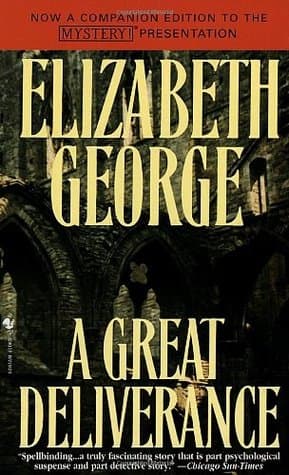
- A Great Deliverance
Elizabeth George
4.0 (40k) average on GoodreadsThrillerOffers the same author's signature blend of intricate plotting, psychological depth, and character-focused mystery.
- The Secret Place
Tana French
3.9 (63k) average on GoodreadsThrillerBoth novels delve into the dark underbelly of youth culture and crime, but French's novel focuses on a private school setting and a police investigation, whereas George's book is a prequel entirely from the perspective of the young victims/perpetrators within a deprived community, without a detective present. George's approach offers a more intimate, subjective look at the causes and immediate impacts of crime on the involved youth, rather than its resolution.
- Trainspotting
Irvine Welsh
4.1 (153k) average on GoodreadsThrillerWhile Welsh's Trainspotting also explores themes of poverty, addiction, and marginalized youth in an urban setting, George's "What Came Before He Shot Her" maintains a more traditional narrative structure and a less nihilistic, albeit still bleak, tone. George focuses more on the tragic innocence lost and the desperate struggle for survival and protection, whereas Welsh often revels in the chaotic and self-destructive aspects of his characters' lives, often with dark humor. George's academic precision in character development contrasts with Welsh's raw, stream-of-consciousness style.
- Angels & Demons
Dan Brown
3.9 (2.7M) average on GoodreadsThrillerA Harvard symbologist races through Rome's ancient sites, deciphering cryptic clues to unmask the Illuminati and stop a vengeful plot to destroy the Vatican with a stolen antimatter weapon.




Enjoyed the summary?
A summary gives you the shape of the book. The book itself has the detail, the examples and the voice.
Find What Came Before He Shot Her on AmazonAs an Amazon Associate, BookBrief earns from qualifying purchases. How we're funded