
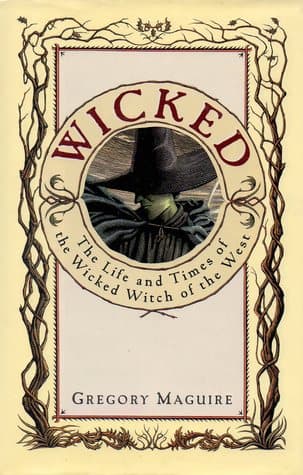
Synopsis
Covers the whole plot, including the ending.
- Difficulty
- Medium
- Pacing
- Moderate
- Mood
- Dark, Thought-provoking, Allegorical, Melancholy
- Read it if
- You enjoy dark fantasy, political allegory, and morally ambiguous characters, and are interested in a deep, revisionist take on a classic tale.
- Skip it if
- You prefer lighthearted fantasy, straightforward good-vs-evil narratives, or are not open to a cynical reinterpretation of beloved stories.
Wicked Plot Summary
Covers the whole plot, including the ending.
The Unconventional Birth of Elphaba
The story starts in the Quadling Country with Elphaba's unusual birth. Melena Thropp, a missionary's wife, has an affair with a mysterious man, implied to be the Wizard of Oz, though she believes it was from a 'green elixir' given by a salesman. Nine months later, in Munchkinland, she gives birth to Elphaba, a baby with emerald-green skin, sharp teeth, and a fear of water. Her father, Frexspar, a devout Unionist minister, struggles to accept her, though he tries to love her. Elphaba's younger sister, Nessarose, is born without arms, making Frexspar believe Elphaba is God's punishment. The family's life includes the challenges of raising Elphaba and the growing political unrest in Oz regarding Animal rights.
Student Life at Shiz University
Elphaba, now a young woman, goes to Shiz University, a school in the Gillikin Country, with her younger sister Nessarose and their nanny, Madame Morrible. At Shiz, Elphaba is an outcast because of her green skin and sharp personality. She first rooms with Galinda, a popular and vain girl, and they form an unlikely, often difficult, friendship. Boq, a Munchkinlander, and Fiyero, a charming Vinkun prince, later join them; Fiyero becomes Elphaba's first love. Elphaba's intelligence and strong sense of justice become clear, especially her passion for Animal rights, a controversial topic at the university. She also meets Doctor Dillamond, a talking Goat professor, who becomes a mentor and a symbol of the Animals' struggle.
The Wizard's Influence and Doctor Dillamond's Demise
At Shiz, Elphaba sees the Wizard's oppressive government and his policies against Animals, which remove their civil rights and make them 'animals' without a capital 'A'. Doctor Dillamond, Elphaba's Goat professor, tries to research the Animals' origins, believing it holds the key to their future. His research ends when he is brutally murdered. This event deeply affects Elphaba and strengthens her belief in the Wizard's tyranny. The official story is that a mob attacked him, but Elphaba suspects the ruling powers, possibly Madame Morrible, who has become an advisor to the Wizard, orchestrated it.
Life in the Emerald City and the Underground
After leaving Shiz, Elphaba and Fiyero move to the Emerald City, where Elphaba tries to confront the Wizard about his unfair treatment of Animals. She fails to meet him and becomes disappointed with direct political action. Fiyero, however, joins a secret resistance group working against the Wizard. Elphaba eventually joins him, becoming a known figure in the underground movement. Their relationship deepens, and they become lovers, even though Fiyero is married with children. This time marks a big change in Elphaba's life, as she fully accepts her role as an activist and rebel, strengthening her commitment to the Animal cause and her opposition to the Wizard's rule.
Fiyero's Tragic End
The Wizard's forces discover the resistance movement in the Emerald City. The Gale Force, the Wizard's secret police, capture and torture Fiyero to death, trying to get information about Elphaba and the other rebels. Elphaba sees his horrific death, which breaks her. This traumatic event is a turning point, pushing her further into despair and radicalization. Believing her actions have only caused suffering, she flees the Emerald City, seeking refuge and a new path, always haunted by Fiyero's sacrifice and the failure of their rebellion. She feels immense guilt and wants vengeance.
Seclusion in the Monastery
After Fiyero's death, Elphaba goes to a secluded monastery in the Quadling Country. She spends a long time there, trying to deal with her grief, guilt, and the failure of her political efforts. She studies religious texts and talks with the monks, especially the Abbot, seeking meaning and understanding in a world that seems increasingly cruel and unfair. During this time, she also studies magic and forgotten histories of Oz, hoping to find answers about good, evil, and her green skin. This time alone helps her reflect on her past and solidify her identity, though it is a darker one.
The Wicked Witch of the East's Reign
While Elphaba is in seclusion, her sister Nessarose becomes the governor of Munchkinland, taking their father's position. Nessarose, bitter about her lack of arms and her unrequited love for Boq, rules with an increasingly strict and tyrannical hand, enforcing harsh religious laws and persecuting the Munchkins. People often call her the 'Wicked Witch of the East' because of her harsh rule. Elphaba eventually returns to Munchkinland to confront her sister, hoping to reason with her and ease the Munchkins' suffering. Their reunion is full of tension and unresolved sibling rivalry, showing their very different paths and beliefs.
The Silver Slippers and Nessarose's Demise
During Elphaba's visit with Nessarose, a cyclone carries a house from Kansas, landing on Nessarose and killing her instantly. This house belongs to Dorothy Gale. Elphaba arrives to find her sister dead and the Munchkins celebrating their freedom from Nessarose's oppressive rule. Dorothy takes the magical Silver Slippers, which Nessarose had worn and imbued with her power. Elphaba is devastated by her sister's death, feeling a deep sense of loss and injustice, despite Nessarose's cruelty. She tries to get the slippers back, believing they are her family's inheritance and hold powerful magic, but Dorothy and the Munchkins refuse.
Elphaba in the Vinkus
After Nessarose's death, Elphaba travels to the Vinkus, the western region of Oz, seeking a new purpose. She settles in Fiyero's former castle, where she finds his surviving family, including his children and wife, Sarima. Elphaba takes on a motherly role, caring for Fiyero's disabled son, Liir, and becomes a guardian to the family, despite Sarima's initial dislike. She dedicates herself to scientific experiments, especially in genetics, trying to understand the origins of Animals and her green skin. She also continues to develop her magical abilities, becoming a strong, though solitary, figure known as the 'Wicked Witch of the West' because of her strange appearance and powerful magic.
Dorothy's Quest and Elphaba's Fate
The Wizard, wanting to get the Silver Slippers from Dorothy, tricks her into a quest to 'kill' the Wicked Witch of the West, Elphaba. Dorothy, with the Scarecrow (Fiyero's spirit, unknown to her), the Tin Woodman (Boq), and the Cowardly Lion, travels to the Vinkus. Elphaba, now isolated and increasingly bitter, confronts Dorothy, demanding the slippers back. She believes the slippers are the key to understanding her family's history and possibly the Wizard's true identity. During their confrontation, Dorothy, to defend herself, throws a bucket of water on Elphaba, causing her to melt. Elphaba's death is a tragic end to her life, marked by misunderstanding, political struggle, and personal loss, fulfilling the 'Wicked Witch' prophecy.
The Aftermath and Elphaba's Legacy
After Elphaba's death, the Wizard is revealed as a fraud, and the people of Oz start to question the official stories. Liir, Fiyero's son, takes on a bigger role, continuing Elphaba's legacy by seeking truth and justice in Oz. The book shows that Elphaba's actions, though often misunderstood and demonized, greatly affected many lives, including the Animals and the people of Oz. Her legacy is one of rebellion against tyranny, a search for identity, and the complexities of good and evil. The ending suggests that the story of Oz is more complicated and morally unclear than previously believed, leaving readers to think about what 'wickedness' and heroism truly mean.
Wicked Characters
Elphaba Thropp
Protagonist
The green-skinned woman who becomes the Wicked Witch of the West
Elphaba is the central protagonist, born with emerald-green skin and a sharp intellect. She is fiercely independent, deeply moral, and driven by a strong sense of justice, particularly for the oppressed Animals of Oz. Her fear of water and her unusual appearance set her apart from birth. Throughout her life, she struggles with her identity, her family's secrets, and her role in a politically turbulent Oz. She is often misunderstood, seen as prickly and aloof, but possesses a deep capacity for love and loyalty, especially towards Fiyero and the Animal cause. Her journey is one of disillusionment, activism, and ultimately, tragic isolation.
Relationships: Frexspar (father, complicated and distant); Melena Thropp (mother, loving but often overwhelmed); Nessarose Thropp (younger sister, strained and rivalrous); Galinda/Glinda (complex friendship, initially antagonistic); Fiyero (lover, deep and passionate); Doctor Dillamond (mentor and inspiration); Madame Morrible (early mentor, later adversary)
Fiyero Tiggular
Supporting
Vinkun prince and Elphaba's love interest
Fiyero is a charming, initially carefree Vinkun prince who attends Shiz University. He is handsome, popular, and a bit of a philanderer, but beneath his superficial exterior lies a thoughtful and courageous man. He develops a deep and passionate love for Elphaba, becoming her confidant and partner in the resistance against the Wizard. He is a key figure in Elphaba's emotional development and her political awakening. His brutal death at the hands of the Wizard's forces is a pivotal traumatic event that profoundly shapes Elphaba's subsequent actions and descent into the 'Wicked Witch' persona. His spirit is later implied to inhabit the Scarecrow.
Relationships: Elphaba (lover, deep and passionate); Sarima (wife, strained but dutiful); Liir (son)
Galinda / Glinda
Supporting
Elphaba's roommate and the future Good Witch of the North
Galinda, later Glinda, is Elphaba's initial roommate at Shiz. She is beautiful, popular, and initially vain and superficial. Despite their contrasting personalities and frequent clashes, she and Elphaba form an unlikely and complex friendship. Galinda's journey sees her mature from a frivolous socialite into a powerful and respected figure, eventually becoming the Good Witch of the North. She represents the societal norms and expectations that Elphaba often rebels against, but also embodies a different path to influence and power. She struggles with her own moral compromises and the weight of her public persona.
Relationships: Elphaba (complex friendship, initially antagonistic); Fiyero (brief romantic interest, unrequited on her part); Madame Morrible (mentor)
Nessarose Thropp
Supporting
Elphaba's younger sister and the Wicked Witch of the East
Nessarose is Elphaba's younger sister, born without arms and deeply religious. She is initially portrayed as fragile and dependent, but grows into a tyrannical and fundamentalist ruler of Munchkinland, becoming known as the 'Wicked Witch of the East'. Her disability and unrequited love for Boq fuel her bitterness and desire for control. She represents a different kind of 'wickedness' – born not of malice, but of rigid piety and emotional deprivation. Her death by Dorothy's house is a pivotal event that indirectly propels Elphaba further into her destiny.
Relationships: Elphaba (sister, strained and rivalrous); Frexspar (father, doting and protective); Boq (unrequited romantic interest, possessive)
The Wizard of Oz (Oscar Diggs)
Antagonist
The deceptive ruler of Oz and Elphaba's biological father
The Wizard, a human from Earth, is the ultimate antagonist of the story. He is a charismatic but manipulative and power-hungry dictator who uses propaganda and fear to control Oz. He is responsible for the systemic oppression of Animals and the consolidation of power in the Emerald City. He is heavily implied to be Elphaba's biological father, adding a layer of personal tragedy to her struggle against him. His motivations are self-preservation and the maintenance of his fabricated image. He represents the corrupting influence of power and the danger of blind adherence to authority.
Relationships: Elphaba (biological father, adversary); Melena Thropp (lover); Madame Morrible (advisor and accomplice)
Madame Morrible
Supporting
Headmistress of Shiz University and the Wizard's conspirator
Madame Morrible is the formidable headmistress of Shiz University and a powerful sorceress. She initially acts as a mentor to Elphaba and Galinda, but her true nature is revealed as a manipulative and ambitious figure. She becomes a key advisor and accomplice to the Wizard, helping him consolidate power and suppress dissent, particularly against Animals. She is deeply involved in the political machinations of Oz and is implied to be responsible for Doctor Dillamond's death. She embodies the corrupting influence of power and the moral compromises made in service of authority.
Relationships: Elphaba (early mentor, later adversary); Galinda/Glinda (mentor); The Wizard (advisor and accomplice)
Doctor Dillamond
Supporting
A talking Goat professor at Shiz University and an Animal rights advocate
Doctor Dillamond is a respected, talking Goat professor of history at Shiz University. He is one of the few prominent Animals remaining in academia and becomes a mentor to Elphaba, inspiring her passion for Animal rights. His quiet dignity and scholarly pursuit of the origins of Animals make him a symbol of the oppressed. His brutal murder, orchestrated by forces aligned with the Wizard, serves as a catalyst for Elphaba's political activism and her deep-seated hatred for the Wizard's regime. He represents the intellectual and moral voice of the Animals and the injustice they face.
Relationships: Elphaba (mentor and inspiration)
Boq
Supporting
Munchkinlander student and Nessarose's unrequited love
Boq is a humble Munchkinlander student at Shiz University. He is kind-hearted and initially smitten with Galinda, but later becomes the object of Nessarose's obsessive affection. He is trapped in a suffocating relationship with Nessarose, who uses her power as Governor to control him. His tragic transformation into the Tin Woodman, due to Nessarose's magical interference (which she claimed was to save him but also punish him), highlights the destructive nature of unrequited love and the dangers of unchecked power. He represents the ordinary citizens caught in the political and personal dramas of Oz.
Relationships: Nessarose (object of unrequited love, victim); Galinda (initial crush)
Frexspar
Supporting
Elphaba's devout Unionist minister father
Frexspar is Elphaba's devout and often conflicted father. A Unionist minister, he struggles deeply with Elphaba's green skin, viewing it as a sign of divine punishment. Despite his attempts to be a loving parent, his religious convictions and discomfort with Elphaba's uniqueness create a strained relationship. He is a moralistic figure, but his rigid beliefs often blind him to the nuances of life and the suffering of others, including his own children. He is deeply affected by the political climate of Oz, particularly the rising tensions regarding Animals.
Relationships: Elphaba (father, complicated and distant); Melena Thropp (wife, strained); Nessarose (daughter, doting and protective)
Melena Thropp
Supporting
Elphaba's mother, haunted by her past
Melena Thropp is Elphaba's mother, a fragile and often overwhelmed woman who holds the secret of Elphaba's true parentage. She is a compassionate but largely passive figure, often seeking solace in drink. Her affair, possibly with the Wizard, and her subsequent belief in the 'green elixir' deeply impact her family. She loves her children, but is unable to fully protect them from the harsh realities of Oz or her husband's judgmental nature. Her story highlights themes of hidden truths and the burdens of secret pasts.
Relationships: Elphaba (mother, loving but often overwhelmed); Frexspar (husband, strained); The Wizard (lover, implied)
Liir
Supporting
Fiyero's son and Elphaba's ward
Liir is Fiyero's son, born with a physical disability that prevents him from speaking normally. After Fiyero's death, Elphaba takes him under her care in the Vinkus. He is a quiet and observant child, deeply affected by the events around him. Liir becomes a symbol of hope and continuity, carrying a part of Elphaba's legacy into the future. His unique connection to Elphaba and his eventual ability to speak and understand her contributes to the ongoing mystery of Oz and the potential for a different future.
Relationships: Fiyero (father); Elphaba (guardian, maternal figure)
Wicked Themes
The Nature of Good and Evil
The novel carefully breaks down the simple good and evil presented in Baum's original. Elphaba, called 'wicked,' is a complex character driven by justice, love, and grief. Seemingly 'good' characters like Glinda and the Wizard have their own moral failures and political manipulations. The book argues that 'wickedness' is often a label given to those who challenge the status quo or whose stories are not told. For example, Nessarose, the 'Wicked Witch of the East,' is wicked not from malice but from rigid, self-righteous piety and emotional abuse, showing that evil can come from various places.
“'The only 'wickedness' she had ever committed was to be born with green skin, and a mind that questioned everything.'”
Identity and Otherness
Elphaba's green skin immediately makes her an 'other' in Oz, leading to lifelong prejudice and isolation. This physical difference represents any form of marginalization. Her journey is a constant fight to define herself against what society expects and the labels placed on her. She deals with her mysterious parents and her unique place in the world. The Animals, stripped of their capital 'A' and their rights, further show this theme, exploring how identity can be taken or suppressed by those in power, and how the 'other' is often demonized to keep control.
“'She was green. So what? Was it a sin to be green?'”
Political Corruption and Tyranny
Maguire shows Oz as a corrupt and oppressive society, ruled by the Wizard, a manipulative dictator who uses propaganda and fear to keep power. The discrimination against Animals, the suppression of free thought, and the Wizard's hidden origins all show this theme. Elphaba's activism and rebellion are direct responses to this tyranny, even if her efforts fail. The political schemes of figures like Madame Morrible further show how power corrupts and how 'good' intentions can be twisted to gain control, revealing a darker, more cynical Oz than previously imagined.
“'The Wizard ruled by sleight of hand and clever words, making the people believe what he wanted them to believe, not what was true.'”
Love, Loss, and Grief
Elphaba's life includes many losses: her distant relationship with her parents, Doctor Dillamond's murder, and Fiyero's brutal death. These losses deeply scar her, fueling her rage, despair, and isolation. Her grief over Fiyero's death is a main reason for her withdrawal from the world and her transformation into the reclusive 'Witch.' Boq's unrequited love for Galinda, and Nessarose's possessive love for Boq, also show how love can lead to suffering and destructive actions, showing the emotional cost of human connections in a harsh world.
“'Grief was a terrible, insidious thing, like a disease that ate away at the soul.'”
The Power of Narrative and Revisionism
The core of 'Wicked' is a new look at a classic story, questioning the established narrative of the Wicked Witch. Maguire purposefully re-examines the 'facts' of Oz, showing how history is written by the winners and how reputations can be deliberately damaged. The book constantly asks what is 'true' and what is propaganda, especially concerning the Wizard and Elphaba herself. This theme encourages readers to look past appearances and official stories, stressing the importance of different viewpoints and the often-unheard voices in history, ultimately suggesting that 'wickedness' is a construct.
“'Every story has two sides. What if the wrong side was told first?'”
Plot Devices & Literary Techniques
Revisionist History / Retelling
Reinterpreting a classic tale from an antagonist's perspective
This is the primary plot device, taking the established narrative of L. Frank Baum's 'The Wonderful Wizard of Oz' and flipping it. By telling the story from the perspective of the 'Wicked Witch,' Maguire challenges readers' preconceived notions of good and evil, heroism and villainy. He fills in the gaps of Elphaba's backstory, motivations, and the political landscape of Oz, transforming a one-dimensional villain into a complex, sympathetic protagonist. This device forces a re-evaluation of the original story and its themes, making the reader question the nature of truth in popular narratives.
Political Allegory
Oz as a metaphor for real-world political struggles
Maguire uses Oz as a thinly veiled allegory for real-world political and social issues. The oppression of the 'Animals' (capital 'A') mirrors racial discrimination, civil rights movements, and ethnic cleansing. The Wizard's manipulative regime and propaganda tactics reflect authoritarian governments and the dangers of unchecked power. Elphaba's activism and the resistance movement can be seen as representing historical and contemporary struggles against injustice. This device allows the author to explore complex moral and political questions within a fantastical setting, making the narrative resonate with contemporary societal concerns.
Symbolism of Green Skin
Elphaba's green skin as a symbol of otherness and identity
Elphaba's green skin is not merely a physical characteristic but a powerful symbol. It represents her 'otherness,' marking her as an outcast from birth and dictating how society perceives and treats her. It also symbolizes her unique identity, her connection to the land of Oz (often depicted as green), and potentially her magical abilities or a deeper, mystical heritage. The mystery of its origin (is it a curse, a result of the 'green elixir,' or a natural variation?) is a driving force in Elphaba's quest for self-understanding, making her greenness a central motif in her struggle with identity and acceptance.
The Wizard as the Unseen Manipulator
A powerful, often unseen, force driving the plot
Initially presented as a mythical figure, the Wizard becomes the central antagonist and an unseen manipulator. His policies and actions, even when he is not physically present, directly influence the lives of Elphaba and all of Oz. He orchestrates events, uses propaganda, and creates a climate of fear that drives much of the plot. His mysterious identity and the eventual revelation of his true nature as a powerless man from Earth further emphasize the theme of deception and the power of illusion, making him a catalyst for Elphaba's rebellion and ultimate demise.
Wicked Quotes
“People who claim that they're evil are usually no worse than the rest of us... It's people who claim that they're good, or any way better than the rest of us, that you have to be wary of.”
“Remember this: Nothing is written in the stars. Not these stars, nor any others. No one controls your destiny.”
“The wicked are not so different from the rest of us, they're just unlucky.”
“I don't cause commotions, I am one.”
“There is no such thing as a witch. There is only a girl.”
“The world is a complicated place. It isn't black and white. It's a million different shades of gray.”
“To be feared is to be respected.”
“Animals have souls, and they have rights. They are not ours to use and abuse.”
“Sometimes the best way to bring about change is to make people uncomfortable.”
“I am not a monster. I am just misunderstood.”
“Power is not given. It is taken.”
“The truth is not always beautiful, nor beautiful words the truth.”
“We are all prisoners of our own perceptions.”
“Love is the most powerful magic of all, and the most dangerous.”
Quiz
10 questions on the plot and the characters. Each answer comes with a short explanation.
Question 1
What is the name of the green-skinned girl who grows up to become the Wicked Witch of the West?
- Glinda
- Nessarose
- Elphaba
- Dorothy
Show answer
C. Elphaba Elphaba is the protagonist of 'Wicked,' born with green skin and later becoming the misunderstood Wicked Witch of the West, as the book reimagines her backstory.
Question 2
In the book, what group strives to be treated as first-class citizens in Oz?
- Munchkinlanders
- Animals
- Witches
- Winkies
Show answer
B. Animals The book portrays Animals (with a capital A) as sentient beings who talk and fight for equal rights, highlighting themes of discrimination and social justice in Oz.
Question 3
What is the primary setting where Elphaba attends university and meets Glinda?
- Emerald City
- Shiz University
- Munchkinland
- Winkie Country
Show answer
B. Shiz University Shiz University is where Elphaba studies and forms a complex friendship with Glinda, a key part of her development and the novel's plot.
Question 4
Why does Elphaba become an activist against the Wizard of Oz?
- He threatens her family directly
- She seeks political power for herself
- He oppresses Animals and uses propaganda
- He bans magic in Oz
Show answer
C. He oppresses Animals and uses propaganda Elphaba's activism is driven by the Wizard's tyrannical rule, including the persecution of Animals and manipulation of truth, reflecting the book's themes of resistance and morality.
Question 5
What is the significance of Elphaba's green skin in the story?
- It is a curse from a witch
- It marks her as inherently evil
- It results from her mother's infidelity with a green-skinned man
- It is a magical gift from the Wizard
Show answer
C. It results from her mother's infidelity with a green-skinned man Elphaba's green skin is due to her mother's affair, making her an outcast from birth and symbolizing how society judges based on appearances, central to her misunderstood nature.
Question 6
How does the book portray the Tin Man's origin?
- As a heroic knight cursed by a witch
- As a victim of domestic violence
- As a robot created by the Wizard
- As a farmer who lost his heart in an accident
Show answer
B. As a victim of domestic violence In 'Wicked,' the Tin Man (originally named Nick Chopper) is a woodcutter whose limbs are cut off by his abusive lover, reimagining his story to explore darker, realistic themes.
Question 7
What role does Doctor Dillamond play in Elphaba's life at Shiz University?
- He is her romantic interest
- He is a strict headmaster who expels her
- He is a Goat professor who inspires her activism
- He is a spy for the Wizard
Show answer
C. He is a Goat professor who inspires her activism Doctor Dillamond is a talking Goat and professor at Shiz whose persecution under the Wizard's regime deeply influences Elphaba, fueling her fight for Animal rights.
Question 8
What is the true nature of Elphaba's relationship with her sister Nessarose?
- They are close allies against the Wizard
- Nessarose is jealous and resentful of Elphaba
- They work together as witches in Munchkinland
- Elphaba secretly despises Nessarose
Show answer
B. Nessarose is jealous and resentful of Elphaba Nessarose, who becomes the Wicked Witch of the East, resents Elphaba for their father's favoritism and her own physical disabilities, adding to the family dynamics and themes of envy.
Question 9
How does the book challenge traditional notions of 'wickedness' in Oz?
- By showing all witches as inherently good
- By depicting the Wizard as a purely evil villain
- By portraying Elphaba as a complex anti-heroine driven by morality
- By making Dorothy the true antagonist
Show answer
C. By portraying Elphaba as a complex anti-heroine driven by morality The book subverts the original 'Wizard of Oz' by presenting Elphaba not as evil, but as a principled, misunderstood figure fighting injustice, blurring lines between good and evil.
Question 10
What pivotal event leads to Elphaba's final confrontation with Dorothy?
- Dorothy steals Elphaba's broomstick
- Elphaba tries to kill Dorothy's dog, Toto
- Dorothy accidentally kills Nessarose with her house
- Elphaba curses the Emerald City
Show answer
C. Dorothy accidentally kills Nessarose with her house Dorothy's house falls on Nessarose, killing her, which sets off Elphaba's quest for revenge and ultimately leads to their iconic clash, recontextualizing the classic story.
Wicked FAQ
What is 'Wicked' about?
'Wicked' reimagines the story of the Wicked Witch of the West from L. Frank Baum's 'The Wizard of Oz,' focusing on her life as Elphaba, a green-skinned girl who grows up in Oz. The novel explores her journey from a misunderstood outcast to the infamous witch, challenging traditional notions of good and evil while delving into political and social issues in Oz, such as animal rights and class struggles.
Why should I read 'Wicked'?
You should read 'Wicked' for its rich, allegorical world-building that recontextualizes a classic story, offering a nuanced perspective on morality and society. It delves into themes like prejudice, power, and identity through Elphaba's complex character, making it a thought-provoking fantasy that goes beyond the original tale's black-and-white morality.
What is the background/setting of 'Wicked'?
The setting is the land of Oz, reimagined as a politically complex world with regions like Munchkinland and the Emerald City. It features a society where talking animals (Animals) face discrimination, and various factions, including the Wizard's authoritarian regime, shape the narrative. The story spans from Elphaba's birth in Munchkinland to her adulthood, leading up to the events of 'The Wizard of Oz.'
What are the most memorable quotes?
Memorable quotes include Elphaba's line, 'I don't cause commotions, I am one,' reflecting her defiant nature, and 'The thing about revolutions is that they always come back around,' highlighting the novel's political themes. Another is 'No one mourns the wicked,' which underscores the societal judgment she faces.
What writing style does the author use?
Gregory Maguire uses a dense, literary style with rich descriptions and allegorical elements, blending fantasy with social commentary. The prose is often philosophical, exploring themes of good and evil through complex characterizations and a non-linear narrative that jumps through time.
What minor details add significant meaning?
Minor details like Elphaba's allergy to water, which causes her skin to blister, symbolize her vulnerability and isolation. The recurring motif of the clock in the Emerald City represents the oppressive control of time and order under the Wizard's rule, adding layers to the political allegory.
What are some subtle foreshadowing moments?
Early scenes where Elphaba shows empathy for oppressed Animals foreshadow her later activism against the Wizard. Her green skin, often mocked, hints at her outsider status that leads to her being labeled 'wicked.' The mention of Dorothy's arrival in Oz is subtly woven into later chapters, setting up the climax.
What unexpected character connections exist?
Unexpected connections include Elphaba's friendship with Glinda, which evolves from rivalry to a complex bond, and her relationship with Fiyero, who becomes the Scarecrow. The Wizard is revealed to have a personal history with Elphaba's mother, adding depth to his antagonistic role.
What are unspoken character motivations?
Elphaba's unspoken motivation is a deep-seated desire for acceptance and justice, driven by her experiences of prejudice. Glinda's ambition for social status masks her insecurity and latent kindness. The Wizard's actions are motivated by a fear of losing power, rather than pure evil.
What psychological complexities do characters exhibit?
Elphaba exhibits complexity through her blend of idealism and cynicism, struggling with her identity as an outcast. Glinda shows a conflict between her superficial desires and moral growth. The Wizard displays manipulative tendencies rooted in insecurity, making him a nuanced antagonist.
What are the major emotional turning points?
Major emotional turning points include Elphaba's decision to become an activist after witnessing Animal oppression, her heartbreak over Fiyero's transformation into the Scarecrow, and her final confrontation with Dorothy, which leads to her death and a poignant reflection on her legacy.
How do relationship dynamics evolve?
Elphaba and Glinda's relationship evolves from competitive classmates to reluctant allies, with Glinda eventually showing sympathy for Elphaba's cause. Elphaba's romance with Fiyero shifts from passion to tragedy as he becomes the Scarecrow. Her interactions with the Wizard move from curiosity to outright rebellion.
Which parts remain ambiguous or open-ended?
Ambiguous parts include the true nature of Elphaba's 'wickedness'—whether it's inherent or imposed by society—and the fate of Oz after her death. The Wizard's origins and motivations are left somewhat vague, inviting interpretation about his role as a villain or victim of circumstance.
What are controversial scenes or decisions?
Controversial scenes include Elphaba's violent actions in her activism, which blur the line between heroism and extremism, and the Wizard's exploitation of Animals, raising ethical questions. Some readers debate whether Elphaba's death is a tragic end or a necessary redemption.
'Wicked' ending explained: how it ends & what it means
The ending shows Elphaba's death at the hands of Dorothy, with her melting away after water is thrown on her. It symbolizes the destruction of a misunderstood figure who fought against oppression, suggesting that society often vilifies those who challenge the status quo. Her legacy lives on through characters like Glinda, hinting at ongoing resistance in Oz.
About the author

Gregory Maguire is an American author known for his works of fiction that often reimagine classic tales. He is best known for "Wicked: The Life and Times of the Wicked Witch of the West," which explores the backstory of the Wicked Witch from "The Wizard of Oz." Other notable works include "Confessions of an Ugly Stepsister," "A Lion Among Men," "Out of Oz," and "Lost."
Similar books
- Circe
Madeline Miller
4.3 (343k) average on GoodreadsFantasyRetells a classic myth from the perspective of a marginalized female character, exploring themes of power and identity.
- The Mists of Avalon
Marion Zimmer Bradley
4.1 (192k) average on GoodreadsFantasyReimagines the Arthurian legends from the viewpoint of its female characters, offering a rich, alternative history.
- A Wizard of Earthsea
Ursula K. Le Guin
4.0 (241k) average on GoodreadsFantasyWhile both authors create intricate fantasy worlds with deep philosophical underpinnings, their approaches differ significantly. Le Guin's A Wizard of Earthsea focuses on a hero's coming-of-age journey and the balance of power, good, and evil within a more traditional, albeit nuanced, epic fantasy framework. Maguire, by contrast, actively subverts these traditional frameworks, making his protagonist an anti-hero whose moral journey is one of disillusionment and political awakening rather than mastery of self or magic. Le Guin's prose is often more sparse and poetic, while Maguire's is denser and more descriptive, reflecting their different narrative goals (Levin, 1976).
- Harry Potter and the Sorcerer's Stone
J.K. Rowling
4.5 (7M) average on GoodreadsFantasyRescued from a miserable life under the stairs, an orphaned boy discovers he's a wizard destined for a magical school, where he uncovers a dangerous secret tied to the dark wizard who murdered his parents.
- The Hunger Games
Suzanne Collins
4.3 (6.4M) average on GoodreadsFantasyIn a future where children fight to the death on live television, Katniss Everdeen volunteers for the arena, turning a death sentence into a fight for survival and a spark of rebellion.
- 1984
George Orwell
4.2 (3.1M) average on GoodreadsPoliticsIn a future where surveillance and thought control are absolute, a man's search for truth clashes with the Party, showing that hope can be a form of rebellion.




Enjoyed the summary?
A summary gives you the shape of the book. The book itself has the detail, the examples and the voice.
Find Wicked on AmazonAs an Amazon Associate, BookBrief earns from qualifying purchases. How we're funded