

Core Idea
- Difficulty
- Easy
- Read it if
- You appreciate raw, witty, and self-aware memoirs, are interested in the behind-the-scenes reality of celebrity, want an honest look at living with mental illness and addiction, or are a fan of Carrie Fisher's unique voice.
- Skip it if
- You prefer traditional, inspirational narratives, are easily offended by dark humor, or are looking for a strictly chronological and reserved autobiography.
Key Takeaways from Wishful Drinking
The Absurdity of Celebrity Offspring
Growing up in the shadow of Hollywood royalty creates a unique, often bizarre, reality.
Fisher's childhood was unusual, a fact she examines with humor and underlying sadness. Being the child of two major stars meant a childhood filled with the surreal—from attending lavish parties to seeing her parents' marriage publicly fall apart, especially when her father left her mother for Elizabeth Taylor. This environment created early wit and a sharp observational eye, but also a feeling of constant scrutiny. Her story shows how this early exposure to celebrity's performative nature affected her own sense of self, making 'normal' seem foreign and 'extraordinary' her standard. It is a strong comment on the inherited effects of fame and its often-distorting impact on personal identity.
“I was born into a show business family. My parents were Debbie Reynolds and Eddie Fisher. They were like the Brad Pitt and Jennifer Aniston of their day. Except I'm not Angelina Jolie.”
In the book: Fisher recounts her parents' scandalous divorce, with her father Eddie Fisher leaving her mother Debbie Reynolds for Elizabeth Taylor, a public drama that shaped her early life and provided ample material for her later comedic observations.
Try this: Recognize that 'normal' is a subjective construct, especially when evaluating your own life story. Embrace the unique, even absurd, elements of your past as foundational to your identity and a source of strength or humor.
Related ideas: celebrity-culture, inherited-fame, childhood-trauma
Princess Leia: A Golden Cage
The iconic role that defined her, yet simultaneously trapped her.
Playing Princess Leia at 19 made Fisher a global star, a phenomenon she often describes with pride, amusement, and some frustration. The role became a lasting part of her identity, an alter ego she could never quite shake. While it opened doors, it also created an almost inescapable public image, overshadowing her other work and personal struggles. Fisher's honest thoughts show the mixed blessing of such immense, early fame: the joy of contributing to a cultural icon, but also the burden of being forever linked to a character, especially one whose iconic status means constant recognition and no anonymity. Her relationship with Leia is complex, showing how fictional characters can deeply shape and sometimes control an actor's real life.
“I am Princess Leia, no matter what. I look like Princess Leia, and I will always look like Princess Leia. And I am Princess Leia. And so is my daughter.”
In the book: Fisher's frequent references to fans' reactions and her own internal monologue about being 'Princess Leia' underscores how the role became an inescapable part of her public and private identity.
Try this: Understand that public perception can be a powerful, often uncontrollable force. While embracing achievements, develop a strong sense of self independent of external labels or past successes.
Related ideas: typecasting, iconic-roles, fame-identity
The Unvarnished Truth of Mental Illness
Confronting bipolar disorder with humor and unflinching honesty.
Fisher's open talk about her struggles with bipolar disorder is one of the book's most important contributions. She makes mental illness easier to understand, removing the stigma with her humor and honesty. Her descriptions of manic episodes, depressive lows, and various treatments (including electroconvulsive therapy) are not self-pitying but factual, even darkly funny. By sharing her experiences, Fisher normalizes conversations about mental health, offering comfort and validation to many others. Her story shows the daily struggle of managing a chronic condition, the frustrations of medication, and the importance of self-awareness and professional help. It is a strong example of resilience and the courage it takes to live authentically with a challenging diagnosis.
“I am mentally ill. I can say that. I am not ashamed of that. I survived that, I'm still surviving it, but it's not a death sentence.”
In the book: Fisher details her experiences with various mental institutions, her diagnosis of bipolar disorder, and her decision to undergo electroconvulsive therapy (ECT), all discussed with surprising candor.
Try this: Seek professional help without shame if you suspect mental health issues. Be open and honest about your struggles, as sharing can destigmatize and foster connection.
Related ideas: bipolar-disorder, mental-health-stigma, resilience
Addiction: A Companion, Not a Choice
Exploring the complex relationship with substance abuse as a coping mechanism.
Fisher's account of her addiction is linked to her mental health struggles, showing substance abuse not as a moral failing but as a desperate attempt to self-medicate and cope with intense emotional pain and neurological imbalances. She talks about her drug use—LSD, cocaine, prescription pills—with a detached, almost clinical observation, yet the underlying desperation is clear. Her honesty about addiction's appeal and subsequent damage is a stark reminder of its sneaky nature. She does not glorify it, nor does she wallow in victimhood; instead, she presents it as part of her journey, a challenge she constantly fought to overcome. This view is important for understanding addiction as a disease rather than a character flaw.
“I was an alcoholic, and I was a drug addict. I was a drug addict before I was an alcoholic. It was a gradual process.”
In the book: Fisher openly discusses her history with various drugs, including LSD and cocaine, and her multiple stints in rehabilitation facilities, framing them as attempts to manage her internal chaos.
Try this: Approach addiction, both in yourself and others, with empathy and understanding, recognizing its roots in pain and attempts at self-medication. Seek professional help for addiction, as it's a disease requiring treatment.
Related ideas: substance-abuse, self-medication, addiction-recovery
Humor as a Shield and a Sword
Using wit to navigate trauma, mental illness, and the absurdities of life.
Fisher's most powerful tool is her humor. She uses it expertly, turning potentially devastating experiences—mental breakdowns, addiction, romantic failures, and the death of friends—into compelling, often funny stories. This is not just about making light of serious situations; it is a profound coping mechanism. Her ability to find the absurd in tragedy allows her to process pain, maintain some emotional distance, and connect with readers on a deeply human level. Her self-deprecating wit and sharp observations serve as both a shield against overwhelming despair and a way to cut through societal taboos about mental health and personal failings. It is a masterclass in using comedy for both survival and genuine communication.
“If my life wasn't funny, it would just be true. And that's unacceptable.”
In the book: Throughout the book, Fisher uses self-deprecating humor to describe her stays in mental institutions, her struggles with medication, and her various relationship failures, making light of deeply personal and often painful experiences.
Try this: Cultivate a sense of humor, especially self-deprecating humor, to navigate difficult situations. Laughter can be a powerful tool for resilience and connecting with others.
Related ideas: coping-mechanisms, dark-humor, resilience
The Unconventional Love Life
Navigating complex relationships with famous figures and personal challenges.
Fisher's romantic life was as turbulent and public as the rest of her existence. Her marriage to Paul Simon, and their on-again, off-again dynamic, is a significant part of the story, showing the complexities of two artists trying to live together. She also openly discusses her relationship with Bryan Lourd, her daughter's father, and his eventual coming out as gay, a situation she handles with grace and humor. These experiences show the challenges of maintaining intimate relationships under public scrutiny, made harder by her own mental health battles and the entertainment industry's instability. Her reflections offer an honest look at love, heartbreak, and the often-unpredictable paths relationships take.
“I've had a lot of relationships. Some good, some bad, some with Paul Simon.”
In the book: Fisher details her marriage to Paul Simon and their subsequent divorce, as well as her relationship with Bryan Lourd and his eventual coming out, all handled with her characteristic frankness.
Try this: Embrace the messy, unpredictable nature of love and relationships. Focus on genuine connection and understanding, rather than conforming to societal expectations of 'normalcy'.
Related ideas: celebrity-relationships, divorce, unconventional-love
The Weight of Being a Single Mother
Balancing fame, mental illness, and raising a child.
Fisher's role as a single mother to her daughter, Billie Lourd, adds another layer to her extraordinary life. She deals with the worries of passing on her genetic predispositions to mental illness, the challenges of keeping stability for her child amid her own personal storms, and the unique pressures of raising a daughter in the public eye. Her story shows the deep love and strong protectiveness she feels, balanced by the constant awareness of her own vulnerabilities. It is a moving exploration of maternal instinct, resilience in the face of adversity, and the deep desire to break cycles for the next generation, all while navigating the strange reality of her celebrity status and personal struggles.
“I'm a single mom. Which means I'm a single mom with a mental illness. Which means I'm a single mom with a mental illness and a job where I have to wear a metal bikini.”
In the book: Fisher frequently references her daughter, Billie, and expresses her anxieties about her own mental health impacting Billie, illustrating the profound responsibility she felt as a mother.
Try this: Prioritize your mental and physical well-being as a parent, recognizing its direct impact on your children. Seek support systems to help navigate the challenges of parenthood, especially when facing personal struggles.
Related ideas: single-motherhood, parenting-challenges, generational-trauma
Finding Meaning in the Absurd
Embracing life's chaos and contradictions as part of the human experience.
Ultimately, 'Wishful Drinking' is an excellent example of finding meaning and even joy in a life that often defied normal logic. Fisher's experiences, from her celebrity upbringing to her battles with mental illness and addiction, were far from ordinary. Yet, through her story, she shows a deep ability to embrace the chaos, to laugh at the absurdities, and to find a unique sense of self amid the contradictions. Her philosophy seems to be that life is messy, and true wisdom comes not from avoiding that mess, but from navigating it with honesty, humor, and a refusal to take oneself too seriously. It is an inspiring call to accept our imperfections and find our own kind of sanity in an often-insane world.
“There's no point in being an adult if you can't be a little childish sometimes.”
In the book: The entire book serves as evidence, as Fisher consistently frames her most difficult experiences—from finding a dead friend in her bed to her various hospital stays—with a blend of dark humor and philosophical reflection.
Try this: Practice radical acceptance of life's unpredictable nature. Cultivate a philosophical perspective that allows you to find humor and meaning even in challenging or absurd circumstances.
Related ideas: existentialism, absurdism, self-acceptance
The Power of Storytelling
Transforming personal pain into universal connection through narrative.
Carrie Fisher's decision to share her most vulnerable moments—her struggles with mental illness, addiction, and the pressures of fame—through her writing shows the power of storytelling. She does not just tell events; she creates a story that is both deeply personal and widely relatable. By telling her experiences with such vivid detail and sharp wit, she not only processes her own trauma but also helps others feel seen and understood. Her work shows how sharing one's truth, no matter how messy or unconventional, can break down barriers, create empathy, and turn individual pain into collective strength and connection. It highlights the profound impact an honest voice can have.
“I've been in therapy for years. I've been in analysis. I've been in a lot of things. And I've written about it. Because if I didn't, it would just be wasted.”
In the book: The very existence of 'Wishful Drinking' as a successful memoir and one-woman show demonstrates Fisher's ability to take her life story and transform it into compelling, relatable art.
Try this: Consider sharing your own experiences, in appropriate ways, to connect with others and contribute to a broader understanding of human struggles. Recognize the healing power of narrative.
Related ideas: narrative-therapy, memoir-writing, empathy
Wishful Drinking Quotes
“I am a product of privilege. I was born into a show business family. I'm a princess, not because I'm a royal, but because I'm a Hollywood child.”
“Resentment is like drinking poison and then waiting for the other person to die.”
“If my life wasn't funny, it would just be true, and that's unacceptable.”
“I'm a fairly, shall we say, colorful personality, and I've had a fairly colorful life. So it's not like I'm making this stuff up.”
“You know how I got this job? They offered me a part in a movie, and I took it. That's how I got this job.”
“I don't want my life to imitate art, I want my life to be art.”
“I am mentally ill. I can say that. I am not ashamed of that. I survived that, I'm still surviving it, but bring it on. Better me than you.”
“I've been in therapy my whole life. I've been in analysis. I've been in group therapy. I've been in individual therapy. I've been in family therapy. I've been in every kind of therapy you can imagine.”
“I don't have a problem with drugs, I have a problem with sobriety.”
“The only thing that really matters is that you're happy. And if you're not, then you should do whatever you need to do to be happy.”
“There is no point at which you can say, 'Well, I'm successful now. I might as well take a nap.'”
“I was Princess Leia for 25 years. I was also a drug addict, a manic-depressive, and a sex addict. I'm a lot of things.”
“I got to be a part of something that was much bigger than me, and that's always a good thing to be a part of.”
“I've been a celebrity since I was 19. I've been famous since I was 19. And it's not a natural state of being.”
Quiz
10 questions on the main ideas. Each answer comes with a short explanation.
Question 1
Which iconic role did Carrie Fisher secure at the age of 19, launching her into global fame?
- Princess Leia in Star Wars
- Dorothy Gale in The Wizard of Oz
- Sarah Connor in The Terminator
- Holly Golightly in Breakfast at Tiffany's
Show answer
A. Princess Leia in Star Wars Carrie Fisher famously landed the role of Princess Leia in Star Wars when she was just 19, a pivotal moment discussed in her memoir.
Question 2
Beyond her acting career and single motherhood, what two significant personal battles does Carrie Fisher openly discuss in 'Wishful Drinking'?
- Anxiety and bulimia
- Addiction and manic depression
- Obsessive-compulsive disorder and anorexia
- Schizophrenia and alcoholism
Show answer
B. Addiction and manic depression The memoir explicitly states that Carrie battles addiction and weathers the wild ride of manic depression, often leading to stays in mental institutions.
Question 3
Who was Carrie Fisher's famous stepmother, as mentioned in 'Wishful Drinking'?
- Debbie Reynolds
- Shirley MacLaine
- Elizabeth Taylor
- Joan Crawford
Show answer
C. Elizabeth Taylor Carrie recounts the unique experience of having Elizabeth Taylor as a stepmother, a detail that highlights her unconventional upbringing.
Question 4
Carrie Fisher's relationship with Paul Simon is a significant part of her memoir. What was the nature of their relationship?
- They were long-term collaborators on a musical project.
- They were engaged but never married.
- They were married and later divorced.
- They had a brief, uncommitted affair.
Show answer
C. They were married and later divorced. The book explicitly mentions Carrie marrying and divorcing Paul Simon, detailing a tumultuous but significant relationship in her life.
Question 5
What significant personal betrayal related to her daughter's father does Carrie Fisher reveal in her memoir?
- He abandoned them without explanation.
- He left her for another woman.
- He left her for a man.
- He stole a large sum of money from her.
Show answer
C. He left her for a man. Carrie shares the deeply personal story of the father of her daughter leaving her for a man, a moment of profound impact on her life.
Question 6
How does Carrie Fisher generally describe her approach to sharing her struggles with mental illness and addiction in 'Wishful Drinking'?
- With a purely clinical and detached perspective.
- With self-pity and a focus on victimhood.
- With humor, wit, and unflinching honesty.
- With an emphasis on finding quick, easy solutions.
Show answer
C. With humor, wit, and unflinching honesty. The book description highlights her 'inimitable wit' and the way she tells her story, including battles with addiction and manic depression, suggesting an honest and humorous approach.
Question 7
The phrase 'it isn't all sweetness and light sabres' is used to describe Carrie Fisher's life. What does this phrase most effectively convey about the memoir's content?
- Her Star Wars experience was actually very difficult and unpleasant.
- Despite her iconic role, her life was filled with significant personal challenges and struggles.
- She preferred other film roles over her work in Star Wars.
- The memoir focuses primarily on the darker aspects of the entertainment industry.
Show answer
B. Despite her iconic role, her life was filled with significant personal challenges and struggles. This phrase serves as a metaphor, indicating that despite the glamorous 'light sabres' aspect of her fame, her life was also marked by profound personal difficulties like addiction and mental illness.
Question 8
What specific, tragic event related to a friend does Carrie Fisher recount waking up to in 'Wishful Drinking'?
- Waking up to find her best friend had moved away unexpectedly.
- Waking up to find a friend had stolen her belongings.
- Waking up to find a friend dead beside her in bed.
- Waking up to find a friend had suffered a severe injury.
Show answer
C. Waking up to find a friend dead beside her in bed. The memoir includes the shocking detail of Carrie waking up one morning to find a friend dead beside her in bed, highlighting the raw and often dark realities of her life experiences.
Question 9
Given the description of Carrie Fisher's life experiences, including celebrity parents, Star Wars fame, and personal struggles, what is a key psychological insight readers might gain from 'Wishful Drinking'?
- Celebrity status inherently protects individuals from mental health issues and addiction.
- Even with immense fame and privilege, individuals can face profound and relatable personal battles with mental health and relationships.
- The only effective way to cope with mental illness is through complete isolation from public life.
- Addiction and mental illness are solely products of a dysfunctional family upbringing.
Show answer
B. Even with immense fame and privilege, individuals can face profound and relatable personal battles with mental health and relationships. The memoir's blend of celebrity life with very human struggles like addiction and manic depression offers insight into the universal nature of these challenges, regardless of external circumstances.
Question 10
How does Carrie Fisher's willingness to discuss her 'hyperspace hairdo' in the same breath as her struggles with addiction and mental institutions contribute to the overall tone and impact of 'Wishful Drinking'?
- It suggests a lack of seriousness about her mental health issues.
- It creates a jarring and inconsistent narrative that is difficult to follow.
- It exemplifies her unique ability to use humor and self-awareness to normalize and destigmatize her complex life experiences.
- It primarily serves to remind the reader of her celebrity status, rather than her personal struggles.
Show answer
C. It exemplifies her unique ability to use humor and self-awareness to normalize and destigmatize her complex life experiences. This juxtaposition highlights Fisher's signature wit and her ability to find humor even in her most challenging experiences, making her narrative both relatable and destigmatizing.
Wishful Drinking FAQ
What is 'Wishful Drinking' about?
'Wishful Drinking' is a humorous and candid memoir by Carrie Fisher, chronicling her unique life experiences, including growing up with celebrity parents, her iconic role as Princess Leia, and her struggles with addiction and bipolar disorder.
Does Carrie Fisher talk about Star Wars in 'Wishful Drinking'?
Yes, Carrie Fisher extensively discusses her experiences filming Star Wars, the impact of playing Princess Leia on her life, and her humorous take on the iconic role.
What is the tone of 'Wishful Drinking'?
The tone of 'Wishful Drinking' is remarkably witty, self-deprecating, and brutally honest, blending humor with poignant reflections on her personal challenges and triumphs.
Does 'Wishful Drinking' offer insights into mental health?
Yes, the book provides raw and insightful accounts of Carrie Fisher's struggles with bipolar disorder and addiction, offering a personal perspective on living with mental health challenges.
How does 'Wishful Drinking' differ from other celebrity memoirs?
'Wishful Drinking' stands out from many celebrity memoirs due to Fisher's unparalleled wit, her unflinching honesty about her vulnerabilities, and her unique ability to find humor in even the darkest aspects of her life.
Is 'Wishful Drinking' a sad book?
While 'Wishful Drinking' touches on serious and often sad themes like addiction and mental illness, Carrie Fisher's signature humor and resilience prevent it from being solely a sad book; it's ultimately an uplifting and entertaining read.
Does 'Wishful Drinking' work as an audiobook?
Yes, 'Wishful Drinking' is highly recommended as an audiobook, as it is narrated by Carrie Fisher herself, adding an extra layer of authenticity and comedic timing to her storytelling.
What is Carrie Fisher's 'mental institution tour' concept in the book?
In the book, Carrie Fisher humorously refers to her various stays in mental health facilities as her 'mental institution tour,' a testament to her ability to find levity in difficult personal experiences.
What kind of personal stories can I expect in 'Wishful Drinking'?
Readers can expect a wide array of personal stories, from her childhood with Debbie Reynolds and Eddie Fisher, to her marriage to Paul Simon, and her candid experiences with Hollywood, fame, and personal struggles.
About the author
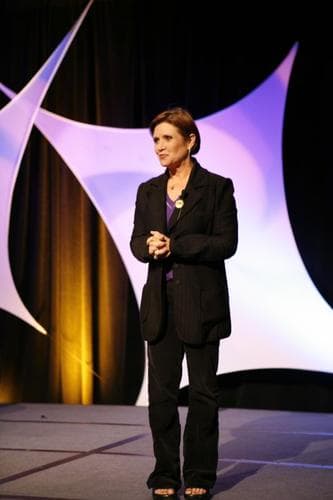
Carrie Fisher was an American actress, screenwriter, and novelist, best known for her iconic role as Princess Leia in the Star Wars saga. Beyond her acting career, Fisher was a celebrated author, penning several best-selling memoirs and novels, including "Wishful Drinking" and "Postcards from the Edge." Her sharp wit and candid explorations of addiction, mental health, and Hollywood made her a beloved and influential voice.
Similar books
- Hyperbole and a Half: Unfortunate Situations, Flawed Coping Mechanisms, Mayhem, and Other Things That Happened
Allie Brosh
4.2 (177k) average on GoodreadsPsychologyExplores mental illness with self-deprecating humor and relatable honesty, similar to Fisher's tone.
- Educated
Tara Westover
4.5 (796k) average on GoodreadsBiographyA powerful memoir about overcoming a challenging upbringing and finding one's own voice and identity.
- Just Kids
Patti Smith
4.2 (179k) average on GoodreadsBiographySmith's memoir is more poetic, reflective, and linear, focusing on artistic development and a deep interpersonal relationship. Fisher's is more performative, immediate, and centered on her personal struggles with fame and mental health, employing humor more overtly.
- Running with Scissors
Augusten Burroughs
3.7 (351k) average on GoodreadsPsychologyBoth use dark humor to recount traumatic experiences. However, Burroughs' work leans more into the grotesque and surreal, focusing on an extremely dysfunctional family dynamic. Fisher's is more self-focused in its critique, making her personal struggles the central axis rather than external family forces to the same degree.
- The Perks of Being a Wallflower
Stephen Chbosky
4.2 (1.3M) average on GoodreadsPsychologyThrough letters, a shy high school freshman learns to navigate first love, trauma, and self-discovery, stepping off the sidelines and into life.
- Eleanor Oliphant Is Completely Fine
Gail Honeyman
4.3 (708k) average on GoodreadsLiterary FictionA lonely woman's structured life changes when an IT guy and an elderly man help her learn to open her heart.






Enjoyed the summary?
A summary gives you the shape of the book. The book itself has the detail, the examples and the voice.
Find Wishful Drinking on AmazonAs an Amazon Associate, BookBrief earns from qualifying purchases. How we're funded