
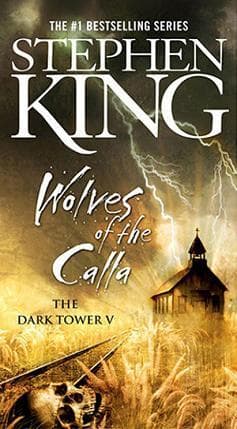
Synopsis
Covers the whole plot, including the ending.
- Difficulty
- Medium
- Pacing
- Moderate
- Mood
- Epic, Mysterious, Suspenseful, Adventurous
- Read it if
- You enjoy epic fantasy with Western elements, complex characters, and a blend of multiple genres.
- Skip it if
- You prefer standalone novels or dislike long, multi-book series with extensive world-building.
Wolves of the Calla Plot Summary
Covers the whole plot, including the ending.
The Path to the Calla
After escaping the Emerald City and their dangerous trip through Topeka, Roland Deschain and his group—Eddie Dean, Susannah Dean, Jake Chambers, and Oy—continue their search along the Path of the Beam. They soon notice they are being followed by a group of new trackers. These riders are not hostile but seem desperate. The group lets them approach, and the trackers introduce themselves as messengers from Calla Bryn Sturgis. They have traveled far, guided by old predictions and a great need for gunslingers to protect their people from a coming threat.
The Plea of the Calla
When they arrive at Calla Bryn Sturgis, Roland and his group are welcomed by the town's leaders, including Sister Coquina and Father Callahan. The townspeople explain their problem: for generations, a terrifying group called the Wolves of the Calla, masked riders from Thunderclap, raid their town every twenty-three years. They kidnap one half of every set of twins born in the Calla. When the children are returned, they are 'roont'—mentally and physically disabled, often unable to move or speak, and very strong. The next raid is less than a month away, and the Calla's people need the gunslingers' help, having lost hope in their own ability to fight.
Father Callahan's Bargain
Father Callahan, a former priest from New York City whom Roland knows from his past meeting with the Crimson King, shares his own sad past and his journey to the Calla. He explains that he has a strong, evil seeing sphere called Black Thirteen, one of the Bends o' the Rainbow, hidden beneath his church. Callahan offers Black Thirteen to Roland if the group will defend the Calla. He warns Roland of its great power and danger, but also suggests it could help their quest to the Dark Tower, especially in traveling between worlds.
The Ka-tet Prepares
Roland and his group agree to help the Calla. They immediately start to look at the situation and make a plan. The people of the Calla, mostly farmers, have little fighting experience, so the gunslingers begin the hard task of training them in basic defense and shooting. Eddie and Susannah, using what they know from their own world, introduce ideas like traps and planned attacks. Meanwhile, Roland, Jake, and Oy focus on finding out about the Wolves, their timing, methods, and any weaknesses. They learn about the 'roont' children and the mysterious Thunderclap.
Discovering the Wolves' True Nature
Through careful investigation, the group starts to understand the truth about the Wolves. They find out that the 'Wolves' are not mythical beings but highly advanced, technologically equipped creatures, likely cyborgs or androids, riding mechanical horses. Their weapons are not guns but energy-based 'sneetches' that cause the 'roont' condition in the children. It becomes clear that the Wolves are working for the Crimson King and the Sombra Corporation, operating from a high-tech facility within Thunderclap. This discovery raises the stakes, showing that the Calla's problem is directly linked to the bigger fight for the Dark Tower.
Susannah's Possession and Mia's Emergence
As the raid gets closer, Susannah's mental state worsens. She has vivid dreams and disturbing visions, and a new, distinct personality starts to appear in her mind. This being calls herself Mia, a 'demon-mother' who claims the child Susannah is carrying as her own. Mia states that the child is not Eddie's, but a result of an unholy union planned by the Crimson King, meant to destroy the Dark Tower. Mia's influence grows, making Susannah act strangely and causing tension within the group, especially between Susannah and Eddie, who struggles to understand what is happening to his wife.
The Defense of the Calla
The day of the raid arrives. The group, along with the newly trained villagers of Calla Bryn Sturgis, gets ready for battle. They have set up traps and chosen strategic spots. The Wolves arrive, not on horses, but on what seem to be advanced, robotic steeds, confirming the group's guesses about their technology. A fierce and brutal battle follows. Roland and his gunslingers lead the charge, using their skills and the villagers' new courage to fight back against the seemingly unbeatable Wolves. The villagers, armed with their slingshots and rifles, manage to do much damage, showing their bravery and dedication to protecting their children.
Victory and the Aftermath
Against great odds, Roland's group and the people of the Calla manage to defeat the Wolves, destroying their mechanical steeds and disabling many of the riders. While some Wolves escape, the immediate threat to the Calla is gone. The win is hard-won, with losses on both sides, but the children are saved from being 'roont.' Afterward, the group must deal with the immediate future. Father Callahan gets Black Thirteen, and it becomes clear that its power is key for their next step. The urgency of their quest to the Dark Tower is strengthened, as is the growing danger from Mia and the Crimson King's plans for Susannah's child.
Black Thirteen's Journey
Knowing they need to use Black Thirteen to move forward with their quest, especially to reach New York and face the Sombra Corporation, the group prepares for a dangerous journey. Black Thirteen, a powerful and unpredictable portal, is activated. However, because of Mia's growing influence and the sphere's natural instability, Susannah is separated from the rest of the group during the trip. She finds herself in a different part of New York, alone and increasingly under Mia's control, with the unborn child acting as a strong link between them. The remaining group—Roland, Eddie, Jake, and Oy—find themselves in another part of the city, desperate to find Susannah.
The Split Ka-tet in New York
Roland, Eddie, Jake, and Oy arrive in New York City, confused but determined. They quickly realize Susannah is not with them. The city is familiar yet strange to Roland, a mix of old and new. They understand that their first goal is to find Susannah and stop Mia from using the child for the Crimson King's plans. Meanwhile, Susannah, now almost completely controlled by Mia, is led by the entity through New York's complicated streets. Mia's goal is clear: to take the child to a specific, evil place, believing it will ensure the child's, and her own, survival, unknowingly playing into the Crimson King's bigger plan.
The Pursuit and the Promise of the Tower
The split group finds itself in a race against time. Roland, Eddie, Jake, and Oy start their desperate search for Susannah, moving through New York City, looking for clues and trying to guess Mia's movements. They understand the great danger Susannah is in, both from Mia and from the Crimson King's forces who are surely waiting for the child. The urgency of their quest to reach the Dark Tower becomes even more clear, as the fate of all worlds now depends on their ability to reunite, protect the child, and stop the Crimson King's final win. The journey continues, full of danger and uncertainty.
Wolves of the Calla Characters
Roland Deschain
Protagonist
The last gunslinger, driven by his quest for the Dark Tower.
Roland is the stoic, determined leader of the ka-tet. His unwavering focus on reaching the Dark Tower often overshadows personal feelings, but he deeply cares for his companions. In Calla Bryn Sturgis, he displays his tactical genius and leadership, training the villagers and devising strategies against the Wolves. He is burdened by his past and the weight of his destiny, constantly making difficult choices for the greater good of the Beam and the Tower. His experience and knowledge of ancient ways are invaluable in understanding the true nature of the threats they face.
Relationships: Eddie Dean (Student/Protege, trusted friend); Susannah Dean (Student/Protege, respected member of ka-tet); Jake Chambers (Adopted son, spiritual connection); Oy (Loyal companion, beloved pet); Father Callahan (Ally, fellow traveler from another world, source of information)
Eddie Dean
Supporting
A former drug addict from New York, now a skilled gunslinger and Roland's right hand.
Eddie has grown significantly from his past as a junkie. He is intelligent, quick-witted, and fiercely loyal to Roland and Susannah. His street smarts and knowledge of contemporary Earth prove invaluable in understanding the technological aspects of the Wolves and later navigating New York. He takes on a significant role in training the Calla villagers, displaying leadership and ingenuity. He is deeply devoted to Susannah, and her deteriorating mental state and the emergence of Mia cause him immense pain and frustration, driving him to protect her at all costs.
Relationships: Roland Deschain (Mentor/Father figure, leader); Susannah Dean (Wife, soulmate, deep love and concern); Jake Chambers (Younger brother figure); Oy (Affectionate friend)
Susannah Dean
Supporting/Antagonist (due to Mia)
A strong-willed, disabled woman possessed by a sinister entity.
Susannah, formerly Odetta Holmes and Detta Walker, is a formidable member of the ka-tet, possessing sharp intellect and courage despite her physical disability. She is a skilled shot and a vital voice of reason. However, her journey in 'Wolves of the Calla' is defined by the emergence of Mia, a separate personality who claims the unborn child Susannah is carrying. Mia's influence increasingly dominates Susannah's mind, turning her into an unwitting pawn in the Crimson King's plans. Susannah struggles internally, but Mia's hold proves incredibly powerful, leading her to betray the ka-tet's immediate goals.
Relationships: Roland Deschain (Mentor/Leader, trusted companion); Eddie Dean (Husband, source of love and support); Jake Chambers (Younger brother figure); Mia (Possessing entity, internal antagonist)
Jake Chambers
Supporting
The boy from New York, now a gunslinger-in-training with psychic abilities.
Jake has matured significantly since joining the ka-tet, becoming a capable and brave member. He is intelligent, observant, and possesses latent psychic abilities, including 'the touch,' which allows him to sense danger and connect with others telepathically. He is particularly close to Roland and Oy. In the Calla, he actively participates in training and investigation, demonstrating his courage and growing understanding of their quest. His bond with Oy is a source of comfort and strength, and he often acts as the moral compass of the group, reminding them of their humanity.
Relationships: Roland Deschain (Father figure, mentor); Eddie Dean (Older brother figure); Susannah Dean (Older sister figure); Oy (Best friend, companion)
Oy
Supporting
A brave and intelligent billy-bumbler, fiercely loyal to Jake.
Oy is a billy-bumbler, a raccoon-like creature native to Mid-World, possessing remarkable intelligence and the ability to mimic human speech. He is fiercely loyal to Jake, whom he considers his 'chap,' but also devoted to the entire ka-tet. Oy's keen senses and bravery prove useful in tracking and in battle against the Wolves. His presence provides moments of levity and emotional grounding for the ka-tet, and his unwavering affection is a constant source of comfort, particularly for Jake.
Relationships: Jake Chambers (Best friend, 'chap'); Roland Deschain (Respected leader); Eddie Dean (Affectionate friend); Susannah Dean (Affectionate friend)
Father Donald Callahan
Supporting
A disgraced priest from Earth, now a protector in Mid-World.
Father Callahan is a defrocked Catholic priest from New York, previously encountered in Stephen King's 'Salem's Lot.' After a traumatic encounter with a vampire, he fled to Mid-World, eventually finding refuge in Calla Bryn Sturgis. He is a weary but resilient man, carrying the burden of his past failures and his struggle with faith. He possesses Black Thirteen, a powerful seeing sphere, which he offers to Roland in exchange for the ka-tet's help against the Wolves. Callahan serves as a bridge between the worlds, providing crucial information about both Earth and the larger mystical conflict.
Relationships: Roland Deschain (Ally, fellow traveler, source of Black Thirteen); The People of Calla Bryn Sturgis (Spiritual leader, protector); Mia (Antagonistic force)
Mia
Antagonist
A parasitic entity inhabiting Susannah, claiming the unborn child.
Mia is a malevolent, ancient entity, a 'demon-mother' or succubus, who takes possession of Susannah Dean's body and mind. She believes the child Susannah is carrying is her own, a 'chap' she lost long ago. Mia's motivations are complex: she seeks to protect the child and ensure its birth, believing it will grant her a form of immortality or release from her suffering. However, her actions are ultimately manipulated by the Crimson King, who intends the child to be a powerful weapon against the Dark Tower. Mia's influence makes Susannah a dangerous and unpredictable member of the ka-tet.
Relationships: Susannah Dean (Host, victim of possession); The Unborn Child (Object of obsession and protection); The Crimson King (Manipulator, ultimate master)
The Wolves of the Calla
Antagonists
Technologically advanced raiders from Thunderclap, serving the Crimson King.
The 'Wolves' are not mythical beasts but highly advanced, masked cyborgs or androids, riding mechanical horses and armed with energy weapons called 'sneetches.' They raid Calla Bryn Sturgis every twenty-three years, abducting one half of every set of twins to 'roont' them, turning them into mindless, super-strong slaves. They operate from a hidden, high-tech facility within Thunderclap, a desolate and dangerous region. They are agents of the Crimson King and the Sombra Corporation, serving the larger purpose of weakening the Dark Tower by creating a new generation of Breakers.
Relationships: The Crimson King (Master, creator); Sombra Corporation (Operational arm); The People of Calla Bryn Sturgis (Victims, target of raids)
Wolves of the Calla Themes
Family and Ka-tet
The idea of 'ka-tet'—a group tied by fate—is central to the story. The bond between Roland, Eddie, Susannah, Jake, and Oy grows, changing from a practical team into a true family. This is clear in their combined efforts to train the Calla villagers, their shared sadness and resolve when Susannah is possessed, and their strong loyalty to each other. The Calla itself, focused on protecting its children and having strong community ties, shows another example of a close-knit group fighting for its life, reinforcing that strength comes from unity and a shared goal.
“There are no goodbyes in our ka-tet. There are only, 'See you later, gunslinger,' or 'Long days and pleasant nights, ka-tet.' We are always together.”
Sacrifice and Responsibility
The book explores the high cost of responsibility and the sacrifices made for a larger purpose. The people of Calla Bryn Sturgis live with constant fear of the Wolves' return, and many willingly give their lives to protect their children. Roland and his group, despite their own urgent quest, choose to delay their journey to defend the Calla, understanding their moral duty. Father Callahan also carries the burden of Black Thirteen, knowing its danger but seeing its potential for good. These actions show that true heroism often needs personal sacrifice for the well-being of others, even strangers.
“The world moves on, and we must move with it, but sometimes we must stand still and fight for what we believe in, even if it means we are broken in the process.”
The Corruption of Technology
'Wolves of the Calla' clearly shows technology as a tool of corruption and destruction when used by evil forces. The 'Wolves' are not mythical creatures but advanced cyborgs or androids, riding mechanical steeds and using energy weapons ('sneetches') to 'roont' children. This technological evil, from Thunderclap and linked to the Sombra Corporation and the Crimson King, contrasts sharply with the Calla's simpler, farming life. It shows the destructive power of unchecked science and its use in breaking the Beams and eventually destroying the Dark Tower.
“They weren't Wolves, not really. They were... machines. With men inside. Or what was left of men.”
Loss of Innocence and Trauma
The most terrible part of the Wolves' raids is the 'roont' children—those who return mentally and physically damaged, losing their innocence and life. This is a deep trauma for the Calla, a wound that happens again over generations. The group sees firsthand the terrible effects of this loss of innocence. Susannah's possession by Mia and the manipulation of her unborn child also touch on this theme, as her body and mind are corrupted for an evil purpose, highlighting the deep and lasting harm that can be done to the innocent.
“They came back, but they weren't the same. They were... empty. Roont.”
Fate vs. Free Will (Ka)
The ongoing theme of 'ka' (destiny) versus individual choices continues to be explored. While Roland's quest is driven by ka, the group often makes choices that, though perhaps fated, feel like acts of free will. Their decision to help the Calla, for example, is a detour from the direct path but matches the moral duties of gunslingers. Susannah's fight against Mia shows the battle for personal control against a strong, outside force, questioning how much power one truly has over their own fate when 'ka' is at play.
“Ka is a wheel. Its turnings are not to be questioned. But sometimes, even the wheel needs a push.”
Plot Devices & Literary Techniques
The Wolves of the Calla
A recurring, technologically advanced threat that drives the immediate conflict.
The Wolves function as the primary external antagonist for the first half of the novel. Initially presented as a mythical horror, their reveal as technologically advanced, cyborg-like agents of the Crimson King elevates the stakes and connects the Calla's local tragedy to the overarching quest for the Dark Tower. They serve as a catalyst for the ka-tet to further develop their skills and bond with a community. The Wolves represent the insidious, technological arm of the Crimson King's forces, demonstrating how even seemingly remote parts of Mid-World are being targeted and corrupted to weaken the Beams.
Black Thirteen
A powerful, malevolent seeing sphere and portal, one of the Bends o' the Rainbow.
Black Thirteen is a significant magical artifact, a 'seeing sphere' of immense power and malevolence. It acts as a dangerous plot device that facilitates travel between worlds, specifically used by the ka-tet to reach New York. Its inherent evil and unpredictability contribute to the separation of Susannah from the rest of the ka-tet, creating a major complication. It also serves as a direct link to the larger mythology of the Dark Tower, being one of the thirteen Bends o' the Rainbow, and its presence underscores the magical and perilous nature of their journey.
Mia and the Unborn Child
A parasitic entity and a magically conceived child, central to Susannah's internal conflict and the Crimson King's plans.
Mia is a crucial plot device that introduces an internal antagonist within the ka-tet and directly advances the Crimson King's overarching plan. Her possession of Susannah and her claim over the magically conceived child create immediate tension and a desperate race against time. The child itself is revealed to be a key element in the Crimson King's scheme to destroy the Dark Tower, possibly intended as a powerful Breaker. This device effectively splits the ka-tet and forces them into a new, urgent quest in New York, while also exploring themes of motherhood, identity, and corruption.
The 'Roont' Children
Victims of the Wolves, physically and mentally damaged, serving as a symbol of the Crimson King's cruelty.
The 'roont' children are a poignant and disturbing plot device that highlights the true horror and long-term consequences of the Wolves' raids. Their condition — mentally disabled but possessing monstrous strength — reveals the manipulative and cruel nature of the Crimson King's forces. These children are essentially prototypes for future Breakers, demonstrating the method of psychological and physical corruption used to turn innocents into tools of destruction. Their existence serves as a powerful motivator for the Calla people and the ka-tet to fight back, emphasizing the high stakes of their conflict.
The Calla Bryn Sturgis Community
A rural, isolated community that serves as a microcosm of Mid-World's struggle against encroaching evil.
Calla Bryn Sturgis functions as a significant setting and plot device, representing a traditional, vulnerable community in Mid-World. Its people, though initially helpless, embody resilience and the will to fight when given guidance. Their plight forces the ka-tet to pause their primary quest, allowing for character development and the demonstration of their gunslinger principles. The Calla also serves as a crucial point of connection between Roland's quest and the larger conflict with the Crimson King, illustrating how even remote settlements are not immune to the forces threatening the Dark Tower.
Wolves of the Calla Quotes
“Go then, there are other worlds than these.”
“The world had moved on, and it was a terrible thing to be left behind.”
“That's how it is. You come to love the things you hate. If you don't, you'll go mad.”
“There are no easy answers, only choices.”
“Sometimes you have to give up on the good fight, you know? Just for a little while. Just long enough to catch your breath.”
“The greatest trick the devil ever pulled was convincing the world he didn't exist.”
“We're not just fighting for the Calla, sai. We're fighting for the Tower.”
“Life can be a sonofabitch, can't it? But you take what it gives you and you run with it.”
“The past is a ghost, the future a dream, and all we ever have is now.”
“A man's got to do what a man's got to do, even if it kills him.”
“There's always a way, if you're brave enough to look for it.”
“The world was a place of endless turning, and sometimes it turned right over you.”
“Ka is a wheel, sai. And it always turns.”
“We are the last gunslingers, and we have a job to do.”
Quiz
10 questions on the plot and the characters. Each answer comes with a short explanation.
Question 1
What is the name of the town that desperately needs the gunslingers' help?
- Thunderclap
- Calla Bryn Sturgis
- Farson's Folly
- Gilead
Show answer
B. Calla Bryn Sturgis The trackers who follow Roland's tet are from Calla Bryn Sturgis, the town plagued by the Wolves.
Question 2
What specific item does Father Callahan offer Roland in exchange for his help against the Wolves?
- A map to the Dark Tower
- A powerful but evil seeing sphere called Black Thirteen
- A cache of ancient weapons
- Safe passage through Thunderclap
Show answer
B. A powerful but evil seeing sphere called Black Thirteen Father Callahan offers Roland Black Thirteen, a sinister seeing globe, in exchange for the gunslingers' aid.
Question 3
How often do the Wolves raid Calla Bryn Sturgis?
- Once every year
- Once every decade
- Once every generation
- Once every century
Show answer
C. Once every generation The Wolves raid Calla Bryn Sturgis once every generation to steal half of the twins.
Question 4
What happens to the children who are returned by the Wolves?
- They are given special powers.
- They are perfectly healthy and normal.
- They are 'roont,' or mentally and physically ruined.
- They have no memory of their time with the Wolves.
Show answer
C. They are 'roont,' or mentally and physically ruined. The returned children are described as 'roont,' meaning mentally and physically ruined, by their experience with the Wolves.
Question 5
Where does Father Callahan originally come from?
- Mid-World
- Thunderclap
- Our world
- The land of the Bends
Show answer
C. Our world Father Callahan is identified as a priest 'originally from our world,' connecting him to Earth.
Question 6
What is the primary objective of Roland and his tet in New York, according to the provided text?
- To find more gunslingers.
- To defeat the Sombra Corporation and save our world’s incarnation of the Dark Tower.
- To retrieve a lost artifact.
- To escape the pursuit of the Wolves.
Show answer
B. To defeat the Sombra Corporation and save our world’s incarnation of the Dark Tower. Roland and his tet must return to New York to save our world's incarnation of the Dark Tower from the Sombra Corporation.
Question 7
What is the primary motivation for the people of Calla Bryn Sturgis to seek Roland's help?
- They need protection from bandits.
- They want the gunslingers to lead them to the Dark Tower.
- The Wolves are coming to steal their children again in less than a month.
- They need help with a farming crisis.
Show answer
C. The Wolves are coming to steal their children again in less than a month. The people of Calla Bryn Sturgis need help because the Wolves are due to raid again in less than a month to steal their twin children.
Question 8
Where does Father Callahan hide Black Thirteen?
- In a secret cave outside the town.
- Buried in the town square.
- Below the floorboards of his church.
- In a locked safe in his home.
Show answer
C. Below the floorboards of his church. Father Callahan has hidden Black Thirteen 'below the floorboards of his church.'
Question 9
The Wolves are described as coming from what 'dark land'?
- The Dogan
- Thunderclap
- End-World
- The Wastelands
Show answer
B. Thunderclap The Wolves are said to gallop out of the 'dark land of Thunderclap'.
Question 10
What specific characteristic makes the Wolves a particularly challenging enemy for Roland and his tet?
- They are invisible.
- They can control minds.
- They are described as 'invincible'.
- They are immune to bullets.
Show answer
C. They are described as 'invincible'. The text states that Roland and his tet must 'discover a way to defeat the invincible Wolves,' highlighting their perceived invincibility as a major challenge.
Wolves of the Calla FAQ
What is the central conflict that brings Roland and his tet to Calla Bryn Sturgis?
The central conflict is the impending raid by the Wolves on Calla Bryn Sturgis. These masked riders from Thunderclap abduct one half of all twins born in the Callas every generation, returning them 'roont,' or severely damaged both mentally and physically. The townspeople, desperate and out of options, seek Roland's help to stop the next raid.
Who is Father Callahan, and what significant item does he offer Roland?
Father Callahan is a priest originally from our world, who found himself transported to Roland's world after his encounter with the vampire Barlow. He offers Roland Black Thirteen, a powerful and malevolent seeing sphere, which he has kept hidden beneath the floorboards of his church. This sphere is crucial for Roland's quest but comes with inherent dangers.
What does it mean for the abducted children to be 'roont'?
When the children are returned by the Wolves, they are 'roont,' which means they are mentally and physically ruined. They exhibit severe developmental delays, intellectual disabilities, and often physical deformities or disabilities, rendering them unable to lead normal lives and placing a heavy burden on their families and the community.
Besides stopping the Wolves, what other critical mission must Roland and his tet undertake?
Beyond defeating the Wolves, Roland and his tet must find a way to return to New York. Their urgent mission there is to save our world's incarnation of the Dark Tower from the sinister machinations of the Sombra Corporation, which is actively working to destroy the Beams and, by extension, the Tower itself.
How do the people of Calla Bryn Sturgis track Roland's tet?
The people of Calla Bryn Sturgis track Roland and his tet using a group of inexperienced trackers. These individuals, despite their lack of refined skills, manage to follow the tet, indicating the desperation and resourcefulness of the Calla's inhabitants in seeking aid against the Wolves.
What is the significance of the Wolves coming from Thunderclap?
Thunderclap is a desolate and dangerous region, known as a place where the fabric of reality is thin and the forces of the Outer Dark are strong. The Wolves' origin in Thunderclap hints at their non-human, possibly extra-dimensional nature and connection to the larger forces threatening the Dark Tower, linking the local conflict to the overarching quest.
How does Black Thirteen connect to other magical objects or powers in Roland's world?
Black Thirteen is one of the Bends o' the Rainbow, a set of thirteen powerful seeing spheres created by Maerlyn. It is unique in its malevolence and its ability to transport individuals across vast distances, often with unpredictable and dangerous consequences. Its power is unparalleled among the Bends and directly tied to the forces of the Outer Dark.
What is the deeper implication of the Wolves only taking 'one half of all the twins'?
The specific act of taking only one twin suggests a deliberate, twisted form of genetic or energetic harvesting, possibly to fuel some larger, nefarious scheme by the forces behind the Wolves, such as the Crimson King or the Breakers. It leaves the other twin alive, creating ongoing trauma and a living reminder of their cruelty.
How does Father Callahan's past experience with vampires influence his role in Calla Bryn Sturgis?
Father Callahan's previous encounter with the vampire Barlow, which led to his spiritual crisis and subsequent banishment to Roland's world, gives him unique insight into dealing with evil and supernatural threats. This experience makes him both wary of powerful artifacts like Black Thirteen and determined to aid against the Wolves, seeing it as a chance for redemption.
How does the cyclical nature of the Wolves' raids (every generation) affect the Calla's collective psyche?
The generational cycle of the Wolves' raids creates a deep-seated trauma and resignation within the Calla's collective psyche. It fosters a sense of helplessness and fatalism, where each generation grows up knowing the horror will repeat, leading to a desperate hope for outside intervention while also instilling a deep fear of the unknown.
What psychological impact does the return of the 'roont' children have on their families and the community?
The return of the 'roont' children inflicts profound psychological damage on their families, forcing them to care for severely impaired children while grieving the loss of their healthy offspring. For the community, it serves as a constant, horrifying reminder of the Wolves' power and cruelty, reinforcing fear and a sense of vulnerability.
How does Roland's gunslinger code influence his decision to help the Callas, despite his urgent quest for the Tower?
Roland's gunslinger code, rooted in justice and protection of the innocent, compels him to help the Callas. Despite his singular focus on the Tower, the sheer injustice and suffering inflicted by the Wolves resonate with his deepest principles, demonstrating that even on his grand quest, he cannot ignore blatant evil when confronted with it.
What psychological toll does concealing Black Thirteen take on Father Callahan?
Concealing Black Thirteen takes a significant psychological toll on Father Callahan. He knows its evil nature and immense power, living with the constant fear of its misuse or discovery. This burden reflects his struggle with his past demons and his desperate attempt to control a force that could easily corrupt or destroy him and others.
Is the Sombra Corporation's presence in New York a direct parallel to the Wolves' actions in Calla Bryn Sturgis?
While not a direct parallel in method, both the Sombra Corporation and the Wolves represent destructive forces working against the stability of the Beams and the Dark Tower. The Wolves physically damage children to weaken the world, while Sombra actively seeks to destroy the Beams, highlighting a coordinated assault on reality from different fronts.
What does the phrase 'our world’s incarnation of the Dark Tower' imply about the nature of the Tower and reality?
The phrase 'our world’s incarnation of the Dark Tower' suggests that the Tower exists in multiple realities or dimensions simultaneously, with each world having a manifestation of its influence or physical presence. This implies a multiverse where the Tower is the nexus, and its destruction in one world could have catastrophic ripple effects across all realities.
Could the 'inexperienced trackers' from Calla Bryn Sturgis symbolize a nascent resistance or hope for self-reliance?
Yes, the 'inexperienced trackers' could symbolize a nascent resistance. Despite their lack of skill, their initiative to seek help and follow the tet demonstrates a flicker of agency and refusal to passively accept their fate. It suggests a community on the brink of organized rebellion, needing only a catalyst like Roland to ignite it.
How does the concept of 'roont' children challenge traditional notions of good versus evil in the series?
The concept of 'roont' children challenges traditional notions by showcasing an evil that is not just about death, but about the insidious destruction of innocence and potential, leaving victims alive but irrevocably broken. It's a form of cruelty that extends beyond immediate harm, creating prolonged suffering and a perversion of life, making the evil more profound and disturbing.
Is Black Thirteen truly evil, or is it merely a powerful tool that can be wielded for good or ill?
Black Thirteen is presented as inherently evil, one of the 'Bends o' the Rainbow' that is steeped in malevolence. While it can be used to achieve certain objectives, its very nature corrupts and its power often comes with a terrible price, suggesting it's not a neutral tool but a conduit for darker forces, making it difficult, if not impossible, to wield without negative consequences.
About the author

Stephen Edwin King is an American author of horror, supernatural fiction, suspense, crime, science-fiction, and fantasy novels. Described as the "King of Horror", his books have sold more than 350 million copies as of 2006, and many have been adapted into films, television series, miniseries, and comic books. King has published over 65 novels/novellas, including seven under the pen name Richard Bachman, and five non-fiction books. He has also written approximately 200 short stories, most of which have been published in book collections.
Similar books
- The Gunslinger
Stephen King
4.0 (515k) average on GoodreadsThrillerIt's the first book in the same series, establishing the world and main characters.
- The Eye of the World
Robert Jordan
4.2 (392k) average on GoodreadsFantasyFeatures a group of heroes on an epic quest against a dark force, with a vast world.
- American Gods
Neil Gaiman
4.1 (758k) average on GoodreadsFantasyBlends fantasy with real-world settings and incorporates mythology and ancient powers.
- A Game of Thrones
George R.R. Martin
4.5 (2M) average on GoodreadsFantasyBoth King's Wolves of the Calla and Martin's A Game of Thrones delve into complex character motivations and brutal realities. However, Martin's series is known for its political intrigue, widespread character perspectives, and a gritty realism that often eschews traditional fantasy tropes, focusing on the human cost of power. King, while capable of realism, injects more overt supernatural and science fiction elements, and the quest for the Tower provides a clearer, albeit convoluted, ultimate goal. Martin's narrative is more fragmented and multi-POV, whereas King, even with the ka-tet split, maintains a tighter focus on Roland's journey. Critics like Adam Roberts (2014) often highlight Martin's deconstruction of fantasy, a path King also takes but through different narrative devices and genre fusions.
- Harry Potter and the Sorcerer's Stone
J.K. Rowling
4.5 (7M) average on GoodreadsFantasyRescued from a miserable life under the stairs, an orphaned boy discovers he's a wizard destined for a magical school, where he uncovers a dangerous secret tied to the dark wizard who murdered his parents.
- The Hunger Games
Suzanne Collins
4.3 (6.4M) average on GoodreadsFantasyIn a future where children fight to the death on live television, Katniss Everdeen volunteers for the arena, turning a death sentence into a fight for survival and a spark of rebellion.



Enjoyed the summary?
A summary gives you the shape of the book. The book itself has the detail, the examples and the voice.
Find Wolves of the Calla on AmazonAs an Amazon Associate, BookBrief earns from qualifying purchases. How we're funded