
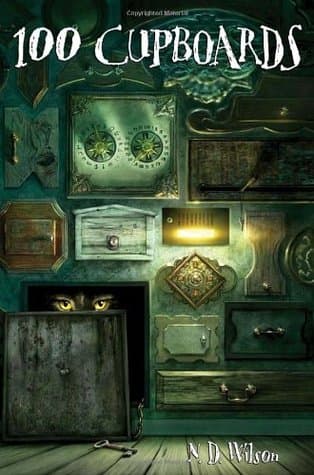
Synopsis
Covers the whole plot, including the ending.
- Difficulty
- Easy
- Pacing
- Moderate
- Mood
- Mysterious, Adventurous, Whimsical, Suspenseful
- Read it if
- You enjoy classic portal fantasy, stories about discovering secret magical worlds, and adventures with a touch of mystery.
- Skip it if
- You prefer high fantasy with complex magic systems, or stories without a clear 'good vs. evil' dynamic.
100 Cupboards Plot Summary
Covers the whole plot, including the ending.
A New Home and a Mysterious Wall
Twelve-year-old Henry York stays with his Aunt Dotty and Uncle Frank in Fitch, Kansas, after his parents are kidnapped during an archaeological dig. He moves into the attic bedroom, which has little furniture and a large, unplastered wall. The first night, Henry hears sounds from the wall. He ignores them, but the next night, plaster dust falls on his head, showing two small, brass doorknobs. Henry chips away at the plaster, finding an old wooden door behind the wall. His cousin, Henrietta, often visits him, interested in his discoveries.
Unveiling the Ninety-Nine Cupboards
Henry and Henrietta remove more plaster, finding not just one door, but ninety-nine cupboards. They vary in size, shape, material, and design. Some are tiny, others large; some look old, others newer. They try a few, finding one leads to a world of endless rain, another to a dark, cold void. The number and variety of the cupboards suggest they are more than storage, making the children wonder about their true purpose. They keep their discovery a secret from the adults.
First Forays and a Glimpse of Another World
Henry chooses a cupboard with a glowing light. He opens it a crack and sees a brightly lit, elegant room where a man is pacing. The man appears to be a wizard in robes and seems distressed. Henry quickly closes the door, surprised by the clear view into another world. This confirms their idea that the cupboards are portals. Later, Henrietta accidentally opens a cupboard, showing a dark, shadowy forest and a sense of old magic, further proving the doors are fantastical. They begin to understand the power and danger of these doors.
The Wizard's Warning and the Witch's Return
Through the glowing cupboard, Henry talks to the wizard, Frank Willis. Willis says the cupboards are portals between worlds, made by a witch named Zither, who was banished through one of them generations ago. He warns Henry that Zither is trying to return and that the cupboards connect to Henry's family history. Willis explains that Henry is a descendant of the house's original owners, and his family helps keep the worlds separate. He tells Henry to be careful, as Zither's return would cause chaos.
Henrietta's Recklessness and the White Witch's Intrusion
Despite Henry's warnings, Henrietta, wanting adventure, opens a cupboard Frank Willis told them not to. This cupboard leads to a world linked to Zither. A cold wind sweeps into the attic, and a shadowy, powerful presence appears. This is Zither, the White Witch, who has partly crossed back into their world. She does not fully appear, but her influence is clear. This act of disobedience has bad results, as Zither now has a way in and can start to use her power, putting Henry and his family in danger.
The Search for the Missing Hundredth Cupboard
Frank Willis tells Henry there were originally one hundred cupboards, and the hundredth controls and can seal the portals. This hundredth cupboard is not behind the wall but is a special, hidden door that opens only when the other ninety-nine are set right. He says Henry's ancestors guarded these portals and stopped Zither's return. The hundredth cupboard is important for trapping Zither permanently and protecting their world, making its discovery a main goal for Henry and Henrietta as they try to fix Henrietta's mistake.
Meeting the Scavengers and the Flying Man
As things get worse, Henry and Henrietta meet two unusual characters who crossed through the cupboards. One group is small, rat-like creatures called Scavengers, who are mischievous and seem to be looking for something. The other is a peculiar, flying man, who seems to be a friend of Frank Willis and also from another world. These meetings show the portals are becoming unstable and danger is growing, as more beings from other dimensions enter Henry's world. Some have unclear intentions, others clearly work against Zither.
The Trap and the Sacrifice
Zither, now stronger, tries to trick Henry into opening a specific cupboard that would let her fully enter. She uses illusions and whispers, trying to use his fears. During a confrontation, Henrietta, understanding her mistake, makes a brave decision. To stop Zither from fully crossing over and to protect Henry, she sacrifices herself, entering one of the dangerous cupboards. This traps her in another world and briefly stops Zither's plan. Her action buys Henry time but leaves him upset and determined to rescue her.
Unlocking the Hundredth Cupboard
Upset by Henrietta's sacrifice and guided by Frank Willis, Henry looks for the hundredth cupboard. He realizes it is not a physical door on the wall but a mechanism or a specific order. Following clues from his ancestors and understanding the house's magic, Henry finds that the hundredth cupboard is the fireplace in his attic room. It appears as a portal only when certain things happen or a specific item is used. This discovery is a big change, as it gives a direct path to the world where Zither was banished and where Henrietta is now trapped.
A Journey to the Other Side
With the hundredth cupboard revealed through the fireplace, Henry, now understanding his family's past and the magical worlds, decides to step through it. He knows this is the only way to find Henrietta and confront Zither. As he passes through the portal, he enters a new, fantastical world, different from his own. This shows he accepts his destiny and his commitment to his cousin. The book ends with Henry starting his journey into the unknown, setting up the next part of his adventure.
Principal Figures
Henry York
Protagonist
A twelve-year-old boy who discovers the magical cupboards and his family's hidden legacy.
Henry is a thoughtful, observant, and initially somewhat timid boy who is thrust into a world of magic and danger. He is sent to live with his aunt and uncle in Kansas after his parents disappear, leading him to discover the ninety-nine cupboards. He is driven by curiosity, a sense of responsibility, and a deep affection for his cousin, Henrietta. Throughout the story, he grapples with fear and uncertainty but ultimately finds courage and a growing understanding of his unique heritage as a descendant of the cupboard guardians.
Relationships: Henrietta (Cousin and close friend, co-discoverer of the cupboards); Aunt Dotty (Caring but unaware guardian); Uncle Frank (Gruff but well-meaning guardian); Frank Willis (Mentor and guide from another world)
Henrietta York
Supporting/Co-protagonist
Henry's adventurous and sometimes reckless cousin, who helps him uncover the secrets of the cupboards.
Henrietta is Henry's slightly older cousin, full of energy, curiosity, and a mischievous spirit. She is quick to embrace the fantastical nature of the cupboards, often pushing Henry to explore them further. Her impulsive nature leads to both exciting discoveries and dangerous mistakes, such as inadvertently allowing Zither to gain a foothold in their world. Despite her recklessness, she is fiercely loyal to Henry and ultimately makes a profound sacrifice to protect him, demonstrating her deep courage and love.
Relationships: Henry York (Cousin and close friend, co-discoverer of the cupboards); Aunt Dotty (Mother); Uncle Frank (Father)
Aunt Dotty
Supporting
Henry's kind and loving aunt, who provides a temporary home but is unaware of the magical events.
Aunt Dotty is Henry's maternal aunt and a warm, nurturing figure who takes Henry in after his parents disappear. She is depicted as a typical, loving mother and homemaker, deeply concerned with the well-being of her family. Unbeknownst to her, her house holds ancient magical secrets. Her normalcy provides a stark contrast to the fantastical events unfolding in her attic, highlighting the hidden nature of the magical world from most adults. She is a source of comfort and stability for Henry amidst his bewildering discoveries.
Relationships: Henry York (Nephew); Uncle Frank (Husband); Henrietta (Daughter)
Uncle Frank
Supporting
Henry's gruff but caring uncle, who is also unaware of the magical secrets of his house.
Uncle Frank is Henry's maternal uncle, a practical and somewhat gruff man who runs a hardware store. He provides a sense of normalcy and routine for Henry, often seen working in his garage. Like Aunt Dotty, he is completely oblivious to the magical cupboards and the interdimensional conflicts occurring in his own home. He represents the everyday world that Henry must navigate while simultaneously discovering extraordinary secrets. Despite his gruff exterior, he cares for Henry and his family, providing a stable, if ordinary, environment.
Relationships: Henry York (Nephew); Aunt Dotty (Wife); Henrietta (Daughter)
Frank Willis
Supporting/Mentor
A wizard from another world who guides Henry about the cupboards and the threat of Zither.
Frank Willis is a wise and powerful wizard from one of the worlds accessible through the cupboards. He is trapped or chooses to remain in his world, communicating with Henry through the glowing cupboard. He serves as Henry's primary mentor, providing crucial information about the history of the cupboards, the nature of the different worlds, the threat of Zither, and Henry's own family legacy. He is patient but urgent, understanding the immense danger Henry faces and the importance of his role in protecting the worlds. He is instrumental in helping Henry understand the hundredth cupboard.
Relationships: Henry York (Mentor/Mentee); Zither (Ancient adversary)
Zither (The White Witch)
Antagonist
An ancient and powerful witch banished through the cupboards, seeking to return to wreak havoc.
Zither is the primary antagonist of the story, a malevolent and powerful witch from ancient times who was banished through one of the cupboards. She is associated with the cold, darkness, and decay. Her return is the central conflict of the book, as she seeks to cross back into Henry's world and reclaim her power. She manipulates and tempts, using fear and deception to achieve her goals. Her influence is felt as a chilling presence, and she represents the ultimate danger that Henry and his family must confront, embodying pure evil.
Relationships: Henry York (Target/Opponent); Frank Willis (Ancient adversary)
Elias (The Flying Man)
Supporting
An enigmatic ally from another world who assists Henry and Frank Willis.
Elias is a mysterious figure from one of the other worlds, characterized by his ability to fly and his unusual appearance. He acts as a scout and messenger for Frank Willis, sometimes appearing unexpectedly to offer aid or information to Henry. He is not fully explained in this first book but clearly serves as an ally in the fight against Zither. His presence further emphasizes the interconnectedness of the worlds and the diverse beings that inhabit them, adding to the sense of wonder and danger.
Relationships: Henry York (Ally); Frank Willis (Ally)
The Scavengers
Supporting/Mentioned
Small, rat-like creatures from another world who cross through the cupboards.
The Scavengers are small, opportunistic creatures from one of the other worlds. They are depicted as somewhat grotesque and mischievous, often causing minor trouble but not inherently evil. They are drawn to the open portals, suggesting a natural tendency to cross between worlds when possible. Their presence adds to the sense of the cupboards being actively used and highlights the growing instability of the barriers between dimensions. They are more of a nuisance than a direct threat, but their appearance signifies the increasing chaos.
Relationships: Henry York (Encountered, but not directly related)
Themes & Insights
Identity and Legacy
Identity is central to Henry's journey as he learns he is not just an ordinary boy but a descendant of a family guarding powerful portals. The cupboards are linked to his ancestors, and his parents' disappearance makes him uncover his true heritage. This makes Henry face who he is and what his family's history means for his future, especially as he learns his role in the magical conflict. The house and cupboards show his family's legacy.
“You are a York, Henry. This house, these cupboards... they belong to your blood. You have a part to play, whether you want it or not.”
Curiosity and its Consequences
Curiosity drives both Henry and Henrietta, leading them to find the cupboards and their secrets. Henry's initial chipping away at the plaster and Henrietta's eager exploration of the doors move the plot. However, the book also explores the dangers of unchecked curiosity, especially through Henrietta's decision to open a forbidden cupboard, which lets Zither enter their world. This shows how discovery can quickly turn from wonder to danger.
“Some doors are best left closed, Henry. Especially when you don't know what's on the other side.”
Responsibility and Sacrifice
As Henry learns about his family's past, he understands the responsibility he has to protect the worlds from Zither. This theme culminates in Henrietta's sacrifice, where she enters a dangerous world to save Henry and stop Zither's return. Her decision shows the seriousness of the situation and how far characters will go for those they care about. Henry's later quest to rescue Henrietta is driven by responsibility and love.
“I have to go, Henry. You can't let her through. Promise me.”
The Hidden World Within the Mundane
The story contrasts the ordinary, rural setting of Fitch, Kansas, with the magical worlds hidden behind an attic wall. Henry's aunt and uncle do not know about the portals in their home, showing how close magic can be to everyday life without most people noticing. This theme highlights that wonder and danger can exist just beyond perception, turning a normal house into a place of fantastic possibilities and old conflicts.
“It was just a wall. A plaster wall in an attic bedroom. But behind it, the whole world was waiting.”
Good Versus Evil
At its core, '100 Cupboards' presents a clear conflict between good and evil, shown by the wizard Frank Willis and the witch Zither. The story establishes Zither as a force of darkness, threatening to corrupt and destroy. Henry and his friends represent good, working to keep balance and protect innocent worlds. This main theme drives the plot, shaping the characters' actions and the ultimate stakes of their adventure, as they fight to stop evil from winning.
“There is a darkness, Henry, that has been trying to break through for a long, long time. And it knows your name.”
Plot Devices & Literary Techniques
The Ninety-Nine Cupboards
A wall of diverse magical portals connecting to other worlds.
The ninety-nine cupboards are the central plot device, serving as literal portals to various dimensions and fantastical realms. Each cupboard has a unique appearance, hinting at the world it connects to. They are the catalyst for the entire story, introducing Henry to magic, his family's legacy, and the conflict with Zither. Their diverse nature allows for a wide range of world-building possibilities and drives the children's exploration and the narrative's forward momentum. They are both a source of wonder and immense danger.
The Hundredth Cupboard
The special, hidden portal that is key to controlling and sealing the other cupboards.
The hundredth cupboard is a crucial mystery and plot device. Unlike the other ninety-nine, it is not visibly part of the attic wall but a hidden, special portal (later revealed to be the fireplace) that holds the power to properly seal or control the other doorways. Its discovery is paramount to defeating Zither and protecting the worlds. This device creates a sense of urgent quest and provides a clear objective for Henry, elevating his role beyond mere explorer to that of a guardian with a specific mission.
Ancestral Legacy
Henry's inherent connection to the cupboards and his family's role as guardians.
Henry's ancestral legacy is a key plot device, establishing his unique connection to the magical world and the cupboards. The house, the cupboards, and the conflict with Zither are all tied to his family's history, revealing that his lineage carries a specific responsibility. This device provides Henry with a destiny and a purpose, moving him beyond being a mere bystander to an active participant in an ancient war. It explains why he, specifically, can interact with the cupboards and why Zither is interested in him.
The Vanished Parents
The unexplained disappearance of Henry's parents, triggering his move and the plot.
The disappearance of Henry's parents while on an archaeological dig serves as the initial inciting incident. It forces Henry to move to Kansas, where he discovers the cupboards. This plot device creates a sense of mystery and unresolved tension, hinting at a larger world beyond the mundane and potentially linking his parents' fate to the magical events unfolding. It also provides Henry with a personal motivation beyond simply protecting the worlds: the hope that the cupboards might lead him to his lost family.
100 Cupboards Quotes
“Henry knew that the fear of the dark was a silly thing, but he also knew that silly things could be very real.”
“The world was not a safe place, but it was a wonderful one, and that was the important thing.”
“It was impossible to be truly alone in a house full of secrets.”
“Some doors are meant to be opened, and some are meant to stay closed. The trick is knowing the difference.”
“Magic wasn't something you could just turn on and off. It was a part of the world, like gravity or the wind.”
“He learned that courage wasn't the absence of fear, but the decision that something else was more important.”
“Every lock has a key, and every secret has a way of being found out.”
“The past wasn't just behind you; sometimes it was all around you, breathing down your neck.”
“Home was more than just a place; it was the people you shared it with, and the stories you made there.”
“There are always more stories in the world than you could ever imagine, just waiting to be told.”
“To truly see, sometimes you had to look with more than just your eyes.”
“Silence could be a kind of noise, especially when it was filled with unspoken questions.”
“The greatest adventures often began in the smallest, most unexpected places.”
“Some things, once broken, could never truly be put back together in the same way, but they could become something new.”
Quiz
10 questions on the plot and the characters. Each answer comes with a short explanation.
Question 1
Where is Henry York staying when he discovers the cupboards?
- His grandparents' house
- His own house in a new city
- His aunt, uncle, and cousins' house
- A boarding school
Show answer
C. His aunt, uncle, and cousins' house Henry is staying with his aunt, uncle, and three cousins in an unfamiliar house when he first hears the bump on the attic wall.
Question 2
What is the initial sign that something unusual is happening in the attic?
- A strange light emanating from the ceiling
- The sound of voices whispering from above
- A bump on the attic wall followed by plaster in his hair
- A small animal scratching inside the wall
Show answer
C. A bump on the attic wall followed by plaster in his hair Henry first hears a bump on the attic wall, and the next night, he wakes up with bits of plaster in his hair, indicating something is breaking through.
Question 3
How many cupboards does Henry initially discover behind the plaster?
- One large cupboard
- Ninety-nine cupboards
- One hundred cupboards
- A dozen small doors
Show answer
B. Ninety-nine cupboards After scraping off the plaster, Henry discovers 'ninety-nine cupboards of all different sizes and shapes'. The book title implies 100, but the initial discovery is specifically 99.
Question 4
What is the first distinct sound Henry hears coming from one of the cupboards?
- The sound of distant thunder
- The sound of falling rain
- The sound of ocean waves
- The sound of wind howling
Show answer
B. The sound of falling rain The description explicitly states, 'Through one he can hear the sound of falling rain,' indicating the first unique sound.
Question 5
What is seen through a different cupboard, suggesting another world?
- A vast, empty desert
- A glowing room with a man strolling back and forth
- A deep, dark forest
- A bustling city street
Show answer
B. A glowing room with a man strolling back and forth The text states, 'Through another he sees a glowing room—with a man strolling back and forth!' This confirms the portals lead to other places with inhabitants.
Question 6
Who is Henry's companion in understanding the nature of the cupboards?
- His aunt
- His uncle
- His cousin Henrietta
- A new friend from school
Show answer
C. His cousin Henrietta The summary mentions, 'Henry and his cousin Henrietta soon understand that these are not just cupboards,' indicating she is his primary confidante and partner in discovery.
Question 7
What is the true nature of the cupboards, as discovered by Henry and Henrietta?
- They are old storage units for the house
- They are magical looking glasses
- They are portals to other worlds
- They are elaborate children's toys
Show answer
C. They are portals to other worlds The core revelation is that 'They are, in fact, portals to other worlds,' which sets up the fantasy adventure.
Question 8
The book '100 Cupboards' is described as the first in a new fantasy adventure. What genre tradition does it draw upon and reinvent?
- Time-traveling narratives
- Detective mystery stories
- World-hopping tradition
- Classic coming-of-age tales
Show answer
C. World-hopping tradition The description states the book is 'written in the best world-hopping tradition and reinvented in N.D Wilson's own inimitable style,' highlighting its genre roots.
Question 9
What specific detail about the cupboards' appearance is mentioned?
- They are all identical in size and shape
- They are made of various precious metals
- They are of all different sizes and shapes
- They are painted in bright, uniform colors
Show answer
C. They are of all different sizes and shapes The text specifies that Henry discovers 'ninety-nine cupboards of all different sizes and shapes,' emphasizing their unique and varied nature.
Question 10
What is Henry's age at the beginning of the story?
- Ten years old
- Eleven years old
- Twelve years old
- Thirteen years old
Show answer
C. Twelve years old The summary clearly states, 'Twelve-year-old Henry York is going to sleep one night...' establishing his age.
100 Cupboards FAQ
What is '100 Cupboards' about?
Twelve-year-old Henry York discovers a wall in his attic room containing ninety-nine mysterious, locked cupboards of various sizes. With the help of his cousin Henrietta, he realizes these aren't just cupboards but portals to other worlds, leading him on an adventure to uncover his own magical heritage and confront ancient evils tied to these interdimensional doors.
Why should I read '100 Cupboards'?
'100 Cupboards' offers a unique blend of mystery, fantasy, and adventure, perfect for readers who enjoy world-hopping narratives and discovering hidden magic in ordinary places. It features intriguing characters, a creative magic system involving 'scriveners' and 'witches,' and a compelling plot that keeps you guessing about the secrets behind each cupboard.
What is the background/setting of '100 Cupboards'?
The story begins with Henry York, an orphan, being sent to stay with his eccentric Aunt Dotty and Uncle Frank and their three children in the small, seemingly ordinary town of Wichita, Kansas. The primary setting is the old, rambling farmhouse, particularly Henry's attic room where the magical cupboards are hidden behind a plastered wall.
What writing style does the author use?
N.D. Wilson employs a vivid, imaginative, and often whimsical writing style that balances detailed descriptions with brisk pacing. His prose is accessible for young readers but also rich with imagery and philosophical undertones, making the fantastical elements feel grounded and the emotional stakes resonate deeply.
What minor details add significant meaning?
The repeated mention of Henry's 'itchy' hands, initially just a nervous habit, subtly foreshadows his inherited scrivener abilities to sense and manipulate magic. Also, Aunt Dotty's peculiar knowledge and cryptic remarks hint at her deeper connection to the magical world long before it's explicitly revealed.
What are some subtle foreshadowing moments?
Early in the book, the strange behavior of the family cat, who seems to react to the attic wall before Henry discovers the cupboards, subtly hints at the magical presence. Additionally, the recurring dream Henry has of a woman's face and a sense of longing foreshadows the truth about his mother and his origins in a magical world.
What unexpected character connections exist?
Perhaps the most significant unexpected connection is Henry's lineage: he is the son of a powerful scrivener and a witch from another world, making him a 'scrivener-witch.' This reveals that Aunt Dotty is not just his aunt by marriage but also deeply involved in the magical world as a former witch and guardian of the cupboards.
What are unspoken character motivations?
Aunt Dotty's unspoken motivation for initially keeping the secrets of the cupboards from Henry stems from a desire to protect him from the dangers of the magical worlds and the wicked witch, Nimian. She carries the burden of past mistakes and the responsibility of guarding the portals, influencing her cautious and secretive behavior.
What psychological complexities do characters exhibit?
Henry grapples with feelings of abandonment and an identity crisis, exacerbated by being an orphan and then discovering his true, magical heritage. His initial fear turns into a courageous resolve, but he struggles with the weight of his newfound responsibilities and the moral ambiguities of the magic he wields.
What are the major emotional turning points?
A key emotional turning point is when Henry first opens a cupboard and glimpses another world, shattering his perception of reality. Another is his reunion with his mother, Penelope, in the other world, which provides a profound sense of belonging and purpose, even amidst the danger.
How do relationship dynamics evolve?
Henry's relationship with his cousin Henrietta evolves from typical cousinly banter to a strong bond of trust and partnership as they navigate the dangers of the cupboards together. His initial distance from Aunt Dotty also transforms into understanding and affection once her true role and intentions are revealed.
Which parts remain ambiguous or open-ended?
The full extent of the history of the cupboards, the exact number of worlds they connect to, and the ultimate fate of some of the more minor characters from other worlds remain somewhat ambiguous. The story concludes with many questions about the broader implications of Henry's powers and the ongoing threat of Nimian, setting up future books.
What are controversial scenes or decisions?
One potentially controversial decision is Aunt Dotty's choice to keep Henry's true parentage and the existence of the cupboards a secret for so long, even after he moves into her house. While done for protection, it initially puts Henry in danger due to his ignorance and forces him to discover these truths on his own.
'100 Cupboards' ending explained: how it ends & what it means
The book ends with Henry having confronted Nimian, the evil witch, and rescued his mother, Penelope, from her captivity. While Nimian is defeated for now, her influence is not completely eradicated, and the cupboards remain active. The ending signifies Henry's acceptance of his scrivener-witch heritage and his readiness for further adventures, understanding that his journey to fully master his powers and protect the worlds has only just begun.
About the author

N.D. Wilson is an American author known for his works of fiction, particularly in the realm of children's and young adult literature. His notable books include "100 Cupboards," a fantasy adventure that explores hidden worlds, and "Leepike Ridge," which combines elements of mystery and survival. Wilson's storytelling often weaves together themes of imagination and discovery.
Similar books
- Fablehaven
Brandon Mull
4.1 (134k) average on GoodreadsFantasyInvolves children discovering a hidden magical preserve and protecting it from dark forces.
- Coraline
Neil Gaiman
4.0 (23k) average on GoodreadsFantasyCoraline also explores a portal to an 'other world' found within a house, but Gaiman's narrative leans heavily into psychological horror and a much darker, more unsettling atmosphere. The 'other mother' in Coraline is a singular, terrifying antagonist, whereas 100 Cupboards presents a broader, more complex magical conflict involving multiple factions and a history of ancient magic. Wilson's tone is generally more adventurous and hopeful, even in the face of danger, suitable for a younger middle-grade audience, while Gaiman's book targets a slightly older demographic with its more mature themes of neglect and existential dread.
- Harry Potter and the Sorcerer's Stone
J.K. Rowling
4.5 (7M) average on GoodreadsFantasyRescued from a miserable life under the stairs, an orphaned boy discovers he's a wizard destined for a magical school, where he uncovers a dangerous secret tied to the dark wizard who murdered his parents.
- The Hunger Games
Suzanne Collins
4.3 (6.4M) average on GoodreadsFantasyIn a future where children fight to the death on live television, Katniss Everdeen volunteers for the arena, turning a death sentence into a fight for survival and a spark of rebellion.
- 1984
George Orwell
4.2 (3.1M) average on GoodreadsPoliticsIn a future where surveillance and thought control are absolute, a man's search for truth clashes with the Party, showing that hope can be a form of rebellion.
- Divergent
Veronica Roth
4.2 (2.9M) average on GoodreadsFantasyIn a society divided by virtues, a sixteen-year-old's difference from the norm starts a rebellion that threatens her world.





Enjoyed the summary?
A summary gives you the shape of the book. The book itself has the detail, the examples and the voice.
Find 100 Cupboards on AmazonAs an Amazon Associate, BookBrief earns from qualifying purchases. How we're funded