
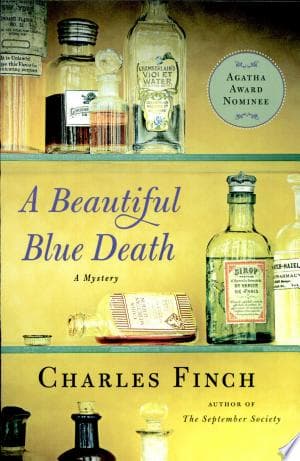
Synopsis
Covers the whole plot, including the ending.
- Difficulty
- Easy
- Pacing
- Moderate
- Mood
- Atmospheric, Engaging, Cerebral, Elegant
- Read it if
- You enjoy classic Victorian mysteries with a charming, amateur detective and a focus on deduction.
- Skip it if
- You prefer fast-paced thrillers or mysteries with graphic violence.
A Beautiful Blue Death Plot Summary
Covers the whole plot, including the ending.
A Friend's Plea
The novel opens with Charles Lenox, a Victorian gentleman, enjoying his life in London. His quiet is interrupted by a visit from his friend, Lady Jane Grey, who is upset. Jane tells Lenox that Prudence Smith, a former maid she had helped get a job with the wealthy Ashton family, has died. The official ruling is suicide by laudanum overdose. However, Jane, knowing Prudence, suspects foul play and asks Lenox to investigate, believing Prudence would not take her own life. Lenox, seeing a challenge and loyal to Jane, agrees to discreetly look into the matter, setting aside his usual routines for a genuine mystery.
Initial Inquiries at the Ashton Estate
Lenox begins his inquiries at the grand Ashton estate, where Prudence worked. He speaks with various members of the household, including Mr. and Mrs. Ashton, their son William, and other servants. He learns that Prudence was known for her beauty and charm, suggesting possible romantic affairs. Lenox observes the family dynamics and the servants' reactions, noting unease and a reluctance to speak openly about Prudence. He quickly finds differences in the accounts of Prudence's final hours and the discovery of her body, strengthening his suspicion that her death was not self-inflicted but murder, perhaps by a subtle poison.
The Poisoner's Hand
Driven by his intuition, Lenox consults his friend Dr. Sidney, a respected physician, about a poison that could mimic a laudanum overdose. Dr. Sidney, after hearing the details Lenox has gathered and the unusual symptoms, confirms Lenox's hunch. He suggests a rare and potent poison, one that would leave few traces and could easily be mistaken for natural causes or an overdose. This medical confirmation solidifies Lenox's belief that Prudence was murdered and narrows his investigation, now focusing on who would have access to such a specific substance, and why.
Unraveling Prudence's Past
Lenox begins to reconstruct Prudence Smith's life, especially her romantic affairs. He finds that Prudence had many admirers, both within the Ashton household and outside it. He learns of a secret affair with William Ashton, the family's son, kept hidden from his parents. He also discovers that Prudence had a previous relationship with Mr. Ashton's coachman, and that she had recently broken off an engagement to a young man named Mr. Finch. Each of these relationships presents a possible motive, from jealousy and betrayal to a desire to hide a scandalous affair, making the list of suspects grow.
A Second Victim
The investigation takes a turn during a ball hosted by Lady Catherine. Amidst the London season, another body is discovered – Mr. Finch, Prudence's jilted fiancé. His death is similar to Prudence's, suggesting the same killer and poison. This second murder elevates the case to a high-profile scandal. Lenox realizes the killer is not afraid to strike again, even in public, and that the motive is deeper and more complex than he first thought, possibly involving a wider conspiracy or an attempt to silence witnesses.
Connecting the Dots
With two victims, Lenox increases his efforts, now searching for a link between Prudence Smith and Mr. Finch beyond their romantic past. He revisits their lives, seeking common threads. Through careful questioning and observation, Lenox discovers that both Prudence and Mr. Finch knew a significant secret involving the Ashton family. This secret, if revealed, could harm the Ashtons' reputation and social standing. Lenox begins to suspect that the murders are not crimes of passion but calculated acts to protect a larger, darker secret, and that the killer is likely someone within the Ashtons' inner circle or someone with an interest in their affairs.
The Threat Nears Home
As Lenox nears the truth, he realizes the killer is systematically eliminating anyone who knows or could expose the Ashton family's secret. This realization alarms him, as Lady Jane Grey, his friend, placed Prudence with the Ashtons and has been involved in the investigation. The danger is no longer distant; it is close to home, threatening those he cares about most. Lenox understands he must act quickly, not just to solve the murders, but to protect his friends from becoming the killer's next victims, increasing the urgency and personal stakes of his pursuit.
The Revelation of the Secret
Through diligent investigation, piecing together information, and deductions, Lenox uncovers the Ashton family's grave secret. It involves a hidden past, a scandalous affair, and a child born out of wedlock, meticulously concealed to protect the family's social standing and inheritance. Prudence Smith had stumbled upon this secret, and Mr. Finch, her fiancé, had also become aware of it, perhaps through Prudence herself or through his own connections. This revelation provides the motive for the murders: a desperate attempt to prevent the truth from coming to light and destroying the Ashton family's carefully constructed image.
Confrontation and Confession
Armed with the full truth, Lenox arranges a confrontation, bringing together the key people. He lays out the evidence, motives, and method of the murders, revealing the killer to be Mrs. Ashton. Driven by a desire to protect her son, William, and the family's reputation and fortune from the scandal of the illegitimate child, she resorted to murder. She had access to the rare poison through her connections and skillfully administered it to Prudence and Mr. Finch. Faced with Lenox's logic and evidence, Mrs. Ashton confesses to the crimes committed to protect her family.
Aftermath and Resolution
With Mrs. Ashton's confession, the mystery of the beautiful blue death is solved. The Ashton family is shattered, their secrets exposed. Justice is served. Lenox, having solved the network of deceit and murder, returns to his quiet life. The experience leaves a lasting mark on him. He reflects on the darker aspects of Victorian society, the lengths people will go to protect their image, and the tragic results of hidden truths. The case solidifies his reputation as a keen amateur detective and leaves him with a new appreciation for his peaceful existence, along with a deeper understanding of human nature.
Principal Figures
Charles Lenox
Protagonist
A Victorian gentleman detective who solves crimes for intellectual stimulation.
Charles Lenox is a man of considerable intellect, refined tastes, and independent means. He possesses a sharp mind, a keen observational ability, and a deep interest in human psychology. Though he enjoys the comforts of his leisurely life, he finds true fulfillment in unraveling complex puzzles. He is empathetic, loyal to his friends, and possesses a strong moral compass that drives him to seek justice, even when it means confronting the unpleasant realities of society. His methods are methodical, relying on deduction, interviews, and a deep understanding of human nature rather than brute force.
Relationships: Lady Jane Grey (Lifelong friend, confidante, and the catalyst for his investigation); Dr. Sidney (Friend and medical consultant who aids in understanding poisons and forensics); Prudence Smith (The murder victim whose death Lenox investigates)
Lady Jane Grey
Supporting
Lenox's lifelong friend whose concern for a former servant ignites the investigation.
Lady Jane Grey is a compassionate and astute woman of society, fiercely loyal to her friends and those she cares about. She is the catalyst for Lenox's involvement in the case, her strong intuition and belief in Prudence Smith's innocence overriding the official verdict of suicide. Jane often acts as Lenox's sounding board and provides valuable insights into the social dynamics of Victorian England. She is not afraid to challenge authority or societal norms when she believes an injustice has occurred, demonstrating a quiet strength beneath her genteel exterior.
Relationships: Charles Lenox (Lifelong friend and confidante); Prudence Smith (Former servant whom she genuinely cared for)
Prudence Smith
Victim
The beautiful young maid whose mysterious death sets the plot in motion.
Prudence Smith is the central victim whose apparent suicide is quickly revealed to be murder. She is described as a beautiful and charming young woman, which attracted the attention of several men, both high-born and low. Her character, though largely revealed through the recollections of others, suggests a woman who was perhaps a little naive, ambitious, and certainly entangled in multiple romantic affairs. Her death is the catalyst for the entire mystery, and her past relationships and secrets are crucial to unraveling the killer's motive.
Relationships: Lady Jane Grey (Former employer and benefactor); William Ashton (Secret lover); Mr. Finch (Jilted fiancé); Mrs. Ashton (Her killer)
Dr. Sidney
Supporting
Lenox's trusted physician friend who provides crucial medical expertise.
Dr. Sidney is a respected and knowledgeable physician, a friend of Charles Lenox. He serves as Lenox's medical consultant, providing expert advice on poisons, symptoms, and forensic possibilities. His scientific expertise is invaluable to the investigation, allowing Lenox to confirm his suspicions about the nature of Prudence's death and to understand the effects of the rare poison used by the killer. Dr. Sidney is pragmatic and grounded, offering a necessary counterpoint to Lenox's more intuitive deductions, grounding the investigation in scientific fact.
Relationships: Charles Lenox (Friend and professional consultant)
Mrs. Ashton
Antagonist
The matriarch of the Ashton family and the desperate killer.
Mrs. Ashton is initially presented as a respectable and somewhat severe woman, the mistress of the house where Prudence worked. Beneath her composed exterior lies a fierce, almost obsessive, devotion to her family's reputation and her son's future. She is driven by a deep-seated fear of social ruin and the exposure of a long-held family secret. Her desperation and willingness to commit murder to protect her family's standing reveal the darker side of Victorian societal pressures and the extreme lengths to which some would go to maintain appearances.
Relationships: Mr. Ashton (Husband); William Ashton (Son, whom she fiercely protects); Prudence Smith (Her victim and former servant)
William Ashton
Supporting
The Ashton family's son, entangled in a secret affair with Prudence Smith.
William Ashton is the son of Mr. and Mrs. Ashton, a young man of privilege who engages in a secret affair with Prudence Smith. He appears somewhat weak-willed and easily manipulated, caught between his desires and his family's expectations. His relationship with Prudence provides a significant romantic motive in the early stages of the investigation, though he is ultimately revealed to be more a pawn in the larger family drama than the instigator of the murders. His character highlights the class divisions and hidden romantic entanglements of the era.
Relationships: Prudence Smith (Secret lover); Mrs. Ashton (Mother, whose protection ultimately leads to murder)
Mr. Finch
Victim
Prudence's jilted fiancé and the second victim of the mysterious killer.
Mr. Finch is introduced as Prudence Smith's former fiancé, a respectable young man whose engagement to Prudence was broken off shortly before her death. His murder during a society ball confirms Lenox's suspicions that there is a serial killer at work and that the motive extends beyond a simple crime of passion. Mr. Finch's connection to Prudence and his unwitting knowledge of the Ashton family's secret make him a dangerous loose end in the killer's eyes, leading to his tragic demise.
Relationships: Prudence Smith (Jilted fiancé); Mrs. Ashton (His killer)
Mr. Ashton
Supporting
The patriarch of the Ashton family, seemingly unaware of the full extent of his family's secrets.
Mr. Ashton is the patriarch of the wealthy Ashton family, a figure of authority within his household. He appears somewhat detached and perhaps less aware of the deeper machinations within his family compared to his wife. His primary concern seems to be maintaining the family's social standing and reputation. While not directly involved in the murders, his passive role in maintaining the family's secrets and his general lack of insight contribute to the environment in which the tragic events unfold. He represents the patriarchal head of a Victorian household, often oblivious to the hidden emotional lives of those around him.
Relationships: Mrs. Ashton (Wife); William Ashton (Son)
Themes & Insights
The Dangers of Reputation and Social Standing
This theme explores the extreme lengths people in Victorian society would go to protect their public image and social status. The Ashton family's hidden secret – an illegitimate child – is deemed so devastating that Mrs. Ashton resorts to murder to prevent its exposure. Prudence Smith and Mr. Finch become victims not due to personal animosity, but because they threaten this carefully constructed facade. The novel shows how the rigid social hierarchy and strict moral codes of the era could drive individuals to desperate and criminal acts, sacrificing lives for appearances, as seen in Mrs. Ashton's calculated murders to protect her son's inheritance and the family name.
“'In this society, a stain on one's name could be more ruinous than a bullet through the heart.'”
Hidden Lives and Secrets
The novel is built on hidden lives and closely guarded secrets. Prudence Smith's romantic affairs, especially with William Ashton, are kept hidden. More significantly, the Ashton family harbors a deep, old secret involving an illegitimate child, which is the motive for the murders. Lenox's investigation unearths these concealed truths, showing how individuals, even in the same household, can lead separate, unknown lives. The theme highlights the hypocrisy and complexity beneath the polished surface of Victorian society, where public decorum often masked private turmoil and illicit affairs.
“'Every grand house, Lenox mused, held its own labyrinth of unspoken truths.'”
Justice vs. Social Order
This theme examines the tension between achieving justice and maintaining the established social order. Lenox, as an amateur detective, works outside the formal police structure, allowing him to pursue truth without the bureaucratic or social pressures that might influence official investigations. The killer's motive is to preserve the social order for the Ashton family, even if it means sacrificing innocent lives. The resolution of the case, while bringing the killer to justice, also shatters the Ashton family's world, highlighting the destructive power of truth when it clashes with deeply held societal expectations.
“'The law, Lenox knew, was often a blunter instrument than the truth.'”
The Nature of Deception
Deception is present throughout the story in various forms. From the initial misdirection of Prudence's death being ruled a suicide, to the lies spun by the killer and the Ashton family, Lenox must navigate through falsehoods. Characters deceive others about their relationships, their knowledge of events, and their true intentions. The rare poison itself is a form of deception, designed to mimic natural causes. Lenox's skill is his ability to see through these layers of deceit, to distinguish between genuine emotion and performance, and to uncover the hidden truths that others desperately wish to keep secret, revealing the widespread nature of human duplicity.
“'Trust, Lenox often thought, was a fragile commodity, easily shattered by the slightest whisper of a lie.'”
Plot Devices & Literary Techniques
The Amateur Detective
A gentleman of leisure who applies his intellect to solving crimes.
Charles Lenox embodies the classic amateur detective archetype. Unburdened by the constraints of official police work or the need for financial gain, he pursues cases out of intellectual curiosity and a strong sense of justice. This allows him greater freedom to investigate, interview suspects across social strata, and employ unconventional methods. His amateur status also provides a crucial narrative function, allowing the reader to experience the investigation through an intelligent, yet relatable, observer who isn't bound by procedural rules, making his deductions feel more personal and insightful.
The Closed Circle Mystery
A limited group of suspects, often within a contained setting.
The primary setting for the initial investigation is the Ashton estate, effectively creating a 'closed circle' of suspects among the family members and their immediate servants. This device intensifies the psychological drama, as the killer is almost certainly known to the victims and the other characters. It heightens the tension by creating an atmosphere of suspicion and distrust within a confined social environment. While the investigation later expands, the core of the mystery remains rooted in the intimate relationships and secrets within this initial, limited group, focusing the reader's attention on subtle interactions and hidden motives.
The Rare Poison
A specific, unusual method of murder that provides a key clue.
The use of a rare and subtle poison is a critical plot device. It immediately distinguishes the deaths from common suicide or murder methods, indicating a killer with specific knowledge or access. This choice of weapon provides an early clue to Lenox, allowing him to challenge the initial ruling of suicide and driving him to consult Dr. Sidney. The specificity of the poison narrows the field of potential suspects to those who might have known about or acquired such a substance, making its identification a crucial turning point in the investigation and adding an element of scientific intrigue to the mystery.
The Red Herring
Misleading clues or suspects designed to divert the reader and detective.
Throughout the investigation, several characters and circumstances serve as red herrings, diverting Lenox's attention and the reader's suspicions. Prudence's various romantic entanglements, for instance, initially suggest a crime of passion, leading Lenox to explore multiple potential jealous lovers. The initial focus on William Ashton as a primary suspect, due to his secret affair with Prudence, is another example. These misleading clues are expertly woven into the narrative, creating suspense and making the true killer's identity more surprising when finally revealed, challenging both Lenox and the reader to look beyond obvious motives.
A Beautiful Blue Death Quotes
“The fog, when it came, was not a gentle drift but a deliberate, suffocating blanket.”
“There are some truths, I find, that are best approached from an angle, like a shy horse.”
“Money, for all its power, rarely purchases contentment, only a more elaborate form of discontent.”
“The past, like a persistent ghost, always finds a way to haunt the present.”
“One must always listen to what is not said as carefully as to what is.”
“London, in its own way, was as much a character as any human being, with its moods and secrets.”
“Grief, I have learned, is not a simple path, but a tangled forest where one can easily become lost.”
“Every secret, no matter how deeply buried, leaves a trace, a faint echo in the air.”
“The human heart, for all its supposed fragility, can harbor a remarkable capacity for darkness.”
“Justice, when it finally arrives, is rarely a swift stroke, but a slow, grinding inevitability.”
“A good book, even a tragic one, offers its own peculiar comfort.”
“The greatest deceptions are often those we tell ourselves.”
“One cannot escape the consequences of one's actions, no matter how far one travels or how long one waits.”
Quiz
10 questions on the plot and the characters. Each answer comes with a short explanation.
Question 1
What is Charles Lenox's primary social status and occupation at the beginning of 'A Beautiful Blue Death'?
- A working-class journalist reporting on crime.
- A professional detective for Scotland Yard.
- A Victorian gentleman of leisure who investigates crime as a diversion.
- A medical doctor specializing in poisons.
Show answer
C. A Victorian gentleman of leisure who investigates crime as a diversion. Charles Lenox is established as a gentleman of leisure, for whom investigating mysteries is a hobby or diversion, not a profession.
Question 2
Who is the first victim whose death prompts Charles Lenox to investigate?
- Lady Jane, Lenox's lifelong friend.
- Prudence Smith, one of Lady Jane's former servants.
- A guest at a fashionable London ball.
- Lord Ashworth, a prominent politician.
Show answer
B. Prudence Smith, one of Lady Jane's former servants. The initial investigation begins when Lady Jane asks Lenox to look into the apparent suicide of her former servant, Prudence Smith.
Question 3
What initial cause of death is suspected for Prudence Smith, before Lenox intervenes?
- Natural causes due to illness.
- An accidental fall down a staircase.
- Suicide.
- A duel gone wrong.
Show answer
C. Suicide. The police and initial reports consider Prudence Smith's death a suicide, but Lenox quickly suspects murder by poison.
Question 4
What specific method of murder does Lenox suspect Prudence Smith fell victim to?
- Stabbing.
- Strangulation.
- A rare and deadly poison.
- Blunt force trauma.
Show answer
C. A rare and deadly poison. Lenox's initial suspicion, which sets him apart from the official view, is that Prudence was murdered using a 'rare and deadly poison'.
Question 5
Where does Prudence Smith work at the time of her death, a location that becomes central to the investigation?
- A small boarding house in a poor district.
- Lady Jane's own country estate.
- A grand house full of potential suspects.
- A bustling London market.
Show answer
C. A grand house full of potential suspects. The synopsis explicitly states that 'The grand house where the girl worked is full of suspects', indicating it's a key setting.
Question 6
What significant event occurs during the investigation that leads to a second body being discovered?
- A quiet private dinner at Lenox's home.
- The London season's most fashionable ball.
- A public lecture on Victorian medicine.
- A clandestine meeting in a dark alley.
Show answer
B. The London season's most fashionable ball. The second body 'turns up during the London season's most fashionable ball,' escalating the mystery.
Question 7
What aspect of Prudence Smith's personal life is mentioned as potentially complicating the motive for her death?
- Her involvement in political activism.
- Her secret work as a spy.
- Her dabbling with the hearts of more than a few men.
- Her significant gambling debts.
Show answer
C. Her dabbling with the hearts of more than a few men. The text notes that 'Prue had dabbled with the hearts of more than a few men,' suggesting romantic entanglements could be a motive.
Question 8
What is presented as a potential initial motive for Prudence Smith's murder that Lenox considers?
- Financial gain through inheritance.
- Political espionage.
- Jealousy related to her romantic life.
- Revenge for a past slight against her family.
Show answer
C. Jealousy related to her romantic life. The text directly asks, 'Was it jealousy that killed Prudence Smith?' indicating it's a primary suspected motive.
Question 9
What distinguishes Charles Lenox's approach to crime-solving from that of official police, as implied by his character description?
- He relies solely on forensic science.
- He uses his intellect and observation as a gentleman detective, often seeing beyond initial conclusions.
- He employs a network of informants from the criminal underworld.
- He prefers to solve crimes through physical confrontations.
Show answer
B. He uses his intellect and observation as a gentleman detective, often seeing beyond initial conclusions. Lenox is described as a 'gentleman detective' who 'investigates crime as a diversion,' implying a more intellectual, armchair approach akin to Sherlock Holmes, contrasting with conventional police work by suspecting murder where others see suicide.
Question 10
What is the ultimate stakes for Lenox as the investigation progresses, hinted at by the end of the synopsis?
- His reputation as a socialite.
- The safety of someone disturbingly close to home.
- A large monetary reward.
- A promotion within the government.
Show answer
B. The safety of someone disturbingly close to home. The synopsis concludes with the urgency for Lenox to find the killer 'before the killer strikes again—this time, disturbingly close to home,' indicating personal danger.
A Beautiful Blue Death FAQ
What is the central mystery Charles Lenox investigates in 'A Beautiful Blue Death'?
Charles Lenox investigates the mysterious death of Prudence Smith, a former servant of his lifelong friend Lady Jane. Initially deemed a suicide by poison, Lenox quickly suspects murder due to the rarity and specific nature of the poison used, leading him to probe the grand house where Prudence worked and the secrets held by its inhabitants.
Who is Charles Lenox and what are his primary characteristics?
Charles Lenox is a Victorian gentleman detective who approaches crime-solving as a sophisticated diversion from his life of leisure. He is characterized by his sharp intellect, keen observational skills, a love for comfort (tea, fire, books), and a strong sense of loyalty to his friends, particularly Lady Jane, which propels him into the investigation.
How does Lady Jane become involved in the initial investigation?
Lady Jane is Lenox's lifelong friend and the one who directly requests his help. Prudence Smith was her former servant, and Jane is deeply disturbed by the circumstances of Prudence's death, prompting her to turn to Lenox's unique investigative talents rather than accepting the official verdict of suicide.
What role does the 'rare and deadly poison' play in Lenox's initial suspicions?
The specific nature of the poison is crucial. Lenox's knowledge of rare substances immediately raises a red flag, suggesting that Prudence's death was not a simple suicide but a deliberate act requiring specialized knowledge, thus shifting his focus from self-harm to murder.
What is the significance of the second body found at the fashionable ball?
The discovery of a second body during a high-society event significantly escalates the stakes of the investigation and confirms Lenox's suspicions of a serial killer. It suggests a broader motive or a connection to the social circles Prudence inhabited, moving beyond a simple crime of passion to something more intricate and dangerous.
What specific clues or details point Lenox towards murder over suicide for Prudence Smith?
Beyond the rarity of the poison, Lenox likely observes inconsistencies in the scene, the victim's known character, or the lack of a clear motive for suicide that would be consistent with such an elaborate method. These subtle discrepancies in the initial police assessment are what pique his detective's intuition.
Are there any subtle indications of future conflicts or recurring characters introduced in this first novel?
While primarily focused on the immediate mystery, the establishment of Lenox's character, his social circle (like Lady Jane), and his particular investigative methods lay the groundwork for future cases. The book subtly hints at the challenges of operating as a gentleman detective outside official channels, which could become a recurring theme.
How does the author use the Victorian London setting to enhance the mystery?
The Victorian London setting provides a rich backdrop of social stratification, grand houses, fashionable balls, and underlying societal tensions. This contrast between upper-class decorum and hidden dark secrets, alongside the limitations of forensic science at the time, creates an atmospheric and challenging environment for Lenox's investigation.
What is the significance of Prudence Smith's 'dabbles with the hearts of more than a few men'?
Prudence's romantic entanglements are presented as a potential motive, suggesting jealousy or revenge as a driving force behind her murder. This detail introduces a classic whodunit element, where personal relationships and secret affairs become key avenues for Lenox to explore in his search for the killer.
How does Lenox's amateur status influence his investigative methods and interactions with the official police?
Lenox's amateur status grants him greater freedom to pursue unconventional lines of inquiry and access social circles that official police might find challenging to penetrate. However, it also means he operates without official authority, requiring him to rely on his charm, intellect, and connections, and potentially creating friction with Scotland Yard.
What psychological insight does Lenox demonstrate into the motivations of the suspects?
Lenox exhibits a keen understanding of human nature, dissecting the loyalties, animosities, and hidden desires within the grand house's inhabitants. He looks beyond superficial appearances to uncover the underlying psychological pressures and emotional complexities that might drive someone to commit murder, discerning motives like jealousy, ambition, or fear.
How does Lenox's personal connection to Lady Jane affect his objectivity in the case?
While Lenox strives for objectivity, his deep friendship with Lady Jane undoubtedly adds a personal stake to the investigation. This connection might fuel his determination but could also subtly influence his perspective, making him more emotionally invested in finding justice for Prudence, given her past association with Jane.
What internal conflicts or challenges does Charles Lenox face during the investigation?
Lenox likely grapples with the moral complexities of the crimes, the challenge of piecing together fragmented truths from unreliable witnesses, and the pressure of finding a killer before they strike again, especially as the threat draws 'disturbingly close to home.' He must balance his gentlemanly demeanor with the grim realities of murder.
What is the primary theme explored through the contrast of 'Sherlock Holmes and P.G. Wodehouse' in the book's description?
This contrast highlights the book's blend of intellectual rigor and charming wit. It suggests a detective who is both brilliant and analytical like Holmes, meticulously solving complex puzzles, but also possesses the refined social grace, humor, and perhaps a touch of the idyllic, upper-crust world reminiscent of Wodehouse, making the mystery more engaging and less grim.
How does the concept of 'murder, by a rare and deadly poison' contribute to the book's overall atmosphere and sophistication?
The use of a rare poison elevates the crime beyond a common violent act, imbuing it with an air of sophistication and premeditation. It suggests a cunning, perhaps educated, killer and creates an atmosphere of intellectual challenge for Lenox, aligning with the cerebral nature of classic detective fiction.
Is the ending of 'A Beautiful Blue Death' conclusive, or does it leave room for future mysteries and character development?
As a debut mystery, the ending likely provides a satisfying resolution to the immediate case, identifying the killer and their motive. However, it is also expected to solidify Charles Lenox's character and establish his world, implicitly leaving room for him to embark on further investigations and continue his development as a gentleman detective in subsequent books.
How does the title 'A Beautiful Blue Death' connect to the plot or themes of the novel?
The title likely refers directly to the rare poison used, which might cause a distinctive 'blue' discolouration in the victim, or it could metaphorically allude to the deceptive elegance of the upper-class world masking a deadly reality. It hints at the specific, perhaps aesthetically unsettling, nature of Prudence's demise.
What commentary does the book offer on Victorian society through its portrayal of crime and class?
The novel subtly critiques Victorian society by showcasing the hidden depravities and secrets lurking beneath the veneer of upper-class respectability. It highlights the vulnerability of individuals like Prudence Smith, a former servant, and how class divisions can complicate justice, forcing Lenox to navigate both the drawing-rooms and the darker corners of society.
Similar books
- A Study in Scarlet
Arthur Conan Doyle
4.2 (324k) average on GoodreadsHistorical FictionFeatures a brilliant Victorian gentleman detective solving a complex murder with keen observation.
- The Moonstone
Wilkie Collins
3.9 (79k) average on GoodreadsHistorical FictionA classic Victorian mystery with an ensemble cast, secrets, and a focus on a seemingly impossible crime.
- The Secret History of the Pink Carnation
Lauren Willig
3.7 (21k) average on GoodreadsHistorical FictionBlends historical setting with a charming, intelligent protagonist unraveling a mystery, though with more romance.
- The Alienist
Caleb Carr
4.1 (182k) average on GoodreadsFictionWhile both 'A Beautiful Blue Death' and Caleb Carr's 'The Alienist' are set in the past and involve solving murders, they differ significantly in tone and approach. Carr's novel delves into the nascent field of criminal psychology and forensic science, presenting a much darker, grittier, and often more violent depiction of its era. Finch's book, in contrast, maintains a more genteel and traditional British mystery sensibility, focusing on social intricacies and polite society's underbelly. 'The Alienist' pushes boundaries with its psychological profiling and graphic details, whereas 'A Beautiful Blue Death' remains firmly within the 'cozy' end of historical mystery, albeit with a compelling plot.
- Nineteen Eighty-Four
George Orwell
4.2 (5.5M) average on GoodreadsFictionWinston Smith dreams of truth and rebellion in a world where Big Brother watches all, but he confronts the terrifying power of a regime that controls not just actions, but thoughts.
- The Frozen River
Ariel Lawhon
4.4 (600k) average on GoodreadsFictionIn 1789 Maine, a heroic midwife's diary helps her expose a murder and get justice in a town that wants to silence her.



Enjoyed the summary?
A summary gives you the shape of the book. The book itself has the detail, the examples and the voice.
Find A Beautiful Blue Death on AmazonAs an Amazon Associate, BookBrief earns from qualifying purchases. How we're funded