

Synopsis
Covers the whole plot, including the ending.
- Difficulty
- Easy
- Pacing
- Variable
- Mood
- Intriguing, Classic, Investigative, Historical
- Read it if
- You want to read the very first adventure of Sherlock Holmes and Dr. Watson, and enjoy classic detective stories with a strong historical narrative.
- Skip it if
- You dislike lengthy historical digressions that interrupt the main mystery, or find some historical attitudes problematic.
A Study in Scarlet Plot Summary
Covers the whole plot, including the ending.
Dr. Watson's Return and Meeting Holmes
Dr. John Watson returns to London after an injury in the Second Anglo-Afghan War, in poor health and with little money. A former hospital orderly suggests he find a flatmate to share costs. This leads to his introduction to Sherlock Holmes, a peculiar man with a strong interest in obscure sciences and many visitors. Watson is at first confused by Holmes's profession, which seems to involve both chemical experiments and an unusual ability to guess personal details from simple observations. They decide to share rooms at 221B Baker Street, starting their famous partnership.
The Lauriston Gardens Mystery
Soon after they settle in, Tobias Gregson of Scotland Yard asks Holmes for help with a puzzling murder at 3, Lauriston Gardens. Enoch Drebber, an American, is found dead in an empty house, with no visible wounds or signs of forced entry. The word 'RACHE' (German for 'revenge') is written in blood on the wall above him. Inspector Lestrade, another Scotland Yard detective, is also there. Holmes immediately begins his careful examination, fascinating Watson, and deduces important details about the victim and the death that the police miss.
Holmes's Deductions and the Second Victim
Holmes's first observations at Lauriston Gardens lead him to believe Drebber died of poison, not violence, and that a woman was involved, though not directly in the murder. He also deduces the killer's height, the type of cab they used, and even details about their personal habits. As the investigation continues, Drebber's secretary, Joseph Stangerson, is also found murdered in a hotel room, stabbed in the heart. Near Stangerson's body is a small box with two pills – one harmless, one deadly. This second murder deepens the mystery and confirms Holmes's theory of a calculated killer.
The Pursuit of Jefferson Hope
Holmes, using his network of informants, learns that Drebber stayed at a specific hotel and had a cab driver named Jefferson Hope. He sets a clever trap: he places an advertisement in the newspaper, pretending to be a cab driver who found a gold wedding ring at Lauriston Gardens, knowing the killer left it there. Jefferson Hope, trying to get the ring, falls into Holmes's trap and is caught by Holmes, Watson, Gregson, and Lestrade. Hope is found to have the poison pills and the knife used to kill Stangerson, confirming him as the murderer of both men.
Jefferson Hope's Confession: The Utah Backstory
While in custody, Jefferson Hope, now very ill, confesses to the murders. He starts his story decades earlier in the American West, describing the situation of John Ferrier and his adopted daughter, Lucy, who were rescued from the desert by a Mormon group led by Brigham Young. They are forced to join the Mormon community in Utah, where polygamy is common. John Ferrier, a Gentile, refuses to let Lucy marry a Mormon, angering the 'Avenging Angels' – a secret society within the community. Lucy falls in love with Jefferson Hope, a trapper, but their plans to run away are stopped.
The Tragedy of Lucy Ferrier
The Mormon elders, especially Enoch Drebber and Joseph Stangerson, demand Lucy choose one of them as a husband within a month, threatening the Ferriers' lives. John Ferrier is murdered by the Avenging Angels for his defiance, and Lucy is forcibly married to Enoch Drebber. Jefferson Hope, who was away hunting, returns to find Lucy dead within a month of her forced marriage, heartbroken and ill from the ordeal. He promises to avenge her death by hunting down Drebber and Stangerson, the men responsible for her suffering and death.
Hope's Relentless Pursuit
For years, Jefferson Hope carefully tracks Drebber and Stangerson, who fled the Mormon community with stolen money. He follows them across the United States and eventually to Europe, working various jobs and enduring hardship, all while staying committed to his revenge. He becomes a cab driver in London, which lets him watch and follow his targets without suspicion. His relentless pursuit shows his deep love for Lucy and his strong commitment to justice, even if it meant acting outside the law.
The Final Confrontation and Drebber's Death
Hope finally confronts Enoch Drebber in London. Drebber, drunk, is forced into the abandoned house at Lauriston Gardens. Hope offers him a choice between two pills: one harmless, one deadly, letting Drebber choose his own fate, mirroring a Mormon tradition of 'blood atonement.' Drebber chooses the poisoned pill and dies. Hope, in his hurry, drops Lucy's wedding ring, which becomes an important clue for Holmes. He then writes 'RACHE' on the wall, showing the revenge he has taken for Lucy.
Stangerson's Death and Hope's Demise
After killing Drebber, Hope finds Joseph Stangerson, also in London. Stangerson resists, and Hope, in a struggle, stabs him with a knife, completing his mission of vengeance. Hope, already suffering from a fatal aortic aneurysm, dies from his illness soon after his confession. He dies peacefully, having fulfilled his life's purpose. Holmes shows some understanding for Hope's motives, acknowledging the deep injustice that drove him, while still condemning his methods.
Holmes's Unsung Triumph
With Hope's death, the case is officially closed. Despite Holmes solving every detail of the mystery, from the specific type of cab to the killer's identity and motive, Inspectors Gregson and Lestrade receive credit for the arrests and the case's resolution in the newspapers. Dr. Watson, however, is very impressed by Holmes's unique deductive abilities and begins to write down their adventures, making sure Holmes's genius will not go unnoticed. This moment establishes Watson's role as Holmes's chronicler and the start of their future partnership.
Principal Figures
Sherlock Holmes
Protagonist
The brilliant, eccentric consulting detective.
Sherlock Holmes is an extraordinary individual with an unparalleled intellect, specializing in forensic science, observation, and deduction. He is a master of disguise, an expert in various obscure fields, and possesses an encyclopedic knowledge of crime. His personality is marked by an almost clinical detachment, a disdain for emotion, and an intense focus on intellectual challenges. He is driven by the thrill of solving complex puzzles and a desire for justice, though he often scoffs at the conventional methods of the police. He can be arrogant and dismissive of others' intelligence but values the companionship and chronicling abilities of Dr. Watson.
Relationships: Dr. John Watson (Flatmate, chronicler, friend, and intellectual sounding board.); Inspector Gregson (Scotland Yard detective, often baffled by Holmes but sometimes seeking his help.); Inspector Lestrade (Scotland Yard detective, frequently competing with and underestimating Holmes.)
Dr. John Watson
Narrator and Supporting Character
Holmes's loyal companion, chronicler, and the reader's entry into Holmes's world.
Dr. John Watson is a former army surgeon who served in Afghanistan. He is a man of honor, courage, and conventional morality, providing a grounded perspective to Holmes's eccentricities. Watson is initially skeptical of Holmes's methods but quickly becomes a fervent admirer and devoted friend. He is the chronicler of Holmes's cases, translating the detective's complex reasoning into accessible narratives for the reader. His role is not merely passive; he often assists Holmes, provides a moral compass, and represents the common man's reaction to Holmes's genius. He is a loyal and steadfast companion, essential to Holmes's public image.
Relationships: Sherlock Holmes (Flatmate, intellectual partner, and the subject of his literary endeavors.); Stamford (Former hospital orderly who introduces Watson to Holmes.)
Jefferson Hope
Antagonist/Vigilante
The vengeful cab driver seeking justice for his beloved Lucy Ferrier.
Jefferson Hope is the primary antagonist, yet he is portrayed with a complex moral ambiguity. A rugged American frontiersman, Hope is driven by an intense and unyielding desire for revenge against Enoch Drebber and Joseph Stangerson for their roles in the tragic death of his beloved Lucy Ferrier. He is resourceful, patient, and single-minded, spending years tracking his targets across continents. While his actions are criminal, his deep love and sense of profound injustice elicit a degree of sympathy from both Watson and Holmes. He is a man who takes the law into his own hands after being failed by conventional justice.
Relationships: Lucy Ferrier (His beloved fiancée, whose death drives his quest for revenge.); Enoch Drebber (One of his targets, forced Lucy into marriage.); Joseph Stangerson (The other target, also involved in Lucy's forced marriage and death.)
Enoch Drebber
Victim
The first murder victim, a former Mormon elder with a dark past.
Enoch Drebber is the first murder victim found in Lauriston Gardens. He is revealed to be a former elder of the Mormon community in Utah, a man characterized by arrogance, cruelty, and a history of exploiting others. He was one of the men who forced Lucy Ferrier into marriage and later fled Utah with stolen wealth. His character is presented as morally corrupt and deserving of the fate he meets, making him a less sympathetic victim. His past actions are the direct cause of Jefferson Hope's vengeful pursuit, highlighting the long-reaching consequences of his earlier misdeeds.
Relationships: Lucy Ferrier (Forcibly married her after her father's death.); Joseph Stangerson (Accomplice in the persecution of the Ferriers and Lucy's forced marriage.); Jefferson Hope (His murderer, driven by revenge.)
Joseph Stangerson
Victim
Drebber's secretary and the second murder victim, also a former Mormon elder.
Joseph Stangerson is Enoch Drebber's secretary and the second murder victim. Like Drebber, he was a former Mormon elder involved in the persecution of the Ferriers and the forced marriage of Lucy. He is portrayed as equally culpable in the injustices suffered by Lucy and her father. Stangerson's death further unravels the mystery for Holmes, confirming a pattern and connecting the murders to a shared motive. His final confrontation with Jefferson Hope is more violent, as he attempts to resist, but ultimately shares Drebber's fate, completing Hope's vendetta.
Relationships: Enoch Drebber (Accomplice in past crimes against the Ferriers.); Lucy Ferrier (Involved in her forced marriage.); Jefferson Hope (His murderer.)
Lucy Ferrier
Supporting/Catalyst
The tragic figure whose suffering sparks the entire revenge plot.
Lucy Ferrier is the adopted daughter of John Ferrier, a beautiful and gentle young woman whose life is tragically cut short by the oppressive practices of the Mormon community in Utah. She falls deeply in love with Jefferson Hope, but her happiness is brutally destroyed when she is forced to marry Enoch Drebber after her father's murder. Her death, caused by heartbreak and illness stemming from her ordeal, serves as the ultimate catalyst for Jefferson Hope's decades-long quest for revenge. Though she appears only in the historical flashback, her suffering and innocence are central to the story's emotional core.
Relationships: John Ferrier (Her adopted father, whom she deeply loves.); Jefferson Hope (Her beloved fiancé.); Enoch Drebber (Her forced husband, a source of her misery.); Joseph Stangerson (Involved in her persecution.)
Inspector Tobias Gregson
Supporting
Scotland Yard detective, known for his cunning and vanity.
Inspector Gregson is one of Scotland Yard's best detectives, known for his cunning and quick thinking, though he often makes premature conclusions. He is presented as a capable but ultimately outmatched investigator when compared to Holmes. Gregson is somewhat vain and eager for public recognition, frequently taking credit for Holmes's work. Despite this, he acknowledges Holmes's abilities to some extent and is willing to consult him when faced with truly baffling cases. He represents the conventional, albeit skilled, police force that Holmes routinely surpasses.
Relationships: Sherlock Holmes (Professional acquaintance, rival for credit.); Inspector Lestrade (Colleague and friendly rival within Scotland Yard.)
Inspector G. Lestrade
Supporting
Scotland Yard detective, known for his tenacity and lack of imagination.
Inspector Lestrade is another prominent Scotland Yard detective, characterized by his bulldog-like tenacity and persistent, but often unimaginative, approach to investigations. He is less cunning than Gregson but equally determined. Lestrade frequently underestimates Holmes, often dismissing his methods as impractical or overly complex. While he eventually recognizes Holmes's genius, he remains somewhat envious and quick to claim credit. He serves as a contrast to Holmes, highlighting the difference between diligent police work and truly brilliant deductive reasoning.
Relationships: Sherlock Holmes (Professional acquaintance, often skeptical of Holmes's methods.); Inspector Gregson (Colleague and friendly rival within Scotland Yard.)
Themes & Insights
Justice vs. Law
The novel explores the complex line between legal justice and personal justice. Holmes operates within the law, but Jefferson Hope's story presents a strong argument for vigilante justice born from a failed system. The Mormon community's 'Avenging Angels' show a corrupt justice system, forcing Hope to seek retribution outside the law. His actions, though criminal, are shown with some sympathy, making the reader wonder if the legal system would have properly addressed the wrongs done to Lucy Ferrier and her father. Holmes, while catching Hope, acknowledges the deep injustice that drove him.
“There are some crimes which are not recorded in the calendar, and some criminals who do not figure in the police-court annals.”
The Power of Deduction and Observation
This is a main theme of the Sherlock Holmes stories. The novel clearly shows Holmes's ability to deduce complex truths from small details. From the type of soil on a shoe to the brand of tobacco ash, Holmes's observations allow him to reconstruct events and people's profiles. Watson's narration often highlights the difference between Holmes's methods and the mistakes of the Scotland Yard inspectors, showing that true insight comes not just from gathering facts, but from the careful thinking needed to interpret them. This theme makes detection an art form, not just police work.
“You see, but you do not observe. The distinction is clear.”
The Duality of Human Nature
The story shows characters who are both good and evil, often within the same person or system. Jefferson Hope, the murderer, is also a man driven by deep love and a righteous quest for revenge against truly evil men. The Mormon community, while initially helping the Ferriers, also has a dark, oppressive, and violent side through the 'Avenging Angels.' This duality extends to Holmes himself; his brilliant mind is detached and almost inhuman, yet he is dedicated to solving crimes and, implicitly, to justice. The narrative makes one think about how circumstances can push people to extreme actions, blurring the lines between hero and villain.
“There is a strong family resemblance about misdeeds, and if you have all the details of a thousand at your finger ends, it is odd if you can't unravel the thousand and first.”
Love and Loss as Motivators
The entire second half of the novel, Jefferson Hope's confession, explores how deep love and devastating loss can be the strongest motivations for human action. Hope's strong affection for Lucy Ferrier and the unbearable pain of losing her, along with the injustice of her forced marriage and death, fuel his decades-long, relentless pursuit of vengeance. This theme shows the emotional depth beneath the seemingly cold, logical mystery. It suggests that while reason can solve crimes, strong human emotions often start them, offering a poignant contrast to Holmes's intellectual detachment.
“I will follow them, I will follow them, by day and by night, by land and by sea, until I have my revenge.”
Plot Devices & Literary Techniques
The Unreliable Narrator (Initially)
Watson's limited perspective gradually reveals Holmes's genius.
Dr. Watson serves as the narrator, and his initial lack of understanding of Holmes's methods and profession creates an initial sense of mystery around the detective. Watson's conventional perspective and occasional misinterpretations allow the reader to experience Holmes's brilliance through a gradual unveiling, making his deductions more impactful. As Watson learns more, he becomes a more reliable chronicler, but his initial bewilderment is crucial for establishing Holmes's unique character and setting the stage for his extraordinary abilities, mirroring the reader's own journey of discovery.
The Flashback Narrative
A lengthy flashback provides the backstory and motive for the murders.
The novel employs a significant flashback, comprising the entire second part of the story, to explain the motive behind the seemingly inexplicable murders in London. This narrative device, told from the perspective of Jefferson Hope, transports the reader to the American West and details the tragic history of Lucy Ferrier and the Mormon community. It serves to provide crucial context, deepen the emotional impact of the crimes, and transform the antagonist, Jefferson Hope, into a sympathetic figure driven by profound injustice. Without this flashback, the London murders would remain a series of random, motiveless acts.
The Impossible Crime
A murder with no apparent means or motive challenges conventional detection.
The initial murder of Enoch Drebber presents itself as an 'impossible crime' – a man found dead in an empty house, with no visible wounds, no signs of forced entry, and a mysterious blood-scrawled message. This setup immediately elevates the case beyond the capabilities of ordinary police work and serves as a perfect vehicle to showcase Sherlock Holmes's extraordinary deductive powers. The impossible nature of the crime forces Holmes to look beyond the obvious, prompting him to deduce poisoning and the subtle clues that conventional detectives overlook, thereby highlighting his unique genius.
The Red Herring
Misleading clues or interpretations designed to divert attention.
Several red herrings are employed to mislead both the police and the reader. The most prominent is the word 'RACHE' scrawled in blood, which Inspector Lestrade immediately interprets as a truncated 'RACHEL,' suggesting a woman's involvement in a passionate crime. Holmes quickly dismisses this, deducing it's German for 'revenge.' Another example is the initial focus on the lack of visible wounds, leading the police astray from the true cause of death (poison). These red herrings highlight the difference between superficial observation and Holmes's deeper analytical approach, making his eventual solutions more impressive.
A Study in Scarlet Quotes
“Data! Data! Data! I can't make bricks without clay.”
“What you do in this world is a matter of no consequence. The question is, what can you make people believe that you have done?”
“There is a science of deduction, and logic. If you have been accustomed to use them, you will find, as a matter of course, that in nine cases out of ten, your conclusions are correct.”
“I consider that a man's brain originally is like a little empty attic, and you have to stock it with such furniture as you choose.”
“There is nothing more deceptive than an obvious fact.”
“To a great mind, nothing is little.”
“He has a brain, but it is like a little engine, which has to be set in motion by a push.”
“The lowest and vilest alleys of London do not present a more dreadful record of sin than does the smiling and beautiful countryside.”
“I never make exceptions. An exception disproves the rule.”
“Detection is, or ought to be, an exact science, and should be treated in the same cold and unemotional manner.”
“I am a brain, Watson. The rest of me is a mere appendix.”
“No, no, I never guess. It is a shocking habit—destructive to the logical faculty.”
“There are no crimes and no criminals in these days. What is the use of having brains in our profession?”
“I never remember feeling so utterly helpless and so keenly alive to the importance of the least detail.”
“You see, but you do not observe.”
Quiz
10 questions on the plot and the characters. Each answer comes with a short explanation.
Question 1
What is the name of the first victim discovered at Lauriston Gardens?
- Enoch Drebber
- Jefferson Hope
- Stangerson
- Drebber
Show answer
D. Drebber The first victim found at Lauriston Gardens is Enoch Drebber.
Question 2
What word is found written in blood on the wall above the first victim?
- RACHE
- VENGEANCE
- DEATH
- BLOOD
Show answer
A. RACHE The word 'RACHE' (German for 'revenge') is found written in blood on the wall above Drebber.
Question 3
Where do Dr. Watson and Sherlock Holmes first meet and decide to become flat-mates?
- A London club
- St. Bartholomew's Hospital laboratory
- A boarding house
- A mutual friend's dinner party
Show answer
B. St. Bartholomew's Hospital laboratory Watson is introduced to Holmes by Stamford at St. Bartholomew's Hospital laboratory, where they discuss sharing lodgings.
Question 4
What is the profession of the murderer, Jefferson Hope, before he becomes a cab driver in London?
- A miner in America
- A hunter in the American West
- A farmer in Utah
- A soldier in the American Civil War
Show answer
B. A hunter in the American West Jefferson Hope was a hunter and trapper in the American West, specifically in the Utah territory, before his quest for revenge brought him to London.
Question 5
What object belonging to the murderer does Holmes use to identify his profession and physical characteristics?
- A distinctive pipe
- A gold watch
- A wedding ring
- A pair of spectacles
Show answer
C. A wedding ring Holmes deduces much about the murderer from a plain gold wedding ring left at the crime scene, including his height and the fact that he was a cab driver.
Question 6
What is the ultimate motive behind Jefferson Hope's murders of Drebber and Stangerson?
- To steal their wealth
- Revenge for the death of Lucy Ferrier and her father
- A political vendetta against the Mormon community
- To cover up another crime
Show answer
B. Revenge for the death of Lucy Ferrier and her father Hope's motive is revenge against Drebber and Stangerson, who were responsible for the deaths of Lucy Ferrier and her adoptive father, John Ferrier, back in Utah.
Question 7
What peculiar detail does Holmes observe about the second victim, Stangerson, that confirms a connection to the first murder?
- He was found with a similar poison
- He had the same type of cigar ashes nearby
- He had a distinctive tattoo mentioned by Drebber
- He had a note signed by the same person
Show answer
A. He was found with a similar poison Stangerson was found stabbed, but also had a small pillbox containing two pills, one of which was harmless and the other a deadly poison, mirroring how Drebber was killed.
Question 8
What method does Holmes use to capture Jefferson Hope?
- He sets a trap by posing as a potential fare for a cab driver.
- He uses a decoy message to lure him to Baker Street.
- He publicly advertises for a cab driver fitting the description.
- He tracks him through the London cab company registry.
Show answer
B. He uses a decoy message to lure him to Baker Street. Holmes places an advertisement for the lost wedding ring, knowing the murderer would try to retrieve it, and then has the Baker Street Irregulars intercept cab drivers fitting the description.
Question 9
The second part of the novel, 'The Country of the Saints,' primarily details which historical context?
- The British colonization of India
- The American Gold Rush era
- The early settlement of the Mormon community in Utah
- The socio-economic conditions of Victorian London
Show answer
C. The early settlement of the Mormon community in Utah 'The Country of the Saints' is a lengthy flashback that details the persecution and emigration of the Mormons to Utah, and the tragic story of John and Lucy Ferrier.
Question 10
What is the crucial 'blunder' that Holmes credits the police (Lestrade and Gregson) with that allows him to solve the case more effectively?
- They failed to secure the crime scene properly.
- They overlooked the significance of the pills found at the scene.
- They dismissed the written word 'RACHE' as a red herring.
- They arrested the wrong man based on circumstantial evidence.
Show answer
D. They arrested the wrong man based on circumstantial evidence. Holmes notes that the police's blunders, particularly arresting a man named Arthur Charpentier, allowed the real murderer to remain at large, giving Holmes the opportunity to prove his superior methods.
A Study in Scarlet FAQ
What is the central mystery that brings Sherlock Holmes and Dr. Watson together in 'A Study in Scarlet'?
The central mystery is the murder of Enoch Drebber, found in an abandoned house at Lauriston Gardens. The scene is peculiar, with no visible wounds on the body, the word 'RACHE' scrawled on the wall in blood, and a woman's wedding ring found nearby, baffling the police and intriguing Holmes.
How do Sherlock Holmes and Dr. Watson first meet and decide to become flat-mates?
They are introduced by a mutual acquaintance, Stamford, at the Criterion Bar. Both are looking for a flat to share to reduce expenses, and after Holmes demonstrates a startlingly accurate deduction about Watson's recent military service in Afghanistan, Watson is intrigued enough to agree to a viewing at 221B Baker Street.
Who are Lestrade and Gregson, and what is their role in the investigation?
Lestrade and Gregson are two prominent detectives from Scotland Yard. They are initially in charge of the Enoch Drebber murder investigation, often relying on traditional police methods and occasionally clashing with Holmes's unconventional, deductive approach, though they grudgingly acknowledge his successes.
What is the significance of the word 'RACHE' found at the crime scene?
The word 'RACHE' is initially interpreted by the police as the German word for 'revenge'. However, Holmes quickly deduces it was a deliberate misdirection by the killer, intended to mislead. It actually refers to the German word for 'revenge', but the killer was attempting to frame a German.
Who is Jefferson Hope and what is his motivation for the murders?
Jefferson Hope is the primary antagonist and killer. His motivation stems from a deep-seated desire for revenge against Enoch Drebber and Joseph Stangerson, who were responsible for the death of his beloved Lucy Ferrier and her adoptive father, John Ferrier, back in the Utah territory.
What is the 'scarlet' in the title 'A Study in Scarlet' referring to?
The 'scarlet' refers to the bloody, vengeful history that forms the second part of the narrative, detailing the tragic events in the American West involving Lucy Ferrier, John Ferrier, and the rise of the Mormon community. Holmes describes it as a 'thread of scarlet' running through the 'colourless skein of life'.
How does Holmes deduce the killer's mode of transport and physical characteristics from the Lauriston Gardens scene?
Holmes deduces the killer arrived by cab due to wheel tracks and distinct footmarks. From the tobacco ash, the size of the footprints, and the scrawled 'RACHE', he infers the killer is a tall, strong man who likely had a florid complexion and was suffering from a recent illness, based on the scent of tobacco and lack of mud on his boots.
What role does the 'Baker Street Irregulars' play in Holmes's investigation?
The Baker Street Irregulars are a group of street urchins employed by Holmes to gather information and run errands. In 'A Study in Scarlet', they are instrumental in locating the cab that transported Jefferson Hope to and from the crime scene, proving Holmes's initial deductions about the mode of transport.
How does Watson's perspective shape the reader's initial understanding of Holmes?
Watson's perspective is crucial as he is initially skeptical yet fascinated, mirroring the reader's own introduction to Holmes's eccentricities and brilliant deductions. His detailed narration of Holmes's methods and results builds awe and credibility for the detective's abilities.
Discuss the psychological impact of Lucy Ferrier's fate on Jefferson Hope.
Lucy Ferrier's forced marriage and subsequent death, along with her father's demise, shatter Jefferson Hope's life, driving him into a deep-seated, singular obsession with revenge. His psychological state becomes entirely consumed by the pursuit of Drebber and Stangerson, making him a relentless and focused killer.
How does the narrative structure, splitting into two distinct parts, affect the reader's experience?
The two-part structure, with the first part being the London mystery and the second detailing the Utah backstory, initially creates a jarring shift. However, it ultimately provides a profound sense of understanding and justification for the killer's actions, enriching the overall thematic depth of revenge and justice.
What ethical questions does Jefferson Hope's pursuit of justice raise?
Jefferson Hope's actions raise significant ethical questions about vigilante justice versus legal justice. While his motives are understandable given the profound injustices he suffered, his violent methods challenge the principles of a lawful society, forcing the reader to consider whether his 'justice' is morally defensible.
In what ways does 'A Study in Scarlet' establish the foundational elements of the Sherlock Holmes legend?
'A Study in Scarlet' establishes key elements such as Holmes's address at 221B Baker Street, his reliance on observation and deduction, his use of disguises, his contempt for the official police, and Watson's role as chronicler and admiring companion, all of which become hallmarks of the series.
How does Holmes's method of deduction, particularly his 'science of deduction', differ from the conventional police work shown?
Holmes's 'science of deduction' relies on meticulous observation of minute details and logical inference, building a comprehensive picture from seemingly insignificant clues. This contrasts sharply with the police's more conventional, often brute-force methods, which tend to overlook subtle evidence and jump to conclusions.
What is the significance of the two pills offered to Enoch Drebber by Jefferson Hope?
Jefferson Hope offers Drebber two identical pills, one harmless and one poisoned, allowing Drebber to choose his own fate, albeit unknowingly. This act signifies Hope's twisted sense of 'fairness' and divine retribution, believing he is giving Drebber a chance, even as he orchestrates his death.
How does the portrayal of the Mormon community in the second part of the book reflect historical biases of the time?
The portrayal of the Mormon community is highly critical and presents them as a ruthless, fanatical, and oppressive sect, particularly through the practice of 'blood atonement' and forced marriages. This reflects prevalent anti-Mormon sentiments and biases common in Victorian-era literature and society.
What is the ultimate fate of Jefferson Hope and how does it impact the story's themes?
Jefferson Hope dies of an aortic aneurysm shortly after his capture, before he can be brought to trial. His death, while preventing legal justice, reinforces the themes of natural consequences and the toll that years of relentless pursuit and emotional turmoil take on an individual, even one driven by a strong sense of purpose.
Discuss the symbolic importance of the wedding ring found at the crime scene in Lauriston Gardens.
The wedding ring, initially baffling to the police, is symbolically crucial. It belongs to Lucy Ferrier and serves as a tangible link to the past injustices. For Jefferson Hope, it is a memento of his lost love and a powerful symbol driving his revenge, which he deliberately leaves behind to taunt his victims.
About the author
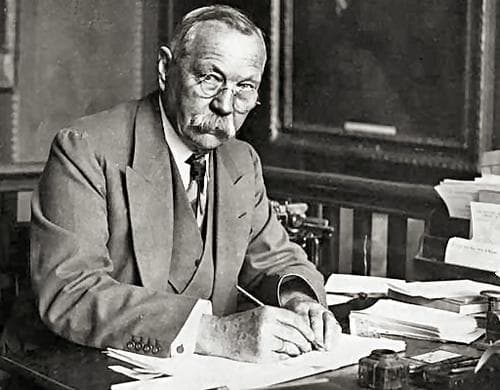
Sir Arthur Ignatius Conan Doyle was a British writer and physician. He created the character Sherlock Holmes in 1887 for A Study in Scarlet, the first of four novels and fifty-six short stories about Holmes and Dr. Watson. The Sherlock Holmes stories are milestones in the field of crime fiction.
Similar books
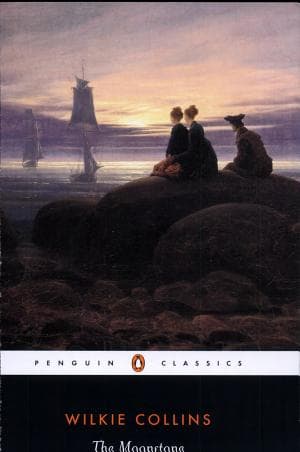
- The Moonstone
Wilkie Collins
3.9 (79k) average on GoodreadsHistorical FictionA foundational detective novel with a complex plot and multiple narrators.
- The Hound of the Baskervilles
Arthur Conan Doyle, Sir Arthur Conan Doyle
4.1 (254k) average on GoodreadsThrillerAnother classic Sherlock Holmes mystery, showcasing his deductive prowess.
- The Murders in the Rue Morgue
Edgar Allan Poe
3.9 (26k) average on GoodreadsMysteryPoe's "The Murders in the Rue Morgue" (1841) is often cited as the first modern detective story, introducing C. Auguste Dupin, a clear precursor to Holmes. Both stories feature brilliant, eccentric detectives who solve seemingly impossible crimes through ratiocination. However, Doyle's "A Study in Scarlet" expands upon Poe's model by introducing the enduring partnership of detective and chronicler (Holmes and Watson), which became a staple of the genre. Poe's stories are more focused on the intellectual exercise of the puzzle itself, often lacking the broader character development and world-building that Doyle begins to establish in "A Study in Scarlet." Furthermore, Poe's resolutions often verge on the sensational and bizarre (e.g., an orangutan), whereas Doyle, despite the melodramatic Utah backstory, strives for a more grounded, albeit still extraordinary, human motivation for the crime.
- To Kill a Mockingbird
Harper Lee
4.3 (4.5M) average on GoodreadsHistorical FictionIn the 1930s Jim Crow South, Harper Lee writes about racial injustice, moral growth, and the quiet courage of a lawyer father, Atticus Finch, as seen through his young daughter's eyes.
- The Great Gatsby
F. Scott Fitzgerald
3.9 (3.8M) average on GoodreadsHistorical FictionIn the opulent Roaring Twenties, a mysterious millionaire's lavish parties hide his desperate, tragic pursuit of a lost love, exposing the emptiness within the American Dream.
- Pride and Prejudice
Jane Austen
4.3 (3M) average on GoodreadsHistorical FictionIn a society focused on status and money, Elizabeth Bennet navigates love and pride, challenging Mr. Darcy and social expectations to find true affection.





Enjoyed the summary?
A summary gives you the shape of the book. The book itself has the detail, the examples and the voice.
Find A Study in Scarlet on AmazonAs an Amazon Associate, BookBrief earns from qualifying purchases. How we're funded