
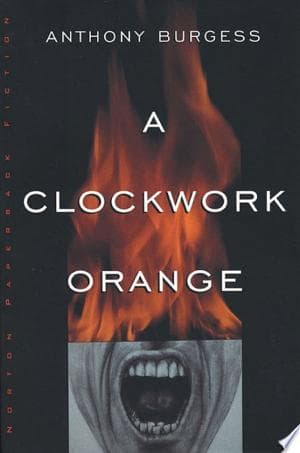
Synopsis
Covers the whole plot, including the ending.
- Difficulty
- Medium
- Pacing
- Moderate
- Mood
- Dark, Provocative, Disturbing, Satirical
- Read it if
- You enjoy thought-provoking dystopian fiction exploring free will, morality, and societal control, with unique language and a challenging perspective on human nature.
- Skip it if
- You are sensitive to graphic violence, sexual assault, and disturbing themes, or prefer straightforward narratives without experimental prose.
A Clockwork Orange Plot Summary
Covers the whole plot, including the ending.
A Night of Ultraviolence and Betrayal
The story opens with Alex, a fifteen-year-old 'nadsat' (teenager), and his three droogs (friends) – Pete, Georgie, and Dim – at the Korova Milkbar, drinking drug-laced milk. They then begin a night of 'ultraviolence.' Their first victims are an old, scholarly man they beat and rob. Next, they drive to the countryside, assault a young couple, and steal their car. Later, they break into a writer's house (F. Alexander), savagely beat him, and gang-rape his wife. Back in the city, they confront a rival gang, leading to a brutal fight. Feeling a loss of control, Alex assaults Dim for insubordination. The droogs, tired of Alex's dominance, betray him during a home invasion, knocking him unconscious and leaving him for the police to arrest.
Prison and the Ludovico Technique
Alex is sentenced to fourteen years in prison for the murder of the woman during the home invasion (his droogs had abandoned him, leaving him to take the fall). While incarcerated, he maintains his violent tendencies, even orchestrating the murder of a cellmate. After two years, he learns of a new experimental treatment called the Ludovico Technique, which promises early release. Desperate to escape prison, Alex volunteers for the program, despite warnings from the prison chaplain. He is chosen as a guinea pig for the state-sponsored aversion therapy, hoping it will cure him of his criminal impulses and provide a path to freedom.
The Ludovico Treatment
Alex is transferred to a medical facility where he undergoes the Ludovico Technique. Strapped to a chair with his eyes forced open by clamps, he is injected with a nausea-inducing drug while being shown films depicting extreme violence, rape, and other horrific acts. The drug causes him to associate these actions with intense physical sickness. A side effect of the treatment is that the background music in one of the films, Beethoven's Ninth Symphony, also becomes associated with the nausea. After two weeks, Alex is 'cured.' During a public demonstration, he cannot defend himself from abuse and feels violently ill at the sight of a beautiful woman, proving his conditioning is complete. He is deemed safe and released back into society.
A World He Can't Connect With
Upon his release, Alex finds himself defenseless. His parents have rented out his room and show little sympathy. He encounters his old droogs, Dim and Georgie, who are now policemen and beat him severely in retaliation for past grievances. He then stumbles upon the house of the old man he and his droogs had beaten at the beginning of the book. The man, recognizing him, gathers other elderly men who viciously attack Alex. He is saved by two policemen, who turn out to be Dim and Georgie again. They take him to a remote location, beat him further, and leave him to drown, but he survives.
Encounter with F. Alexander
Badly injured and disoriented, Alex stumbles to a house and collapses on the doorstep. The owner, F. Alexander, the writer whose house Alex and his droogs had invaded and whose wife they had gang-raped, takes him in. F. Alexander, now a widower and confined to a wheelchair, does not recognize Alex. He is part of a political movement opposing the government and its coercive treatments like the Ludovico Technique, viewing them as an infringement on free will. He sees Alex as a victim of the state and sympathizes with his plight, offering him shelter and food, unaware of Alex's true identity and his role in his personal tragedy.
Political Pawn and Suicide Attempt
As Alex recovers, he overhears F. Alexander and his political associates discussing him, realizing they intend to use him as a symbol of the government's oppressive policies. While alone in the house, Alex begins to sing and remembers the melody of Beethoven's Ninth Symphony. This triggers the conditioned nausea and despair from the Ludovico Technique, causing him immense suffering. The memory of his past atrocities, now linked to his sickness, overwhelms him. In despair and self-loathing, Alex attempts suicide by jumping from a window. He survives the fall but is severely injured and ends up in the hospital, becoming a political tool for the opposition.
De-conditioning and the Minister of the Interior
Alex awakens in a hospital bed, where he is visited by government officials, including the Minister of the Interior. Due to the political outcry surrounding his attempted suicide and the exposure of the Ludovico Technique's cruel effects, the government decides to reverse his conditioning. Alex undergoes further treatment to undo the aversion therapy, allowing him to listen to music and think about violence without suffering. The Minister apologizes for the state's actions and offers Alex a well-paying, respectable job, promising him a fresh start and a reintegration into society, effectively silencing him as a political pawn. Alex feels his old self returning.
A Return to Old Ways
With his conditioning reversed, Alex is once again able to enjoy music, particularly Beethoven, and contemplates violence without the debilitating sickness. The government gives him new clothes, a car, and money. He meets Pete, one of his former droogs, who is now married and has a respectable job, having grown out of his youthful delinquency. Alex initially feels a pang of envy and loneliness, seeing Pete's settled life. However, he quickly dismisses such thoughts, feeling the old urges for ultraviolence stirring within him. He envisions assembling a new gang of young boys, eager to resume his reign of terror and indulge in his violent fantasies, embracing his true nature once more.
The 'Original' Ending (Chapter 21)
In the original British edition (and restored in this edition), Alex, now eighteen, reflects on his past. He is still engaging in petty crimes with a new gang, but he finds less satisfaction in it. He sees Pete again, who is happily married with a child, and feels a sense of emptiness and a yearning for a similar, stable life. He realizes that the cycle of violence and youth must eventually give way to maturity and responsibility. He dreams of finding a wife, having a son, and settling down, understanding that the urge for ultraviolence is a phase of youth that he is now ready to outgrow, seeking genuine happiness and connection rather than fleeting thrills.
A Clockwork Orange Characters
Alex
Protagonist
A charismatic and intelligent, yet nihilistically violent, teenage gang leader.
Alex is a fifteen-year-old boy living in a dystopian near-future England. He is highly intelligent, articulate, and possesses a deep appreciation for classical music, especially Beethoven. However, these refined tastes exist alongside an insatiable appetite for 'ultraviolence,' which he inflicts upon innocent victims with his gang, or 'droogs.' He is manipulative, arrogant, and enjoys asserting dominance. Despite his cruelty, he often narrates his actions with a detached, almost philosophical air, using the unique 'Nadsat' slang. His journey is one from unbridled evil to forced goodness, and then back to a choice between the two.
Relationships: Dim (Droog and eventual betrayer); Georgie (Droog and eventual betrayer); Pete (Droog, later a reformed family man); F. Alexander (Victim and later unwitting host/political ally)
Dim
Supporting
One of Alex's droogs, known for his dullness and physical strength.
Dim is one of Alex's initial droogs, characterized by his lack of intelligence and his physical clumsiness. He is often the target of Alex's verbal and physical abuse, particularly when he fails to understand Alex's more complex thoughts or commands. Despite his loyalty, he secretly resents Alex's dominance. He is instrumental in Alex's betrayal, striking the blow that leads to Alex's arrest. Later, he becomes a policeman, showcasing the government's ability to 'rehabilitate' or absorb delinquents into its system, and exacts revenge on Alex.
Relationships: Alex (Droog, later an enemy); Georgie (Fellow droog)
Georgie
Supporting
Another of Alex's droogs, more ambitious and questioning of Alex's leadership.
Georgie is another member of Alex's gang, slightly more cunning and ambitious than Dim. He occasionally challenges Alex's leadership and suggests more organized or profitable criminal ventures, indicating a nascent desire for independence. He participates in the betrayal of Alex and later becomes a policeman alongside Dim, taking satisfaction in tormenting Alex when he is vulnerable. Georgie represents the internal friction within the gang and the shifting loyalties that exist in their violent world.
Relationships: Alex (Droog, later an enemy); Dim (Fellow droog)
Pete
Supporting
The most unassuming of Alex's droogs, who later reforms and settles down.
Pete is the least prominent of Alex's original three droogs. He is less vocal and less prone to challenging Alex than Dim or Georgie. His character serves as a contrast to Alex's persistent violence. After Alex's imprisonment and subsequent 'cure,' Pete is the only former droog who appears to have genuinely reformed. He is encountered by Alex as a married man with a stable job, representing the possibility of growing out of youthful delinquency and embracing a conventional, responsible life. His transformation offers Alex a glimpse of an alternative future.
Relationships: Alex (Droog, later a reformed acquaintance); Dim (Fellow droog); Georgie (Fellow droog)
F. Alexander
Supporting
A writer whose life is destroyed by Alex, later becoming a political activist.
F. Alexander is a writer whose home is invaded by Alex and his droogs, resulting in him being severely beaten and his wife gang-raped, leading to her death. This tragedy leaves him a widower confined to a wheelchair. He later becomes a prominent figure in the political opposition against the government, particularly against the Ludovico Technique, which he views as inhumane and an infringement on free will. Unaware of Alex's identity as his tormentor, he takes Alex in after his release, seeing him as a victim of the state, and attempts to use him as a symbol for his political cause.
Relationships: Alex (Victim of Alex, later unwitting political ally)
The Minister of the Interior
Antagonist
A high-ranking government official representing state control and political pragmatism.
The Minister of the Interior is a cynical and pragmatic government official. He is the face of the state's efforts to control crime and maintain order, initially by supporting the Ludovico Technique. However, when the technique's adverse effects on Alex become a political liability, he swiftly changes course. He manipulates Alex for political gain, first by approving his 'cure' and later by 'de-conditioning' him and offering him a job to silence the opposition. He embodies the state's willingness to sacrifice individual freedom and moral principles for the sake of political expediency and public image.
Relationships: Alex (Political pawn)
The Prison Chaplain
Supporting
A morally conflicted spiritual guide in the prison.
The Prison Chaplain is a compassionate, though somewhat ineffectual, spiritual figure within the prison system. He attempts to guide Alex towards genuine repentance and moral understanding, often engaging him in discussions about good and evil, and free will. He expresses strong reservations about the Ludovico Technique, warning Alex about its implications for human choice and dignity, believing that true goodness must be chosen, not forced. His moral objections provide a counterpoint to the state's utilitarian approach to crime.
Relationships: Alex (Spiritual advisor)
Dr. Brodsky
Supporting
The cold and scientific inventor of the Ludovico Technique.
Dr. Brodsky is the detached, scientific figure responsible for overseeing the Ludovico Technique. He embodies the scientific community's potential for ethical blindness in the pursuit of social engineering. He views Alex and other subjects purely as experimental specimens, focusing solely on the technical efficacy of the aversion therapy without concern for the moral implications or the subject's human dignity. His character represents the danger of science devoid of humanistic considerations, creating a 'clockwork orange' – a mechanically good but fundamentally dehumanized being.
Relationships: Alex (Scientist/experimenter)
A Clockwork Orange Themes
Free Will vs. State Control
This is the central theme of 'A Clockwork Orange.' Burgess explores whether it is better for an individual to be inherently evil and possess free will, or to be forcibly conditioned into 'goodness' at the expense of their humanity. Alex's journey through the Ludovico Technique directly addresses this, as the state strips him of his ability to choose, rendering him a 'clockwork orange.' The prison chaplain argues that true morality requires choice, even the choice of evil, while the government prioritizes social order above all else, willing to sacrifice individual freedom for a crime-free society. F. Alexander's opposition also highlights the political dangers of such state intervention.
“What does God want? Does God want goodness or the choice of goodness? Is a man who chooses bad in some way better than a man who has good imposed upon him?”
The Nature of Good and Evil
The novel challenges conventional definitions of good and evil. Alex's 'goodness' after the Ludovico Technique is merely the inability to do evil, not a genuine moral choice, making it a superficial and dehumanizing state. His original capacity for extreme violence is presented as an inherent part of his youth and human nature, however abhorrent. Burgess suggests that true goodness must stem from an internal moral compass and the freedom to choose it, rather than being an imposed condition. The suffering Alex experiences when unable to defend himself, despite being 'good,' raises questions about the value of such a forced morality.
“The important thing is moral choice. Evil is an illness, and the state, in the name of the social good, is trying to cure it. But the cure is worse than the disease.”
Youth, Rebellion, and Social Decay
The novel portrays a society grappling with youth delinquency and moral decay. Alex and his droogs represent a generation characterized by nihilistic violence, hedonism, and a rejection of societal norms. Their 'nadsat' slang further emphasizes their isolation and distinct subculture. The government's extreme response with the Ludovico Technique reflects a desperate attempt to control this breakdown in social order. The story suggests a cyclical nature of rebellion, as Alex, even after his 'cure' and subsequent de-conditioning, initially contemplates forming a new gang, indicating that the underlying issues of youth dissatisfaction and social fragmentation persist.
“We were four, and a Famous Four we were, and we'd been out to get the like of what we were now getting, a bit of the old ultra-violence.”
The Corruption of Power
Both the individual and the state show the corrupting influence of power. Alex wields absolute power over his droogs, leading to their eventual betrayal and his downfall. More significantly, the government abuses its power through the implementation of the Ludovico Technique. It sacrifices individual rights and human dignity for social control and political expediency, transforming citizens into mere cogs in a machine. The Minister of the Interior's cynical manipulation of Alex for political gain, first as a 'cure' then as a 'victim' to be silenced, exemplifies the state's moral bankruptcy.
“When a man cannot choose, he ceases to be a man.”
Plot Devices & Literary Techniques
Nadsat Slang
A unique, Russian-influenced argot used by the youth.
Nadsat is a fictional argot, primarily derived from Russian words, used by Alex and his droogs. This linguistic device serves multiple purposes: it immediately establishes a distinct subculture for the youth, creating a sense of alienation from mainstream society and emphasizing their 'otherness.' It forces the reader to actively engage with the text, deciphering meaning and thus immersing them in Alex's world. It also highlights the generational gap and the breakdown of traditional communication, reflecting the social decay and fragmentation prevalent in the novel's dystopian setting.
First-Person Narrative (Unreliable Narrator)
Alex's subjective and biased account of events.
The story is told entirely from Alex's first-person perspective. This makes him an unreliable narrator, as his account is filtered through his own twisted morality, self-justifications, and subjective experiences. The reader is privy to his thoughts, his love for Beethoven, and his rationalizations for 'ultraviolence,' which creates a complex and disturbing intimacy. This device forces the reader to confront the protagonist's horrific actions directly, without authorial judgment, and to question the nature of good and evil through his eyes, even as his perspective is clearly biased and self-serving.
Aversion Therapy (Ludovico Technique)
A fictional psychological conditioning method used by the state.
The Ludovico Technique is a central plot device, serving as the catalyst for Alex's transformation and the primary vehicle for exploring the novel's themes of free will and state control. This fictional aversion therapy involves forcing subjects to watch violent imagery while being injected with drugs that induce extreme nausea and discomfort. The technique effectively conditions Alex to become physically ill at the thought or sight of violence and sex. It represents the ultimate infringement on individual liberty, creating a 'good' person by stripping them of their moral choice, thus becoming a symbol of dehumanization and authoritarian overreach.
The Beethoven Ninth Symphony Motif
A recurring musical piece symbolizing Alex's refined tastes and later, his suffering.
Beethoven's Ninth Symphony acts as a powerful motif throughout the novel. Initially, it symbolizes Alex's deep, almost spiritual connection to art and beauty, contrasting sharply with his brutal actions and highlighting his complex, contradictory nature. During the Ludovico Technique, the symphony is inadvertently paired with the violent films and nausea, turning his greatest pleasure into a source of excruciating pain. This transformation underscores the cruelty of the conditioning, as it corrupts the one pure joy in Alex's life, demonstrating how the state's 'cure' destroys not just evil, but also genuine human appreciation.
A Clockwork Orange Quotes
“What's it going to be then, eh?”
“It's funny how the colors of the real world only seem really real when you viddy them on the screen.”
“The important thing is moral choice. Evil has to exist along with good, in order that moral choice may operate.”
“When a man cannot choose, he ceases to be a man.”
“Oh, it was gorgeousness and gorgeosity made flesh.”
“The attempt to impose upon man, a creature of growth and capable of sweetness, to ooze juicily at the last round the bearded lips of God, to attempt to impose, I say, laws and conditions appropriate to a mechanical creation, against this I raise my sword-pen.”
“I was cured all right.”
“It's a stinking world because it lets the young get on to the old like you done, and there's no law nor order no more.”
“The sweetest and most heavenly of activities partake in some measure of violence.”
“He has no real choice, has he? Self-interest, fear of physical pain, drove him to that grotesque act of self-abasement. Its insincerity was clearly to be seen. He ceases to be a wrongdoer. He ceases also to be a creature capable of moral choice.”
“We can destroy what we have written, but we cannot unwrite it.”
“The not-self cannot have the bad, meaning they of the government and the judges and the schools cannot allow the bad because they cannot allow the self.”
“It's a sin, using Ludwig van like that. He did no harm to anyone. Beethoven just wrote music.”
“The old veck began to make bolshy big threats and I gave him a tolk on the head and that shut him up.”
Quiz
10 questions on the plot and the characters. Each answer comes with a short explanation.
Question 1
What is the name of the teenage protagonist who leads a gang in 'A Clockwork Orange'?
- Dim
- Pete
- Alex
- Georgie
Show answer
C. Alex Alex is the 15-year-old narrator and leader of the gang who engages in 'ultraviolence' throughout the novel. His name is central to the story's exploration of free will and identity.
Question 2
What is the fictional teen slang called that Burgess created for the novel?
- Droog-speak
- Nadsat
- Ultralingo
- Burgessian
Show answer
B. Nadsat Nadsat is the Russian-influenced slang used by Alex and his gang. The restored edition includes a glossary of Nadsat terms, highlighting Burgess's linguistic invention.
Question 3
What does Alex call his friends or gang members?
- Bratty
- Droogs
- Moloko
- Devotchkas
Show answer
B. Droogs Droogs is the Nadsat term for friends or gang members, derived from the Russian word for 'friend'. Alex's droogs include Dim, Pete, and Georgie.
Question 4
What is the name of the controversial psychological treatment used by the State to 're-educate' Alex?
- Ludovico Technique
- Pavlovian Conditioning
- Behavioral Modification
- Neuro-Linguistic Programming
Show answer
A. Ludovico Technique The Ludovico Technique is a fictional aversion therapy that conditions Alex to feel nauseous at thoughts of violence, raising questions about free will and state control.
Question 5
What beverage, often spiked with drugs, do Alex and his droogs consume at the Korova Milkbar?
- Vodka
- Moloko
- Synthemesc
- Horrorshow
Show answer
B. Moloko Moloko is milk laced with drugs like 'vellocet' or 'synthemesc', which Alex drinks at the Korova Milkbar to prepare for nights of ultraviolence.
Question 6
Why does the restored edition of 'A Clockwork Orange' edited by Andrew Biswell differ from some earlier versions?
- It adds new chapters written by Burgess later in life
- It restores the original 21st chapter that was omitted in early U.S. editions
- It removes all Nadsat slang for clarity
- It changes the ending to be more violent
Show answer
B. It restores the original 21st chapter that was omitted in early U.S. editions The restored edition includes Burgess's original 21st chapter, which shows Alex maturing and considering a different path, whereas early U.S. editions ended at Chapter 20 with Alex still violent.
Question 7
What major theme does 'A Clockwork Orange' explore through Alex's treatment and its consequences?
- The inevitability of technological advancement
- The conflict between free will and state-imposed morality
- The importance of family bonds in a dystopian society
- The role of art in political revolution
Show answer
B. The conflict between free will and state-imposed morality The novel delves into whether it is better to choose evil freely than to be forced into goodness, as seen in Alex's loss of agency after the Ludovico Technique.
Question 8
In the restored edition, what significant element does Andrew Biswell include to provide context on Burgess's work?
- A foreword by Stanley Kubrick
- Pages from the original typescript, interviews, and reviews
- A sequel written by Martin Amis
- An alternate ending where Alex becomes a politician
Show answer
B. Pages from the original typescript, interviews, and reviews Biswell's edition includes archival materials like the original typescript pages and critical essays, offering insights into Burgess's creative process and the novel's reception.
Question 9
How does the novel's use of first-person narration by Alex affect the reader's perception of his actions?
- It makes his violence seem justified and heroic
- It creates a sympathetic or complicit view despite his atrocities
- It provides an objective account of dystopian society
- It distances the reader by using complex Nadsat slang exclusively
Show answer
B. It creates a sympathetic or complicit view despite his atrocities Alex's charismatic and witty narration, even during horrific acts, forces readers to engage with his perspective, blurring moral lines and enhancing the novel's black comedy.
Question 10
What does the term 'horrorshow' mean in Nadsat, and how does it reflect the novel's tone?
- It means 'terrible' and emphasizes the dystopian gloom
- It means 'good' or 'cool', derived from Russian, and adds ironic contrast to violent acts
- It refers to the Ludovico Technique's films
- It describes Alex's nightmares after his treatment
Show answer
B. It means 'good' or 'cool', derived from Russian, and adds ironic contrast to violent acts Horrorshow comes from the Russian 'khorosho' (good). Its use in positive contexts amid violence creates irony, underscoring the novel's blend of horror and dark humor.
A Clockwork Orange FAQ
What is 'A Clockwork Orange' about?
The novel follows fifteen-year-old Alex and his gang of 'droogs' as they engage in 'ultraviolence'—robbery, assault, rape, and murder—in a dystopian future Britain. After being betrayed by his friends and arrested, Alex undergoes the Ludovico Technique, a state-sponsored behavioral conditioning that makes him physically ill at the thought of violence, stripping him of free will. The story explores his subsequent victimization and eventual return to his old self, raising questions about morality, choice, and societal control.
Why should I read 'A Clockwork Orange'?
It's a groundbreaking dystopian novel that blends horror, black comedy, and philosophical inquiry into free will and morality. Burgess's inventive use of 'Nadsat'—a slang mixing Russian, English, and invented terms—creates a immersive, unsettling world. The book's exploration of whether it's better to choose evil than to be forced into goodness remains profoundly relevant to debates on crime, punishment, and human nature.
What is the background/setting of 'A Clockwork Orange'?
Set in a near-future, totalitarian Britain plagued by youth gangs and societal decay, the world features oppressive government control, decaying urban landscapes, and a culture of fear. The setting reflects Cold War anxieties, with 'Nadsat' slang hinting at Russian influence, and serves as a bleak backdrop for exploring themes of violence, authority, and individual agency against a backdrop of state manipulation.
What are the most memorable quotes from 'A Clockwork Orange'?
Key quotes include Alex's iconic 'What's it going to be then, eh?' which opens chapters and reflects his chaotic agency, and 'A clockwork orange'—a metaphor for a person mechanically conditioned to be good, losing their humanity. Another is 'The important thing is moral choice,' spoken by the prison chaplain, emphasizing the novel's central debate on free will versus forced morality.
What writing style does Anthony Burgess use in 'A Clockwork Orange'?
Burgess employs a first-person narrative from Alex's perspective, using vivid, rhythmic prose infused with 'Nadsat' slang to immerse readers in his violent worldview. The style blends poetic descriptions of brutality with dark humor, creating a jarring contrast that highlights the novel's themes. The restored edition preserves Burgess's original text, including the controversial final chapter omitted in some versions.
What minor details add significant meaning to 'A Clockwork Orange'?
Details like Alex's love for Beethoven's Ninth Symphony, which becomes a tool of torture in the Ludovico Technique, symbolize how art can be perverted by authority. The recurring image of milk—spiked with drugs at the Korova Milkbar—represents corrupted innocence. Alex's pet snake, missing in later editions, hints at his latent humanity and the loss of natural instincts under conditioning.
What are some subtle foreshadowing moments in 'A Clockwork Orange'?
Early scenes, such as Alex beating a homeless man who later reappears as a vengeful victim, foreshadow his downfall and the cycle of violence. The betrayal by his droogs, Georgie and Dim, is hinted at through their growing dissent. References to 'the old in-out' (sex) and state control subtly predict the Ludovico Technique's invasive manipulation of his body and mind.
What unexpected character connections exist in 'A Clockwork Orange'?
Alex's victims resurface in ironic roles: the writer he assaults, F. Alexander, later shelters him unknowingly and becomes a tool for anti-government propaganda. The homeless man he beats early on leads a gang that attacks him post-conditioning. These connections highlight the cyclical nature of violence and how Alex's actions haunt him, blurring lines between perpetrator and victim.
What are Alex's unspoken motivations in 'A Clockwork Orange'?
Beneath his violent exterior, Alex seeks transcendence through art—particularly classical music—which he associates with heightened emotions and control. His ultraviolence may stem from a desire to assert identity in a dehumanizing society, and his eventual rejection of conditioning hints at a deeper craving for authentic experience, even if immoral, over mechanized existence.
What psychological complexities do characters exhibit in 'A Clockwork Orange'?
Alex displays a paradoxical blend of brutality and sensitivity, reveling in violence while being deeply moved by music. The prison chaplain embodies internal conflict, advocating for moral choice but cooperating with the state's unethical methods. F. Alexander shows how trauma can twist idealism into vengeance, using Alex for political ends while mirroring the violence he condemns.
What are the major emotional turning points in 'A Clockwork Orange'?
Key turning points include Alex's betrayal by his gang, leading to his arrest and loss of freedom; the Ludovico Technique sessions, where he becomes physically ill at violence and music, stripping him of joy; his attempted suicide after being tormented by former victims; and the final chapter's restoration of his old self, offering a ambiguous redemption or relapse into chaos.
How do relationship dynamics evolve in 'A Clockwork Orange'?
Alex's relationships shift from dominance with his droogs—based on fear and loyalty—to betrayal and isolation after his arrest. Post-conditioning, he becomes dependent on and victimized by former enemies like F. Alexander and the homeless man. His interactions with authority figures, from brutal police to manipulative scientists, reveal a cycle of control that ultimately leads him to reclaim agency, albeit ambiguously.
Which parts of 'A Clockwork Orange' remain ambiguous or open-ended?
The ending is highly ambiguous: in the restored edition, Alex spontaneously reforms, choosing goodness out of maturity rather than coercion, but it's unclear if this is genuine change or another phase. The morality of the Ludovico Technique is debated without resolution, and Alex's future after the novel ends—whether he relapses or sustains his new path—is left uncertain, inviting reader interpretation.
What are controversial scenes or decisions in 'A Clockwork Orange'?
Graphic scenes of ultraviolence, including gang rapes and murders, sparked censorship debates for their explicit brutality. Alex's re-education via the Ludovico Technique raises ethical questions about state-mandated torture and loss of free will. The restored final chapter, where Alex chooses reform, contrasts with earlier versions that ended more pessimistically, fueling controversy over whether redemption is earned or contrived.
'A Clockwork Orange' ending explained: how it ends and what it means
In the restored edition, Alex, after being used by political factions and attempting suicide, recovers and naturally outgrows his violent tendencies, choosing a settled life and considering fatherhood. This ending suggests that true morality comes from free choice and personal growth, not forced conditioning. It contrasts with the omitted chapter, offering a more hopeful but debated resolution on whether humanity can evolve beyond inherent violence.
How does the use of 'Nadsat' slang impact the reader's experience?
Nadsat, a blend of Russian, English, and invented terms, initially disorients readers, mirroring Alex's alien worldview, but becomes decipherable through context, creating immersion in his subculture. It softens the horror of violence through linguistic distancing, while also highlighting themes of youth rebellion and cultural hybridity in a dystopian setting. The included glossary in this edition aids understanding without diluting the novel's inventive language.
What role does classical music play in the novel's themes?
Classical music, especially Beethoven's Ninth Symphony, serves as a symbol of sublime beauty and Alex's inner complexity, contrasting with his external brutality. When the Ludovico Technique conditions him to associate the music with nausea, it represents the state's destruction of individual passion and art for control. This perversion underscores the novel's warning against sacrificing humanity for societal order.
How does the novel critique both individualism and authoritarianism?
The novel critiques unchecked individualism through Alex's violent hedonism, which harms society, and authoritarianism via the state's oppressive methods like the Ludovico Technique, which strips free will. By showing both extremes as destructive, Burgess argues for a balance where moral choice is preserved, suggesting that forcing goodness is as dehumanizing as choosing evil, with the restored ending hinting at natural moral development.
About the author
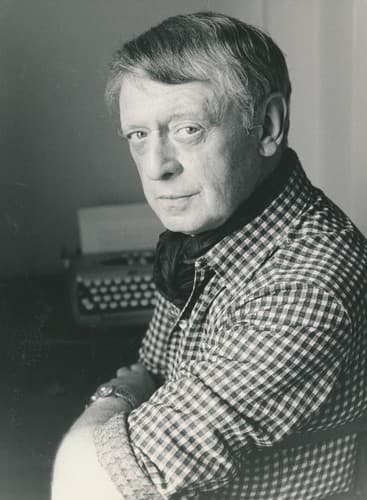
John Anthony Burgess Wilson, who published under the name Anthony Burgess, was an English writer and composer.
Similar books
- 1984
George Orwell
4.2 (3.1M) average on GoodreadsPoliticsExplores totalitarian control and the manipulation of individual thought.
- Brave New World
Aldous Huxley
4.0 (1.4M) average on GoodreadsFantasyDepicts a dystopian society with conditioning and loss of individuality.
- Lord of the Flies
William Golding
3.7 (2.3M) average on GoodreadsYoung AdultExamines the innate capacity for evil and societal breakdown.
- Nineteen Eighty-Four
George Orwell
4.2 (5.5M) average on GoodreadsFictionWhile Orwell's Nineteen Eighty-Four focuses on external totalitarian surveillance and thought control as a means of societal conformity, A Clockwork Orange delves into the internal psychological conditioning of an individual, questioning the nature of 'goodness' when it's enforced rather than chosen. Burgess's work explores the ethics of altering individual will, whereas Orwell depicts the crushing of it through overt oppression.
- Angels & Demons
Dan Brown
3.9 (2.7M) average on GoodreadsThrillerA Harvard symbologist races through Rome's ancient sites, deciphering cryptic clues to unmask the Illuminati and stop a vengeful plot to destroy the Vatican with a stolen antimatter weapon.
- Gone Girl
Gillian Flynn
4.1 (2.3M) average on GoodreadsThrillerA wife's sudden disappearance on her fifth anniversary reveals a web of lies and psychological warfare, exposing the secrets within a seemingly perfect marriage.






Enjoyed the summary?
A summary gives you the shape of the book. The book itself has the detail, the examples and the voice.
Find A Clockwork Orange on AmazonAs an Amazon Associate, BookBrief earns from qualifying purchases. How we're funded