
Synopsis
Covers the whole plot, including the ending.
- Difficulty
- Medium
- Pacing
- Fast
- Mood
- Epic, Adventurous, Suspenseful, Magical
- Read it if
- You're a fan of the 'School for Good and Evil' series and want to see the conclusion of the Camelot arc.
- Skip it if
- You haven't read the previous books in the series, as this is the fifth installment and relies heavily on prior plot.
A Crystal of Time Plot Summary
Covers the whole plot, including the ending.
A Coronation and a Capture
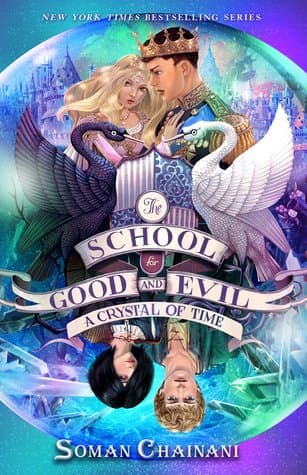
The story opens with the forced coronation of Rhian as the new King of Camelot, orchestrated by the School Master. Tedros, the rightful heir, is framed for the murder of his father, King Arthur, and is captured and imprisoned, awaiting execution. Sophie, under the School Master's influence and bound by a magical curse, is forced into marriage with Rhian and crowned his Queen. Agatha, witnessing the entire spectacle, manages to escape the castle with the help of Hort and Professor Dovey, realizing their dire situation. The School for Good and Evil, once a beacon of balance, is now under the School Master's complete control, with many students and faculty manipulated or imprisoned. Agatha knows she must find a way to save Tedros and Camelot from this tyrannical new regime.
Agatha's Desperate Escape and a New Alliance
After witnessing Tedros's capture and Sophie's forced marriage, Agatha, Hort, and Professor Dovey flee Camelot. They are pursued by the School Master's forces, including the 'Lieutenants' – corrupted former students and faculty. Their escape is harrowing, but they eventually find refuge with the Coven of Witches in the Whispering Woods, led by Lady Lesso. Though initially wary of Agatha and her companions due to their past association with the School for Good, Lady Lesso agrees to help, recognizing the greater threat posed by the School Master's twisted vision. This alliance marks a turning point, as Agatha begins to gather allies against the School Master's seemingly insurmountable power.
The Search for Merlin and the Truth
Believing that the wizard Merlin is the only one powerful enough to counter the School Master's magic and expose Rhian's deception, Agatha, Hort, and a group of witches embark on a perilous journey. They navigate treacherous landscapes and evade the School Master's relentless pursuers, facing various magical traps and moral dilemmas. Their quest leads them through ancient ruins and forgotten pathways, gathering clues about Merlin's whereabouts. Along the way, Agatha grapples with her responsibilities, her fear for Tedros, and her complex feelings for Sophie, who appears to be an unwilling participant in the School Master's scheme. The search for Merlin becomes a race against time as Tedros's execution draws nearer.
Sophie's Internal Struggle and Forced Loyalty
Meanwhile, in Camelot, Sophie is forced to play the role of Rhian's queen, her every move monitored by the School Master and his loyalists. She is tormented by her forced loyalty and the knowledge that Tedros is imprisoned, but a powerful curse prevents her from directly defying the School Master. She subtly tries to find ways to communicate with the outside world and gather information, using her position to observe Rhian and the School Master's plans. Despite her outward compliance, Sophie secretly plots to undermine them, driven by her affection for Tedros and a lingering sense of duty to her friends. Her internal struggle is intense, torn between self-preservation and the desire to do what is right, even if it means risking her own life.
The Trial of Tedros and a Desperate Rescue Attempt
Tedros is put on a public trial, a thinly veiled farce designed to solidify Rhian's claim to the throne. The School Master manipulates evidence and witnesses, painting Tedros as a villain and a traitor. News of the impending execution reaches Agatha and her allies, forcing them to accelerate their plans. Knowing they cannot wait for Merlin, Agatha, Hort, and the witches launch a desperate infiltration of Camelot. Their goal is not just to free Tedros, but also to expose Rhian's lies to the public. The rescue mission is fraught with danger, leading to intense confrontations with the School Master's Lieutenants and revealing the true extent of his power and influence over Camelot.
Merlin's Revelation and the Crystal of Time
Amidst the chaos of the rescue attempt, Agatha finally locates Merlin, who has been hidden away, weakened but still powerful. Merlin reveals the shocking truth: the School Master is not just a villain, but a being who has manipulated time and destiny across countless fairy tales. He explains that the School Master is attempting to rewrite the very fabric of their world, turning Good into Evil and Evil into Good, and that Rhian is merely a pawn. Merlin reveals the 'Crystal of Time,' a powerful artifact that allows the School Master to alter past events, which is the source of his immense power. He emphasizes that to defeat him, they must not just fight him in the present, but also correct the past.
The Journey into the Past
With Merlin's guidance, Agatha, Sophie (who manages to break free from the School Master's direct control with a surge of her own magic), and a newly freed Tedros embark on a perilous journey through time using the Crystal of Time. They must revisit moments in their own past and the history of the School for Good and Evil, identifying and undoing the School Master's alterations. This involves facing past versions of themselves and their friends, reliving painful memories, and understanding how subtle changes in key events led to the current distorted reality. They learn that the School Master has been tampering with their destinies for generations, subtly shifting the balance between Good and Evil to his own advantage.
Confronting the Original Lie
As they go deeper into the past, Agatha, Sophie, and Tedros uncover the School Master's true origin. They learn that he was once a student himself, deeply wronged and abandoned, leading to his desire to control and rewrite stories. They discover that the School Master's power stems from a single, original lie he told himself and others, a lie that grew and corrupted over time, enabling him to manipulate the fabric of reality. This revelation is crucial, as it provides them with the understanding needed to truly dismantle his power. They realize that simply defeating him in a physical battle won't suffice; they must undo the foundational lie that sustains his existence.
The Battle for Truth and Destiny
The climax of the story has Agatha, Sophie, and Tedros confront the School Master in a multi-layered battle that spans across different timelines and realities. The School Master unleashes his full power, manifesting as distorted versions of their deepest fears and past failures. The fight is not just physical, but also a battle of wills and truths. The trio must use their combined strengths, their understanding of the School Master's vulnerabilities, and their unwavering belief in their own stories to counter his manipulations. Each character faces their personal demons, and their bonds of friendship and love are tested as they fight to restore their true destinies and prevent the complete unraveling of their world.
Restoring Balance and a New Beginning
Through their combined efforts, Agatha, Sophie, and Tedros finally expose the School Master's original lie and break his hold over the Crystal of Time, weakening him significantly. Rhian's deception is revealed to all of Camelot, and he is stripped of his false power. With the School Master defeated and the timeline largely corrected, balance is restored to the School for Good and Evil and the wider fairytale world. Tedros is reinstated as the rightful King of Camelot, and the students and faculty return to their proper places. The experience leaves all three protagonists changed, with a deeper understanding of their own identities, the nature of good and evil, and the power of choice in shaping one's own destiny.
Principal Figures
Agatha of Woods Beyond
Protagonist
The determined, kind-hearted witch who always fights for what's right.
Agatha is initially portrayed as an outcast with a reputation for being 'evil,' but she possesses a fiercely loyal heart and an unwavering moral compass. She is intelligent, pragmatic, and deeply empathetic, often putting others' needs before her own. Her strength lies in her ability to see beyond superficial appearances and her profound love for her friends, especially Sophie and Tedros. She is driven by a deep sense of justice and a desire to protect those she cares about, making her a natural leader in times of crisis.
Relationships: Sophie of Woods Beyond (Best friend, complex bond of love and rivalry); Tedros of Camelot (Boyfriend, deep love and partnership); Hort (Loyal friend and companion); Professor Dovey (Mentor and ally)
Sophie of Woods Beyond
Protagonist
The beautiful, vain girl who grapples with her destiny and true nature.
Sophie is initially obsessed with being a princess and finding her 'happily ever after,' often prioritizing beauty and superficiality. Beneath her vanity, however, lies a complex character capable of profound love, self-sacrifice, and immense power. She struggles with her inner demons, constantly battling between her desire for good and her temptations towards evil. Her journey is marked by a deep yearning for acceptance and a struggle to understand where she truly belongs, often making choices that are both selfish and surprisingly selfless.
Relationships: Agatha of Woods Beyond (Best friend, complex bond of love and rivalry); Tedros of Camelot (Complicated romantic interest, then friend/ally); School Master (Manipulated pawn, then enemy)
Tedros of Camelot
Protagonist
The noble prince and rightful heir to Camelot, struggling with self-doubt and leadership.
Tedros is the son of King Arthur and the rightful heir to Camelot. He is brave, honorable, and fiercely protective of his friends and kingdom. However, he often struggles with the immense pressure of his legacy, leading to moments of insecurity, jealousy, and rash decisions. His journey is about learning to be a true king, not just by birthright, but by character, proving his worth through actions and selflessness. He deeply loves Agatha and is tormented by the injustices inflicted upon his kingdom and his friends.
Relationships: Agatha of Woods Beyond (Girlfriend, deep love and partnership); Sophie of Woods Beyond (Complicated romantic interest, then friend/ally); King Arthur (Father, legacy to uphold); Rhian (False friend, usurper)
The School Master
Antagonist
The manipulative entity seeking to rewrite fairy tales and control destiny.
The School Master is the enigmatic and immensely powerful director of the School for Good and Evil, whose true intentions are shrouded in mystery. He is revealed to be a being who manipulates the balance of Good and Evil, twisting stories and destinies to his own design. His motivations are born from a deep-seated desire to control and correct what he perceives as the flaws in the fairytale world. He is cunning, strategic, and capable of wielding immense magic, using both persuasion and force to achieve his goals. He embodies the idea of a warped sense of justice, believing he knows best for everyone.
Relationships: Sophie of Woods Beyond (Manipulated pawn); Rhian (Pawn, false king); Agatha of Woods Beyond (Primary opposition); Tedros of Camelot (Primary opposition)
Rhian
Supporting
The deceptive false king of Camelot, manipulated by the School Master.
Rhian initially appears as a charming and charismatic figure, a seemingly good-natured boy who becomes a close friend to Tedros. However, he is revealed to be a pawn of the School Master, manipulated into usurping the throne of Camelot and framing Tedros. He is ambitious and easily swayed by promises of power, lacking the moral fortitude to resist the School Master's influence. His character highlights the corrupting nature of ambition and the ease with which one can be misled when seeking power.
Relationships: Tedros of Camelot (False friend, rival); Sophie of Woods Beyond (Forced husband); School Master (Manipulator, master)
Hort
Supporting
The loyal, often bumbling, half-werewolf student of the School for Evil.
Hort is a student from the School for Evil, a half-werewolf who is fiercely loyal to his friends, particularly Agatha. Despite his gruff exterior and occasional cowardice, he possesses a good heart and often provides comic relief. He is devoted to Agatha, though his feelings are often unrequited. Hort proves to be a reliable and brave companion in their quest, always willing to stand by his friends, even when faced with overwhelming odds. His journey is one of growing confidence and self-acceptance.
Relationships: Agatha of Woods Beyond (Unrequited love, loyal friend); Nicola (Friend); Professor Dovey (Teacher, ally)
Professor Dovey
Supporting
The kind-hearted head of the School for Good, an ally to Agatha.
Professor Dovey is the benevolent and nurturing head of the School for Good, known for her flowing white hair and gentle demeanor. She embodies the ideals of goodness, grace, and compassion. When the School Master seizes control, she becomes a crucial ally to Agatha, using her wisdom and knowledge of the fairytale world to guide and protect the students. She represents the enduring spirit of true Good, even in the face of overwhelming evil, and provides a moral anchor for the protagonists.
Relationships: Agatha of Woods Beyond (Mentor, ally); Professor Sader (Colleague); Hort (Teacher, ally)
Lady Lesso
Supporting
The formidable head of the School for Evil, who becomes an unlikely ally.
Lady Lesso is the stern and imposing head of the School for Evil, known for her sharp wit and formidable magical abilities. Despite her fearsome reputation, she possesses a deep, albeit hidden, sense of justice and loyalty to her students. When the School Master's actions threaten the balance of the entire fairytale world, she recognizes the greater danger and reluctantly forms an alliance with Agatha and her companions. She is pragmatic, powerful, and provides a crucial source of strength and strategic thinking for the resistance.
Relationships: Agatha of Woods Beyond (Reluctant ally); Professor Dovey (Long-standing rival, then ally); Hort (Teacher)
Merlin
Supporting
The legendary wizard of Camelot, holding knowledge of time and destiny.
Merlin is the ancient and powerful wizard, a figure of legend within Camelot and the wider fairytale world. He possesses immense magical knowledge and a deep understanding of time and destiny. He is initially sought out by Agatha as the only one capable of countering the School Master's magic. Though weakened and hidden, Merlin provides crucial revelations about the School Master's true nature, the Crystal of Time, and the necessity of correcting past manipulations. He serves as a wise, if cryptic, guide for the protagonists in their journey through time.
Relationships: Agatha of Woods Beyond (Mentor, guide); Tedros of Camelot (Advisor to his lineage)
Themes & Insights
The Nature of Good and Evil
This theme is central to the entire series, but in 'A Crystal of Time,' it reaches its peak. The School Master's manipulation of time and destiny blurs the lines between Good and Evil, forcing characters to question what truly defines them. Sophie's struggle with her inner darkness and her desire to do good, Agatha's 'evil' appearance masking her good heart, and even Lady Lesso's alliance with Good, all highlight that Good and Evil are not absolute, but rather choices and actions. The story argues that true Good involves active resistance to injustice, not passive acceptance of a label. The School Master's attempt to rewrite history to create 'perfect' Good and Evil ultimately shows the dangers of rigid definitions.
“Good and Evil aren't born. They're made. By choices. By stories. By the lies we tell ourselves and the truths we choose to believe.”
The Power of Story and Destiny
The novel explores how stories shape reality and destiny. The School Master's ability to manipulate the 'Crystal of Time' allows him to rewrite past events, thereby altering the present and future of all fairy tales. This highlights the idea that narratives are not just passive accounts, but active forces that define identities and outcomes. Agatha, Sophie, and Tedros must fight to reclaim their true stories, asserting their agency against the School Master's attempts to impose a twisted narrative. The theme emphasizes that while destiny might offer a path, individual choices and the truth of one's own story ultimately determine who a character becomes.
“Every story has a heart. If you can change the heart, you can change the story.”
Friendship and Loyalty vs. Betrayal
The bonds of friendship and loyalty are tested throughout the book. Agatha's commitment to saving Tedros and Sophie, even when Sophie appears to be allied with the enemy, shows the strength of their connection. The betrayal by Rhian, once a friend to Tedros, highlights the devastating impact of deceit. The novel demonstrates that true loyalty requires sacrifice and belief in one another, even when circumstances seem to suggest otherwise. The ultimate victory against the School Master is achieved through the combined strength and trust of the protagonists, proving that these relationships are the most powerful weapon against manipulation and division.
“Some bonds are stronger than any curse, stronger than any lie. They're carved into your very soul.”
Identity and Self-Acceptance
Each protagonist grapples with their identity. Tedros struggles to live up to the legacy of King Arthur while finding his own voice as a leader. Sophie battles her dual nature, constantly caught between her desire for beauty and her capacity for darkness, ultimately learning to accept all parts of herself. Agatha, who has always felt like an outsider, must fully embrace her role as a hero, regardless of external perceptions. The School Master's manipulations often target these insecurities, forcing the characters to confront who they truly are, independent of the stories assigned to them. The journey through time forces them to understand how past choices shaped their present identities.
“You are not just the story you were given. You are the story you choose to live.”
Plot Devices & Literary Techniques
The Crystal of Time
A powerful artifact that allows manipulation of past events and destinies.
The Crystal of Time is the central magical artifact that drives the plot. It is the source of the School Master's immense power, enabling him to travel through time and subtly alter pivotal moments in the history of the School for Good and Evil and the wider fairytale world. This device creates the urgency for Agatha, Sophie, and Tedros to journey into the past, as merely defeating the School Master in the present would not undo the damage already done. The Crystal represents the ultimate power over destiny, and its control is central to restoring balance and truth to their world.
Time Travel and Alternate Timelines
The narrative technique of revisiting and altering past events to change the present.
Time travel is a crucial plot device, allowing the story to delve into the origins of the School Master's manipulations and the true history of the fairytale world. By revisiting past events, the protagonists gain critical information and the opportunity to undo the School Master's changes. This creates a complex narrative structure where the characters must understand the ripple effects of their actions in the past on their present reality. The concept of alternate timelines highlights the fragility of their world's history and the power of choice in shaping destiny.
The School Master's Lieutenants
Corrupted former students and faculty who enforce the School Master's twisted regime.
The Lieutenants are a plot device used to show the pervasive influence and corruption of the School Master's power. These are characters who were once familiar, often students or teachers from the School for Good and Evil, but have been twisted and empowered by the School Master to serve his will. They act as formidable antagonists for Agatha and her allies, forcing them to confront distorted versions of their peers and mentors. This device adds a layer of personal conflict and tragedy, demonstrating how easily individuals can be swayed by power and false promises.
The Forced Coronation and Marriage
A political and magical setup designed to legitimize Rhian's claim and control Sophie.
This plot device immediately establishes the stakes and the antagonist's power at the beginning of the novel. The forced coronation of Rhian as king and Sophie's coerced marriage to him serve multiple purposes: it frames Tedros, entrenches Rhian's false authority, and places Sophie under the School Master's direct magical control. This event ignites Agatha's quest for justice and freedom, creating a clear objective for the protagonists. It also highlights the theme of manipulation and the perversion of traditional fairytale tropes (a wedding becoming a symbol of oppression rather than love).
A Crystal of Time Quotes
“There are no good or evil people. Only people who make good or evil choices.”
“The greatest love isn't about finding the right person. It's about being the right person.”
“Sometimes the only way to save someone is to let them save themselves.”
“True strength isn't about never falling. It's about getting up every time you do.”
“The past isn't a burden to carry, but a path to learn from.”
“Fairytales don't end with 'happily ever after.' They begin with it.”
“To truly know someone, you must see them not just for who they are, but for who they could be.”
“Hope is a dangerous thing, but despair is a deadlier one.”
“Magic isn't about what you can do. It's about who you are.”
“Sometimes the greatest betrayals come from those who love you most.”
“The future isn't written in stone. It's written in every choice we make.”
“Even the darkest night will end, and the sun will rise.”
“Love isn't a spell you cast. It's a story you live.”
“The greatest battles are not fought with swords, but with hearts.”
Quiz
10 questions on the plot and the characters. Each answer comes with a short explanation.
Question 1
Who has claimed the throne of Camelot at the beginning of 'A Crystal of Time'?
- Tedros
- Rhian
- Rafal
- Hester
Show answer
B. Rhian Rhian has taken over Camelot, falsely claiming the throne and imprisoning Tedros.
Question 2
What is Sophie forced to become under the false king's rule?
- A knight of Camelot
- An advisor to the School Master
- The false king's queen
- A prisoner in the dungeon
Show answer
C. The false king's queen The false king, Rhian, forces Sophie to marry him and become his queen.
Question 3
Who is the only main character to escape Camelot when the false king takes over?
- Sophie
- Tedros
- Agatha
- Hester
Show answer
C. Agatha Agatha is the one who manages to escape Camelot and seeks help to restore Tedros.
Question 4
What is the primary goal of Agatha and the students of the School for Good and Evil in this book?
- To find a new School Master
- To defeat the School for Evil
- To restore Tedros to his throne and save Camelot
- To discover new fairy tale endings
Show answer
C. To restore Tedros to his throne and save Camelot Their main mission is to overthrow the false king and return Tedros to his rightful place as king of Camelot.
Question 5
Which magical object is crucial to understanding the past and future events in 'A Crystal of Time'?
- The Sword in the Stone
- The Crystal of Time
- The Ever After Map
- The Wishing Star
Show answer
B. The Crystal of Time The 'Crystal of Time' itself is central to the plot, allowing characters to view and potentially alter the past and future.
Question 6
What significant revelation about Rhian's true identity is made during the story?
- He is a long-lost prince of Camelot.
- He is a disguised witch from the School for Evil.
- He is actually Rafal, the School Master, in disguise.
- He is a creation of Sophie's darkest desires.
Show answer
C. He is actually Rafal, the School Master, in disguise. It is revealed that Rhian is a disguise for Rafal, the School Master, who is manipulating events to rewrite their stories.
Question 7
What is the ultimate consequence if Agatha and her friends fail to restore Tedros?
- They will be forced to attend a new school.
- All of their fairy tales will come to a lethal end.
- Sophie will remain queen forever.
- The School for Good and Evil will be destroyed.
Show answer
B. All of their fairy tales will come to a lethal end. The synopsis explicitly states that failure means 'all of their fairy tales will come to a lethal end,' signifying the complete destruction of their stories and happy endings.
Question 8
How does the 'sinister evil' mentioned in the synopsis manipulate the situation in Camelot?
- By magically transforming people into animals.
- By twisting lies into the truth and seeking to rewrite their story.
- By creating an army of enchanted creatures.
- By stealing all the magic from the Ever After.
Show answer
B. By twisting lies into the truth and seeking to rewrite their story. The synopsis highlights that the evil 'twists lies into the truth and seeks to rewrite their story,' indicating a manipulation of narrative and perception.
Question 9
What role does the 'truth' play in the conflict against the false king?
- It is a magical weapon that can defeat him directly.
- It is something that needs to be uncovered and revealed to expose the false king's lies.
- It is irrelevant, as magic is the only way to win.
- It is a prophecy that guides Agatha's actions.
Show answer
B. It is something that needs to be uncovered and revealed to expose the false king's lies. Given that the evil 'twists lies into the truth,' the protagonists must uncover and reveal the actual truth to expose the false king and restore order.
Question 10
What makes the challenge of restoring Tedros particularly difficult beyond the false king's power?
- They lack any magical abilities themselves.
- They must overcome the rewritten stories and altered realities that obscure the true past.
- Tedros himself no longer wishes to be king.
- They are constantly being hunted by dragons.
Show answer
B. They must overcome the rewritten stories and altered realities that obscure the true past. The core conflict involves the 'sinister evil that twists lies into the truth and seeks to rewrite their story,' implying that the very fabric of their reality and history has been altered, making it hard to discern what is real.
A Crystal of Time FAQ
What is the core conflict driving the plot of 'A Crystal of Time'?
The core conflict revolves around a false king, Rhian, usurping the throne of Camelot, sentencing Tedros to death, and forcing Sophie to be his queen. Agatha, along with the students of the School for Good and Evil, must find a way to restore Tedros and save Camelot from this rewritten, sinister reality before their fairy tales are irrevocably destroyed.
How does Rhian manage to seize control of Camelot and frame Tedros?
Rhian manipulates the narrative by twisting lies into truth, creating a false history where he is the rightful heir and Tedros is a villain. He uses powerful magic, possibly linked to the Storian itself, to subtly alter memories and perceptions, making the citizens of Camelot believe his fabricated story and turn against Tedros.
What is Agatha's primary goal at the beginning of the book, and who are her main allies?
Agatha's primary goal is to escape the clutches of Rhian and then to rescue Tedros and restore him to his rightful place as king. Her main allies include the students of the School for Good and Evil, particularly Hort, Dot, Anadil, and Hester, who remain loyal despite the altered reality and join her quest.
What role does Sophie play under Rhian's rule, and what are her initial motivations?
Sophie is forced to be Rhian's queen, a position she initially seems to embrace due to her long-standing desire for power and recognition, even if it means betraying her friends. Her motivations are complex, driven by a mix of genuine fear, a yearning for importance, and a deep-seated insecurity that Rhian expertly exploits.
How does the 'Crystal of Time' itself factor into the story's central mystery or solution?
The Crystal of Time is a crucial artifact that allows characters to glimpse or even manipulate past events, revealing the truth behind Rhian's lies and the true history of Camelot. It becomes the key to undoing Rhian's twisted narrative and restoring the original timeline, forcing characters to confront uncomfortable truths about their own pasts.
What specific magical artifact or power does Rhian utilize to rewrite history and manipulate perceptions?
Rhian uses the Storian's ink, specifically the 'Evernever ink,' which allows him to subtly alter the narrative of fairy tales and rewrite history. This dark magic twists the truth, making his fabricated past seem real to the inhabitants of the Endless Woods and even affecting the memories of some characters.
Are there any subtle clues early in the book that hint at Rhian's true identity or his connection to past events?
Yes, there are subtle clues, such as Rhian's uncanny knowledge of certain prophecies or his seemingly effortless manipulation of the narrative, which hint at a deeper connection to the Storian or a lineage tied to the original School Master. His unwavering confidence in his false claims also suggests a power beyond mere deception.
How does the concept of 'true love' or 'true friendship' manifest as a hidden strength against Rhian's magic?
True love, specifically the bond between Tedros and Agatha, and true friendship, particularly among the 'coven' of Hester, Anadil, and Dot, proves resilient against Rhian's mind-altering magic. Their deep-seated connections create a resistance to his rewritten truths, acting as anchors to the original reality and providing the emotional strength needed to fight back.
What seemingly insignificant detail from previous books becomes crucial in understanding Rhian's plan or weakness?
The seemingly insignificant detail of the 'first prince' and his true lineage, hinted at in earlier tales, becomes crucial. Rhian's claim to be the rightful heir is based on a distorted version of this history, and uncovering the actual truth about the first prince's destiny and the Storian's original intentions reveals the cracks in his power.
Analyze Sophie's initial compliance with Rhian from a psychological perspective. What does it reveal about her character?
Sophie's initial compliance with Rhian stems from her deep-seated insecurities and a lifelong yearning for validation and power. Psychologically, she is drawn to the perceived stability and status Rhian offers, even if it's built on lies. This reveals her persistent struggle with self-worth and her tendency to seek external approval, even at the cost of her friendships and true self.
How does Tedros's experience of being framed and imprisoned impact his psychological state and leadership capabilities?
Tedros's experience of being framed and imprisoned deeply shakes his confidence and sense of identity as a future king. Psychologically, he grapples with feelings of betrayal and helplessness, which initially cripple his leadership. However, this crucible ultimately strengthens his resolve, forcing him to confront his own vulnerabilities and emerge as a more empathetic and resilient leader.
Explore the psychological resilience of Agatha. What internal mechanisms allow her to resist Rhian's pervasive lies?
Agatha's psychological resilience stems from her unwavering moral compass, her deep love for Tedros, and her strong sense of justice. Her internal mechanisms include critical thinking and a refusal to accept easily presented 'truths.' She relies on her intuition and the strength of her emotional bonds to discern reality from Rhian's fabricated narrative, making her a formidable mental opponent.
In what ways does the book explore the psychological impact of having one's identity or past rewritten?
The book deeply explores the psychological trauma of identity and past being rewritten, showing characters grappling with confusion, self-doubt, and a loss of memory. It highlights how a fabricated reality can erode one's sense of self and trust in others, forcing characters like Tedros and even some students to question their own perceptions and memories, leading to significant internal conflict.
Is Rhian purely evil, or are there elements of his backstory or motivations that suggest a more complex villain?
While Rhian's actions are undeniably evil, his motivations suggest a more complex villain. He believes he is the rightful heir, driven by a deep-seated conviction that history has wronged him and his lineage. This belief, born from a twisted interpretation of prophecy and a desire to reclaim what he perceives as his, adds a layer of tragic ambition rather than pure malevolence.
To what extent does 'A Crystal of Time' challenge the traditional notions of Good and Evil established in previous books?
'A Crystal of Time' significantly challenges traditional notions of Good and Evil by demonstrating how easily truth can be manipulated and how heroes can be villainized. It blurs the lines, showing that even those considered 'Good' can be swayed by power or fear, and that 'Evil' can masquerade as justice, forcing characters and readers to question surface appearances.
How does the ending of 'A Crystal of Time' set up future conflicts or character developments for the series?
The ending of 'A Crystal of Time' resolves the immediate threat but often leaves lingering questions about the stability of the Storian's narrative and the true nature of power. It sets up future conflicts by hinting at deeper cosmological threats to the balance of Good and Evil, and by forcing characters like Sophie, Agatha, and Tedros to confront the long-term consequences of their choices and the weight of their roles in the Endless Woods.
Does the book suggest that destiny is fixed, or can characters truly alter their fated paths?
The book strongly suggests that while destiny can be influenced and even twisted, true fate ultimately reasserts itself, or at least provides a path that characters must choose to follow. Characters like Agatha and Tedros actively fight against a 'rewritten' destiny, proving that agency and free will play a crucial role in shaping their paths, even when faced with powerful narrative manipulation.
Discuss the significance of the 'lie' and 'truth' motif throughout the narrative. How does it contribute to the book's themes?
The 'lie' and 'truth' motif is central to the narrative, highlighting the fragility of reality and the power of storytelling. It contributes to themes of perception versus reality, the dangers of propaganda, and the importance of critical discernment. The book argues that truth, even when buried, has an inherent power that can ultimately triumph over even the most expertly crafted lies, especially when bolstered by genuine love and friendship.
About the author

Soman Chainani is an author known for his fantasy series, "The School for Good and Evil." His works include "A World Without Princes," "The Last Ever After," "Quests for Glory," "One True King," and "A Crystal of Time," which explore themes of friendship, adventure, and the complexities of good and evil. Chainani's storytelling has garnered a dedicated readership.
Similar books
- A World Without Princes
Soman Chainani
4.1 (26k) average on GoodreadsFantasyAnother book in the series, continuing the core conflict and character development.
- Harry Potter and the Sorcerer's Stone
J.K. Rowling
4.5 (7M) average on GoodreadsFantasyRescued from a miserable life under the stairs, an orphaned boy discovers he's a wizard destined for a magical school, where he uncovers a dangerous secret tied to the dark wizard who murdered his parents.
- The Hunger Games
Suzanne Collins
4.3 (6.4M) average on GoodreadsFantasyIn a future where children fight to the death on live television, Katniss Everdeen volunteers for the arena, turning a death sentence into a fight for survival and a spark of rebellion.
- 1984
George Orwell
4.2 (3.1M) average on GoodreadsPoliticsIn a future where surveillance and thought control are absolute, a man's search for truth clashes with the Party, showing that hope can be a form of rebellion.
- Divergent
Veronica Roth
4.2 (2.9M) average on GoodreadsFantasyIn a society divided by virtues, a sixteen-year-old's difference from the norm starts a rebellion that threatens her world.
- The Hobbit, or There and Back Again
J.R.R. Tolkien
4.3 (2.9M) average on GoodreadsFantasyA comfort-loving hobbit named Bilbo Baggins is whisked away by a mischievous wizard and a band of dwarves on an unexpected journey to reclaim stolen treasure from a fearsome dragon, discovering courage and a magical ring along the way.





Enjoyed the summary?
A summary gives you the shape of the book. The book itself has the detail, the examples and the voice.
Find A Crystal of Time on AmazonAs an Amazon Associate, BookBrief earns from qualifying purchases. How we're funded