
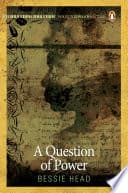
Synopsis
Covers the whole plot, including the ending.
- Difficulty
- Hard
- Pacing
- Slow
- Mood
- Introspective, Disturbing, Philosophical, Intense
- Read it if
- You are interested in a deep, introspective psychological novel exploring mental illness, identity, and the immigrant experience, with a unique narrative style.
- Skip it if
- You prefer fast-paced plots, clear-cut realism, or find detailed portrayals of mental breakdown too disturbing.
A Question of Power Plot Summary
Covers the whole plot, including the ending.
Arrival in Motabeng
Elizabeth, a mixed-race woman from South Africa, arrives in Motabeng, Botswana, seeking escape from her past and apartheid. She comes with her young son, Serowe. The local community, especially the kind people of the agricultural cooperative, welcome them. Elizabeth works in the village's vegetable garden, a peaceful and productive place. She initially feels a sense of belonging and relief from her anxieties, finding comfort in the work and her neighbors' acceptance. Despite this calm, hints of her internal struggles are already present, foreshadowing the coming psychological turmoil.
The Onset of Visions and Voices
As Elizabeth settles in Motabeng, her inner world starts to fall apart. She begins to have vivid, terrifying hallucinations, mainly involving two figures: Sello and Dan. Sello often appears as a kind but unclear figure, and Dan embodies a more sinister, aggressive presence. These figures torment her with accusations, sexual suggestions, and big questions, blurring the line between reality and delusion. The voices are constant, creating an internal struggle that isolates her despite being in a supportive community. This marks the start of her severe mental health crisis.
The Battle for Her Soul
Elizabeth's mind becomes a cosmic battleground. Sello and Dan, along with other strange figures, fill her thoughts. Sello, in his various forms (from a monk to a king), represents a spiritual search for truth, often testing Elizabeth's morals. Dan, in contrast, embodies pure evil, lust, and destructive human traits, constantly accusing and demeaning her. Elizabeth sees herself as the chosen one for this ultimate fight, enduring psychological torture and confusion. Motabeng village, though unaware of her internal drama, becomes the setting for this deeply personal, spiritual war.
Community Support and Misunderstanding
Despite her inner chaos, Elizabeth maintains a normal daily life, working in the garden and caring for Serowe. Some villagers, like the kind Tom, offer her true friendship and support, sensing her distress without fully understanding it. However, her erratic behavior, sudden withdrawals, and occasional outbursts are often met with confusion, fear, or gossip. The cultural view of mental illness, sometimes linked to witchcraft, further complicates her situation. This mix of compassion and misunderstanding reinforces Elizabeth's feeling of being an outsider, trapped in her mind while trying to connect with the world.
The Influence of Sello
Initially, Sello is one of Elizabeth's main tormentors, appearing in various forms and putting her through intense spiritual tests. He is shown as an ancient, powerful figure, a 'god of the earth' or a 'Buddha,' who seems to direct the entire hallucinatory drama. Over time, his role changes. While still a source of great pressure and philosophical debate, Sello begins to represent a path to understanding and spiritual awakening. He challenges Elizabeth to face her deepest fears, her sense of self, and the nature of good and evil. His presence, though terrifying, ultimately pushes her towards self-reflection and a deeper connection with the human experience, guiding her through her own mind.
The Torment of Dan
Dan is the embodiment of pure evil in Elizabeth's hallucinations. He is a grotesque, sexually depraved figure who constantly attacks her with accusations of promiscuity, worthlessness, and a lack of identity. His presence is suffocating, turning her mind into a fight for her dignity and sanity. Dan represents the societal pressures, racial prejudice, and sexual objectification Elizabeth has faced, amplifying them to a terrifying degree. His constant accusations and attempts to degrade her aim to break her spirit, forcing her to confront her deepest anxieties about her mixed-race identity and her place in the world. He is the main foe in her internal struggle.
Hospitalization and Treatment
As Elizabeth's mental state worsens, her behavior becomes increasingly erratic and alarming to others. The hallucinations intensify, making it impossible for her to tell reality from delusion. Recognizing her severe condition, the community, with the help of people like Tom, arranges for her hospitalization. She is admitted to a psychiatric facility for medical treatment, including medication. This hospitalization is a turning point, offering a temporary break from the constant internal torment and providing the necessary help for her slow recovery. It is a moment where the outside world finally acknowledges her inner crisis.
The Road to Recovery
After her hospitalization, Elizabeth begins a long and difficult recovery. The medication helps quiet the most tormenting voices and visions, allowing her to slowly regain clarity. She returns to Motabeng and resumes work in the communal garden, finding comfort in the physical labor and the tangible results. This period brings a gradual understanding of her own mind and what caused her breakdown. She starts to process her experiences, realizing that the 'gods' and 'devils' were manifestations of her own internal struggles and societal pressures. Her connection to the earth and community becomes a grounding force.
Reconciliation with Self and Identity
A key part of Elizabeth's recovery involves facing her complex identity as a mixed-race woman in a society marked by racial divisions. Her past as an 'outsider' in South Africa, combined with internal accusations from figures like Dan, forced her to grapple with her sense of belonging and self-worth. Through her ordeal, she accepts her unique heritage, seeing it as a strength rather than a source of shame. She also begins to come to terms with her childhood trauma and her mother's abandonment, understanding how these events shaped her vulnerability. This process leads to a fragile but deep inner peace.
Finding a Place in Motabeng
As Elizabeth recovers, she solidifies her place in the Motabeng community. Her dedication to the communal garden grows, and she becomes an important part of its success. She finds true connection with her neighbors, especially with people like Tom and the other women of the cooperative. The initial feeling of being an outsider slowly fades as she actively contributes to the village's well-being and finds acceptance for who she is, including her past struggles. The village, once a setting for her internal war, becomes a symbol of healing, community, and the chance to build a new life. She finds a stable foundation and a sense of belonging she had long sought.
Principal Figures
Elizabeth
Protagonist
A mixed-race South African woman battling profound mental illness and searching for identity.
Elizabeth is a complex, sensitive, and highly introspective woman of mixed racial heritage, originating from South Africa. Driven by a desire to escape the racial oppression and personal trauma of her past, she seeks refuge in the Botswanan village of Motabeng. She is intelligent and observant, but her inner world is deeply fractured, leading to severe hallucinations and a prolonged mental breakdown. Her core struggle revolves around identity, belonging, and the nature of good and evil. Despite her illness, she possesses immense resilience and a profound capacity for spiritual and intellectual growth, seeking meaning amidst chaos.
Relationships: Serowe (Her young son, a source of grounding and love.); Sello (A primary hallucinatory figure, initially a tormentor, later a spiritual guide.); Dan (A primary hallucinatory figure, embodying evil, lust, and accusation.); Tom (A kind and supportive villager who offers practical help and friendship.)
Sello
Hallucinatory Figure
A multifaceted spiritual entity in Elizabeth's mind, representing cosmic power and wisdom.
Sello is one of the two dominant hallucinatory figures in Elizabeth's mind. He appears in various forms – an ancient meditating monk, a powerful king, a 'god of the earth' – and embodies a blend of spiritual wisdom, cosmic power, and ambiguous intent. Initially, he is a primary tormentor, subjecting Elizabeth to rigorous spiritual and intellectual trials, forcing her to confront profound philosophical questions about good, evil, and the nature of power. Over time, his role shifts to that of a guide, albeit a harsh one, pushing her towards self-discovery and a deeper understanding of the universal human condition. He represents the potential for both enlightenment and overwhelming pressure.
Relationships: Elizabeth (His primary focus and 'student' in her internal spiritual battle.); Dan (His antagonist in the cosmic drama playing out in Elizabeth's mind.)
Dan
Hallucinatory Figure
A malevolent, sexually predatory entity in Elizabeth's mind, embodying evil and societal judgment.
Dan is the antithesis of Sello, representing the dark, destructive, and sexually aggressive aspects of humanity and societal prejudice within Elizabeth's hallucinations. He is a grotesque, relentlessly tormenting figure who constantly bombards Elizabeth with accusations of promiscuity, worthlessness, and a lack of identity. Dan embodies the racial prejudice and sexual objectification Elizabeth has experienced, magnifying them to a terrifying degree. His goal is to degrade, humiliate, and ultimately break Elizabeth's spirit. He is the personification of the external and internal forces that seek to diminish her, making him the ultimate antagonist in her profound psychological struggle.
Relationships: Elizabeth (His primary victim and target of degradation.); Sello (His antagonist in the cosmic drama.)
Serowe
Supporting
Elizabeth's young son, a grounding presence in her tumultuous life.
Serowe is Elizabeth's young son, who accompanies her to Motabeng. He is largely oblivious to the extent of his mother's internal struggles, representing innocence and a tangible link to reality. Despite Elizabeth's deep descent into mental illness, her love and responsibility for Serowe remain a constant, grounding force. His needs and presence often provide moments of clarity and motivation for Elizabeth to continue fighting for her sanity. He is a symbol of hope and the future, representing the life Elizabeth is striving to build and protect, even amidst her profound internal chaos. His well-being is a driving factor in her desire to recover.
Relationships: Elizabeth (His mother, whom he deeply loves and depends on.)
Tom
Supporting
A kind and practical Botswanan villager who offers Elizabeth friendship and support.
Tom is a Botswanan villager who works alongside Elizabeth in the communal garden. He is characterized by his kindness, practicality, and gentle nature. Unlike many others who might misunderstand or fear Elizabeth's erratic behavior, Tom offers her unwavering friendship and support. He senses her distress and, while not fully comprehending the nature of her mental illness, he provides a stable, reassuring presence. Tom represents the best of the Motabeng community – its capacity for empathy, acceptance, and quiet solidarity. He plays a crucial role in Elizabeth's journey, offering practical help and emotional solace, and is instrumental in ensuring she receives the care she needs.
Relationships: Elizabeth (A supportive friend and colleague in the garden.)
Eugene
Mentioned
Elizabeth's childhood lover, whose memory contributes to her internal struggles.
Eugene is a figure from Elizabeth's past, her childhood lover from South Africa. Though not physically present in the narrative, his memory and their relationship are significant to Elizabeth's internal struggles. He represents a period of youthful intimacy and perhaps a lost innocence, but also the complexities of her early life and relationships, which contribute to the psychological landscape of her breakdown. Dan often uses Eugene's memory to accuse and torment Elizabeth, twisting their past intimacy into something shameful. He symbolizes the unresolved aspects of Elizabeth's past romantic and sexual experiences that she grapples with during her illness.
Relationships: Elizabeth (Her past lover, now a memory that fuels her torment.)
Motabeng Villagers (Collective)
Supporting
The community in Botswana that provides Elizabeth with a new home and varied interactions.
The villagers of Motabeng, as a collective, represent the broader social environment in which Elizabeth attempts to rebuild her life. They embody a range of reactions to her: some, like Tom, offer genuine kindness and acceptance, particularly through the communal work in the garden. Others display curiosity, suspicion, or misunderstanding towards her 'urban' ways and later, her erratic behavior. They represent the communal spirit of Botswana, but also the limitations of their understanding regarding mental illness. Their interactions, both positive and negative, contribute to Elizabeth's sense of belonging or alienation, shaping her external reality as she battles her internal demons.
Relationships: Elizabeth (Her new community, providing both support and social challenges.)
Themes & Insights
The Nature of Power and Oppression
The novel explores various forms of power: the oppression of apartheid, the internalized power of social judgment, and the spiritual power in Elizabeth's hallucinations. Her mental breakdown is a direct result of these pressures. Sello and Dan represent opposing powers, one seeking enlightenment, the other control. Her journey is about reclaiming personal power from these overwhelming forces, real and imagined. This is clear in her fight against Dan's accusations, which reflect social structures meant to diminish her identity.
“There was no escape from the fact that she was a black woman. Not only black, but of mixed blood. A half-caste. A bastard.”
Identity and Belonging
Elizabeth's mixed-race background and displacement make her a perpetual outsider, always searching for a place. Her mental illness further isolates her, blurring her identity. Sello and Dan constantly challenge her sense of self, forcing her to question who she is and her worth. Her recovery involves accepting her identity, embracing her heritage instead of seeing it as a source of shame. The communal garden in Motabeng is a metaphor for finding a rooted sense of belonging, both to the earth and to an accepting community.
“She had no identity. She was just a thing. A thing that could be used, abused, discarded.”
Sanity and Madness
The novel puts the reader deep into Elizabeth's psychosis, blurring the lines between objective reality and subjective experience. Her hallucinations are not just symptoms; they are complex stories through which she processes trauma, societal pressures, and spiritual questions. The detailed descriptions of her visions and internal battles make the reader question sanity itself. Her journey shows the fragility of the human mind and its capacity to create terrifying realities and eventually heal. The contrast between her internal world and the supportive external world of Motabeng highlights the deep isolation of mental illness.
“The boundary between reality and hallucination was not a line, but a vast, swirling ocean.”
The Search for Spiritual Meaning
Elizabeth's mental breakdown is tied to a spiritual quest. Sello and Dan, though products of her illness, embody a cosmic battle between good and evil. Sello, in particular, acts as a spiritual guide, pushing her to confront universal truths about humanity. Her experiences lead her to a unique understanding of spirituality, one rooted in the earth, communal living, and the acceptance of all human experience, rather than traditional religion. This search for meaning contributes to her healing and a more integrated worldview.
“The soul of the world was a great river, and she had fallen into it, drowning and being reborn.”
The Healing Power of Community and Labor
Despite the deep isolation from her mental illness, communal life and physical labor in Motabeng help Elizabeth recover. The vegetable garden provides a tangible connection to the earth and a sense of purpose. The rhythmic work, nurturing life, and shared effort with villagers ground her in reality. The kindness and practical support from people like Tom, and the community's general acceptance, offer a stable external environment that contrasts with her inner chaos. This shows the healing potential of meaningful work and supportive human connection.
“The earth was the only thing that held her steady, the only thing that made sense.”
Plot Devices & Literary Techniques
Stream of Consciousness
Narrative technique that directly mirrors Elizabeth's internal thought processes and hallucinations.
The novel extensively uses stream of consciousness to immerse the reader directly into Elizabeth's fractured mind. This technique blurs the lines between internal monologue, sensory perceptions, and her vivid hallucinations, making it difficult for the reader to distinguish reality from delusion, just as Elizabeth struggles to do. It allows for a deep, unfiltered exploration of her psychological state, her philosophical inquiries, and the relentless torment she endures. This device is crucial for conveying the disorienting and overwhelming nature of her mental illness, making her subjective experience the primary lens through which the story is told.
Allegorical Figures (Sello and Dan)
Characters who personify abstract concepts like good, evil, spiritual power, and societal oppression.
Sello and Dan are not literal characters but powerful allegorical figures within Elizabeth's hallucinations. Sello personifies spiritual wisdom, cosmic power, and the potential for enlightenment, often appearing as a guru or god-like entity. Dan embodies destructive evil, sexual predation, and the internalized societal judgment Elizabeth has faced, particularly regarding her mixed-race identity and sexuality. These figures serve as externalizations of Elizabeth's internal conflicts, representing a cosmic battle for her soul. Through their interactions, the novel explores profound themes of good versus evil, power, and identity on a grand, symbolic scale.
Setting as Refuge and Catalyst
Motabeng, Botswana, serves as both a sanctuary from Elizabeth's past and a crucible for her psychological breakdown.
The village of Motabeng, Botswana, functions as a dual-purpose plot device. Initially, it is a refuge, a place where Elizabeth seeks escape from the racial oppression and personal trauma of South Africa, offering a sense of peace and community through the communal garden. However, it also becomes a catalyst for her mental breakdown. The relative quiet and isolation, combined with the lack of external distractions, force Elizabeth to confront her unresolved internal conflicts, leading to the full manifestation of her psychosis. The setting's simplicity contrasts sharply with the complexity of her internal world, highlighting her profound internal struggle against an outwardly calm backdrop.
Symbolism of the Garden
The communal vegetable garden represents healing, growth, purpose, and connection to the earth.
The communal vegetable garden in Motabeng is a powerful symbol throughout the novel. Initially, it provides Elizabeth with a practical job and a sense of routine. As her illness progresses, it becomes a grounding force, a tangible connection to reality and life amidst her internal chaos. The act of tending the earth, nurturing plants, and witnessing growth mirrors Elizabeth's own slow process of healing and self-cultivation. It symbolizes productivity, community, and the cyclical nature of life, offering a stark contrast to the barren, destructive landscape of her mind. Ultimately, the garden represents the possibility of renewal and finding purpose through labor and connection to the natural world.
A Question of Power Quotes
“The world was not a good place. It was a place where what was beautiful was killed.”
“There was only one way out of the world and that was through suicide. The only way to live was to be insane.”
“She had fallen into a world of myth and symbol, where the only reality was the reality of her own mind.”
“She was not herself. She was a stage on which the most terrible dramas were enacted.”
“All knowledge was power, and all power was evil.”
“The soul could only be destroyed by itself, never by another.”
“She had to learn to live with the devils, and not against them.”
“The silence was so vast and profound that it seemed to contain all the secrets of the universe.”
“Perhaps the only way to understand life was to live it as if it were a dream.”
“She had always been a solitary person, a stranger in every land, an outcast from every community.”
“There was no such thing as normal. Everyone was mad in their own way.”
“The greatest power was the power to love, and the greatest freedom was the freedom from fear.”
“She decided that if there was to be a God, he would have to be a God of the common people, a God of the earth.”
“The only way to create was to destroy, to break down the old forms and build new ones.”
Quiz
10 questions on the plot and the characters. Each answer comes with a short explanation.
Question 1
What is the name of the village in Botswana where Elizabeth and her son settle?
- Gaborone
- Serowe
- Motabeng
- Francistown
Show answer
C. Motabeng Elizabeth and her son make their new home in the village of Motabeng, which means 'place of sand'.
Question 2
From which country did Elizabeth and her son emigrate to Botswana?
- Zimbabwe
- South Africa
- Lesotho
- Namibia
Show answer
B. South Africa The book states that Elizabeth and her son left their old life in South Africa to move to Botswana.
Question 3
What aspect of Elizabeth's background marks her as an outsider in Motabeng?
- Her wealth and education
- Her mixed racial heritage and urban ways
- Her political activism
- Her profession as a teacher
Show answer
B. Her mixed racial heritage and urban ways The synopsis explicitly states that Elizabeth's 'mixed racial heritage and urban ways mark her as an outsider'.
Question 4
What is the primary internal struggle Elizabeth faces throughout the novel?
- Her longing to return to South Africa
- Her battle with nightmares and hallucinations
- Her difficulty finding employment in Motabeng
- Her desire to marry a local man
Show answer
B. Her battle with nightmares and hallucinations The novel 'tracks Elizabeth's struggle to emerge from... the nightmares and hallucinations that torment her'.
Question 5
The novel is described as 'semi-autobiographical'. What does this imply about Bessie Head's connection to the story?
- It is a purely fictional story with no real-world basis.
- It contains elements inspired by the author's own life experiences.
- It is a biography of a historical figure.
- The author wrote the book based on interviews with Elizabeth.
Show answer
B. It contains elements inspired by the author's own life experiences. Semi-autobiographical means that the work incorporates elements of the author's own life, even if presented as fiction.
Question 6
What does the phrase 'the past cannot be conveniently left behind at the border' suggest about Elizabeth's move?
- She has unresolved legal issues in South Africa.
- Her emotional and psychological burdens from her past persist despite changing locations.
- She frequently travels back and forth between the two countries.
- Her son misses their old home in South Africa.
Show answer
B. Her emotional and psychological burdens from her past persist despite changing locations. This phrase highlights that physical relocation doesn't automatically resolve internal or historical struggles, implying her past continues to affect her mental state.
Question 7
The novel is described as 'mind-bending' and takes the reader 'in and out of sanity'. What literary technique does this description imply is heavily used?
- Extensive use of dialogue between characters.
- A linear, straightforward narrative style.
- Exploration of subjective reality and altered states of consciousness.
- Frequent flashbacks to historical events.
Show answer
C. Exploration of subjective reality and altered states of consciousness. Being 'mind-bending' and moving 'in and out of sanity' strongly suggests a focus on Elizabeth's internal, often distorted, perception of reality.
Question 8
What is the primary source of Elizabeth's 'oppressive social situation' in Motabeng, beyond her personal mental struggles?
- The harsh desert climate and lack of resources.
- The village's strict religious customs.
- Her status as an outsider due to her heritage and origins.
- Financial debt she accrued in South Africa.
Show answer
C. Her status as an outsider due to her heritage and origins. The text explicitly states she is 'marked her as an outsider' due to her 'mixed racial heritage and urban ways', contributing to her oppressive social situation.
Question 9
The title 'A Question of Power' most likely refers to which central theme in the novel?
- The political power dynamics between Botswana and South Africa.
- Elizabeth's struggle to reclaim control over her own mind and identity.
- The power of nature over human existence in the desert.
- The hierarchical power structure within the Motabeng village.
Show answer
B. Elizabeth's struggle to reclaim control over her own mind and identity. Given Elizabeth's internal battle with sanity and her struggle to 'emerge from' oppressive situations, 'power' likely refers to her internal struggle for self-control and agency.
Question 10
What does the phrase 'free to reinvent herself in this new country' imply about Elizabeth's initial hopes or intentions upon moving to Botswana?
- She planned to change her name and identity completely.
- She hoped to escape the historical and personal burdens of her past and start anew.
- She intended to establish a new business venture.
- She wanted to become a respected elder in the community.
Show answer
B. She hoped to escape the historical and personal burdens of her past and start anew. To 'reinvent herself' suggests a desire for a fresh start, free from the constraints and difficulties of her past life and identity in South Africa.
A Question of Power FAQ
What is the central conflict Elizabeth faces upon arriving in Motabeng?
Elizabeth's central conflict in Motabeng is the struggle to escape her traumatic past in South Africa and establish a stable, sane life, while simultaneously confronting the internal demons and external pressures that brand her as an outsider due to her mixed racial heritage and unconventional background. She battles profound loneliness and the psychological strain of being an 'alien' in a new land, despite her efforts to integrate into the community.
How does Elizabeth's mixed racial heritage impact her experience in Botswana?
Elizabeth's mixed racial heritage, specifically her status as a 'coloured' woman from South Africa, marks her as an outsider in the predominantly black Batswana village of Motabeng. This difference contributes to her feelings of alienation and fuels some of the community's suspicions and misunderstandings about her, exacerbating her sense of isolation and contributing to her psychological distress.
Who are Sello and Dan, and what role do they play in Elizabeth's mental state?
Sello and Dan are two prominent figures in Elizabeth's elaborate hallucinations and nightmares, representing opposing forces within her psyche. Sello embodies a complex mix of spiritual wisdom and insidious malevolence, often appearing as a seductive but tormenting monk, while Dan is a more overtly aggressive and sexually predatory figure. They symbolize the internal battle between good and evil, purity and corruption, and the patriarchal oppression Elizabeth perceives.
What is the significance of the 'place of sand' (Motabeng) as a setting?
Motabeng, the 'place of sand,' signifies both a literal new beginning and a barren, challenging landscape for Elizabeth's psychological and emotional growth. The harsh, isolated environment mirrors her internal desolation and the struggle to cultivate a new life from nothing. It also represents a departure from the urban chaos of South Africa, offering a different kind of challenge and a canvas for her internal turmoil.
How does the novel explore the theme of power dynamics?
The novel explores power dynamics through Elizabeth's experience of being disempowered by her race, gender, and mental illness, and her struggle to reclaim agency. It delves into the power dynamics within her hallucinatory world, where Sello and Dan exert immense control over her, and also subtly examines the power structures within the Motabeng community that marginalize her.
What is the implied connection between Elizabeth's childhood trauma and her adult hallucinations?
The novel strongly implies that Elizabeth's early childhood trauma—being born in a mental asylum to a white mother and a black father, and then separated from her mother—forms the foundational wound for her adult hallucinations. Her feelings of abandonment, racial otherness, and the institutionalized 'madness' of her origins resurface in her adult mind, manifesting as the tormenting voices and figures of Sello and Dan.
How does Bessie Head's own biography subtly inform Elizabeth's character and experiences?
Bessie Head's own semi-autobiographical experiences, particularly her mixed racial heritage, her birth in a mental institution, and her exile from South Africa to Botswana, profoundly inform Elizabeth's character. The author's personal struggles with mental illness, feelings of displacement, and the search for belonging are mirrored in Elizabeth's internal and external conflicts, making the novel a deeply personal exploration of these themes.
Is there a symbolic significance to Elizabeth's work in the horticultural project?
Yes, Elizabeth's work in the horticultural project is highly symbolic. It represents her tangible effort to cultivate life, beauty, and order in a seemingly barren environment, mirroring her internal struggle to nurture her own sanity and build a meaningful existence. The act of growing plants from seeds parallels her attempt to regenerate herself and find a sense of rootedness and purpose.
What hidden meaning can be found in Sello's multiple personas, such as the monk and the snake?
Sello's multiple personas, particularly the monk and the snake, represent the duality of spiritual guidance and insidious corruption within Elizabeth's psyche. The monk persona initially offers wisdom and spiritual exploration, while the snake symbolizes betrayal, temptation, and the destructive forces that undermine her well-being. This reflects her internal conflict between seeking enlightenment and succumbing to psychological torment.
How does Elizabeth's 'madness' serve as a form of resistance or coping mechanism?
Elizabeth's 'madness' can be interpreted as a complex coping mechanism and a form of resistance against overwhelming external and internal pressures. Her elaborate hallucinatory world, while tormenting, allows her to process deep-seated traumas and societal injustices that she cannot confront directly. It becomes a space where she grapples with existential questions and reclaims a form of agency, even if distorted, in a world that denies her a voice.
Discuss the psychological impact of being an 'outsider' on Elizabeth's mental health.
Being an 'outsider' profoundly exacerbates Elizabeth's mental health struggles, fueling her paranoia, isolation, and feelings of worthlessness. The constant scrutiny and misunderstanding from the community, coupled with her past trauma, reinforce her belief that she is fundamentally flawed and unlovable. This external pressure intensifies her internal battles, making it harder to distinguish reality from hallucination and contributing to her breakdown.
How does the novel portray the experience of trauma and its long-term effects on the psyche?
The novel vividly portrays trauma as a pervasive force that shapes Elizabeth's entire existence, manifesting in her debilitating hallucinations and profound sense of alienation. It demonstrates how unresolved childhood trauma, combined with subsequent experiences of racism and social ostracization, can fragment the self and lead to a deep-seated psychological struggle that impacts every aspect of an individual's life, demanding an intense internal battle for healing.
What is the psychological significance of Elizabeth's repeated attempts to find a 'home' or belonging?
Elizabeth's repeated attempts to find a 'home' or belonging reflect a fundamental human need for safety, identity, and connection, which she has been denied since birth. Psychologically, these attempts are crucial for her healing, as finding a stable external environment and social acceptance could provide the grounding necessary to overcome her internal chaos. Her failure to fully achieve this in Motabeng further destabilizes her, intensifying her search.
Is Elizabeth's eventual 'recovery' presented as a complete cure or a more nuanced acceptance of her condition?
Elizabeth's eventual 'recovery' is presented as a nuanced acceptance and integration of her experiences, rather than a complete cure. She doesn't become 'normal' in the conventional sense, but she achieves a profound understanding and peace regarding her past and her unique identity. Her journey culminates in a form of spiritual and psychological resilience, allowing her to live with her experiences rather than be consumed by them, finding power in her vulnerability.
How does the novel challenge traditional notions of sanity and madness?
The novel profoundly challenges traditional notions of sanity and madness by blurring the lines between them, suggesting that Elizabeth's 'madness' is a deeply personal and often insightful response to an oppressive world. It implies that true sanity might involve confronting one's inner demons and accepting one's unique reality, rather than adhering to rigid societal norms. Her hallucinations, while terrifying, are also avenues for profound self-discovery and spiritual exploration.
What is the novel's ultimate message about human resilience and the search for identity?
The novel's ultimate message emphasizes the extraordinary resilience of the human spirit in the face of profound adversity and the lifelong, often solitary, journey of forging an identity amidst societal prejudice and personal trauma. It suggests that identity is not fixed but is constantly being shaped by inner and outer forces, and that true strength lies in confronting one's deepest fears and finding a unique sense of self, even if it deviates from conventional paths.
How does the novel incorporate elements of spiritual or mythological symbolism?
The novel heavily incorporates spiritual and mythological symbolism, particularly through the figures of Sello and Dan, who often take on god-like or demonic qualities. Sello's association with various deities and spiritual traditions, and the overarching battle between good and evil, reflects a universal quest for meaning and purity. These symbols elevate Elizabeth's personal struggle to a broader, archetypal level, suggesting her journey is a mythic quest for self-realization.
Does the ending offer a hopeful or ambiguous resolution for Elizabeth?
The ending offers a hopeful, yet nuanced, resolution for Elizabeth. While she doesn't achieve a conventional 'happy ending,' she finds a profound sense of peace and self-acceptance. She integrates her past and her experiences, forging a unique identity rooted in her own understanding rather than external validation. This resolution suggests a triumph of the spirit, where inner harmony is achieved even if external circumstances remain challenging, offering a powerful message of personal liberation.
About the author

Bessie Amelia Emery Head was a South African writer who, though born in South Africa, is usually considered Botswana's most influential writer. She wrote novels, short fiction and autobiographical works that are infused with spiritual questioning and reflection.
Similar books
- The Bell Jar
Sylvia Plath
4.0 (591k) average on GoodreadsPsychologyExplores a young woman's descent into mental illness and her struggle for identity.
- Things Fall Apart
Chinua Achebe
3.7 (288k) average on GoodreadsHistorical FictionOffers a profound look at cultural clash and the individual's struggle within a changing society, though 'A Question of Power' is far more internal.
- Nervous Conditions
Tsitsi Dangarembga
4.0 (12k) average on GoodreadsHistorical FictionWhile both A Question of Power and Nervous Conditions are seminal works of African literature by women, they approach the theme of identity and societal pressures differently. Dangarembga's novel focuses more on the socio-economic and educational struggles of young black women in Rhodesia, exploring the 'nervous conditions' imposed by colonialism and patriarchy on the mind and body. Head's work, conversely, delves deeper into the internal, psychological disintegration of the individual, with external societal pressures acting as catalysts rather than primary antagonists. Head's narrative is more abstract and introspective, while Dangarembga's is more overtly political and social realist in its critique of colonial education and gender roles. Both, however, are critical in understanding the complex psychological landscape of post-colonial Africa.
- Nineteen Eighty-Four
George Orwell
4.2 (5.5M) average on GoodreadsFictionWinston Smith dreams of truth and rebellion in a world where Big Brother watches all, but he confronts the terrifying power of a regime that controls not just actions, but thoughts.
- The Frozen River
Ariel Lawhon
4.4 (600k) average on GoodreadsFictionIn 1789 Maine, a heroic midwife's diary helps her expose a murder and get justice in a town that wants to silence her.
- A Man Called Ove
Fredrik Backman
4.4 (569k) average on GoodreadsFictionA stubborn widower, who lives by strict rules, finds his quiet world changed by a lively new family next door, making him face his past and find happiness in human connection.





Enjoyed the summary?
A summary gives you the shape of the book. The book itself has the detail, the examples and the voice.
Find A Question of Power on AmazonAs an Amazon Associate, BookBrief earns from qualifying purchases. How we're funded