

Synopsis
Covers the whole plot, including the ending.
- Difficulty
- Medium
- Read it if
- You are interested in the psychological impact of societal pressures, the experience of depression and mental health struggles, or the gendered aspects of identity formation in mid-20th century America.
- Skip it if
- You prefer books with a fast-paced plot, explicit resolution, or find descriptions of mental illness and institutionalization too distressing.
The Bell Jar Quotes
“I saw my life branching out before me like the green fig tree in the story. From the tip of every branch, like a fat purple fig, a wonderful future beckoned and winked.”
“I felt very still and very empty, the way the eye of a tornado must feel, moving dully along in the middle of the surrounding hullabaloo.”
“To the person in the bell jar, blank and stopped as a dead baby, the world itself is the bad dream.”
“I took a deep breath and listened to the old brag of my heart. I am, I am, I am.”
“If neurotic is wanting two mutually exclusive things at one and the same time, then I'm neurotic as hell. I'll be flying back and forth between one mutually exclusive thing and another for the rest of my days.”
“I felt my lungs inflate with the onrush of scenery—air, mountains, trees, people. I thought, 'This is what it is to be happy.'”
“The silence depressed me. It wasn't the silence of silence. It was my own silence.”
“I wanted to be where nobody I knew could ever come.”
“I saw the years of my life spaced along a road in the form of telephone poles, threaded together by wires. I counted one, two, three... nineteen telephone poles, and then the wires dangled into space, and try as I would, I couldn't see a single pole beyond the nineteenth.”
“I am an observer, and I observe.”
“I felt myself melting into the shadows like the negative of a person I'd never seen before in my life.”
“The trouble was, I had been inadequate all along, I simply hadn't thought about it.”
“I wanted to tell her that if only something were wrong with my body it would be fine, I would rather have anything wrong with my body than something wrong with my head.”
“I saw the world divided into people who had slept with somebody and people who hadn't, and this seemed the only really significant difference between one person and another.”
“I felt wise and cynical as all hell.”
Quiz
10 questions on the plot and the characters. Each answer comes with a short explanation.
Question 1
What is Esther Greenwood's primary occupation or goal at the beginning of the novel?
- To become a famous poet
- To work as a guest editor for a fashion magazine in New York
- To study medicine at Harvard
- To travel to Europe as a journalist
Show answer
B. To work as a guest editor for a fashion magazine in New York At the start of the novel, Esther is a college student who wins a contest to work as a guest editor for a New York fashion magazine, which sets the stage for her experiences and eventual breakdown.
Question 2
What does the 'bell jar' metaphor in the title symbolize?
- A protective shield from society's pressures
- The feeling of being trapped and suffocated by mental illness
- A scientific instrument used in Esther's experiments
- The glamorous but empty world of New York fashion
Show answer
B. The feeling of being trapped and suffocated by mental illness The 'bell jar' represents Esther's sense of isolation and suffocation due to her depression and mental breakdown, as if she is trapped under a glass jar, cut off from the world.
Question 3
Which character serves as a foil to Esther, representing a traditional path of marriage and domesticity that Esther rejects?
- Doreen
- Joan Gilling
- Betsy
- Mrs. Greenwood
Show answer
C. Betsy Betsy, another guest editor in New York, embodies the conventional, wholesome ideals of femininity and marriage that Esther finds oppressive and unappealing.
Question 4
Why does Esther feel particularly alienated during her time in New York?
- Because she is homesick for her family in Boston
- Because she fails to win a writing competition
- Because she struggles with the expectations of femininity and success in a male-dominated world
- Because she has a falling out with all her friends
Show answer
C. Because she struggles with the expectations of femininity and success in a male-dominated world Esther feels trapped by societal expectations for women in the 1950s, such as marriage and domesticity, while also grappling with her own ambitions and mental health, leading to a sense of alienation.
Question 5
What significant event triggers Esther's first suicide attempt in the novel?
- Being rejected from a writing program
- Learning that her boyfriend Buddy Willard is not a virgin
- Failing her chemistry exam and losing a scholarship
- Being rejected from a writing course taught by a famous author
Show answer
D. Being rejected from a writing course taught by a famous author After returning from New York, Esther applies to a writing course taught by a famous author but is rejected, which exacerbates her feelings of failure and contributes to her decision to attempt suicide.
Question 6
How does Sylvia Plath use Esther's experiences with electroconvulsive therapy (ECT) to critique the mental health system of the time?
- By showing it as a miraculous cure that saves Esther's life
- By depicting it as a brutal and dehumanizing procedure that worsens her trauma
- By portraying it as a common and harmless treatment for depression
- By ignoring its effects to focus on other therapies
Show answer
B. By depicting it as a brutal and dehumanizing procedure that worsens her trauma Plath vividly describes Esther's traumatic and painful experience with ECT, highlighting the lack of empathy and effectiveness in mid-20th century psychiatric treatments, which adds to the novel's critique of mental health care.
Question 7
What role does the fig tree metaphor play in expressing Esther's internal conflict?
- It symbolizes her desire to travel and see the world
- It represents the many life choices available to her and her paralysis in deciding
- It illustrates her love for nature and gardening as a therapeutic escape
- It signifies her fear of aging and mortality
Show answer
B. It represents the many life choices available to her and her paralysis in deciding Esther imagines a fig tree with branches representing different life paths (e.g., career, marriage, motherhood), but she feels unable to choose any, symbolizing her indecision and the overwhelming pressure of societal expectations.
Question 8
In the context of the novel, what is the significance of Esther's loss of virginity?
- It marks her rebellion against societal norms and her quest for autonomy
- It leads to her immediate recovery from depression
- It results in a pregnancy that forces her to marry
- It symbolizes her acceptance of traditional female roles
Show answer
A. It marks her rebellion against societal norms and her quest for autonomy Esther deliberately loses her virginity to a man she does not love, Irwin, as an act of defiance against the double standards and expectations placed on women, reflecting her struggle for control over her own body and life.
Question 9
How does Joan Gilling's character and fate relate to Esther's journey in the novel?
- Joan serves as a successful model of recovery that Esther fails to emulate
- Joan's suicide mirrors Esther's struggles but highlights different responses to mental illness
- Joan is a romantic rival who distracts Esther from her goals
- Joan provides financial support that helps Esther through her breakdown
Show answer
B. Joan's suicide mirrors Esther's struggles but highlights different responses to mental illness Joan, who also suffers from mental illness and is treated in the same hospital as Esther, ultimately commits suicide. This contrasts with Esther's survival, underscoring the varied outcomes of depression and adding depth to the novel's exploration of mental health.
Question 10
What does the ending of the novel suggest about Esther's future?
- She is fully cured and ready to embrace a traditional life
- She has accepted her mental illness as a permanent part of her identity
- She is about to be released from the hospital but with an uncertain and fragile recovery
- She plans to move abroad to escape her past
Show answer
C. She is about to be released from the hospital but with an uncertain and fragile recovery The novel ends ambiguously with Esther about to leave the psychiatric hospital for a hearing that may grant her release. This suggests a tentative step toward recovery, but the bell jar metaphor implies that her mental health struggles may linger, leaving her future uncertain.
The Bell Jar FAQ
What is 'The Bell Jar' about?
'The Bell Jar' is a semi-autobiographical novel that chronicles the mental breakdown of Esther Greenwood, a talented young woman who struggles with depression, societal expectations, and her own identity in 1950s America. It explores themes of mental illness, feminism, and the pressures of conformity through Esther's descent into madness.
Is 'The Bell Jar' based on Sylvia Plath's life?
Yes, 'The Bell Jar' is widely considered semi-autobiographical, drawing heavily from Sylvia Plath's own experiences with depression, electroconvulsive therapy, and her time as a guest editor in New York. The protagonist Esther Greenwood shares many similarities with Plath's own life and struggles.
What does the bell jar symbolize in the book?
The bell jar symbolizes Esther's feeling of suffocation, isolation, and detachment from the world around her. It represents how mental illness creates a barrier between her and normal life, trapping her in a distorted reality where she can see the world but cannot fully participate in it.
How is 'The Bell Jar' different from other mental illness memoirs?
Unlike clinical accounts of mental illness, 'The Bell Jar' provides an intensely personal, visceral experience of depression from the inside. Plath's poetic prose makes Esther's descent feel rational and accessible, creating empathy rather than clinical distance. The novel also uniquely combines feminist critique with mental health themes.
Does 'The Bell Jar' accurately portray depression?
Yes, 'The Bell Jar' is praised for its authentic and nuanced portrayal of depression. Plath captures not just the symptoms but the subjective experience - the numbness, distorted thinking, and sense of detachment that characterize severe depression. Many readers with mental health struggles find Esther's experience resonates deeply with their own.
What is electroconvulsive therapy (ECT) in 'The Bell Jar'?
Electroconvulsive therapy (ECT) appears in the novel as a traumatic, poorly administered treatment Esther receives without proper consent or preparation. This reflects both the historical reality of mental health treatment in the 1950s and Plath's own negative experiences with ECT, which she portrays as dehumanizing and terrifying.
How different is 'The Bell Jar' from 'The Catcher in the Rye'?
While both novels feature young protagonists struggling with identity and societal expectations, 'The Bell Jar' focuses specifically on female experience and clinical depression, whereas 'The Catcher in the Rye' explores male adolescence and alienation. Plath's novel also has a more intense, poetic style and grapples more directly with mental illness.
Does reading 'The Bell Jar' help understand depression?
Yes, 'The Bell Jar' can help readers understand depression by providing an intimate, first-person perspective on the experience. It illustrates how depression affects perception, relationships, and daily functioning in ways that clinical descriptions often cannot capture. However, it's important to remember it represents one person's experience.
What is the significance of the fig tree metaphor?
The fig tree metaphor represents Esther's paralysis when faced with life choices and possibilities. Each fig symbolizes a different life path (career, marriage, motherhood, travel), but choosing one means losing the others, creating overwhelming anxiety that prevents her from choosing any, leading to the figs rotting and falling.
Is 'The Bell Jar' appropriate for young readers?
'The Bell Jar' contains mature themes including suicide, depression, and sexual content that may be challenging for younger readers. While often taught in high schools and colleges, it's recommended for mature teenagers with guidance, as the intense portrayal of mental illness requires emotional readiness and contextual understanding.
About the author
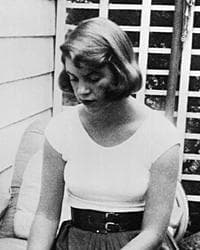
Sylvia Plath was an American poet, novelist, and short story writer. She is credited with advancing the genre of confessional poetry and is best known for two of her published collections, The Colossus and Other Poems (1960) and Ariel (1965), as well as The Bell Jar, a semi-autobiographical novel published shortly before her suicide in 1963. The Collected Poems was published in 1981, which included previously unpublished works. For this collection Plath was awarded a Pulitzer Prize in Poetry in 1982, making her the fourth to receive this honour posthumously.
Similar books
- One Flew Over the Cuckoo's Nest
Ken Kesey
4.2 (631k) average on GoodreadsPsychologyWhile Kesey's novel also critiques mental healthcare institutions and societal control, it primarily focuses on a male protagonist and the oppressive power structures within a psychiatric ward. 'The Bell Jar' offers a more intimate, internal exploration of depression and anxiety from a female perspective, emphasizing the insidious, internalized pressures of society rather than just overt institutional control. Kesey's critique is more outwardly confrontational, whereas Plath's is deeply psychological and personal, reflecting the subtle ways societal norms can erode an individual's psyche.
- The Perks of Being a Wallflower
Stephen Chbosky
4.2 (1.3M) average on GoodreadsPsychologyThrough letters, a shy high school freshman learns to navigate first love, trauma, and self-discovery, stepping off the sidelines and into life.
- Eleanor Oliphant Is Completely Fine
Gail Honeyman
4.3 (708k) average on GoodreadsLiterary FictionA lonely woman's structured life changes when an IT guy and an elderly man help her learn to open her heart.
- The Subtle Art of Not Giving a F*ck: A Counterintuitive Approach to Living a Good Life
Mark Manson
3.9 (530k) average on GoodreadsBusinessEmbrace your flaws and stomach life's lemons, because true happiness isn't about relentless positivity, but about choosing what truly matters to give a f*ck about.
- Sapiens: A Brief History of Humankind
Yuval Noah Harari
4.4 (502k) average on GoodreadsPsychologySapiens tells the story of Homo sapiens, showing how our ability to create shared fictions helped us go from an ordinary ape to the planet's main species, changing Earth and our future.
- Speak
Laurie Halse Anderson
4.0 (485k) average on GoodreadsPsychologyA silent freshman artist navigates high school, her quietness a shield against a traumatic secret until she finds her power to speak through art and confronts her rapist.






Enjoyed the summary?
A summary gives you the shape of the book. The book itself has the detail, the examples and the voice.
Find The Bell Jar on AmazonAs an Amazon Associate, BookBrief earns from qualifying purchases. How we're funded