
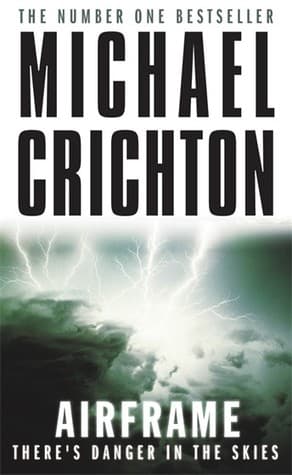
Synopsis
Covers the whole plot, including the ending.
- Difficulty
- Medium
- Pacing
- Fast
- Mood
- Suspenseful, Technical, Intriguing, Urgent
- Read it if
- You enjoy fast-paced techno-thrillers with detailed scientific and engineering explanations, corporate intrigue, and a whodunit mystery.
- Skip it if
- You prefer character-driven narratives over plot and technical details, or are not interested in the intricacies of aviation and corporate politics.
Airframe Plot Summary
Covers the whole plot, including the ending.
The Emergency Landing
TransPacific Airlines Flight 545, a new N-22 wide-body jet, flying from Hong Kong to Denver, declares an emergency off the coast of California. The pilot reports severe turbulence and asks for priority landing at Los Angeles International Airport (LAX), requesting forty ambulances. When the plane lands, rescue workers find a terrible scene: ninety-four passengers are hurt, three are dead, and the plane's inside is badly damaged, with seats torn loose and blood everywhere. Everyone assumes extreme turbulence, but the amount of damage and the crew's vague statements raise questions.
Casey Singleton's Assignment
Casey Singleton, Vice President of Quality Assurance at Norton Aircraft, the N-22's maker, is called in by her boss, John Marder. TransPacific Airlines threatens to cancel a multi-billion dollar order for more N-22s, which could bankrupt Norton. Casey has only twelve hours to write an initial report explaining what happened on Flight 545, as the media and corporate rivals close in. Her main goal is to find out if the incident was due to a mechanical failure of the N-22, which would be disastrous for Norton.
Initial Investigations and Conflicting Accounts
Casey's team, including technician Doug Doherty, starts a careful examination of the N-22. They find no clear signs of structural failure or mechanical problem that would explain the damage. Meanwhile, interviews with the flight crew, including Captain John Hammond and First Officer Ted Olsen, give inconsistent and evasive answers. The flight attendants are too traumatized to give clear details. A key piece of evidence, the cockpit voice recorder (CVR), is found, but its contents are vital and must be analyzed carefully. The pressure on Casey grows as time runs out.
The Media Storm and Corporate Espionage
The media descends on LAX, and sensational reports start appearing, often suggesting a design flaw in the N-22. Marty Reardon, a well-known tabloid journalist, becomes a constant problem, trying to control the story. Casey also suspects that Norton's rival, Donaldson Aircraft, is actively trying to hurt Norton's reputation by leaking false information and encouraging TransPacific to cancel their order. Her investigation is not just about finding the truth, but also about protecting Norton from outside attacks.
Examining the Flight Data Recorder
Doug Doherty and his team carefully analyze the Flight Data Recorder (FDR), which records things like airspeed, altitude, and control surface movements. The data starts to contradict the crew's claims of severe clear-air turbulence. Instead, the FDR suggests unusual and violent maneuvers, including rapid climbs and descents and sudden turns. These are not consistent with normal flight or even extreme weather. This discovery shifts the focus from a possible aircraft problem to a possible human factor or outside force.
The Role of the Chinese Delegation
Casey learns that a Chinese delegation, led by Ambassador Chang, was on Flight 545. This delegation was important to a multi-billion dollar deal for Norton to sell N-22s to China. The incident, especially the death of one of the Chinese delegates, threatens to ruin this critical deal. The delegation's presence adds another layer of complexity to the investigation, suggesting possible motives beyond simple mechanical failure or turbulence. The political and economic stakes are very high.
The Video Footage Discovery
A breakthrough happens when Casey's team finds a passenger's camcorder. The footage, though shaky and broken, gives a terrifying, first-hand account of the events inside the cabin. It clearly shows a violent struggle, not just turbulence. Passengers are seen fighting, and the camera catches glimpses of a young woman, later identified as Charlotte Kinross, acting erratically and aggressively, attacking other passengers. This footage completely changes the direction of the investigation, pointing to a deliberate act of violence.
Unraveling Charlotte Kinross's Motive
Casey focuses on Charlotte Kinross, the woman seen attacking passengers in the video. Kinross is a former Norton Aircraft employee who was fired for incompetence. Driven by anger and a desire for revenge, she planned the incident. Her plan was to fake an aircraft malfunction by causing chaos and damage, then claim she was a heroic victim. Her goal was to discredit Norton and profit from the lawsuits and media attention, possibly with help from a rival company or a lawyer specializing in aviation incidents.
The Truth Revealed and Confrontation
Casey, with the video evidence and FDR data, confronts the flight crew. They finally admit they covered up the truth to protect their careers and avoid blame. Kinross, with help from some crew members and possibly outside plotters, deliberately caused the damage by violently attacking passengers and interior fittings. She then claimed the plane had severe, unexplained turbulence. The three deaths were a direct result of her actions, not a mechanical failure. The crew's initial claims were a desperate attempt to avoid responsibility.
The Press Conference and Aftermath
At a high-stakes press conference, Casey Singleton presents her findings. She uses the video footage and data to prove that the N-22 was not at fault. She reveals that Charlotte Kinross, acting out of malice, was responsible for the violence on board, and that the flight crew, fearing consequences, tried to cover it up. This revelation clears Norton Aircraft, saving the company from financial ruin and restoring its reputation. Kinross is arrested, and the crew members face charges for their involvement and obstruction.
Airframe Characters
Casey Singleton
Protagonist
Vice President of Quality Assurance at Norton Aircraft, tasked with investigating Flight 545.
Casey is intelligent, tenacious, and highly competent. She is dedicated to her job and fiercely loyal to Norton Aircraft. Despite facing immense pressure from her superiors, the media, and corporate rivals, she remains focused on uncovering the truth. She possesses strong analytical skills and a deep understanding of aircraft mechanics and corporate politics. Her personal life is alluded to, but her professional integrity and drive are central to her character.
Relationships: John Marder (Boss, initially skeptical but eventually supportive); Doug Doherty (Colleague and technical expert, provides crucial support); Marty Reardon (Antagonist, manipulative journalist); Charlotte Kinross (Antagonist, former employee and perpetrator of the incident)
John Marder
Supporting
President of Norton Aircraft and Casey's direct superior.
Marder is a shrewd and pragmatic corporate executive, primarily concerned with the financial stability and reputation of Norton Aircraft. He is under immense pressure from the board and investors, making him initially focused on damage control and quick answers, even if they are incomplete. He recognizes Casey's talent but is not above putting extreme pressure on her to deliver results within an impossible timeframe. He represents the corporate stakes of the investigation.
Relationships: Casey Singleton (Boss-employee relationship, high-pressure dynamic)
Doug Doherty
Supporting
A skilled technician on Casey's team, specializing in aircraft systems and data analysis.
Doug is a quiet, meticulous, and highly intelligent technician. He is invaluable to Casey's investigation, providing the technical expertise needed to analyze the damaged aircraft, interpret flight data recorders, and reconstruct events. He is loyal to Casey and dedicated to finding the truth through scientific and technical evidence. He often acts as the grounded, factual counterpoint to the corporate and media hysteria surrounding the incident.
Relationships: Casey Singleton (Colleague and trusted technical assistant)
Charlotte Kinross
Antagonist
Former Norton employee and the true perpetrator of the violence on Flight 545.
Charlotte Kinross is a disgruntled former employee of Norton Aircraft, fired for incompetence. She is cunning, manipulative, and driven by a deep-seated resentment and desire for revenge against the company. She meticulously planned the incident on Flight 545 to discredit Norton, frame the N-22 as unsafe, and potentially profit from the resulting chaos. She is a master of deception, presenting herself as a victim while orchestrating the violence. Her actions are cold, calculated, and ultimately deadly.
Relationships: Casey Singleton (Adversary, the object of Kinross's deception and ultimately her downfall)
Marty Reardon
Supporting
A sensationalist tabloid journalist exploiting the Flight 545 incident.
Marty Reardon is a cynical and opportunistic journalist who thrives on scandal and sensationalism. He is not interested in the truth but in crafting a compelling, dramatic narrative that sells newspapers and boosts ratings. He actively tries to manipulate the investigation, leak false information, and pressure Casey to confirm his preconceived notions about the N-22's failure. He embodies the destructive power of irresponsible media in a crisis.
Relationships: Casey Singleton (Adversary, constantly trying to extract or twist information from her)
Captain John Hammond
Supporting
The pilot of Flight 545, initially evasive about the incident.
Captain Hammond is an experienced pilot who, along with his crew, initially attempts to cover up the true nature of the events on Flight 545. He is motivated by self-preservation and fear of losing his career and reputation. While not directly involved in Kinross's plot, his complicity in the cover-up significantly complicates Casey's investigation. He is a product of a system that often prioritizes protecting corporate image over immediate transparency.
Relationships: Casey Singleton (Initially resistant to her investigation, later forced to cooperate)
Ted Olsen
Supporting
First Officer of Flight 545, complicit in the cover-up.
Ted Olsen is Captain Hammond's First Officer and is also involved in the attempted cover-up of the incident. Like Hammond, he is primarily concerned with saving his career and avoiding blame. He provides inconsistent accounts, further muddying the waters for Casey's team. His character highlights the pressure on individuals within a hierarchical system to protect themselves and their colleagues, even at the expense of the truth.
Relationships: Casey Singleton (Initially resistant to her investigation, later forced to cooperate); Captain John Hammond (Colleague, shares complicity in the cover-up)
Ambassador Chang
Mentioned
Head of the Chinese delegation on Flight 545.
Ambassador Chang is a key figure in the multi-billion dollar aircraft deal between Norton and China. His presence on Flight 545 and the death of one of his delegates elevate the incident into an international diplomatic and economic crisis. While not a direct participant in the plot, his role underscores the immense financial and political stakes involved for Norton Aircraft.
Relationships: Norton Aircraft (Potential business partner)
Airframe Themes
The Nature of Truth and Perception
The novel explores how truth can be hidden, manipulated, and seen differently based on individual biases and outside pressures. Initial reports of 'turbulence' are widely accepted until Casey's careful investigation uncovers the reality of a deliberate attack. The media, corporate rivals, and even the flight crew actively shape perceptions to serve their own goals, making it hard for Casey to find out what really happened. This theme is clear in the different stories presented by Marty Reardon versus Casey's evidence-based findings.
“'Everybody sees what they want to see, or what they're paid to see.'”
Corporate Espionage and Ethics
The novel looks at the harsh world of corporate competition, especially in the aviation industry. Norton Aircraft faces not only the immediate crisis of Flight 545 but also active sabotage from rival companies like Donaldson Aircraft. Ethical lines blur as competitors leak false information and try to use the disaster for their own financial gain. Casey's fight is as much against outside corporate enemies as it is about finding the truth of the incident itself, showing the moral compromises made to make money.
“'In this business, you don't just compete. You attack.'”
The Impact of Media on Public Opinion
Crichton critically examines the powerful and often harmful role of the media, especially tabloid journalism, in shaping public opinion during a crisis. Marty Reardon shows this by valuing sensationalism and a dramatic story over factual accuracy. His constant pursuit of Casey and his willingness to publish unproven rumors create fear and suspicion, putting huge pressure on Norton and hindering the investigation. The novel shows how media can twist events, cause panic, and even influence corporate decisions, regardless of the truth.
“'The public doesn't want the truth, Casey. They want a story.'”
Technology vs. Human Error/Malice
A main tension in the story is whether the incident was caused by a technological failure of the advanced N-22 aircraft or by human actions. Initially, people assume a mechanical flaw, matching public fears about new technology. However, Casey's investigation, using data from the FDR and raw camcorder footage, systematically disproves this. The final reveal points to human malice and a deliberate act of violence, made worse by human error (the crew's cover-up). This shows that even with advanced technology, the human element remains the most unpredictable and dangerous factor.
“'The machine is perfect. It's the people who are not.'”
Personal Responsibility and Accountability
The theme of responsibility is explored through many characters. Charlotte Kinross is directly responsible for the violence and deaths, driven by personal revenge. The flight crew, Captain Hammond and First Officer Olsen, are accountable for their initial cover-up and misleading statements, trying to avoid blame for not controlling the situation. Casey, in contrast, shows accountability, relentlessly seeking the truth even when it is uncomfortable or politically inconvenient for her company. The novel argues for the need for individuals to take responsibility for their actions, regardless of the outcomes.
“'The truth is always inconvenient, but it has to be told.'”
Plot Devices & Literary Techniques
The Twelve-Hour Deadline
A ticking clock that creates intense pressure and urgency for Casey's investigation.
The arbitrary twelve-hour deadline imposed by John Marder on Casey forces her to work with extreme speed and efficiency. This device heightens the tension throughout the narrative, making every discovery and every interview feel critical. It also serves to illustrate the immense corporate pressure Casey is under, as the fate of Norton Aircraft hinges on her ability to produce a credible report within this impossible timeframe. The deadline is a constant reminder of the high stakes involved.
Flight Data Recorder (FDR) and Cockpit Voice Recorder (CVR)
Key technological artifacts that provide objective evidence of the flight's events.
The FDR and CVR act as crucial, unbiased witnesses to the events on Flight 545. The FDR's detailed data, recording airspeed, altitude, and control inputs, objectively contradicts the crew's claims of turbulence. The CVR, though initially difficult to interpret, eventually provides audio clues. These devices represent the triumph of objective data over subjective accounts and cover-ups, allowing Casey to piece together the truth despite human deception and faulty memory.
The Passenger's Camcorder Footage
A found-footage element that provides a visceral, undeniable eyewitness account from inside the cabin.
The discovery of the camcorder footage is the turning point in the investigation. It serves as a visual, unfiltered, and irrefutable piece of evidence that directly contradicts all previous assumptions and lies. The shaky, chaotic footage brings the horror of the event directly to the reader and Casey, shifting the focus from mechanical failure to human violence. It's a powerful device for revealing the 'hidden' truth and exposing the perpetrator.
Red Herrings (Turbulence, Mechanical Failure)
Misleading clues and initial assumptions designed to divert the investigation.
The initial and widely accepted explanation for the incident—severe clear-air turbulence or a mechanical flaw in the N-22—serves as a major red herring. This narrative is reinforced by the crew's vague statements and the media's sensationalism. These diversions force Casey to painstakingly eliminate false leads and challenge conventional wisdom, making her eventual discovery of human malice all the more impactful. They highlight the difficulty of finding truth amidst misinformation.
Airframe Quotes
“The machine was not a mystery. It was a problem.”
“There's always a reason. Sometimes it's a good reason, sometimes it's a bad reason, but there's always a reason.”
“Everyone wants to believe the worst. It's a fundamental human trait.”
“The truth is rarely pure and never simple.”
“Aviation is a series of compromises.”
“People don't want to know the truth. They want to be told a story.”
“The difference between an accident and an incident is often a matter of luck, and a few inches.”
“If you don't know what you're looking for, you won't find it.”
“The purpose of a press conference is to control the message, not to convey information.”
“No amount of data will ever replace a good pair of eyes and a clear head.”
“Fear is a powerful motivator. And a powerful distorter.”
“The world is not a perfect place, and neither are the machines we build.”
“The more complex the system, the more ways it has to fail.”
“Sometimes the most obvious explanation is the right one, and sometimes it's the one they want you to believe.”
Quiz
10 questions on the plot and the characters. Each answer comes with a short explanation.
Question 1
What is the initial destination of TransPacific Flight 545?
- Los Angeles
- San Francisco
- Denver
- Seattle
Show answer
C. Denver The book states that the twin jet plane is en route to Denver from Hong Kong when the emergency call is made.
Question 2
How many ambulances does the pilot of TransPacific 545 initially request upon declaring an emergency?
- Ten
- Twenty
- Forty
- Sixty
Show answer
C. Forty The pilot requests 'forty ambulances on the runway' after declaring an emergency.
Question 3
What is the professional role of Casey Singleton at Norton Aircraft?
- Chief Engineer
- Head of Quality Assurance
- Vice President of Manufacturing
- Vice President of Production
Show answer
D. Vice President of Production Casey Singleton is the Vice President of Production at Norton Aircraft, tasked with investigating the incident.
Question 4
What specific part of the aircraft's interior is described as 'virtually destroyed' upon inspection?
- The cockpit
- The cargo hold
- The interior cabin
- The engine compartments
Show answer
C. The interior cabin The book states, 'The interior cabin virtually destroyed,' highlighting the significant damage within the passenger area.
Question 5
What is the primary concern for Norton Aircraft in the immediate aftermath of the incident?
- Determining the cause of the emergency before the next quarterly board meeting
- Negotiating compensation for the injured passengers
- Launching a new aircraft model to distract from the incident
- Filing a lawsuit against the airline for negligence
Show answer
A. Determining the cause of the emergency before the next quarterly board meeting Casey's urgent task is to determine the cause of the incident before the upcoming quarterly board meeting, which could jeopardize a crucial merger.
Question 6
Which media outlet's reporter, John Marden, becomes a significant antagonist to Casey Singleton during the investigation?
- The New York Times
- USA Today
- National Daily Review
- The Wall Street Journal
Show answer
C. National Daily Review John Marden, a reporter for the National Daily Review, is a persistent and often hostile presence, seeking to sensationalize the story.
Question 7
What is the primary technological evidence Casey and her team meticulously analyze to reconstruct the events on Flight 545?
- Passenger cell phone videos
- The flight data recorder (FDR) and cockpit voice recorder (CVR)
- Satellite imagery of the flight path
- Air traffic control audio transcripts
Show answer
B. The flight data recorder (FDR) and cockpit voice recorder (CVR) The core of the investigation relies heavily on the 'black boxes'—the flight data recorder and cockpit voice recorder—to understand the aircraft's performance and crew actions.
Question 8
What is the underlying theme concerning the relationship between technology and human perception explored in 'Airframe'?
- That technology always provides an objective truth, regardless of human bias.
- That human interpretation and bias can distort the understanding of technological data and events.
- That technological failures are always due to inherent design flaws, not human error.
- That advanced technology makes human decision-making obsolete in crises.
Show answer
B. That human interpretation and bias can distort the understanding of technological data and events. A central theme is how human perception, media sensationalism, and corporate pressures can misinterpret or manipulate seemingly objective technological data, creating a distorted narrative of events.
Question 9
What specific type of mechanical event is initially suspected but later dismissed as the primary cause of the incident aboard TPA 545?
- Engine failure due to bird strike
- A sudden decompression event
- A 'pitch event' involving rapid, uncontrollable changes in altitude
- Structural fatigue in the wings
Show answer
C. A 'pitch event' involving rapid, uncontrollable changes in altitude Initially, the incident is widely speculated to be a 'pitch event' or uncommanded flight control input, but the investigation eventually reveals a different, more human-centric cause.
Question 10
What is the ultimate, shocking discovery about the true cause of the chaos and injuries aboard Flight 545?
- A severe electrical fire that incapacitated the crew
- A deliberate act of sabotage by a disgruntled employee
- A fight among passengers that escalated into a violent riot
- A sudden, unexplainable atmospheric disturbance
Show answer
C. A fight among passengers that escalated into a violent riot The ultimate revelation is that the severe injuries and damage were caused by a violent altercation between a group of passengers and the flight crew, triggered by a misunderstanding and escalating out of control, rather than a mechanical failure.
Airframe FAQ
What is the central mystery surrounding TransPacific Flight 545?
The central mystery is determining what caused the violent in-flight incident on TransPacific Flight 545, which resulted in three deaths, numerous injuries, and significant damage to the cabin. The initial reports from the crew are vague and contradictory, leading to suspicion and a high-stakes investigation by Norton Aircraft.
Who is Casey Singleton and what is her role in the story?
Casey Singleton is the Vice President of Quality Assurance at Norton Aircraft, the manufacturer of the N-22 wide-body jet involved in the incident. Her role is to lead the internal investigation to determine the cause of the malfunction and prove the aircraft's airworthiness, especially with a crucial Chinese deal hanging in the balance.
What is the significance of the impending deal with China for Norton Aircraft?
The impending deal with China is critical for Norton Aircraft's survival, as they are close to securing a multi-billion dollar contract for their N-22 aircraft. The incident on Flight 545 threatens to derail this deal entirely, as the Chinese delegation is highly sensitive to safety concerns and public perception.
Who are the primary suspects or groups under investigation for causing the incident?
The investigation initially considers several possibilities: a mechanical failure with the N-22, pilot error, passenger terrorism, or a more complex interaction of factors. The crew's inconsistent testimonies and the unusual nature of the injuries suggest human involvement rather than a simple technical malfunction.
How does the media influence the investigation into Flight 545?
The media, particularly the sensationalist TV news program 'Newsline' hosted by Jennifer Malone, plays a significant and often detrimental role by prematurely reporting unverified information and pushing dramatic narratives. Their pressure and misrepresentation of facts complicate Norton's efforts to conduct a thorough and unbiased investigation.
What is the 'pitch trim' issue, and how does it relate to the incident?
The 'pitch trim' issue refers to the aircraft's control surfaces that adjust its nose-up or nose-down attitude. During the incident, the pitch trim system was manipulated, causing extreme and rapid oscillations. This manipulation was not a malfunction but a deliberate act by the pilots, exacerbated by their attempts to correct it and by an unrelated technical glitch.
What role did the flight simulator play in uncovering the truth?
The flight simulator was crucial in recreating the precise conditions and actions taken by the pilots during the incident. By meticulously inputting the flight data recorder information and pilot inputs, Casey and her team were able to demonstrate that the pilots' actions, not a fundamental aircraft defect, led to the violent pitch oscillations.
What was the actual cause of the deaths and injuries on Flight 545?
The deaths and injuries were primarily caused by the uncontrolled, violent pitch oscillations of the aircraft, which threw passengers and crew around the cabin with extreme force. This was a direct result of the pilots' incorrect and panicked responses to a minor technical anomaly (a faulty slat sensor) and their deliberate manipulation of the pitch trim.
How did the pilots' actions contribute to the disaster, and what was their motive?
The pilots, particularly Captain John Marden, attempted to cover up their initial errors and create a narrative of a mechanical failure to protect their careers and reputation. Their repeated, incorrect use of the pitch trim, combined with their reluctance to admit fault, escalated a minor issue into a catastrophic event. Their motive was self-preservation and fear of accountability.
What does the book suggest about the nature of corporate responsibility and blame in high-stakes industries?
The book suggests that corporate responsibility is often complex and subject to external pressures like media scrutiny and financial imperatives. It highlights how companies like Norton are quick to defend their products, sometimes at the expense of admitting potential flaws, but also how external parties can unfairly shift blame without full understanding of the facts.
How does Casey Singleton's leadership style compare to others in the book, particularly Bob Richman?
Casey Singleton's leadership is characterized by her methodical, data-driven approach, her commitment to truth, and her ability to remain calm under immense pressure. In contrast, Bob Richman, her superior, is more focused on public relations and corporate image, often prioritizing expediency over thoroughness, reflecting a more political and less technical leadership style.
What psychological factors contribute to the pilots' deception and cover-up?
The pilots' deception stems from a potent mix of fear, ego, and professional pride. Facing the potential end of their careers and public disgrace, they resort to fabricating a story of mechanical failure. The 'hero complex' and the pressure to maintain an image of infallible expertise also contribute to their inability to admit error.
How does the novel explore the concept of truth versus perception in an age of instant information?
The novel critically examines how truth can be distorted by media sensationalism, corporate self-interest, and individual biases. It shows that in an age of instant information, public perception often outpaces factual investigation, making it difficult for the actual truth to emerge without significant effort and a commitment to evidence.
Is the N-22 aircraft inherently flawed, or is the incident purely human error?
The N-22 aircraft is not inherently flawed in its fundamental design; the incident is primarily attributed to human error. While there was a minor, non-critical technical anomaly (the faulty slat sensor), it was the pilots' incorrect and extreme reactions, particularly their repeated manipulation of the pitch trim, that turned a minor issue into a catastrophic event.
What is the ultimate message or warning about technology and human interaction that 'Airframe' conveys?
The ultimate message is a cautionary tale about the complex interplay between advanced technology and human fallibility. It warns that even in highly automated and sophisticated systems, human error, ego, and the pressure to conceal mistakes can have devastating consequences, often more so than the technology itself. It emphasizes the importance of transparency and accountability.
How does the book critique the role of the news media in crisis situations?
The book offers a strong critique of the news media, particularly 'Newsline,' portraying it as driven by sensationalism, ratings, and a desire for immediate, dramatic narratives rather than accurate reporting. It suggests that the media often jumps to conclusions, misrepresents facts, and fuels public panic, hindering objective investigations and exacerbating crises.
What does the ending suggest about the future of Captain Marden and Norton Aircraft?
The ending suggests that while Captain Marden's deception is exposed, the full extent of his accountability might be mitigated by various factors, including the airline's desire to avoid further negative publicity. For Norton Aircraft, the truth about the N-22's airworthiness is revealed, likely saving the China deal and reaffirming their product's integrity, despite the initial crisis.
Could the incident on Flight 545 have been prevented, and if so, how?
Yes, the incident could have been prevented. Had the pilots correctly identified the minor slat sensor issue and followed standard operating procedures, or even admitted their initial misjudgment and subsequent overcorrections, the situation would not have escalated. The lack of transparent communication and the attempt to cover up errors were key preventable factors.
About the author

Michael Crichton was an American author and filmmaker known for his contributions to the science fiction genre. His notable works include Jurassic Park, The Andromeda Strain, Timeline, Sphere, Congo, and State of Fear, many of which explore themes of technology and its impact on society. Crichton's writing often blends scientific concepts with thrilling narratives, making him a significant figure in contemporary literature.
Similar books
- Sphere
Michael Crichton
3.8 (167k) average on GoodreadsThrillerShares Crichton's signature blend of scientific mystery and high-stakes thriller.
- The Da Vinci Code
Dan Brown
3.9 (1.9M) average on GoodreadsThrillerFeatures a race against time, intricate puzzles, and a protagonist uncovering a conspiracy.
- Executive Orders
Tom Clancy
4.1 (46k) average on GoodreadsPoliticsInvolves detailed technical and political realism, with a focus on national and corporate security.
- Airport
Arthur Hailey
4.0 (37k) average on GoodreadsThrillerWhile both are aviation thrillers, Hailey's Airport focuses on an immediate crisis with a broad ensemble cast and airport operations. Crichton's Airframe delves deeper into the post-incident forensic investigation and corporate espionage, offering a more technical and detailed mystery. Hailey's strength is character interaction; Crichton's is technical accuracy and plot intricacy.
- Debt of Honor
Tom Clancy
4.0 (45k) average on GoodreadsThrillerClancy's thrillers, like Debt of Honor, are typically broader in scope, involving global politics, military operations, and overt heroism. Airframe maintains a tighter focus on a corporate incident and internal investigation. Crichton's protagonist is a corporate troubleshooter, contrasting with Clancy's more traditional heroic figures. Airframe is more prescient in its critique of media and corporate image management.
- Angels & Demons
Dan Brown
3.9 (2.7M) average on GoodreadsThrillerA Harvard symbologist races through Rome's ancient sites, deciphering cryptic clues to unmask the Illuminati and stop a vengeful plot to destroy the Vatican with a stolen antimatter weapon.


Enjoyed the summary?
A summary gives you the shape of the book. The book itself has the detail, the examples and the voice.
Find Airframe on AmazonAs an Amazon Associate, BookBrief earns from qualifying purchases. How we're funded