
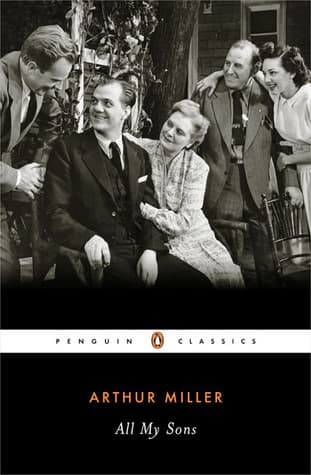
Synopsis
Covers the whole plot, including the ending.
- Difficulty
- Medium
- Pacing
- Moderate
- Mood
- Intense, Tragic, Thought-provoking, Suspenseful
- Read it if
- You enjoy classic American dramas that explore moral responsibility, family secrets, and the devastating consequences of wartime profiteering.
- Skip it if
- You prefer lighthearted stories with clear heroes and villains, or shy away from intense emotional conflict and tragic endings.
All My Sons Plot Summary
Covers the whole plot, including the ending.
A Sunday Morning in the Keller Backyard
The play starts on a Sunday morning in the backyard of the Keller home in a Midwestern American town. Joe Keller, a successful businessman, reads the newspaper while his neighbor, Frank Lubey, tries to calculate Larry Keller's horoscope, believing Larry, missing in action for three years, might still be alive. Chris Keller, Joe's surviving son, is there. Kate Keller, Joe's wife, still grieves Larry's presumed death, hoping he will return. A young apple tree, planted for Larry, blew down in the night, which Kate sees as a bad sign. Ann Deever, Larry's former fiancée and the daughter of Joe's ex-business partner, Steve Deever, is expected to visit.
Ann Deever's Arrival and Chris's Proposal
Ann Deever arrives, and it quickly becomes clear she and Chris Keller are in love. Chris proposes marriage, but Ann hesitates, knowing Kate Keller's strong belief that Larry is still alive and that Ann is 'Larry's girl.' Ann also reveals that her father, Steve Deever, imprisoned for selling cracked cylinder heads to the military during the war, has written to her, wanting to make amends. Joe Keller, who was cleared in the same scandal, tries to stop Ann from seeing her father, pointing out the shame Steve brought on their families. Despite the problems, Chris is set on marrying Ann, seeing her as a chance for a new life.
Kate's Opposition and Joe's Secret
Kate Keller strongly opposes Chris and Ann's marriage, stating that if Larry is truly dead, then Ann belongs to Chris, but if Larry is alive, then Ann is still his fiancée. Her refusal to accept Larry's death comes from a deep need to believe in moral order, which would break if Joe's involvement in the cylinder head scandal was fully known. Joe, trying to calm Kate and help Chris, tells a partial truth: he admits knowing the cylinder heads were faulty but claims Steve Deever, his partner, ordered them shipped, making Steve solely responsible and himself a victim of circumstances and Steve's poor judgment.
George Deever's Return
George Deever, Ann's brother and a lawyer, arrives unexpectedly. He just visited his father, Steve, in prison. George is bitter and suspicious, having heard his father's story for the first time in years. He says Steve claimed Joe Keller was equally responsible for the faulty parts and convinced him to cover them up. George is determined to expose the truth and stop Ann from marrying Chris, believing the Kellers caused his family's ruin. His arrival creates tension in the Keller home, threatening to expose Joe's carefully built image of innocence.
George Confronts Joe
George confronts Joe directly, questioning his role in the cylinder head scandal. He points out inconsistencies in Joe's story and notes that Joe was sick on the day the faulty parts were shipped, suggesting Joe couldn't have truly been unaware of the decision to ship them. Joe tries to dismiss George's claims, portraying Steve as a weak and easily manipulated man. However, George's persistent questions and his retelling of his father's desperate plea for help from Joe on that day start to break Joe's composure, making him visibly uncomfortable and defensive. Kate, sensing danger, tries to step in and change George's questions.
Kate's Slip of the Tongue
During the confrontation between George and Joe, Kate, trying to defend Joe and stop George from digging further, accidentally makes a key slip. She exclaims that Joe 'never was sick in his life,' directly contradicting Joe's earlier claim that he was home with the flu on the day the faulty parts were shipped. This reveals Joe's lie and destroys his alibi. Chris, who always believed in his father's innocence, is devastated and horrified by this proof of Joe's involvement in the crime that killed twenty-one pilots. The truth begins to come out before their eyes.
Chris's Disillusionment
Chris, shaken by Kate's accidental revelation, confronts Joe with deep disillusionment and moral outrage. He cannot understand how his father, whom he admired, could have knowingly allowed faulty parts to be shipped, leading to the deaths of fellow soldiers, possibly including his own brother, Larry. Chris struggles with the weight of his father's guilt, feeling that his entire life and the values he believed in were a lie. He struggles to reconcile the loving father he knows with the man who put profit over human lives, feeling betrayed and having a crisis of conscience.
Ann's Letter
As tension builds, Ann, wanting to bring resolution and force Chris to face the truth, reveals a letter she received from Larry before his death. The letter clearly states Larry's despair upon learning of his father's and Steve Deever's conviction for shipping faulty parts. Larry expresses shame and an inability to live with the knowledge that his father was responsible for the deaths of his fellow pilots. He indicates his intention to commit suicide by crashing his plane, making it look like a combat death. This letter confirms Larry's death was not an accident of war but a deliberate act, a result of his father's actions.
Joe's Realization and Suicide
After reading Larry's letter, Joe Keller must face the full extent of his responsibility. He finally understands that "all my sons" refers not just to Larry, but to all the soldiers who died because of his defective parts. The realization that his actions directly led to Larry's suicide, and the immense moral weight of his crime, finally breaks him. Overwhelmed by guilt, shame, and the irreversible damage he caused, Joe goes into the house and shoots himself. His suicide is a final, tragic act of atonement, ending the family's long denial and the play's escalating conflict.
Aftermath
After Joe's suicide, Kate and Chris are left to deal with the profound consequences. Kate is shattered by her husband's death, but also by the definite proof of Larry's death and Joe's guilt. Chris, though heartbroken, also faces the burden of his father's actions and the moral implications of his own role in letting Joe's lies continue for so long. The family is broken, forced to confront the harsh realities of their past and the moral compromises that led to such a tragic end. The play closes with the characters facing a future forever changed by the truth.
Principal Figures
Joe Keller
Protagonist/Antagonist
A successful, self-made businessman haunted by a wartime crime.
Joe Keller is a successful, seemingly jovial businessman in his sixties, who built his machine shop into a thriving enterprise. He projects an image of a loving family man and a pillar of the community, but beneath this facade lies a deep-seated guilt. During World War II, he allowed faulty cylinder heads to be shipped from his factory, resulting in the deaths of twenty-one pilots. He was exonerated, while his partner, Steve Deever, went to prison. Joe's primary motivation is to protect his family and his business, often at the expense of moral integrity, believing that his actions were justified by his desire to provide for his sons.
Relationships: Kate Keller (Wife, accomplice in denial); Chris Keller (Son, object of his protection, ultimately his judge); Larry Keller (Deceased son, his death is a direct consequence of Joe's actions); Steve Deever (Former business partner, scapegoat for Joe's crime)
Kate Keller
Supporting
Joe's wife, desperately clinging to the hope of her son Larry's return.
Kate Keller is Joe's wife, a woman in her late fifties, deeply affected by the presumed death of her son, Larry, and the lingering shadow of Joe's wartime scandal. She clings to the belief that Larry is still alive, partly as a coping mechanism for her grief, but also because Larry's death would force her to confront the full extent of Joe's guilt. Kate possesses a strong, almost psychic intuition, often sensing underlying truths that others try to suppress. She is fiercely protective of Joe and their family, willing to maintain illusions and half-truths to preserve their fragile peace, even if it means sacrificing her own emotional well-being.
Relationships: Joe Keller (Husband, complicit in his secret); Larry Keller (Deceased son, object of her denial); Chris Keller (Surviving son, her emotional anchor and source of conflict); Ann Deever (Larry's former fiancée, initially sees her as a threat to Larry's memory)
Chris Keller
Protagonist
Joe's surviving son, an idealist haunted by his wartime experiences.
Chris Keller is Joe and Kate's surviving son, a thirty-two-year-old idealist who served in the war and returned with a profound sense of communal responsibility and a deep disillusionment with the pursuit of material wealth. He admires his father, viewing him as an honest, hard-working man, and struggles with the moral compromises he sees in the post-war American dream. Chris wants to marry Ann Deever, Larry's former fiancée, but is torn by his mother's grief and his own lingering loyalty to his missing brother. His driving force is a desire for truth and moral integrity, which ultimately puts him at odds with his family's secrets.
Relationships: Joe Keller (Father, initially an idol, later a source of profound betrayal); Kate Keller (Mother, source of emotional conflict and eventual truth); Larry Keller (Deceased brother, whose memory complicates his love for Ann); Ann Deever (Lover, his hope for a new life, also the catalyst for revealing truth)
Ann Deever
Supporting
Larry's former fiancée, seeking a new beginning amidst family shame.
Ann Deever is Larry Keller's former fiancée, a young woman in her late twenties. Her father, Steve Deever, is in prison for the same crime Joe Keller was involved in. Ann has cut ties with her father due to the shame and guilt associated with his actions. She has moved on from Larry and is deeply in love with Chris Keller, seeking a fresh start and a normal life away from the scandal. Ann is pragmatic and determined, but also carries the emotional scars of her family's past. She eventually plays a crucial role in exposing the ultimate truth, driven by her love for Chris and her desire for honesty.
Relationships: Larry Keller (Deceased former fiancée); Chris Keller (Lover, her hope for a future); Steve Deever (Imprisoned father, source of her shame); Kate Keller (Larry's mother, initial obstacle to her marriage with Chris)
George Deever
Supporting
Ann's brother, a lawyer seeking justice for his imprisoned father.
George Deever is Ann's older brother, a lawyer who served in the war. He arrives at the Keller home directly after visiting his father, Steve Deever, in prison. George is intense, intelligent, and driven by a strong sense of loyalty to his father and a desire for justice. He is convinced that Joe Keller manipulated Steve and is equally, if not more, responsible for the wartime crime. His arrival acts as a catalyst, bringing the outside world's judgment and Steve's perspective directly into the Keller household, forcing the family to confront the uncomfortable truths they have long suppressed. He is an instrument of the play's rising action.
Relationships: Ann Deever (Sister, whom he tries to protect from marrying into the Keller family); Steve Deever (Imprisoned father, whom he seeks to vindicate); Joe Keller (Former business partner of his father, whom he suspects of guilt)
Larry Keller
Mentioned
Joe and Kate's deceased son, whose memory and suicide drive the plot.
Larry Keller is Joe and Kate's elder son, a pilot who went missing in action three years before the play begins. Though never seen, his presence is central to the plot. Kate clings to the belief that he is alive, while Chris and Ann want to move on. Larry represents the innocent victim of his father's actions, and his memory is a constant source of grief, denial, and moral conflict for the family. His suicide, revealed through a letter, is the ultimate consequence of Joe's crime, directly linking Joe's ethical failure to the destruction of his own family.
Relationships: Joe Keller (Father, whose actions led to his suicide); Kate Keller (Mother, whose denial revolves around his memory); Chris Keller (Brother, whose moral compass is shaped by his death); Ann Deever (Former fiancée, who holds the key to his fate)
Frank Lubey
Supporting
A neighbor obsessed with astrology and a symbol of ordinary life.
Frank Lubey is a neighbor of the Kellers, a somewhat eccentric and superstitious man. He is obsessed with astrology and spends his time calculating Larry Keller's horoscope, believing it can prove Larry is still alive. Frank serves as a foil to the intense drama unfolding within the Keller family, representing a more mundane, albeit superstitious, aspect of small-town life. His seemingly harmless hobby inadvertently contributes to Kate's denial and offers a brief respite from the play's darker themes, though his calculations ultimately prove irrelevant to the tragic truth.
Relationships: Kate Keller (Neighbor, encourages her belief in Larry's survival); Lydia Lubey (Wife, his partner in everyday life)
Lydia Lubey
Supporting
A cheerful neighbor who embodies domesticity and normalcy.
Lydia Lubey is Frank's wife and a neighbor to the Kellers. She is a cheerful, domestic woman with three children, who often engages in lighthearted conversation. Lydia represents the normalcy and everyday life that the Keller family struggles to maintain amidst their deep-seated secrets. Her presence highlights the stark contrast between the Kellers' internal turmoil and the external appearance of a happy, functioning community. She offers a glimpse into a simpler, less complicated existence, serving as a backdrop against which the Kellers' tragedy unfolds.
Relationships: Frank Lubey (Husband); Chris Keller (Former boyfriend, adding a touch of past romance)
Jim Bayliss
Supporting
A doctor, neighbor, and friend, who understands Joe's true nature.
Jim Bayliss is a doctor and a neighbor of the Kellers. He is a cynical but compassionate man who, despite his profession, longs for a more meaningful life in medical research. Jim is one of the few characters who seems to understand Joe Keller's true nature and the moral compromises he has made, though he doesn't openly condemn him until the truth is undeniable. He acts as a confidante for Chris and offers a perspective on the societal pressures that lead men like Joe to prioritize material success over ethical conduct. His presence provides a voice of reason and a subtle commentary on the corrupting influence of ambition.
Relationships: Joe Keller (Neighbor and friend, but also a silent observer of his moral failings); Sue Bayliss (Wife, who is more overtly critical of Joe); Chris Keller (Friend and confidant)
Sue Bayliss
Supporting
Jim's wife, a perceptive neighbor with a pragmatic view of the Kellers.
Sue Bayliss is Jim's wife and a neighbor. She is a perceptive, somewhat cynical woman who openly resents Joe Keller's influence and the way he represents a certain kind of capitalist success that she finds morally objectionable. Sue is not afraid to speak her mind and offers a blunt, realistic assessment of the Kellers' situation. She recognizes Joe's guilt long before others and fears that Chris's idealism will negatively impact her husband's career. She acts as a voice of the community's unspoken judgment and provides a contrast to Kate's denial.
Relationships: Jim Bayliss (Husband); Joe Keller (Neighbor, whom she openly dislikes and judges); Chris Keller (Neighbor, whom she fears will influence her husband negatively)
Themes & Insights
The American Dream and Materialism vs. Morality
The play explores the corrupted American Dream, where the pursuit of wealth and success, seen in Joe Keller, overrides ethics and human life. Joe shipped faulty parts to keep his factory running and provide for his family, believing financial security was the ultimate good. This theme appears when Chris confronts Joe, saying, "There's a universe of people outside and you're responsible to it." The play argues that this narrow, self-serving dream leads to moral decay and, ultimately, tragedy.
“I'm not a red-hot momma, but I think a man is a fool who doesn't mind his business. And a man who is a fool in business... is a fool.”
Fathers and Sons / Filial Responsibility
A central theme is the complex and often destructive relationship between fathers and sons, and the weight of family responsibility. Chris Keller idolizes his father, Joe, and struggles greatly when confronted with Joe's guilt, feeling betrayed and questioning his own identity. Larry Keller's suicide is a direct result of his shame over his father's actions, showing the deep impact a father's choices have on his sons. The play challenges the idea that a father's responsibility is only to his immediate family, arguing that a father's actions have wider societal implications that affect his children.
“I'm his father and he's my son, and if there's anything bigger than that I'll put a bullet in my head!”
Truth, Denial, and Guilt
The play is a relentless uncovering of truth from layers of denial and guilt. Joe Keller lives in self-deception, convincing himself his actions were justified and he is innocent. Kate Keller actively participates in this denial, hoping Larry will return to avoid facing Joe's guilt. The gradual revelation of Joe's lie, first through Kate's slip, then George's accusations, and finally Ann's letter, forces the characters to face uncomfortable realities. The play shows how denial can prolong suffering and how suppressing truth ultimately leads to catastrophic results, as seen in Joe's suicide.
“It's all right, Joe. Just be your own self. She thinks so much of you.”
Social Responsibility vs. Individualism
Arthur Miller contrasts the American ideal of individualism with the need for social responsibility. Joe Keller believes his main duty is to his family, leading him to justify actions that harm the wider community. Chris, having seen wartime camaraderie, believes in a broader responsibility to humanity: "We were all responsible to each other." The play argues that true individual well-being is tied to the well-being of the group, and that ignoring this social contract results in moral bankruptcy and personal devastation. Joe's final realization, "They were all my sons," sums up this theme.
“I don't understand why nothing has an end, and no one ever makes a mistake, and all the innocent people suffer.”
Plot Devices & Literary Techniques
The Fallen Apple Tree
A symbolic omen foreshadowing tragedy and the shattering of illusions.
The apple tree, planted in memory of Larry Keller, falls in a storm at the beginning of the play. This serves as a powerful symbol and a foreshadowing device. For Kate, it is a bad omen, reinforcing her superstitious belief in Larry's continued existence. More profoundly, it symbolizes the fragility of the Keller family's carefully constructed peace and the imminent collapse of their illusions. Its destruction foreshadows the shattering of the family's denial regarding Larry's death and Joe's guilt, signaling that the truth, like the storm, will violently uproot their false foundations.
Larry's Letter
A crucial piece of evidence that reveals the ultimate truth and catalyzes the climax.
Larry's letter, held by Ann Deever, is the ultimate plot device that brings about the play's tragic climax. Its existence is hinted at, but its contents are withheld until the opportune moment. When Ann finally reveals the letter, it provides irrefutable proof of Larry's suicide and his motivation – his shame over his father's actions. This revelation forces Joe Keller to confront the full, devastating scope of his responsibility, not just for the pilots' deaths but for his own son's. The letter serves as the final, undeniable piece of truth that shatters all remaining denial and directly leads to Joe's suicide.
Kate's Slip of the Tongue
An accidental revelation that cracks Joe's alibi and accelerates the truth's emergence.
Kate Keller's inadvertent slip of the tongue, where she blurts out that Joe 'never was sick in his life,' is a pivotal plot device. It directly contradicts Joe's long-held alibi that he was home with the flu on the day the faulty cylinder heads were shipped, thus shifting the blame entirely to Steve Deever. This accidental revelation is the first significant crack in Joe's carefully constructed facade of innocence. It immediately alerts George and Chris to the possibility of Joe's deeper culpability, driving the dramatic tension and accelerating the play's movement towards the full exposure of the truth.
The War
A pervasive backdrop that highlights moral compromises and the cost of human life.
The backdrop of World War II is a crucial plot device, even though the play takes place after its conclusion. The war serves as the context for Joe Keller's crime, making his actions of shipping faulty parts morally reprehensible against the backdrop of soldiers fighting and dying. It also shapes Chris's idealism and his sense of collective responsibility, contrasting sharply with his father's narrow self-interest. The war elevates the stakes of Joe's actions, transforming a business decision into an act that directly leads to the deaths of 'all my sons,' emphasizing the universal cost of individual moral failure.
All My Sons Quotes
“I'm his father and he's my son and if there's something bigger than that I'll put a bullet in my head!”
“There are no islands in the world anymore. We're all in it together.”
“Once and for all you can know that there's a universe of people outside and you're responsible to it.”
“He's not coming back. We all know it. I resent you for making me deny it.”
“It's what you do to people. It's what I do to people. What the hell did I work for?”
“I'm not a murderer. I'm a businessman.”
“I'm going to make a fortune here!”
“Because he's not dead, Chris. He's been killed.”
“You don't want to be the man your father is.”
“A man can't be a Jesus in this world.”
“He folded up like a handkerchief.”
“I want to get married, I want to have children, I want to build a house, I want to make a future.”
“The world is an alley, and you either lick 'em or join 'em.”
“Every time I reach out for somebody I end up with my finger in somebody's eye.”
Quiz
10 questions on the plot and the characters. Each answer comes with a short explanation.
Question 1
What was the specific defect in the airplane parts produced by Joe Keller and Herbert Deever?
- Faulty wiring in the engines
- Cracked cylinder heads
- Substandard propeller blades
- Incorrect fuel line connections
Show answer
B. Cracked cylinder heads The play reveals that the defective parts were cracked cylinder heads, which led to the planes crashing.
Question 2
Who was sent to prison for the crime of shipping defective airplane parts?
- Joe Keller
- Chris Keller
- Herbert Deever
- George Deever
Show answer
C. Herbert Deever Herbert Deever, Joe Keller's partner, took the fall and was sent to prison, while Keller was acquitted.
Question 3
What is the relationship between Chris Keller and Ann Deever at the beginning of the play?
- They are estranged former friends.
- They are secretly engaged.
- They are siblings.
- They are business rivals.
Show answer
B. They are secretly engaged. Chris and Ann are in love and plan to marry, a fact that creates significant tension given their families' history.
Question 4
What is the primary reason George Deever returns from the war?
- To visit his sister, Ann.
- To celebrate Joe Keller's acquittal.
- To confront Joe Keller about his father's imprisonment.
- To start a new business venture with Chris Keller.
Show answer
C. To confront Joe Keller about his father's imprisonment. George returns filled with bitterness and suspicion, driven to expose Joe Keller's role in the defective parts scandal and clear his father's name.
Question 5
Which of Joe Keller's sons is missing in action and presumed dead?
- Chris
- Larry
- George
- Herbert
Show answer
B. Larry Larry Keller, Chris's brother, is the son who went missing during the war, and his fate is a significant underlying tension in the play.
Question 6
What is the main conflict highlighted by the play's themes, as mentioned in the description?
- The conflict between urban and rural life.
- The conflict between science and religion.
- The conflict between business and personal ethics.
- The conflict between tradition and modernity.
Show answer
C. The conflict between business and personal ethics. The play explicitly explores the tension between the pursuit of business success and maintaining personal integrity and moral responsibility.
Question 7
What does Ann Deever reveal that ultimately pushes Joe Keller to his tragic realization?
- That she has inherited a large sum of money.
- That she is pregnant with Chris's child.
- Larry's suicide letter.
- That George is planning to expose Joe to the authorities.
Show answer
C. Larry's suicide letter. Ann reveals Larry's letter, which states his intention to commit suicide due to his father's guilt, leading to Joe's final, devastating understanding.
Question 8
What is Joe Keller's primary justification for his actions regarding the defective parts?
- He believed the parts were safe despite the cracks.
- He was following orders from a superior officer.
- He did it for his family, particularly to protect his business for his sons.
- He was coerced by Herbert Deever into shipping them.
Show answer
C. He did it for his family, particularly to protect his business for his sons. Joe consistently argues that his actions, though morally reprehensible, were driven by a desire to provide for his family and secure their future, particularly his sons' inheritance.
Question 9
How does Chris Keller react upon fully learning and accepting his father's guilt?
- He immediately forgives his father.
- He decides to leave town and start a new life.
- He expresses profound disillusionment and intends to turn his father in.
- He blames Ann Deever for bringing up the past.
Show answer
C. He expresses profound disillusionment and intends to turn his father in. Chris is utterly devastated and disillusioned by his father's admission, feeling betrayed and expressing an intent to report him to the authorities, reflecting his strong moral compass.
Question 10
What is the ultimate fate of Joe Keller at the end of the play?
- He is arrested and sent to prison.
- He commits suicide.
- He confesses publicly and dedicates his life to charity.
- He is forgiven by his family and lives out his days peacefully.
Show answer
B. He commits suicide. Overwhelmed by guilt and the realization of his responsibility for the deaths of 'all his sons,' including Larry, Joe Keller goes into the house and shoots himself.
All My Sons FAQ
What is the central conflict driving the plot of 'All My Sons'?
The central conflict revolves around Joe Keller's past wartime crime of knowingly shipping defective cylinder heads, which led to the deaths of 21 pilots. This past deed directly impacts his family's present, particularly through Chris's naive idealism and Ann Deever's arrival, forcing a confrontation with the truth and the consequences of moral compromise.
Who are the key members of the Keller family and what are their primary motivations at the story's outset?
The Keller family consists of Joe Keller, the patriarch driven by providing for his family; Kate Keller, the matriarch clinging to the belief that her missing son Larry is alive; and Chris Keller, the idealistic younger son who deeply admires his father and seeks to marry Ann Deever, Larry's former fiancée.
What is the significance of Larry Keller's disappearance?
Larry's disappearance as a pilot during the war serves as a central point of denial and hope for Kate, who refuses to accept his death. It also creates a moral dilemma for Chris and Ann, as their desire to marry is complicated by Kate's unwavering belief in Larry's return, which implicitly protects Joe from confronting his guilt.
How does Ann Deever's presence act as a catalyst in the play?
Ann Deever's arrival at the Keller home is a major catalyst. She represents the past, being the daughter of Joe's imprisoned former business partner, Herbert Deever, and also the former fiancée of Larry. Her desire to marry Chris forces the family to confront the truth about Joe's actions and Larry's fate, disrupting the carefully constructed peace.
What is George Deever's role in uncovering the truth?
George Deever, Ann's brother, arrives from New York after visiting his imprisoned father, Herbert. He has learned new details about the defective parts case and his father's testimony, which convinces him of Joe's sole guilt. His bitter accusations and determination to expose Joe's culpability serve as a direct threat to the Keller family's denial.
What subtle clues does Kate Keller exhibit early on that hint at her knowledge of Joe's guilt?
Kate Keller frequently makes veiled remarks and displays nervous behavior, such as her insistence that Larry is alive, her aversion to Joe's tree, and her sharp reactions to discussions of the past. These actions subtly suggest she knows more about Joe's involvement in the crime than she lets on, and her denial serves to protect him.
How does the pear tree, planted for Larry, symbolize the family's denial and ultimate destruction?
The pear tree, planted in Larry's memory, represents the false foundation of the Keller family's happiness and the lie they live by. Its destruction by a storm before the play begins foreshadows the eventual shattering of their illusions and the collapse of the family unit once the truth about Joe's crime and Larry's suicide is revealed.
What is the significance of the seemingly innocuous conversations about business and money throughout the play?
The frequent discussions about business, making money, and Joe's success are crucial because they highlight the core conflict between personal ethics and capitalist ambition. Joe rationalizes his crime as a 'business decision' made for his family, demonstrating how easily moral lines can be blurred when profit and security are prioritized over human life and integrity.
How does the play subtly reveal the psychological toll of Joe's guilt on Kate?
Kate Keller's psychological toll is evident in her constant state of anxiety, her desperate clinging to the belief in Larry's survival, and her recurring nightmares. She uses Larry's potential return as a shield against confronting Joe's guilt, indicating that the burden of knowing the truth has deeply affected her mental and emotional well-being.
Analyze Chris Keller's shift from idealistic admiration to profound disillusionment.
Chris begins as an idealist, deeply admiring his father's perceived integrity and wartime sacrifice. However, as the truth about Joe's crime unravels, Chris experiences a profound disillusionment. His father, the symbol of his moral compass, is revealed as a murderer, shattering Chris's worldview and leading to a crisis of faith in his own judgment and humanity.
How does Joe Keller's character embody the psychological defense mechanism of rationalization?
Joe Keller exemplifies rationalization by consistently justifying his actions as being 'for the family.' He convinces himself that his crime was merely a business necessity to protect his loved ones, thereby avoiding the moral responsibility for the deaths he caused. This defense allows him to live without overt guilt until the truth is undeniably exposed.
What psychological impact does Larry's suicide letter have on Joe Keller?
Larry's suicide letter has a devastating psychological impact on Joe, forcing him to confront the direct human cost of his actions. Learning that his own son chose death rather than live with the shame of his father's crime shatters Joe's carefully constructed rationalizations, leading to his ultimate realization that 'all my sons' were affected by his guilt.
To what extent is Chris Keller complicit in his father's crime before the truth is revealed?
Chris Keller is not directly complicit in the crime itself, but he is complicit in the family's collective denial and the benefits derived from Joe's ill-gotten wealth. His profound admiration for his father and his initial willingness to overlook inconsistencies contribute to the maintenance of the lie, making his eventual awakening even more painful.
Discuss the play's commentary on the American Dream and its potential corruption.
The play critically examines the American Dream, suggesting that its pursuit, particularly through unchecked ambition and material success, can lead to moral corruption. Joe Keller achieves financial prosperity, but at the cost of human lives and his own integrity, demonstrating how the dream can be perverted when ethical considerations are sacrificed for profit.
Is Joe Keller a villain or a tragic figure, and why?
Joe Keller can be interpreted as both. He is a villain for his egregious crime and lack of immediate remorse, but also a tragic figure in the classical sense. His fatal flaw is his inability to see beyond his immediate family to a wider human responsibility, leading to his downfall once he is forced to confront the universal consequences of his actions.
How does Arthur Miller use the concept of 'responsibility' throughout the play?
Miller explores multiple layers of responsibility: individual responsibility for one's actions (Joe's crime), familial responsibility (Joe's justification), and societal responsibility (the 'all my sons' revelation). The play argues for a broader, universal sense of responsibility, suggesting that our actions have consequences far beyond our immediate circle.
What is the significance of the title, 'All My Sons'?
The title 'All My Sons' refers to Joe Keller's climactic realization that his responsibility extends beyond his biological children, Larry and Chris, to all the young men who died due to his defective parts. It signifies his profound understanding that all humanity is interconnected, and his actions impacted a larger 'family' of sons.
Compare and contrast the moral compasses of Joe and Chris Keller.
Joe Keller's moral compass is pragmatic and self-serving, prioritizing his family's material well-being above all else, even at the cost of lives. Chris Keller, in contrast, possesses a strong, albeit initially naive, moral idealism, believing in honesty and integrity. Their contrasting values drive much of the play's conflict and Chris's ultimate disillusionment.
About the author

Arthur Asher Miller was an American playwright, essayist and screenwriter in the 20th-century American theater. Among his most popular plays are All My Sons (1947), Death of a Salesman (1949), The Crucible (1953), and A View from the Bridge (1955). He wrote several screenplays and was most noted for his work on The Misfits (1961). The drama Death of a Salesman is considered one of the best American plays of the 20th century.
Similar books
- Death of a Salesman
Arthur Miller
3.5 (186k) average on GoodreadsFictionExplores the American Dream's dark side, family dynamics, and a father's tragic flaws.
- A Streetcar Named Desire
Tennessee Williams
4.0 (261k) average on GoodreadsFictionA classic American play delving into family secrets, disillusionment, and intense emotional conflict.
- The Glass Menagerie
Tennessee Williams
3.7 (112k) average on GoodreadsFictionFeatures complex family relationships and the weight of the past on present lives.
- Nineteen Eighty-Four
George Orwell
4.2 (5.5M) average on GoodreadsFictionWinston Smith dreams of truth and rebellion in a world where Big Brother watches all, but he confronts the terrifying power of a regime that controls not just actions, but thoughts.
- The Frozen River
Ariel Lawhon
4.4 (600k) average on GoodreadsFictionIn 1789 Maine, a heroic midwife's diary helps her expose a murder and get justice in a town that wants to silence her.
- A Man Called Ove
Fredrik Backman
4.4 (569k) average on GoodreadsFictionA stubborn widower, who lives by strict rules, finds his quiet world changed by a lively new family next door, making him face his past and find happiness in human connection.





Enjoyed the summary?
A summary gives you the shape of the book. The book itself has the detail, the examples and the voice.
Find All My Sons on AmazonAs an Amazon Associate, BookBrief earns from qualifying purchases. How we're funded