
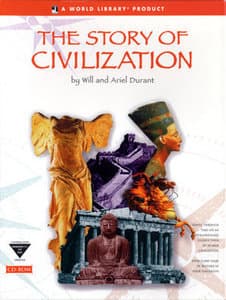
Core Idea
- Difficulty
- Hard
- Read it if
- You seek a comprehensive, narrative-driven, multi-volume synthesis of Western and Eastern civilization, integrating history, philosophy, science, and art, and are prepared for a significant time commitment.
- Skip it if
- You prefer highly specialized historical analysis, are looking for a quick overview, or are averse to a singular, often Eurocentric, authorial voice shaping such a vast historical narrative.
Key Takeaways from The Story of Civilization
The Enduring Cycles of History
Civilizations rise and fall in predictable patterns, driven by recurring forces.
Durant shows that history is less a straight line and more a series of cycles. Empires appear due to good geography, strong leaders, and new ideas, but eventually fall to internal problems, outside pressure, or the very success that created complacency. This cyclical view highlights that human nature—its ambition, creativity, and destructiveness—stays constant over thousands of years. Understanding these patterns helps us see how fragile even the most advanced societies are, reminding us that no civilization is safe from the forces that brought down earlier ones. What we see as 'progress' often involves ups and downs, with each cycle building on the last.
“Civilization is not a gift; it is an achievement and a precarious possession.”
In the book: Durant's entire work is an evidence base, but specific examples include the rise and fall of ancient Egypt, the Greek city-states, the Roman Empire, and various dynasties in China and India, each demonstrating a birth, maturity, decline, and often a violent end, only for new powers to emerge from the ashes.
Try this: Recognize the inherent impermanence of all human constructs, from political systems to cultural norms. Invest in institutions that promote long-term stability and adaptation rather than short-term gains. Learn from historical failures to avoid repeating common pitfalls in governance and societal development.
Related ideas: historical-cycles, civilizational-collapse, human-nature
The Interplay of Geography and Culture
Physical environment profoundly shapes a civilization's development, but culture ultimately defines its character.
Durant consistently shows how geographical features—rivers, mountains, deserts, coastlines—determine early settlement, resources, trade routes, and defenses, setting the initial path for a civilization. The fertile crescent allowed early farming; Greece's broken landscape led to independent city-states. However, he also demonstrates that culture—the combined wisdom, beliefs, arts, and institutions—moves beyond these physical limits. While geography sets the stage, culture writes the story. The Greeks, despite their difficult land, developed unique philosophy and democracy. The Romans, using their central Italian location, built an empire through law and engineering. This interaction shows that while the environment sets boundaries, human ingenuity and cultural growth determine a society's final form and legacy.
“Geography is the matrix of history.”
In the book: The distinct cultural developments of river valley civilizations (Egypt, Mesopotamia) versus maritime civilizations (Greece, Phoenicia) are prime examples. The defensive advantages of Rome's seven hills, combined with Roman legal and military innovation, allowed its expansion.
Try this: When analyzing societal challenges or planning new initiatives, consider both the physical constraints and the cultural context. Understand that while resources are finite, human creativity and cultural adaptation can overcome significant environmental hurdles. Foster cultural exchange and innovation as drivers of progress.
Related ideas: geopolitics, cultural-determinism, environmental-influence
The Indispensable Role of Religion
Religion provides the moral framework and social cohesion necessary for complex societies.
Durant argues that religion, rather than being simple superstition, has been a basic support for almost all major civilizations. It provides a shared worldview, a moral code, and a sense of community that connects different groups. From ancient Egyptian polytheism to the monotheistic faiths of Judaism, Christianity, and Islam, religious beliefs have inspired art, architecture, law, and social order. While he acknowledges the conflicts and strictness religion can cause, Durant stresses its role in creating ethical systems, encouraging charity, and offering comfort and meaning, especially during hard times. Its decline often happens with social breakdown, suggesting its ongoing use in keeping society stable.
“Religion is the last bastion of hope for a humanity that has lost faith in itself.”
In the book: The pervasive influence of religion in shaping Egyptian pharaonic rule and monumental architecture, the role of the Ten Commandments in Jewish and Christian law, the unifying force of Islam in the medieval Arab world, and the Catholic Church's preservation of knowledge during the Dark Ages.
Try this: Recognize the deep historical and ongoing impact of belief systems on human behavior and societal structure. Foster understanding and respect for diverse moral frameworks, even in secular contexts, to build common ground and shared values. Understand that purely rational arguments often fall short in addressing humanity's deeper existential needs.
Related ideas: social-cohesion, moral-philosophy, religious-influence
The Fragility of Freedom and Democracy
Democracy is a rare and delicate achievement, easily undermined by internal corruption and external threats.
Durant's discussion of Greek democracy and the Roman Republic warns about the weaknesses of self-governance. He shows that while these systems offered much individual freedom and political involvement, they often suffered from divisions, manipulative leaders, economic inequality, and the harmful effects of expanding empires. The Athenian experiment eventually failed due to wars and internal conflict, while the Roman Republic became an empire. This point emphasizes that freedom is not automatic but is hard-won and always at risk, needing constant watchfulness, civic virtue, and a shared commitment to the common good to last. Its failure often comes from the very excesses it allows.
“The greatest lesson of history is that we should learn to be humble.”
In the book: The Athenian assembly's susceptibility to populist rhetoric and its ultimate defeat by Sparta. The Roman Republic's decline due to civil wars, the rise of powerful generals like Marius and Sulla, and the concentration of wealth and power that led to figures like Caesar.
Try this: Actively participate in democratic processes and hold leaders accountable. Advocate for policies that reduce extreme inequality and promote civic education. Be wary of populist movements and charismatic leaders who promise simplistic solutions, as they often erode democratic institutions from within. Understand that individual liberties come with civic responsibilities.
Related ideas: democratic-decay, civic-virtue, political-instability
The Power of Individual Genius
While shaped by their era, exceptional individuals can profoundly alter the course of history.
Despite focusing on broad historical forces, Durant pays attention to the lives and influence of important figures. From Akhenaten's religious changes to Alexander's empire-building, from Caesar's political skill to Napoleon's military genius, and from Plato's philosophical ideas to Voltaire's intellectual challenge, he shows how certain individuals have the vision, will, and talent to overcome their circumstances and leave a lasting mark. These figures often combine existing ideas, lead social movements, or change political landscapes. While recognizing they work within specific historical contexts, Durant argues that their personal choices, innovations, and strong personalities are key drivers of change, showing that history is not just a predetermined march of forces, but also a story shaped by extraordinary human actions.
“History is the biography of great men.”
In the book: The profound influence of figures like Socrates, Plato, and Aristotle on Western thought; the lasting legal and administrative reforms of Napoleon; the artistic and scientific breakthroughs of the Renaissance led by individuals like Leonardo da Vinci.
Try this: Cultivate individual excellence and critical thinking. Support and recognize those who demonstrate exceptional talent and vision. Understand that while collective action is vital, the spark of individual genius can ignite transformative change. Encourage leadership and innovation in all fields.
Related ideas: great-man-theory, historical-agency, intellectual-leadership
The Persistent Quest for Knowledge and Beauty
Humanity's enduring drive for understanding and aesthetic expression transcends epochs and disasters.
Throughout history, Durant consistently highlights humanity's endless curiosity and its need to create beauty. From the cave paintings of Lascaux to the pyramids of Egypt, from Greek philosophy to Renaissance art, and from the Enlightenment's scientific discoveries to the Romantic era's literary explosions, civilizations have always put great effort into understanding the world and expressing the human condition. This drive for knowledge (science, philosophy) and beauty (art, literature, music) is presented as a basic part of human flourishing and a core element of 'civilization.' Even during war and political unrest, intellectual and artistic effort often continues, showing a strong, inborn human desire.
“To be truly civilized is to be fully human.”
In the book: The libraries of Alexandria, the Parthenon, Gothic cathedrals, the scientific revolution, the works of Shakespeare and Goethe—all serve as testaments to this continuous pursuit.
Try this: Prioritize education, scientific research, and the arts within society. Support institutions that foster intellectual inquiry and creative expression. Recognize that cultural achievements are as vital as economic or political ones for a civilization's long-term health and legacy. Engage in lifelong learning and appreciation of beauty.
Related ideas: cultural-legacy, human-flourishing, intellectual-pursuit
The Double-Edged Sword of Progress
Advancements often bring unforeseen challenges, requiring constant adaptation and ethical reflection.
Durant often illustrates that 'progress' in one area often creates new problems in another. More farm output led to population growth but also to social classes and conflicts over resources. New technologies like gunpowder changed warfare. The Enlightenment's focus on reason, while freeing, also weakened traditional religious authority, leading to new forms of uncertainty and social division. This idea challenges a simple view of linear progress, suggesting that each solution brings new difficulties, requiring continuous ethical thought and societal adaptation. It shows the inherent trade-offs in human development and the constant need to balance new ideas with wisdom.
“Every advance in civilization has been accompanied by a corresponding increase in the complexity of its problems.”
In the book: The Roman Empire's vast infrastructure and military might led to unprecedented expansion, but also to immense administrative burdens, social unrest, and eventual overextension. The industrial revolution, while boosting productivity, also created profound social inequalities and environmental degradation.
Try this: Approach technological and societal changes with a critical eye, anticipating potential negative consequences. Prioritize ethical considerations alongside efficiency and innovation. Foster interdisciplinary thinking to address complex problems holistically. Develop robust social safety nets to mitigate the downsides of economic and technological shifts.
Related ideas: unintended-consequences, technological-ethics, societal-adaptation
The Enduring Struggle for Justice
The fight against inequality and oppression is a constant throughout human history.
Across all volumes, Durant reveals a constant current of human effort for fairness, equality, and dignity, often against great odds. From slave revolts in ancient Rome to peasant uprisings in medieval Europe, from demands for democratic rights during the Enlightenment to calls for social justice in revolutionary times, the desire for a fairer society is a recurring theme. While complete justice often remains hard to achieve, each struggle, even if it fails, contributes to a slow, gradual change in moral awareness and legal systems. This ongoing fight shows that power imbalances are part of complex societies, but so is the human spirit's refusal to accept constant subjugation. It shows humanity's moral sense, however imperfectly applied.
“History is a record of man's struggle for justice and his failure to achieve it completely.”
In the book: The Gracchi brothers' attempts at land reform in Rome, Spartacus's slave rebellion, the English Peasants' Revolt, the French Revolution's demands for 'Liberty, Equality, Fraternity,' and the American struggle for independence.
Try this: Actively advocate for social justice and human rights. Recognize the historical roots of present-day inequalities. Support movements and policies that aim to reduce oppression and promote equitable distribution of resources and opportunities. Understand that progress towards justice is a long, continuous effort.
Related ideas: social-justice, inequality, human-rights
The Role of War and Conquest
Conflict, though destructive, has been a powerful, albeit tragic, engine of historical change and cultural diffusion.
Durant clearly shows war not just as an unusual event, but as a repeated and often transformative part of human history. Conquest, while causing great suffering, often spread ideas, technologies, and administrative systems. Roman armies spread law and language; the Mongol Empire helped trade and cultural exchange across Eurasia. Wars often spurred new ideas, strengthened power, and redrew political maps, sometimes leading to periods of relative peace for the winners. This view does not praise violence but acknowledges its deep, though regrettable, historical effectiveness. It makes us confront the complex link between destruction and creation, and how human conflict has unintentionally shaped new civilizations.
“War is a biological necessity, an historical continuity, and a force that has often shaped the world more than peace.”
In the book: Alexander the Great's conquests spreading Hellenistic culture across the Middle East. The Pax Romana following centuries of Roman expansion and military dominance. The Crusades, despite their brutality, facilitating European exposure to Islamic science and culture.
Try this: Understand the historical causes and consequences of conflict to better work towards peace. Recognize that while war can accelerate change, its human cost is immense. Invest in diplomacy and conflict resolution mechanisms. Study military history not to glorify war, but to understand its profound impact on societies.
Related ideas: geopolitical-conflict, cultural-diffusion, military-history
The Enduring Human Spirit
Despite challenges, humanity's resilience, creativity, and hope persist across all ages.
After thousands of pages detailing wars, plagues, collapses, and the often harsh realities of human existence, Durant ends with a strong sense of hope for the human spirit. He consistently highlights humanity's ability to rebuild after destruction, to innovate when resources are scarce, to create beauty amid ugliness, and to find meaning even in chaos. Whether through the philosophical strength of the Stoics, the artistic explosions of the Renaissance, or the scientific discoveries of the Enlightenment, the drive to overcome, to understand, and to improve remains constant. This idea offers a hopeful contrast to the cycles of decline, suggesting an inherent and persistent human will to not only survive but to thrive, to learn, and to aim for something greater, making the entire project of civilization a story of lasting hope.
“Man is a creature of hope and not of despair.”
In the book: The rebuilding of cities after devastating fires or wars (e.g., London after the Great Fire, various European cities after WWII). The persistence of intellectual inquiry and artistic creation even during 'dark ages.' The continuous pursuit of scientific knowledge despite setbacks.
Try this: Cultivate resilience and an optimistic outlook in the face of adversity. Focus on human potential for creativity and problem-solving. Support initiatives that foster human connection, empathy, and collective well-being. Recognize that even small acts of hope and creativity contribute to the larger tapestry of civilization.
Related ideas: human-resilience, optimism, creative-spirit
The Story of Civilization Quotes
“Civilization is a social process, an ever-shifting balance between order and freedom, between the individual and the community.”
“History is a voice forever sounding across the centuries the laws of right and wrong.”
“The past is not dead; it is not even past. We, by remembering it, make it live.”
“We are what we repeatedly do. Excellence, then, is not an act, but a habit.”
“The first step toward wisdom is to call things by their proper names.”
“As the physically strong survive in the struggle for existence, so do the mentally strong survive in the struggle for truth.”
“The sane man is a man who knows how to control his desires and emotions, not a man who has no desires and emotions.”
“Every advance in civilization has been an advance in peace; every retreat in civilization has been a retreat in peace.”
“To be able to endure the world as it is, is to be able to live in the world as it should be.”
“The family is the nucleus of civilization.”
“Progress is not an accident, but a necessity... Man is by nature a progressive animal.”
“Tolerance is the one virtue that makes all other virtues possible.”
“Science without philosophy is a torso; philosophy without science is a phantom.”
“The greatest lesson of history is that we learn nothing from history.”
Quiz
10 questions on the main ideas. Each answer comes with a short explanation.
Question 1
Which volume in 'The Story of Civilization' primarily covers the period of the Roman Empire's rise and fall, including figures like Julius Caesar and Jesus Christ?
- Vol. 2: The Life of Greece
- Vol. 3: Caesar and Christ
- Vol. 4: The Age of Faith
- Vol. 1: Our Oriental Heritage
Show answer
B. Vol. 3: Caesar and Christ Volume 3, 'Caesar and Christ,' specifically details the history of Rome from its origins through the early Christian era, encompassing the lives and impacts of both Julius Caesar and Jesus Christ.
Question 2
According to Will Durant's 'Our Oriental Heritage,' which of the following ancient civilizations is NOT primarily discussed in that volume?
- Egypt
- Mesopotamia
- India
- Greece
Show answer
D. Greece 'Our Oriental Heritage' (Vol. 1) focuses on the civilizations of the Near and Far East, including Egypt, Mesopotamia, India, China, and Japan. Greece is covered in Vol. 2.
Question 3
Which volume of 'The Story of Civilization' is dedicated to the intellectual and political ferment leading up to the French Revolution, featuring prominent thinkers like Jean-Jacques Rousseau?
- Vol. 9: The Age of Voltaire
- Vol. 10: Rousseau and Revolution
- Vol. 8: The Age of Louis XIV
- Vol. 7: The Age of Reason Begins
Show answer
B. Vol. 10: Rousseau and Revolution Volume 10, 'Rousseau and Revolution,' specifically chronicles the Enlightenment era's culmination and the societal shifts that preceded the French Revolution, with a focus on figures like Rousseau.
Question 4
In 'The Age of Faith' (Vol. 4), Will Durant explores the development and impact of which major world religion across Europe and the Near East following the fall of Rome?
- Ancient Roman paganism
- Buddhism
- Christianity and Islam
- Judaism in the modern era
Show answer
C. Christianity and Islam 'The Age of Faith' covers the period from the fall of the Roman Empire to the Renaissance, focusing heavily on the rise and spread of Christianity in Europe and Islam in the Near East and North Africa.
Question 5
Which of the following best describes Will Durant's overarching approach to history in 'The Story of Civilization'?
- A narrow focus on political and military events, largely ignoring cultural aspects.
- A comprehensive synthesis encompassing philosophy, art, science, religion, and politics across different civilizations.
- A Marxist interpretation emphasizing economic determinism as the sole driver of historical change.
- A postmodern deconstruction of historical narratives, questioning the possibility of objective truth.
Show answer
B. A comprehensive synthesis encompassing philosophy, art, science, religion, and politics across different civilizations. Durant's work is renowned for its panoramic scope, integrating all facets of human endeavor—philosophy, art, science, religion, and politics—into a single narrative of civilization's development.
Question 6
In 'The Reformation' (Vol. 6), which major religious and political schism is the central subject, detailing its causes, key figures, and immediate consequences?
- The Great Schism between Eastern and Western Christianity in 1054
- The Protestant Reformation, initiated by Martin Luther
- The Investiture Controversy between the Papacy and Holy Roman Empire
- The Albigensian Crusade against Catharism in Southern France
Show answer
B. The Protestant Reformation, initiated by Martin Luther 'The Reformation' specifically addresses the 16th-century religious movement that led to the establishment of Protestantism, with Martin Luther as a pivotal figure.
Question 7
Which pair of volumes in 'The Story of Civilization' directly precede and succeed the period of the Enlightenment, as characterized by rationalism and scientific inquiry?
- Vol. 5: The Renaissance and Vol. 6: The Reformation
- Vol. 7: The Age of Reason Begins and Vol. 8: The Age of Louis XIV
- Vol. 8: The Age of Louis XIV and Vol. 9: The Age of Voltaire
- Vol. 9: The Age of Voltaire and Vol. 10: Rousseau and Revolution
Show answer
B. Vol. 7: The Age of Reason Begins and Vol. 8: The Age of Louis XIV The Enlightenment period, marked by reason and scientific inquiry, is largely covered in 'The Age of Reason Begins' (Vol. 7) and 'The Age of Louis XIV' (Vol. 8), which detail the intellectual and political landscape of the 17th century.
Question 8
Will Durant often emphasizes the cyclical nature of history, including the rise and fall of civilizations. Which of the following is a recurring theme he might use to explain the decline of a great civilization?
- The consistent triumph of religious dogma over scientific progress.
- An increasing complexity and specialization leading to social fragmentation and moral decay.
- The inevitable dominance of a single, superior race over others.
- The sustained peace and prosperity making societies eternally resilient.
Show answer
B. An increasing complexity and specialization leading to social fragmentation and moral decay. Durant frequently points to factors like the loss of collective purpose, growing social inequalities, moral laxity, and external pressures exacerbated by internal weaknesses as contributors to civilizational decline.
Question 9
How does Will Durant's treatment of the Renaissance (Vol. 5) differ from a purely artistic history, reflecting his broader 'Story of Civilization' approach?
- He exclusively focuses on Italian painting and sculpture, ignoring other European developments.
- He integrates the artistic revival with concurrent political changes, philosophical shifts, scientific advancements, and social structures of the era.
- He argues that the Renaissance was solely a religious movement, devoid of secular influence.
- He dismisses the Renaissance as a minor historical period with little lasting impact.
Show answer
B. He integrates the artistic revival with concurrent political changes, philosophical shifts, scientific advancements, and social structures of the era. Consistent with his overall methodology, Durant's 'The Renaissance' (Vol. 5) provides a holistic view, connecting the flourishing of art and literature to the political landscape, the rise of humanism, new scientific ideas, and the changing social fabric of Europe.
Question 10
Considering the entire scope of 'The Story of Civilization,' what might Will Durant suggest is the primary challenge for any civilization to sustain itself over millennia?
- Consistently expanding its territorial borders through military conquest.
- Maintaining a balance between individual liberty and social order, while adapting to change and preserving vital cultural heritage.
- Achieving absolute technological superiority over all contemporary societies.
- Eliminating all forms of religious belief and promoting pure secularism.
Show answer
B. Maintaining a balance between individual liberty and social order, while adapting to change and preserving vital cultural heritage. Throughout his work, Durant often highlights the delicate balance between freedom and order, the necessity of adapting to new challenges, and the importance of transmitting accumulated knowledge and values across generations as crucial for long-term civilizational survival.
The Story of Civilization FAQ
What is 'The Story of Civilization' by Will Durant?
'The Story of Civilization' is an 11-volume non-fiction series by Will and Ariel Durant that provides a comprehensive overview of human history and culture from ancient times to the early 19th century. It covers various aspects like politics, philosophy, science, and art across different civilizations.
Does 'The Story of Civilization' cover all of human history?
While incredibly comprehensive, the series primarily covers human history from the ancient Near East and Asia through to the Age of Napoleon in the early 19th century. It does not extend to the modern era or 20th-century events.
What is the historical scope of 'Our Oriental Heritage'?
'Our Oriental Heritage' is the first volume in the series and explores the civilizations of the ancient Near East, India, China, and Japan. It lays the groundwork for understanding the foundational cultures that influenced later Western development.
How does 'The Story of Civilization' differ from other world history books?
Unlike many general history books, Durant's series is renowned for its narrative quality, philosophical insights, and integration of various disciplines like art, literature, and science alongside political and social history. It offers a deeply personal and engaging perspective on historical events.
Is 'The Story of Civilization' accessible for general readers or only academics?
The Durants wrote the series with a broad audience in mind, aiming for both scholarly depth and readability. Its engaging prose and narrative style make it highly accessible to general readers interested in a comprehensive understanding of history, not just academics.
What is the 'Age of Faith' volume about?
'The Age of Faith' is the fourth volume and delves into the history of medieval Europe and the Near East from 325 to 1300 AD. It primarily focuses on the rise and influence of Christianity and Islam during this period.
How does 'The Story of Civilization' handle scientific and philosophical developments?
The series intricately weaves scientific discoveries and philosophical ideas into the broader historical narrative, demonstrating their impact on societies and cultures. The Durants highlight key thinkers and their contributions across each era.
Can I read individual volumes of 'The Story of Civilization' out of order?
While each volume can stand alone to some extent, the series is designed to be read chronologically to fully appreciate the progression of civilizations and the interconnectedness of historical events. Starting from the beginning offers the most complete experience.
What is the overall message or theme of 'The Story of Civilization'?
A recurring theme is the cyclical nature of history, the interplay between freedom and order, and the enduring human quest for truth, beauty, and meaning across different cultures and eras. The Durants often reflect on the lessons history offers for contemporary society.
About the author

Will Durant was an American writer and historian, best known for his work in the field of philosophy and history. He is particularly recognized for "The Story of Civilization," a multi-volume series co-authored with his wife, Ariel Durant, which explores the history of Western civilization. Durant's writings emphasize the interplay of cultural and historical forces shaping societies.
Similar books
- Sapiens: A Brief History of Humankind
Yuval Noah Harari
4.4 (502k) average on GoodreadsPsychologyProvides a similarly broad, interdisciplinary narrative of human history, though much shorter and more contemporary.
- 1984
George Orwell
4.2 (3.1M) average on GoodreadsPoliticsIn a future where surveillance and thought control are absolute, a man's search for truth clashes with the Party, showing that hope can be a form of rebellion.
- Animal Farm
George Orwell
4.0 (2.7M) average on GoodreadsPoliticsA farm animals' rebellion against humans turns into a pig-led dictatorship, showing how power corrupts and revolutionary ideals are betrayed.
- Freakonomics: A Rogue Economist Explores the Hidden Side of Everything
Steven D. Levitt
4.0 (709k) average on GoodreadsBusinessThis book uses economic principles to reveal the surprising incentives behind everything from drug dealing and real estate to cheating teachers and the decline of crime.
- I Am Malala: The Story of the Girl Who Stood Up for Education and Was Shot by the Taliban
Malala Yousafzai
4.1 (419k) average on GoodreadsPoliticsA teenage girl from a Taliban-controlled valley refuses to give up her books, becoming a global voice for education even after an assassination attempt.
- Atlas Shrugged
Ayn Rand
3.7 (354k) average on GoodreadsPoliticsIn a dystopian America where innovators vanish, a brilliant heiress races to uncover the truth behind the disappearing industrialists and the enigmatic John Galt, who vows to stop the world's progress.





Enjoyed the summary?
A summary gives you the shape of the book. The book itself has the detail, the examples and the voice.
Find The Story of Civilization on AmazonAs an Amazon Associate, BookBrief earns from qualifying purchases. How we're funded