
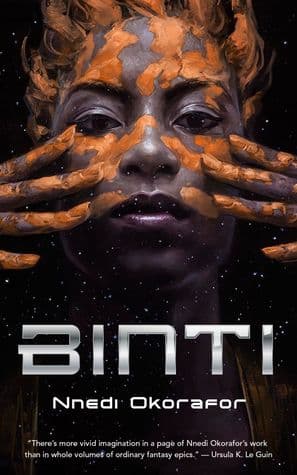
Synopsis
Covers the whole plot, including the ending.
- Difficulty
- Easy
- Pacing
- Fast
- Mood
- Thought-provoking, Hopeful, Culturally Rich, Tense
- Read it if
- You enjoy novellas that blend cultural identity with sci-fi, exploring themes of prejudice, communication, and finding common ground.
- Skip it if
- You prefer long, intricate world-building or stories with extensive action sequences over character-driven conflict resolution.
Binti Plot Summary
Covers the whole plot, including the ending.
The Decision and Departure
Binti, a seventeen-year-old Himba girl, struggles with the decision to accept admission to Oomza University, the galaxy's most respected academic institution. This choice means leaving her traditional Himba life, her family, and her role as a 'master harmonizer' of otjize, a sacred clay mixture. Her family, especially her father, is upset by her decision, seeing it as a betrayal of their heritage and a dangerous step. Despite her inner conflict and the pain of leaving, Binti wants knowledge and the chance to study mathematics and engineering at Oomza. She packs her edan (a spiritual communication device) and her otjize, symbols of her Himba identity.
The Shuttle Journey
Binti boards a local shuttle to the spaceport, immediately feeling like an outsider. Her Himba appearance—dark skin, braided hair covered in otjize, and traditional clothing—draws stares, whispers, and prejudice from the Khoush passengers, the main human ethnic group. She tries to blend in, but her distinctiveness makes her a target of curiosity and subtle hostility. The journey confirms her worries about leaving home and the challenges she will face in a world that does not understand or respect her culture. She finds comfort in mathematics, a universal language, and the feel of her otjize, which connects her to her roots in the alien environment.
On the University Ship
Upon boarding the large interstellar ship for Oomza University, Binti goes to her assigned room. The ship's advanced technology, with shifting walls and an adaptable environment, is both amazing and overwhelming. She carefully applies her otjize, a daily ritual that provides comfort and a link to her heritage. She avoids common areas, sensing continued discomfort and judgment from other students, mostly Khoush. Her isolation is deep, yet she finds a strange peace in solitude, using the time to reflect and prepare for the intellectual challenges ahead. She begins to understand the true weight of being the first Himba at Oomza.
The Meduse Attack
Suddenly, the ship is attacked by the Meduse, a jellyfish-like alien race with a long, violent history with humanity, especially the Khoush. Binti hides in her room, terrified. The Meduse kill everyone else on board, leaving only Binti alive. She is spared because she is Himba; her otjize, with a unique copper substance, creates a static charge that the Meduse's electrical sensors perceive differently. The horrific massacre leaves Binti traumatized, the sole survivor of unimaginable carnage. This event changes how she sees the universe and her place in it, forcing her to face the brutal reality of interspecies conflict.
Encounter with Okwu
After the attack, Binti carefully leaves her room and finds a surviving Meduse, whom she names Okwu. Okwu, a young, aggressive Meduse, is injured and hostile. Binti, using her Himba traditions of harmony and her innate gift for 'tree-rooting' (a deep intuition and connection), approaches Okwu with fear and empathy. She uses her edan, a spiritual device, to try to communicate. Surprisingly, Okwu responds, though with initial aggression. Through shared space, fear, and Binti's persistent, non-violent approach, a fragile connection begins to form, starting interspecies understanding.
The Hostage and the Plea
Binti realizes she is not just a survivor but a 'hostage' in a unique position. Okwu reveals, through Binti's edan and shared experience, the deep reasons for the Meduse's attack: Oomza University stole a sacred Meduse artifact, a 'God-Herder'. The Meduse demand its return and reparations for centuries of conflict and cultural disrespect. Binti, horrified by the massacre but understanding the Meduse's pain, agrees to act as their emissary to Oomza University. She becomes the unlikely link between two warring species, responsible for preventing more bloodshed and seeking justice for the Meduse.
Transformation and Isolation
During her journey with Okwu, Binti undergoes a terrifying and painful physical change. She develops 'stinger' hair, a Meduse biological trait, causing intense pain and shame. This change isolates her further, making her even more alien to humans. She fears how the university, and humanity, will react to her new appearance. This change is not just physical; it symbolizes her growing connection to the Meduse and her role as a 'between-person', no longer fully Himba or human, but also not Meduse. It is a visible sign of her journey of cultural and personal synthesis.
Arrival at Oomza University
Binti and Okwu arrive at Oomza University aboard the Meduse ship. The university is a sprawling, living entity, filled with countless alien species. Binti, now visibly changed with her Meduse-like hair, faces shock, fear, and hostility from university authorities and students. She is a paradox: a human survivor of a Meduse attack, now seemingly allied with the enemy. The weight of her mission is immense; she must convince the university to return the stolen artifact and negotiate peace, all while dealing with her own trauma and identity crisis. Her unique appearance makes her an immediate spectacle and a symbol of the conflict.
Negotiations and the God-Herder
Binti, with Okwu beside her, confronts the Dean of Oomza University and the Council of Elders. She delivers the Meduse's demands, explaining their history of grievances and the sacred importance of the stolen 'God-Herder.' The university officials are initially resistant and disbelieving, seeing the Meduse as savage aggressors. However, Binti's unique position as a survivor and her ability to communicate with Okwu give her credibility. She reveals the God-Herder, a complex, ancient Meduse device, which the university had been studying without understanding its true meaning or sacred value. Tension is high as Binti tries to bridge the vast cultural gap.
The Resolution and Binti's New Path
Through Binti's persistent and emotional mediation, the university finally agrees to return the God-Herder to the Meduse and negotiate real peace. The Meduse, in turn, agree to stop fighting. Binti's Himba gift of harmonization, her ability to bridge divides and find common ground, helps achieve this historic resolution. With peace established, Binti can finally begin her studies at Oomza University. She finds a unique place for herself, not fully Himba, not fully human, but a new kind of being—a harmonizer of cultures and a symbol of interspecies understanding. Her journey of self-discovery and acceptance has only just begun.
Principal Figures
Binti Ekeopara Zimu
Protagonist
A Himba girl who becomes the first of her people to attend Oomza University.
Binti is a brilliant, introverted Himba girl with an extraordinary talent for mathematics and 'tree-rooting' (a deep intuitive connection to people and objects). She is deeply rooted in her Himba culture, cherishing her otjize, edan, and family traditions, yet she possesses an unyielding curiosity and a desire for knowledge that pushes her beyond societal expectations. She is sensitive, observant, and deeply empathetic, which allows her to connect with the Meduse. Her internal conflict between tradition and progress, belonging and individuality, drives her journey.
Relationships: Her Family (Deep but strained due to her departure; she loves them but feels misunderstood.); Okwu (Initially hostile, evolving into a profound, symbiotic, and respectful interspecies friendship.)
Okwu
Supporting
A young, aggressive Meduse who becomes Binti's companion and a catalyst for peace.
Okwu is a young Meduse, initially portrayed as fiercely aggressive and vengeful, embodying the Meduse's deep-seated anger towards humanity, particularly the Khoush. They are driven by a desire for justice for their people and the return of their stolen sacred artifact. Despite their initial hostility, Okwu possesses a capacity for understanding and eventually forms a unique bond with Binti. Their actions are often direct and violent, reflecting the Meduse's culture, but their connection with Binti allows them to see humanity in a new light.
Relationships: Binti (Evolving from captor-hostage to a deep, transformative friendship and partnership.); Other Meduse (Part of a collective, representing their people's grievances.)
The Himba People
Mentioned/Cultural Influence
Binti's traditional, deeply communal, and technologically advanced people.
The Himba are Binti's people, a real-world ethnic group adapted into a futuristic setting. They are characterized by their deep connection to tradition, their use of otjize, their distinct hairstyles, and their advanced 'harmonizing' abilities. They are insular, valuing community and ancestral ways above all else, and are wary of outsiders and technological advancements that threaten their cultural purity. They are master 'harmonizers' and 'tree-rooters', capable of understanding and integrating complex systems, both social and mathematical.
Relationships: Binti (Her foundation and source of identity, despite her breaking from tradition.); Khoush (Historically distinct and often viewed with suspicion.)
The Khoush People
Supporting/Antagonistic
The dominant human ethnic group, often prejudiced and in conflict with the Meduse.
The Khoush represent the dominant human culture in the galaxy, characterized by their lighter skin, straighter hair, and often, their prejudice against those who are different, like the Himba. They are primarily responsible for the long-standing conflict with the Meduse, having stolen their sacred artifact and perpetrated acts of violence. They are often depicted as technologically advanced but culturally insensitive and prone to xenophobia, viewing other species and cultures through a narrow lens of superiority. Their actions directly trigger the Meduse attack.
Relationships: Binti (Initially prejudiced against her, later forced to acknowledge her unique role.); Meduse (Long-standing, violent antagonists, fueled by historical grievances.)
Binti's Father
Supporting
A master harmonizer who struggles with Binti's decision to leave.
Binti's father is a respected master harmonizer within the Himba community and a pivotal figure in Binti's life. He embodies the Himba traditions and values, and his resistance to Binti leaving for Oomza University stems from a deep concern for her safety and the preservation of their culture. His sadness and sense of betrayal at her departure highlight the profound cultural clash Binti faces. Despite his initial disapproval, his love for Binti is evident, and his teachings about harmonization profoundly influence her.
Relationships: Binti (Loving but conflicted, representing the tension between tradition and individual ambition.)
The Dean of Oomza University
Supporting
The leader of Oomza University, initially resistant to the Meduse's demands.
The Dean is the authoritative figurehead of Oomza University, representing the institution's vast knowledge, but also its potential for arrogance and cultural blindness. Initially, the Dean is dismissive of the Meduse's grievances and protective of the university's possession of the 'God-Herder,' viewing it as a scientific specimen rather than a sacred artifact. They embody the academic world's detachment and the human-centric perspective that has fueled the conflict with the Meduse. Their eventual concession to Binti's demands demonstrates the power of empathy and diplomacy.
Relationships: Binti (Initially skeptical, eventually respects her as a mediator and student.); Meduse (Represents the institutional antagonist, responsible for the theft of the 'God-Herder'.)
Themes & Insights
Identity and Belonging
Binti's journey is about finding her identity as a Himba woman in a galaxy that often does not understand or accept her. She struggles with leaving her culture, the prejudice she faces on the shuttle, and her physical change into a 'stinger'. Her otjize and edan become symbols of her Himba heritage, grounding her when she feels most alone. By the end, she creates a new, hybrid identity, embracing her role as a 'between-person' who belongs to multiple worlds, showing that identity can change and be a source of strength. This is clear when she uses her Himba 'harmonizing' skills to bridge the gap between species, proving her unique identity is her greatest asset.
“My Himba identity was a part of me, a part of my body. And that part of me was always in conflict with the rest of the world.”
Prejudice and Xenophobia
The story clearly shows the dangers of prejudice, both between humans and between species. Binti faces prejudice from the Khoush for her Himba appearance, encountering stares and whispers on the shuttle. This mirrors the deeper, violent xenophobia between humans and the Meduse, caused by centuries of misunderstanding and conflict, leading to the massacre on the university ship. The Khoush's inability to see the Meduse as anything but monsters, and the Meduse's retaliatory violence, show how fear of what is 'other' leads to destruction. Binti's role is to break down these prejudices through empathy and understanding, offering a path beyond violence.
“They were scared of me. Not because I was Himba, but because I was alien to them. And that fear, it was old. Older than me.”
The Power of Harmony and Communication
A main part of the story is the Himba idea of 'harmonizing' and 'tree-rooting'—Binti's natural ability to understand, connect, and bring balance to complex systems and beings. This skill, first seen as a traditional Himba practice, becomes the key to galactic peace. Her use of the edan to talk with Okwu, and her patient mediation between the Meduse and Oomza University, show that true understanding and resolution come from empathy and a willingness to bridge divides, not through force. Binti's ability to 'harmonize' the different parts of two warring cultures ultimately saves many lives and changes the galaxy's future.
“I was a harmonizer. Not just with numbers, but with people. With living things. It was a Himba thing.”
Tradition vs. Progress
Binti's initial decision to leave her family and Himba traditions for the advanced, alien world of Oomza University immediately sets this theme. Her family sees her departure as betraying their heritage, while Binti seeks knowledge beyond their traditional limits. However, the story suggests that tradition and progress are not separate. Binti's Himba heritage—her otjize, her edan, and her harmonization skills—are exactly what help her survive the Meduse attack and make peace. She does not abandon her roots but combines them into her new, progressive life, proving that ancestral wisdom can be important in facing future challenges.
“My people always said that tradition was like a tree. It grew, it changed, but its roots stayed deep.”
Plot Devices & Literary Techniques
Otjize
A sacred Himba clay mixture that acts as a physical and spiritual shield.
Otjize is a red ochre mixture used by Himba women for skin and hair. In the story, it serves multiple functions: it's a powerful symbol of Binti's Himba identity and connection to her ancestors, a physical comfort, and a spiritual grounding. Crucially, the unique properties of the otjize (containing copper) create an electrical field that shields Binti from the Meduse's sensors, saving her life during the attack. It becomes a literal and metaphorical protective layer, allowing her to survive and eventually mediate between the warring factions.
Edan
A spiritual communication device that facilitates understanding across species.
The edan is a small, ancient, and highly spiritual Himba device that Binti carries. It functions as a communication tool, allowing her to 'tree-root' and connect with other beings, including the alien Meduse. It helps her to understand their language and intentions, and to convey her own. The edan is instrumental in Binti's ability to bridge the communication gap between humanity and the Meduse, transforming a violent encounter into an opportunity for dialogue and peace. It represents the Himba's unique spiritual technology and Binti's inherited gifts.
Tree-rooting
Binti's innate Himba ability to deeply connect with and harmonize complex systems.
Tree-rooting is Binti's extraordinary Himba gift, an intuitive ability to understand, connect with, and bring balance to complex systems, whether mathematical equations, living organisms, or even emotional states. It's a form of deep empathy and pattern recognition that allows her to harmonize disparate elements. This ability is initially seen in her mathematical prowess and her skill with otjize, but it becomes critical in her interactions with Okwu and her subsequent mediation between the Meduse and Oomza University. It's the core of her 'harmonizer' identity and her most powerful tool for diplomacy.
The God-Herder
A sacred Meduse artifact whose theft incites the conflict.
The God-Herder is an ancient, sacred Meduse artifact, described as a complex, living machine with profound cultural and spiritual significance to the Meduse. Its theft by Oomza University is the direct cause of the Meduse's violent retaliation against humanity. For the Meduse, it is not merely a piece of technology but a vital part of their heritage and identity, a 'god' that connects them to their past. Its return is the central demand in the Meduse's negotiations, highlighting the theme of cultural disrespect and the importance of respecting other species' sacred objects.
Binti Quotes
“Home is a place on Earth. It is a place in my heart. It is a place in my spirit.”
“I was Binti. I was Himba. I was not just Himba. I was also something new. I was also what I was becoming.”
“The universe was a big, scary place, but it was also a place of wonder and beauty.”
“My family had always told me that to be Himba was to be connected to the earth, to the stars, to everything.”
“Sometimes, the things that make us different are the very things that save us.”
“I was a peacemaker, not a warrior. But sometimes, a peacemaker had to be a warrior too.”
“Math was my language. It was how I understood the world. It was how I spoke to the stars.”
“Tradition was important, but so was progress. And sometimes, progress meant breaking with tradition.”
“Fear was a powerful thing, but hope was even more powerful.”
“There was a thin line between genius and madness, and sometimes, the most brilliant people danced right on it.”
“To truly see someone, you had to look past their skin, past their culture, past everything that made them seem different.”
“The universe was not just a collection of stars and planets; it was a living, breathing entity.”
“Sometimes, the greatest journeys were not about going to a new place, but about discovering a new part of yourself.”
“My otjize was my shield, my comfort, my connection to my people. And now, it was also a bridge.”
Quiz
10 questions on the plot and the characters. Each answer comes with a short explanation.
Question 1
What is the name of the prestigious university Binti is accepted into?
- Galaxy Institute
- Oomza University
- Starfall Academy
- Himba Grand College
Show answer
B. Oomza University Binti is accepted into Oomza University, described as the finest institution of higher learning in the galaxy.
Question 2
Which alien race has a long-standing conflict with Oomza University and becomes a threat during Binti's journey?
- The Khoush
- The Meduse
- The Edan
- The Okwu
Show answer
B. The Meduse The Meduse are the alien race that has long warred with Oomza University and are a major threat in the story.
Question 3
What is Binti's unique ethnic group, known for their distinct customs and appearance, that she is the first to leave for university?
- The Himba
- The Khoush
- The Otjize
- The Ena
Show answer
A. The Himba Binti belongs to the Himba people, and she is the first of them to be offered a place at Oomza University.
Question 4
What specific item from her Himba culture does Binti bring with her that represents her identity and offers comfort?
- A traditional Himba necklace
- A special family cooking pot
- Her otjize paste
- A woven Himba blanket
Show answer
C. Her otjize paste Binti brings her otjize, a red ochre paste used by Himba women for skin and hair, which is central to her identity and provides comfort.
Question 5
What is Binti's special aptitude or gift that allows her to manipulate technology and 'understand' machines, crucial for her studies?
- Mastery of alien languages
- Exceptional piloting skills
- Her ability as a 'harmonizer' or 'mathematician'
- Advanced combat training
Show answer
C. Her ability as a 'harmonizer' or 'mathematician' Binti is a 'harmonizer' or 'mathematician,' meaning she has an innate ability to understand and connect with technology and numbers, a core part of her identity and a skill valued at Oomza.
Question 6
What is the primary reason Binti feels alienated from her family and community when she decides to go to Oomza University?
- She has rejected their religious beliefs.
- She is breaking tradition by leaving their ancestral home and customs.
- She committed a crime against her village.
- She refused an arranged marriage.
Show answer
B. She is breaking tradition by leaving their ancestral home and customs. Binti feels alienated because her decision to attend Oomza University means leaving her Himba traditions and family behind, which is unprecedented and goes against their established way of life.
Question 7
What specific act of violence occurs on Binti's spaceship journey to Oomza University?
- A ship malfunction causes a massive explosion.
- Pirates raid the ship for valuables.
- The Meduse attack and kill most of the passengers.
- A disease outbreak incapacitates the crew.
Show answer
C. The Meduse attack and kill most of the passengers. The Meduse attack the spaceship, killing all the Khoush passengers, leaving Binti as one of the few survivors.
Question 8
How does Binti initially survive the Meduse attack on the ship?
- She hides in an escape pod.
- She is protected by a force field she activates.
- She locks herself in her room, and her otjize helps mask her presence.
- She is mistaken for one of the Meduse.
Show answer
C. She locks herself in her room, and her otjize helps mask her presence. Binti locks herself in her room, and her otjize, along with her Himba scent, makes her undetectable to the Meduse's sensors, allowing her to survive the initial massacre.
Question 9
What is the primary symbolic meaning of Binti's hair-braiding and the otjize she applies to it?
- It is a sign of wealth and status.
- It represents her connection to her Himba identity, family, and tradition.
- It is purely for aesthetic beauty in her culture.
- It is a form of camouflage in her home environment.
Show answer
B. It represents her connection to her Himba identity, family, and tradition. Binti's hair and otjize are deeply symbolic of her Himba heritage, family, and traditions. It's not just cosmetic but a profound part of her identity.
Question 10
What 'gift' does Binti ultimately offer the Meduse leader, Okwu, to facilitate peace between the Meduse and Oomza University?
- A rare artifact from Earth.
- Access to advanced Himba technology.
- Part of her own hair (her 'master's' dreadlock) as a symbol of trust and connection.
- A promise of an alliance against a common enemy.
Show answer
C. Part of her own hair (her 'master's' dreadlock) as a symbol of trust and connection. Binti offers Okwu a piece of her own hair, specifically a master's dreadlock, which is a highly personal and significant gesture of trust and a desire for integration, allowing for a connection between them.
Binti FAQ
What is the central conflict Binti faces at the very beginning of the story?
Binti's initial conflict is internal: choosing to accept her admission to Oomza University means leaving her Himba family and their traditions behind. This decision is momentous because no Himba has ever left home for a university, and it signifies a radical break from her cultural norms and the expectations placed upon her as a 'master harmonizer' of her people.
Who are the Meduse, and what is their significance to the plot?
The Meduse are a tentacled, alien race that has been at war with humanity for a long time, often depicted as monstrous. They are significant because they attack the transport ship Binti is on, seeking a specific artifact from Oomza University and killing nearly everyone, forcing Binti to confront her prejudices and act as a mediator.
What unique abilities or gifts does Binti possess due to her Himba heritage?
Binti is a 'master harmonizer,' meaning she is exceptionally skilled at creating akwa, a special paste made from otjize and other ingredients that connects her to her people and helps her process emotions. She also has a deep intuitive understanding of mathematics and computing, which she calls 'tree-root mathematics,' allowing her to mentally solve complex problems and even interact with technology on a profound level.
What is 'otjize' and why is it so important to Binti and her Himba identity?
Otjize is a sacred red paste made from butterfat, ochre, and aromatic resins that Himba women use to cover their skin and hair. For Binti, it is a direct link to her cultural identity, her family, and her sense of self; its presence or absence signifies her connection to her heritage and her emotional state, making its removal a profound act of vulnerability and defiance.
How does Binti's 'tree-root mathematics' manifest during critical moments?
Binti's 'tree-root mathematics' manifests as an intuitive, almost spiritual understanding of numbers and systems. She uses it to reconfigure the ship's navigation system to help the Meduse leader, Okwu, and later to understand and interact with the Meduse's 'edan' artifact, seeing complex calculations as interconnected roots and branches rather than linear equations.
What is the significance of the 'edan' artifact that the Meduse are seeking?
The edan is a powerful, ancient Meduse artifact that was stolen by Oomza University, leading to the long-standing war. It holds a deep cultural and spiritual significance for the Meduse, representing a part of their soul and history. Binti's ability to activate and understand it is key to her mediation efforts.
How does the 'khoush' culture contrast with Himba traditions as depicted through Binti's experiences?
Khoush culture, represented by the majority of the university students, is depicted as technologically advanced but also judgmental, prejudiced, and focused on individual achievement. This contrasts sharply with Himba traditions, which emphasize community, deep connection to heritage through practices like otjize, and a more spiritual, integrated understanding of knowledge and nature.
What subtle clues suggest Binti's unique abilities beyond typical Himba practices even before the Meduse attack?
Even before the Meduse attack, Binti demonstrates an extraordinary aptitude for mathematics and an almost preternatural ability to harmonize complex systems, which she applies to her family's calculations for akwa. Her deep connection to her otjize and her 'tree-root mathematics' are presented as more profound than typical, hinting at her future role as a mediator.
How does Binti's psychological state evolve from fear to agency during her encounter with the Meduse?
Initially, Binti is paralyzed by fear and prejudice, seeing the Meduse as monsters as she was taught. However, her deep-seated Himba need for harmony and her empathetic nature compel her to engage with Okwu. This interaction, combined with her strategic use of her otjize and mathematical abilities, transforms her fear into courageous agency, making her an active participant in resolving the conflict.
What role does Binti's 'otherness' play in both her vulnerability and her strength?
Binti's 'otherness' – being Himba among Khoush, and later a human trying to understand Meduse – makes her vulnerable to prejudice and isolation. However, this same 'otherness' is her greatest strength, allowing her to see beyond existing biases, use unique Himba practices like otjize as tools for communication, and approach problems with a fresh, harmonizing perspective that others lack.
Discuss the psychological impact of Binti's transformation into a 'meduse' human.
Binti's transformation, growing Meduse-like tentacles from her hair, is a profound psychological shift. It marks her as an outsider to both humans and Meduse, creating a new layer of identity confusion and acceptance. This physical change symbolizes her role as a bridge between cultures, forcing her to embrace a hybrid identity and challenge her own perceptions of self and beauty.
How does Binti's internal conflict between tradition and progress reflect a universal human experience?
Binti's internal conflict mirrors a universal human struggle between honoring one's heritage and embracing new opportunities or knowledge. Her journey explores the fear of losing oneself when stepping outside familiar boundaries, the pain of leaving family, and the courage required to forge a new path while attempting to integrate, rather than abandon, one's roots.
Is Binti's act of 'harmonizing' with Okwu a form of surrender or a strategic negotiation? Justify your answer.
Binti's act of harmonizing with Okwu is a strategic negotiation, not surrender. She uses her unique Himba practices, like offering her otjize, as a calculated move to establish trust and communication, leveraging her cultural identity to bridge a diplomatic gap. She retains her agency, actively shaping the terms of their interaction and ultimately brokering a peace.
How does the author use the concept of 'home' throughout the novella, and how does Binti redefine it?
The author initially portrays 'home' as Binti's Himba village, a place of comfort, tradition, and family. As Binti travels, she experiences a profound sense of displacement. By the end, she redefines 'home' not as a fixed geographical location, but as a state of being where she feels accepted and where her multiple identities—Himba, university student, Meduse-human—can coexist harmoniously.
To what extent is Binti a chosen one, or does she simply make choices that lead to extraordinary outcomes?
While Binti possesses unique inherent gifts (tree-root mathematics, master harmonizer), her extraordinary outcomes stem primarily from her choices. She chooses to leave home, to engage with Okwu despite fear, to offer her otjize, and to mediate. Her agency and willingness to act, rather than a predetermined destiny, are what drive the narrative and lead to peace.
What is the broader message about prejudice and understanding that the novella conveys?
The novella powerfully conveys that prejudice is often rooted in fear and ignorance, perpetuated by a lack of communication. It argues that true understanding comes from stepping outside one's comfort zone, actively engaging with 'the other,' and being willing to see past superficial differences to find common ground, ultimately leading to peace and growth.
How does Binti's relationship with her otjize evolve, reflecting her changing identity?
Initially, Binti's otjize is a source of comfort and a symbol of her Himba identity. When she shaves it off in fear, it represents her vulnerability and a momentary rejection of her heritage. Later, she uses it strategically as a diplomatic tool and eventually, with her meduse hair, it symbolizes a new, integrated identity, demonstrating her evolving comfort with her multifaceted self.
What does the ultimate resolution of the conflict between humans and Meduse imply about the nature of peace?
The resolution implies that true peace is not achieved through conquest or simple treaties, but through deep empathy, mutual understanding, and a willingness to acknowledge past wrongs and make reparations. It requires individuals to bridge divides and find commonality, suggesting that peace is a continuous process of communication and respect, rather than a final state.
About the author
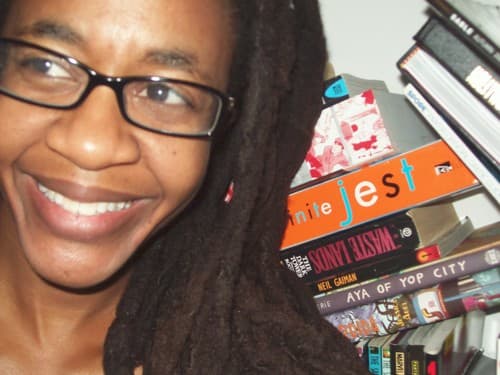
Nnedi Okorafor is a Nigerian-American author known for her contributions to speculative fiction. Her notable works include "Binti," which explores themes of identity and culture, "Akata Witch," a coming-of-age story set in Nigeria, "Who Fears Death," a post-apocalyptic narrative, and "The Book of Phoenix," a prequel to her earlier work. Okorafor's writing often blends African culture with science fiction and fantasy elements.
Similar books
- A Wizard of Earthsea
Ursula K. Le Guin
4.0 (241k) average on GoodreadsFantasyBoth Binti and A Wizard of Earthsea are seminal works in young adult speculative fiction that center on a protagonist leaving home to attend a prestigious, magical/academic institution and undergoing significant personal transformation. However, Le Guin's work, while deeply influential, operates within a more traditional Western fantasy framework concerning magic and heroism. Binti, in contrast, grounds its narrative in specific African cultural practices and presents a protagonist whose 'magic' is intrinsically tied to her heritage and mathematical prowess, offering a distinctly different lens on power, identity, and belonging. Binti also tackles overt themes of racial and cultural prejudice in a way that Earthsea, while exploring good vs. evil and balance, does not as directly confront.
- Harry Potter and the Sorcerer's Stone
J.K. Rowling
4.5 (7M) average on GoodreadsFantasyRescued from a miserable life under the stairs, an orphaned boy discovers he's a wizard destined for a magical school, where he uncovers a dangerous secret tied to the dark wizard who murdered his parents.
- The Hunger Games
Suzanne Collins
4.3 (6.4M) average on GoodreadsFantasyIn a future where children fight to the death on live television, Katniss Everdeen volunteers for the arena, turning a death sentence into a fight for survival and a spark of rebellion.
- 1984
George Orwell
4.2 (3.1M) average on GoodreadsPoliticsIn a future where surveillance and thought control are absolute, a man's search for truth clashes with the Party, showing that hope can be a form of rebellion.
- Divergent
Veronica Roth
4.2 (2.9M) average on GoodreadsFantasyIn a society divided by virtues, a sixteen-year-old's difference from the norm starts a rebellion that threatens her world.
- The Hobbit, or There and Back Again
J.R.R. Tolkien
4.3 (2.9M) average on GoodreadsFantasyA comfort-loving hobbit named Bilbo Baggins is whisked away by a mischievous wizard and a band of dwarves on an unexpected journey to reclaim stolen treasure from a fearsome dragon, discovering courage and a magical ring along the way.






Enjoyed the summary?
A summary gives you the shape of the book. The book itself has the detail, the examples and the voice.
Find Binti on AmazonAs an Amazon Associate, BookBrief earns from qualifying purchases. How we're funded