
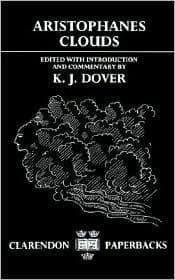
Synopsis
Covers the whole plot, including the ending.
- Difficulty
- Hard
- Pacing
- Moderate
- Mood
- Satirical, Philosophical, Comedic, Critical
- Read it if
- you're interested in classical Greek comedy, satirical critiques of philosophy and education, or the historical context of ancient Athenian society and intellectual movements.
- Skip it if
- you prefer modern storytelling structures, are sensitive to outdated humor, or are not interested in philosophical debates presented through satire.
Clouds Plot Summary
Covers the whole plot, including the ending.
Strepsiades' Financial Woes and the Thinkery
The play opens with Strepsiades, an elderly Athenian farmer, agonizing over his immense debts, mainly from his horse-obsessed son, Pheidippides. Strepsiades laments Pheidippides' extravagant life and his own inability to sleep due to financial worries. He plans to avoid creditors: he will send Pheidippides to the 'Thinkery,' a school run by the philosopher Socrates, where students learn to make the weaker argument seem stronger. Strepsiades believes that if Pheidippides learns these techniques, he can outwit creditors and escape their financial obligations. Initially, Pheidippides is reluctant, seeing Socrates' teachings as absurd, but Strepsiades persuades him, promising a life free of manual labor.
Strepsiades' Failed Enrollment and Encounter with a Student
Strepsiades arrives at the Thinkery, eager to enroll. He meets a student who studies obscure, seemingly trivial matters, such as how far a flea can jump. The student also reveals some of Socrates' strange practices and theories, including his belief that gnats' buzzing comes from their anuses. Strepsiades is both confused and curious about these revelations, finding them ridiculous yet insightful. He tries to join the school himself, hoping to grasp the sophistical arts directly, but his age, poor memory, and lack of intellectual ability hinder him. His attempts to understand concepts are met with frustration from the student, showing his unsuitability for serious philosophical study.
Socrates' Grand Entrance and the Invocation of the Clouds
Socrates makes his dramatic entrance, suspended in a basket above the stage. He claims this elevated position allows him to better contemplate celestial phenomena. Strepsiades is awestruck and expresses his desire to learn from the master. Socrates then introduces Strepsiades to the Clouds, whom he claims are the true deities, the source of all thought, rhetoric, and inspiration, replacing the traditional Olympian gods. The Chorus of Clouds appears, singing of their power and influence over weather and human affairs. Strepsiades is initially confused but quickly embraces the new pantheon, eager to learn their secrets and use their power for his own financial gain, showing his practical and self-serving motivation.
Strepsiades' Initial Lessons and Misunderstandings
Socrates tries to teach Strepsiades various sophistical concepts, focusing on rhetoric, grammar, and natural philosophy. Strepsiades' lessons are a comedic disaster. He struggles with basic grammatical distinctions, like gender agreement, and misunderstands philosophical terms, often interpreting them in crude, literal ways. For example, when taught about meter, he thinks of measuring grain. His mind constantly returns to his debts and his desire to learn only what is useful for defrauding his creditors. Socrates becomes increasingly exasperated with Strepsiades' intellectual limits and his stubborn refusal to engage with ideas for their own sake, concluding that the old man is unteachable.
Pheidippides' Enrollment and Transformation
After Strepsiades' failure, he convinces Pheidippides to enroll in the Thinkery. Unlike his father, Pheidippides is an apt and eager student of Socrates. He quickly absorbs the sophistical techniques, learning to manipulate arguments, make the weaker argument stronger, and reject traditional notions of justice and morality. His change is rapid. He sheds his aristocratic pretensions and dedicates himself to rhetoric, much to Strepsiades' delight. Strepsiades sees his investment paying off, believing Pheidippides will now defeat their creditors in court and secure their financial freedom, unaware of the moral cost.
The Agon: Just vs. Unjust Argument
The play features a debate between two personified arguments: Just Argument (representing traditional morality, justice, and the old ways) and Unjust Argument (representing the new sophistical teachings, moral relativism, and the ability to win any case). Just Argument champions modesty, physical training, and respect for elders, lamenting the decline of traditional Athenian values. Unjust Argument, however, skillfully dismantles Just Argument's points, ridiculing old-fashioned education and promoting the benefits of cleverness, self-interest, and the ability to escape punishment through persuasive speech. Unjust Argument ultimately triumphs, symbolizing the perceived victory of sophistry over traditional ethics in Athenian society.
Pheidippides' First Victory and Strepsiades' Relief
With his new sophistical skills, Pheidippides successfully defeats one of Strepsiades' creditors, Pasias, in a legal dispute. Using cunning arguments and exploiting legal loopholes, Pheidippides manages to invalidate the debt, leaving Pasias enraged and bewildered. Strepsiades is overjoyed by his son's success, believing his plan worked perfectly. He gloats over his newfound freedom from debt and praises Pheidippides' cleverness, completely oblivious to the moral implications of their actions. He celebrates the triumph of sophistry as a means to escape responsibility, reinforcing his self-serving nature and his admiration for deceit when it benefits him.
The Beatings and Pheidippides' Justification
Strepsiades' joy is short-lived. Pheidippides, having learned to make the weaker argument stronger, begins to apply his sophistical logic to his own family. He argues that if a father can beat his child for their own good, it is equally permissible for a son to beat his aging father, especially if the father makes mistakes. He presents a series of absurd yet logically constructed arguments to justify filial violence. Strepsiades is horrified and enraged, realizing the consequences of the education he so eagerly sought for his son. The very skills he admired are now turned against him.
The Argument for Beating His Mother
Pheidippides extends his twisted logic, arguing that if he can justify beating his father, he can also justify beating his mother. He presents an even more outrageous argument: if a mother has the right to discipline her child, then a child, being a more rational individual, has the right to discipline his mother. Strepsiades is appalled by this moral inversion. He finally recognizes the destructive nature of the sophistical teachings and the complete erosion of traditional values and familial piety that his son has embraced. The situation escalates into physical violence, with Pheidippides threatening to beat his father.
Strepsiades' Repentance and Attack on the Thinkery
Strepsiades, now aware of the destructive consequences of the sophistical education he inflicted upon his son, changes his mind. He denounces Socrates and the Thinkery as corrupting influences that undermine morality, tradition, and family values. Filled with anger, he gathers his servants and sets out to destroy the Thinkery. He sets fire to the building, burning it down while Socrates and his students are still inside. Strepsiades' act of arson is a violent rejection of the new intellectualism and a desperate attempt to restore the old order, even through destructive means, showing his complete repentance.
Clouds Characters
Strepsiades
Protagonist
A Debt-Ridden, Naive Athenian Farmer
Strepsiades is an elderly Athenian farmer, burdened by debt due to his son Pheidippides' extravagant lifestyle. He is initially portrayed as cunning but naive, seeking a quick fix to his financial woes through sophistry. He is pragmatic and self-serving, valuing cleverness over traditional morality if it benefits him. Despite his initial enthusiasm for Socrates' teachings, he is intellectually dull and struggles to grasp complex concepts. His character undergoes a significant transformation from a hopeful, if misguided, seeker of knowledge to a vengeful defender of traditional values when his own family is threatened.
Relationships: Pheidippides (Father-son, initially indulgent, then student-teacher, finally victim-abuser); Socrates (Would-be student-teacher, then antagonist); Chorus of Clouds (Initially revered deities, then abandoned)
Pheidippides
Supporting
Strepsiades' Extravagant Son Turned Sophist
Pheidippides is Strepsiades' aristocratic and horse-obsessed son, responsible for incurring most of his father's debts. Initially reluctant to attend the Thinkery, he proves to be an exceptionally quick and adept student of sophistry. He quickly masters the art of rhetoric and logical manipulation, shedding his old identity and embracing the new intellectualism. His transformation is complete when he uses his new skills to justify beating his own father and mother, demonstrating a complete abandonment of filial piety and traditional morality. He represents the corrupting influence of unchecked sophistry.
Relationships: Strepsiades (Son-father, initially disobedient, then student-teacher, finally abuser-victim); Socrates (Student-teacher)
Socrates
Antagonist
The Head of the Thinkery and Sophist Teacher
Socrates in 'Clouds' is a satirical caricature of the historical philosopher, depicted as a eccentric and amoral sophist. He runs the 'Thinkery,' a school where students learn to make the weaker argument stronger, question traditional gods, and engage in pseudo-scientific inquiries (like studying fleas). He is portrayed as arrogant, detached, and concerned with trivial intellectual pursuits, ultimately fostering moral decay. He is not the wise, ethical Socrates of Plato's dialogues, but rather a representation of the perceived dangers of new intellectual movements that challenged traditional Athenian values.
Relationships: Strepsiades (Teacher-would-be student, then antagonist); Pheidippides (Teacher-student); Chorus of Clouds (Revered deities)
Chorus of Clouds
Supporting
The New Deities and Narrators
The Chorus of Clouds represents the new, non-traditional deities worshipped by Socrates and his students. They are presented as powerful, ethereal beings who control weather, inspire thought, and influence human rhetoric. They serve as commentators on the action, offering insights into the philosophical and moral debates, and often reflecting the play's themes. Their presence emphasizes the shift from traditional Olympian gods to abstract, natural forces, symbolizing the intellectual and religious changes occurring in Athens. They are initially sympathetic to Strepsiades but ultimately side with justice when the moral consequences of sophistry become clear.
Relationships: Socrates (Revered deities); Strepsiades (Initially revered deities, then abandoned)
Just Argument
Supporting
Personification of Traditional Morality
Just Argument is a personified character who champions traditional Athenian morality, education, and values. He represents the old ways, advocating for modesty, physical training, respect for elders, and adherence to established laws and customs. He laments the decline of these virtues and the rise of sophistry, which he sees as corrupting the youth and undermining society. He engages in an 'agon' with Unjust Argument, passionately defending the importance of justice and integrity, but ultimately loses the debate, symbolizing the perceived waning influence of traditional ethics.
Relationships: Unjust Argument (Rhetorical opponent)
Unjust Argument
Supporting
Personification of Sophistic Logic
Unjust Argument is a personified character who embodies the new sophistical teachings, moral relativism, and the art of making the weaker argument appear stronger. He is clever, articulate, and cynical, skillfully dismantling Just Argument's points and ridiculing traditional values. He promotes self-interest, the manipulation of logic, and the ability to escape punishment through persuasive speech. His victory in the 'agon' signifies the perceived triumph of sophistry and the erosion of traditional ethics in Athenian society, highlighting the dangers of unchecked intellectualism without a moral compass.
Relationships: Just Argument (Rhetorical opponent)
Pasias
Minor
A Creditor of Strepsiades
Pasias is one of Strepsiades' creditors, a straightforward and honest man who is owed money for a horse. He appears briefly to demand payment, only to be outwitted and defrauded by Pheidippides using his newly acquired sophistical skills. Pasias represents the ordinary Athenian citizen who is vulnerable to the clever manipulations of the sophists and the breakdown of traditional legal and moral obligations. His frustration and bewilderment highlight the injustice enabled by the Thinkery's teachings.
Relationships: Strepsiades (Creditor-debtor); Pheidippides (Legal opponent)
Amynias
Minor
Another Creditor of Strepsiades
Amynias is another creditor of Strepsiades, who, like Pasias, seeks payment for a debt. He is also subjected to Pheidippides' sophistical arguments and is left frustrated and unpaid. His appearance reinforces the pattern of Strepsiades and Pheidippides using their new 'education' to avoid financial responsibility, further illustrating the moral decay fostered by the Thinkery. Amynias serves to demonstrate that the initial success against Pasias was not an isolated incident but a systematic application of their learned deceit.
Relationships: Strepsiades (Creditor-debtor); Pheidippides (Legal opponent)
Clouds Themes
The Corruption of Traditional Morality and Education
The central theme is the perceived decay of traditional Athenian values, ethics, and education by the 'new learning' of sophistry and Socrates. The play argues that the ability to 'make the weaker argument stronger' undermines justice, filial piety, and civic responsibility. Strepsiades' initial desire to defraud creditors and Pheidippides' eventual justification of violence against his parents show how this intellectual pursuit, when detached from a moral framework, leads to societal breakdown. The play critiques intellectual movements that challenged established norms without providing a new ethical foundation.
“If you'll only learn to argue, you'll never have to pay a single penny to anyone!”
The Conflict Between Old and New
This theme is a clash between the 'old' ways of traditional Athenian society (represented by Strepsiades' initial traditional values, Just Argument, and the Olympian gods) and the 'new' intellectual and moral world (represented by Socrates, sophistry, Unjust Argument, and the Clouds). The play explores the anxiety and disruption caused by rapid social and intellectual change. While the 'new' offers liberation from old constraints (like debt), it also brings chaos and moral inversion. Strepsiades' ultimate destruction of the Thinkery symbolizes a violent rejection of the disruptive 'new' for a return to, or defense of, the 'old'.
“I will teach you to argue for either side, and always win, no matter the truth.”
The Dangers of Unchecked Intellectualism
Aristophanes explores the dangers of intellectual pursuits when they detach from practical wisdom, common sense, and ethical considerations. Socrates' focus on seemingly trivial matters (like flea jumps or gnat anuses) and the sophists' emphasis on rhetorical victory over truth are examples of intellectualism gone wrong. This unchecked intellectualism leads to moral relativism, where clever arguments can justify any action, as Pheidippides shows. The play suggests that while knowledge is powerful, using it without a moral compass can harm individuals and society.
“He who studies the heavens, and measures the earth, and finds out what's under the earth, he's the man for me!”
Filial Impiety and Family Breakdown
A major theme is the breakdown of the traditional family unit and filial piety. Strepsiades initially seeks to use sophistry to protect his family's finances, but his son's education ultimately turns against him. Pheidippides' arguments for the right to beat his father and mother represent the ultimate reversal of familial respect and duty. This extreme example highlights how rejecting traditional morality, enabled by sophistry, can erode fundamental social bonds and destroy the family, a cornerstone of Athenian society.
“If it is right for a father to beat his son, is it not even more right for a son to beat his father, if he errs?”
Plot Devices & Literary Techniques
Agon (Debate)
A formal debate between opposing viewpoints.
The 'Agon' in 'Clouds' is a central dramatic device, specifically the debate between Just Argument and Unjust Argument. This formal, structured confrontation allows Aristophanes to present the core ideological conflict of the play: the clash between traditional Athenian values and the 'new learning' of sophistry. By personifying these abstract concepts, the play makes the philosophical debate tangible and dramatic. The victory of Unjust Argument serves as a powerful symbolic statement about the perceived triumph of moral relativism and rhetorical skill over established ethics in Athenian society, setting the stage for the play's tragicomic resolution.
Caricature
Exaggerated portrayal for satirical effect.
Aristophanes employs caricature extensively, most notably in his portrayal of Socrates. The historical Socrates was known for his ethical philosophy, but in 'Clouds', he is exaggerated into an eccentric, amoral sophist who teaches trivialities and undermines traditional religion and morality. This device allows the playwright to satirize and criticize contemporary intellectual movements by presenting them in an absurd and exaggerated light, highlighting their perceived dangers and ridiculousness. The caricature of Socrates serves to lampoon the perceived threats of new philosophical ideas to Athenian society and values.
Dramatic Irony
Audience knows more than characters.
Dramatic irony is prevalent throughout 'Clouds', particularly concerning Strepsiades' motivations and expectations. The audience understands the inherent dangers and moral implications of sophistry, while Strepsiades naively believes it will be a simple solution to his financial problems. His joy at Pheidippides' ability to defeat creditors is ironic, as the audience foresees that these very skills will inevitably turn against him. This irony heightens the tragicomic effect, as the audience anticipates the disastrous consequences of Strepsiades' choices long before he realizes them himself, making his eventual repentance all the more impactful.
The Chorus as Narrators and Commentators
The Chorus guides and reflects the play's themes.
The Chorus of Clouds serves multiple functions beyond simply representing Socrates' new deities. They act as narrators, introducing themes and characters, and as commentators, offering insights and moral judgments on the unfolding events. Their songs and dialogue often reflect the play's central debates about old versus new, justice versus sophistry. Initially appearing to endorse Socrates' teachings, their eventual shift to condemning the moral decay wrought by sophistry underscores the play's ultimate message. The Chorus acts as a moral compass, guiding the audience's interpretation of the play's complex ethical questions.
Clouds Quotes
“By the Gods, what a vision!”
“But I have learned one thing, at least; that the gods are not the things that matter.”
“It is the Clouds, the Clouds that have saved me.”
“You must not be ashamed of your ignorance.”
“The unexamined life is not worth living.”
“It is a shame to be ignorant, but worse to be ashamed of it.”
“Justice is a fool's word.”
“The world is full of fools.”
“Wisdom is the daughter of experience.”
“He who is ashamed of his own ignorance is a fool.”
“The greatest wealth is to live content with little.”
“The fault, dear Brutus, is not in our stars, But in ourselves, that we are underlings.”
“The mind is not a vessel to be filled, but a fire to be kindled.”
“He who learns the worse arguments will win the suit.”
Quiz
10 questions on the plot and the characters. Each answer comes with a short explanation.
Question 1
Who is the author of the play 'Clouds'?
- Plato
- Aristophanes
- Socrates
- Homer
Show answer
B. Aristophanes The text explicitly states that the play is by Aristophanes.
Question 2
What does the provided text suggest is a key theme explored in the interpretation of 'Clouds'?
- The Peloponnesian War
- The nature of Athenian democracy
- The Greek notion of right and wrong
- The myths of the Olympian gods
Show answer
C. The Greek notion of right and wrong The text lists 'the Greek notion of right and wrong' as one of the problems surrounding the play's interpretation.
Question 3
What is included in this paperback edition besides the Greek text?
- Only a glossary of terms
- Extensive notes and commentary
- A modern English translation
- Biographies of the actors
Show answer
B. Extensive notes and commentary The text states that the edition includes 'extensive notes and commentary'.
Question 4
According to the text, what does Dover examine regarding the play?
- Only the historical context
- The staging and performance aspects
- The two versions of the play
- The influence of 'Clouds' on later comedies
Show answer
C. The two versions of the play The text mentions that Dover 'examines the two versions of the play'.
Question 5
What is one of the specific interpretive problems surrounding the play mentioned in the text?
- The allegorical meaning of the characters' names
- The historical accuracy of the setting
- The purpose of the chorus
- The economic conditions of ancient Athens
Show answer
C. The purpose of the chorus The text lists 'the purpose of the chorus' as a problem surrounding the play's interpretation.
Question 6
What aspect of Aristophanes' writing is specifically highlighted for analysis in relation to interpretation?
- His use of political satire
- His poetic meter and rhythm
- His sexual jokes
- His philosophical dialogues
Show answer
C. His sexual jokes The text mentions 'Aristophanes' sexual jokes' as a topic for analysis.
Question 7
The text implies that understanding 'Clouds' requires grappling with:
- Only the literal plot of the play
- The author's personal life
- Complex ethical and interpretive questions
- The evolution of Greek theatre architecture
Show answer
C. Complex ethical and interpretive questions The mention of 'problems surrounding the play's overall interpretation' and specific issues like morality and the chorus suggests the need to engage with complex questions.
Question 8
What does the phrase 'extensive notes and commentary' most likely suggest about the depth of analysis in this edition?
- The edition provides only basic definitions of difficult words.
- The edition offers a superficial overview of the play.
- The edition delves deeply into the play's context, language, and meaning.
- The edition focuses solely on the historical background of Aristophanes.
Show answer
C. The edition delves deeply into the play's context, language, and meaning. The term 'extensive' implies a thorough and detailed examination, going beyond superficial explanations.
Question 9
If the play's interpretation involves 'the Greek notion of right and wrong,' what does this suggest about the play's potential themes?
- It is purely a comedic work with no deeper meaning.
- It likely engages with moral philosophy and societal values of the time.
- It is a historical document with no literary merit.
- It is primarily a critique of the gods.
Show answer
B. It likely engages with moral philosophy and societal values of the time. A discussion of 'right and wrong' directly points to themes of morality, ethics, and the prevailing societal norms and philosophical ideas of ancient Greece.
Question 10
Based on the description, the analysis of 'Aristophanes' sexual jokes' implies that the play might contain elements that require:
- A modern, secular interpretation devoid of historical context.
- An understanding of the cultural and comedic conventions of ancient Greece.
- A focus solely on the political messages within the jokes.
- A translation into a more accessible, contemporary language.
Show answer
B. An understanding of the cultural and comedic conventions of ancient Greece. Analyzing 'sexual jokes' from an ancient play necessitates understanding the specific social, cultural, and comedic norms of that era, rather than imposing modern sensibilities.
Clouds FAQ
What is Aristophanes' play 'Clouds' about?
Aristophanes' 'Clouds' is a satirical comedy that primarily targets Socrates and the Sophists, presenting them as charlatans who corrupt Athenian youth. The play follows Strepsiades, a man burdened by debt, who enrolls his son in Socrates' 'Thinkery' to learn how to argue his way out of his financial obligations.
Who is Socrates in Aristophanes' 'Clouds'?
In 'Clouds,' Socrates is portrayed not as the philosopher we know from Plato, but as a figure who runs a school for rhetoric and intellectual trickery. Aristophanes uses him as a stand-in for intellectual trends he finds dangerous and misguided.
What is the role of the chorus in 'Clouds'?
The chorus in 'Clouds' represents the 'Clouds' themselves, personified as goddesses who are invoked by Strepsiades. They initially seem to offer wisdom but ultimately align with the prevailing intellectual trends, reflecting the play's critique of contemporary Athenian society and thought.
What is the historical context of Aristophanes' 'Clouds'?
Written and performed in Athens in 423 BCE, 'Clouds' was part of the Old Comedy tradition. It reflects the social, political, and intellectual climate of Athens during the Peloponnesian War, a period of significant philosophical and rhetorical development.
How does 'Clouds' explore the Greek notion of right and wrong?
The play contrasts 'Just Argument' and 'Unjust Argument,' which represent traditional morality and the new Sophistic rhetoric, respectively. Through this debate, Aristophanes critiques the erosion of traditional ethical values in favor of persuasive, but potentially amoral, argumentation.
What is the significance of the sexual jokes in Aristophanes' 'Clouds'?
The sexual jokes, common in Old Comedy, serve to underscore the play's critique of intellectual and moral decay. They often highlight the base desires and absurdities that Aristophanes associates with the characters and the intellectual trends he satirizes.
Are there different versions of Aristophanes' 'Clouds'?
Yes, there are two versions of 'Clouds.' The version performed in 423 BCE was not well-received and was revised by Aristophanes. The revised version, which survives today, incorporates changes and improvements based on the initial reception.
What are the main interpretive challenges of 'Clouds'?
Key interpretive challenges include understanding the historical Socrates versus Aristophanes' caricature, the precise nature of the Sophistic movement being satirized, and the play's ultimate message regarding tradition, reason, and morality in Athenian society.
Is this edition of 'Clouds' suitable for students of Greek?
This edition is highly suitable for students of Greek as it includes the complete Greek text, extensive notes, and detailed commentary. It offers in-depth analysis of the language, historical context, and interpretive issues, making it a valuable resource for serious study.
How does 'Clouds' compare to other works by Aristophanes?
'Clouds' is a prime example of Aristophanes' satirical genius, similar to his other comedies like 'Lysistrata' and 'The Frogs.' It shares the characteristic use of political and social satire, ribald humor, and a critical examination of Athenian society, though 'Clouds' focuses heavily on intellectual and philosophical targets.
About the author

Aristophanes, son of Philippus, of the deme Kydathenaion, was a comic playwright or comedy-writer of ancient Athens and a poet of Old Attic Comedy. Eleven of his forty plays survive virtually complete. These provide the most valuable examples of a genre of comic drama known as Old Comedy and are used to define it, along with fragments from dozens of lost plays by Aristophanes and his contemporaries.
Similar books
- Lysistrata
Aristophanes
3.9 (35k) average on GoodreadsFictionAnother classic Greek comedy by the same author, exploring social and political themes through humor.
- The Republic
Plato
3.9 (171k) average on GoodreadsPoliticsEngages with philosophical ideas and the nature of justice, though in a dialogue rather than a comedic play.
- Apology
Plato
4.2 (36k) average on GoodreadsPoliticsProvides context to the societal perception and charges against Socrates, who is satirized in 'Clouds'.
- Gorgias
Plato
4.0 (10k) average on GoodreadsPoliticsPlato's 'Gorgias' directly confronts the very issues Aristophanes satirizes in 'Clouds': the nature of rhetoric and its potential for misuse. In 'Gorgias', Socrates distinguishes between true arts (like medicine) and mere flattery (like rhetoric and cookery), arguing that rhetoric, as practiced by Sophists, aims only at persuasion without regard for truth or justice. While 'Clouds' humorously depicts the Sophists making 'the weaker argument appear stronger,' 'Gorgias' provides a serious philosophical dismantling of this practice, showing how it corrupts both the speaker and the audience, echoing Aristophanes' anxieties but through rigorous dialectic rather than comedic lampoon.
- Brave New World
Aldous Huxley
4.0 (1.4M) average on GoodreadsFantasyIn a future where happiness comes from chemicals and individuality is gone, one man's desire for real experience threatens the calm, controlled society.
- Life of Pi
Yann Martel
3.9 (1.3M) average on GoodreadsFantasyStranded in the vast Pacific, a young Indian boy forms an unlikely bond with a Bengal tiger, questioning belief and survival.


Enjoyed the summary?
A summary gives you the shape of the book. The book itself has the detail, the examples and the voice.
Find Clouds on AmazonAs an Amazon Associate, BookBrief earns from qualifying purchases. How we're funded