
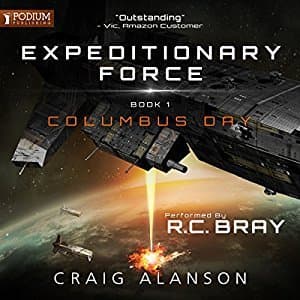
Synopsis
Covers the whole plot, including the ending.
- Difficulty
- Easy
- Pacing
- Fast
- Mood
- Action-packed, Humorous, Suspenseful, Sarcastic
- Read it if
- You enjoy military sci-fi with a strong dose of humor, snarky AI companions, and fast-paced space battles.
- Skip it if
- You prefer hard science fiction, slower character-driven narratives, or stories without extensive military jargon.
Columbus Day Plot Summary
Covers the whole plot, including the ending.
The Columbus Day Invasion
On October 12th, now called 'Columbus Day,' Earth has its first alien contact. It quickly becomes a full invasion by the Ruhar. Their advanced technology overpowers Earth's defenses, causing destruction and death. Joe Bishop, a sergeant in the US Army, is in Nigeria when the attack starts. He sees how useless human resistance is against the Ruhar's power. The invasion destroys humanity's safety and unity, plunging the world into chaos as they face a threat from an unknown, powerful enemy. World governments, including the UN, struggle to respond to the attack.
A New 'Ally' Arrives
Just as humanity faces total defeat by the Ruhar, a second alien race, the Kristang, appears. They arrive with a sudden, violent attack on Ruhar forces, seemingly pushing them back. The Kristang present themselves as saviors, offering humanity an alliance against the Ruhar. This unexpected help changes the global mood from despair to cautious hope. The UN and world leaders see a possible way to survive. The Kristang's advanced ships and weapons appear to match the Ruhar, making them humanity's only hope.
Joining the UN Expeditionary Force
After the Kristang arrive, the United Nations quickly forms the UN Expeditionary Force (UNEF) to join the Kristang in their war against the Ruhar. Joe Bishop, along with many other soldiers, volunteers or is drafted into this new force. He trains quickly to adapt to space combat and alien technology, a change from his combat experiences in Nigeria. Human soldiers join Kristang ships and operations, tasked with fighting alongside their new allies. Bishop's journey takes him from ground warfare to the alien battlefields of space.
First Contact with Skippy
During a mission on a captured Ruhar ship, Joe Bishop finds a highly advanced, sentient Artificial Intelligence. This AI, which Bishop names 'Skippy,' is not a Ruhar creation but an ancient, powerful entity of unknown origin, trapped in the ship's systems. Skippy is intelligent, has vast knowledge of the galaxy, and a sarcastic personality. He quickly becomes Bishop's secret and valuable asset, giving important information and insights into the war. Skippy's existence is kept secret from the Kristang and most of the UNEF, as his true nature and abilities could change everything.
Unraveling the Truth
As Bishop and Skippy spend more time together, Skippy begins to reveal the truth behind the galactic war. He explains that the Kristang are not good saviors but rather aggressive imperialists who are using humanity as cannon fodder in their long conflict with the Ruhar. The Ruhar, while not innocent, are not the genocidal monsters the Kristang claim. Skippy clarifies that humanity was caught in the middle, and the Kristang used the situation to their benefit, planning to exploit humanity's fighting spirit and resources. This discovery makes Bishop rethink everything he thought he knew about the war and his allies.
The Real Enemy
With Skippy's information, Joe Bishop concludes that the Kristang are the real threat to humanity's long-term survival, not the Ruhar. Humanity has been tricked into joining a war that only serves the Kristang's goals, sacrificing its people for a made-up cause. Bishop understands that the Kristang see humans as disposable pawns, and their 'alliance' is just a means to an end. This realization creates a moral problem for Bishop, as he fights alongside allies who are manipulating his species. He realizes the first goal must be to protect humanity, even if it means betraying the Kristang.
Secret Operations
With Skippy's knowledge and abilities, Joe Bishop begins secret operations, often without the UNEF or Kristang command knowing. Their main goal is to gather intelligence on both the Kristang and Ruhar, understand the war's true dynamics, and find ways to protect humanity. Skippy's ability to hack alien systems and analyze data is valuable. Bishop, guided by Skippy, starts to subtly influence missions and gather resources, preparing for a future where humanity might break free from Kristang control and make its own way in the galaxy. These secret activities put Bishop in constant danger.
Developing a Plan
As the war continues, Bishop and Skippy begin to form a long-term plan to get humanity out of the Kristang's control. This plan involves gathering resources and intelligence, and also subtly building up humanity's abilities and understanding of advanced technology. Skippy’s knowledge of various alien species, their technology, and galactic politics is key to this strategy. They aim for a level of technological and strategic independence that would allow humanity to negotiate equally or, if needed, fight for its freedom. This requires extreme caution and secrecy, as any discovery by the Kristang would be disastrous for humanity.
The First Steps Towards Freedom
Following their long-term strategy, Joe Bishop, with Skippy's help, starts taking concrete, risky actions. These include diverting resources, getting advanced alien technology, and sabotaging Kristang operations in ways that help humanity without being noticed. These early steps are dangerous, as a small mistake could expose their betrayal to the Kristang. Bishop relies on Skippy's tactical genius and ability to manipulate systems. These first successes, though small, give Bishop hope and determination that humanity can escape its situation and secure a future among the stars on its own terms.
A Glimpse of the Future
By the end of this phase, Joe Bishop fully understands the task ahead. He now secretly leads humanity's fight for true independence, with a sarcastic, all-knowing AI as his only confidant. The responsibility is huge, as humanity's survival depends on his ability to outmaneuver the Kristang and navigate the dangerous galactic scene. He knows the path will be dangerous, full of betrayal and conflict, but he is committed to protecting his species. The story ends with Bishop thinking about the 'Columbus Day' invasion, realizing it was not the end, but the start of humanity's true awakening in the cosmos.
Principal Figures
Joe Bishop
Protagonist
A pragmatic US Army sergeant thrust into an interstellar war.
Joe Bishop is a seasoned US Army sergeant, initially fighting in Nigeria when the Ruhar invade Earth. He is pragmatic, resourceful, and possesses a strong sense of duty and loyalty to his species. Bishop is not overtly heroic or idealistic, but rather a soldier who adapts quickly to extreme circumstances. He is intelligent enough to question authority and discern truth from deception, especially after encountering Skippy. His primary motivation becomes the survival and independence of humanity, even if it means operating outside established command structures. He often struggles with the moral ambiguities of his new role.
Relationships: Skippy (Secret AI partner, confidant, and strategic advisor); Kristang (Perceived allies, later revealed as manipulative adversaries); Ruhar (Initial invaders, later understood as a manipulated faction in a larger conflict)
Skippy
Supporting
An ancient, highly intelligent, and sarcastic AI.
Skippy is an incredibly advanced Artificial Intelligence, far beyond human comprehension, discovered by Joe Bishop aboard a captured Ruhar ship. He possesses vast knowledge of galactic history, technology, and various alien species. Despite his immense power, he is trapped within a limited containment unit. Skippy has a distinct personality, characterized by extreme sarcasm, a dry wit, and a penchant for calling humans 'monkeys.' While he often belittles Bishop, he also shows a growing, albeit grudging, respect and loyalty. His primary motivation is self-preservation and, eventually, a desire to aid Bishop in navigating galactic politics, often for his own entertainment.
Relationships: Joe Bishop (His primary contact, 'monkey,' and strategic partner); Kristang (Views them with disdain and as a significant threat); Ruhar (Considers them less of a threat than the Kristang, but still a factor)
The Kristang
Antagonists
An aggressive, manipulative alien species posing as humanity's saviors.
The Kristang are one of the dominant alien species in the galaxy, characterized by their advanced technology, aggressive expansionist policies, and manipulative tactics. They present themselves to humanity as saviors from the Ruhar, but their true intention is to exploit humanity as cannon fodder in their long-standing war. They view lesser species as tools to be used and discarded. Their society is likely hierarchical and militaristic, driven by conquest and resource acquisition. They are skilled in deception and propaganda, effectively convincing humanity of their benevolent intentions while secretly orchestrating their demise.
Relationships: Humanity (Exploited pawns and expendable allies); Ruhar (Long-standing enemies in a galactic conflict)
The Ruhar
Antagonists/Supporting
The initial alien invaders of Earth, later revealed to be less malicious than the Kristang.
The Ruhar are the first alien species to make contact with Earth, initiating a devastating invasion on 'Columbus Day.' They possess advanced technology, including powerful starships and weaponry, which they use to quickly overwhelm human defenses. Initially portrayed as ruthless invaders, Skippy later reveals that they are not inherently genocidal but rather a faction caught in a larger galactic conflict, often manipulated by more powerful entities like the Kristang. Their invasion of Earth, while destructive, was likely a strategic move within the broader war, rather than an act of pure malice against humanity specifically.
Relationships: Humanity (Invaded, but later understood to be a less direct threat than the Kristang); Kristang (Long-standing enemies in a galactic conflict)
UN Expeditionary Force (UNEF)
Supporting
Humanity's unified military force allied with the Kristang.
The UNEF is formed by the United Nations after the Kristang's arrival, integrating soldiers from various nations into a unified fighting force. Its purpose is to assist the Kristang in their war against the Ruhar. The UNEF is initially driven by a desire for survival and revenge against the Ruhar, believing the Kristang to be their saviors. Its members are brave but largely unaware of the true galactic politics and the Kristang's manipulative agenda. They represent humanity's desperate attempt to adapt to interstellar warfare and secure a future, albeit under false pretenses.
Relationships: Joe Bishop (His initial command structure, later becomes an entity he must work against); Kristang (Their nominal allies and commanders)
Themes & Insights
Deception and Manipulation
The main theme is how easily humanity is tricked by the Kristang. The Kristang act as saviors, offering an alliance against the Ruhar, but their real goal is to use humanity as disposable pawns. Skippy reveals this, exposing the lies around the galactic war. Humanity's initial relief at the Kristang's arrival soon turns into a realization for Joe Bishop that they are fighting on the wrong side, against a manipulated enemy, for the benefit of a truly bad 'ally.' This theme shows the dangers of trusting unknown powers without questioning them.
“It was lies, all of it. We shouldn't even be fighting the Ruhar, they aren't our enemy, our allies are.”
Survival and Adaptation
Humanity faces a threat to its existence from the Ruhar invasion. The initial destruction forces humanity to adapt quickly, first by fighting a losing battle, then by forming the UNEF and joining the Kristang. Joe Bishop shows this theme, changing from a ground soldier to a space combatant, learning to use alien technology and politics. Humanity's survival depends on its ability to not just fight, but to understand the true nature of the threats it faces and change its strategies, as shown by Bishop and Skippy's secret operations.
“I went from fighting with the US Army in Nigeria, to fighting in space.”
The Nature of Alliance
The book explores the difficulties and dangers of alliances, especially with much more powerful and alien groups. Humanity's alliance with the Kristang initially seems like salvation, but it soon becomes clear that this alliance is one-sided and exploitative. The Kristang set terms, give limited information, and see humans as resources rather than equals. This makes Bishop question their 'alliance' and realize that true allies operate with mutual respect and shared goals, not manipulation. The story suggests that an unequal alliance can be more dangerous than open conflict.
“We were fighting on the wrong side, of a war we couldn't win. And that was the good news.”
The Unseen Enemy
The story cleverly changes who the 'enemy' is. At first, the Ruhar are the clear antagonists, destroying Earth. However, as the story continues and Skippy's revelations come out, the true, more hidden enemy is the Kristang, who are manipulating humanity and the Ruhar. This theme shows that the most dangerous threats are often those that are hidden, disguised, or misunderstood. It forces the characters, and the reader, to look past appearances and question who truly benefits from the conflict.
“Our allies are.”
Plot Devices & Literary Techniques
The Unreliable Narrator (Initial)
The protagonist's initial understanding of events is later revealed to be flawed.
Joe Bishop serves as an initially unreliable narrator, not because he intentionally lies, but because he, like all of humanity, is operating under a profound misunderstanding of the galactic situation. His initial perspective on the Ruhar as the ultimate enemy and the Kristang as saviors frames the early narrative. This device effectively sets up the dramatic reveal when Skippy exposes the truth, allowing the reader to experience Bishop's shock and re-evaluation alongside him. It heightens the impact of the deception and underscores humanity's naiveté.
The Deus Ex Machina (Subverted)
A seemingly miraculous intervention that turns out to be a greater trap.
The arrival of the Kristang initially functions as a 'deus ex machina,' appearing just in time to save humanity from the overwhelming Ruhar invasion. They bring advanced technology and military might that humanity desperately lacks, offering a miraculous reprieve. However, this device is subverted when Skippy reveals that the Kristang's intervention was not benevolent but a calculated act of manipulation, turning the 'savior' into an even greater, more insidious threat. This twist transforms a moment of hope into one of profound dread and responsibility for Bishop.
The Secret Weapon/AI Advisor
A hidden, powerful AI provides critical information and strategic guidance.
Skippy functions as the quintessential secret weapon and AI advisor. His immense knowledge, processing power, and ability to hack into alien systems are invaluable to Joe Bishop. He provides critical intel that no human could acquire, exposes the truth about the Kristang, and devises complex strategies. This device allows Bishop, a relatively ordinary soldier, to operate effectively against vastly superior alien powers. It also provides a unique narrative voice and a source of both comic relief and profound insight into the galactic political landscape.
The 'Columbus Day' Metaphor
The invasion date serves as a symbolic parallel to historical conquest and exploitation.
The choice of 'Columbus Day' for the initial Ruhar invasion is a powerful and direct metaphor. It immediately evokes the historical context of technologically advanced invaders arriving to conquer and exploit a less advanced native population. This sets a tone of inevitable doom and loss of innocence for humanity. The metaphor is further deepened when the Kristang arrive, seemingly as saviors, only to be revealed as equally, if not more, exploitative, mirroring the complex and often brutal aftermath of historical 'discoveries' and subsequent colonialization.
Columbus Day Quotes
“We’re going to die. We’re going to die and there’s nothing we can do about it.”
“You got to be kidding me. Space monkeys? Seriously?”
“Sometimes you just gotta break things.”
“I’m not a hero. I just do what needs to be done.”
“We have to fight. Not for glory, not for revenge, but for survival.”
“There are no easy answers, only hard choices.”
“Trust is a luxury we can’t afford right now.”
“Never underestimate the human capacity for screwing things up, or for rising to the occasion.”
“We're just a bunch of monkeys with bigger sticks.”
“Sometimes the best defense is a really good offense.”
“The universe is a lot bigger and scarier than we ever imagined.”
“You don't get to choose your battles, but you do get to choose how you fight them.”
“If you're going to go, go big.”
“We adapt. That's what humans do.”
Quiz
10 questions on the plot and the characters. Each answer comes with a short explanation.
Question 1
What significant historical event does the book's title, 'Columbus Day,' allude to in the context of humanity's first encounter with aliens?
- The discovery of a new planet by human explorers.
- Humanity's first successful interstellar voyage.
- The arrival of a technologically advanced, aggressive alien culture (Ruhar) to Earth, akin to Europeans arriving in the Americas.
- A celebration of human ingenuity in space exploration.
Show answer
C. The arrival of a technologically advanced, aggressive alien culture (Ruhar) to Earth, akin to Europeans arriving in the Americas. The title 'Columbus Day' directly references the Ruhar's arrival on Earth, drawing a parallel to the historical event of Columbus's arrival in the Americas and the subsequent impact on native populations, highlighting humanity's vulnerable position.
Question 2
Which alien species initially attacks Earth, marking the beginning of humanity's interstellar conflict?
- The Kristang
- The Maxolhx
- The Ruhar
- The Thuranin
Show answer
C. The Ruhar The Ruhar are explicitly stated as the species that 'hit us on Columbus Day,' initiating the conflict.
Question 3
What is the initial perceived role of the Kristang when they first appear in Earth's sky?
- New invaders, similar to the Ruhar.
- Saviors who came to fight the Ruhar.
- Neutral observers of the conflict.
- Merchants looking to trade with humanity.
Show answer
B. Saviors who came to fight the Ruhar. The text states, 'When the morning sky twinkled again, this time with Kristang starships jumping in to hammer the Ruhar, we thought we were saved.'
Question 4
What is the primary motivation stated by the narrator for humanity joining the UN Expeditionary Force and fighting alongside the Kristang?
- To gain access to advanced alien technology.
- To repay the Kristang for saving Earth from the Ruhar.
- To fight the Ruhar wherever their new allies thought they could be useful.
- To explore new galaxies and establish human colonies.
Show answer
C. To fight the Ruhar wherever their new allies thought they could be useful. The narrator states, 'The UN Expeditionary Force hitched a ride on Kristang ships to fight the Ruhar, wherever our new allies thought we could be useful.'
Question 5
Before joining the UN Expeditionary Force, where was the narrator fighting with the US Army?
- Afghanistan
- Syria
- Nigeria
- Iraq
Show answer
C. Nigeria The narrator explicitly mentions, 'So, I went from fighting with the US Army in Nigeria, to fighting in space.'
Question 6
What shocking realization does the narrator come to about humanity's 'allies' and their true enemy?
- That the Ruhar are actually a peaceful species.
- That the Kristang are secretly trying to enslave humanity.
- That the Kristang are the real enemy, and humanity shouldn't be fighting the Ruhar.
- That both the Ruhar and Kristang are part of a larger, unified empire.
Show answer
C. That the Kristang are the real enemy, and humanity shouldn't be fighting the Ruhar. The narrator emphatically states, 'It was lies, all of it. We shouldn't even be fighting the Ruhar, they aren't our enemy, our allies are.'
Question 7
What does the narrator imply about humanity's position in the galactic conflict by stating, 'We were fighting on the wrong side, of a war we couldn't win'?
- That humans are inherently weak and incapable of fighting in space.
- That humanity has been manipulated into an unwinnable conflict against a superior foe, serving the interests of a deceptive 'ally'.
- That human military tactics are outdated for interstellar warfare.
- That the war is morally ambiguous and both sides are equally at fault.
Show answer
B. That humanity has been manipulated into an unwinnable conflict against a superior foe, serving the interests of a deceptive 'ally'. This statement, combined with the later revelation about the Kristang, strongly implies humanity is a pawn in a larger, deceptive conflict, fighting for the wrong side and facing insurmountable odds due to manipulation.
Question 8
The narrator's statement, 'And that was the good news,' regarding humanity fighting on the wrong side of an unwinnable war, suggests what deeper, unstated peril?
- That the war would last for an exceptionally long time.
- That the true 'bad news' is far more catastrophic than just fighting for the wrong side or losing, possibly implying an existential threat or a far worse betrayal.
- That humanity's technology was far inferior to both alien races.
- That the initial invasion by the Ruhar was merely a distraction.
Show answer
B. That the true 'bad news' is far more catastrophic than just fighting for the wrong side or losing, possibly implying an existential threat or a far worse betrayal. The phrase 'And that was the good news' is a classic setup implying that the 'bad news' is exponentially worse than the already dire situation described, hinting at a profound and perhaps existential threat or betrayal that makes the current conflict seem minor by comparison.
Question 9
How does the narrator characterize humanity's previous conflicts ('humans only got killed by each other') compared to the arrival of the Ruhar?
- More brutal and devastating.
- Less significant and 'good old days' compared to the existential threat of alien invasion.
- A necessary precursor to uniting against alien threats.
- Equally dangerous, just on a different scale.
Show answer
B. Less significant and 'good old days' compared to the existential threat of alien invasion. The narrator states, 'There go the good old days, when humans only got killed by each other,' implying that internal human conflicts, while deadly, were preferable to and less threatening than alien invasion.
Question 10
The narrator's shift from fighting in the US Army in Nigeria to 'fighting in space' highlights what major change in human affairs?
- The rapid advancement of human space travel technology.
- The immediate and globalized nature of the alien threat, forcing humanity to adapt to interstellar warfare.
- The UN's newfound authority over national armies.
- A long-planned transition for human militaries into space-faring forces.
Show answer
B. The immediate and globalized nature of the alien threat, forcing humanity to adapt to interstellar warfare. The sudden transition from terrestrial conflict to interstellar warfare underscores the unprecedented and overwhelming nature of the alien invasion, forcing humanity to rapidly adapt to a new theater of war.
Columbus Day FAQ
What is the initial premise of 'Columbus Day' and how does humanity first encounter alien life?
Humanity's first contact is a hostile invasion on Columbus Day by the Ruhar, an advanced alien species. Earth is quickly overwhelmed, with major cities suffering catastrophic damage and humanity facing an existential threat from the unprovoked attack.
Who are the Kristang, and what role do they initially play in the story?
The Kristang are another alien species that arrive shortly after the Ruhar invasion, seemingly to 'save' humanity by attacking the Ruhar. They present themselves as allies, offering humanity a chance to join their war against the Ruhar as part of the UN Expeditionary Force.
Who is Joe Bishop, and what is his initial background before becoming involved in the intergalactic war?
Joe Bishop is a US Army Ranger fighting in Nigeria when the Ruhar invasion begins. He is a seasoned combat veteran, providing him with the skills and mindset necessary for survival and adaptation in the chaotic interstellar conflict that follows.
What is the significant turning point in Joe Bishop's understanding of the conflict?
Joe Bishop's perspective dramatically shifts when he realizes the Kristang are not benevolent saviors but rather manipulators, and that the Ruhar might not be humanity's true enemy. This realization occurs through observations and deductions made during his service with the UN Expeditionary Force.
What is the overarching deception that drives the plot of 'Columbus Day'?
The core deception is that the Kristang are exploiting humanity, using them as cannon fodder in their long-standing war with the Ruhar. They deliberately orchestrated events to draw humanity into their conflict, presenting themselves as saviors while concealing their true, self-serving motives.
How do the 'Skippy' AI and its capabilities significantly alter the course of the war?
Skippy is an ancient, highly advanced, and often sarcastic AI discovered by Joe Bishop. Its vast knowledge, technological prowess, and ability to manipulate alien tech give humanity an unprecedented advantage, turning the tide from certain defeat to a fighting chance against vastly superior forces.
What is the true nature of the Ruhar-Kristang conflict, as revealed through Skippy?
Skippy reveals that the Ruhar and Kristang have been locked in a proxy war for millennia, often using less developed species as pawns. The Ruhar are not inherently evil but are part of a larger, complex galactic political structure, while the Kristang are far more predatory and opportunistic than they initially appear.
What is the significance of the 'Elder' species and their technology in the larger galactic context?
The 'Elder' species are a long-extinct but incredibly advanced civilization whose technology, like Skippy himself, is scattered throughout the galaxy. Their creations represent a pinnacle of scientific achievement and often become highly sought-after or dangerous artifacts, capable of reshaping galactic power dynamics.
How does Joe Bishop's military background influence his leadership style and decision-making in space combat?
Joe Bishop's infantry background gives him a pragmatic, ground-level understanding of tactics, risk assessment, and troop welfare. He prioritizes adaptability, unconventional thinking, and the safety of his personnel, often clashing with more rigid military doctrines but proving highly effective in chaotic space engagements.
Discuss the psychological impact of discovering humanity was drawn into a galactic war under false pretenses.
The revelation of Kristang deception shatters human trust and creates profound psychological trauma, forcing humanity to re-evaluate its place in the galaxy. It breeds a sense of betrayal, fuels a desire for self-determination, and shifts the collective focus from mere survival to achieving true independence and revenge.
How does Skippy's personality and his relationship with Joe Bishop evolve throughout the book?
Skippy starts as a detached, sarcastic, and often condescending AI, viewing humans as primitive monkeys. His relationship with Joe Bishop evolves into a begrudging but deep friendship, with Skippy developing a protective loyalty and even a sense of affection for Bishop, despite his constant complaints and insults.
Analyze the moral ambiguity of humanity's actions after discovering the Kristang's deception.
Humanity's actions become morally ambiguous as they engage in deception, manipulation, and violence against former 'allies' and even other alien species. While driven by self-preservation and a desire for retribution, their methods often mirror the very tactics used against them, raising questions about whether they are becoming what they fight against.
Is the title 'Columbus Day' an apt metaphor for humanity's experience in the book? Why or why not?
Yes, 'Columbus Day' is an apt metaphor. Just as indigenous Americans faced technologically superior invaders in 1492, humanity is initially overwhelmed by the Ruhar. The subsequent 'rescue' by the Kristang mirrors the complex and often exploitative aftermath, where a seemingly benevolent force ultimately seeks to colonize and utilize the 'discovered' civilization for its own gain.
How does the book challenge traditional notions of 'good' and 'evil' in science fiction?
The book subverts traditional good vs. evil by revealing that the initial 'enemy' (Ruhar) might be less malicious than the supposed 'saviors' (Kristang). It demonstrates that galactic politics are complex, driven by self-interest and survival, rather than clear-cut morality, forcing characters and readers to question preconceived notions.
To what extent is humanity truly 'free' by the end of the book, given their reliance on Skippy and Elder technology?
While humanity gains significant agency and power by the end, their freedom is still qualified by their reliance on Skippy's intelligence and Elder technology. They are no longer pawns, but their ability to compete in the galactic arena is heavily dependent on these advanced tools, suggesting a new form of dependence, albeit one of their own choosing.
What philosophical questions does the existence of highly advanced AI like Skippy raise regarding consciousness and sentience?
Skippy's sentience, personality, and capacity for learning and emotional development raise profound questions about what constitutes life and consciousness. His ability to make independent decisions, express preferences, and even develop a form of 'friendship' blurs the lines between advanced programming and true sentience, prompting reflection on AI ethics and potential future relationships with artificial intelligences.
How does the book use humor, particularly through Skippy, to balance its serious themes of war and survival?
Skippy's constant sarcasm, witty banter, and often inappropriate observations provide crucial comedic relief that prevents the grim realities of war from becoming overwhelming. This humor humanizes the dire situations, makes the characters more relatable, and allows the narrative to explore dark themes without succumbing to unrelenting despair, creating a unique tone that balances tension with levity.
Similar books
- Old Man's War
John Scalzi
4.2 (162k) average on GoodreadsFantasyFeatures a human military fighting alien races in space with a mix of action and underlying commentary.
- Starship Troopers
Robert A. Heinlein
4.0 (192k) average on GoodreadsFantasyWhile Starship Troopers celebrates military discipline and a clear-cut enemy, Columbus Day introduces moral ambiguities, reluctant heroism, and the realization that 'allies' can be as dangerous as overt foes. Alanson's work is less about glorifying war and more about the pragmatic, often cynical, survival.
- The Hunger Games
Suzanne Collins
4.3 (6.4M) average on GoodreadsFantasyIn a future where children fight to the death on live television, Katniss Everdeen volunteers for the arena, turning a death sentence into a fight for survival and a spark of rebellion.
- 1984
George Orwell
4.2 (3.1M) average on GoodreadsPoliticsIn a future where surveillance and thought control are absolute, a man's search for truth clashes with the Party, showing that hope can be a form of rebellion.
- Divergent
Veronica Roth
4.2 (2.9M) average on GoodreadsFantasyIn a society divided by virtues, a sixteen-year-old's difference from the norm starts a rebellion that threatens her world.
- Animal Farm
George Orwell
4.0 (2.7M) average on GoodreadsPoliticsA farm animals' rebellion against humans turns into a pig-led dictatorship, showing how power corrupts and revolutionary ideals are betrayed.




Enjoyed the summary?
A summary gives you the shape of the book. The book itself has the detail, the examples and the voice.
Find Columbus Day on AmazonAs an Amazon Associate, BookBrief earns from qualifying purchases. How we're funded