
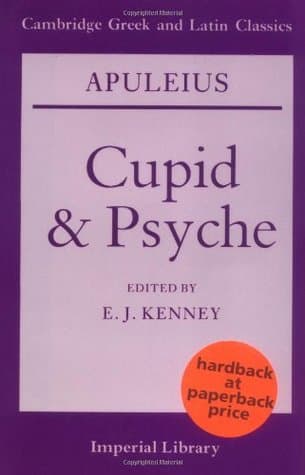
Synopsis
Covers the whole plot, including the ending.
- Difficulty
- Medium
- Pacing
- Moderate
- Mood
- Mythical, Romantic, Allegorical, Adventurous
- Read it if
- You enjoy ancient myths, allegorical tales, or stories of love, perseverance, and transformation.
- Skip it if
- You prefer modern narrative structures or find classical allegories too abstract.
Cupid and Psyche Plot Summary
Covers the whole plot, including the ending.
The Envy of Venus
In a certain city, a king and queen have three daughters, the youngest and most beautiful of whom is Psyche. Her beauty is so extraordinary that mortals begin to worship her as a new Venus, neglecting the altars of the true goddess. This angers Venus, who feels her divine honor is taken by a mortal girl. Consumed by jealousy, Venus calls her son, Cupid, the god of love, and commands him to use his arrows to make Psyche fall in love with the most hideous creature imaginable, humiliating her and restoring Venus's supremacy. Cupid, however, is secretly moved by Psyche's innocence and beauty.
The Oracle and the Prophecy
Despite Psyche's beauty, she remains unwed, while her two elder sisters, though less beautiful, find royal husbands. Her parents, distressed by her solitude and fearing divine displeasure, consult the Oracle of Apollo at Miletus. The oracle delivers a terrifying prophecy: Psyche is to marry not a mortal man, but a monstrous, serpent-like creature, feared by gods and men alike. She is to be adorned in bridal attire and left on a desolate mountaintop to await her fated husband. The city mourns, believing Psyche is being sacrificed to a terrible fate.
Abduction by Zephyr and the Invisible Palace
Following the oracle's decree, Psyche is led in a funereal procession, dressed as a bride for death, to the designated mountaintop. Her parents and the people weep, believing her doomed. As she stands alone, weeping and terrified, the gentle West Wind, Zephyr, lifts her tenderly from the peak and carries her down into a beautiful, green valley. There, she finds a magnificent palace, made not of stone but of light and sound, seemingly built by divine hands. Invisible servants attend to her every need, and an unseen voice welcomes her as the mistress of the house, promising her a husband who will come only in the darkness of night.
The Nocturnal Husband
In the magnificent palace, Psyche is treated like a queen, waited on by unseen hands and serenaded by invisible choirs. Each night, in the complete darkness, her mysterious husband arrives. He is loving, gentle, and passionate, but strictly forbids her from ever trying to see his face. He warns her that if she attempts to discover his identity, all their happiness will be destroyed, and she will be separated from him forever. Despite his warnings and her growing affection for him, Psyche is filled with human curiosity and a nagging fear of his unknown nature, especially as she begins to suspect she is pregnant.
The Sisters' Malice
Psyche, feeling lonely despite her luxurious life, wants to see her family. Her husband, against his better judgment, allows Zephyr to bring her sisters to visit. Upon seeing Psyche's opulent palace and divine wealth, her sisters are consumed by bitter envy, disguised as concern. They question her husband's identity, suggesting he is the monstrous serpent foretold by the oracle, who will devour her and her unborn child. They urge her to defy his command, insisting she must see his face to confirm his true nature, giving her a lamp and a razor to kill the monster.
The Betrayal and Flight of Cupid
Tormented by her sisters' words, Psyche gives in to doubt. That night, after her husband has fallen asleep, she lights a lamp and approaches his bed. Instead of a monster, she sees the beautiful, winged god Cupid himself, arrows and quiver by his side. Startled by his divine beauty, she accidentally pricks herself with one of his arrows, falling instantly and irrevocably in love. A drop of oil from the lamp falls onto Cupid's shoulder, waking him. Disappointed and heartbroken by her betrayal of his trust, Cupid flies away without a word, leaving Psyche alone and desolate in the now-empty palace.
Psyche's Wanderings and Venus's Wrath
Devastated by Cupid's departure, Psyche wanders the earth, searching for her lost love. Meanwhile, Cupid, wounded and angry, returns to his mother, Venus. When Venus discovers that Cupid has not only disobeyed her command but has also fallen in love with Psyche and married her, she is enraged. She vows to punish Psyche severely for daring to love a god and for taking her beauty. Venus actively hunts Psyche down, while Psyche, desperate, eventually surrenders herself to the goddess, hoping to appease her and perhaps find a path back to Cupid.
The Four Impossible Tasks
Venus, holding Psyche captive, subjects her to four seemingly impossible tasks, each designed to break her spirit and ensure her demise. First, Psyche must sort a massive heap of mixed grains (wheat, barley, millet, poppy seeds, lentils, beans) before nightfall. Second, she must retrieve golden fleece from fierce, man-eating sheep. Third, she must collect water from the inaccessible and dangerous source of the Styx and Cocytus rivers. Finally, she must descend into the Underworld to retrieve a box of Proserpina's beauty ointment.
Divine and Natural Aid
Despite the impossibility of the tasks, Psyche receives unexpected aid. For the first task, a colony of ants, pitying her, sorts the grains for her. For the golden fleece, a green reed advises her to wait until the sheep are tangled in thorny bushes. An eagle, sent by Jupiter at Cupid's plea, collects the Styx water for her. For the Underworld task, a tower provides detailed instructions on how to navigate the realm of the dead, avoid its dangers, and appease its guardians, including Charon and Cerberus, warning her specifically not to open Proserpina's box.
The Final Temptation and Cupid's Intervention
Having successfully completed the perilous journey to the Underworld and retrieved Proserpina's beauty ointment, Psyche, on her way back, gives in to one last temptation. She believes that if she applies some of the divine beauty herself, she might regain Cupid's favor. Disobeying the tower's warning, she opens the box, but instead of ointment, it contains a Stygian sleep that instantly overcomes her. Cupid, now recovered from his wound and desperate to save his beloved, flies to her, awakens her from her slumber, and closes the box.
Plea to Jupiter and Divine Union
After reviving Psyche, Cupid flies to Mount Olympus and appeals to Jupiter, the king of the gods, for help. He passionately recounts his love for Psyche and the trials she has endured. Jupiter, moved by Cupid's plea and perhaps weary of Venus's relentless cruelty, agrees to intervene. He summons a council of the gods, including Venus, and declares that Psyche has proven herself worthy of divine status. To make their union legitimate and eternal, Jupiter offers Psyche a cup of ambrosia, the food of the gods, which instantly bestows immortality upon her.
The Birth of Pleasure
With Jupiter's decree, Venus is finally placated, as Psyche is now a goddess and no longer a rival mortal. Psyche and Cupid are formally married in a grand ceremony on Mount Olympus, attended by all the gods. Apollo plays the lyre, the Muses sing, and Bacchus provides wine. In due course, Psyche gives birth to a daughter, whom they name Voluptas, meaning Pleasure or Delight. Thus, the story concludes with the triumph of love, perseverance, and the ultimate union of the Soul (Psyche) with Love (Cupid), resulting in enduring happiness and bliss.
Principal Figures
Psyche
Protagonist
A mortal princess of unparalleled beauty, destined to become a goddess.
Psyche is initially portrayed as a beautiful but passive figure, adored by mortals but isolated by her divine-like beauty. She is innocent and trusting but also susceptible to curiosity and doubt, particularly when influenced by her envious sisters. Her journey transforms her from a fearful girl into a courageous, resilient woman who endures immense suffering and performs impossible tasks out of love. She represents the human soul's quest for true happiness and union with the divine, overcoming trials through perseverance and external aid.
Relationships: Cupid (Husband and true love, initially unseen and later sought after.); Venus (Cruel mother-in-law and tormentor.); Her Sisters (Envious and manipulative, leading her to betray Cupid.); Jupiter (Ultimate savior and bestower of immortality.)
Cupid (Eros)
Deuteragonist
The god of love, son of Venus, who falls in love with Psyche.
Cupid is a mischievous but ultimately loving god. Initially tasked by his mother, Venus, to make Psyche fall in love with a monster, he accidentally pricks himself with his own arrow and falls deeply in love with her instead. He is protective and tender towards Psyche but also prone to anger and heartbreak when his trust is betrayed. His actions, both in secret marriage and later in appealing to Jupiter, demonstrate his profound devotion and willingness to defy his mother for love. He represents divine love and passion.
Relationships: Psyche (Wife and true love.); Venus (Mother, whose commands he defies for Psyche.); Jupiter (Father figure who ultimately aids him.)
Venus (Aphrodite)
Antagonist
The goddess of beauty and love, consumed by jealousy of Psyche.
Venus is portrayed as vain, cruel, and vindictive. Her primary motivation is her overwhelming jealousy of Psyche's mortal beauty, which she perceives as a direct threat to her divine status and worship. She uses her power to inflict immense suffering upon Psyche, setting impossible tasks and delighting in her torment. Her character embodies the destructive and possessive aspects of love and beauty, highlighting how envy can corrupt even a goddess. She is a formidable obstacle, representing the trials and tribulations that the soul must overcome.
Relationships: Psyche (Rival and tormentor, later grudgingly accepts her as daughter-in-law.); Cupid (Son, whom she attempts to control and punish for his disobedience.)
Psyche's Sisters
Supporting/Minor Antagonists
Envious and manipulative, they incite Psyche's betrayal.
Psyche's two elder sisters are depicted as deeply envious and malicious. Despite their initial display of sisterly affection, they are quick to jealousy upon witnessing Psyche's luxurious life. They manipulate Psyche with false concern and fear-mongering, planting the seeds of doubt about her unseen husband's true nature. Their actions directly lead to Psyche's betrayal of Cupid, demonstrating the destructive power of envy and the dangers of bad counsel. They ultimately meet unfortunate ends due to their greed.
Relationships: Psyche (Sisters, whom they envy and betray.)
Jupiter (Zeus)
Supporting
King of the gods, who ultimately intervenes to resolve the conflict.
Jupiter is the supreme ruler of Mount Olympus. He initially remains somewhat distant but is eventually moved by Cupid's sincere plea and the suffering Psyche has endured. He acts as the ultimate arbiter of justice and order among the gods, using his authority to overrule Venus's wrath and legitimize Cupid and Psyche's union. His intervention signifies the triumph of true love and perseverance, bringing about divine resolution and bestowing immortality upon Psyche. He represents divine power and ultimate authority.
Relationships: Cupid (Aids him by granting his request.); Venus (Overrules her objections.)
Zephyr
Supporting
The gentle West Wind, who transports Psyche.
Zephyr is a benevolent force in the story, acting as a divine messenger and helper. He gently carries Psyche from the mountaintop to Cupid's palace and later brings her sisters for a visit. His actions are always in service of facilitating Cupid's wishes and providing comfort to Psyche, highlighting the sympathetic elements of nature. He represents the helpful, unseen forces that guide and protect the innocent.
Relationships: Psyche (Transports her to and from the palace.); Cupid (Serves his will.)
Voluptas (Pleasure)
Mentioned
The daughter of Cupid and Psyche.
Voluptas, meaning 'Pleasure' or 'Delight', is the child born to Cupid and Psyche after their divine marriage. Her birth symbolizes the ultimate outcome of the union between Love (Cupid) and the Soul (Psyche) – true and lasting happiness. She represents the fruit of their trials and the culmination of their journey, solidifying their eternal bliss.
Relationships: Cupid (Father.); Psyche (Mother.)
Proserpina (Persephone)
Mentioned
Queen of the Underworld, whose beauty ointment Psyche must retrieve.
Proserpina is the queen of the Underworld and Hades' wife. She is central to Psyche's final, most perilous task, as Psyche must retrieve a box of her beauty ointment. While she does not appear directly, her presence is significant as the target of Venus's demand, underscoring the extreme nature of the final trial and the dangers of the Underworld. Her 'beauty' is a symbolic prize that Venus maliciously seeks to deny Psyche.
Relationships: Hades (Husband and King of the Underworld.)
Themes & Insights
The Soul's Journey (Allegory)
The story of Cupid and Psyche is an allegory for the human soul's (Psyche, from the Greek word for soul) journey through suffering, temptation, and purification to achieve divine love and immortality. Psyche's initial isolation, her descent into trials, and her eventual ascension to Olympus mirror the soul's path to enlightenment and union with the divine. Her trials, set by Venus, symbolize the purification process required to shed mortal imperfections and achieve spiritual growth. For example, the task of sorting grains represents the soul's need to distinguish between good and evil, while the journey to the Underworld signifies confronting one's deepest fears and mortality.
“Thus, the Soul, after so many labours and sufferings, finally finds rest and joy in the arms of Love.”
Love and Trust
Central to the narrative is the exploration of love in its various forms: passionate, jealous, and enduring. Cupid and Psyche's relationship highlights the importance of trust and faith in love. Cupid's initial demand for unseen love tests Psyche's ability to trust beyond appearances. Her betrayal, prompted by her sisters' malicious doubts, shatters this trust and leads to immense suffering. The subsequent trials become a test for Psyche to prove her unwavering love and dedication, ultimately earning back Cupid's trust and solidifying their bond. This theme emphasizes that true love requires blind faith and perseverance through adversity.
“Oh, most simple Psyche, didst thou not remember the warnings of thy husband?”
Envy and Jealousy
Envy is a destructive force throughout the story, driving much of the conflict. Venus's jealousy of Psyche's mortal beauty starts the entire plot, leading her to inflict cruel punishments. Similarly, Psyche's sisters are consumed by envy upon seeing her luxurious palace, leading them to manipulate and betray her. Their malicious advice directly causes Psyche's separation from Cupid. This theme illustrates how envy can corrupt individuals, lead to deceitful actions, and cause immense suffering for both the perpetrator and the victim, highlighting the dangers of unchecked desire and comparison.
“And now, through the envy of her sisters, Psyche was driven to the very edge of ruin.”
Perseverance and Resilience
Psyche's journey shows the power of perseverance and resilience in the face of overwhelming adversity. Despite being a mortal girl subjected to the wrath of a goddess and set impossible tasks, Psyche never gives up hope of reuniting with Cupid. Her willingness to endure suffering, humiliation, and even a journey to the Underworld shows her unwavering determination. Each time she faces an insurmountable challenge, she finds a way, often with the help of external forces, to overcome it, emphasizing the idea that steadfastness and hope can conquer even the most formidable obstacles.
“And Psyche, though weary and despairing, did not cease her search for her beloved.”
Plot Devices & Literary Techniques
The Oracle's Prophecy
A divine prediction that sets the initial tragic stage for Psyche's fate.
The Oracle of Apollo delivers a prophecy that Psyche is destined to marry a monstrous, serpent-like creature. This device creates immediate tension and foreboding, setting in motion the events that lead Psyche to Cupid's palace. It also serves as a crucial piece of misinformation, as the 'monster' is actually the beautiful Cupid. The prophecy cleverly builds suspense and justifies Psyche's initial fear of her unseen husband, making her subsequent betrayal more understandable, yet tragic.
Deus ex Machina
Divine intervention by gods or natural forces to resolve seemingly impossible situations.
Throughout Psyche's trials, she receives timely and often miraculous help from various sources: ants sort grains, a reed advises on the golden fleece, an eagle retrieves Styx water, and a tower provides instructions for the Underworld. Finally, Cupid and Jupiter intervene directly to save her and grant her immortality. This device highlights the benevolent aspects of the divine world and emphasizes that the soul, though it must strive, is not alone in its journey, often receiving grace or aid when at its lowest point. It also ensures a happy, fantastical resolution.
Forbidden Knowledge/Taboo
A rule or secret that, if broken, leads to dire consequences.
Cupid's strict command that Psyche must never look upon his face is the central taboo of their relationship. The breaking of this taboo, driven by curiosity and her sisters' manipulation, directly leads to their separation and Psyche's subsequent suffering. This device explores themes of trust, obedience, and the consequences of violating sacred boundaries. It also serves to heighten the emotional impact of their separation, as it was a self-inflicted wound, and underscores the idea that certain truths are not meant to be known prematurely.
Symbolism (Psyche as the Soul)
The allegorical representation of Psyche's name and journey.
The name 'Psyche' itself, meaning 'soul' or 'breath' in Greek, is a powerful symbolic device. Her entire journey—from mortal beauty to suffering, purification, and eventual immortal union with Love (Cupid)—is an allegory for the human soul's quest for fulfillment and divine connection. Her trials represent the challenges and temptations the soul faces, while her ultimate apotheosis signifies the soul's potential for spiritual transcendence and eternal happiness. This symbolism elevates the fairy tale into a profound philosophical and religious narrative.
Cupid and Psyche Quotes
“For you, O Psyche, I fear the worst, for you are mortal, and your beauty is beyond all measure.”
“There is no joy in the world, no pleasure, no delight, if you are not there.”
“Love cannot exist without trust.”
“For what is life, if not a series of trials and tribulations to be overcome?”
“But the greatest love is that which transcends all obstacles, all fears, all doubts.”
“Even the gods themselves are subject to the whims of fate.”
“Beauty without virtue is like a flower without fragrance.”
“Do not despise the humblest of creatures, for they may hold the key to your salvation.”
“The heart, when truly touched by love, finds strength it never knew it possessed.”
“And so, from the ashes of despair, new hope was born.”
“For those who seek with a pure heart, the path will always be revealed.”
“Love, like a flame, can be rekindled, even after being extinguished.”
“Happiness is not a destination, but a journey, filled with both joy and sorrow.”
“The greatest magic lies within the human spirit, capable of enduring all things for love.”
“And thus, a mortal became immortal, by the power of love itself.”
Quiz
10 questions on the plot and the characters. Each answer comes with a short explanation.
Question 1
What is the primary reason Venus becomes jealous of Psyche?
- Psyche refuses to worship Venus.
- Men begin to worship Psyche's beauty instead of Venus's.
- Psyche claims to be more powerful than Venus.
- Psyche steals one of Venus's sacred doves.
Show answer
B. Men begin to worship Psyche's beauty instead of Venus's. Venus becomes jealous because Psyche's extraordinary beauty causes mortals to neglect Venus's altars and worship Psyche as a new goddess.
Question 2
What task does Venus initially order Cupid to perform concerning Psyche?
- To make Psyche fall in love with a noble prince.
- To make Psyche fall in love with a monstrous creature.
- To make Psyche fall in love with Venus herself.
- To make Psyche forget her own beauty.
Show answer
B. To make Psyche fall in love with a monstrous creature. Venus, in her anger, commands her son Cupid to make Psyche fall in love with the most vile and abject of creatures.
Question 3
How does Psyche discover the identity of her mysterious husband?
- He reveals himself to her during the day.
- Her sisters tell her his name.
- She lights a lamp and sees him while he sleeps.
- A dream reveals his divine nature.
Show answer
C. She lights a lamp and sees him while he sleeps. Persuaded by her jealous sisters, Psyche lights a lamp while her husband sleeps, intending to see the 'monster' they described, and instead discovers Cupid.
Question 4
What happens immediately after Psyche sees her husband's true form?
- He embraces her and forgives her curiosity.
- He wakes, is burned by a drop of oil, and flies away.
- He turns into a monstrous serpent.
- She is instantly turned to stone by his divine power.
Show answer
B. He wakes, is burned by a drop of oil, and flies away. A drop of hot oil from Psyche's lamp falls on Cupid's shoulder, waking him. He sees her betrayal and immediately flies away.
Question 5
Which deity offers Psyche advice and assistance during her trials, despite Venus's wrath?
- Juno
- Ceres
- Minerva
- Diana
Show answer
B. Ceres While many gods refuse to help Psyche directly out of fear of Venus, Ceres (and Juno) offer her some comfort and advice, though they cannot defy Venus openly.
Question 6
What is the third impossible task Venus assigns Psyche?
- To separate a pile of mixed grains.
- To fetch golden fleece from ferocious sheep.
- To collect water from a dangerous mountain spring.
- To retrieve a box of Proserpina's beauty.
Show answer
B. To fetch golden fleece from ferocious sheep. The third task is to collect golden wool from violent, man-eating sheep. Psyche is advised by a talking reed to wait until the sheep rub their wool on bushes and then collect it.
Question 7
What is the symbolic meaning of Psyche's name in Greek?
- Beauty
- Love
- Soul
- Heart
Show answer
C. Soul The name 'Psyche' means 'soul' in Greek, which is central to the allegorical interpretation of the story as the soul's journey to find happiness and fulfillment.
Question 8
What is the final, most perilous task Venus demands of Psyche?
- To bring back water from the River Styx.
- To retrieve a box containing a portion of Proserpina's beauty from the Underworld.
- To gather jewels from the deepest ocean trench.
- To capture the multi-headed dog Cerberus.
Show answer
B. To retrieve a box containing a portion of Proserpina's beauty from the Underworld. The final and most dangerous task is for Psyche to descend into the Underworld and ask Proserpina (Persephone) for a portion of her beauty in a box.
Question 9
How is Psyche ultimately granted immortality and reunited with Cupid?
- Venus eventually relents and blesses their union.
- Jupiter intervenes, making Psyche a goddess and officiating their marriage.
- Cupid uses his arrows to convince the other gods.
- Psyche performs one final act of sacrifice, proving her worth.
Show answer
B. Jupiter intervenes, making Psyche a goddess and officiating their marriage. Cupid appeals to Jupiter, who, after hearing their story, summons an assembly of the gods. Jupiter then grants Psyche immortality by having her drink ambrosia and formally marries her to Cupid.
Question 10
What specific warning does a tower give Psyche before she embarks on her journey to the Underworld?
- To not speak to the ferryman Charon.
- To ignore the pleas of a lame ass-driver and a drowning man.
- To avoid looking into the box of Proserpina's beauty.
- To offer Cerberus a honey cake and Charon two coins.
Show answer
B. To ignore the pleas of a lame ass-driver and a drowning man. Before her journey to the Underworld, a talking tower provides Psyche with detailed instructions, including specific warnings not to help or speak to certain figures she will encounter, like the lame ass-driver and the drowning man, to avoid being distracted from her mission.
Cupid and Psyche FAQ
What is the core premise of the story 'Cupid and Psyche'?
The story follows Psyche, a mortal princess so beautiful that she incites Venus's jealousy. Venus sends her son, Cupid, to make Psyche fall in love with a monster, but Cupid accidentally pricks himself with his own arrow and falls deeply in love with Psyche instead. He arranges for her to be taken to a magnificent palace where she lives in luxury, visited only by her unseen husband at night, under the strict condition that she must never try to see his face.
How do Psyche's sisters contribute to her eventual downfall and trials?
Psyche's envious sisters, upon visiting her opulent palace, plant seeds of doubt in her mind about her unseen husband's true nature. They convince her that he must be a hideous monster destined to devour her, urging her to break her promise and discover his identity. This manipulation directly leads to Psyche's betrayal of Cupid's trust and his subsequent departure.
What are the four impossible tasks Venus imposes on Psyche?
Venus, furious at Psyche for stealing her son and for her perceived arrogance, imposes four seemingly impossible tasks: sorting a huge pile of mixed grains, retrieving golden fleece from aggressive sheep, collecting water from the inaccessible River Styx, and bringing a box of Proserpina's beauty ointment from the Underworld. Each task is designed to be fatal or insurmountable for a mortal.
How does Psyche ultimately achieve immortality and reunion with Cupid?
After successfully completing her trials, or at least attempting them with divine assistance, Psyche is eventually rescued by Cupid, who appeals to Jupiter. Jupiter intervenes, summons Psyche to Olympus, and gives her ambrosia, making her immortal. This act allows her to marry Cupid openly and live among the gods, finally achieving eternal happiness and acceptance.
What specific assistance does Psyche receive during her tasks, and from whom?
During her first task, ants help her sort the grains. A green reed advises her on how to safely collect the golden fleece. An eagle, Jove's bird, assists her in gathering water from the treacherous River Styx. For her journey to the Underworld, a talking tower provides detailed instructions on how to navigate the realm of the dead and appease its guardians.
What is the significance of Psyche opening Proserpina's box, despite being warned not to?
Psyche's act of opening Proserpina's box, driven by vanity and curiosity, represents her final failure of self-control and her relapse into mortal flaws. Instead of beauty, she finds a death-like sleep, symbolizing the perils of unchecked desire and the necessity of complete obedience in her spiritual journey. It's a crucial test of her growth, which she initially fails.
Are there any parallels between Psyche's story and other myths or fairy tales?
Yes, 'Cupid and Psyche' shares strong thematic and narrative parallels with 'Beauty and the Beast,' particularly the motif of an invisible or disguised husband and the forbidden gaze. It also echoes 'Cinderella' with the jealous sisters and the seemingly impossible tasks, and elements of 'East of the Sun and West of the Moon' in its 'search for the lost love' journey.
How does the story subtly suggest Cupid's own growth and transformation?
Initially, Cupid is a mischievous, somewhat irresponsible god, acting on his mother's behalf. His accidental injury and subsequent love for Psyche lead him to defy Venus and endure separation. His eventual appeal to Jupiter for Psyche's immortality demonstrates a profound commitment, maturity, and willingness to fight for his love, marking a significant personal evolution from his initial carefree nature.
What psychological aspect does Psyche's initial fear of her unseen husband represent?
Psyche's fear of her unseen husband, fueled by her sisters' manipulation, can be interpreted as a fear of the unknown or the subconscious. It represents humanity's inherent mistrust of what cannot be perceived or understood through rational means, highlighting the struggle between faith and doubt in a relationship that requires absolute trust and acceptance beyond superficial appearances.
How does Venus's relentless persecution of Psyche reflect a deeper psychological theme?
Venus's relentless persecution of Psyche embodies the destructive power of envy and the ego's resistance to challenges to its perceived supremacy. Psychologically, it can represent the internal obstacles and 'shadow' aspects one must confront and overcome in the pursuit of genuine love and spiritual fulfillment. Venus acts as an externalized manifestation of Psyche's internal trials.
In what ways does Psyche's journey mirror the human experience of spiritual or emotional growth?
Psyche's journey, from innocent beauty to abandoned suffering to triumphant goddess, mirrors the human path of psychological and spiritual maturation. Her trials, betrayals, and perseverance represent the necessary struggles, failures, and learning experiences required for self-discovery, resilience, and ultimately, the attainment of true fulfillment and inner harmony.
Is Psyche's curiosity a flaw or a necessary catalyst for her development?
Psyche's curiosity, while leading to her immediate downfall and separation from Cupid, is arguably a necessary catalyst for her development. It forces her out of a state of passive luxury into active striving and suffering. Without this 'flaw,' she might never have undertaken the trials that ultimately forge her character, prove her worth, and lead to her apotheosis, transforming her from a naive girl into a resilient goddess.
How can the story be interpreted as an allegory for the Soul's journey?
As an allegory for the Soul's journey, Psyche (Greek for 'soul') represents the human soul searching for divine love (Cupid). Her trials symbolize the purification and suffering the soul must endure to overcome earthly desires and attachments. Her eventual union with Cupid and apotheosis signifies the soul's ultimate reunion with the divine and attainment of immortality and true happiness.
What is the significance of the 'unseen husband' motif in the context of divine love?
The 'unseen husband' motif emphasizes the nature of divine love as something that requires faith, trust, and acceptance beyond physical perception. It suggests that true love and spiritual connection are not based on superficial appearances but on an inner bond and commitment to the unknown. Psyche's failure to trust his unseen presence leads to her initial loss of this divine connection.
Does the story offer a critique of divine power, particularly through Venus's actions?
While Venus's actions are presented as cruel and unjust, the story doesn't explicitly critique divine power as inherently flawed, but rather highlights the capricious and often human-like emotions of the gods. Her jealousy and vindictiveness serve as obstacles for Psyche, but ultimately, a higher divine authority (Jupiter) intervenes to restore order and reward virtue, suggesting a balance within the divine pantheon.
How does the ending, with Psyche's apotheosis, resolve the conflict between mortality and divinity?
The ending resolves the conflict by elevating Psyche to divinity, thereby transcending the limitations of mortality that initially made her unsuitable for Cupid. Her apotheosis signifies that through suffering, perseverance, and love, a mortal can achieve a state of grace and eternal union with the divine, bridging the gap between the human and godly realms and offering a hopeful vision of ultimate fulfillment.
What is the role of 'creativity' in the story, as suggested by the book's themes?
The theme of 'creativity' in the story can be interpreted through Psyche's resourcefulness and the imaginative solutions provided by her divine helpers during her impossible tasks. It also relates to the creative act of love itself, which transforms and elevates. Furthermore, the story's enduring appeal and its allegorical depth showcase the creative power of storytelling to explore profound human experiences and spiritual journeys.
Could Cupid be seen as a 'wounded healer' figure in this narrative?
Yes, Cupid can be seen as a 'wounded healer.' He is wounded by his own arrow, falling in love with Psyche, which causes him immense pain and suffering when she betrays his trust. This wound, however, deepens his understanding of love and commitment, compelling him to fight for Psyche and ultimately facilitating her healing and apotheosis. His own suffering enables his capacity to save and elevate his beloved.
How does the 'children's' theme apply to a story with such mature and complex elements?
The 'children's' theme applies due to its fairytale structure, clear moral lessons, and archetypal characters (jealous stepmother figure, innocent heroine, prince in disguise). While it contains mature themes of jealousy, betrayal, and suffering, its narrative arc of trials, perseverance, and ultimate happy ending resonates with the classic elements found in children's literature, albeit with deeper allegorical layers for adult interpretation.
About the author

Apuleius was a Roman author and philosopher. He is best known for his novel "The Golden Ass," a satirical and fantastical tale that includes the famous myth of "Cupid and Psyche." His work is considered a significant example of Latin prose and a precursor to the picaresque novel.
Similar books
- Till We Have Faces
C.S. Lewis
4.2 (55k) average on GoodreadsFantasyA reimagining of the Cupid and Psyche myth from Psyche's sister's perspective, exploring similar themes.
- Circe
Madeline Miller
4.3 (343k) average on GoodreadsFantasyA modern retelling of a classical myth, focusing on a female protagonist's journey and divine challenges.
- Harry Potter and the Sorcerer's Stone
J.K. Rowling
4.5 (7M) average on GoodreadsFantasyRescued from a miserable life under the stairs, an orphaned boy discovers he's a wizard destined for a magical school, where he uncovers a dangerous secret tied to the dark wizard who murdered his parents.
- The Hunger Games
Suzanne Collins
4.3 (6.4M) average on GoodreadsFantasyIn a future where children fight to the death on live television, Katniss Everdeen volunteers for the arena, turning a death sentence into a fight for survival and a spark of rebellion.
- 1984
George Orwell
4.2 (3.1M) average on GoodreadsPoliticsIn a future where surveillance and thought control are absolute, a man's search for truth clashes with the Party, showing that hope can be a form of rebellion.
- Divergent
Veronica Roth
4.2 (2.9M) average on GoodreadsFantasyIn a society divided by virtues, a sixteen-year-old's difference from the norm starts a rebellion that threatens her world.




Enjoyed the summary?
A summary gives you the shape of the book. The book itself has the detail, the examples and the voice.
Find Cupid and Psyche on AmazonAs an Amazon Associate, BookBrief earns from qualifying purchases. How we're funded