
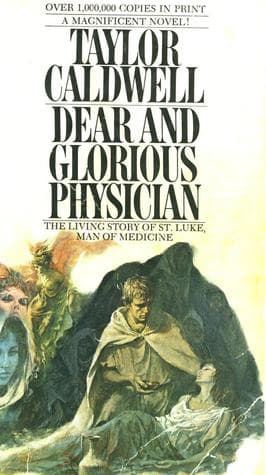
Synopsis
Covers the whole plot, including the ending.
- Difficulty
- Medium
- Pacing
- Moderate
- Mood
- Inspiring, Reflective, Epic, Spiritual
- Read it if
- You enjoy epic historical fiction that delves deeply into the lives of biblical figures, are interested in the intellectual and spiritual journey of early Christianity, or appreciate richly detailed narratives of faith and discovery.
- Skip it if
- You prefer fast-paced thrillers, dislike lengthy historical narratives, or are not interested in stories with strong religious themes.
Dear and Glorious Physician Plot Summary
Covers the whole plot, including the ending.
Lucanus's Early Life and Scholarly Pursuit
Lucanus, born into a wealthy Greek family in Antioch, is a sickly child who recovers from a severe illness after his mother's prayers to an unknown God. This experience shapes his inquisitive and spiritual nature. He develops a passion for medicine and healing, studying under physicians and philosophers like Dr. Menander. Despite his studies, Lucanus experiences grief with the deaths of his sister, Livia, and his first love, Thea, who dies in childbirth. These losses leave him feeling empty and searching for deeper meaning beyond medicine and Hellenistic philosophy. He questions the Greek gods and the finality of death.
The Quest for the 'Unknown God' and Encounter with Jews
Driven by spiritual hunger, Lucanus travels the Roman world, seeking answers to life, death, and suffering. His search for the 'Unknown God' leads him to Jerusalem, a city he initially finds strange and unwelcoming because of its strict Jewish customs and the perceived fanaticism of its people. Despite his discomfort, Lucanus is interested in the Jews' unwavering faith and their devotion to one God. He observes their practices, listens to their teachings, and hears rumors of a prophet, a Messiah, who has walked among them, performing miracles and speaking with authority. These accounts, though dismissed by Roman authorities and some Jewish groups, stir Lucanus's scientific curiosity and spiritual yearning.
Meeting with Pontius Pilate and Early Disciples
In Jerusalem, Lucanus meets Pontius Pilate, the Roman governor, hoping to learn about recent events concerning Jesus of Nazareth. Pilate, a pragmatic Roman, dismisses Jesus as a deluded zealot but gives Lucanus some facts about his trial and crucifixion, confirming Jesus's existence and his impact. Lucanus also meets early followers of Jesus, including Martha and Mary of Bethany, and later, Peter and John. These encounters are important. He is struck by their strong belief, their love, and the peace they show despite persecution. Their stories, though fragmented, begin to show a man unlike any Lucanus has studied, a healer and teacher whose power went beyond human ability.
The Conversion of Saul and Lucanus's Growing Conviction
Lucanus travels to Damascus and sees Saul of Tarsus, a persecutor of Christians, become Paul, a fervent apostle of Jesus. This miraculous transformation, which blinds Saul and then restores his sight, affects Lucanus deeply. He observes Paul's immediate and radical shift from hatred to devotion, and his healing by Ananias. This event, seen firsthand, gives Lucanus clear evidence of a divine power at work, a power beyond any medical or philosophical explanation. It is a turning point for Lucanus, solidifying his belief that Jesus was the Son of God and that the 'Unknown God' he sought was revealed in Him. He feels a call to understand and document this truth.
Lucanus's Dedication to Documenting the Gospel
After Paul's conversion and his own deepening faith, Lucanus realizes his life's purpose: to research and write a full account of Jesus's life, teachings, miracles, and resurrection. He sees this as his unique contribution, using his skills as a physician, scholar, and historian. He travels through Judea and Galilee, interviewing many eyewitnesses, including those who knew Jesus personally, such as the apostles, Mary Magdalene, and other women who followed him. Lucanus is careful, seeking confirmation for every detail, sifting through oral traditions, and aiming for historical accuracy. His goal is not just to recount events but to present a nuanced portrait of Jesus, showing his compassion, humanity, and divine nature for a Greek-speaking audience.
Meeting Mary, the Mother of Jesus
A significant moment in Lucanus's research is his encounter with Mary, Jesus's mother. He travels to her home, where she lives with John the Apostle. Mary, initially reserved, eventually shares personal recollections of Jesus's birth, childhood, and the events of his life. She recounts the Annunciation, the Nativity in Bethlehem, the visit of the Magi, and the family's flight to Egypt. Her story gives Lucanus a unique perspective, showing Jesus's human development and his connection to his mother. Mary's wisdom and faith move Lucanus, giving his narrative a tender, personal dimension no other source could provide.
Challenges and Persecution for the Early Church
As Lucanus continues his work, he sees the increasing persecution of the growing Christian community. He sees apostles and other believers endure imprisonment, torture, and martyrdom for their faith. He travels with Paul on some missionary journeys, observing the hardships, dangers, and frequent arrests Paul faces. Roman authorities and some Jewish groups see Christians as a dangerous group, a threat to their established order. Despite the constant threat and personal risks, Lucanus stays firm in his mission, understanding the urgency of preserving the truth of Jesus's life before it is lost or distorted. The steadfast faith and courage of the persecuted Christians strengthen his own conviction.
The Completion of the Gospel and Acts
After years of research, travel, and prayer, Lucanus finishes his Gospel, a detailed account of Jesus's life and ministry, written to appeal to a Greek-speaking, educated audience. His narrative emphasizes Jesus's compassion, miracles, and universal message of salvation. He then begins a second work, the Acts of the Apostles, documenting the early history of the Christian Church, focusing on Paul's missionary journeys, with whom he has a close bond. Lucanus's medical background helps him describe healings with precision, and his historical training ensures a structured and verifiable narrative. These writings become foundational texts for the new Christian faith.
Continued Ministry and Paul's Imprisonment
Lucanus remains a loyal companion and physician to Paul throughout his later ministry, including Paul's journey to Rome and his imprisonment. Lucanus's medical skills are useful, tending to Paul's ailments and those of other prisoners and believers. He acts as Paul's scribe and confidante, documenting his letters and supporting him during his trials. Even in a Roman prison, Lucanus observes Paul's unwavering faith, tireless preaching, and impact on those around him. Lucanus's presence during these challenging times shows his deep commitment to Paul and to spreading the Gospel, demonstrating his own quiet courage and steadfastness.
Lucanus's Legacy and Enduring Faith
Lucanus continues to serve the Christian community as a physician and evangelist long after Paul's martyrdom. He is believed to have lived a long life, dedicated to healing and faith. His Gospel and the Acts of the Apostles circulate widely and influence many, shaping the understanding of Jesus and the early Church for generations. Lucanus's initial intellectual curiosity, changed by personal loss and divine revelation, leads to a life of purpose and spiritual impact. He leaves a legacy not only as a physician but as a 'Dear and Glorious Physician' of souls, his writings showing his unwavering faith in the Christ he sought and documented.
Principal Figures
Lucanus (St. Luke)
Protagonist
A Greek physician and scholar who becomes the author of a Gospel and Acts of the Apostles.
Lucanus is a brilliant, intellectual, and deeply introspective Greek physician from Antioch. Initially driven by a rational, scientific mind and Hellenistic philosophy, he is also profoundly spiritual, constantly searching for deeper meaning beyond the material world. Early losses, particularly his sister Livia and his love Thea, leave him with a gnawing emptiness and a quest for the 'Unknown God.' He is methodical, observant, and compassionate, skills that serve him well in his later mission to document Jesus's life. His journey is one of intellectual curiosity transforming into profound faith, culminating in his dedication to the Christian message.
Relationships: Livia (beloved younger sister, whose death deeply impacts him); Thea (first love, whose death in childbirth causes profound grief); Dr. Menander (esteemed medical mentor); Paul (Saul of Tarsus) (close friend, fellow evangelist, and patient); Mary, Mother of Jesus (key interviewee and source of intimate details about Jesus)
Paul (Saul of Tarsus)
Supporting
A zealous persecutor of Christians who dramatically converts and becomes a leading apostle.
Initially known as Saul, a fiercely intelligent and zealous Pharisee who vehemently persecutes Christians, he undergoes a dramatic conversion experience on the road to Damascus, becoming blind and then having his sight restored. This event transforms him into Paul, a passionate and tireless apostle of Christ. He becomes a central figure in the early Church, traveling extensively to spread the Gospel among Gentiles. Paul is characterized by his unwavering faith, intellectual prowess, rhetorical skill, and profound endurance in the face of suffering. He is a pivotal figure in Lucanus's journey and a key source for the Acts of the Apostles.
Relationships: Lucanus (close companion, physician, and fellow evangelist); Ananias (healed Paul's blindness and baptized him)
Mary, Mother of Jesus
Supporting
The gentle and devout mother of Jesus, who provides intimate details of his early life to Lucanus.
Mary is portrayed as a woman of profound faith, humility, and quiet strength. She provides Lucanus with the most intimate and personal details of Jesus's birth, childhood, and family life, offering a unique perspective on his human development. Her recollections are essential for Lucanus's Gospel, particularly the narratives of the Annunciation, Nativity, and the early years. She represents the embodiment of maternal love and unwavering devotion to God, and her testimony deeply moves and inspires Lucanus, adding a tender, human dimension to his scholarly work.
Relationships: Jesus (her divine son); Lucanus (provides her personal testimony for his Gospel); John the Apostle (cares for her in her later years)
Pontius Pilate
Supporting
The Roman governor of Judea who condemned Jesus, offering a secular perspective to Lucanus.
Pontius Pilate is depicted as a pragmatic, somewhat cynical Roman governor, primarily concerned with maintaining order in a volatile province. He views Jesus as a minor agitator whose death was politically expedient rather than spiritually significant. His conversation with Lucanus, though dismissive of Jesus's divinity, confirms the historical reality of Jesus's existence and crucifixion from a Roman perspective. Pilate's character highlights the clash between Roman imperial power and the burgeoning spiritual movement of Christianity, and his account provides Lucanus with an important, albeit unsympathetic, official record.
Relationships: Lucanus (provides information about Jesus from a Roman viewpoint)
Livia
Mentioned
Lucanus's beloved younger sister, whose early death profoundly affects him.
Livia is Lucanus's younger sister, whom he deeply loves. Her premature death from illness is one of the earliest and most painful losses Lucanus experiences. Her death contributes significantly to his initial grief and his subsequent spiritual quest, driving him to seek answers about life, death, and the nature of God beyond the limitations of human medicine and philosophy. Although she appears only briefly in flashbacks, her memory serves as a powerful motivator for Lucanus's search for ultimate truth and comfort.
Relationships: Lucanus (beloved younger sister)
Thea
Mentioned
Lucanus's first love, whose death in childbirth causes him immense sorrow.
Thea is Lucanus's first love, a beautiful and virtuous woman whom he intends to marry. Her tragic death during childbirth, along with their infant, devastates Lucanus and intensifies his existential crisis. This loss further fuels his search for meaning and a God who can offer solace and triumph over death. Thea represents the ephemeral nature of human happiness and the inadequacy of worldly understanding in the face of profound sorrow, pushing Lucanus further into his spiritual quest.
Relationships: Lucanus (first love and intended wife)
Dr. Menander
Supporting
Lucanus's esteemed medical mentor in Antioch.
Dr. Menander is a highly respected and wise physician under whom Lucanus studies in Antioch. He represents the pinnacle of Hellenistic medical knowledge and philosophical thought of the era. Menander recognizes Lucanus's exceptional talent and intellect but also senses his deeper, spiritual yearning that traditional medicine cannot satisfy. He provides Lucanus with a strong foundation in healing arts and critical thinking, but his teachings ultimately highlight the limits of human knowledge in the face of spiritual mysteries, indirectly guiding Lucanus toward his ultimate quest.
Relationships: Lucanus (medical mentor and teacher)
Peter
Supporting
One of Jesus's chief apostles, providing an eyewitness account of Jesus's ministry.
Peter, originally a fisherman, is one of Jesus's closest disciples and a foundational leader of the early Christian Church. Lucanus interviews Peter to gather firsthand accounts of Jesus's ministry, teachings, and miracles. Peter's testimony, characterized by his passion, occasional impulsiveness, and unwavering loyalty to Christ, offers Lucanus a vivid and authentic perspective on Jesus's life and the challenges faced by his early followers. His experiences, including his denial and subsequent repentance, illustrate the human struggles and profound faith of the apostles.
Relationships: Jesus (chief apostle); Lucanus (provides eyewitness accounts of Jesus)
John the Apostle
Supporting
The beloved disciple of Jesus, who cares for Mary and shares his memories with Lucanus.
John is depicted as the 'beloved disciple' of Jesus, known for his deep spiritual insight and profound love. He is entrusted with the care of Mary, Jesus's mother, after the crucifixion. Lucanus seeks out John to gather his unique perspective on Jesus, particularly his teachings on love and the deeper spiritual truths. John's gentle wisdom and close relationship with Mary are crucial for Lucanus, as he facilitates the interview with Mary and provides his own valuable recollections, further enriching Lucanus's understanding of Jesus's divine nature.
Relationships: Jesus (beloved disciple); Mary, Mother of Jesus (her guardian); Lucanus (provides eyewitness accounts and facilitates meeting with Mary)
Themes & Insights
The Search for Truth and Meaning
Lucanus's life is a search for truth, starting with his scientific inquiries as a physician and becoming a spiritual search. He is not satisfied with Hellenistic philosophy and the Roman gods, especially when faced with death and suffering. His journey to find the 'Unknown God' is driven by personal loss (Livia, Thea) and a yearning for ultimate answers. This search ends with his discovery of Jesus Christ as the truth, giving meaning beyond human understanding and medical science.
“What manner of man was my Lord?”
Faith and Reason
The novel explores how intellectual inquiry and spiritual belief interact through Lucanus's character. As an educated physician and philosopher, Lucanus approaches the accounts of Jesus with a critical, investigative mind, seeking evidence. However, his rational mind changes due to spiritual experiences, such as Paul's conversion and the stories of eyewitnesses. This theme shows that faith is not against reason but can extend it, providing answers where reason alone falls short. It guides Lucanus to embrace a truth beyond scientific proof.
“He had sought the truth in the minds of men; he would find it now in the heart of God.”
Healing, Both Physical and Spiritual
As a physician, Lucanus is dedicated to physical healing, but the book presents a deeper healing: spiritual. Lucanus's early experiences with illness and death show the limits of medical science. He sees Jesus's miraculous healings and the spiritual change of individuals like Paul, which go beyond physical remedies. His own journey is one of spiritual healing from grief and emptiness. Ultimately, Lucanus's Gospel helps many souls, showing his role as a 'glorious physician' not just of the body, but of the soul, offering hope and salvation.
“For what profit is it to a man if he gains the whole world, and loses his own soul?”
The Power of Testimony and Documentation
A central theme is the importance of eyewitness testimony and documentation in preserving the truth of Jesus's life. Lucanus spends years traveling, interviewing, and cross-referencing accounts to create an accurate and full narrative. The novel emphasizes how fragile oral tradition is and how necessary written records are to ensure the lasting legacy of the Gospel. This theme highlights Lucanus's contribution as a historian and chronicler, whose diligence ensures that the story of Christ would be passed down to future generations, forming the foundation of Christian faith.
“Many have undertaken to set down an orderly account of the events that have been fulfilled among us... I too decided, after investigating everything carefully from the very first, to write an orderly account for you.”
Suffering and Resilience
The novel addresses suffering, both personal and communal. Lucanus experiences grief with the deaths of Livia and Thea, which fuels his spiritual search. He also sees the suffering and persecution of early Christians, including Paul's imprisonments and the martyrdom of believers. Despite these hardships, the characters show resilience, drawing strength from their faith in Jesus. This theme shows that suffering can lead to spiritual growth and that faith provides comfort and perseverance in adversity, turning pain into purpose.
“Blessed are you when people hate you, and when they exclude you, revile you, and defame you on account of the Son of Man.”
Plot Devices & Literary Techniques
First-Person Perspective (Implied/Framing)
The story is told from Lucanus's viewpoint, detailing his personal journey and research.
While not strictly first-person, the narrative is deeply immersed in Lucanus's perspective, thoughts, and feelings. The entire story unfolds through his experiences, observations, and intellectual and spiritual struggles. This allows the reader to intimately follow his journey from a skeptical, rational inquirer to a devout believer and chronicler. The 'I' of the Gospel's introduction (Luke 1:1-4) frames the novel's approach, making Lucanus's personal quest the central lens through which the historical and spiritual events are understood and presented.
Quest Narrative
Lucanus's journey is a quest for spiritual truth and the 'Unknown God'.
The novel is structured as a classic quest narrative, with Lucanus embarking on a literal and metaphorical journey. His quest is not for a physical object but for spiritual truth and the identity of the 'Unknown God' he senses. This journey takes him across the Roman world, through different cultures and philosophies, eventually leading him to the testimonies of Jesus's followers. The 'quest' provides the overarching plot structure, driving Lucanus's actions and ultimately culminating in his discovery of Christ and his life's purpose in documenting the Gospel.
Historical Reconstruction and Eyewitness Accounts
The narrative meticulously reconstructs historical events and relies on collected testimonies.
Caldwell uses Lucanus's role as a historian and physician to structure the narrative around the meticulous collection and corroboration of eyewitness accounts. The novel details Lucanus's travels, interviews with apostles, Mary, and other followers, and his critical assessment of various stories. This device lends a sense of authenticity and historical weight to the spiritual narrative, presenting the Gospel as a carefully researched and verified historical document rather than mere myth. It reflects the author's own historical research and gives credibility to the story's spiritual claims.
'Unknown God' Motif
A recurring symbol representing Lucanus's initial spiritual longing before discovering Christ.
The 'Unknown God' motif, referenced from Acts 17:23, is a powerful symbol throughout the novel. It represents Lucanus's deep spiritual yearning and the void left by the limitations of Greek philosophy and traditional Roman religion. This motif encapsulates his intellectual and emotional search for a divine being who can provide ultimate answers to life, death, and suffering. His eventual discovery of Jesus as the fulfillment of this 'Unknown God' provides the ultimate resolution to his lifelong spiritual quest and gives meaning to his work.
Dear and Glorious Physician Quotes
“The physician must be a philosopher, for philosophy is the mother of all sciences, and medicine is the highest of the sciences.”
“To heal the body is nothing if the soul is sick; to heal the soul is everything.”
“Faith is not believing without proof, but trusting without reservation.”
“The greatest disease of mankind is the hardness of the heart.”
“In every patient, see not a case, but a person; in every illness, a story.”
“Love is the only medicine that never fails, if it is pure and selfless.”
“To write is to make immortal the fleeting moments of truth.”
“Doubt is the shadow cast by the light of faith; without it, faith would have no substance.”
“The body is but the temple; the spirit is the god within.”
“History is not made by events, but by the souls who endure them.”
“A physician's first duty is to do no harm; his second, to bring hope.”
“In silence, we hear the voice of God; in stillness, we find our purpose.”
“The rich man's gold cannot buy health, but the poor man's prayer can move mountains.”
“To understand Christ, one must first understand suffering.”
“Every life is a book written by God; our task is to read it with compassion.”
Quiz
10 questions on the plot and the characters. Each answer comes with a short explanation.
Question 1
What is the protagonist's original name before he becomes known as St. Luke?
- Lucius
- Lucanus
- Lucas
- Luke
Show answer
B. Lucanus In the book, the protagonist begins as Lucanus, a Greek physician, before his spiritual journey leads him to become St. Luke, the author of the third Gospel.
Question 2
What major personal experience drives Lucanus to question the nature of Jesus?
- A miraculous healing he witnessed
- The emptiness of bereavement
- A vision in a dream
- A political uprising in Greece
Show answer
B. The emptiness of bereavement The book describes Lucanus experiencing profound grief and loss, which propels him on a quest to understand Jesus, asking, 'What manner of man was my Lord?'
Question 3
In which region does Lucanus travel to seek answers about Jesus?
- The deserts of Egypt
- The hills and wastes of Judea
- The mountains of Galilee
- The coasts of Syria
Show answer
B. The hills and wastes of Judea The book specifies that Lucanus journeys through the hills and wastes of Judea as part of his spiritual investigation into the life of Jesus.
Question 4
What profession does Lucanus practice, which later influences his Gospel writings?
- A historian
- A philosopher
- A physician
- A scribe
Show answer
C. A physician Lucanus is depicted as a Greek physician, and his medical background is reflected in the detailed accounts of healings and compassion in the Gospel of Luke.
Question 5
How does Taylor Caldwell characterize the story of Lucanus in the book's description?
- As a historical documentary
- As one of the most stirring stories ever lived or written
- As a fictional adventure tale
- As a theological treatise
Show answer
B. As one of the most stirring stories ever lived or written The book's description emphasizes its emotional and narrative power, calling it 'one of the most stirring stories ever lived or written,' highlighting its blend of history and spirituality.
Question 6
What key question does Lucanus repeatedly ask during his travels in Judea?
- 'Where can I find the truth?'
- 'What is the purpose of life?'
- 'What manner of man was my Lord?'
- 'How can I heal the sick?'
Show answer
C. 'What manner of man was my Lord?' This central question drives the plot, as Lucanus seeks to understand the character and divinity of Jesus, reflecting the book's exploration of faith and identity.
Question 7
Which aspect of St. Luke's legacy is highlighted as his primary contribution in the book's description?
- His medical discoveries
- His travels as a missionary
- His authorship of the third Gospel of the New Testament
- His role as a disciple of Paul
Show answer
C. His authorship of the third Gospel of the New Testament The book frames Lucanus's journey as leading to his role as St. Luke, the author of the Gospel of Luke, emphasizing his literary and spiritual impact.
Question 8
What cultural background does Lucanus have, which influences his perspective in the story?
- Roman
- Jewish
- Greek
- Egyptian
Show answer
C. Greek Lucanus is described as a Greek, which sets him apart in the Judean setting and adds depth to his quest, as he approaches Jesus from an outsider's viewpoint.
Question 9
How does the book blend historical and spiritual elements in its portrayal of Lucanus?
- By focusing solely on biblical miracles
- By depicting him as a mythical hero
- By exploring his personal emotions and historical context to understand his faith journey
- By presenting a chronological account of early Christianity
Show answer
C. By exploring his personal emotions and historical context to understand his faith journey The book uses Lucanus's grief, travels, and inquiries to weave a narrative that combines historical setting with spiritual exploration, making his transformation relatable and profound.
Question 10
What is the significance of the title 'Dear and Glorious Physician' in relation to Lucanus's story?
- It refers to his reputation as a healer in ancient Greece
- It highlights his divine calling to write the Gospel
- It symbolizes his dual role as a compassionate healer and a seeker of spiritual truth
- It is a title given to him by the Roman authorities
Show answer
C. It symbolizes his dual role as a compassionate healer and a seeker of spiritual truth The title encapsulates the central theme of the book: Lucanus's journey from a skilled physician to a devoted follower of Jesus, blending his medical compassion with his glorious spiritual mission.
Dear and Glorious Physician FAQ
What is 'Dear and Glorious Physician' about?
The novel follows the life of Lucanus, a Greek physician who later becomes St. Luke, author of the third Gospel. It explores his personal journey from a man experiencing love and profound loss to his spiritual quest across Judea, where he seeks to understand the nature of Jesus Christ, ultimately leading to his conversion and role in early Christianity.
Why should I read 'Dear and Glorious Physician'?
This book offers a deeply humanized portrayal of a biblical figure, blending historical fiction with spiritual themes. Caldwell's rich storytelling provides insight into the emotional and intellectual struggles of Lucanus, making it compelling for readers interested in character-driven narratives, early Christian history, or explorations of faith and doubt.
What is the background/setting of 'Dear and Glorious Physician'?
Set in the 1st century AD, the story spans the Greco-Roman world and Judea, reflecting the cultural and political tensions of the era. Key locations include Greek cities where Lucanus practices medicine and the rugged landscapes of Judea where he travels to investigate the life and teachings of Jesus, amidst Roman occupation and Jewish traditions.
What are the most memorable quotes from the book?
Notable quotes include Lucanus's recurring question, 'What manner of man was my Lord?', which drives his spiritual search, and reflections on suffering and healing, such as 'The physician must heal himself before he can heal others.' These lines encapsulate the novel's themes of inquiry, personal growth, and the intersection of medicine and faith.
What writing style does Taylor Caldwell use in this book?
Caldwell employs a detailed, descriptive prose style that immerses readers in the historical setting, with a focus on emotional depth and psychological insight. The narrative blends factual historical elements with imaginative fiction, using a third-person perspective to explore Lucanus's inner conflicts and spiritual evolution in a lyrical yet accessible manner.
What minor details add significant meaning to the story?
Details like Lucanus's medical tools and practices highlight his identity as a healer, symbolizing his later role in spiritual healing. His interactions with minor characters, such as patients or travelers in Judea, often reveal subtle critiques of societal norms or foreshadow his growing curiosity about Jesus, enriching the thematic depth of his journey.
What are some subtle foreshadowing moments in the book?
Early scenes of Lucanus grappling with loss and emptiness foreshadow his eventual search for deeper meaning. His medical encounters with suffering individuals hint at the broader human condition he will explore through Christianity, while references to Greek philosophy subtly contrast with the spiritual truths he discovers in Judea.
What unexpected character connections exist in the narrative?
Lucanus's path intersects with various historical and fictional figures, including early Christians and Roman officials, who influence his beliefs. A key connection is his relationship with individuals who have witnessed Jesus's miracles, providing firsthand accounts that bridge his medical skepticism with growing faith, weaving a network of influences that shape his conversion.
What are the unspoken character motivations of Lucanus?
Beneath his professional demeanor, Lucanus is driven by a deep-seated need to find purpose after personal bereavement, which he masks with intellectual curiosity. His journey to Judea is not just a factual inquiry but an emotional quest to fill the void left by loss, motivating his relentless pursuit of truth about Jesus.
What psychological complexities do characters exhibit?
Lucanus embodies the conflict between reason and faith, as a scientist grappling with supernatural claims. Supporting characters, such as skeptics or believers he meets, display varying degrees of doubt, zeal, or hypocrisy, reflecting the psychological tensions of an era where new religious ideas challenged established worldviews.
What are the major emotional turning points in Lucanus's life?
Key emotional turning points include the death of a loved one that plunges him into despair, his decision to travel to Judea sparked by haunting questions, and transformative encounters with testimonies about Jesus that shift him from skepticism to awe. These moments build toward his ultimate acceptance of faith, marking his emotional and spiritual rebirth.
How do relationship dynamics evolve throughout the story?
Lucanus's relationships evolve from professional detachment to deep spiritual connections. Initially isolated by grief, he forms bonds with fellow seekers and converts in Judea, moving from a solitary investigator to a member of the early Christian community. This mirrors his internal shift from loneliness to belonging through shared faith.
Which parts of the book remain ambiguous or open-ended?
The novel leaves some aspects of Lucanus's early life and specific historical events open to interpretation, blending fact with fiction. His inner doubts and the exact moment of conversion are portrayed with nuance, allowing readers to ponder the gradual nature of spiritual awakening rather than presenting a definitive, sudden revelation.
What are controversial scenes or decisions in the book?
Scenes depicting Lucanus's skepticism toward miracles may challenge devout readers, while his integration of Greek medical knowledge with Christian faith sparks debate about the compatibility of science and religion. Decisions like his abandonment of a secure life to pursue spiritual truth in Judea highlight themes of risk and conviction that can polarize interpretations.
How does 'Dear and Glorious Physician' end, and what does it mean?
The book concludes with Lucanus embracing Christianity and beginning to write his Gospel, symbolizing the fusion of his medical insight with spiritual testimony. This ending signifies a journey from doubt to faith, suggesting that personal experience and inquiry can lead to profound transformation, and positions Luke as a bridge between human suffering and divine hope.
About the author

Taylor Caldwell was an American author known for her historical fiction. Among her notable works are "Captains and the Kings," which explores themes of power and ambition, and "Dear and Glorious Physician," a fictional account of St. Luke's life. Caldwell's writing often delves into the complexities of human nature and historical events.
Similar books
- The Robe
Lloyd C. Douglas
4.2 (23k) average on GoodreadsHistorical FictionExplores the early Christian era through the eyes of a Roman tribune, focusing on conversion and the impact of Jesus.
- The Bronze Bow
Elizabeth George Speare
4.0 (20k) average on GoodreadsChildren'sA Newbery Medal winner that, while for younger readers, similarly explores the political and religious context of Judea during Jesus's time.
- To Kill a Mockingbird
Harper Lee
4.3 (4.5M) average on GoodreadsHistorical FictionIn the 1930s Jim Crow South, Harper Lee writes about racial injustice, moral growth, and the quiet courage of a lawyer father, Atticus Finch, as seen through his young daughter's eyes.
- The Great Gatsby
F. Scott Fitzgerald
3.9 (3.8M) average on GoodreadsHistorical FictionIn the opulent Roaring Twenties, a mysterious millionaire's lavish parties hide his desperate, tragic pursuit of a lost love, exposing the emptiness within the American Dream.
- Pride and Prejudice
Jane Austen
4.3 (3M) average on GoodreadsHistorical FictionIn a society focused on status and money, Elizabeth Bennet navigates love and pride, challenging Mr. Darcy and social expectations to find true affection.
- Angels & Demons
Dan Brown
3.9 (2.7M) average on GoodreadsThrillerA Harvard symbologist races through Rome's ancient sites, deciphering cryptic clues to unmask the Illuminati and stop a vengeful plot to destroy the Vatican with a stolen antimatter weapon.





Enjoyed the summary?
A summary gives you the shape of the book. The book itself has the detail, the examples and the voice.
Find Dear and Glorious Physician on AmazonAs an Amazon Associate, BookBrief earns from qualifying purchases. How we're funded