“The South, in my experience, was a place where the past was never dead. It wasn't even past.”
— Anna Pigeon reflects on the pervasive influence of history in the South.

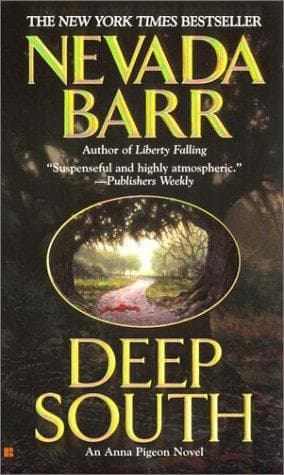
Nevada Barr (2000)
Goodreads Rating
3.98/ 5(9,435 reviews)
Genre
General
Summary Read
10 min
Book Length
450 min
Sign in to track this book
Park Ranger Anna Pigeon investigates a murder tied to Mississippi's dark racial history, risking her own safety in the process.
Ask anything about Deep South and get instant answers grounded in the summary.
Anna Pigeon, now a District Ranger, arrives at the Natchez Trace Parkway in Mississippi, a career move she initially resisted. Her first day is unusual. While exploring the parkland, she finds a young woman's body near an old country cemetery. The victim, prom queen Brandy Wilson, is found with a sheet over her head and a noose around her neck. This scene suggests both ritualistic murder and a link to the region's dark racial history. Local authorities, especially Sheriff Paulsen, seem unwilling to investigate thoroughly, raising Anna's suspicions and prompting her to pursue the truth on her own.
Sheriff Paulsen and his deputies quickly call Brandy Wilson's death a suicide, despite the unusual circumstances and clear signs of foul play. Their quick judgment and lack of real investigation immediately concern Anna. She notices their dismissive attitude toward the victim and the crime scene, feeling a distinct lack of urgency. This resistance from local law enforcement makes Anna realize she cannot rely on them. Her experience as a ranger compels her to investigate deeper, even if it means clashing with local power and risking her safety.
Anna, undeterred by local resistance, begins her own investigation into Brandy Wilson's life. She learns that Brandy, despite her public image, had a more complex and private life. Anna discovers Brandy was involved in local historical reenactments, specifically portraying a 'slave girl' at a plantation. This detail adds another layer of racial undertones to the case. Brandy also had a troubled relationship with her father, who was struggling financially and involved in questionable land deals. These early clues show a young woman caught in personal drama, historical reenactment, and potentially dangerous secrets.
Anna focuses her investigation on 'Paradise,' the local plantation where Brandy participated in reenactments. She meets Clementine, a perceptive elderly Black woman who works at the plantation and offers Anna subtle but important insights into local dynamics and the plantation's history. Anna learns about the people connected to Paradise, including the owner, Miss Amelia, and the historical society that organizes the reenactments. The plantation, with its Southern charm, begins to reveal itself as a place where old prejudices remain and where the past is not just reenacted but manipulated, possibly to hide current wrongdoings.
As Anna investigates, she starts receiving warnings and threats, both subtle and direct, urging her to stop. These come from various sources, including Sheriff Paulsen, who remains uncooperative, and other local figures who seem to want the truth buried. Anna experiences vandalism at her home and receives anonymous phone calls, making it clear someone is trying to intimidate her. These threats only strengthen her resolve, confirming her suspicion that she is close to uncovering something significant and dangerous. The deeper she probes, the more hostile the environment becomes, signaling the importance of the secrets she is disturbing.
Anna investigates the local historical society, discovering its strong influence in the community and its deep involvement in the plantation reenactments. She learns that prominent, wealthy families largely control the society. They are very protective of their image and the local history narrative. Anna suspects that the reenactments, especially the 'slave girl' role Brandy played, are not just about education but serve a more harmful purpose, possibly tied to land ownership, financial schemes, or maintaining outdated social hierarchies. The society's members appear to have a strong interest in keeping certain truths hidden and maintaining the current situation.
Through her investigation and conversations with Clementine and other older residents, Anna uncovers a connection between Brandy's murder and an unsolved lynching from decades past involving a Black man. The similarities in the crime scene – the sheet, the noose – are too striking to be accidental. This suggests Brandy's death is not just a standalone crime but a modern echo of a historical injustice, possibly meant to send a message or hide a secret tied to the past. The racial undertones become more pronounced, indicating a deep problem within the community.
Anna's investigation into Brandy's father's financial troubles and land deals leads her to a scheme of land fraud and manipulation. She discovers that valuable land, including property near the Natchez Trace and the plantation, is being illegally acquired and developed. Brandy had found evidence of this corruption, making her a dangerous witness. The financial motives connect with the historical narrative, revealing that preserving 'history' and the plantation's image are being used to cover up modern illicit gains. This economic conspiracy provides a strong motive for Brandy's murder.
Anna gathers enough evidence to confront the perpetrators, leading her back to the Paradise plantation. She connects the roles of several key figures: Miss Amelia, the plantation owner, who organized the reenactments; and a prominent historical society member, who was deeply involved in the land fraud. Brandy had inadvertently discovered their illegal activities and was silenced to prevent exposure. The confrontation is tense and dangerous, as Anna finds herself isolated and in peril, facing individuals desperate to protect their secrets and reputations, no matter the cost.
In a confrontation, Anna exposes Miss Amelia and her co-conspirator as the people behind Brandy's murder. Brandy had uncovered their plan to fraudulently acquire land for development, using the historical society as a front. The 'lynching' motif was a deliberate, twisted attempt to deflect suspicion towards racial hatred, rather than the true motive of financial greed and land fraud. Anna reveals that Brandy, unknowingly, had become a pawn and then a threat, leading to her brutal silencing. The truth is finally brought to light, revealing the dark side of a seemingly polite Southern community.
With the truth exposed, Miss Amelia and her accomplice are arrested, and justice is served for Brandy Wilson. However, Anna realizes that while the immediate crime is solved, the deep-seated issues of racial prejudice, historical revisionism, and corruption in the community will likely continue. The case's resolution offers closure but also highlights the ongoing challenges of confronting ingrained biases and how the past continues to influence the present in the Deep South. Anna's experience changes her, giving her a deeper understanding of the region's complexities.
The Protagonist
Anna initially resists her promotion but grows into her new leadership role, navigating complex social dynamics and ultimately reaffirming her dedication to justice.
The Victim
Though deceased, Brandy's character is revealed through Anna's investigation, showing her transition from an innocent, if naive, young woman to a tragic figure caught in a web of deceit.
The Antagonist
Paulsen remains largely static, his resistance highlighting the pervasive corruption and insularity of the local community until Anna's efforts force his hand.
The Supporting
Clementine's character provides a steady source of wisdom and perspective, helping to bridge the gap between historical context and the current investigation, remaining a steadfast moral center.
The Antagonist
Miss Amelia's true nature is gradually revealed, transitioning from a seemingly harmless local matriarch to the calculating mastermind behind the crime.
The Supporting
Brandy's father remains a character burdened by his poor choices, serving as a tragic figure whose actions indirectly contribute to his daughter's demise.
The Antagonists/Supporting
Their collective arc reveals the pervasive influence of money and power in shaping historical narratives and obstructing justice within the community.
The Supporting
James provides consistent, albeit minor, support to Anna, remaining a steady, reliable presence in her new environment.
The novel explores how the past, especially the history of slavery and racial violence in the American South, still strongly influences the present. The reenactment of a 'slave girl' role, the image of a lynching, and the deep-seated prejudices in the community show how historical injustices are not just old events but living forces that shape current events and motives. The story suggests that until these historical wrongs are truly addressed, they will continue to appear in new forms of injustice and violence.
“The past wasn't dead, not here. It was a suffocating vine, choking the life out of the present.”
The theme of corruption appears on many levels, from local law enforcement obstructing justice to complex financial schemes involving land fraud. This corruption is often hidden behind a facade of Southern politeness, historical preservation, and community pride. The novel exposes the hypocrisy of people who outwardly uphold tradition and morality while secretly engaging in illegal activities and exploiting others. It critiques how power and wealth can be used to manipulate stories, suppress truth, and perpetuate injustice, showing a community where moral decay runs deep beneath a polished surface.
“It was all about the land, Anna realized, always had been. And the history was just a pretty lie to cover the greed.”
Anna Pigeon, a National Park Ranger from outside Mississippi, is an outsider confronting a very insular and resistant community. Her investigation efforts are met with suspicion, hostility, and deliberate obstruction. This highlights the difficulty of penetrating tightly knit social structures that prioritize protecting local secrets over truth and justice. This theme explores the clash between outside moral authority and established local customs, showing how an outsider's perspective can uncover hidden truths but at significant personal risk.
“They didn't want the truth, not if it meant disturbing the comfortable lies they'd all agreed to live by.”
The novel examines how history can be selectively remembered, glorified, or manipulated to serve current agendas. The historical reenactments at the plantation, especially the romanticized or distorted portrayal of the past, are not just innocent entertainment but become a tool to hide present-day crimes and perpetuate harmful stereotypes. This theme questions who controls the narrative of history and why, revealing how 'heritage' can be used to maintain power structures, justify injustices, and distract from uncomfortable truths about a community's past and present.
“History, here, was a costume, worn to hide the ugliness underneath.”
Misleading clues to divert suspicion.
The initial staging of Brandy Wilson's murder, with the sheet and noose, is a significant red herring. It strongly suggests a racially motivated lynching, deliberately drawing Anna's and the reader's attention towards historical racial violence as the primary motive. This misdirection is intended to obscure the true motive: financial gain through land fraud. The perpetrators strategically crafted the scene to exploit the region's dark history, hoping to lead investigators down the wrong path and make the crime appear as a hate crime rather than a calculated murder driven by greed.
Hints of future events and underlying tensions.
From Anna's initial discomfort with her new assignment in Mississippi, to the immediate resistance she faces from Sheriff Paulsen, the novel employs subtle foreshadowing. The descriptions of the suffocating kudzu vines and the pervasive heat serve as atmospheric foreshadowing, hinting at the oppressive and entangled nature of the secrets Anna will uncover. Clementine's cryptic remarks about the past not being dead also foreshadow the deep historical connections to the present crime. These elements create a growing sense of unease and hint at the dangerous truths that lie beneath the surface.
Objects and settings representing deeper meanings.
Several powerful symbols are used throughout the novel. The kudzu vine symbolizes the invasive, suffocating, and inescapable nature of the region's past and secrets, constantly threatening to overwhelm. The Paradise plantation itself symbolizes the idealized, often false, image of the Old South, behind which corruption and exploitation truly thrive. The noose and sheet are potent symbols of racial terror and historical lynching, deliberately invoked by the murderers to mislead. These symbols enrich the narrative by imbuing settings and objects with layers of historical and thematic significance.
The collective community narrative as a source of deception.
While the novel is told from Anna's perspective, the 'community' itself acts as an unreliable narrator, presenting a carefully constructed facade of Southern charm and historical reverence. The official narrative put forth by Sheriff Paulsen and the historical society about Brandy's death and the region's past is deliberately misleading. This collective unreliability forces Anna to question everything she is told and to dig deeper to uncover the hidden truths. It highlights how powerful groups can control information and perpetuate false realities to protect their interests, making it difficult for an outsider to discern the true nature of events.
“The South, in my experience, was a place where the past was never dead. It wasn't even past.”
— Anna Pigeon reflects on the pervasive influence of history in the South.
“There are some things you can't outrun, no matter how fast you travel.”
— Anna's realization about the inescapable nature of her past and personal demons.
“It's a funny thing about murder. It tends to leave a mess.”
— Anna's pragmatic observation about the aftermath of a crime.
“The air in the South was thick with secrets.”
— Describing the atmosphere of hidden truths and unspoken histories in the region.
“She was a woman who knew how to use her solitude like a weapon.”
— Character description of a woman who is self-sufficient and potentially dangerous.
“The wild places were where she felt most herself, most alive.”
— Anna's deep connection to nature and the wilderness.
“You can't judge a place by the postcards. You have to walk the dirt roads.”
— A metaphor for understanding the true nature of a place beyond its superficial appearance.
“The heat was a living thing, pressing down, making you feel slow and heavy.”
— Sensory description of the oppressive Southern climate.
“Some people are born with a compass, others have to stumble their way through.”
— Reflection on inherent intuition versus learned navigation in life.
“The beauty of the South was a dangerous beauty, a lure that hid sharp teeth.”
— Anna's perception of the deceptive allure of the Southern landscape and its inhabitants.
“She carried her grief like a shadow, always with her, sometimes more visible than others.”
— Describing a character's ongoing struggle with loss.
“The river was a mirror, reflecting the sky, the trees, and the darkness within.”
— Symbolic use of the river as a reflection of both the external world and internal turmoil.
“Fear was a constant companion, but courage was a choice.”
— Anna's understanding of facing her anxieties.
“The truth, like a stubborn root, would eventually break through the surface.”
— Anna's belief in the eventual revelation of truth, no matter how hidden.
Ready to see how well you understood this book? Take our interactive quiz with 10 questions.
Support the author — grab the full book.
As an Amazon Associate, BookBrief earns from qualifying purchases, at no extra cost to you. How we're funded.