
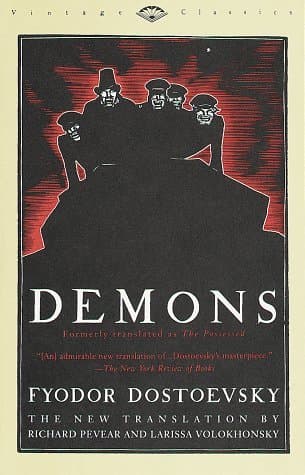
Synopsis
Covers the whole plot, including the ending.
- Difficulty
- Hard
- Read it if
- You are fascinated by the psychological and societal impact of radical political ideologies, the corrosive effects of nihilism, and the moral dilemmas faced by intellectuals grappling with revolutionary fervor. Essential for understanding the roots of totalitarian thought and its human cost.
- Skip it if
- You prefer fast-paced plots with clear heroes and villains, or you're not prepared for a lengthy, dense philosophical novel with a large cast of characters and intricate ideological debates. This is not light reading.
Demons Quotes
“Man is unhappy because he doesn't know he's happy. It's only that. That's all, that's all! If anyone finds out, he'll become happy at once, that minute.”
“Shower upon man every earthly blessing, drown him in bliss so that nothing but bubbles would dance on the surface of his bliss, give him such economic prosperity that he would have nothing else to do but sleep, eat cakes, and busy himself with the continuation of his species, and even then out of sheer ingratitude, sheer spite, man would play you some nasty trick.”
“The best way to keep a prisoner from escaping is to make sure he never knows he's in prison.”
“I am a ridiculous man. Now they call me a madman. That would be a promotion if it were not that I remain as ridiculous in their eyes as before.”
“To kill someone for committing murder is a punishment incomparably worse than the crime itself. Murder by legal sentence is immeasurably more terrible than murder by brigands.”
“Socialism is not only the labor question or the question of the so-called fourth estate, but it is before all else the atheistic question, the question of the modern incarnation of atheism, the question of the Tower of Babel built without God, not to reach heaven from earth but to bring heaven down to earth.”
“If there is no God, then I am God.”
“The whole law of human existence consists in nothing other than a man's always being able to bow before the immeasurably great. If people are deprived of the immeasurably great, they will not live and will die in despair.”
“We are all nihilists now.”
“I want to suffer so that I may love.”
“The ant heap is coming, the age of the anthill.”
“Man has no more tormenting care than to find someone to whom he can hand over as quickly as possible that gift of freedom with which he is born.”
“Everything is permitted.”
“The higher the intelligence, the greater the suffering.”
Quiz
10 questions on the plot and the characters. Each answer comes with a short explanation.
Question 1
What real-life event inspired Dostoyevsky to write 'Demons'?
- The assassination of Tsar Alexander II
- The Petrashevsky Circle conspiracy trial
- The political murder of student Ivan Ivanov by the Nechayev circle
- The Decembrist Revolt of 1825
Show answer
C. The political murder of student Ivan Ivanov by the Nechayev circle Dostoyevsky was horrified by the 1869 murder of student Ivan Ivanov by Sergei Nechayev's revolutionary circle, which became the central inspiration for the novel's plot about ideological extremism.
Question 2
Which character in 'Demons' represents the charismatic but amoral revolutionary leader inspired by Sergei Nechayev?
- Pyotr Stepanovich Verkhovensky
- Nikolai Stavrogin
- Ivan Shatov
- Stepan Trofimovich Verkhovensky
Show answer
A. Pyotr Stepanovich Verkhovensky Pyotr Stepanovich Verkhovensky is directly modeled on Sergei Nechayev, the real-life revolutionary who believed any means were justified for political ends, including murder and manipulation.
Question 3
What does Dostoyevsky primarily criticize through the novel's depiction of revolutionary ideology?
- Monarchical corruption and inefficiency
- The plague of materialist ideology destroying spiritual and moral values
- The backwardness of Russian peasant culture
- Western European military aggression
Show answer
B. The plague of materialist ideology destroying spiritual and moral values Dostoyevsky conceived 'Demons' as a 'novel-pamphlet' against the materialist ideologies he saw infecting Russia, which he believed rejected spiritual values and led to moral decay.
Question 4
What is the significance of the novel's title 'Demons' in relation to its themes?
- It refers to literal supernatural beings haunting the characters
- It symbolizes the destructive ideological forces possessing Russian society
- It describes the criminal underworld operating in the town
- It represents the mental illnesses afflicting several main characters
Show answer
B. It symbolizes the destructive ideological forces possessing Russian society The title 'Demons' (also translated as 'The Possessed') metaphorically represents how radical ideologies possess individuals and society, driving them toward destruction, much like the biblical story of the Gadarene swine.
Question 5
Which character serves as the intellectual father figure whose liberal ideas inadvertently contribute to the revolutionary chaos?
- Andrei Antonovich von Lembke
- Stepan Trofimovich Verkhovensky
- Kirillov
- Captain Lebyadkin
Show answer
B. Stepan Trofimovich Verkhovensky Stepan Trofimovich Verkhovensky represents the older generation of liberal intellectuals whose abstract Western ideas, while well-meaning, create the cultural conditions that enable his son Pyotr's violent revolutionary pragmatism.
Question 6
What philosophical concept does Kirillov embrace that leads to his dramatic fate?
- Nihilistic rejection of all moral values
- The idea that suicide can make one a 'man-god' who transcends fear
- Utilitarian calculation of the greatest good
- Slavophile devotion to traditional Russian Orthodoxy
Show answer
B. The idea that suicide can make one a 'man-god' who transcends fear Kirillov develops a philosophical theory that by committing suicide voluntarily to demonstrate absolute freedom from fear, one becomes a 'man-god' - a concept that Pyotr Verkhovensky manipulates for his revolutionary purposes.
Question 7
How does Nikolai Stavrogin's character function in the novel's critique of ideology?
- He represents the ideal revolutionary leader everyone should follow
- He demonstrates how spiritual emptiness makes one susceptible to destructive ideologies
- He serves as comic relief through his absurd philosophical musings
- He provides the economic analysis that justifies the revolution
Show answer
B. He demonstrates how spiritual emptiness makes one susceptible to destructive ideologies Stavrogin embodies the spiritual vacuum at the heart of modern Russian society - brilliant but morally empty, he becomes a figure others project their ideologies onto, showing how lack of positive values creates space for destructive ones.
Question 8
What is the practical consequence of the revolutionary cell's ideology as depicted in the novel's climax?
- Successful overthrow of the local government
- The murder of Shatov to maintain organizational secrecy
- Mass conversion of townspeople to their cause
- Peaceful establishment of a socialist commune
Show answer
B. The murder of Shatov to maintain organizational secrecy The novel's central violent act - the murder of Ivan Shatov - demonstrates how revolutionary ideology in practice leads to the sacrifice of individuals for 'the cause,' mirroring the real Nechayev circle's murder of Ivanov.
Question 9
Which of these represents Dostoyevsky's alternative to the materialist ideologies he critiques in 'Demons'?
- Shatov's vision of a Russian people chosen by God for a spiritual mission
- Pyotr Verkhovensky's pragmatic revolutionary organization
- Kirillov's philosophical suicide as ultimate freedom
- Stavrogin's aristocratic detachment from all causes
Show answer
A. Shatov's vision of a Russian people chosen by God for a spiritual mission Through Shatov, Dostoyevsky presents his own Slavophile alternative: Russia's unique spiritual destiny based on Orthodox Christianity and the Russian people's special relationship with God, countering Western materialist ideologies.
Question 10
How does the novel's structure as a 'novel-pamphlet' affect its narrative approach?
- It presents a straightforward chronological biography of the main revolutionary
- It combines fictional storytelling with direct ideological critique of contemporary issues
- It focuses exclusively on philosophical dialogues without plot development
- It adopts the format of official government documents and reports
Show answer
B. It combines fictional storytelling with direct ideological critique of contemporary issues Dostoyevsky described 'Demons' as a 'novel-pamphlet,' meaning it uses fictional narrative to engage directly with current political debates and ideologies, making it both literature and political commentary.
Demons FAQ
What is 'Demons' by Dostoyevsky about?
'Demons' is a political and philosophical novel inspired by a real-life 1869 murder, exploring the spread of radical materialist ideology in pre-revolutionary Russia. It critiques nihilism and revolutionary movements through a darkly satirical narrative of conspiracy and violence.
Does 'Demons' work as a critique of political ideology?
Yes, Dostoyevsky intended 'Demons' as a 'novel-pamphlet' to expose the dangers of materialist and nihilist ideologies he saw corrupting Russia. Its portrayal of fanaticism and moral decay remains a powerful critique of extremist political movements.
How different is 'Demons' from 'Crime and Punishment'?
While both explore morality and psychology, 'Demons' focuses more on collective political ideology and societal decay, whereas 'Crime and Punishment' centers on individual guilt and redemption. 'Demons' is broader in scope, satirizing revolutionary groups.
What is the 'novel-pamphlet' concept in 'Demons'?
Dostoyevsky described 'Demons' as a 'novel-pamphlet,' meaning it combines fictional storytelling with direct political and philosophical commentary. This approach allows him to aggressively critique ideological movements while maintaining narrative engagement.
Does 'Demons' predict the Russian Revolution?
While not a literal prediction, 'Demons' is seen as prophetic in its depiction of ideological fanaticism and societal collapse, mirroring themes that later emerged in the 1917 Russian Revolution. Dostoyevsky foresaw the destructive potential of radical movements.
How different is 'Demons' from 'The Brothers Karamazov'?
'Demons' emphasizes political and ideological conflict, while 'The Brothers Karamazov' delves deeper into religious, existential, and familial themes. Both are philosophical, but 'Demons' is more focused on societal critique than spiritual exploration.
What is nihilism in 'Demons'?
In 'Demons,' nihilism is portrayed as a destructive ideology that rejects moral and religious values, leading characters to embrace violence and chaos. Dostoyevsky uses it to critique the radical movements threatening Russian society.
Does 'Demons' have humor as described?
Yes, despite its dark themes, 'Demons' includes ferocious satire and irony, mocking the absurdities and hypocrisies of its characters and their ideologies. This humor sharpens its critique of political fanaticism.
What is the significance of the 1869 murder in 'Demons'?
The novel is loosely based on the 1869 murder of student Ivan Ivanov by a radical group, which Dostoyevsky uses to explore themes of ideological violence and moral corruption. This real event grounds the story's political commentary.
How different is 'Demons' from Tolstoy's political works?
Unlike Tolstoy's more humanist and pacifist approaches in works like 'War and Peace,' 'Demons' offers a darker, more satirical critique of ideology, focusing on the psychological and societal dangers of radicalism rather than historical narrative.
About the author

Fyodor Mikhailovich Dostoevsky, sometimes transliterated as Dostoyevsky, was a Russian novelist, short story writer, essayist and journalist. Numerous literary critics regard him as one of the greatest novelists in all of world literature, as many of his works are considered highly influential masterpieces.
Similar books
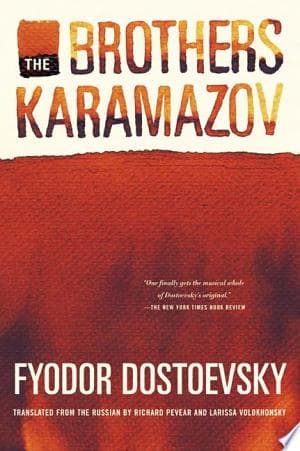
- The Brothers Karamazov
Fyodor Dostoyevsky
4.3 (243k) average on GoodreadsSpiritualityExplores similar themes of faith, nihilism, morality, and the human condition within a complex family drama.
- Darkness at Noon
Arthur Koestler
4.0 (26k) average on GoodreadsPoliticsExamines the psychological toll and moral compromises within a totalitarian communist regime, focusing on a disgraced revolutionary.
- Notes from Underground
Fyodor Dostoevsky
4.2 (84k) average on GoodreadsPsychologyDemons expands on the philosophical themes of alienation and the rejection of rationalism introduced in Notes from Underground. While Notes focuses on the internal struggle of an isolated individual against utopian ideals, Demons projects these struggles onto a broader societal canvas, showing how such ideas, when adopted by a collective, can lead to destructive political action. The Underground Man's spiteful rebellion against determinism finds its societal manifestation in the nihilistic plots of Pyotr Verkhovensky and the spiritual void of Stavrogin, demonstrating Dostoevsky's evolving concern with the social consequences of individual philosophical stances.
- 1984
George Orwell
4.2 (3.1M) average on GoodreadsPoliticsIn a future where surveillance and thought control are absolute, a man's search for truth clashes with the Party, showing that hope can be a form of rebellion.
- Animal Farm
George Orwell
4.0 (2.7M) average on GoodreadsPoliticsA farm animals' rebellion against humans turns into a pig-led dictatorship, showing how power corrupts and revolutionary ideals are betrayed.
- Freakonomics: A Rogue Economist Explores the Hidden Side of Everything
Steven D. Levitt
4.0 (709k) average on GoodreadsBusinessThis book uses economic principles to reveal the surprising incentives behind everything from drug dealing and real estate to cheating teachers and the decline of crime.



Enjoyed the summary?
A summary gives you the shape of the book. The book itself has the detail, the examples and the voice.
Find Demons on AmazonAs an Amazon Associate, BookBrief earns from qualifying purchases. How we're funded