
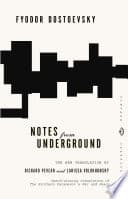
Synopsis
Covers the whole plot, including the ending.
- Difficulty
- Hard
- Pacing
- Slow
- Mood
- Philosophical, melancholic, cynical, introspective, unsettling
- Read it if
- you enjoy deep psychological dives, philosophical introspection, and challenging narratives that explore the darker aspects of human nature, free will, and alienation. Ideal for those interested in the origins of existentialist thought and critiques of Enlightenment rationalism.
- Skip it if
- you prefer straightforward plots, optimistic themes, or characters who are easy to empathize with. This book can be dense, cynical, and emotionally taxing.
Notes from Underground Plot Summary
Covers the whole plot, including the ending.
Part One, Chapter I: Underground Man's Introduction
The narrator, an unnamed former civil servant, introduces himself as a spiteful, sick, and unpleasant man. He claims to be intelligent and aware, yet incapable of doing anything, especially not becoming an insect, which he feels is a more natural state. He lives in a small, squalid apartment in St. Petersburg and has withdrawn from society for the past twenty years. He often contradicts himself, asserting his freedom and will while also lamenting his inaction. He reflects on his inability to become 'evil' or 'good,' instead existing in a state of constant self-awareness and self-loathing. He considers the nature of suffering and consciousness, suggesting that increased awareness is a disease and that he prefers pain to the 'crystal palace' of rational utopianism.
Part One, Chapter II: The Delights of Toothache
The narrator describes his enjoyment of suffering, using a toothache as an example. He finds pleasure in the humiliation and degradation of his pain, refusing to seek a cure and instead embracing the discomfort. He contrasts this with 'men of action' who are naive enough to believe in simple solutions and natural laws. He argues that consciousness itself is a disease, making it impossible for him to be a simple, natural man. He criticizes the idea of 'natural laws' and the belief that humanity can be perfected through reason, asserting that man will always choose to act irrationally, simply to prove his free will, even if it harms him. He finds satisfaction in his own weakness and inability to act.
Part One, Chapter III: The Wall and Free Will
The Underground Man continues his philosophical argument against rational egoism and the idea that human actions can be predicted and controlled by scientific laws. He mocks the concept of the 'crystal palace' – a utopian society based on reason and efficiency – arguing that humanity will always rebel against such a perfectly ordered existence. He believes that man's most cherished desire is not happiness or profit, but the exercise of his free will, even if it leads to suffering. He thinks that to surrender one's will to reason or science is to stop being human. He sees the 'wall' of natural laws not as an insurmountable barrier, but as something against which he can defiantly bang his head, asserting his individuality.
Part One, Chapter IV: The Benefits of Consciousness
The narrator concludes the first part of his 'notes' by summarizing his philosophy of consciousness. He argues that while heightened awareness leads to suffering, indecision, and inaction, it also distinguishes him from the 'men of action' and the naive masses. He believes that his suffering is a sign of his superiority and that it gives him a deeper understanding of human nature than those who blindly follow rational principles. He embraces his 'underground' existence, seeing it as a refuge where he can indulge in his complex and contradictory thoughts, free from society's demands. He hints that his 'notes' are a form of self-therapy, an attempt to articulate his unique perspective, even if it is ultimately pointless.
Part Two, Chapter I: The Wet Snow
The second part of the notes begins with anecdotes from the narrator's past, twenty years prior. He recounts an incident where he felt slighted by an officer who moved him out of the way on the street without acknowledging him. This minor event deeply wounds his pride, and he obsessively plots revenge for months, fantasizing about bumping into the officer on purpose to assert his equality. He describes his extreme self-consciousness and his inability to act decisively, constantly rehearsing the confrontation. This incident shows his insecurity and his desperate need for recognition and respect, which he believes society denies him. He sees himself as inferior, yet also superior in his intellect.
Part Two, Chapter II: The Dinner Party
The narrator recalls a period of loneliness and social awkwardness during his youth. He decides to crash a farewell dinner for Zverkov, a former schoolmate he despises but secretly envies. The dinner is hosted by other former schoolmates. He is not invited and unwelcome, but he forces his presence on them, convinced that he needs to assert himself and prove his intellectual superiority. His attempts to talk are met with indifference and mockery. He tries to give a grand speech, which fails, and he is repeatedly humiliated. He wants to be accepted and admired, but his pride and self-loathing lead him to act in ways that further alienate him, ending in a public breakdown.
Part Two, Chapter III: The Drunken Confession and Pursuit
After his disastrous attempt to join the dinner, the narrator, drunk and enraged, insults his former schoolmates and throws money at them, declaring that he will never see them again. He immediately regrets his actions and becomes consumed by a desire to follow them to a brothel, convinced that he needs to salvage his dignity or continue his self-abasement. He spends his last money on a cab and arrives at the brothel, only to find the others have already left. His pursuit is driven by vengeful pride, masochistic self-punishment, and a desperate yearning for connection, even if it is through further humiliation. He is left alone, feeling miserable and defeated.
Part Two, Chapter IV: Liza's Arrival
At the brothel, the narrator meets Liza, a young prostitute. Drunk and self-important, he gives a long, melodramatic speech about her miserable future, describing her eventual decline and death. He tries to 'save' her, not out of genuine compassion, but to assert his intellectual and moral superiority, to play the role of a benevolent savior. He gives her his address, inviting her to visit him, believing he has made a lasting impact. His motives are ambiguous, a blend of a desire for power, a fleeting impulse for goodness, and a need to escape his own self-loathing by projecting it onto someone else.
Part Two, Chapter V: Liza's Visit and His Shame
A few days later, Liza unexpectedly visits the narrator's squalid apartment. Her arrival catches him by surprise; he had not truly expected her and is unprepared for her presence. He is mortified by her seeing his poverty, his dirty servant Apollon, and his pathetic existence. His intellectual persona crumbles, replaced by intense shame and humiliation. He becomes defensive and cruel, lashing out at Liza, retracting his earlier compassionate words, and showing the cynical and manipulative nature of his previous 'saving' efforts. He feels exposed and vulnerable, and his pride demands that he reassert control, even if it means hurting her.
Part Two, Chapter VI: The Cruelty and Liza's Departure
Overwhelmed by shame and his inability to reconcile his intellectual grandiosity with his pathetic reality, the narrator cruelly tells Liza that he was merely toying with her and that his earlier words were a performance. He emphasizes his misery and pride, making it clear that he cannot offer her any genuine help or love. As she is about to leave, he shoves a five-rouble note into her hand, further humiliating her by treating her as a prostitute. Liza, deeply wounded, places the money on the table and leaves. A moment later, he rushes after her, filled with a fleeting sense of regret and the desire to apologize, but she is gone. He is left alone, consumed by his usual cycle of self-hatred and intellectual paralysis.
Part Two, Chapter VII: The Conclusion of the Notes
The narrator concludes his 'notes' by reflecting on his writing and his existence. He acknowledges that he has revealed too much and that his confessions are ugly and perhaps unreadable. He reiterates his belief that he is a representative type, an extreme embodiment of the modern, over-conscious man who cannot act. He suggests that everyone carries a bit of his 'underground' within them. He expresses his inability to truly live, to experience genuine emotions, or to escape the cycle of self-analysis and paralysis. He laments the impossibility of being 'a man of action' and the burden of his excessive consciousness. The notes end abruptly, with him stating that he is not finished but can write no more, leaving his fate uncertain.
Notes from Underground Characters
The Underground Man (Unnamed Narrator)
Protagonist
A retired civil servant living in isolation, consumed by self-loathing and philosophical rebellion.
The unnamed narrator is a 40-year-old former civil servant living in St. Petersburg, who has withdrawn from society for the past twenty years. He is highly intelligent, acutely self-aware, spiteful, and profoundly alienated. He constantly contradicts himself, oscillating between assertions of his superior intellect and lamentations of his own weakness and inaction. He despises conventional morality, rationalism, and utopian ideals, believing that human nature is fundamentally irrational and driven by a perverse desire for free will, even if it leads to suffering. His 'notes' are a torrent of philosophical diatribes and humiliating personal anecdotes, revealing his profound insecurity, pride, and inability to connect with others.
Relationships: Liza (Object of his perverse 'salvation' and subsequent cruelty); Apollon (His servant, a source of constant irritation and psychological power struggle); Zverkov (Former schoolmate, object of his envy and hatred); Simonov, Ferfichkin, Trudolyubov (Former schoolmates, figures of his social humiliation)
Liza
Supporting
A young, vulnerable prostitute who briefly enters the Underground Man's life.
Liza is a young prostitute whom the Underground Man encounters in a brothel. She is depicted as vulnerable, naive, and initially receptive to his 'saving' rhetoric. Her character serves as a foil to the Underground Man's intellectual cynicism, representing a potential for genuine human connection and compassion that he ultimately rejects. Her visit to his apartment exposes his pathetic reality and triggers his most cruel and humiliating behavior. Despite his abuse, she shows a moment of profound dignity by leaving the money he gave her, highlighting his moral bankruptcy. She embodies the innocent suffering that the Underground Man is incapable of truly empathizing with.
Relationships: The Underground Man (Recipient of his perverse 'salvation' and subsequent emotional abuse)
Apollon
Supporting
The Underground Man's stoic, silently disapproving servant.
Apollon is the Underground Man's servant, a silent, meticulous, and profoundly irritating figure. He is described as a man of extreme order and self-possession, who performs his duties with an air of superiority and silent judgment. He serves as a constant source of frustration for the Underground Man, who is unable to assert dominance over him and feels perpetually undermined by Apollon's unspoken disapproval. Apollon's presence highlights the Underground Man's inability to control even his immediate environment and his pathetic attempts to assert authority, which always fail. He represents the ordinary, unthinking man whom the Underground Man simultaneously despises and secretly envies for his simple existence.
Relationships: The Underground Man (His employer, a source of constant mutual antagonism)
Zverkov
Supporting
A former schoolmate, successful and arrogant, who embodies everything the Underground Man despises.
Zverkov is a former schoolmate of the Underground Man, now a successful officer in the army. He is portrayed as handsome, self-satisfied, arrogant, and popular – everything the Underground Man is not and secretly desires to be. He is the object of the Underground Man's intense envy and hatred. Zverkov represents the superficial, conventional 'man of action' who navigates society with ease and confidence, oblivious to the deeper philosophical anxieties that plague the narrator. His farewell dinner serves as the stage for the Underground Man's most humiliating social failures, as Zverkov and his friends effortlessly dismiss and mock him.
Relationships: The Underground Man (Object of his intense envy, hatred, and social rivalry); Simonov, Ferfichkin, Trudolyubov (His friends and fellow schoolmates)
Simonov
Supporting
A former schoolmate, the most tolerant of the Underground Man's group.
Simonov is one of the Underground Man's former schoolmates and the host of Zverkov's farewell dinner. He is depicted as slightly more tolerant and less overtly hostile towards the narrator than Ferfichkin or Trudolyubov, though he still finds him awkward and irritating. The Underground Man owes him money, which further exacerbates his feelings of humiliation and dependence. Simonov represents the slightly more reasonable but still dismissive face of the conventional society that the Underground Man both yearns to join and despises. He is a relatively minor character whose primary role is to facilitate the social humiliation of the narrator.
Relationships: The Underground Man (Acquaintance to whom he owes money); Zverkov, Ferfichkin, Trudolyubov (Friends and fellow schoolmates)
Ferfichkin
Supporting
A former schoolmate, particularly obnoxious and antagonistic towards the Underground Man.
Ferfichkin is another former schoolmate, portrayed as particularly obnoxious, sycophantic towards Zverkov, and openly antagonistic towards the Underground Man. He actively participates in mocking and dismissing the narrator during the farewell dinner. His character embodies the petty cruelty and herd mentality of the social group that excludes the Underground Man. Ferfichkin's direct insults and condescending remarks further fuel the narrator's rage and self-loathing, contributing to his social breakdown. He is a caricature of the 'man of action' who lacks any genuine depth or self-awareness, making him an easy target for the Underground Man's internal contempt.
Relationships: The Underground Man (Antagonist, openly hostile); Zverkov, Simonov, Trudolyubov (Friends and fellow schoolmates)
Notes from Underground Themes
The Nature of Free Will vs. Rationalism
This is the central philosophical conflict of the novel. The Underground Man rejects the deterministic view of human nature championed by 19th-century rationalists and utopians. He argues that humans are not simply rational beings who will always act in their own best interest if only shown the 'truth.' Instead, he insists that man's most cherished desire is to assert his free will, even if it means acting irrationally, self-destructively, or simply 'out of spite.' He sees the 'crystal palace' of perfect reason as a threat to human individuality and a denial of man's essential, unpredictable nature. His own inaction and self-sabotage affirm his freedom against any imposed order.
“And why are you so firmly, so triumphantly, convinced that only the normal and the positive – in short, only well-being – is profitable for man? Is reason not mistaken about profit? Perhaps man loves something besides well-being? Perhaps he loves suffering just as much?”
Alienation and Isolation
The Underground Man's physical withdrawal into his 'underground' apartment mirrors his psychological and social alienation. He is estranged from society, from his former schoolmates, and even from himself. His excessive self-consciousness prevents him from forming genuine connections, as he constantly analyzes and judges both himself and others. He longs for acceptance and love, but his pride, insecurity, and spite lead him to sabotage any potential relationship, as seen with Liza. His isolation is a self-imposed prison, a consequence of his inability to reconcile his intellectual superiority with his social ineptitude and the perceived mediocrity of the world around him.
“I am a sick man… I am a spiteful man. I am an unattractive man. I believe my liver is diseased. However, I know nothing at all about my disease, and do not know for certain what it is that pains me.”
The Pain and Paralysis of Excessive Consciousness
The narrator repeatedly asserts that heightened consciousness is a 'disease,' a curse that prevents him from being a 'man of action.' His acute self-awareness leads to endless introspection, doubt, and paralysis. He over-analyzes every situation, emotion, and potential action, making him incapable of decisive behavior. This excessive consciousness breeds self-loathing, as he constantly judges his own thoughts and motives, finding them base and contradictory. He is trapped in a cycle of thought without action, suffering without resolution, contrasting sharply with the 'men of action' who, despite their perceived stupidity, are capable of living and engaging with the world.
“I swear to you, gentlemen, that to be overly conscious is a disease, a genuine, full-fledged disease.”
Humiliation and Pride
The Underground Man is consumed by an overwhelming sense of pride and an equally strong fear of humiliation. His pride demands that he be recognized as superior, intelligent, and unique, yet his actions and circumstances constantly expose his pathetic reality. Every interaction becomes a battle for dignity, which he invariably loses, often through his own self-sabotaging behavior. The incidents with the officer, the dinner party, and especially Liza, are all driven by his desperate need to assert himself and his subsequent shame when he fails. He often inflicts humiliation on himself or others as a twisted way of maintaining control or expressing his spite, revealing a masochistic streak tied to his pride.
“I would not have given a straw for myself if I had not found an excuse for myself, if I had not made a point of the fact that I had done nothing for my own pleasure, and that I had done it 'against my will,' in spite of myself.”
The Lure of Suffering and Degradation
The Underground Man finds a strange 'delight' in suffering and degradation. He actively seeks out situations that cause him pain and humiliation, as if these experiences validate his existence or provide a perverse form of pleasure. His enjoyment of a toothache, his deliberate social blunders, and his cruel treatment of Liza all stem from this attraction to suffering. He believes that suffering is an essential part of human experience, a sign of man's freedom and irrationality, and perhaps even a source of heightened consciousness. This theme challenges conventional notions of happiness and well-being, suggesting that there is a darker, more complex side to human motivation.
“Oh, tell me, who was it who first declared, who was it who first proclaimed that man does dirty deeds only because he does not know his true interests; and that if he were enlightened, if his eyes were opened to his true, normal interests, he would immediately cease to commit vile deeds and would immediately become good and noble?”
Plot Devices & Literary Techniques
First-Person Stream of Consciousness Narrative
An unfiltered, rambling account from the narrator's perspective.
The novel is presented as the unfiltered 'notes' of the Underground Man, written in a first-person, stream-of-consciousness style. This allows the reader direct access to his chaotic, contradictory, and deeply subjective thoughts, philosophical diatribes, and emotional turmoil. The narrative is non-linear, often rambling, and filled with self-interruptions and rhetorical questions, mirroring the narrator's fragmented and over-conscious mind. This device immerses the reader in his psychological state, forcing them to confront his uncomfortable truths and unreliable perspective, making the reader complicit in his internal world. It blurs the line between confession and performance, leaving the reader to question the narrator's true motives and sanity.
The Unreliable Narrator
The narrator's perspective is biased, self-serving, and often contradictory.
The Underground Man is an archetypal unreliable narrator. He frequently contradicts himself, admits to lying or exaggerating, and presents his actions and motivations in a biased, self-serving light. He constantly challenges the reader, anticipating their judgments and attempting to manipulate their perception. His accounts of past events are filtered through his present bitterness and self-loathing, making it difficult to discern objective truth. This unreliability is crucial to the novel's philosophical core, as it forces the reader to actively engage with the text, question the nature of truth, and grapple with the complexities of human psychology, rather than passively accepting a singular viewpoint.
Direct Address to the Reader
The narrator frequently speaks directly to an imagined audience.
Throughout the 'notes,' the Underground Man frequently addresses an imagined audience, using phrases like 'gentlemen,' 'you,' or rhetorical questions. This device serves multiple purposes: it creates a sense of immediacy and intimacy, draws the reader into his confessional monologue, and allows the narrator to anticipate and preempt criticism. It highlights his desperate need for an audience, even a hostile one, to validate his existence and his ideas. This direct address also underscores his alienation, as he has no real-world confidantes and must create an imaginary one to whom he can vent his frustrations and philosophical musings.
The 'Underground' as Metaphor
A symbol of isolation, psychological depth, and rebellion against society.
The 'underground' is a powerful metaphor throughout the novel. Physically, it refers to the narrator's squalid, isolated apartment where he has withdrawn from the world. Psychologically, it represents his internal world of intense self-consciousness, bitterness, and philosophical rebellion against societal norms and rational utopianism. It is a space of hidden truths, dark thoughts, and unacknowledged desires. The underground also symbolizes a rejection of the superficiality and conformity of the 'above-ground' world, serving as a refuge for his spite and a stage for his intellectual rebellion. It is a place of both torment and perverse freedom, where he can indulge his contradictions without judgment.
Notes from Underground Quotes
“I was ill, terribly ill.”
“It is better to do nothing!”
“Man is sometimes extraordinarily, passionately, in love with suffering.”
“What is to be done?”
“I would rather be beaten than… than have to choose.”
“We have so much of ourselves that we are forced to be untrue to ourselves.”
“The most painful thing is to know that even the lowest creature knows all the same truths.”
“We are all of us, our whole generation, living in the most profound contempt for everything that has gone before.”
“To be too conscious is an illness.”
“You might say that I'm a blackguard. I have no answer to that.”
“I can understand a man of genius, but I cannot understand myself.”
“The direct, natural, and inevitable result of any consciousness is to make one want to stop.”
“I am a sick man… I am a wicked man. I am a unattractive man.”
“It is precisely the suffering that we are to blame for that we love most.”
Quiz
10 questions on the plot and the characters. Each answer comes with a short explanation.
Question 1
What is the primary setting of the narrator's existence in "Notes from Underground"?
- A bustling city square
- A remote mountain monastery
- An underground dwelling
- A luxurious palace
Show answer
C. An underground dwelling The narrator explicitly describes his withdrawal into an 'underground existence'.
Question 2
The narrator's narrative is described as a 'devastating attack' on what?
- Religious dogma
- Social utopianism
- Scientific progress
- Artistic expression
Show answer
B. Social utopianism The text states the narrative serves as a 'devastating attack on social utopianism'.
Question 3
What is asserted as man's 'essentially irrational nature'?
- His capacity for logic
- His drive for societal improvement
- His inherent goodness
- His unpredictability and self-contradiction
Show answer
D. His unpredictability and self-contradiction The narrator's obsession with his own irrationality and self-contradictory thoughts is a central theme.
Question 4
Which of the following best describes the narrator's attitude towards society?
- He is an active participant seeking reform.
- He feels alienated and has defiantly withdrawn.
- He is indifferent to its existence.
- He believes society is inherently perfect.
Show answer
B. He feels alienated and has defiantly withdrawn. The narrator has 'definitively withdrawn into an underground existence' and is 'in full retreat from society'.
Question 5
The novel is described as marking a dividing line between which two eras of fiction and vision of self?
- Ancient and Medieval
- Renaissance and Enlightenment
- Nineteenth and Twentieth Century
- Modern and Postmodern
Show answer
C. Nineteenth and Twentieth Century The text states the novel 'marks the dividing line between nineteenth- and twentieth-century fiction'.
Question 6
What is the nature of the narrator's narrative?
- A factual historical account
- A rational and objective analysis
- A passionate, obsessive, and self-contradictory account
- A collection of humorous anecdotes
Show answer
C. A passionate, obsessive, and self-contradictory account The description calls the narrative 'passionate, obsessive, self-contradictory'.
Question 7
The translators Richard Pevear and Larissa Volokhonsky are noted for what quality in their Dostoevsky translations?
- Modernizing the language for contemporary readers
- Simplifying complex philosophical ideas
- Being brilliantly faithful to the original
- Adding their own interpretations and commentary
Show answer
C. Being brilliantly faithful to the original The text mentions their translations 'have become the standard' and are 'brilliantly faithful'.
Question 8
The narrator's 'underground existence' can be interpreted as a metaphor for what?
- A literal subterranean dwelling
- A state of intellectual and psychological isolation
- A rejection of all forms of physical shelter
- A desire for a simpler, agrarian life
Show answer
B. A state of intellectual and psychological isolation While literal, the 'underground existence' is a powerful metaphor for the narrator's alienation and psychological withdrawal from society.
Question 9
The novel's "tormented comedy" suggests a blend of what two seemingly opposing elements?
- Joy and celebration
- Tragedy and humor
- Hope and despair
- Love and hate
Show answer
B. Tragedy and humor The phrase 'tormented comedy' implies the presence of both suffering (tragedy) and elements that provoke laughter or irony (comedy).
Question 10
Considering the narrator's critique of social utopianism and assertion of man's irrational nature, what philosophical position does 'Notes from Underground' most strongly anticipate?
- Positivism
- Existentialism
- Utilitarianism
- Behaviorism
Show answer
B. Existentialism The focus on individual freedom, irrationality, alienation, and the critique of rationalistic systems are hallmarks of existentialist thought, which the novel is often seen as foreshadowing.
Notes from Underground FAQ
What is the main theme of Notes from Underground?
The main theme explores the irrationality and perversity of human nature, challenging Enlightenment ideals of reason and progress. The narrator's 'underground' existence represents a rejection of societal norms and a deep dive into the contradictions of the self.
Who is the narrator in Notes from Underground?
The narrator is an unnamed former civil servant who has retreated from society into a self-imposed exile. He is a deeply introspective, bitter, and contradictory character whose narrative is a passionate, albeit unreliable, account of his thoughts and experiences.
What does the 'underground' symbolize in the novel?
The 'underground' symbolizes a state of psychological and social alienation. It represents a retreat from the rational, ordered world into a space of intense introspection, suffering, and defiance of conventional morality and logic.
How does Notes from Underground relate to psychology?
The novel is a seminal work in psychological literature, delving into the complexities of consciousness, free will, and the darker, irrational aspects of the human psyche. It anticipates existentialist and psychoanalytic thought by exploring themes of alienation, neurosis, and the struggle for identity.
What is the philosophical significance of Notes from Underground?
Philosophically, it critiques utopianism and rationalism, asserting that human freedom lies precisely in our capacity for irrationality and self-contradiction. It questions the possibility of a perfectly ordered society and highlights the inherent freedom found in embracing one's own perversity.
What is the significance of the narrator's suffering?
The narrator's suffering is central to his identity and his philosophical stance. He believes that consciousness and suffering are intrinsically linked, and that true freedom and self-awareness can only be achieved through embracing pain and acknowledging one's own flaws and irrationality.
Is Notes from Underground a difficult book to read?
The novel can be challenging due to its dense philosophical content and the narrator's often rambling and contradictory internal monologue. However, its psychological depth and literary significance make it a rewarding read for those who engage with its complexities.
What is the difference between the first and second parts of the novel?
The first part, 'Underground,' is a philosophical confession and exploration of the narrator's consciousness and ideas. The second part, 'Apropos of the Wet Snow,' presents specific anecdotes from his past that illustrate the psychological and philosophical points made in the first part.
About the author

Fyodor Mikhailovich Dostoevsky, sometimes transliterated as Dostoyevsky, was a Russian novelist, short story writer, essayist and journalist. Numerous literary critics regard him as one of the greatest novelists in all of world literature, as many of his works are considered highly influential masterpieces.
Similar books
- The Stranger
Albert Camus
4.1 (3k) average on GoodreadsFantasyFeatures an alienated, detached protagonist who grapples with the absurdity of existence and societal expectations.
- Nausea
Jean-Paul Sartre
3.9 (86k) average on GoodreadsPhilosophyA philosophical novel presented as a diary, exploring themes of existential dread, alienation, and the nature of being.
- The Perks of Being a Wallflower
Stephen Chbosky
4.2 (1.3M) average on GoodreadsPsychologyThrough letters, a shy high school freshman learns to navigate first love, trauma, and self-discovery, stepping off the sidelines and into life.
- Eleanor Oliphant Is Completely Fine
Gail Honeyman
4.3 (708k) average on GoodreadsLiterary FictionA lonely woman's structured life changes when an IT guy and an elderly man help her learn to open her heart.
- One Flew Over the Cuckoo's Nest
Ken Kesey
4.2 (631k) average on GoodreadsPsychologyIn a mind-bending asylum, the boisterous Randle McMurphy wages a defiant war against the tyrannical Nurse Ratched, inspiring his fellow inmates, including the seemingly catatonic Chief Bromden, to reclaim their lost humanity.
- The Bell Jar
Sylvia Plath
4.0 (591k) average on GoodreadsPsychologyIn the suffocating grip of 1950s expectations, a brilliant young woman's descent into mental illness is painted with such vivid, internal clarity that her 'insanity' feels terrifyingly rational and inevitable.





Enjoyed the summary?
A summary gives you the shape of the book. The book itself has the detail, the examples and the voice.
Find Notes from Underground on AmazonAs an Amazon Associate, BookBrief earns from qualifying purchases. How we're funded