
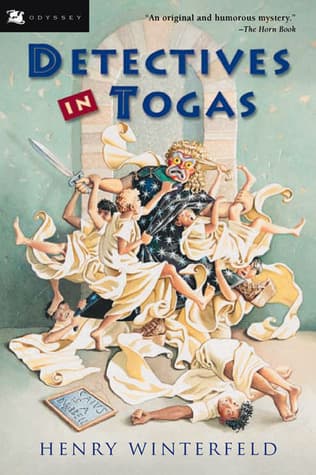
Synopsis
Covers the whole plot, including the ending.
- Difficulty
- Easy
- Pacing
- Moderate
- Mood
- Lighthearted, Whimsical, Engaging, Clever
- Read it if
- You enjoy classic children's mysteries, historical fiction set in ancient Rome, or stories about clever kids solving crimes with a touch of humor.
- Skip it if
- You prefer complex adult mysteries, dark or gritty historical fiction, or stories without a clear, triumphant resolution.
Detectives in Togas Plot Summary
Covers the whole plot, including the ending.
The Scandalous Inscription
The story begins in ancient Rome with seven schoolboys: Caius, Rufus, Antonius, Publius, Mucius, Flavius, and Julius. Their day changes when 'CAIUS IS A DUMBBELL' appears painted in red on the Temple of Minerva. The handwriting matches Rufus's. Rufus had written the same insult on his wax tablet earlier, but he denies painting it on the temple. Their teacher, Xantippus, is angry, and everyone, including Rufus's father, Senator Vinicius, suspects Rufus. The boys realize that if they do not solve this mystery, Rufus faces severe punishment, possibly being sent to a gladiatorial school or exile.
The First Clues and Xantippus's Abduction
The six friends begin their investigation to clear Rufus's name. They first ask Rufus about his wax tablet, which he says was stolen from his desk. The boys then return to the schoolroom, hoping to find more clues. They are surprised to find their teacher, Xantippus, tied up and gagged on the floor. He had been locked inside the schoolroom after everyone left. This new event makes the mystery deeper and more urgent, as it now seems someone framed Rufus and then silenced their teacher. The boys realize they face a clever and dangerous opponent.
The Mysterious Thief and the Disappearing Tablet
After freeing Xantippus, the boys and their teacher examine the schoolroom. They find a broken window latch and signs of forced entry, proving that Xantippus was a victim and not involved in the temple incident. Xantippus recalls hearing a noise the previous night but ignored it. More importantly, they confirm that Rufus's wax tablet, with 'CAIUS IS A DUMBBELL' on it, is missing. This confirms Rufus's story and suggests the culprit stole the tablet to copy Rufus's handwriting and frame him. The reason for such a plan is still unclear, but the boys are sure Rufus is innocent.
The Slave's Testimony and the Missing Pig
The boys, with Xantippus's guidance, continue their detective work. They interview a slave named Stichus, who works for Senator Vinicius (Rufus's father). Stichus says he saw a 'flying pig' during the night of the temple incident. Initially, the boys think this is nonsense, but Xantippus tells them to consider all possibilities. They realize Stichus might have seen something unusual, not a real flying pig, but an object carried or moved strangely. This testimony, though seemingly odd, starts a new line of inquiry, suggesting the culprit might have used an unusual method to reach the temple wall.
The Discovery of the Ladder and the Pig-Seller
Following Xantippus's advice to think about the 'flying pig,' the boys search the area around the Temple of Minerva more carefully. They soon find a hidden makeshift ladder. The ladder is made from rough planks and appears to have been used to reach the upper parts of the temple wall. On one plank is a symbol: a pig. This immediately reminds them of Stichus's 'flying pig' and the symbol. They trace the symbol to a local pig-seller named Barbus, who often uses a similar mark on his goods. This is the first lead to a possible suspect.
Barbus's Denial and the Hidden Workshop
The boys confront Barbus, the pig-seller, who denies any involvement in the temple defacement or the attack on Xantippus. He claims he knows nothing about a ladder or any 'flying pig.' However, the boys, suspicious of his defensive manner, decide to investigate his property. They sneak into a hidden workshop behind Barbus's stall, where they find tools and evidence of recent woodworking. They also discover a large, hollow wooden pig, designed to be moved and perhaps used as a disguise or a container, which explains Stichus's unusual sighting.
The Plan Unveiled: Counterfeiting and the Temple
Inside Barbus's workshop, the boys uncover a counterfeiting operation: Barbus makes fake Roman coins. The wooden pig they found is a device used to transport the fake currency or materials. They realize that the 'CAIUS IS A DUMBBELL' inscription on the Temple of Minerva and the attack on Xantippus were distractions. By creating a scandal involving Rufus and the temple, Barbus drew attention away from his illegal activities. He had used the ladder to paint the inscription, framing Rufus, and then tied up Xantippus to prevent him from discovering the truth or identifying him.
The Trap is Set
With this information, the boys return to Xantippus and explain their findings. Xantippus, at first doubtful, is convinced by the evidence and the boys' logical thinking. Together, they plan to catch Barbus. They decide to create a situation that will force Barbus to reveal his counterfeiting operation and confess to framing Rufus. The plan involves surveillance and a trick to make Barbus believe his secret is about to be exposed, making him act. The boys are nervous but want justice for Rufus.
The Confrontation and Barbus's Capture
The boys put their plan into action. They arrange for a message to reach Barbus, implying his workshop has been discovered. Panicked, Barbus rushes to his workshop to move his counterfeiting equipment. The boys, with Xantippus and some Roman guards they had alerted, ambush him. Caught with his fake coins and tools, Barbus confesses. He admits to painting the inscription on the Temple of Minerva, stealing Rufus's tablet, and tying up Xantippus, all to divert suspicion from his illegal counterfeiting business. Rufus's name is cleared, and Barbus is taken away.
Rufus's Redemption and the Boys' Triumph
With Barbus's confession, Rufus is cleared. His father, Senator Vinicius, who had believed Rufus guilty, shows relief and pride in his son and his friends. The boys are praised for their cleverness and persistence in solving the mystery. Even Xantippus, their stern teacher, acknowledges their intelligence. The incident strengthens their bond as friends and detectives, and they return to their studies, having learned about justice, observation, and not judging too quickly. The Temple of Minerva is cleaned, and peace returns to their part of Rome.
Principal Figures
Caius
Protagonist
The 'dumbbell' whose name sparked the initial mystery, and a leader of the detective group.
Caius is one of the seven schoolboys and often finds himself at the center of the group's activities. While initially the target of Rufus's insult, he quickly sets aside any personal feelings to help clear his friend's name. Caius is intelligent and observant, often contributing key insights to the boys' investigations. He is practical and generally level-headed, acting as a calming influence when the others get overly excited or discouraged. His name being central to the initial crime makes him deeply invested in solving the mystery.
Relationships: Rufus (friend, initially the target of Rufus's insult); Antonius (friend, fellow detective); Xantippus (teacher)
Rufus
Protagonist
The accused boy whose insult on a tablet leads to his wrongful implication.
Rufus is one of the seven schoolboys, known for his somewhat impulsive nature and his distinctive handwriting. He is the one who originally wrote 'CAIUS IS A DUMBBELL' on his wax tablet, making him the prime suspect when the same phrase appears on the Temple of Minerva. Despite his initial guilt over the insult, he is genuinely innocent of the larger crime and is terrified of the consequences. Rufus is brave in protesting his innocence and relies heavily on his friends to prove it, showing a deep trust in their loyalty.
Relationships: Caius (friend, the object of his initial insult); Senator Vinicius (father); Xantippus (teacher)
Antonius
Supporting
A resourceful and quick-witted member of the group, often suggesting practical steps.
Antonius is one of the seven boys, often portrayed as resourceful and quick-thinking. He is good at observing details and is not afraid to take initiative, often suggesting practical approaches to their investigation. Antonius is loyal to his friends and plays an active role in gathering clues and piecing together the mystery. He demonstrates a good balance of caution and daring, making him a valuable member of the detective team. His contributions help keep the investigation moving forward.
Relationships: Caius (friend, fellow detective); Rufus (friend); Xantippus (teacher)
Publius
Supporting
A thoughtful and logical boy who helps with deductions.
Publius is another member of the schoolboy detective team. He is generally portrayed as thoughtful and logical, often taking a more measured approach to their deductions. Publius is good at connecting disparate pieces of information and helping the group to form coherent theories. While perhaps not as impulsive as some of his friends, his calm reasoning is essential in steering the investigation in the right direction. He values truth and justice, driving him to help clear Rufus's name.
Relationships: Caius (friend, fellow detective); Rufus (friend); Xantippus (teacher)
Mucius
Supporting
A brave and sometimes impulsive boy who provides comic relief and bold suggestions.
Mucius is one of the more energetic and sometimes impulsive members of the group. He often provides comic relief and is not afraid to suggest bold, if sometimes reckless, courses of action. Mucius is loyal and eager to help, often being the first to volunteer for risky tasks. His enthusiasm is infectious, and he helps to motivate the group when they face setbacks. Despite his impetuousness, he is dedicated to uncovering the truth and clearing Rufus's name.
Relationships: Caius (friend, fellow detective); Rufus (friend); Xantippus (teacher)
Flavius
Supporting
A quiet but observant member of the group, contributing to details.
Flavius is one of the seven boys, often portrayed as quieter and more observant than some of his boisterous friends. He may not speak as much, but he pays close attention to details and often notices things that others overlook. His keen observations prove valuable in the boys' detective work, helping them to piece together clues. Flavius is a reliable and steadfast friend, committed to helping Rufus prove his innocence through careful investigation.
Relationships: Caius (friend, fellow detective); Rufus (friend); Xantippus (teacher)
Julius
Supporting
A slightly timid but loyal friend who contributes to the group effort.
Julius is the seventh member of the schoolboy group. He is sometimes depicted as a bit more timid or cautious than his friends, but he is equally loyal and committed to solving the mystery. Despite his apprehension, Julius actively participates in the investigation, offering his thoughts and helping with tasks. His presence ensures the full dynamic of the group, and he often mirrors the audience's own initial reactions to the unfolding events, providing a relatable perspective.
Relationships: Caius (friend, fellow detective); Rufus (friend); Xantippus (teacher)
Xantippus
Supporting
The strict but ultimately wise teacher who guides the boys' investigation.
Xantippus is the boys' stern and highly respected teacher. Initially quick to condemn Rufus, he becomes a victim himself when he is tied up in the schoolroom. This experience changes his perspective, and he reluctantly but effectively guides the boys in their detective work, encouraging them to think logically and observe carefully. He is a man of learning and discipline, and while he maintains a serious demeanor, he secretly admires the boys' intelligence and courage. He provides the crucial adult perspective and access to resources.
Relationships: Caius (student); Rufus (student); Barbus (antagonist, the one he helps capture)
Barbus
Antagonist
The pig-seller and counterfeiter who frames Rufus.
Barbus is the primary antagonist of the story, a seemingly ordinary pig-seller who is secretly engaged in counterfeiting Roman coins. He is cunning and resourceful, devising an elaborate plan to frame Rufus and abduct Xantippus to divert attention from his illegal activities. Barbus uses a distinctive pig symbol, which ultimately becomes a crucial clue. He is driven by greed and a desire to protect his criminal enterprise, leading him to commit increasingly desperate acts. His disguise as a simple vendor makes him an unexpected villain.
Relationships: Caius and the boys (his adversaries); Xantippus (his victim and captor)
Stichus
Mentioned
A slave of Senator Vinicius whose odd testimony provides a crucial clue.
Stichus is a slave who works for Senator Vinicius, Rufus's father. He is a minor character but plays a pivotal role by providing a crucial, albeit cryptic, piece of testimony: seeing a 'flying pig' on the night of the temple defacement. His seemingly nonsensical report initially confuses the boys but, under Xantippus's guidance, leads them to the pig-seller Barbus and his hidden workshop. Stichus represents the unexpected sources of information that can be vital in solving a mystery.
Relationships: Senator Vinicius (master); Caius and the boys (the recipients of his clue)
Senator Vinicius
Mentioned
Rufus's father, a respected Roman senator who initially believes his son is guilty.
Senator Vinicius is Rufus's father, a prominent and respected figure in Roman society. He is initially quick to believe that Rufus is guilty of defacing the Temple of Minerva, reflecting the societal pressure and severity of the crime. His reaction highlights the serious consequences Rufus faces. However, upon the boys' successful investigation and Barbus's confession, Senator Vinicius expresses immense relief and pride in his son and his friends, showcasing his love and eventual trust in the truth. He represents the adult authority figure who must be convinced by evidence.
Relationships: Rufus (son); Caius and the boys (his son's friends, who clear his son's name)
Themes & Insights
Justice and Truth
The main theme is the pursuit of justice for Rufus, who is wrongly accused. The boys want to find the truth, even when adults, including Rufus's father and their teacher, are quick to judge. Their careful investigation, despite their youth, shows that truth can be found through observation and logic, regardless of first impressions. The ending brings justice for Rufus and the community.
“It is not enough to be innocent, Rufus,' Xantippus had said. 'You must prove it. And that, my boys, is what we shall do.”
Friendship and Loyalty
The friends' loyalty to Rufus is a strong part of the story. Even with Rufus's initial mistake (writing the insult), his friends believe he is innocent of the temple defacement and work to clear his name. Their combined effort, support, and refusal to give up on Rufus show how strong their friendship is. This theme means that true friends stand by each other, especially in hard times.
“'We must help Rufus. He's our friend, even if he did call Caius a dumbbell,' Antonius declared, summing up the boys' resolve.”
Logic and Deduction
The boys' journey from confusion to solving a crime shows the power of logical thinking. Guided by Xantippus, they learn to analyze clues, question assumptions, and connect unrelated information. From understanding the 'flying pig' to tracing the ladder and finding the counterfeiting operation, their success comes from thinking systematically and critically, turning small details into important evidence.
“'A good detective does not ignore anything, no matter how foolish it may sound. Sometimes the most ridiculous clue holds the greatest truth,' Xantippus lectured.”
Appearance vs. Reality
This theme is central to the mystery. Rufus appears guilty because of his handwriting, but he was framed. Barbus appears to be a simple pig-seller, but he is a counterfeiter. The 'flying pig' seems absurd, but it is a real, disguised object. The story constantly asks characters and readers to look beyond appearances and find hidden truths. This theme reinforces that things are not always what they seem.
“'The world is full of disguises, boys. What seems obvious is often a trick,' Xantippus mused, after the truth about Barbus began to unfold.”
Plot Devices & Literary Techniques
Red Herring
The initial focus on Rufus's insult diverts attention from the real crime.
The inscription 'CAIUS IS A DUMBBELL' and Rufus's matching handwriting serve as a classic red herring. This seemingly obvious clue immediately points to Rufus as the culprit, drawing suspicion away from the true criminal's activities. The initial focus on Rufus's personal misdeed effectively distracts everyone, including the authorities and even Rufus's own father, from the larger, more serious crime of counterfeiting and the elaborate framing device. This misdirection is crucial for the antagonist's plan to succeed, making the boys' eventual discovery of the real plot more impactful.
The Unreliable Witness (or Cryptic Testimony)
Stichus's 'flying pig' testimony, initially dismissed, becomes a vital clue.
The slave Stichus's report of seeing a 'flying pig' is an example of cryptic or initially unreliable testimony. At first, the boys and Xantippus dismiss it as a hallucination or exaggeration. However, Xantippus later encourages them to consider its literal meaning, leading them to search for a physical 'pig' object. This device highlights the importance of not dismissing seemingly absurd clues and training oneself to interpret information creatively. It ultimately leads the boys directly to Barbus, the pig-seller, and his unique method of transporting goods, turning a bizarre statement into a breakthrough.
The Locked-Room Mystery Element
Xantippus being tied up in the locked schoolroom adds complexity and urgency.
The discovery of Xantippus tied up inside the schoolroom, which had been locked from the outside, introduces a 'locked-room mystery' element. This event not only proves Rufus's innocence in that specific act but also establishes the presence of an unknown, cunning perpetrator. It creates a secondary mystery that needs to be solved alongside the temple defacement, adding layers of intrigue and increasing the stakes. The boys must figure out how the culprit entered, tied up Xantippus, and exited without being seen, ultimately leading them to discover the broken latch and the forced entry.
Symbolism (The Pig)
The pig symbol, from the inscription to the pig-seller, connects clues.
The symbol of the pig is a recurring motif and a significant plot device. It first appears as the 'flying pig' in Stichus's testimony, then as the symbol etched on the ladder, and finally identifies Barbus as the pig-seller and the owner of the hollow wooden pig. This consistent symbol serves as a breadcrumb trail for the boys, allowing them to connect disparate pieces of evidence and ultimately identify the culprit. It demonstrates how seemingly trivial details, when observed and connected, can lead to the resolution of a complex mystery.
Detectives in Togas Quotes
“We are not just students; we are detectives!”
“In Rome, even a slave can be a hero.”
“A true friend stands by you, even when the evidence seems against you.”
“The truth is like a hidden coin in the sand—you must dig to find it.”
“In Rome, the law is for all, but justice must be fought for.”
“Sometimes, the smallest clue can solve the biggest mystery.”
“We may be young, but our minds are as sharp as any senator's.”
“Fear not the unknown, for it holds the answers we seek.”
“In friendship, we find strength greater than any army.”
“A riddle from the past can teach us about the present.”
“Even in togas, we can run faster than trouble.”
“The greatest lessons are not in scrolls, but in life's adventures.”
“To accuse without proof is to build a house on sand.”
“In every mystery, there is a thread that leads to the truth.”
Quiz
10 questions on the plot and the characters. Each answer comes with a short explanation.
Question 1
What insult does Rufus write about Caius that starts the mystery?
- Caius is a liar
- Caius is a coward
- Caius is a dumbbell
- Caius is a thief
Show answer
C. Caius is a dumbbell The mystery begins when Rufus writes 'CAIUS IS A DUMBBELL' on his wax tablet at school, which later appears painted on the Temple of Minerva, making him the prime suspect.
Question 2
How many boys work together to solve the mystery in 'Detectives in Togas'?
- Five
- Six
- Seven
- Eight
Show answer
C. Seven Seven boys in Ancient Rome—including Rufus and his six classmates—work together to solve the crime, using logic and teamwork to clear Rufus's name.
Question 3
What major location is vandalized with the insult about Caius?
- The Roman Forum
- The Temple of Minerva
- The Colosseum
- The schoolhouse
Show answer
B. The Temple of Minerva The insult 'CAIUS IS A DUMBBELL' is painted on the Temple of Minerva, a serious crime in Ancient Rome that escalates the mystery and puts Rufus in grave danger.
Question 4
Why is Rufus initially suspected of the crime?
- He was seen near the temple at night
- He had a grudge against Caius
- The handwriting on the temple matches his
- He confessed under pressure
Show answer
C. The handwriting on the temple matches his Rufus is suspected because the graffiti on the Temple of Minerva is in his own handwriting, making it seem like he committed the vandalism, even though he denies it.
Question 5
What role does the boys' teacher play in the story?
- He is the main villain
- He helps solve the mystery despite being cranky
- He punishes the boys for investigating
- He is unaware of the mystery
Show answer
B. He helps solve the mystery despite being cranky The boys' cranky teacher provides crucial help and guidance as they investigate, using his knowledge and authority to aid their detective work in clearing Rufus.
Question 6
What key discovery do the boys make about a suspect?
- He is secretly rich
- He is not what he appears to be
- He is related to Caius
- He confesses immediately
Show answer
B. He is not what he appears to be The boys eventually stumble upon someone who is not what he appears to be, a turning point that helps unravel the mystery and identify the true culprit.
Question 7
Which theme is emphasized through the boys' investigation?
- The importance of wealth in Roman society
- The value of logic and reasoning
- The dangers of ancient technology
- The superiority of adults over children
Show answer
B. The value of logic and reasoning The story highlights how the boys use logic, observation, and reasoning—along with some misadventures—to solve the crime, showcasing critical thinking as a key theme.
Question 8
What additional crime is Rufus accused of besides the graffiti?
- Stealing from the temple
- Breaking into the schoolroom and tying up the teacher
- Forging official documents
- Assaulting Caius
Show answer
B. Breaking into the schoolroom and tying up the teacher Rufus is accused not only of painting the insult on the temple but also of breaking into the schoolroom and tying up his teacher, though he denies both charges.
Question 9
How do the boys' 'amusing misadventures' contribute to the plot?
- They distract from the mystery
- They provide comic relief but no clues
- They lead to new, confusing clues
- They get them expelled from school
Show answer
C. They lead to new, confusing clues The boys' misadventures during their investigation often bring new and confusing clues every hour, advancing the plot and adding to the mystery's complexity.
Question 10
What historical setting is central to the book's atmosphere?
- Medieval Europe
- Ancient Greece
- Ancient Rome
- Renaissance Italy
Show answer
C. Ancient Rome The story is set in Ancient Rome, with details like togas, wax tablets, and the Temple of Minerva immersing readers in the historical context of the mystery.
Detectives in Togas FAQ
What is 'Detectives in Togas' about?
The story follows seven schoolboys in Ancient Rome who must solve a mystery to clear their friend Rufus. Rufus is falsely accused of breaking into their schoolroom, tying up their teacher, and painting an insult about Caius on the Temple of Minerva, despite the evidence appearing in his handwriting. The boys use logic, teamwork, and misadventures to uncover the real culprit.
Why should I read 'Detectives in Togas'?
It's a delightful blend of historical fiction and mystery that makes Ancient Rome accessible and fun for young readers. The book combines humor, clever problem-solving, and engaging characters, offering an entertaining way to learn about Roman daily life while following a suspenseful whodunit plot.
What is the background/setting of 'Detectives in Togas'?
The story is set in Ancient Rome, specifically in a school environment and surrounding areas like the Temple of Minerva. It depicts Roman social structures, education, and daily life through the eyes of seven boys, providing a vivid, child-friendly glimpse into historical customs and settings.
What are the most memorable quotes?
While specific quotes vary, memorable lines often include Rufus's protest 'I did not break into the schoolroom!' and the boys' rallying cries to solve the mystery. The insult 'CAIUS IS A DUMBBELL' written on the tablet and temple becomes a central, humorous motif driving the plot.
What writing style does the author use?
Henry Winterfeld employs a lighthearted, accessible style with straightforward prose, humor, and fast-paced dialogue. The narrative balances mystery suspense with amusing misadventures, making it engaging for children while incorporating historical details without overwhelming the story.
What minor details add significant meaning?
The detail that the insult is in Rufus's own handwriting but he didn't write it highlights the mystery's core paradox. Additionally, the boys' use of everyday Roman objects and school routines as clues—like tablets and temple visits—adds depth to the historical setting and plot.
What are some subtle foreshadowing moments?
Early mentions of someone 'not what he appears to be' foreshadow the reveal of the culprit's hidden identity. The confusion over how Rufus's handwriting was replicated hints at forgery or deception, setting up the eventual discovery of the real responsible party.
What unexpected character connections exist?
The cranky teacher, initially seen as a victim tied up in the schoolroom, becomes an unlikely ally who helps the boys with logic and guidance. The culprit's connection to the school or temple—revealed as someone familiar but deceptive—adds a twist to the character relationships.
What are unspoken character motivations?
Rufus is motivated by a desperate need to prove his innocence and maintain his friendships. The other boys are driven by loyalty and a sense of justice, while the culprit's motivation—possibly jealousy, revenge, or a hidden agenda—is revealed slowly through the investigation.
What psychological complexities do characters exhibit?
Rufus shows resilience under false accusation, while the boys demonstrate teamwork and critical thinking under pressure. The culprit exhibits deception and manipulation, hiding behind a facade, which adds psychological depth to the mystery and its resolution.
What are the major emotional turning points?
Key moments include Rufus's initial despair when accused, the boys' determination to investigate, the discovery of confusing clues that raise hopes and doubts, and the climax where they expose the culprit, leading to relief and vindication for Rufus.
How do relationship dynamics evolve?
The boys start as classmates but grow into a tight-knit detective team, strengthening their bonds through collaboration. Their relationship with their teacher shifts from seeing him as strict to appreciating his wisdom, and Rufus's trust is restored as his innocence is proven.
Which parts remain ambiguous or open-ended?
Some details about the culprit's full backstory or exact methods might be left vague to keep the focus on the boys' solving process. The aftermath of the mystery—how relationships fully mend or future adventures—is hinted at but not deeply explored, leaving room for imagination.
What are controversial scenes or decisions?
The false accusation against Rufus based on handwriting could spark debate about justice and evidence. Some readers might question the boys' risky investigations or the teacher's initial harshness, but these elements drive the plot and moral lessons about truth and loyalty.
'Detectives in Togas' ending explained: how it ends & what it means
The boys successfully identify the real culprit—someone who is not what he appears to be—clearing Rufus's name. The ending emphasizes themes of friendship, logic, and justice, showing that perseverance and teamwork can overcome deception, with the group stronger and wiser for the experience.
About the author

Henry Winterfeld was a German author known for his contributions to children's literature. He is best recognized for his novel "Detectives in Togas," which combines elements of mystery and adventure set in ancient Rome. Winterfeld's works often engage young readers with historical themes and imaginative storytelling.
Similar books
- The Eagle of the Ninth
Rosemary Sutcliff
3.9 (9k) average on GoodreadsFantasySutcliff's work, while renowned for its meticulous historical accuracy and atmospheric prose, primarily focuses on adventure and historical drama rather than mystery. Her narratives are generally more serious, less lighthearted, and targeted at an older young adult audience, providing a deeper dive into the emotional and physical hardships of ancient life compared to Winterfeld's more playful approach.
- Harry Potter and the Sorcerer's Stone
J.K. Rowling
4.5 (7M) average on GoodreadsFantasyRescued from a miserable life under the stairs, an orphaned boy discovers he's a wizard destined for a magical school, where he uncovers a dangerous secret tied to the dark wizard who murdered his parents.
- The Hobbit, or There and Back Again
J.R.R. Tolkien
4.3 (2.9M) average on GoodreadsFantasyA comfort-loving hobbit named Bilbo Baggins is whisked away by a mischievous wizard and a band of dwarves on an unexpected journey to reclaim stolen treasure from a fearsome dragon, discovering courage and a magical ring along the way.
- Harry Potter and the Goblet of Fire
J.K. Rowling
4.6 (2.6M) average on GoodreadsFantasyA bewildered Harry Potter, underage and thrust into a deadly Triwizard Tournament, must brave dragons, mermaids, and a resurgent dark magic to survive a year that will forever alter the wizarding world.
- Harry Potter and the Order of the Phoenix
J.K. Rowling
4.5 (2.5M) average on GoodreadsFantasyIn a year of oppressive secrets and the threat of Voldemort, Harry Potter and Dumbledore's Army secretly train for war, shown through Jim Kay and Neil Packer's dark illustrations.
- The Lightning Thief
Rick Riordan
4.3 (2M) average on GoodreadsFantasyThrust into a world of mythological monsters and divine treachery, an ordinary boy discovers he's the son of Poseidon and must embark on a perilous quest across modern America to prevent an Olympian war.





Enjoyed the summary?
A summary gives you the shape of the book. The book itself has the detail, the examples and the voice.
Find Detectives in Togas on AmazonAs an Amazon Associate, BookBrief earns from qualifying purchases. How we're funded