
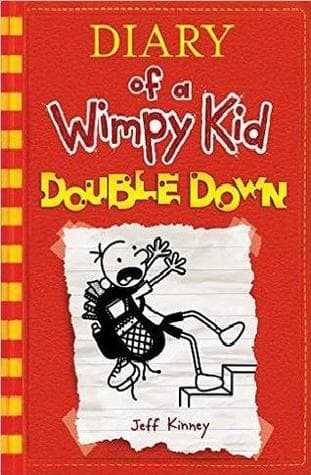
Synopsis
Covers the whole plot, including the ending.
- Difficulty
- Easy
- Pacing
- Fast
- Mood
- Humorous, Lighthearted, Relatable, Witty
- Read it if
- You enjoy humorous, illustrated diaries about the everyday misadventures of a middle schooler.
- Skip it if
- You prefer complex narratives or books without a strong emphasis on illustrations.
Double Down Plot Summary
Covers the whole plot, including the ending.
The Quest for Creativity
The story begins with Greg Heffley feeling pressure from his mom, Susan, who thinks he plays too many video games. She insists he find a creative hobby. Susan signs him up for the school's Fall Talent Show, hoping it will spark his artistic side. Greg has no interest in performing. His first tries at creative expression, like learning an instrument or joining a club, are half-hearted and quickly dropped. He mainly sees the talent show as a chance to impress Holly Hills, but his lack of real talent or interest makes this hard from the start.
The Gummy Worm Revelation
While trying to avoid the talent show, Greg finds a bag of gummy worms. This small discovery gives him an idea: he could make a horror movie using the worms as monster props. He thinks this will be a quick way to meet his mom's creative demands, avoid the talent show, and perhaps even gain fame. His friend Rowley Jefferson is excited and agrees to help. Greg sees himself as a visionary director, even though he knows little about filmmaking, and his main goal is to escape his current problem, not to create art.
Pre-Production and Creative Differences
Greg and Rowley start working on their gummy worm horror movie, which Greg calls 'The Gummy Worms 2: The Revenge of the Gummy Worms.' Greg takes on the roles of director, writer, and lead actor, while Rowley is the cameraman and supporting actor. Their creative process is full of arguments. Greg's ideas are often impractical or too big for their limited resources, and he often ignores Rowley's suggestions. Rowley, despite his first excitement, becomes more frustrated by Greg's bossiness and lack of teamwork. This early stage shows their different personalities and sets the tone for their difficult partnership.
Casting and Crew Troubles
As filming continues, Greg realizes he needs more actors for his ambitious horror movie. He tries to recruit other kids from school, but his reputation and the low budget make it hard. He tries to get his younger brother, Manny, to play a part, but Manny is uncooperative. Greg's older brother, Rodrick, is not interested at first but eventually helps with special effects, though his methods are often crude and unhelpful. The lack of a proper crew and the constant arguing among the Heffley brothers make filmmaking chaotic and slow, further showing Greg's struggles as a director.
Filming Fiascos
Making 'The Gummy Worms 2' is a series of mistakes. They struggle with lighting, sound, and getting the gummy worms to act like scary monsters. Rowley's camera work is often shaky, and Greg's acting is not convincing. One bad scene involves them trying to film in the backyard at night, leading to a confrontation with their neighbor, Mr. Henderson, who thinks they are causing trouble. The boys face constant interruptions, technical problems, and their own incompetence, making it clear their dream of a hit movie is far from reality. The film becomes less about telling a story and more about overcoming one problem after another.
Halloween Horrors
Amidst their filmmaking, Halloween arrives, bringing its own worries for Greg. He and Rowley plan their trick-or-treating route, hoping to get a lot of candy. However, their night has small scares and annoyances, including meeting older kids who try to steal their candy and various pranks. Greg's costume is uncomfortable, and he is constantly nervous. The Halloween events provide a background to their movie project, reminding Greg of the pressures he faces from his mom and the general chaos of his life. The night ends with a small incident that further lowers their spirits.
The Talent Show Dilemma
Susan Heffley remains firm in her decision for Greg to be in the Fall Talent Show. With the deadline close, Greg realizes he cannot avoid it. He sees his unfinished gummy worm movie as his only possible escape. He starts to quickly edit the footage they have, hoping to present it as his creative contribution. The pressure from his mom grows, and Greg feels stuck between her expectations and his own wish to avoid public performance. He starts to see the movie not as a path to fame, but as a desperate way to please his mother and avoid embarrassment.
A Premiere and a Problem
Greg finally finishes a rough cut of 'The Gummy Worms 2' and decides to show it to his family. He hopes for their approval, but the viewing is a disaster. The movie is disjointed, poorly filmed, and fails to impress. Susan, while acknowledging his effort, points out its flaws and repeats her desire for him to be in the talent show. This setback further discourages Greg. To make matters worse, Rodrick, always looking for a way to tease Greg, records the family's negative reactions, adding to Greg's humiliation. Greg is back to where he started, with the talent show very close.
The Big Night
The night of the Fall Talent Show arrives. Greg and Rowley are set to perform a magic act, a last-minute attempt to fulfill Susan's wishes. However, their performance quickly turns into chaos. Greg's stage fright and Rowley's clumsiness lead to several failed tricks. The audience is not impressed, and Greg feels completely humiliated. Just as they are about to leave the stage in defeat, something unexpected happens with the gummy worms they brought as props. This unforeseen event captures the audience's attention in a way their magic act never could, giving them a moment of unexpected, accidental success.
Accidental Success
During their bad magic act, the gummy worms they were using as props somehow come to life (or seem to) in a way that truly surprises and entertains the audience. This accidental show, completely unplanned by Greg, becomes the best part of their performance. The crowd reacts with amusement and awe, giving Greg and Rowley an unexpected standing ovation. While it was not the fame Greg first imagined from his movie, this moment of accidental success brings relief and validation. It shows the unpredictable nature of creativity and how sometimes, the best moments are unplanned.
Aftermath and Reflection
After the talent show, Greg thinks about his entire creative effort. He did not become a famous director, nor did he completely escape his mom's creative pressures. However, the accidental success at the talent show provides a brief break. He realizes that while his movie did not turn out as planned, he did engage in a creative process, even if he did it to avoid other things. The book ends with Greg still trying to handle the difficulties of middle school and his family, often finding himself in situations he would rather avoid, but with a slightly different view on what 'creativity' means for him.
Principal Figures
Greg Heffley
Protagonist
A middle schooler trying to navigate social pressures and family expectations.
Greg is a self-centered, often lazy, and somewhat insecure middle schooler. He constantly seeks shortcuts to fame, popularity, and avoiding responsibility. He views himself as smarter and more capable than he often proves to be. His primary motivation throughout the book is to get his mom off his back about finding a creative hobby and to avoid public embarrassment. He often manipulates those around him, especially Rowley, to achieve his goals. Despite his flaws, he occasionally shows flashes of insight, though usually self-serving.
Relationships: Susan Heffley (Mother, source of pressure and expectations); Frank Heffley (Father, often exasperated by Greg); Rodrick Heffley (Older brother, tormentor and occasional reluctant helper); Manny Heffley (Younger brother, spoiled and mischievous); Rowley Jefferson (Best friend, loyal but often manipulated by Greg)
Rowley Jefferson
Supporting
Greg's naive and loyal best friend, often the victim of Greg's schemes.
Rowley is Greg's best friend, characterized by his innocence, good nature, and unwavering loyalty, despite Greg's frequent mistreatment. He is easily excitable and genuinely enthusiastic about Greg's ideas, even when they are flawed. Rowley often gets the short end of the stick, being bossed around, taking the blame, or having his ideas dismissed. He is less concerned with popularity or status than Greg and often finds joy in simple things. His cheerful disposition contrasts sharply with Greg's cynical outlook.
Relationships: Greg Heffley (Best friend, often manipulated); Mr. and Mrs. Jefferson (Parents, often more responsible than Greg's parents)
Susan Heffley
Supporting
Greg's well-meaning but often overbearing mother, who pushes him to be creative.
Susan is Greg's mother, who genuinely cares about her children's development but often goes about it in ways that frustrate them. She is determined to get Greg off video games and into a creative hobby, believing it's essential for his growth. She is persistent, sometimes to the point of being nagging, and has a tendency to micromanage her children's lives. While her intentions are good, her methods often backfire or create more problems for Greg. She represents the external pressure Greg faces to conform to certain expectations.
Relationships: Greg Heffley (Son, target of her creative initiatives); Frank Heffley (Husband, often shares her exasperation with the boys); Rodrick Heffley (Son, occasionally a source of concern); Manny Heffley (Son, often spoiled by her)
Rodrick Heffley
Supporting
Greg's older brother, a lazy and mischievous teenager who enjoys tormenting Greg.
Rodrick is Greg's older brother, a typical teenager who is obsessed with his band, Löded Diper, and generally avoids responsibility. He enjoys pranking and teasing Greg, often making his life more difficult. He is lazy and unmotivated, especially when it comes to schoolwork or helping out around the house. While he occasionally helps Greg, it's usually for his own benefit or with a mischievous twist. He serves as a source of conflict and comic relief, highlighting Greg's position as the middle child.
Relationships: Greg Heffley (Younger brother, primary target of teasing); Susan Heffley (Mother, often tries to enforce rules on him); Frank Heffley (Father, shares a similar dynamic with him as Susan)
Frank Heffley
Supporting
Greg's father, who is often exasperated by his sons' antics.
Frank is Greg's father, a pragmatic and often stressed parent. He is less involved in the day-to-day creative pushing than Susan but frequently expresses his frustration with his sons' behavior, especially Rodrick's. He enjoys his privacy and quiet, which are often disturbed by the boys' antics. He represents a more traditional, no-nonsense approach to parenting compared to Susan's more hands-on, emotionally driven style. He occasionally tries to bond with Greg, but these attempts often fall flat.
Relationships: Greg Heffley (Son, often a source of frustration); Susan Heffley (Wife, often shares parenting frustrations); Rodrick Heffley (Son, particularly exasperated by him); Manny Heffley (Son, less bothered by him than the older boys)
Manny Heffley
Supporting
Greg's spoiled and mischievous younger brother.
Manny is the youngest Heffley brother, a toddler who is doted on by his mother, Susan. He is often portrayed as manipulative and gets away with mischievous behavior due to his age and cuteness. He speaks in a simplified language but is surprisingly intelligent and cunning, often causing trouble for Greg without consequence. He serves as a minor antagonist to Greg, inadvertently or intentionally complicating Greg's plans.
Relationships: Greg Heffley (Older brother, often tormented by Manny's antics); Susan Heffley (Mother, dotes on him); Frank Heffley (Father, less bothered by him than the older boys)
Mr. Henderson
Mentioned
The Heffleys' neighbor, easily annoyed by their activities.
Mr. Henderson is a minor character, a neighbor who frequently gets annoyed by the Heffley boys' noise and activities. He represents the external world's reaction to Greg's various schemes and often serves as a source of minor conflict, such as when he confronts Greg and Rowley during their nighttime filming. He embodies the typical 'grumpy neighbor' archetype.
Relationships: Heffley Family (Neighbors, often a source of annoyance)
Themes & Insights
The Pressure to be Creative
This theme looks at the expectation for children to be creative, often without real interest. Susan Heffley's insistence that Greg find a 'creative side' drives much of the story. Greg's attempts to make a movie do not come from passion, but from a wish to please his mother and avoid other, less appealing, creative activities like the talent show. The story shows how forced creativity can lead to half-hearted efforts and resentment, rather than real artistic expression. It questions whether all children must be 'creative' in a standard way.
“My mom thinks video games are turning my brain to mush, so she wants her son to put down the controller and explore his 'creative side.'”
Escapism and Avoidance
Greg Heffley consistently tries to escape uncomfortable situations and avoid responsibility. His entire movie-making effort is mainly a big plan to get his mom to stop bothering him about finding a hobby and to avoid the dreaded Fall Talent Show. He uses the movie as a shield, hoping it will get him out of other duties. This theme is clear in his half-hearted tries at other creative activities before he thought of the gummy worm idea. Even his approach to the movie itself is about finding the easiest, quickest way to seem successful, rather than truly putting effort into the craft.
“I figured if I could make a movie, Mom would get off my back about finding a creative hobby. Plus, I could become rich and famous.”
The Nature of Friendship
The relationship between Greg and Rowley is central to this theme. Rowley's strong loyalty and good nature are constantly tested by Greg's self-centeredness and manipulative ways. Greg often takes advantage of Rowley, bossing him around, ignoring his ideas, and using him as a scapegoat. Despite this, Rowley remains Greg's friend, showing the complexities of childhood friendships where one person often has more power. The story subtly questions the true nature of their friendship, showing Rowley as a consistently supportive, though often overlooked, friend.
“Rowley was always enthusiastic about my ideas, even the bad ones.”
Accidental Success vs. Planned Achievement
Throughout the book, Greg seeks fame and money through his movie, but his efforts are mostly poor and lead to failure. However, at the very end, he and Rowley find unexpected success at the talent show through a completely unplanned, accidental event involving the gummy worms. This theme explores the irony that sometimes, real 'success' or recognition comes not from careful planning and ambition, but from lucky moments. It contrasts Greg's big, often badly done, plans with the spontaneous, unforced moment that ultimately gets the audience's attention.
“It just goes to show you that sometimes the best things happen when you're not even trying.”
Plot Devices & Literary Techniques
First-Person Narration (Diary Format)
The story is told through Greg Heffley's perspective in a diary/journal style.
This device allows readers direct access to Greg's thoughts, biases, and often flawed logic. It establishes his voice as self-centered and humorous, shaping the reader's perception of events. The diary format, complete with hand-drawn illustrations, reinforces the idea that this is Greg's unfiltered account, making his exaggerations and rationalizations more believable and comedic. It also creates an intimate connection with the protagonist, despite his often unlikable traits, as readers experience his struggles directly from his point of view.
Situational Irony
Events unfold in a way that is contrary to what is expected, often with humorous results.
Situational irony is prevalent throughout the story, particularly in Greg's attempts to achieve his goals. He tries to make a grand horror movie but produces a shambolic mess. He attempts to avoid the talent show, only to find himself performing in it. Most notably, his planned creative endeavor (the movie) fails, while an accidental, unplanned moment at the talent show brings him unexpected success. This irony highlights the unpredictability of life and the often-comical gap between Greg's aspirations and his reality.
The MacGuffin (The Gummy Worms)
An object that serves as a plot device to drive the story forward, though its specific nature is less important than its role.
The bag of gummy worms acts as a MacGuffin. It is the catalyst that sparks Greg's idea for a horror movie, thereby driving the central plot of his creative endeavor. While the worms themselves are props in his film, their significance lies in their ability to inspire Greg's scheme to avoid his mom's creative pressures. Their ultimate role in the accidental talent show success further underscores their function as a plot device, rather than an object of inherent importance.
Foil Characters
Characters who contrast with another character, usually the protagonist, to highlight particular qualities.
Rowley Jefferson serves as a primary foil to Greg Heffley. Rowley's innocence, loyalty, and genuine enthusiasm contrast sharply with Greg's cynicism, self-centeredness, and manipulative tendencies. This contrast highlights Greg's flaws and motivations, making them more apparent to the reader. Similarly, Susan Heffley's persistent, well-meaning but overbearing nature foils Greg's desire for freedom and avoidance of responsibility, creating much of the story's central conflict.
Double Down Quotes
“I’ve always wondered why they make kids learn cursive. I mean, I’ve never seen an adult use it.”
“The only reason I ever wanted to play an instrument was so I could smash it on stage like rock stars do.”
“Sometimes I think the whole point of school is just to make you tired so you don't have enough energy to cause trouble.”
“Being popular is a lot of work. You have to constantly be trying to impress people.”
“I don't know why adults always say 'money doesn't grow on trees.' Because it kinda does, if you think about paper.”
“The worst thing about having a younger brother is that he always wants to do whatever you're doing.”
“I think the best way to get out of doing chores is to do them really badly the first time.”
“It's not fair that grown-ups get to do whatever they want and kids have to follow all the rules.”
“If there's one thing I've learned, it's that you can't trust anyone with your secrets, especially your family.”
“I just don't understand why people like scary movies. All they do is make you scared.”
“My mom always says 'practice makes perfect,' but I think 'practice makes bored.'”
“I think the only reason adults like to read is because they don't have video games.”
“Sometimes I wish I could just fast-forward through the boring parts of life.”
“The problem with having a good idea is that everyone else thinks it's a good idea, too.”
Quiz
10 questions on the plot and the characters. Each answer comes with a short explanation.
Question 1
Why does Greg's mom want him to explore his 'creative side'?
- She thinks he spends too much time reading.
- She believes video games are making his brain 'mushy'.
- She wants him to get better grades in art class.
- She wants him to join a theater group.
Show answer
B. She believes video games are making his brain 'mushy'. Greg's mom is concerned about his video game usage and believes it's negatively impacting his brain, leading her to push for him to find a creative outlet.
Question 2
What holiday is approaching that adds to Greg's anxieties?
- Christmas
- Thanksgiving
- Halloween
- Valentine's Day
Show answer
C. Halloween The description explicitly states that 'Halloween is just around the corner and the frights are coming at Greg from every angle.'
Question 3
What item does Greg discover that sparks his idea for a movie?
- A comic book
- A bag of gummy worms
- An old video camera
- A script his dad wrote
Show answer
B. A bag of gummy worms The summary states, 'When he discovers a bag of gummy worms, it sparks an idea.'
Question 4
What is Greg's primary motivation for wanting to make a movie?
- To win an award at a film festival.
- To get his mom to stop bothering him about being creative.
- To impress a girl at school.
- To document his family's Halloween traditions.
Show answer
B. To get his mom to stop bothering him about being creative. The text states, 'Can Greg get his mom off his back by making a movie....'
Question 5
What does the phrase 'doubling down on this path' refer to in the context of Greg's situation?
- Greg making two movies instead of one.
- Greg committing fully to his plan of making a movie to solve his problems.
- Greg's decision to play video games twice as much.
- Greg getting into trouble with two different people.
Show answer
B. Greg committing fully to his plan of making a movie to solve his problems. The phrase 'doubling down' implies Greg is going all-in on his movie-making venture as a solution, with the risk that it might 'double Greg's troubles'.
Question 6
What is Greg's ultimate hope regarding the outcome of his movie-making endeavor?
- To simply finish the project and show it to his family.
- To become rich and famous.
- To prove to his mom that video games are creative.
- To win a local talent show.
Show answer
B. To become rich and famous. The summary asks, '...and will he become rich and famous in the progress?' indicating his aspiration.
Question 7
What is the central conflict Greg faces with his mom at the beginning of the story?
- His mom wants him to clean his room more often.
- His mom is concerned about his academic performance.
- His mom disapproves of his video game habit and wants him to be more creative.
- His mom wants him to spend more time with his siblings.
Show answer
C. His mom disapproves of his video game habit and wants him to be more creative. The opening sentence establishes this: 'His mom thinks video games are turning his brain to mush, so she wants her son to put down the controller and explore his 'creative side'.'
Question 8
The title 'Double Down' likely refers to Greg's decision to:
- Eat twice as many gummy worms.
- Intensify his efforts on a risky plan, potentially increasing his problems.
- Play two video games at once.
- Face two different monsters on Halloween night.
Show answer
B. Intensify his efforts on a risky plan, potentially increasing his problems. The summary ends with, 'Or will doubling down on this path just double Greg's troubles?', suggesting that 'doubling down' means taking a bigger gamble that could lead to more problems.
Question 9
Based on the provided text, what is a key theme explored in 'Double Down'?
- The importance of physical exercise.
- The conflict between parental expectations and a child's desires.
- The benefits of healthy eating habits.
- The challenges of moving to a new school.
Show answer
B. The conflict between parental expectations and a child's desires. The core of the plot involves Greg's mom's expectations for him to be creative clashing with his preference for video games, and his attempt to navigate this pressure.
Question 10
What kind of 'frights' are coming at Greg from every angle around Halloween?
- Only supernatural ghosts and monsters.
- A combination of Halloween-related scares and the pressure from his mom.
- Frights related to his school grades.
- Frights from his older brother, Rodrick.
Show answer
B. A combination of Halloween-related scares and the pressure from his mom. The text states, 'Halloween is just around the corner and the frights are coming at Greg from every angle.' This implies both the typical Halloween scares and the ongoing pressure from his mom and the consequences of his choices, creating a broader sense of 'frights'.
Double Down FAQ
What is the main conflict Greg Heffley faces at the beginning of "Double Down"?
Greg's mom is concerned about his excessive video game use and wants him to explore his 'creative side' instead of playing games. This pressure to find a new hobby is a significant source of stress for Greg.
What event is approaching that adds to Greg's anxieties in the book?
Halloween is just around the corner, and the various frights and spooky elements associated with the holiday are amplifying Greg's general anxieties and making him feel even more stressed.
What discovery sparks Greg's idea for a creative project?
Greg discovers a bag of gummy worms, which unexpectedly gives him the idea to make a movie. He believes this project could be a way to satisfy his mom and potentially achieve fame and wealth.
What is Greg's primary motivation for wanting to make a movie?
Greg's main motivation is to get his mom off his back about his video game habit by showing her he's being creative. He also secretly hopes to become rich and famous from his film project.
Who are some of the key characters involved in Greg's movie-making endeavor?
Rowley Jefferson is, as usual, Greg's sidekick and often unwilling participant in his schemes, including the movie. Other classmates and family members are roped in, often to Greg's frustration, as he tries to direct his film.
What specific movie genre does Greg initially consider for his film?
Greg initially considers making a horror movie, influenced by the approaching Halloween and his desire to make something 'scary' and impactful. This genre choice reflects his current anxieties and the theme of frights.
How does Greg try to recruit actors for his movie, and what challenges does he face?
Greg attempts to recruit various classmates and even his younger brother Manny, but he struggles with their lack of cooperation and inability to follow his precise directions. He often resorts to bribery or manipulation.
What specific prop or costume does Greg struggle with during the filming process?
Greg has significant trouble with a particular monster costume, possibly a 'gummy worm monster' or similar creature, which proves difficult to manage and often leads to comedic mishaps during filming.
What role does Rodrick Heffley play in Greg's movie project?
Rodrick, ever the older brother, is mostly unhelpful and often mocks Greg's efforts, but he might inadvertently provide some 'special effects' or sound advice, usually in a sarcastic manner, or simply be a nuisance.
How does Greg's desire for fame and fortune influence his decision-making throughout the movie project?
Greg's ambition for fame often blinds him to the practicalities and ethical implications of his actions, leading him to make impulsive decisions or exploit others for the sake of his 'vision' and potential payout.
What psychological defense mechanism does Greg frequently employ when his movie plans go awry?
Greg often uses projection, blaming others like Rowley or his family for the failures of his movie, rather than taking responsibility for his own poor planning or directorial shortcomings. He rarely internalizes criticism.
How does Greg's relationship with Rowley evolve or devolve during the stressful movie-making process?
Greg often takes advantage of Rowley's good nature and loyalty, pushing him into uncomfortable roles or situations. This dynamic strains their friendship, highlighting Greg's self-centeredness and Rowley's patience.
In what ways does Greg demonstrate a lack of empathy towards his 'actors' and crew?
Greg frequently disregards the feelings and discomfort of his friends and family, forcing them into roles or situations they dislike, and becoming frustrated when they don't meet his unrealistic expectations. He sees them as tools for his project.
What do the 'frights coming at Greg from every angle' symbolize beyond just Halloween?
These 'frights' symbolize Greg's overwhelming anxieties about growing up, societal pressures, his mom's expectations, and the general unpredictability of life. Halloween serves as a metaphorical backdrop for his internal struggles.
Is Greg's movie project truly an exploration of his 'creative side' or simply a means to an end?
While Greg does engage in creative activities, his primary motivation is to appease his mom and gain personal benefit, suggesting it's more a means to an end. His lack of genuine passion for the craft itself is evident.
Does Greg ultimately learn a valuable lesson about creativity or friendship from his movie experience?
Greg's lessons are often subtle and hard-won. He might gain a glimmer of understanding about the effort involved in creative work, but his self-centered nature often prevents a profound shift in his understanding of friendship or collaboration.
How does the title "Double Down" reflect Greg's situation and choices in the book?
The title refers to Greg's decision to commit fully to his movie idea as a solution, hoping to solve his problems but risking greater failure. It implies a high-stakes gamble where doubling his efforts could either pay off or 'double his troubles'.
What message does the book convey about the pressures parents place on their children regarding hobbies?
The book subtly critiques the pressure to conform to parental expectations of 'creativity', showing how such demands can lead to forced, uninspired efforts rather than genuine passion. It highlights the importance of intrinsic motivation.
About the author

Jeffrey Patrick Kinney is an American author and cartoonist, best known as the creator of the children's book series Diary of a Wimpy Kid. He also created the child-oriented website Poptropica.
Similar books
- The Strange Case of Origami Yoda
Tom Angleberger
3.9 (28k) average on GoodreadsChildren'sFeatures a middle schooler's quirky adventures and social dynamics told through a unique format.
- Harry Potter and the Sorcerer's Stone
J.K. Rowling
4.5 (7M) average on GoodreadsFantasyRescued from a miserable life under the stairs, an orphaned boy discovers he's a wizard destined for a magical school, where he uncovers a dangerous secret tied to the dark wizard who murdered his parents.
- The Hobbit, or There and Back Again
J.R.R. Tolkien
4.3 (2.9M) average on GoodreadsFantasyA comfort-loving hobbit named Bilbo Baggins is whisked away by a mischievous wizard and a band of dwarves on an unexpected journey to reclaim stolen treasure from a fearsome dragon, discovering courage and a magical ring along the way.
- Harry Potter and the Goblet of Fire
J.K. Rowling
4.6 (2.6M) average on GoodreadsFantasyA bewildered Harry Potter, underage and thrust into a deadly Triwizard Tournament, must brave dragons, mermaids, and a resurgent dark magic to survive a year that will forever alter the wizarding world.
- Harry Potter and the Order of the Phoenix
J.K. Rowling
4.5 (2.5M) average on GoodreadsFantasyIn a year of oppressive secrets and the threat of Voldemort, Harry Potter and Dumbledore's Army secretly train for war, shown through Jim Kay and Neil Packer's dark illustrations.
- The Lightning Thief
Rick Riordan
4.3 (2M) average on GoodreadsFantasyThrust into a world of mythological monsters and divine treachery, an ordinary boy discovers he's the son of Poseidon and must embark on a perilous quest across modern America to prevent an Olympian war.






Enjoyed the summary?
A summary gives you the shape of the book. The book itself has the detail, the examples and the voice.
Find Double Down on AmazonAs an Amazon Associate, BookBrief earns from qualifying purchases. How we're funded