
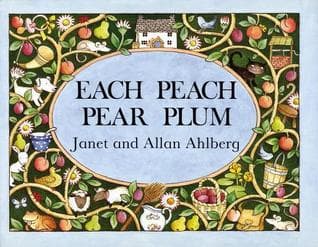
Synopsis
Covers the whole plot, including the ending.
- Difficulty
- Easy
- Pacing
- Slow
- Mood
- Playful, Nostalgic, Gentle, Whimsical
- Read it if
- You want a classic 'I spy' book for young children with charming illustrations and familiar characters.
- Skip it if
- You are looking for a complex narrative or a book for older children.
Each Peach Pear Plum Plot Summary
Covers the whole plot, including the ending.
The Opening Rhyme and Tom Thumb's Debut
The book starts with the rhyme 'Each Peach Pear Plum, I spy Tom Thumb,' setting up the interactive nature of the story. On the first pages, a detailed country scene shows a small cottage, hills, and a tree with peaches, pears, and plums. Readers look for Tom Thumb, who is hidden in the picture, peeking from behind a tree. This first scene establishes the playful mood and the 'I spy' game, drawing young readers into the search for familiar fairy tale and nursery rhyme characters who will appear on later pages.
Tom Thumb Spies Cinderella
After finding Tom Thumb, the story continues with the rhyme, 'Tom Thumb in the wood, I spy Cinderella Hood.' The picture changes to a cozy indoor scene, where Cinderella bathes in a large wooden tub. Her glass slippers are nearby, and a towel hangs ready. Tom Thumb is subtly hidden here, peeking through a window or from behind a curtain, watching Cinderella. This moment shows a new character and continues the chain of watching, with each found character then becoming the 'spy' for the next.
Cinderella Spies the Three Bears
The story goes on with 'Cinderella on the stairs, I spy the Three Bears.' The setting changes to a sunny forest. Papa Bear, Mama Bear, and Baby Bear have a picnic, with porridge, honey, and berries on a blanket. Cinderella is hidden in this picture, perhaps peeking from behind a tree or a bush, watching the bears. This scene adds another classic fairy tale group to the growing cast and keeps the gentle, observant nature of the 'I spy' game going.
The Three Bears Spy Goldilocks
As the rhyme progresses, 'Three Bears in a row, I spy Goldilocks, you know.' The picture moves inside the bears' cottage, specifically their bedroom. Goldilocks is asleep in Baby Bear's bed, with the other two beds visible. The Three Bears are hidden, watching Goldilocks from a doorway or through a window, having come home to find their guest. This scene refers directly to the 'Goldilocks and the Three Bears' story, adding some story context to the 'I spy' game and building excitement for the characters' interactions.
Goldilocks Spies the Wicked Witch
The next rhyme is 'Goldilocks with a frown, I spy the Wicked Witch from town.' The setting darkens slightly, moving to a spooky, twisted forest. The Wicked Witch stirs a bubbling pot over a fire, surrounded by strange items and maybe a black cat. Goldilocks, having woken up, is now hidden in the scene, watching the Witch with a careful look. This introduces a more villainous character, adding a hint of mild suspense and contrast to the earlier friendly characters, while keeping the book's gentle tone.
The Wicked Witch Spies Jack and Jill
The rhyme continues, 'Wicked Witch in a fix, I spy Jack and Jill with sticks.' The picture shows a steep, grassy hill with a well at the top. Jack and Jill tumble down the hill, having just gotten water, their pail rolling away. The Wicked Witch is hidden in this scene, watching their accident, perhaps from behind a tree or a rock. This moment brings in another well-known nursery rhyme pair and continues the chain of watching, showing a moment of classic misfortune from a hidden spot.
Jack and Jill Spy Little Bo Peep
Next, 'Jack and Jill in the street, I spy Little Bo Peep with feet.' The scene changes to a country setting, with green fields and a few trees. Little Bo Peep looks sad, her shepherd's crook in hand, searching for her lost sheep. Jack and Jill, recovered from their fall, are hidden in the picture, watching Bo Peep from a distance. This adds another tender nursery rhyme character to the group, highlighting the theme of searching and finding that runs through the whole book.
Little Bo Peep Spies the Wolf
The rhyme then says, 'Little Bo Peep, half asleep, I spy the Wolf, oh dear me, oh dear me, oh dear me!' The picture becomes a bit darker, showing a dense part of the forest. The Big Bad Wolf is cleverly hidden among the trees, his eyes gleaming. Little Bo Peep is hidden in this scene, watching the Wolf, perhaps with some worry. This brings back a classic enemy and adds a mild element of danger, leading up to all the characters eventually gathering.
The Wolf Spies Tom Thumb (Again)
The story loop begins to close with 'Wolf in the wood, I spy Tom Thumb, it's understood.' The picture returns to a scene like the beginning, with trees and bushes. Tom Thumb is again hidden, perhaps peeking from behind a mushroom or a leaf, now being watched by the Wolf. This moment brings the first and last 'spy' into a direct (though still hidden) relationship, showing the circular nature of the 'I spy' game and preparing for the big ending.
All the Characters Gather for Plum Pie
The final pages bring all the characters together. 'Everybody in the book, Eating plum pie, take a look!' Tom Thumb, Cinderella, the Three Bears, Goldilocks, the Wicked Witch, Jack and Jill, Little Bo Peep, and even the Wolf (who seems to have changed, or at least enjoys the pie) all gather around a large table outdoors. They happily share and eat a plum pie, made from the very plums seen at the start of the book. This joyful gathering provides a satisfying ending, uniting all the different fairy tale figures in a harmonious, celebratory meal.
Each Peach Pear Plum Characters
Tom Thumb
Protagonist/Observer
The first character introduced and the initial 'spy'.
Tom Thumb is a tiny, adventurous boy, often depicted in traditional folklore as no bigger than his father's thumb. In this book, he serves as the initial observer, kicking off the 'I spy' game. He is curious and seemingly fearless, peeking from various hiding spots to spot other characters. His small stature makes him an ideal hidden figure, encouraging young readers to search carefully for him.
Relationships: Cinderella (Tom spies Cinderella); Wolf (Wolf spies Tom)
Cinderella
Supporting/Observer
The fairy tale princess spied by Tom Thumb.
Cinderella is a classic fairy tale character, known for her kindness and iconic glass slippers. In 'Each Peach Pear Plum,' she is first seen taking a bath, a moment of peaceful domesticity before she becomes an observer herself. She represents grace and innocence within the cast of characters, and her presence adds to the magical atmosphere of the book. Her role is to be spotted and then, in turn, to spot another character.
Relationships: Tom Thumb (Tom spies Cinderella); Three Bears (Cinderella spies the Three Bears)
The Three Bears (Papa, Mama, Baby)
Supporting/Observers
The family of bears from the classic children's story.
The Three Bears are a well-loved trio from the story of Goldilocks. Papa Bear is large and gruff, Mama Bear is medium and kind, and Baby Bear is small and sweet. In this book, they are initially depicted enjoying a picnic, embodying a sense of familial warmth and routine. They then become the observers, discovering Goldilocks in their home. Their presence grounds the story in familiar nursery rhyme settings.
Relationships: Cinderella (Cinderella spies the Three Bears); Goldilocks (The Three Bears spy Goldilocks)
Goldilocks
Supporting/Observer
The inquisitive girl who visits the Three Bears' cottage.
Goldilocks is famous for her curiosity and her eventful visit to the Three Bears' home. In 'Each Peach Pear Plum,' she is first seen asleep in Baby Bear's bed, having caused a bit of mischief. Upon waking, she becomes an observer, spotting the Wicked Witch. She represents the adventurous, sometimes impish, spirit of childhood, and her inclusion adds a touch of narrative consequence to the 'I spy' chain.
Relationships: Three Bears (The Three Bears spy Goldilocks); Wicked Witch (Goldilocks spies the Wicked Witch)
The Wicked Witch
Supporting/Observer/Antagonist (mild)
The classic villainess, surprisingly included in the convivial gathering.
The Wicked Witch is a traditional antagonist, often associated with dark magic and mischief. In this book, she is first seen brewing a potion in a spooky forest, maintaining her classic persona. However, her role is softened by the 'I spy' format; she is an observer rather than an active threat. Her inclusion adds a hint of mild suspense and a contrasting element to the more benign characters, before she, too, joins the final happy scene.
Relationships: Goldilocks (Goldilocks spies the Wicked Witch); Jack and Jill (The Wicked Witch spies Jack and Jill)
Jack and Jill
Supporting/Observers
The nursery rhyme duo known for their tumble.
Jack and Jill are a memorable pair from the nursery rhyme, famous for their mishap involving a pail of water and a hill. In 'Each Peach Pear Plum,' they are depicted in the midst of their iconic tumble. They embody the innocent, sometimes clumsy, adventures of childhood. After their fall, they become observers, spotting Little Bo Peep. Their presence adds a touch of familiar childhood rhyme and gentle humor.
Relationships: Wicked Witch (The Wicked Witch spies Jack and Jill); Little Bo Peep (Jack and Jill spy Little Bo Peep)
Little Bo Peep
Supporting/Observer
The shepherdess who lost her sheep.
Little Bo Peep is a gentle character from a nursery rhyme, known for her lost sheep. She is depicted looking for her flock, evoking a sense of sweet melancholy and innocence. In the 'I spy' sequence, she observes the Wolf, adding a touch of apprehension to her character. Her inclusion brings a classic, tender nursery rhyme element to the story, contrasting with some of the more boisterous or villainous figures.
Relationships: Jack and Jill (Jack and Jill spy Little Bo Peep); Wolf (Little Bo Peep spies the Wolf)
The Wolf
Supporting/Observer/Antagonist (mild)
The Big Bad Wolf, seen hiding and then enjoying pie.
The Wolf is a quintessential fairy tale antagonist, often associated with cunning and danger. In 'Each Peach Pear Plum,' he is first seen hiding in the woods, maintaining his traditional role as a lurking presence. However, much like the Wicked Witch, his role is tempered by the 'I spy' format; he is an observer of Tom Thumb rather than an active threat. His ultimate appearance at the plum pie feast suggests a temporary or complete cessation of his 'bad' behavior, emphasizing the book's themes of community and shared enjoyment.
Relationships: Little Bo Peep (Little Bo Peep spies the Wolf); Tom Thumb (The Wolf spies Tom Thumb)
Each Peach Pear Plum Themes
Community and Coexistence
The main theme is that different characters, even traditional bad guys like the Wicked Witch and the Wolf, can come together peacefully. The book ends with all the characters, from Tom Thumb to Cinderella to the Three Bears, sharing a plum pie. This final scene shows that differences can be put aside for shared joy and community, creating a sense of belonging and peaceful living. It gently teaches young readers about acceptance and the chance for unexpected friendships, going beyond usual character roles.
“Everybody in the book, Eating plum pie, take a look!”
Observation and Discovery
The whole design of 'Each Peach Pear Plum' is built around watching and finding things. The 'I spy' rhyme encourages children to actively look for characters hidden in the detailed pictures. This theme helps with visual understanding and attention to detail, making reading interactive and fun. Each character, once found, becomes the next one to watch, keeping a chain of discovery going that moves the story forward and creates a sense of wonder.
“With your little eye, Take a look, And play 'I spy'.”
Familiarity and Intertextuality
The book skillfully combines beloved characters from various fairy tales and nursery rhymes. By featuring figures like Cinderella, Goldilocks, Jack and Jill, and the Big Bad Wolf, the book uses children's existing knowledge of these stories. This use of familiar stories creates a sense of comfort, while also showing these characters in new, connected ways. It celebrates the rich world of children's literature, showing how classic figures can interact in a fresh, imaginative story.
“Each Peach Pear Plum, I spy Tom Thumb.”
The Joy of Simple Pleasures
The book ends with all the characters happily sharing a plum pie, a simple yet powerful symbol of joy and contentment. This final image highlights that happiness can be found in basic, shared activities. The story does not rely on big adventures or complex plots but on the quiet pleasure of finding familiar friends and sharing a meal. It promotes valuing the everyday moments that bring people together, creating a heartwarming and satisfying ending.
“Everybody in the book, Eating plum pie, take a look!”
Plot Devices & Literary Techniques
I Spy Rhyme Scheme
A repetitive, interactive verse that guides the reader.
The 'I spy' rhyme scheme is the central plot device, creating a call-and-response interaction between the book and the reader. Each page presents a couplet that identifies the current observer and then prompts the reader to 'spy' the next character. This repetitive, predictable structure makes the book highly engaging for young children, encouraging participation and aiding in memory. It transforms the passive act of reading into an active game, making the narrative unfold through discovery.
Hidden Characters in Illustrations
Characters are subtly integrated into the detailed artwork.
This device is crucial for the 'I spy' game. Each new character is not explicitly presented but must be actively sought out within the detailed and often busy illustrations. The characters are not always in obvious places; they might be peeking from behind a tree, through a window, or camouflaged within the scenery. This encourages close observation, develops visual literacy, and adds a layer of fun and challenge to the reading experience, making each discovery a small triumph for the child.
Cumulative Narrative Chain
Each found character leads to the discovery of the next.
The story employs a cumulative chain, where the discovery of one character directly leads to the introduction of the next. Tom Thumb spies Cinderella, Cinderella spies the Three Bears, and so on. This creates a clear, logical progression that is easy for young children to follow and provides a satisfying sense of momentum. It builds anticipation for who will be spied next and reinforces the interconnectedness of the characters and their stories within this unique narrative.
Cyclical Structure
The narrative returns to earlier elements, creating a complete loop.
The plot features a subtle cyclical structure. It begins with 'Each Peach Pear Plum' and the sighting of Tom Thumb, and eventually, the Wolf spies Tom Thumb, bringing the observation chain full circle. The final scene features all characters eating plum pie, linking back to the initial mention of plums. This creates a sense of completion and harmony, reinforcing the idea that all elements of the story are connected and resolved in a satisfying, unified conclusion.
Each Peach Pear Plum Quotes
“Each Peach Pear Plum, I spy Tom Thumb.”
“Tom Thumb in the cupboard, eating currant bun.”
“I spy Mother Hubbard.”
“Mother Hubbard in the cupboard, getting something out.”
“I spy the Three Bears.”
“The Three Bears in the woods, looking for a treat.”
“I spy Cinderella.”
“Cinderella in the cellar, mending her shoe.”
“I spy the Wolf.”
“The Wolf in the woods, having a good read.”
“I spy Baby Bunting.”
“Baby Bunting, fast asleep, in her little bed.”
“And everyone is here!”
“Hooray! Let's have a party!”
Quiz
10 questions on the plot and the characters. Each answer comes with a short explanation.
Question 1
Which character is the first one that the reader is asked to 'spy' with their little eye?
- Tom Thumb
- Mother Hubbard
- Cinderella
- Three Bears
Show answer
B. Mother Hubbard The book begins by asking the reader to spy Mother Hubbard in the plum tree.
Question 2
What kind of fruit tree is Mother Hubbard found in at the beginning of the story?
- Peach
- Pear
- Plum
- Apple
Show answer
C. Plum Mother Hubbard is spotted in the 'plum tree', which is mentioned on the first page.
Question 3
Which character is seen 'in the wood' looking for someone?
- Baby Bunting
- Jack and Jill
- Cinderella
- The Three Bears
Show answer
D. The Three Bears The Three Bears are described as being 'in the wood', looking for Baby Bunting.
Question 4
Where does Tom Thumb hide from the Giant?
- Under the bed
- Behind the curtain
- In the cupboard
- Under the table
Show answer
C. In the cupboard Tom Thumb is hiding 'in the cupboard' while the Giant is 'under the stair'.
Question 5
Which character is NOT initially involved in the 'I spy' game, but joins the picnic at the end?
- Jack and Jill
- Baby Bunting
- Witch
- Robin Hood
Show answer
C. Witch The Witch is seen flying past, but is not 'spied' in the same chase sequence as other characters. She eventually joins the picnic.
Question 6
What item is Mother Hubbard carrying when she is first seen?
- A basket of fruit
- A watering can
- Her dog
- A pie
Show answer
D. A pie Mother Hubbard is depicted holding a pie as she looks into the plum tree.
Question 7
Who is looking for Cinderella 'in the cellar'?
- The Giant
- The Ugly Sisters
- Prince Charming
- Her Stepmother
Show answer
B. The Ugly Sisters The Ugly Sisters are looking for Cinderella 'in the cellar' in one of the book's scenes.
Question 8
What is the primary interactive element encouraged by the book's text on each page?
- Singing a song
- Counting objects
- Playing 'I Spy'
- Identifying colors
Show answer
C. Playing 'I Spy' The book explicitly states 'With your little eye, Take a look, And play 'I spy'' at the beginning, guiding the reader to find characters.
Question 9
At the very end of the book, which character is shown 'eating a pie' at the picnic, having previously been the one who had the pie stolen?
- Tom Thumb
- Mother Hubbard
- Baby Bunting
- The Giant
Show answer
B. Mother Hubbard Mother Hubbard, who had her pie stolen by the Giant earlier, is happily eating a pie at the final picnic scene.
Question 10
Which two characters are seen together 'by the river' at one point in the story?
- Cinderella and Mother Hubbard
- Jack and Jill
- The Three Bears and Baby Bunting
- Robin Hood and the Witch
Show answer
B. Jack and Jill Jack and Jill are 'by the river', with Jack looking at Jill, in one of the book's illustrations.
Each Peach Pear Plum FAQ
What is the core premise of 'Each Peach Pear Plum' and how does it engage young readers?
'Each Peach Pear Plum' is an interactive picture book that uses the 'I spy' game to guide children through a whimsical world populated by classic fairy tale and nursery rhyme characters. Each page presents a clue, often rhyming, prompting the child to find the next character hidden within the detailed illustrations, fostering engagement and observational skills.
Which specific characters are featured in the book, and what is their general order of appearance?
The book features a delightful sequence of characters. It begins with Tom Thumb, who spies Mother Hubbard, who in turn spies her Dog. Later, the Dog spies Little Bo-Peep, who spies Jack and Jill, and so forth, leading to characters like the Three Bears and Cinderella.
What is the significance of the phrase 'With your little eye, Take a look, And play 'I spy''?
This phrase is the book's central rhyming mantra, directly inviting the child to participate in the 'I spy' game. It establishes the interactive nature of the story, making the reader an active participant in discovering the characters and their unfolding journey.
How does the book conclude, and what common activity brings all the characters together?
The book culminates in all the characters gathering for a shared meal, specifically plum pie. This communal ending provides a satisfying resolution, bringing together the disparate characters observed throughout the story in a warm, festive scene.
What role do the illustrations play in the storytelling beyond simply depicting characters?
The detailed illustrations are integral to the 'I spy' game, often subtly hiding characters or providing visual context for the rhymes. They also convey the charming, slightly rustic atmosphere of the setting and the personalities of the characters, enriching the narrative beyond the simple text.
Are there any subtle visual cues or recurring motifs that link the characters' journeys?
Yes, observant readers might notice small visual connections, such as a character's gaze leading directly to the next character's location, or elements from one character's story subtly appearing in the background of another's page. The path of the characters, though not explicitly drawn, is subtly guided by these visual leads.
How does the Ahlbergs' distinctive art style contribute to the book's enduring appeal?
The Ahlbergs' art style is characterized by its warmth, detail, and gentle humor, creating a cozy and inviting world. The soft colors and expressive characters make the familiar fairy tale figures feel approachable and friendly, contributing significantly to the book's comforting and timeless quality.
Is there a deliberate progression or 'chain reaction' in how characters spy each other?
Absolutely. The narrative is structured as a clear chain reaction: Tom Thumb spies Mother Hubbard, who spies her Dog, who spies Little Bo-Peep, and so on. This sequential spying creates a sense of continuous movement and anticipation, propelling the story forward page by page.
Beyond the main characters, are there any background elements that hint at other stories or cultural references?
While the primary focus is on the main fairy tale and nursery rhyme characters, the detailed settings often include subtle background elements—like a familiar house, a specific type of tree, or a small object—that might evoke other classic tales or general pastoral imagery, adding depth to the visual world.
How does the book's structure foster a sense of mastery and confidence in young children?
By successfully finding each character, children experience repeated small victories, which builds confidence in their observational skills and ability to follow instructions. The predictable 'I spy' pattern and clear visual clues make success achievable, encouraging a positive learning experience.
What psychological benefits does the repetitive 'I spy' game offer to a developing child?
The repetitive 'I spy' game helps develop visual discrimination, focus, and memory skills in young children. It also encourages active participation and turn-taking if read aloud, enhancing language development and social interaction.
How does the book subtly teach cause and effect through its character interactions?
The 'spying' mechanism inherently teaches a simple form of cause and effect: one character's action (spying) leads to the introduction of the next character. This sequential structure helps children understand basic narrative progression and logical connections between events.
In what ways does the book promote imaginative play and storytelling after reading?
By bringing together well-known characters in a new context, the book sparks imagination. Children often enjoy retelling the story, inventing new 'I spy' sequences, or imagining further adventures for the characters, extending the narrative beyond the page.
Could the gathering for plum pie at the end be interpreted as a symbolic representation of community or shared joy?
Yes, the communal plum pie gathering can be interpreted as a symbolic representation of community, harmony, and shared joy. It brings together diverse characters from different tales, emphasizing themes of togetherness and the simple pleasure of sharing a meal, creating a warm and inclusive final image.
How does the book's 'deceptively simple' nature contribute to its genius, as suggested by Elaine Moss?
Elaine Moss's comment highlights how the book's seemingly simple concept of 'I spy' cleverly masks its rich layers of engagement, educational value, and artistic depth. Its genius lies in achieving profound developmental and emotional impact through a straightforward, accessible format that appeals universally to young children.
Is there an underlying message about the interconnectedness of stories or folklore?
The book strongly suggests an underlying message about the interconnectedness of stories and folklore. By having characters from various tales interact and spy on one another, it subtly illustrates that these beloved figures inhabit a shared imaginative landscape, fostering a holistic appreciation for classic narratives.
How might the book challenge traditional narrative structures found in other children's books?
Instead of a linear plot with a clear conflict and resolution, 'Each Peach Pear Plum' uses a circular, interactive, and discovery-based narrative. This challenges traditional structures by prioritizing engagement and observation over a dramatic storyline, making the reader the driving force of the narrative progression.
What makes 'Each Peach Pear Plum' a 'timeless' classic, as described in its synopsis?
'Each Peach Pear Plum' is timeless due to its universal appeal, simple yet effective interactive mechanism, and its celebration of beloved, enduring fairy tale characters. Its focus on discovery, repetition, and a comforting resolution ensures it remains relevant and cherished across generations, transcending fleeting trends.
Similar books
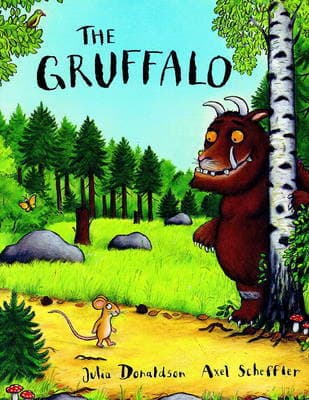
- The Gruffalo
Julia Donaldson
4.5 (31k) average on GoodreadsFantasyFeatures rhyming text and a journey through a forest encountering different characters, though with a different plot.
- The Very Hungry Caterpillar
Eric Carle
4.3 (396k) average on GoodreadsChildren'sWhile both books use repetition and visual engagement, Carle's book focuses on sequential learning, days of the week, and the life cycle of a butterfly, whereas Ahlberg's emphasizes intertextual recognition and a hide-and-seek game with diverse characters.
- Harry Potter and the Sorcerer's Stone
J.K. Rowling
4.5 (7M) average on GoodreadsFantasyRescued from a miserable life under the stairs, an orphaned boy discovers he's a wizard destined for a magical school, where he uncovers a dangerous secret tied to the dark wizard who murdered his parents.
- The Hunger Games
Suzanne Collins
4.3 (6.4M) average on GoodreadsFantasyIn a future where children fight to the death on live television, Katniss Everdeen volunteers for the arena, turning a death sentence into a fight for survival and a spark of rebellion.
- 1984
George Orwell
4.2 (3.1M) average on GoodreadsPoliticsIn a future where surveillance and thought control are absolute, a man's search for truth clashes with the Party, showing that hope can be a form of rebellion.
- Divergent
Veronica Roth
4.2 (2.9M) average on GoodreadsFantasyIn a society divided by virtues, a sixteen-year-old's difference from the norm starts a rebellion that threatens her world.





Enjoyed the summary?
A summary gives you the shape of the book. The book itself has the detail, the examples and the voice.
Find Each Peach Pear Plum on AmazonAs an Amazon Associate, BookBrief earns from qualifying purchases. How we're funded